
Ptah the Creator Craftsman: Egypt's Divine Artisan and Primordial Force
Ptah speaks creation into being through thought and word, sculpting the cosmos from chaos with divine skill. Discover how this Memphis craftsman became Egypt's greatest creator god, his influence across three millennia, and what makes him central to understanding Egyptian theology.
Contents
In the beginning, there was Ptah. Not stirring chaos or warring primordial forces. Not even the sun rising on the first day. Before Ra lit the sky, before Osiris took the throne of the dead, Ptah the creator craftsman stood alone in the void and thought. His thought became word. His word became flesh, stone, water, air. Every temple pillar, every human heartbeat, every law that held the universe together: Ptah made them all, not through force, but through the discipline of divine craft.
For nearly three thousand years, priests in Memphis whispered his name while kneeling before his shrines. Pharaohs invoked him when they laid the first stone of a monument. Sculptors left offerings at his altar before picking up their chisels. Yet Ptah remains less known in the modern world than Ra's blazing journeys or Osiris's resurrection myth. This absence is an oversight. To miss Ptah is to miss the very architecture of Egyptian theology.
The Primordial Moment: Ptah Thinks the World Into Being
The Memphite Theology, a text preserved on the Shabaka Stone (a granite slab from around 700 BC, now in the British Museum), gives us the clearest account of Ptah's creation. The stone records an ancient hymn or theological treatise that priesthoods had recited for centuries before. It says that Ptah existed first, alone, in a state the Egyptians called nun (the primordial waters of chaos and nothingness). But Ptah was not passive. He exercised his mind.
The text uses two verbs that anchor the entire creation: sia, meaning "to perceive" or "to know", and hu, meaning "to command" or "to utter". Ptah perceived all possibilities. Then Ptah uttered them into form. Not by physical labor. By thought, by will, by the sacred speech that is itself creative force. The Egyptians understood speech, heka or divine utterance, as ontologically real. To name something is to make it. To speak something is to birth it.
So Ptah speaks. The waters separate into sky and earth. The Ennead, the nine great gods, emerge from his thought. His own body becomes the material world: his bones are stone, his flesh is the ground, his sinews are the Nile. A god does not build creation the way a craftsman builds a chair. Ptah is the act of making, and creation is the substance of his being.
What makes Ptah extraordinary, compared to creator deities in other cultures, is that his creation is not violent. He does not defeat an enemy or tear apart a primordial giant. He does not seduce or deceive. He simply knows and speaks. The universe obeys because speech and knowledge, to the Egyptian mind, are the deepest forces in existence. They come before muscle, before magic, before even time itself.
Ptah as the Divine Artificer: Shaping Stone and Soul
If Ptah is thought and word, what do humans experience of him? The priest in the temple, the mason cutting limestone blocks, the mother bearing a child. These encounters teach us that Ptah the craftsman is not metaphorical. He is the patron of all makers.
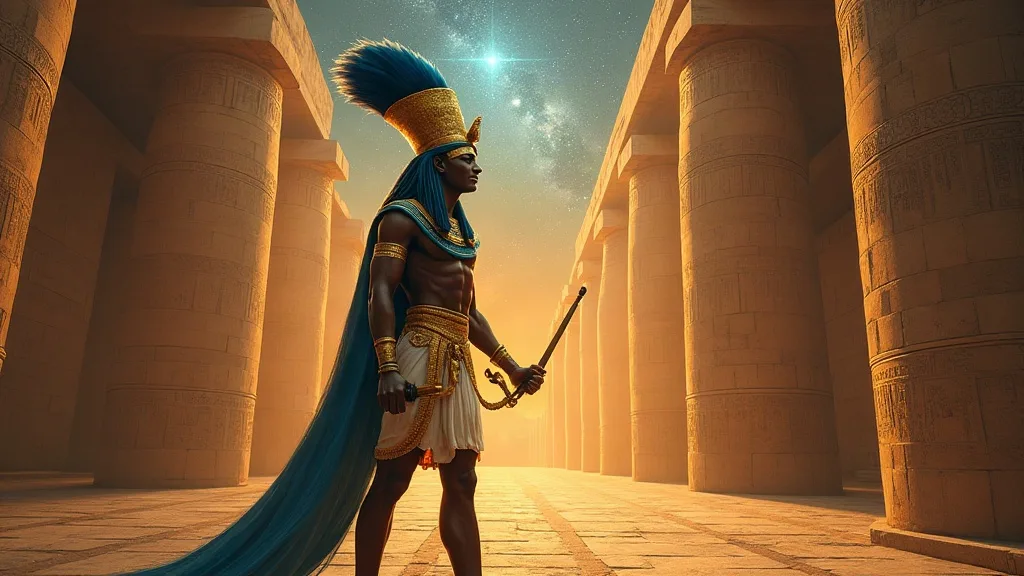
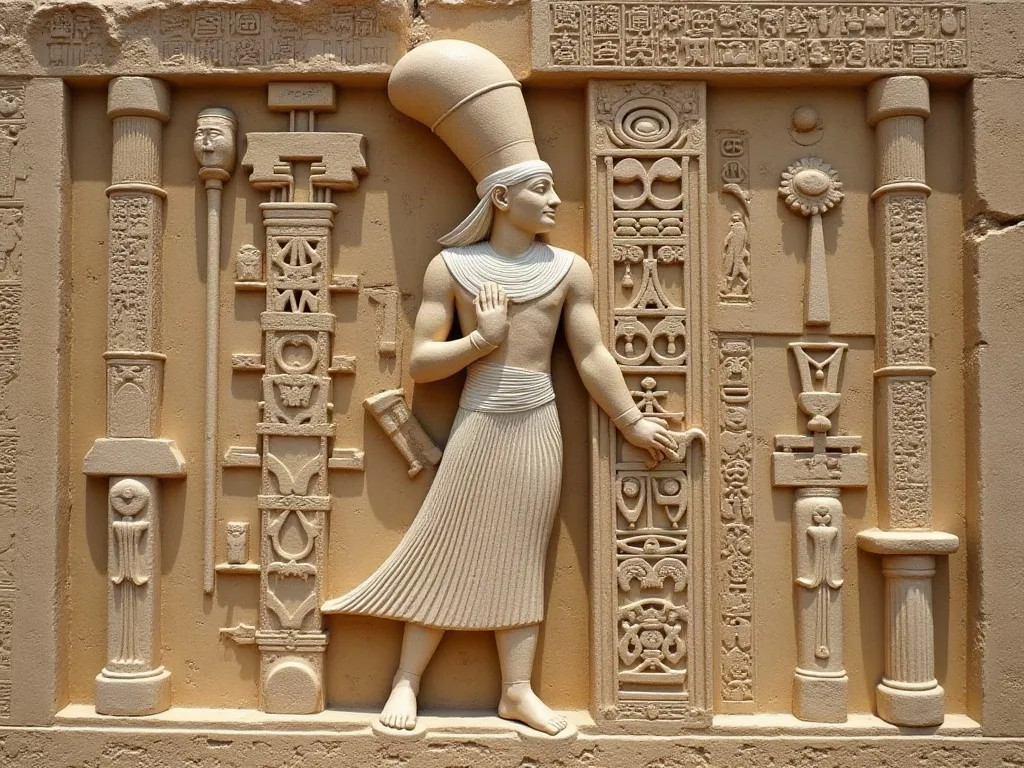
Sculptures of Ptah show him in a very specific pose. He stands wrapped in a tight white linen garment, like a mummy. His green or dark skin (copper sometimes) contrasts with the pale cloth. In his hands or beside him lie the sacred tools: the ankh (eternal life), the was scepter (power and dominion), and sometimes the carpenter's set itself. His beard is straight, the beard of a living god, not the curved false beard of Osiris or Ra. On his head sits the atef crown, a tall staff with ostrich plumes on either side. Every detail speaks: he is bound, focused, serious. He does not lounge or feast. He works.
The Memphis craftsmen understood Ptah as their direct patron. When a sculptor's hands trembled on a block of limestone, Ptah guided them. When an architect planned the angles of a pylon, Ptah whispered the geometry. The Pyramid Texts (the oldest religious writing in the world, carved inside Old Kingdom burial chambers around 2400-2300 BC) invoke Ptah as "he who fashioned his own body" and "the great artificer". Pharaohs sought his blessing before they commissioned temples. Khafre, builder of the second Giza pyramid, had himself portrayed in a statue at Ptah's temple in Memphis, showing that the pharaoh himself was Ptah's apprentice in the work of building civilization.
The relationship between Ptah and craft extended to medicine. Ptah was associated with Imhotep, a brilliant architect and physician who designed the Step Pyramid of Djoser around 2650 BC. After his death, Imhotep was deified, and the Egyptians came to see him as Ptah's son, the intermediary who brought Ptah's healing knowledge to mortals. Imhotep became the god of wisdom and medicine, but his authority derived from Ptah, the original maker.
Ptah and the Memphis Triad: Family and Theology
Ptah was never alone in the temple. He was the head of a divine family, each member reflecting an aspect of his creative power. The Memphis Triad included Ptah, Sekhmet, and Nefertem. This was no casual grouping. It was a theological statement about how creation unfolds.
Sekhmet, the ferocious lion-headed goddess, was Ptah's wife. She embodied the fierce, destructive power necessary to maintaining cosmic order. After creation, chaos does not disappear. It constantly creeps in at the edges. Sekhmet, with her blazing eyes and lethal arrows, kept that chaos at bay. She was Ptah's destroyer counterpart, the one who protected what he had built. When the Egyptians prayed to Sekhmet, they were asking Ptah's own power to defend them, just as the sculptor's hammer and chisel are the same craftsman's tool of destruction and creation.
Nefertem, their son, represented the god of perfume and renewal. He was the lotus that emerges from the waters at dawn, symbolizing the perpetual renewal of creation. Every morning, as the sun rose, Nefertem rose with it, a daily reminder that Ptah's work was never finished. Creation is not a single act in the past. It is an ongoing conversation between order and chaos, knowledge and ignorance, speech and silence.
Ptah in Memphis Theology
Creation through thought and sacred speech (sia and hu); operates in silence and planning; characterized as bound, focused, the eternal craftsman; associated with Memphis and the cult of the pharaoh's building projects; works through mind and will, not visible force.
Ra in Heliopolitan Theology
Creation through the sun's daily journey; operates visibly, blazing across the sky; characterized as dynamic, ever-moving, the fiery eye; associated with Heliopolis and solar theology; works through heat, light, and the visible cycle of day and night.
The two creator theologies coexisted in ancient Egypt. Ptah belonged to the older, Memphis-based priesthood. Ra belonged to the later, Heliopolis-based tradition. Over time, they merged: Ptah-Sokar-Osiris combined the craftsman with the lord of death; Ptah-Ra merged the maker with the sun. But they never fully dissolved into one. The Egyptians loved complexity. They held multiple truths at once.
Ptah's Names and the Power of Divine Language
Like all Egyptian gods, Ptah had many names, each one revealing a different facet of his power. To know the name of a god was to have power over that god's essence. But in Ptah's case, the names themselves were acts of creation, echoes of how he had spoken the world into being.
He was called Ptah-Tatenen, "Ptah the rising land", because he emerged from the primordial waters and caused the earth to rise, just as the Nile deposits caused islands and fertile soil to emerge from the annual flood. He was Ptah-Sokar, combining his essence with Sokar, the god of the dead and the depths beneath Memphis, suggesting that Ptah's craftsman power extended even into the afterlife, where the soul was shaped and transformed. He was Ptah-Nun, merging with the chaos waters themselves, because even chaos obeys his thought. Each name was a theological argument, encoded in sound.
The most sacred of all was simply Ptah, from the root pta, possibly meaning "to open" or "to unfold". When a priest whispered his name in the inner sanctum of the Temple of Ptah at Memphis, surrounded by the smell of incense and myrrh, that whisper was not merely a word. It was a repetition of the original utterance, the first creative speech. Every invocation of his name was a re-creation.
The Temple of Ptah at Memphis: The House of the Creator
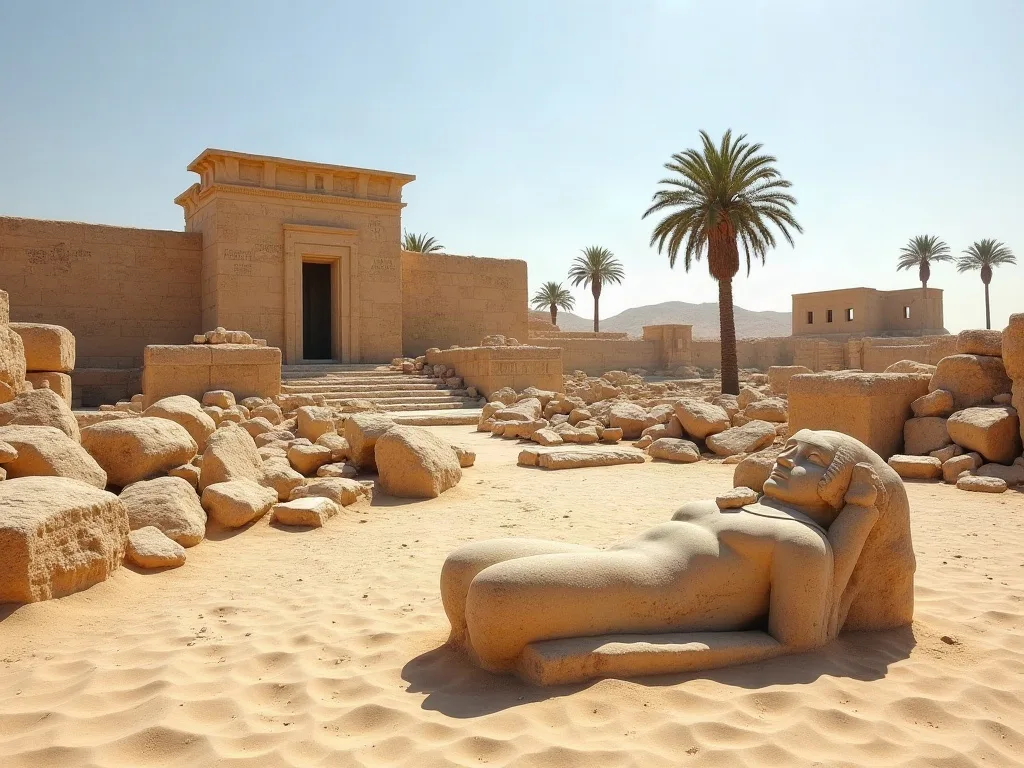
Memphis, the capital of Egypt during the Old Kingdom (around 2686-2181 BC), was Ptah's earthly home. The Temple of Ptah there was one of the largest and most important sanctuaries in all of Egypt. Its ruins still stand near the modern town of Mit Rahina, though only fragments remain: a few limestone blocks, a fallen colossus, a stone wall.
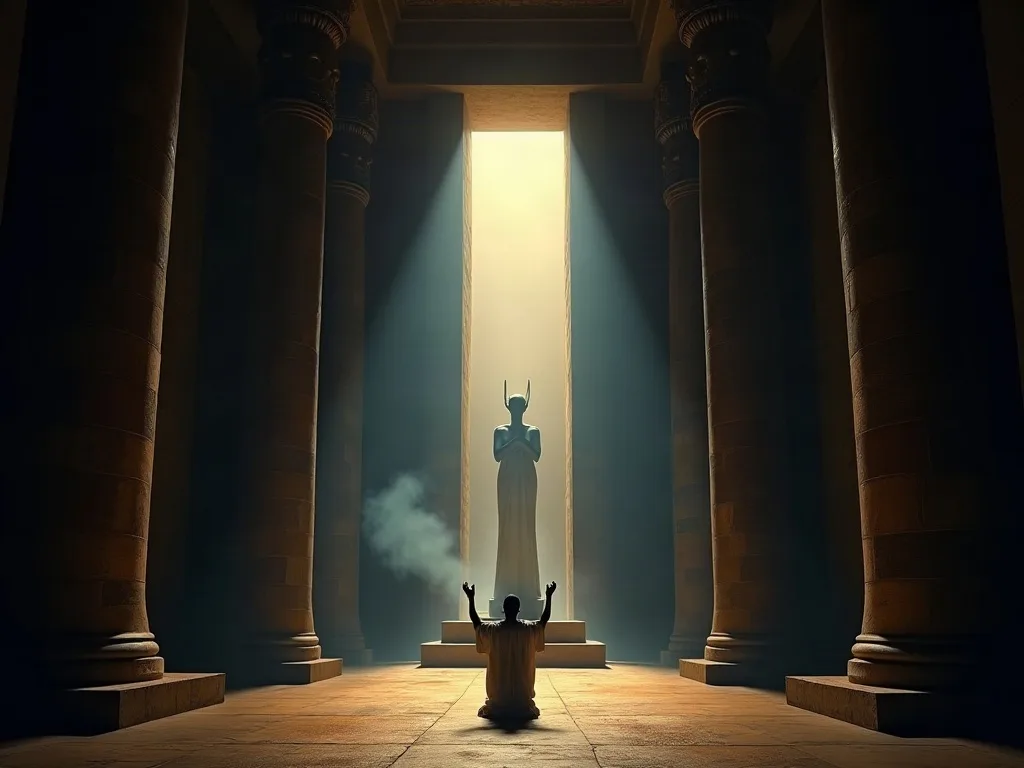
In its glory, the temple was a vast courtyard surrounded by pylons (monumental gateways), columned halls, and the inner sanctum where the god's statue or symbolic representation stood. Priests approached it barefoot, ritually purified. Only the pharaoh and the highest priests could enter the innermost chamber. There, in darkness, the statue of Ptah sat, wrapped and still, like a craftsman deep in thought.
The annual festivals at Memphis drew crowds from across Egypt. During the "Beautiful Festival of the Valley", people processed to the temples, carrying offerings of bread, beer, flowers, and incense. They did not expect to see Ptah in any dramatic way. They did not seek ecstasy or divine possession. They came to be near the presence of orderliness itself, to touch, even from a distance, the thought that held the cosmos together. The temple was a place where chaos was kept at the gate.
The priesthood of Ptah developed complex rituals to maintain the god's power. Each morning, before dawn, the high priest would enter the sanctuary and perform the sacred rites: washing the statue, anointing it with oils, clothing it in fine linen, presenting it with food and drink. These acts were not metaphorical nourishment. They were communication. The priest was saying to Ptah: "Your work continues. We see you. We depend on you. Keep us in order."
Ptah's Influence Across Dynasties and Neighboring Lands
Ptah's worship endured longer than almost any other Egyptian god. From the Third Dynasty (around 2670 BC) through the Ptolemaic Period (ending in 30 BC, when Rome annexed Egypt), Ptah remained central to state theology and common devotion. Pharaohs of every era left inscriptions honoring him. The Ramesside Period saw a resurgence of Ptah theology, particularly in the famous Poetic Stele of Ramesses II, which praises Ptah's creative power in language that echoes the ancient Memphite Theology.
Ptah's influence extended beyond Egypt's borders. In Nubia to the south, Ptah temples were built, and his image was carved into rock faces. In the Levant, where Egyptian influence was strongest during the New Kingdom, Ptah was venerated alongside local deities. Some scholars argue that the Phoenician creator god Baal-Berith and even distant echoes in Hebrew theology may carry traces of Ptah's conception of creation through speech (compare to the dabar or "word of God" in Hebrew texts, which shares the same metaphysical weight: speech that makes things real).
The Ptolemaic rulers, Greek-speaking foreign kings who ruled Egypt after Alexander the Great's conquest in 332 BC, took care to honor Ptah. The Rosetta Stone, that famous basalt slab that unlocked hieroglyphic writing, includes decrees honoring Ptah. Even as Greek and Egyptian cultures merged, Ptah remained unmoved in his temple, still thinking, still speaking creation into order.
Ptah and the Pharaoh: Divine Mandate Through Craft
The pharaoh was not merely a king. He was Ptah's representative on earth, the one through whom divine order flowed into human society. When a pharaoh ascended the throne, priesthoods would perform rituals declaring that the god Ptah had touched the pharaoh's heart, giving him wisdom. When the pharaoh laid a foundation stone for a new temple, he was reenacting Ptah's original creative act.
This was not mere propaganda. It was theology expressed through action. The pharaoh's legitimacy rested not on conquest or birth alone, but on demonstrated craft: the ability to organize labor, design monuments, maintain law, and preserve maat, the cosmic principle of truth, order, and justice. Ptah was the god of maat-in-action. He was the first king, the one who had set things right and kept them that way through the force of his will and wisdom.
The reign of Amenhotep III (1390-1352 BC), one of Egypt's greatest pharaohs, saw a particular flowering of Ptah theology. Amenhotep built at an astonishing scale: temples, palaces, colossal statues. He was emulating Ptah's own creative capacity. The Colossi of Memnon, those two massive limestone statues at Luxor that still stand today, were built under his patronage. Later observers believed these statues spoke at dawn, a voice from the divine craftsman himself, though the sound was only the wind and heated stone cracking.
Ptah in Magic and Spiritual Practice
For ordinary Egyptians, Ptah was not distant. People wore amulets inscribed with his name. They kept small statues of him in their homes. They invoked him when they began any work: "Ptah, guide my hands. Let my work be true." Magicians and healers called upon Ptah's knowledge. Midwives prayed to Ptah to guide them through difficult births, for Ptah was the god who had shaped every human form in the womb (a role he shared with Khnum, another creator god, but Ptah's shaping was understood to be through knowledge and will, while Khnum's was through physical molding).
The concept of ib, the heart (which the Egyptians understood as the seat of intelligence and will, not emotion), was considered Ptah's special domain. When the dead were weighed against the feather of truth in the afterlife, it was their heart that was judged. Ptah had shaped that heart in life. He knew its capacities. In death, he remained the witness to its truth.
Magic (heka) itself was understood as an extension of Ptah's creative speech. The word heka originally meant something like "to be skilled" or "to have power to accomplish". A magician was one who knew the right words, spoken in the right way, with the right intention. All magic ultimately derived from Ptah's first utterances, the creative words that had shaped the cosmos. To do magic was, in a sense, to imitate Ptah, to use speech as a tool of transformation. But true magic, the kind approved by temples and pharaohs, was never chaotic or disruptive. It was craft. It worked within maat, not against it.
Ptah's Decline and the Problem of Invisibility
Yet Ptah faded from popular memory faster than many other gods. After Egypt fell to Rome, and then to Islamic conquest, the temples of Ptah crumbled. His priesthood vanished. His stories, unlike those of Ra or Osiris or Horus, did not survive as dramatic narratives that later cultures could retell and reinterpret.
Why? Perhaps because Ptah's nature is too abstract. He does not journey like Ra. He does not die and resurrect like Osiris. He does not battle his enemies like Horus fighting Set. He sits and thinks. He speaks creation into order. For storytellers and artists across centuries, these are harder to dramatize. A sun god racing across the sky is vivid. A craftsman in silent contemplation is not.
The later Greco-Roman world, when it encountered Egyptian theology, found Ptah most easily merged with Hephaestus (the Greek god of craft and metalworking) or occasionally with Osiris. But the synthesis was never complete. Ptah's distinctive theology of creation through thought and speech remained marginal to the understanding of Egypt held by Greek, Roman, and later European scholars. Only in the 20th century, as Egyptologists learned to read the Shabaka Stone and the Pyramid Texts with greater precision, did Ptah's centrality to Egyptian theology become clear again.
Frequently asked questions about Ptah the creator craftsman?
Frequently asked questions
How does Ptah's creation differ from Ra's?
Ptah creates through thought and sacred speech, standing still and focused. Ra creates through his visible journey across the sky each day. Ptah's creation is primordial and abstract; Ra's is continuous and visible. Over time, Egyptians merged them into Ptah-Ra, but they represent two different theologies: Ptah is the craftsman who establishes order once; Ra is the force that sustains it daily.
What is the Shabaka Stone and why does it matter for understanding Ptah?
The Shabaka Stone is a granite slab inscribed around 700 BC with an ancient hymn or theological text, now in the British Museum. It preserves the Memphite Theology, the most detailed account of how Ptah thinks and speaks creation into being. Without this text, scholars would have far less concrete knowledge of Ptah's role as a creator deity. It's one of the oldest sustained theological arguments in human history.
Why was Ptah the patron god of craftsmen and builders?
Because Ptah's very essence is the act of making things. He creates through knowledge, skill, and will applied with precision. Any craftsman, sculptor, architect, or maker who worked with intention and discipline was imitating Ptah. Temple records show that artisans left offerings at Ptah's shrines before beginning major projects, seeking his guidance and blessing.
Did Ptah have children, and what role did they play in Egyptian theology?
Yes, most prominently Nefertem (god of renewal and the lotus) and Sekhmet (goddess of destruction and protection). Together with Ptah, they formed the Memphis Triad. Sekhmet represented the fierce force needed to maintain Ptah's created order against chaos; Nefertem symbolized the daily renewal of creation. Some texts also associate Imhotep, the deified architect, as Ptah's son or intermediary.
How did the worship of Ptah change from the Old Kingdom to the end of ancient Egypt?
Ptah's core theology remained stable across three millennia, but his prominence shifted. He was paramount in the Old Kingdom when Memphis was the capital. During the New Kingdom, other gods like Amun rose in importance, but Ptah never lost authority. His worship merged with other gods (Ptah-Sokar-Osiris, Ptah-Ra) to incorporate new theological insights. By the Ptolemaic Period, his temples still functioned, but his influence in popular imagination had diminished.
What is the connection between Ptah and the Egyptian concept of maat?
Maat is cosmic order and truth. Ptah, through his act of creation and his continuing will, is the force that establishes and maintains maat. When Ptah thinks and speaks, he is imposing order on chaos. Pharaohs were seen as agents of Ptah, responsible for preserving maat on earth. Without Ptah's original creative knowledge and power, maat could not exist.
Ptah's Shadow in Modern Thought and Future Excavations
The rediscovery of Ptah's theology has implications beyond Egyptology. When scholars compare creation myths across cultures, they often focus on dramatic narratives: primordial combat, cosmic sacrifice, divine seduction. But Ptah reminds us that another tradition exists: creation through language, thought, and craft. The Hebrew Bible's "and God said, 'Let there be light'" echoes Ptah's model. The Vedic Rigveda's account of creation through vac (sacred speech) follows the same pattern. Even postmodern philosophy's interest in how language constitutes reality traces back, sometimes unaware, to models like Ptah's, where utterance and existence are inseparable.
Ongoing excavations at Memphis and neighboring sites continue to reveal fragments of Ptah's history. A recent discovery of votive statues left by ordinary worshippers shows how widespread his cult was, not merely an elite priesthood concern. The Temple of Ptah remains one of the largest unexcavated temple complexes in Egypt. Future digs may uncover administrative records, offering lists, or inscriptions that deepen our understanding of how Ptah theology was actually practiced and lived.
Free 25-page sample
Want the whole story?
Take the first 25 pages free. If it pulls you in, the full edition is yours as an instant PDF download, with a paperback on Amazon for selected titles.

Mythology
The World Mythology Book: The Gods, Heroes and Myths of Every Culture
The Gods, Heroes and Myths of Every Culture, in One Volume
The whole of world mythology in a single volume: Greek, Norse, Egyptian, Japanese, Hindu, Celtic, Slavic, Mesoamerican and African myths gathered side by side, each drawn from the primary sources.