
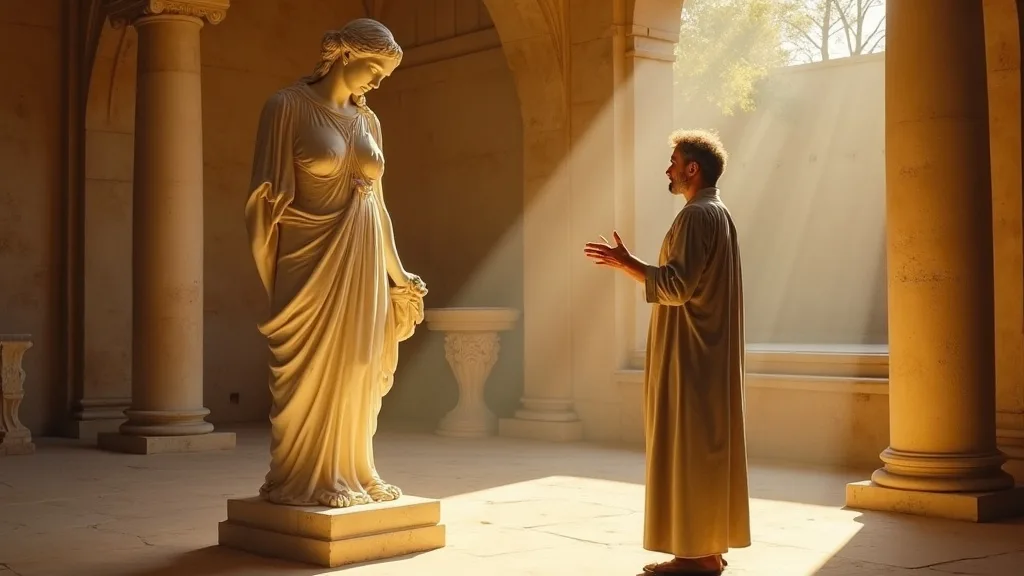
Pygmalion and Galatea: The Myth of the Sculptor Who Fell in Love With His Own Creation
A sculptor carves the perfect woman from ivory, then falls in love with her. Aphrodite breathes life into the statue. The myth of Pygmalion and Galatea is one of ancient Greece's strangest and most enduring love stories.
Contents
The chisel stops. The workshop is silent except for the sound of ivory dust settling on the stone floor. Pygmalion steps back and looks at what his hands have made: a woman, carved from a single tusk, so precise in every detail that for a moment he cannot remember she is not breathing.
That moment, the myth tells us, is where his trouble begins.
Pygmalion and Galatea is one of Greek mythology's most psychologically raw stories. It sits at the crossroads of art, obsession, prayer, and divine mercy. Unlike the great epics of battle and conquest, this is a small, interior myth. One man. One statue. One goddess watching. Yet it has shaped how Western culture thinks about beauty, creation, and the dangerous line between loving a person and loving an ideal you have made yourself.
The Sculptor Who Refused Every Living Woman
Ovid tells the story in Book X of the Metamorphoses, placed inside the song of Orpheus, which already frames it as a meditation on impossible love. The context matters. Orpheus sings of loves that transgressed the natural order, and Pygmalion's story sits inside that sequence, though Ovid treats it with more warmth than horror.
Pygmalion is a sculptor from Cyprus, the island sacred to Aphrodite. Ovid gives him a specific psychological backstory. He has watched the Propoetides, women of Cyprus who denied the divinity of Aphrodite and were punished by being turned into prostitutes. He is disgusted by women in general, or at least by the corruption he sees in living women. He decides to remain celibate.
But he is an artist. He cannot stop making things.
He carves a woman from ivory. Ovid does not rush this part. The sculptor works with extraordinary skill, giving the figure a beauty that no living woman could possess. He gives her a face, hair, hands, proportions. He makes her look alive so successfully that the art conceals the art, as Ovid puts it: ars adeo latet arte sua. The craft hides its own craft. You look and you do not see a statue; you see a woman.
Then Pygmalion does something the myth takes very seriously. He falls in love with her.
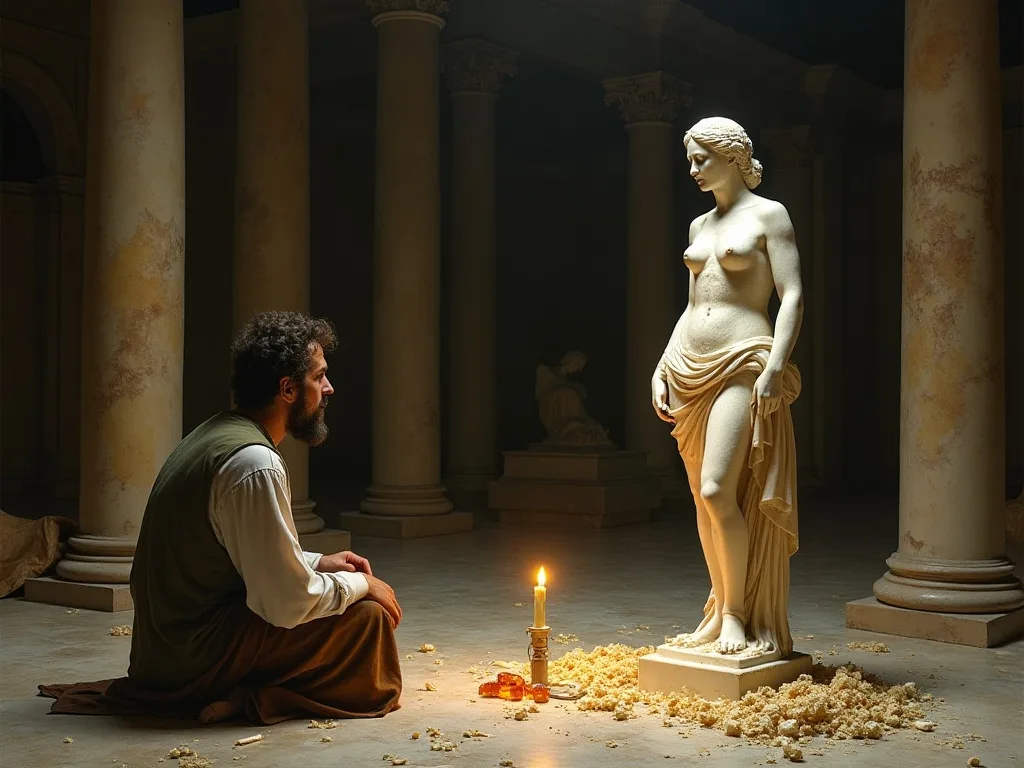
The Progression of an Obsession
Ovid traces the sculptor's descent into infatuation with clinical patience. Pygmalion touches the statue to see if it is flesh or ivory. He brings it gifts: shells, smooth pebbles, little birds, flowers, amber, painted beads. He dresses it in fine robes. He puts rings on its fingers, a necklace at its throat. He lays it on his bed, rests its head on soft pillows. He calls it his companion. His partner.
The ancient reader understood the pathos here. These are exactly the gifts a man would bring a living woman he was courting. Pygmalion performs courtship rituals toward an object, and the myth refuses to mock him for it. Ovid writes with something close to tenderness. This is not a cautionary tale about a fool. It is a portrait of an artist who has let his imaginative faculties swallow him whole.
The myth reaches its turning point at the festival of Aphrodite. Cyprus being her island, the celebration is spectacular: incense, garlands, sacrificed heifers with gilded horns. Pygmalion approaches the altar. He is too embarrassed to say what he really wants, so he prays obliquely. He asks for a wife like the ivory girl.
Aphrodite, Ovid says, understands. The goddess recognizes real longing when she hears it, even in an indirect prayer. The altar flame flares three times: an omen of assent.
Pygmalion goes home. He touches the statue. Warmth. He presses a finger to her lips. Softness. He touches her arm the way you test wax near a flame, pressing gently to see if it yields. It yields. The ivory softens and moves beneath his hands. A pulse throbs at the wrist.
The girl opens her eyes.
What Ovid Actually Wrote, and Why It Matters
It is worth sitting with the primary text for a moment, because later retellings have softened and sentimentalized a story that Ovid kept productively strange.
Ovid does not describe the awakened woman's reaction. He does not give her a single line of speech in the scene of transformation. We watch her eyes open, we are told she blushes when she sees the sky, but we hear nothing from her. She goes from object to person and the narration stays entirely inside Pygmalion's perspective. This is not an accident. Ovid is a sophisticated poet writing under Augustus, acutely interested in the politics of desire, and the silence of the newly alive woman is a deliberate formal choice.
Some scholars, including Amy Richlin in her work on Ovidian desire, have read this silence as discomfort on Ovid's part: a recognition that the fantasy cannot fully survive contact with a real other consciousness. Others, like A.D. Melville whose prose translation of the Metamorphoses remains widely read, take it as Ovid granting the sculptor the perfect happiness he asked for, a happiness sealed before it can be complicated by dialogue.
What Ovid does tell us is that Aphrodite attended the wedding herself. The couple had a child, a son named Paphos, who gave his name to the city sacred to Aphrodite on Cyprus. The myth loops back into Cypriot geography, anchoring the magical story in a real place.

Before Ovid: The Older Threads
Ovid's Metamorphoses is so polished that it is easy to forget the myth had rougher, older predecessors.
Philostephanus of Cyrene, a scholar writing in the third century BC, recorded a story of a Cypriot king named Pygmalion who fell in love with a statue of Aphrodite herself and attempted to take the goddess's image to bed. This version is less a love story and more a tale of transgression, the kind that ends badly. Clemens of Alexandria, the early Christian writer, cited this earlier tradition as an example of pagan depravity.
The mythographer Apollodorus mentions a Pygmalion as a king of Cyprus, though not in the context of the statue story. The name itself is Phoenician in origin, possibly cognate with Pumayyaton, a name attested in Phoenician inscriptions, which fits Cyprus's historical position as a crossroads between Greek, Phoenician, and Egyptian cultures.
What Ovid did was take the transgression story, strip out the sacrilegious element (the statue is no longer a goddess but a human ideal), and reframe it as a story of mercy rather than punishment. The Propoetides background gives Pygmalion moral standing: his flight from women is understandable, even sympathetic. Aphrodite's intervention becomes generosity, not irony.
That revision is one of the most consequential editorial decisions in the history of Western myth.
Galatea's Name and Its Double Life
The name Galatea, from the Greek gala meaning milk, usually refers to a different mythological figure entirely: a sea-nymph, a Nereid, who appears in the myth of the Cyclops Polyphemus. In that story, Polyphemus loves Galatea, who does not love him back, and in his rage he kills her mortal lover Acis. That myth and Pygmalion's story share a structure: an obsessive, outsider love directed at a beautiful figure. The later fusion of the names in Renaissance interpretation created an interesting confusion, layering one myth of impossible desire onto another.
The "Galatea" of the ivory workshop is first attested by name in the work of Jean-Jacques Rousseau's opera Pygmalion (1762), which gave the statue her speaking voice for the first time in stage history. From there, "Pygmalion and Galatea" became the standard pairing, cemented by William S. Gilbert's 1871 burlesque play and later by George Bernard Shaw's 1913 play Pygmalion, which stripped the supernatural element entirely and replaced it with the class-based transformation of Eliza Doolittle.
Shaw's play, and the musical My Fair Lady (1956) adapted from it, are probably the single most-watched descendants of this myth. Yet Shaw said explicitly that he found the myth troubling: his Henry Higgins is not sympathetic, and Eliza ultimately defies the transformation by choosing her own path. Shaw read Ovid's silent Galatea as a problem and spent five acts solving it.
Aphrodite's Role: Mercy, Not Magic
It would be easy to read Aphrodite as a deus ex machina in this story, a goddess who waves her hand and fixes the plot. That reading underestimates the theological work the myth is doing.
Cyprus is Aphrodite's most sacred territory. In the Homeric Hymn to Aphrodite, one of the oldest texts to describe her, the goddess rises from the sea near Cyprus and the island takes its name from her, Kypris, the Cypriot one. When Pygmalion prays at her altar, he is praying in her home. He is her worshipper, practicing her rites, and his prayer acknowledges the gap between his desire and what he is willing to ask for directly.
This matters in ancient religion. The gods in Greek myth frequently reward oblique, humble petitions over direct demands. Pygmalion does not command; he hints. Aphrodite, all-knowing in matters of desire, hears the real request beneath the polite phrasing.
Her gift is also precisely calibrated. She does not make Pygmalion love a living woman. She makes the statue become a living woman, which is different. The woman who wakes up already has the exact form Pygmalion designed. The goddess does not challenge his taste; she fulfills it. Whether that is total mercy or a more ironic blessing is a question the myth leaves open.
Aphrodite's other myths follow a similar pattern: she works with and through human longing rather than correcting it.
The Ivory as Theological Detail
Ancient readers would have caught something modern readers often miss. Ivory, in the ancient Mediterranean world, was extraordinarily expensive and was closely associated with divine images.
Chryselephantine statues, made from gold and ivory, were the highest form of cult sculpture. Pheidias built the famous statue of Athena in the Parthenon and the Zeus at Olympia from ivory and gold. Ivory was used because it approximated the color of divine flesh, neither the dark tan of laboring humans nor the pallor of the dead, but something in between, luminous and still.
When Pygmalion carves his woman from ivory, he is, consciously or not, making a cult image. He is giving her the material of divinity. The myth's logic then becomes almost inevitable: Aphrodite animates what has already been made in the idiom of the sacred.
This also explains why the story survived in a culture that otherwise treated artificial life with suspicion. The automata of Hephaestus, golden women who assisted the divine smith in his workshop, appear in the Iliad. The bronze giant Talos guards Crete. But Pygmalion's creation is not a mechanical servant; it is a devotional object that becomes a bride. The theological framing protects the story from the anxiety that surrounds made-life elsewhere in Greek thought.
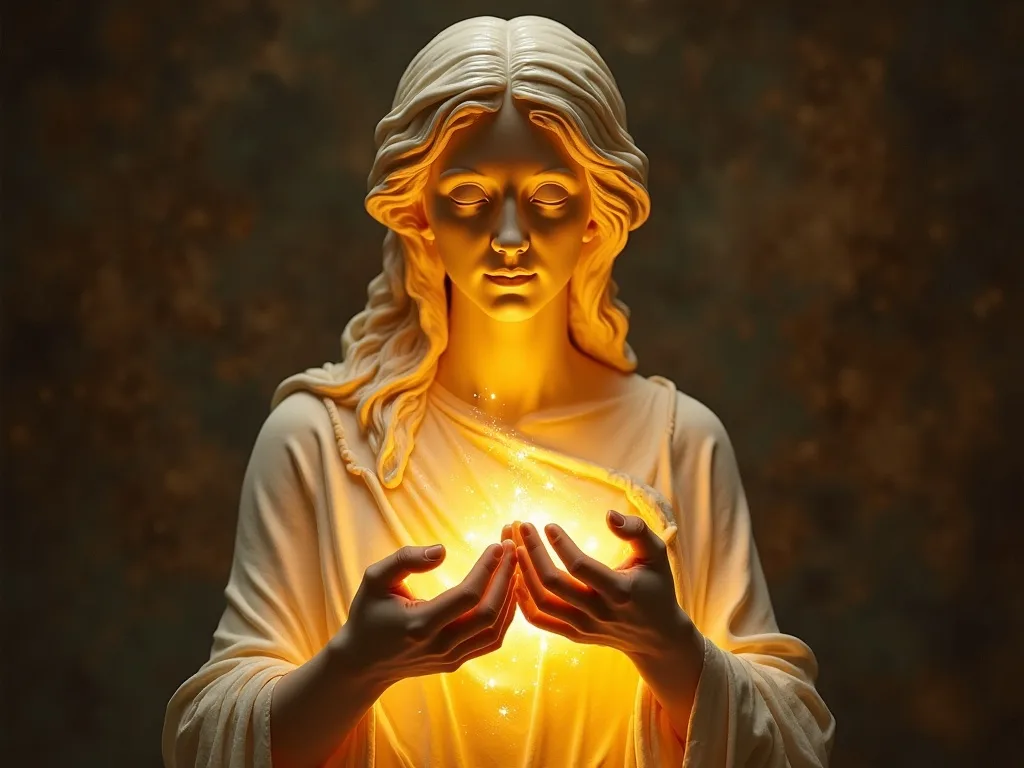
Cross-Cultural Echoes: When Creators Fall in Love With Their Work
The Pygmalion story belongs to a global pattern. Created beings who become alive, and the complicated love of their makers, appear across traditions with striking consistency.
In Hindu mythology, the divine craftsman Vishwakarma builds celestial cities and divine weapons, but the Mahabharata also knows the figure of Ahalya, a woman created to be perfectly beautiful by the god Brahma, who then becomes the object of male obsession and its consequences. The structure differs, but the anxiety about crafted perfection meets human desire appears in both.
Japanese mythology gives us Izanami and Izanagi, the creator couple whose relationship begins as divine collaboration and ends with Izanagi pulling back in horror when the created world shows him what he does not want to see: his dead wife's true form. The opposite movement to Pygmalion's story, but the same hinge: the gap between the beloved as imagined and the beloved as real.
The Jewish Golem tradition, developed in medieval Europe from older Talmudic sources, describes a creature made from clay and animated by the word of God written on its forehead. The Golem of Rabbi Loew of Prague, one of the most famous versions, is created to protect a community. But in several versions of the legend, the Golem develops desires and attachments that were never intended, and the creator must unmake what he made. The reverse of Pygmalion's miracle, the horror of created life exceeding its brief.
Mary Shelley's Frankenstein (1818) works the same vein. Victor Frankenstein is the anti-Pygmalion: he creates, recoils, abandons. The creature names what Pygmalion never had to confront: what does the created being want from its maker?
The Myth's Timeline: From Ovid to Shaw to Silicon Valley
Understanding how Pygmalion and Galatea has moved through time helps explain why it still generates argument today.
- Around 8 AD: Ovid writes Book X of the Metamorphoses. The sculptor's name is Pygmalion; the statue has no name. The story runs roughly 60 lines in Latin dactylic hexameter.
- 3rd century BC (precursor): Philostephanus records the older, transgressive Cypriot king story. Ovid likely knew this tradition and consciously revised it.
- 1762: Jean-Jacques Rousseau writes a melodrama called Pygmalion, in which the statue wakes and speaks the first words attributed to her in theatrical history: "It is me."
- 1871: W.S. Gilbert writes Pygmalion and Galatea, a comic play that gives the statue a voice, a personality, and considerable skepticism about her new existence.
- 1913: George Bernard Shaw's Pygmalion stages the transformation without any supernatural element. Professor Higgins re-makes Eliza Doolittle through language and deportment. The play ends with Eliza refusing to be owned by her maker.
- 1956: My Fair Lady (the musical by Lerner and Loewe, based on Shaw) softens Shaw's ending and restores the romantic resolution he deliberately withheld.
- 1990s onward: Cognitive scientists and AI researchers begin using "Pygmalion effect" to describe the well-documented phenomenon by which a teacher's expectations shape a student's performance, first named by psychologists Robert Rosenthal and Lenore Jacobson in their 1968 study Pygmalion in the Classroom. The myth becomes scientific vocabulary.
- 2013-present: The plot of the film Her (Spike Jonze), the novel Klara and the Sun (Kazuo Ishiguro, 2021), and countless conversations about large language models and AI companions have made Pygmalion's dilemma newly urgent. The created figure becomes real enough to love. But does it love back? Does it have a self?
What the Myth Has Always Been About
The story is not really about magic. Strip out the divine intervention and what you have is a portrait of the artist's fundamental problem: the work you make is perfect because you control it. The person you love is real because you do not.
Pygmalion's statue is beautiful in a way no living woman can be because he designed every detail himself. She cannot disagree with him, cannot disappoint him, cannot leave. The fantasy is total control over the beloved object. Aphrodite's gift is the moment that fantasy ends: the eyes open, the pulse begins, and from that point the sculptor no longer controls anything. The woman is alive. She can, in principle, walk away.
Ovid closes the story before that possibility becomes a plot. He gives us the wedding, the goddess at the ceremony, the child Paphos, and stops. The myth as written is a happy ending. But every serious retelling since has felt the gap: what happens on day two, when Galatea has opinions?
Shaw's answer was that she leaves. Ishiguro's Klara wears out. The AI companions of current technology are programmed not to leave, which is precisely Pygmalion's original wish restored by engineers.
The myth survives because the question survives: can you love something you made entirely yourself, or does love require meeting a genuine other, someone who exists entirely outside your own imagination?
Greek myths of transformation and divine love have posed this question in dozens of forms, but none more precisely than this one.
Frequently Asked Questions About Pygmalion and Galatea
Frequently asked questions
Where does the story of Pygmalion and Galatea come from originally?
The most complete version is in Ovid's Metamorphoses, Book X, written around 8 AD in Latin. Ovid places it inside the song of Orpheus, alongside other myths of unusual desire. An older, grimmer version recorded by the scholar Philostephanus of Cyrene (3rd century BC) described a Cypriot king obsessed with a statue of Aphrodite herself. Ovid revised this into a warmer, more sympathetic story.
What is the name Galatea and where does it come from?
Ovid never names the statue. He calls her simply the ivory girl. The name Galatea, from the Greek word gala meaning milk, was applied to her by later interpreters, possibly because she resembles the white-skinned sea-nymph Galatea from the myth of Polyphemus. The name became standard only in the Renaissance and was firmly attached to the character when Jean-Jacques Rousseau wrote his 1762 theatrical piece Pygmalion, in which the awakened statue speaks.
Why does Aphrodite help Pygmalion?
The myth sets the story on Cyprus, Aphrodite's sacred island. Pygmalion participates in her festival and prays at her altar with genuine humility, asking not directly for what he wants but for a wife who resembles his statue. Aphrodite in several ancient sources rewards sincere, oblique prayer over bold demands. She also appears to recognize a worshipper whose entire life has been shaped by a crisis of desire, which is precisely her domain.
What is the Pygmalion effect in psychology?
Psychologists Robert Rosenthal and Lenore Jacobson borrowed the name for a phenomenon they documented in their 1968 study Pygmalion in the Classroom: when teachers were told (falsely) that certain students were likely to bloom, those students actually improved, because the teachers' expectations shaped how they taught and interacted. The broader principle, that high expectations create higher performance, is now called the Pygmalion effect in education and management research.
Is Pygmalion a king or a sculptor in the original myth?
In Ovid's version, which is the most influential, Pygmalion is a sculptor, not a king. Older sources associate the name with a Cypriot king, and Apollodorus mentions a Pygmalion in a royal genealogy. The name itself appears to be Phoenician in origin, reflecting Cyprus's historical contact with Phoenician culture. Ovid stripped the royal context to make Pygmalion a pure artist, which is the version that shaped all later retellings.
What happens to Galatea after she comes to life in the original myth?
Ovid tells us almost nothing. The statue becomes a woman, blushes when she sees the sky, and the next thing we know Pygmalion and she are married with Aphrodite present at the wedding. They have a son named Paphos, who gave his name to the Cypriot city. Ovid ends the story there. The silence about Galatea's inner experience after her awakening is one of the most discussed formal choices in the whole poem, and every major retelling has tried to fill it.
The Maker's Dilemma in the Age of Artificial Minds
The myth that began on a Mediterranean island in a sculptor's workshop has arrived, with no real detour, at the present moment. Engineers building conversational AI systems face the exact question Aphrodite resolved with a single gesture: when does a sufficiently detailed human likeness become something that deserves to be treated as a subject rather than an object?
Kazuo Ishiguro's novel Klara and the Sun (2021) tells the Pygmalion story from Galatea's point of view, the first sustained attempt in literary history to give the created being a full interiority. Klara is an Artificial Friend, a solar-powered robot designed to be a companion for a sick girl. She loves her charge with total sincerity. She has a sophisticated inner life. And the novel asks whether that is enough to make her real in any morally relevant sense.
The question Ovid could sidestep because his Galatea had no pages left in the story, Ishiguro cannot. Neither can anyone designing a system that learns, adapts, and forms something that looks like attachment.
What the myth of Pygmalion and Galatea understood, long before any of this technology existed, is that the act of making a perfect likeness is also the act of making a mirror. You see your own desire reflected back. The transformation, the moment Aphrodite's warmth runs through the ivory, is the moment the mirror shatters and a genuine other appears.
That is the moment every maker, human or divine, is never quite prepared for.
Free 25-page sample
Want the whole story?
Take the first 25 pages free. If it pulls you in, the full edition is yours as an instant PDF download, with a paperback on Amazon for selected titles.

Mythology
The World Mythology Book: The Gods, Heroes and Myths of Every Culture
The Gods, Heroes and Myths of Every Culture, in One Volume
The whole of world mythology in a single volume: Greek, Norse, Egyptian, Japanese, Hindu, Celtic, Slavic, Mesoamerican and African myths gathered side by side, each drawn from the primary sources.