

Aphrodite: Goddess of Love and Beauty in Greek Mythology
Born from sea-foam or the desire of Zeus, Aphrodite ruled over love, beauty, and the irresistible pull between mortals and gods alike. Her myths cut to the heart of what the Greeks feared most: desire itself.
Contents
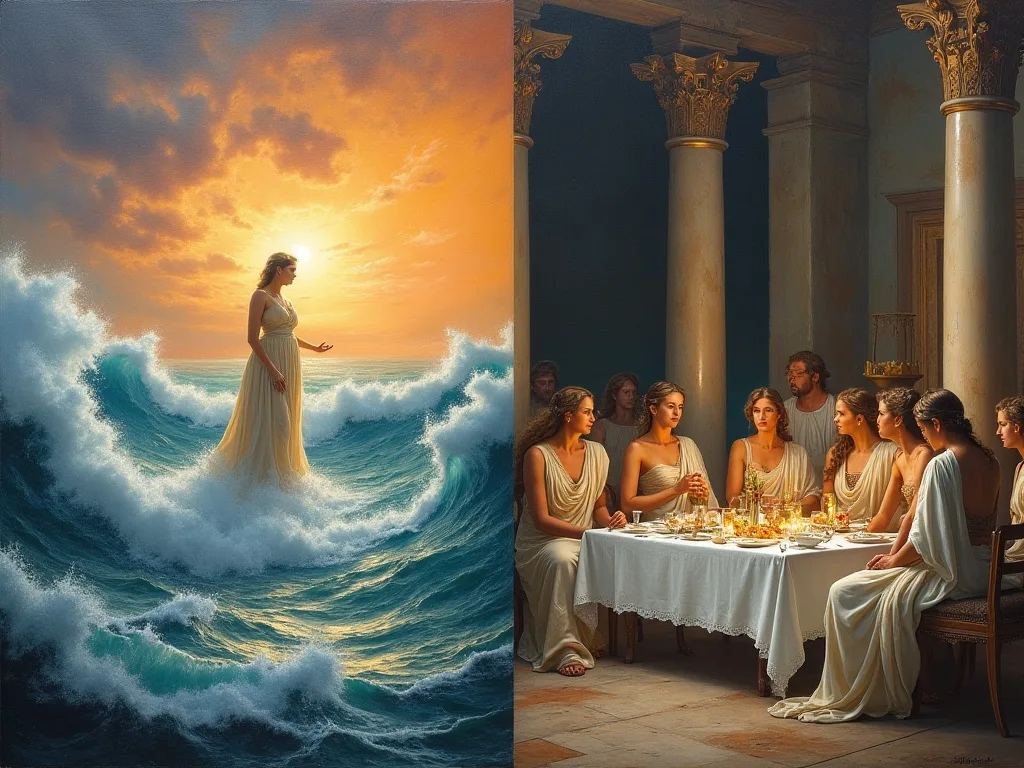
The sea off the coast of Cyprus broke open one morning, and something impossible rose from the foam. Not a fish, not a wave, not a trick of the light. A woman, fully formed, radiant, standing on the water as if the ocean had been holding its breath until that moment. The Homeric Hymn to Aphrodite, composed sometime in the seventh century BC, describes the Horai (the goddesses of the seasons) rushing to clothe her in gold and flowers before escorting her to the assembly of the immortals. Every god who saw her wanted her. That reaction, that helpless turning of every face, is exactly what Aphrodite: Goddess of Love and Beauty was made to provoke.
She is one of the twelve Olympians, but she sits among them like a lit candle in a room full of weapons. Ares brings war. Athena brings strategy. Aphrodite brings the force that makes both wars and strategies feel worthless by comparison. The Greeks called it Eros, the desire that dissolves the rational mind, and they gave it a goddess because they understood it could not be tamed, only personified.
Her cults stretched from Cyprus to Corinth, from the Aegean islands to the western edge of the Greek world. Sailors prayed to her before crossing open water. Soldiers kept her shrines beside those of Ares. Brides offered her their childhood toys on the eve of their weddings. No other deity in the Greek pantheon gathered such a wide and contradictory congregation.
Two Births, Two Natures
The Greeks gave Aphrodite two distinct origin stories, and the philosopher Plato (in his Symposium, written around 385 BC) treated those two versions as reflecting two fundamentally different kinds of love.
The older story, told by the poet Hesiod in his Theogony around 700 BC, is violent and strange. The Titan Kronos cut off the genitals of his father Ouranos, the sky, and threw them into the sea. Sea-foam (aphros) gathered around the severed flesh, and from that foam Aphrodite rose near the island of Kythera before drifting to Cyprus. This version makes her older than the Olympians. She predates Zeus. She comes from the first blood spilled between gods, from the wound at the beginning of divine history. Plato called this version "Heavenly Aphrodite," Aphrodite Ourania, the goddess of a love that transcends the body and moves toward wisdom.
The second story appears in Homer's Iliad and Odyssey, where Aphrodite is simply the daughter of Zeus and the Titaness Dione. This makes her a proper Olympian, younger, more domestic in her troubles, easier to mock. And the gods do mock her. In Book 5 of the Iliad, the warrior Diomedes wounds her in battle, and she flees to her mother Dione weeping, blood on her wrist. Plato called this version "Common Aphrodite," Aphrodite Pandemos, the goddess of physical desire and earthly passion.
The tension between these two Aphrodites runs through every myth she appears in. She is both the cosmic force that binds the universe together and the embarrassingly petty goddess who starts a war over a beauty contest. Both are true. Both matter.
The Marriage to Hephaistos and the Affair with Ares
Among all the Olympian marriages, none is stranger than the union of Aphrodite with Hephaistos, the smith god. He is scarred, lame, covered in forge-soot. She is desire made flesh. The Iliad mentions the marriage in passing, as if Homer finds it as baffling as we do.
Various myths explain how it happened. One version, told by Hesiod, claims that Hephaistos had been thrown from Olympus as a child, either by Hera in disgust at his ugliness or by Zeus in a fit of rage. When he grew powerful enough in his smithy to forge wonders that even the gods wanted, Aphrodite was given to him as payment. She did not choose him. She was a prize.
The affair with Ares, the god of war, is the logical consequence. The Odyssey's eighth book contains one of the funniest scenes in all of ancient literature: the blind bard Demodokos sings the story to an audience of Phaiakians. Helios, the sun, who sees everything, reports the secret lovers to Hephaistos. The smith god, furious and methodical, forges a net so fine it is invisible, drapes it over the marriage bed, and pretends to leave for the island of Lemnos. When Ares and Aphrodite lie together, the net snaps shut. Hephaistos then calls the other gods to witness the humiliation. The goddesses, perhaps with more dignity, stay away. The gods come and laugh, then debate among themselves whether the trade (being caught with Aphrodite) was worth the embarrassment. Hermes, notoriously, says yes.
But the laughter does not diminish Aphrodite. She and Ares are released, go their separate ways, and the union between war and love produces children that tell us something real about human experience: Harmonia (the harmony that follows conflict), Phobos (fear), Deimos (dread), and Eros himself, in some traditions, the personification of desire.
Aphrodite and the Trojan War
No myth shows the raw power of Aphrodite: Goddess of Love and Beauty more clearly than the Judgment of Paris, the story that sets the Trojan War in motion.
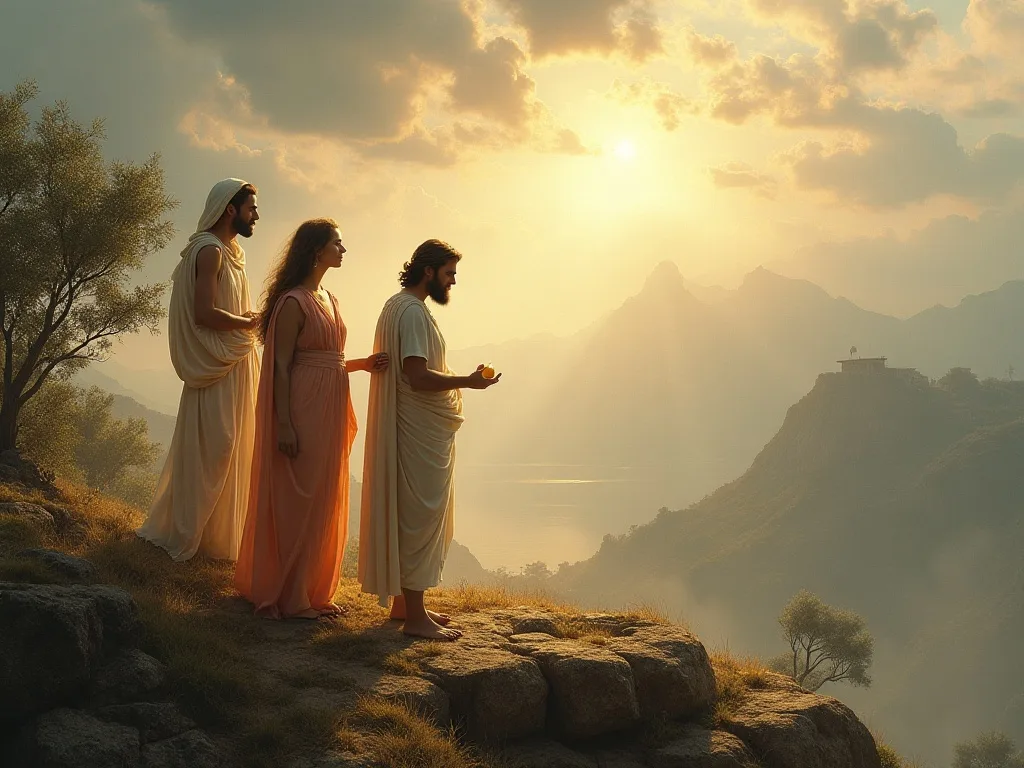
At the wedding of the mortal hero Peleus and the sea-nymph Thetis, the goddess Eris (Strife) arrives uninvited and throws a golden apple inscribed with the words "for the most beautiful" into the banquet. Three goddesses claim it: Athena, Hera, and Aphrodite. Zeus refuses to judge them himself (wisely) and instead sends the three goddesses to Mount Ida, where a young Trojan prince named Paris will decide.
Each goddess offers a bribe. Hera promises power and kingdoms. Athena promises military genius. Aphrodite promises Paris the most beautiful mortal woman alive. Paris chooses Aphrodite. The most beautiful woman alive is Helen, who is already the wife of the Spartan king Menelaos. Aphrodite arranges for Paris to visit Sparta, ensures Helen falls in love with him, and the two sail to Troy together. The war that follows kills heroes on both sides for a decade and eventually burns an entire city.
Aphrodite is not distant from that war. She fights in it, almost literally. She rescues Paris from combat when he is about to be killed by Menelaos (Book 3 of the Iliad), wrapping him in a mist and depositing him back in his bedroom in Troy, then compelling Helen to go to him. Helen argues with the goddess, one of the most striking moments in Homer: a mortal woman telling the goddess of love to fight the war herself if she wants it so badly. Aphrodite answers with a cold threat. Helen goes.
This scene is important. It shows that Aphrodite's power is not purely benevolent. She does not offer love as a gift. She imposes it, bends human will, and when resisted, she frightens. Ancient Greek religion took this seriously. Eros was not soft. It was terrifying.
The Mortal Lovers: Adonis and Anchises
Aphrodite herself loved mortals, and those stories carry a specific weight: the tragedy of divine love falling on a human life.
The myth of Adonis is one of the most emotionally intense in all of Greek mythology. Adonis was born from a forbidden union between a king and his own daughter (the myth varies in detail across sources; the Hellenistic poet Apollodoros gives one of the fuller accounts). He was so beautiful that Aphrodite took him as her lover, but also placed him in a box and gave the box to Persephone to keep. Persephone opened the box, saw Adonis, and refused to give him back. The dispute between the two goddesses had to be settled by Zeus, who decreed that Adonis would spend part of the year with each.
Then a wild boar killed him, either sent by a jealous Ares or by the hunter god Artemis. The blood of Adonis fell into the earth and became the anemone flower. Aphrodite's grief was public, ritualised, and immense. The Adonia, a festival mourning his death, was observed across the Greek world, particularly by women, who planted fast-growing and fast-dying seedlings in clay pots on rooftops as symbols of short-lived beauty.
The myth of Anchises has a different texture. Aphrodite visited the herdsman prince of Troy, disguised as a mortal woman. She lay with him on Mount Ida, and when he woke and realized he had slept with a goddess, he was terrified. The Homeric Hymn to Aphrodite, one of the oldest and most detailed of the Hymns, records the whole encounter with unusual psychological depth. Aphrodite tells him not to fear death, but warns him never to boast of what happened. He will be partially blinded (some versions say lamed) if he brags. The son born from that union is Aeneas, who carries his aging father on his back out of burning Troy and eventually, in Virgil's retelling, founds the Roman people.
Cult, Worship, and Sacred Places
Aphrodite was not only a literary figure. She had active, well-documented cults across the ancient Mediterranean.
Her most important sanctuary stood at Paphos on Cyprus, where the island's culture had mixed Greek and Near Eastern elements for centuries before the Olympian cult solidified. The Paphian Aphrodite was served by priests and priestesses who maintained a sacred precinct the Roman historian Tacitus described as unusually wealthy even by imperial standards. Worshippers arrived by sea, crossing the water she had emerged from.
In Corinth, the sanctuary of Aphrodite Pandemos on the Acrocorinth had a reputation that ancient writers, particularly the geographer Strabo (64 BC - 24 AD), linked to ritual prostitution, though modern scholars debate how literally to read those accounts. What is clear is that Corinth was one of the busiest trading ports in the Greek world and that Aphrodite was closely associated with commerce, exchange, and the city's prosperity, not merely with sex.
Her sacred animals included the dove, the sparrow, the hare, and the swan. Her sacred plants were the rose, the myrtle, and the anemone. Offerings to her included incense, honey-cakes, and flowers. Soldiers dedicated captured armor at her shrines after victories; the connection between love and war was not ironic to the Greeks. It was structural.

Aphrodite Across Cultures: Astarte, Ishtar, Venus
The goddess of love and beauty archetype appears independently across the ancient world, and the connections between Aphrodite and her Near Eastern counterparts are not superficial. They are historical.
The Phoenician goddess Astarte was worshipped from Carthage to Sidon. Her domain: war, sex, the evening star. When Greek colonists settled in the Levant and Phoenicians traded in Greek ports, the two goddesses began to merge in the minds of their worshippers. By the classical period, Greek writers regularly identified them as the same deity with different names.
Further east, the Babylonian and Sumerian goddess Ishtar (known as Inanna in the older Sumerian tradition) ruled over exactly the same complex: love, beauty, fertility, and war. The Epic of Gilgamesh, which dates in parts to around 2100 BC, shows Ishtar proposing marriage to the hero Gilgamesh and being furiously rejected. Her response is to send the Bull of Heaven to destroy him. This is not so different from what happens when any mortal in Greek myth refuses or offends Aphrodite.
The Romans called her Venus, and in Roman hands she became both softer and more politically important. Julius Caesar traced his family, the gens Julia, directly to Aeneas and therefore to Venus herself. She shifted from the dangerous, independent Olympian to a foundation goddess of empire, though the older power never entirely vanished from her Roman cult.
What Makes Aphrodite Dangerous
Greek literature and philosophy return again and again to a single insight: Aphrodite's power is not optional. Mortals who ignore her or reject her domain suffer for it. The Hippolytos of the playwright Euripides (performed in 428 BC) is the clearest statement of this. Hippolytos, a young man devoted to the virgin hunt goddess Artemis, refuses to honor Aphrodite at all. He calls her worship degrading. Aphrodite, in the play's opening, explains calmly that she will destroy him for this. She does. She causes his stepmother Phaidra to fall in love with him; the consequences unravel everyone in the story.
Euripides is not writing a morality tale about lust. He is writing about the danger of denying any part of human experience its due. The Greeks understood that love, desire, and beauty were not decorative. They were forces. Refusing to acknowledge them did not make you pure. It made you a target.
This is why the Greeks built temples to Aphrodite beside temples to Ares and Athena. Not because they confused love with war, but because they understood that desire shapes strategy and that beauty justifies bloodshed in ways no rational argument can. The philosopher Empedoklos (fifth century BC) took it further, proposing that Philia, love, was literally one of the two forces governing the physical universe, alternating with Neikos, strife, to create and destroy all matter. In that framework, Aphrodite is not just a goddess. She is half of reality.
Frequently Asked Questions About Aphrodite
Frequently asked questions
Where was Aphrodite born according to Greek mythology?
Hesiod's Theogony places her birth near the island of Kythera, with the sea-foam gathering around the severed remains of the Titan Ouranos. She then drifted to Cyprus, which is why she carries the epithet Kypris (the Cyprian) throughout Greek literature. Homer's tradition, which makes her a daughter of Zeus and Dione, does not specify a birthplace with the same precision.
Why did Aphrodite start the Trojan War?
The immediate cause was the Judgment of Paris: the Trojan prince Paris chose Aphrodite over Hera and Athena in a beauty contest, accepting her bribe of the most beautiful mortal woman (Helen of Sparta). Aphrodite then ensured Helen fell in love with Paris and helped him bring her to Troy. The war that followed was the ten-year conflict that Homer recounts in the Iliad. Aphrodite continued to actively protect Paris and other Trojan allies throughout the fighting.
What is the difference between Aphrodite Ourania and Aphrodite Pandemos?
Plato introduced this distinction in the Symposium. Aphrodite Ourania (Heavenly Aphrodite) is linked to Hesiod's birth story: she is older, born from the sea-foam of Ouranos, and associated with a love that aspires toward the beautiful and the true. Aphrodite Pandemos (Common Aphrodite) is the daughter of Zeus, associated with earthly, physical desire shared among all people. These were not two separate goddesses in cult practice; the distinction is philosophical, a framework for talking about two different qualities of love.
What is Aphrodite's relationship to the Roman goddess Venus?
When the Romans absorbed Greek religion, they identified Aphrodite with their own goddess Venus, originally a deity of gardens and fertility. The identification became politically charged when the Roman statesman Julius Caesar claimed descent from Aeneas, the Trojan prince who was the son of Aphrodite and the mortal Anchises. Caesar therefore traced his lineage directly to Venus. This made the goddess a founding figure of Roman imperial ideology, a role the Greek Aphrodite never quite occupied.
What were Aphrodite's symbols and sacred animals?
Her most consistent symbols are the dove and the rose, both of which appear on her earliest votive offerings and coin imagery from Cyprus. Other sacred animals include the sparrow (Sappho's seventh-century BC poetry mentions sparrows pulling Aphrodite's chariot), the swan, and the hare. Her sacred plants are the myrtle and the anemone, the latter linked specifically to the death of Adonis. The scallop shell, familiar from later art, becomes strongly associated with her birth scene in Hellenistic and Roman iconography.
Did Aphrodite have children, and who were they?
Yes. Her most significant children are Eros (Desire, though his parentage varies across sources), Harmonia (Harmony), Phobos (Fear), and Deimos (Dread), all born from her affair with Ares. Her union with the Trojan mortal Anchises produced Aeneas, the hero of Virgil's Aeneid and the legendary ancestor of Rome. Some traditions also list Hermaphroditos, a son born from her union with Hermes, who was merged with a water-nymph to become a being of dual nature.
The Goddess Who Never Quite Left
The Aphrodite: Goddess of Love and Beauty tradition did not die when the Greek temples closed. She moved.
Botticelli painted her rising from the sea in 1484-1486, the Birth of Venus, in what is now one of the most recognized images in Western art. He was drawing directly on Hesiod and on a lost painting by the classical Greek artist Apelles that ancient writers had described in detail. The iconography was not rediscovered in the Renaissance. It was continuous, passing through Roman mosaics, early medieval manuscript illustrations, and Byzantine ivory carvings until Italian humanists gave it a new canvas.
In the modern world, she survives in forms less obviously divine. The word "aphrodisiac" carries her name. The planet Venus, the brightest object in the night sky after the moon, bears her Roman name and has since antiquity. Every February, the feast of love that popular culture attributes to a Christian martyr contains rhythms far older than Christianity: the exchange of tokens, the focus on beauty and desire, the sense that love operates outside normal social rules.
Scholars of comparative religion, including Walter Burkert in his 1985 study Greek Religion, trace her lineage through the Near East with careful precision, showing that the goddess the Greeks called Aphrodite carries four thousand years of human reflection on the same terrifying question: why does desire override everything else we value, and what do we do about that?
The Greeks built her temples on hilltops and coastlines. They sacrificed doves. They lit incense at marriages and at departures by sea. They gave her a husband she did not love and a lover who was all war. They let her start the worst conflict in their mythological memory and never blamed her for it, not really, because they understood that the force she embodied was not subject to blame. It simply was.
That is what makes Aphrodite different from almost every other Olympian. Ares can be avoided. Poseidon can be appeased with the right prayers. Even Zeus has rules. But desire has no rules, and the Greeks were honest enough to build their acknowledgment of that fact in stone, on the most beautiful hillsides they owned, facing the sea she came from.
Free 25-page sample
Want the whole story?
Take the first 25 pages free. If it pulls you in, the full edition is yours as an instant PDF download, with a paperback on Amazon for selected titles.
Greek
The Greek Mythology Book: Zeus, the Olympians, the Heroes, and the Sacred Stories of Ancient Greece
Zeus, the Olympians, the Heroes, and the Sacred Stories of Ancient Greece
The complete guide to Greek mythology from Hesiod's Theogony to Homer's epics. Every Olympian, every hero, every descent to the underworld.
More from Greek
All articles
Greek
The Labyrinth and the Minotaur: Crete's Most Dangerous Secret
Beneath the palace of Knossos, a king hid his shame in stone. The story of the Labyrinth and the Minotaur is a myth about power, sacrifice, and the monsters we create.

Greek
The Eleusinian Mysteries: Sacred Rites of Demeter
For nearly two thousand years, thousands of Greeks walked a sacred road to Eleusis and returned changed. The Eleusinian Mysteries promised something no other ritual could: a glimpse of what waited after death.

Greek
Odysseus: Hero of the Odyssey
Cunning, restless, and indestructible in will, Odysseus spent ten years trying to reach home. His story is not just about survival. It is about what it costs a man to remain himself.

Greek
Hades: Lord of the Underworld
Hades rules the Greek underworld with quiet, absolute authority. Neither villain nor demon, he is the god who keeps the cosmic balance that Zeus and Poseidon could never maintain alone.