
Taweret the Hippo Goddess: Protector of Mothers and Childbirth in Ancient Egypt
Taweret, the fierce hippopotamus goddess, safeguarded Egyptian mothers during pregnancy and birth. Discover her dual nature as both protector and destroyer, her sacred role in temples, and why ancient families kept her amulets in every home.
Contents
A pregnant woman lies on a birth brick in an ancient Egyptian home. Around her neck hangs a blue faience amulet shaped like a hippo standing on its hind legs. She whispers a prayer to Taweret, the goddess who has guarded Egyptian mothers for over three thousand years. In that moment, between fear and hope, she is not alone. The fierce protector is there.
Taweret (also spelled Tawart, Toeris, or Ipet) is one of Egypt's most beloved goddesses, yet she rarely appears in the grand mythological narratives that dominate popular understanding of the Egyptian pantheon. She has no epic journey, no seat at the primary divine court, no children born from cosmic union. Instead, she belongs to the intimate sphere of home, pregnancy, and the dangerous threshold between life and death that every birth represents. The Egyptians loved her fiercely for exactly this reason.
The Form and Symbolism of Taweret
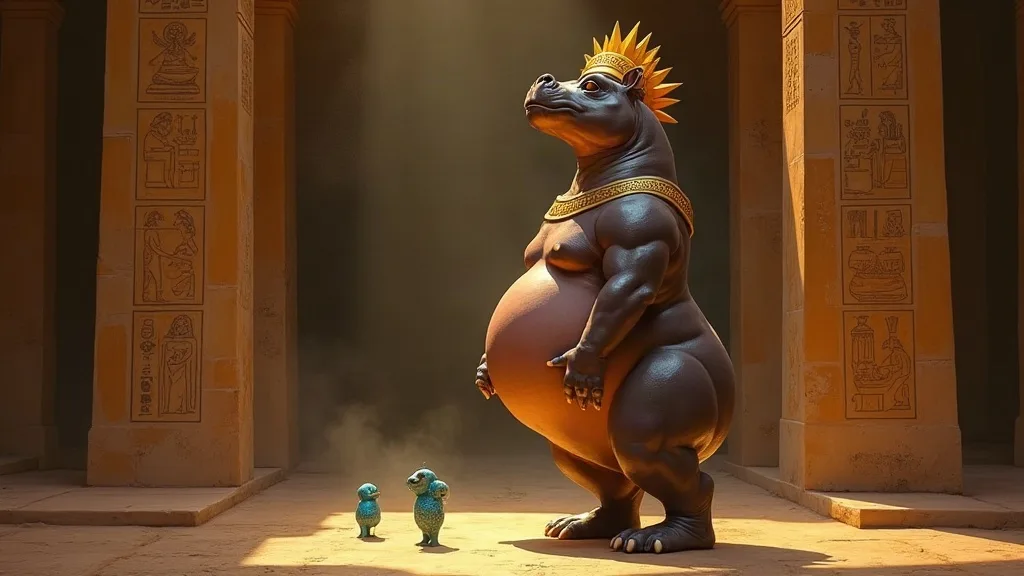
Taweret appears in art as a pregnant hippopotamus, standing upright on her hind legs like a human. Her belly is swollen with child, her breasts full. Sometimes she wears the solar disk (ra) or the crown of Upper Egypt between her ears. Her face is gentle but unmistakably wild. This hybrid form carries the full weight of her power: she combines the massive strength of the hippo, one of Africa's most dangerous creatures, with the tenderness of a mother protecting her own.
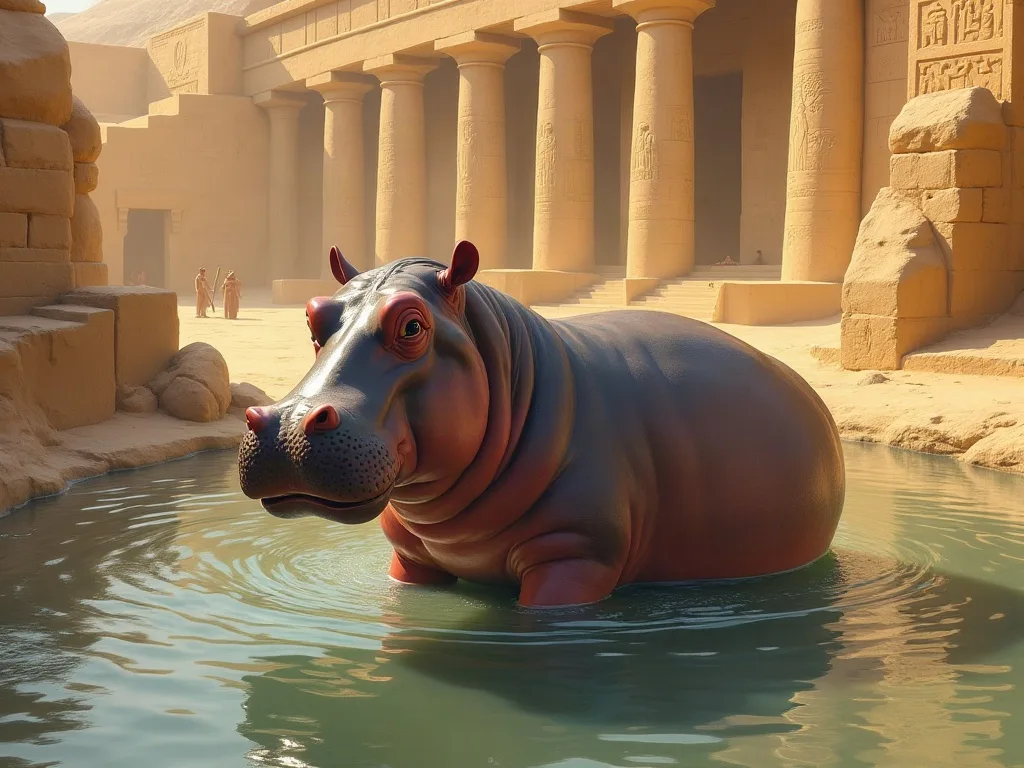
The hippopotamus itself was loaded with spiritual meaning in ancient Egypt. The hippo was both revered and feared. It could destroy crops, topple boats, and kill men with brutal efficiency. Yet it was also a symbol of fertility, abundance, and the life-giving waters of the Nile. Egyptians recognized that the same creature that threatened their survival was also essential to it. Taweret embodies this paradox: she is the power that both threatens and protects.
Her name likely derives from the word taweret or tawart, meaning "the great female one" or "she who is great." In some texts, she is called the "Mistress of the Interval" (the space between pregnancy and birth), reflecting her role as a guardian of transition. She stands at the threshold, keeping danger out while letting life through.
The Mythology of Protection and Danger
Unlike Horus, Osiris, or Amun, Taweret has no elaborate creation story or place in the primary cosmogony told in texts like the Pyramid Texts or the Book of the Dead (collections of spells and instructions for the Egyptian afterlife, inscribed in tombs from around 2400 BCE onward). Instead, her mythology emerges from ritual practice and the daily anxieties of ordinary Egyptians.
One of the few surviving myths involving Taweret appears in the Coffin Texts (spells written in coffins from roughly 2100 to 1800 BCE). In this tradition, she was sometimes called upon to help the deceased travel safely through the underworld. She was also associated with the demon Apepi, the great serpent of chaos who tried to swallow the sun each night. Though the myths vary, Taweret sometimes appears as a figure who stands against this chaos, her strength deployed to protect against the forces of dissolution and death.
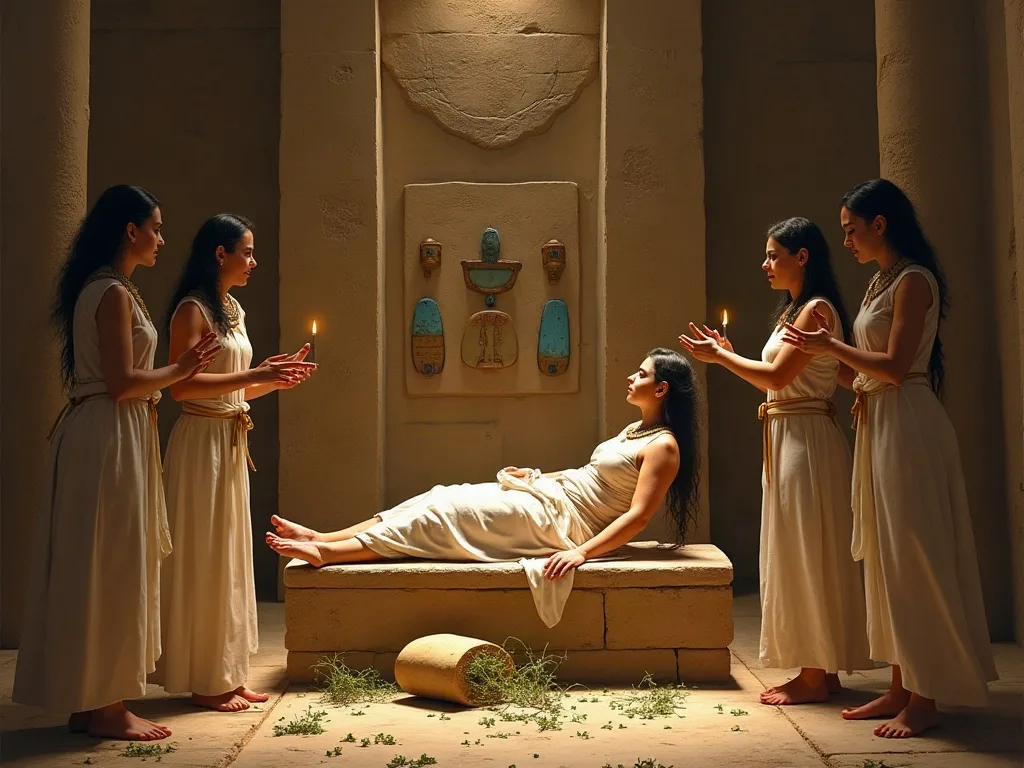
Her primary domain, however, was childbirth itself. Pregnancy was genuinely dangerous in the ancient world. Complications that we now treat routinely with modern medicine were often fatal. Many mothers died; many infants never drew breath. In the absence of medical solutions, the Egyptians turned to the spiritual realm. Taweret was their answer: a powerful, protective presence that mothers could invoke and carry with them.
She was not merely a gentle helper. She was a warrior protecting the weak. Amulets and statuettes show her with her front legs raised in a defensive posture, ready to fight off evil spirits and demons that might threaten the mother or child. Some texts describe her as the slayer of demons, the one who destroys the forces of miscarriage, stillbirth, and maternal death. Her fierceness was her gift.
Worship, Temples, and Daily Practice
Taweret was worshipped throughout Egypt, from the Old Kingdom (around 2686-2181 BCE) through the Greco-Roman period. She appeared in temple reliefs, household shrines, and amulets. While major temples like those dedicated to Amun or Re dominated official religion, Taweret held a unique place in domestic spirituality.
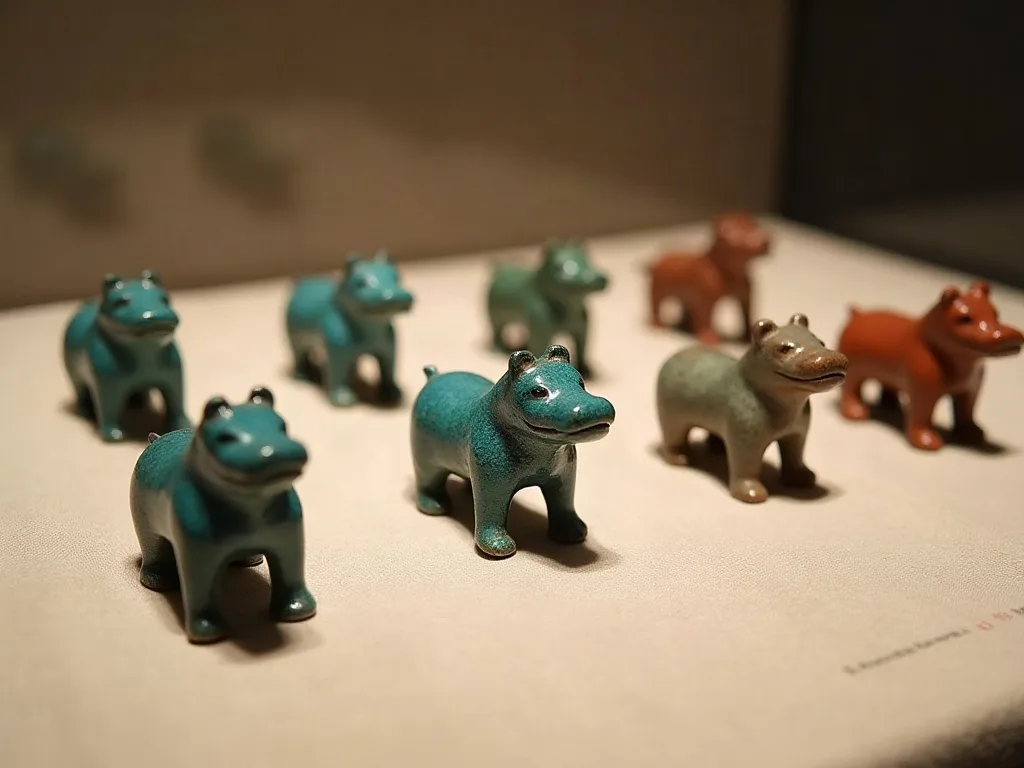
Many families kept small faience (glazed ceramic) or stone statuettes of Taweret in their homes. These were not mere decorations. They were protective presences, spiritual allies. Pregnant women wore amulets shaped like the goddess around their necks or placed them under their pillows. Midwives invoked her name during difficult births. Families brought offerings to her shrines, asking for safe passage through pregnancy and delivery.
Some temples dedicated sections to Taweret's worship. At the temple of Dendera, devoted primarily to Hathor (goddess of love and motherhood), Taweret had a sacred space. The Mammisi (birth houses) that existed at several major temples included her imagery. These structures were designed to magically ensure royal births and were decorated with scenes of gods and goddesses blessing the newborn. Taweret's fierce presence in these spaces sent a clear message: this child will be protected; this mother will not walk this path alone.
Papyri from medical texts sometimes invoke Taweret's protection. One obstetric papyrus, the Kahun Gynaecological Papyrus (dating to around 1800 BCE), describes treatments for pregnant women alongside prayers to protective deities. Taweret's name appears as a guardian against the complications that physicians could not always cure.
The Dual Nature: Protection and Cosmic Power
Taweret's power extended beyond the household. She was sometimes depicted as a guardian of the dead in the underworld. In the Book of the Dead, she appears alongside other protective deities, watching over the soul's journey through the Duat (the Egyptian underworld). Her aggressive stance and fearsome reputation made her an ideal guardian against the demons and obstacles that souls faced on their passage.
In some theological texts, she was connected to the primordial waters from which all creation emerged. Like the hippo wallows in the Nile, she was associated with water, fertility, and the chaotic but generative forces of nature. This placed her in a larger cosmic drama: she represented the life-giving power that could also destroy, the abundance that required constant vigilance to protect.
The relationship between Taweret and other goddesses was sometimes complex. Hathor, goddess of motherhood and love, was her colleague and occasional counterpart. Sekhmet, the fierce lioness goddess of plague and protection, operated in a similar protective mode. Yet Taweret was distinct: she specialized in the specific vulnerability of pregnancy and the particular courage required to bring new life into the world.
The Hippo in Egyptian Culture and Belief
The hippopotamus held a special place in Egyptian imagination. The creature was dangerous, unpredictable, and powerful. Ancient Egyptians hunted hippos, but they also respected them profoundly. A hippo could defend its young with devastating force. An ancient hunter or fisherman who came too close to a hippo's offspring would likely not survive the encounter. This maternal ferocity became a template for understanding divine protection.
Taweret's hippo form was not accidental. The animal's physical characteristics conveyed theological meaning. The hippo's massive body spoke of strength and abundance. Its semi-aquatic nature connected it to the Nile, which Egyptians saw as the source of all fertility and civilization. Its aggressive defense of its young mirrored the protective role Egyptians needed from a childbirth goddess. The form fit the function perfectly.
Cross-Cultural Echoes and Comparative Mythology
The figure of a fierce female protector of mothers and children appears across many ancient cultures. In Mesopotamia, Ereshkigal and other goddesses held protective roles. In Greek tradition, Artemis watched over women in childbirth (though she was also a fierce, aggressive deity). In Hindu mythology, Durga combines ferocity with maternal protection.
What makes Taweret distinctive is the specific form she takes and the democratic, household-centered nature of her worship. While royal and elite religions in Egypt often featured distant, abstract cosmic deities, Taweret belonged equally to everyone. She was as likely to be found in a servant's amulet as on a queen's necklace. This speaks to a fundamental truth: the vulnerability of childbirth transcended social class.
Hieroglyphic Representation and Iconography
In Egyptian art, Taweret was identified by consistent visual markers. The hieroglyph for her name shows a hippo with a crown or the solar disk. Artists depicted her with pronounced breasts and a swollen belly to emphasize her role as a protective mother. Her raised front legs, in that ready-to-fight posture, became her signature. Sometimes she held a knife or wore protective symbols.
On amulets, she often appears in profile, her distinctive hippo head unmistakable. The color of these amulets carried meaning: blue faience represented rebirth and divine protection. Green stone spoke of fertility. Red symbolized the power to ward off danger. Each material and color reinforced her protective message.
The Afterlife of Taweret in Later Periods
As Egyptian civilization continued into the Greco-Roman period (after 332 BCE), Taweret's worship continued largely unchanged. Greek and Roman visitors to Egypt encountered her in temples and homes. Some incorporated her into their own spiritual practices. She appears in Greco-Roman amulets and inscriptions, a testament to her enduring appeal.
Her story did not end with pharaonic Egypt. Medieval European travelers who wrote about Egypt sometimes mentioned hippo-headed figures in temples, though they often misunderstood or misidentified them. In the 19th and 20th centuries, as Egyptology developed as a discipline, scholars gradually reconstructed Taweret's identity and significance from papyri, temple reliefs, and archaeological finds. Today, she stands as one of the most recognizable figures in the Egyptian pantheon, beloved by modern visitors and enthusiasts.
Why Taweret Matters Today
Taweret represents a side of ancient Egyptian religion that the grand mythological narratives often obscure. She was not worshipped because she fit into a cosmic hierarchy or played a role in creation. She was beloved because she answered a real, urgent need. She gave voice to the spiritual anxieties of pregnant women, midwives, and families who understood that birth was perilous and that some protection, some belief in a powerful presence standing guard, could make the difference between despair and hope.
Her story also reveals how ancient religions operated at multiple levels. Official state religion focused on the sun god's daily journey, the pharaoh's role as intermediary between human and divine, the great cosmic struggles between order and chaos. But parallel to this, in homes and villages, people maintained relationships with deities like Taweret who addressed immediate, personal concerns. The grand and the intimate coexisted.
Understanding Taweret opens a window into the daily spiritual life of ancient Egyptians in a way that the Book of the Dead or temple inscriptions sometimes cannot. She was the goddess that a terrified pregnant woman could reach out and touch in the form of a small amulet. She was the presence invoked by a midwife trying to save a mother's life. She was fierce because she needed to be. And she was loved because she answered the call.
Frequently asked questions about Taweret the hippo goddess
Frequently asked questions
What does Taweret's name mean and how do you pronounce it?
Taweret (pronounced tah-WEH-ret) likely means "the great female one" or "she who is great" in ancient Egyptian. She is also known by variant spellings including Tawart, Toeris (from Greek), and Ipet. The name itself emphasizes her status as a powerful protective force rather than a minor deity.
Why was Taweret depicted as a hippo rather than any other animal?
The hippopotamus was both dangerous and fertile in ancient Egyptian culture. Hippos fiercely protected their young and could be lethal to threats, making them a perfect symbol for maternal protection. The animal's association with the Nile's life-giving waters also connected it to fertility and abundance, making the hippo an ideal form for a childbirth protector.
Did Taweret have a family or relationships with other Egyptian gods?
Taweret's mythology is sparse compared to major deities. She sometimes appears in texts alongside other protective goddesses like Hathor and Sekhmet, and her presence is noted in underworld texts where she guarded souls. However, she lacks the elaborate family relationships and romantic narratives associated with gods like Osiris or Horus. Her role was specialized and intimate rather than dynastic.
How common were Taweret amulets in ancient Egypt, and who wore them?
Taweret amulets were extremely common. Archaeological finds show that people across all social classes owned small faience or stone statuettes shaped like the hippo goddess. Pregnant women wore them as necklaces, families kept them in home shrines, and even royal palaces displayed her image. This democratic worship made her one of Egypt's most universally beloved deities.
Is there any historical evidence that Taweret's protection actually worked for ancient mothers?
While we cannot measure spiritual efficacy scientifically, the psychological comfort of belief likely mattered enormously. For an ancient pregnant woman facing genuine medical danger, the confidence provided by invoking Taweret and wearing her amulet may have reduced stress and improved outcomes. Beyond psychology, Taweret's associated midwives and birth attendants presumably had skills and experience that helped many births succeed.
What happened to worship of Taweret after ancient Egypt ended?
Taweret continued to be worshipped into the Greco-Roman period and beyond. Her image appears in amulets and temple inscriptions through the Roman era. As Christianity spread through Egypt, her worship gradually faded, though folk traditions and magical practices may have preserved some veneration. By the Medieval period, her cult had essentially disappeared, though her image was occasionally encountered in temples by travelers.
The Enduring Lesson of the Hippo Goddess
Taweret teaches us that not all divine power operates at the scale of cosmic drama. Some of the most important spiritual work happens in homes, at the bedside of a laboring mother, in the hands of a midwife, in the small blue amulet worn around a neck. The ancient Egyptians understood that protection is as much a divine function as creation or kingship. They honored the goddess who stood at the threshold between life and the unknown, fierce and unwavering, for over three thousand years.
Her story endures because it speaks to something universal: the courage required to bring new life into the world, the vulnerability that comes with it, and the deep human need to believe that we are not alone in facing that challenge. In Taweret, ancient Egyptians found not a distant cosmic power but a neighbor, a guardian, a fighter who stood on the side of mothers and children. That intimacy, that practical tenderness combined with absolute fierceness, is why she mattered then and why her memory still resonates now.
Free 25-page sample
Want the whole story?
Take the first 25 pages free. If it pulls you in, the full edition is yours as an instant PDF download, with a paperback on Amazon for selected titles.

Mythology
The World Mythology Book: The Gods, Heroes and Myths of Every Culture
The Gods, Heroes and Myths of Every Culture, in One Volume
The whole of world mythology in a single volume: Greek, Norse, Egyptian, Japanese, Hindu, Celtic, Slavic, Mesoamerican and African myths gathered side by side, each drawn from the primary sources.