
Thunder Gods Compared: Thor, Zeus, Perun, and Raijin Across Four Pantheons
Thor, Zeus, Perun, Raijin: four thunder gods, four civilizations, one shared obsession with the storm. See what the parallels reveal about humanity itself.
Contents
Thunder gods compared across Thor, Zeus, Perun, and Raijin is one of the most revealing exercises in comparative mythology. Four storm-wielders, four civilizations separated by thousands of miles and centuries of independent tradition, yet each one shares a core of lightning, justice, and cosmic order. That convergence is not a coincidence.
Stand for a moment at the edge of a dark sky, the air gone electric, the horizon backlit in white fire. Every culture on earth has stood there too. And almost every one of them saw a god in that light. The question worth asking is: why do their answers look so similar?
The parallels run deeper than the obvious props, the hammer, the bolt, the drum. They reach into cosmology, into how each society organized power, feared chaos, and protected its farmers. Peel back the specific names and images, and a single archetype emerges, ancient enough to predate writing. What follows is a close comparison of four of its most powerful expressions.
The Weapon as World-View: Mjolnir, the Thunderbolt, the Oak Club, and the Drum
Every thunder god carries a signature tool. Each tool is a compressed theology.
Thor swings Mjolnir, the hammer forged by the dwarf brothers Brokkr and Sindri in the halls of Svartalfheim. The Prose Edda, compiled by the Icelandic scholar Snorri Sturluson around 1220 CE, describes Mjolnir as the single greatest treasure of the Aesir: it can flatten mountains, and it always returns to Thor's hand. The weapon is not only destructive; Norse farmers wore miniature Mjolnir amulets at weddings and births, asking Thor to hallow the occasion. The hammer blesses as readily as it strikes.
Zeus throws the thunderbolt, a weapon the Cyclopes fashioned for him in Hesiod's Theogony, the Greek cosmogonic poem composed around 700 BCE. The bolt is pure kinetic sovereignty. Zeus deploys it to punish oath-breakers, overthrow the Titans, and remind the other Olympians who runs Olympus. Unlike Mjolnir, it is not a blunt instrument of agricultural protection; it is a scepter made of fire, the physical expression of the right to rule.
Perun, the great storm deity of Slavic tradition, carries both an axe and an oak club. The medieval chronicler Procopius, writing in the sixth century CE, noted that the Slavic peoples venerated a single thunder god above all others, and later sources confirm Perun as his name. His weapon splits the sky not to demonstrate rule but to hunt: Slavic mythology frames the entire cosmos as a perpetual chase, Perun pursuing the shape-shifting serpent Veles through clouds, rivers, and the roots of the world-tree to reclaim stolen cattle and stolen souls.
Raijin (sometimes written Raiden), the Japanese god of thunder, beats a ring of drums to produce the roll and crack of storms. He appears in the eighth-century Nihon Shoki, one of Japan's earliest chronicles, and his image, a fearsome oni-faced figure surrounded by taiko drums, became one of the most reproduced icons in Japanese religious art. The drum frames thunder as rhythm, as percussion, as the heartbeat of a living sky, rather than a weapon aimed at anyone in particular.
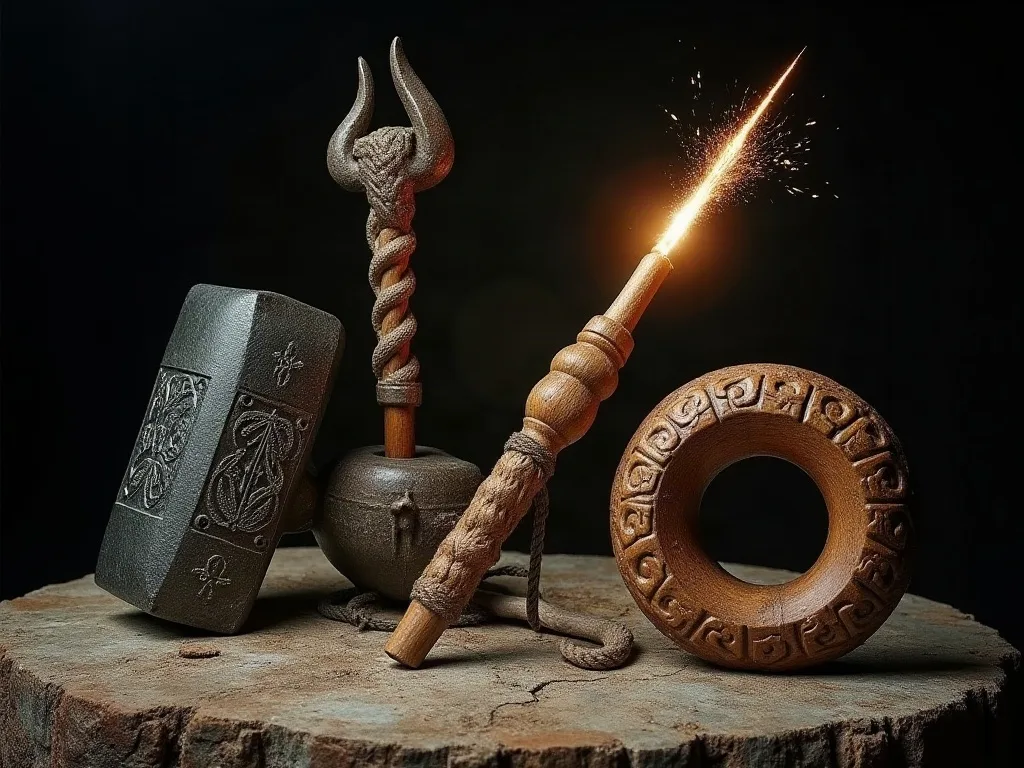
Same storm, four different gestures. The hammer blesses farmers. The bolt punishes kings. The club defeats chaos. The drum fills the sky with sound. Each metaphor tells you exactly what the society behind it valued most.
Origin Stories: Where Each God Gets His Power
How a thunder god comes into being reveals what his culture believed power was made of.
Zeus earns nothing by birth alone. He is the youngest child of the Titans Kronos and Rhea, swallowed at birth because Kronos feared being overthrown. Rhea substitutes a stone wrapped in cloth. Zeus grows in secret on Crete, returns, forces Kronos to regurgitate his siblings, and then wages the Titanomachy, a ten-year war described in the Theogony, before seizing the sky. His thunder is a conquered inheritance, authority that had to be fought for, generation against generation.
Thor is born a god in full from the beginning of his mythology. His father is Odin, his mother the earth goddess Jord. There is no Eddic war of ascension for Thor himself; he arrives already the champion of the Aesir, already carrying Mjolnir. His identity is defined not by conquest but by perpetual guardianship. The Prose Edda and the Poetic Edda alike present Thor as the one who stands between the ordered world and the giants of Jotunheim who would unmake it.
Perun's origin is less documented in surviving texts, most Slavic religious literature was destroyed after Christianization, but reconstructed from folk ballads, ethnographic records, and comparative Indo-European studies, his essential story is the same combat myth played on a loop: the sky-god battles the underworld-serpent and wins, bringing rain, spring, and fertile earth. His power is ecological. He doesn't hold a throne; he restores a balance.
Raijin enters Japanese cosmology as a divine function before a full personality. The Kojiki (712 CE), the oldest chronicle of Japanese mythology, situates Raijin within the broader storm cycle associated with Susanoo, the tempestuous brother of the sun goddess Amaterasu. Raijin is not sovereign; he is one of many specialized heavenly forces, his power defined by its specific sensory register: the sound, the percussion, the shock of storm.
Justice, Chaos, and the Serpent: What Each God Fights For
Strip the cosmetic differences away, and most thunder gods are guardians of a particular kind of order against a particular kind of threat.
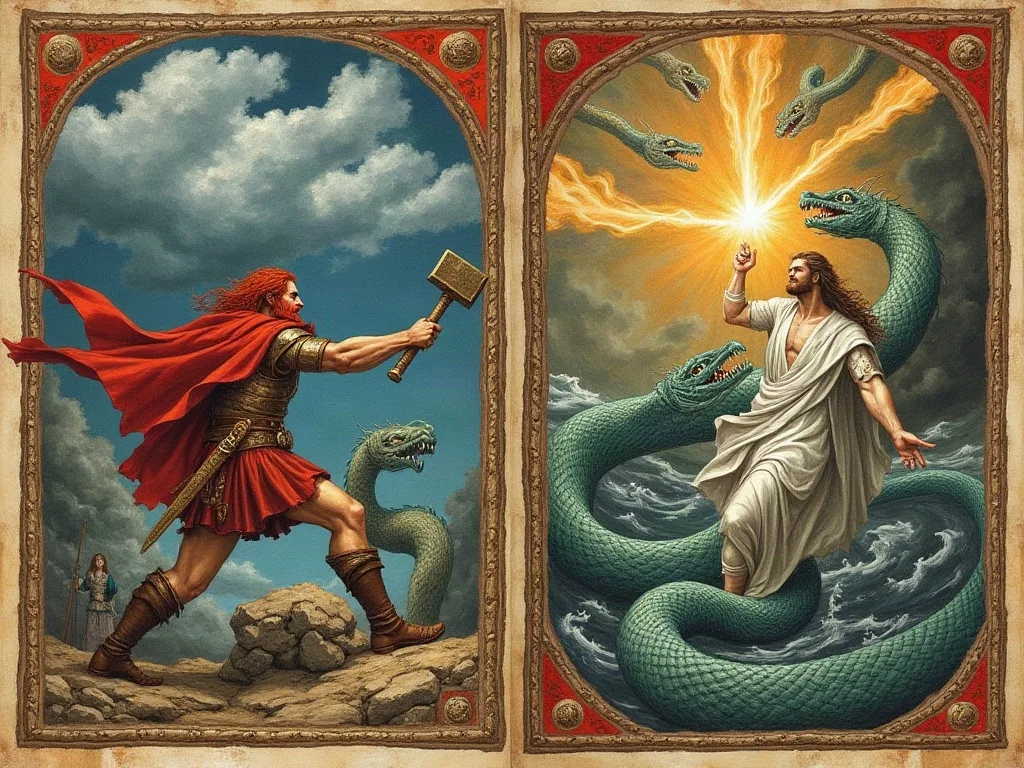
Zeus fights for vertical order, the supremacy of the Olympian hierarchy over the older, chthonic powers. His enemies are the Titans, the Giants, and Typhon, the monstrous storm-being described in the Theogony as the last great challenge to Olympian rule. Typhon has a hundred serpent heads and voices that fill the sky with animal sounds. Zeus finally buries him under Mount Etna, trapping primordial chaos beneath a volcano. The thunderbolt here is the instrument of permanent political settlement.
Thor's wars are never permanently won. He kills the Midgard Serpent Jormungandr at Ragnarok, but falls nine steps after the final blow, poisoned by its venom. The Prose Edda is explicit: this is not a triumphant ending. It is a tragic balance, the champion and the monster cancel each other out. Norse cosmology does not believe in permanent victories; it believes in heroic resistance and honorable endings.
Perun and Veles enact perhaps the oldest version of this drama. Scholars like Vyacheslav Ivanov and Vladimir Toporov, in their foundational 1970s work on Slavic mythology, traced the Perun-Veles conflict to the Proto-Indo-European "combat myth": a sky-god against an earth-serpent, recapitulating the tension between rain and drought, life and death, upper world and underworld. Veles steals cattle or children; Perun chases him across every layer of the cosmos; rain follows the victory. The myth is seasonal, cyclical, and agricultural at its core.
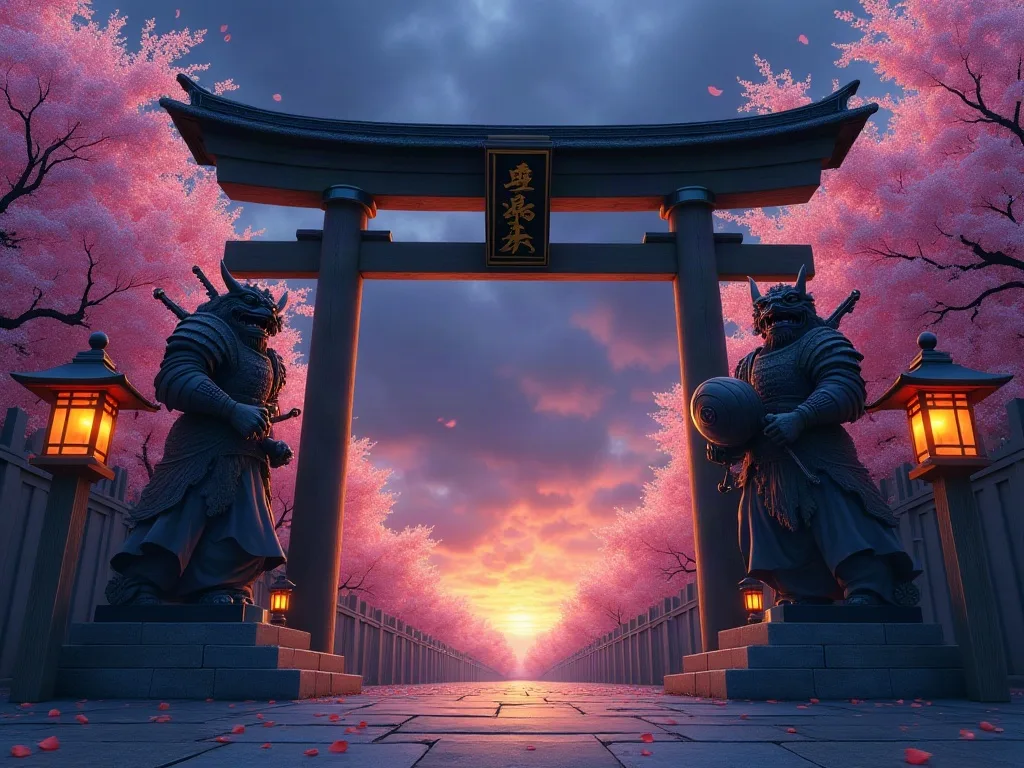
Raijin does not fight a named adversary in the way the others do. His closest counterpart in Japanese mythology is his own companion and opposite, Fujin, the wind god, with whom he is almost always depicted as a pair. Together they appear at the gates of Buddhist temples across Japan, fierce protectors rather than cosmic warriors. The Japanese tradition frames storm not as the aftermath of war but as the raw energy of a living sky, neither good nor evil, requiring ritual propitiation rather than mythological conquest.
Thor (Norse)
- Weapon: Mjolnir (hammer), blesses and destroys
- Role: Protector of humans and farmers, champion against giants
- Enemies: Jotnar (giants), Midgard Serpent Jormungandr
- Fate: Dies at Ragnarok, poisoned by Jormungandr
- Social register: God of the common people, warriors, homesteads
- Sacred animal: Goats (Tanngrisnir and Tanngnjóstr)
Zeus (Greek)
- Weapon: Thunderbolt, punishes and commands
- Role: King of the Olympians, enforcer of divine law
- Enemies: Titans, Giants, Typhon
- Fate: Eternal reign, no apocalyptic end in Greek tradition
- Social register: God of kings, oath-keepers, rulers
- Sacred animal: Eagle, bull
Sacred Spaces and Ritual: How Humans Answered the Thunder
Knowing who a god is matters less to ancient worshippers than knowing what to do when the sky goes dark.
Thor was worshipped across Scandinavia, Iceland, and Anglo-Saxon England. Place-names preserve his cult: Thursday (from Old English Þūnresdæg, "Thor's day"), Thundersley in Essex, Thorshavn in the Faroe Islands. His temples received offerings of animals, particularly goats. At the great temple of Uppsala in Sweden, described by the German chronicler Adam of Bremen around 1070 CE, a statue of Thor occupied the central position, flanked by Odin and Freyr. He was the most immediately relevant god to ordinary Norsemen, and they showed it.
Zeus commanded the most politically significant oracular shrine in the ancient Greek world: Dodona in northwestern Greece, where priests interpreted the rustling of oak trees and the clanging of bronze cauldrons as the god's voice. He also held Mount Olympus and every hilltop altar where Greeks called down rain during drought. His sacred oak groves drew pilgrims across centuries. Pausanias, the Greek traveler and geographer writing in the second century CE, recorded details of Zeus's cult sites across the Peloponnese with the thoroughness of a guidebook author.
Perun's shrines stood almost exclusively in the open air on hilltops, near ancient oaks. Nestor's Chronicle, a Kievan Rus text from around 1113 CE, records that the Christianizing prince Vladimir I erected a wooden idol of Perun in Kyiv, then had it thrown into the Dnieper River when he converted to Christianity in 988 CE. The idol floated downstream while crowds wept on the banks. That detail captures the coercive rupture of Slavic paganism in a single image.
Raijin's worship was folded into Buddhist temple iconography as Buddhism spread through Japan from the sixth century CE onward. He and Fujin guard the Sensoji Temple in Asakusa, Tokyo, as a famous pair of gate sculptures. Farmers prayed to Raijin for rain, and children were warned not to expose their navels during thunderstorms, because Raijin was said to eat belly-buttons. That last detail is charming evidence that even cosmic forces get domesticated when they live long enough inside a culture.
The Proto-Indo-European Thread: One God, Many Languages
The comparison above is not merely thematic. Three of these four thunder gods, Thor, Zeus, and Perun, share a genetic linguistic ancestor.
Comparative linguists reconstructed a Proto-Indo-European storm deity they denote Perk(w)unos, from the root perkwu- meaning "oak" or "striking." The cognates are striking in their own right:
- Norse Fjorgyn (Thor's mother, personification of earth, storm-adjacent)
- Lithuanian Perkunas (thunder god still worshipped in folk practice into the modern era)
- Latvian Perkons
- Slavic Perun
- Sanskrit Parjanya (Vedic rain deity)
- Greek Keraunos (a word for thunderbolt, possibly a partial cognate)
The linguist Calvert Watkins and the mythologist Jaan Puhvel both argued, separately and with strong philological evidence, that behind this shared vocabulary lies a shared narrative: the sky-striker defeats the serpent or dragon of the deep. You can trace it from the Vedic Indra slaying the serpent Vritra to Perun chasing Veles to Zeus burying Typhon to Thor killing Jormungandr.
Raijin stands outside this lineage. Japanese mythology developed from a distinct, non-Indo-European tradition. The Shinto cosmogonic texts trace the universe from a primordial void into a sequence of divine generations with no overlap with the Indo-European family. Yet Raijin converges on the same cluster of functions: storm, rain, fertility, cosmic vitality. That independent convergence is its own kind of proof. When you give people a thunderstorm, they build something like the same god.
Father Figures, Warrior Sons, and the Question of Rank
One of the subtler differences among these four gods is where each sits in his pantheon's hierarchy.
Zeus is the father himself. He is the top of the Greek divine structure, husband to Hera, father to Apollo, Athena, Ares, Hermes, and dozens of others. His thunder is the expression of absolute authority. No one corrects him; everyone fears his bolt. This arrangement reflects Greek political life, where patriarchal sovereignty, at home and in the polis, was the organizing principle of society.
Thor is a son. Odin holds the highest seat in the Norse pantheon. Thor is powerful, loved, and essential, but he is not the All-Father. He is the champion, the muscle, the one who stands in the gap while Odin works strategy. This distinction mattered to Norse society: Thor's worshippers tended to be farmers, seafarers, and warriors, while Odin's worshippers clustered among kings, poets, and the aristocratic elite. The thunder god was for people who needed immediate, practical protection, not divine wisdom.
Perun occupies the functional top of the Slavic pantheon, often described as ruler of the sky in the same breath as Veles rules the underworld. But the surviving record is too fragmentary for certainty. Vladimir's Kyiv pantheon put Perun first among six gods, but Christianization disrupted the tradition so thoroughly that historians work largely from reconstruction.
Raijin holds no top rank. He is one agent among many in a densely populated Shinto cosmos. His power is real and feared, but he is not sovereign. The Japanese theological tradition does not organize the divine world around a single supreme patriarch in the way Greek or Norse tradition does. Raijin's relative equality with other kami (divine forces) reflects the broader Shinto sense that the sacred is diffuse, present everywhere in nature, not concentrated in a single commanding will.
Thunder Gods in Modern Culture: Why the Archetype Refuses to Die
Thor is now among the most recognized fictional characters on earth, thanks to Marvel Comics (first appearance: Journey into Mystery #83, August 1962) and the film franchise that followed. The cinematic Thor carries Mjolnir, speaks of Asgard, and faces Loki, all genuine elements of Norse mythology rendered through a superhero lens. Academics like Tom Shippey have noted that Marvel's Thor has done more to spread awareness of the Eddas than most university courses, even if the theology got flattened in the process.
Zeus never left Western culture. Renaissance painters gave him the eagle and the thunderbolt; Enlightenment thinkers used him as a symbol of reason and law; he appears on the seals and coins of nations that saw themselves as heirs to Greco-Roman civilization. His name gave English the word "zeugma" through its grammatical association with the act of yoking, because Zeus's root, dyeus, meant "shining sky" and connected to the Latin deus (god) and the Sanskrit deva.
Perun underwent a peculiar transformation under Christianization: his qualities were absorbed by Saint Elijah the Prophet, who in Eastern Orthodox folk tradition rides a fiery chariot across the sky and controls rain and storms. The folk calendar still marks Elijah's Day (August 2nd) with prohibitions against fieldwork during storms. Perun did not die; he changed coats.
Raijin lives on in modern Japanese culture through anime, manga, and video games, often depicted as a tattooed, drum-beating figure somewhere between terrifying and comedic. The word kaminari (thunder, literally "god-sound") preserves the Shinto sense that thunder is literally the voice of the divine, built into everyday Japanese.
Frequently Asked Questions About Thunder Gods Compared Across World Mythology
Frequently asked questions
Are Thor and Zeus related to the same original god?
Linguistically and mythologically, yes. Both descend from a Proto-Indo-European deity reconstructed as Perkwunos or Dyeus Phter (sky-father), the divine storm-wielder of the ancestral culture that spread across Eurasia roughly 4,000 to 6,000 years ago. Their weapons differ, their personalities differ, but the core function, storm-control as cosmic authority, is shared. Calvert Watkins, in his 1995 book "How to Kill a Dragon," traces the shared narrative grammar across Indo-European traditions in detail.
Is Raijin related to Thor or Zeus?
Not by ancestry. Raijin comes from a separate, non-Indo-European cosmological tradition rooted in Shinto and later shaped by Chinese Buddhism. His convergence with Thor and Zeus on the same cluster of functions, storm, rain, fertility, protection, is an example of independent parallel development, what scholars call "convergent mythological evolution." Two separate traditions arriving at similar answers to the same question: what is the storm?
Which thunder god was the most widely worshipped?
By geographic spread and longevity of active cult, Zeus and Thor are the strongest contenders. Zeus's worship stretched from Spain to Syria for over a millennium of classical antiquity. Thor's cult covered Scandinavia, Iceland, the British Isles, and Norse settlements in Greenland and North America, and his name survives in Thursday in every Germanic language. Perun's worship was geographically broad across Slavic Europe but documented far less thoroughly before Christianization. Raijin's cult remains active in Japan today, making him the only one of the four with an unbroken living tradition.
What does the thunder god archetype tell us about ancient societies?
It tells us that storm control was civilization-critical. Rain meant crops; crops meant survival. A god who commanded the rain was not a luxury of theology; he was insurance against famine. The thunder god's secondary role as justice-enforcer, punishing oath-breakers and monsters alike, reflects a deep social need: people needed to believe that the sky itself backed up the moral order. Whoever broke a covenant could be struck down from above. That belief made oaths binding in a world without police forces or written law.
Who would win in a fight between Thor and Zeus?
Ancient theologians never asked the question this way, and modern scholars wouldn't either, but it's a useful provocation. In raw power as described by primary texts, Zeus arguably wins: the Iliad makes clear that he can outpower all other gods combined if he chooses, while the Eddas show Thor losing at least one contest of strength (to the disguised Utgard-Loki in the Prose Edda). But Thor fights to the death at Ragnarok knowing he will die; Zeus has no equivalent sacrifice in Greek tradition. The better comparison is not power but purpose.
How did Perun's worship survive Christianization?
Largely through folk syncretism. As Christianity spread through Slavic Eastern Europe, Perun's attributes migrated onto Saint Elijah the Prophet, who in Orthodox tradition controls rain and rides a fiery sky-chariot. Elijah's feast day (August 2nd) inherited many of Perun's agricultural rituals, including prohibitions on working in the fields during thunderstorms. Slavic folk songs collected in the nineteenth century by ethnographers like Alexander Afanasyev preserve Perun's combat with Veles in thinly disguised narrative forms, the dragon slain by a thunder-wielding hero.
The Living Storm: What These Four Gods Still Teach Us
The comparison does not end with ancient history. Every time a culture faces a world that feels chaotic, ungovernable, too large for human hands, it reaches for the thunder god archetype. Not necessarily the literal deity: the shape of the idea. A force powerful enough to enforce order, close enough to the human world to be called upon, remote enough to remain awe-inspiring.
In the nineteenth century, Romantic painters like J.M.W. Turner rendered the storm as sublime force, godlike but unnamed. In the twentieth, Thor returned through comic books not because Marvel writers were archaeologists but because the archetype was available, instantly readable, viscerally compelling. In contemporary Japanese pop culture, Raijin shows up in video games like Smite and Nioh, coded as fierce but not alien, because the visual grammar of drum-beating storm deity is centuries deep in Japanese visual memory.
What none of these modern iterations fully captures is the original function: the thunder god was the guarantor that the moral universe held. Zeus's bolt fell on the oath-breaker. Perun's axe drove off the chaos-serpent so the rain could return. Thor's hammer consecrated marriages, blessed newborns, hallowed the dead. The storm was not random; it was responsive. It meant something. That is perhaps the deepest human need these four gods share: the conviction that the sky is not indifferent.
It is also what makes comparative mythology one of the richest fields of inquiry available to us. When four completely separate civilizations, Norse, Greek, Slavic, Japanese, independently arrive at the same answer to "what lives in the thunder," the convergence is not a curiosity. It is evidence of something structural about how human minds process power, fear, and the need for cosmic accountability. The storm asks a question. Thor, Zeus, Perun, and Raijin are four different languages giving the same answer.
Free 25-page sample
Want the whole story?
Take the first 25 pages free. If it pulls you in, the full edition is yours as an instant PDF download, with a paperback on Amazon for selected titles.

Mythology
The World Mythology Book: The Gods, Heroes and Myths of Every Culture
The Gods, Heroes and Myths of Every Culture, in One Volume
The whole of world mythology in a single volume: Greek, Norse, Egyptian, Japanese, Hindu, Celtic, Slavic, Mesoamerican and African myths gathered side by side, each drawn from the primary sources.