
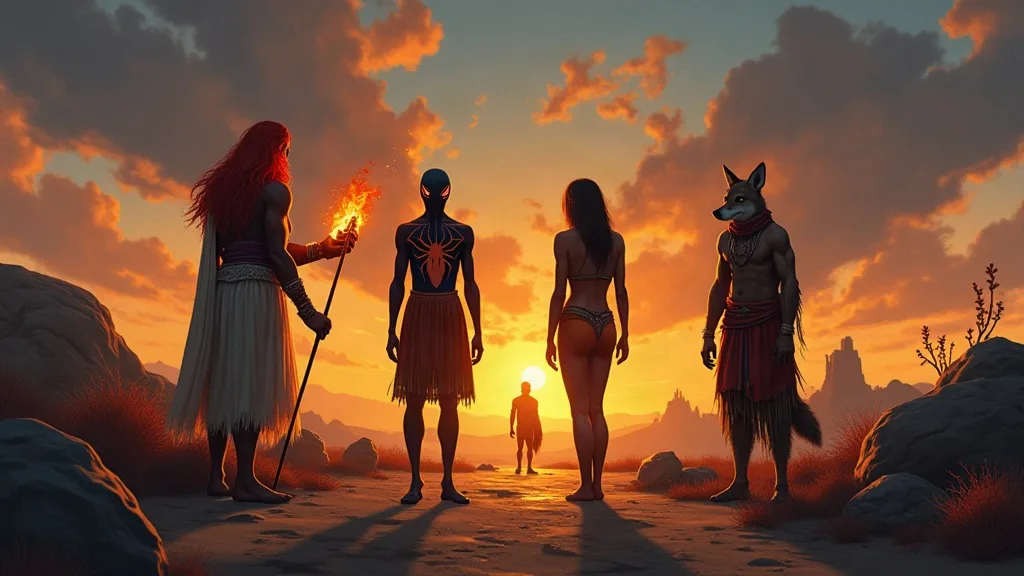
Trickster Gods Compared: Loki, Anansi, Coyote, and Eshu Across Four Mythologies
Loki, Anansi, Coyote, Eshu: four trickster gods from four continents who break rules, reshape worlds, and refuse to stay in their lane. Here is what they share, and why it matters.
Contents
A god walks into a sacred assembly and says exactly the wrong thing. He insults the host, reveals a secret, steals something precious, or simply laughs at a moment that calls for silence. The other gods rage. The world trembles a little. And somehow, the story that follows is more alive than any orderly hymn of praise could be.
That figure appears in cultures with no contact with each other. In the longhouses of Scandinavia, the spider-tales of West Africa, the oral traditions of the Navajo and Coyote peoples of the American Southwest, and the crossroads shrines of Yoruba Nigeria. The scholars who have spent careers on this problem use the term trickster, a category coined in modern comparative mythology, not a word any of these traditions would have recognized. But the category points at something real: a type of divine actor who bends rules, crosses categories, and makes the cosmos a stranger and richer place because of it.
Trickster gods compared is not just an academic exercise. Follow Loki, Anansi, Coyote, and Eshu side by side and something surprising emerges. The differences are as revealing as the parallels. Each trickster is shaped by the world that made him. Together they form a rough map of why every human culture seems to need a sacred rule-breaker.
The Shape of the Trickster: What All Four Share
Before separating them, look at the skeleton they share.
Each of the four tricksters operates at a boundary. Loki sits at the edge of the Aesir, the Norse gods he travels with but does not fully belong to; he is the son of giants, admitted to Asgard by old oath, never fully trusted. Anansi sits between the sky and the earth, between the human and the divine, between story and silence. Coyote (in most traditions of the Great Basin, Plateau, and Southwest peoples) lives at the margin between the ordered world and the wild lands beyond it. Eshu, called Elegba or Legba in some Yoruba and Ewe traditions, stands at every crossroads, threshold, and doorway, the hinge between worlds.
They are all shape-shifters to some degree. Loki becomes a mare, a salmon, an old woman. Anansi shrinks into a spider and expands into a man. Coyote dies and resurrects, changes sex in several Shoshone and Paiute stories. Eshu is described in the odu, the Yoruba divination corpus, as appearing now old, now young, now wearing white, now black.
They all use language as a weapon. Loki's sharpest tool is always his tongue: the binding oath, the clever lie, the insult timed perfectly to wound. Anansi wins every contest through story and misdirection. Coyote talks his way into meals, marriages, and disasters. Eshu is the oriki of speech itself; without him, no message between the human and divine worlds gets through at all.
And they all cause irreversible change. After every major trickster act, the world is different. Something new exists that did not exist before, or something that existed is gone forever. This is the trickster's secret job: not chaos for its own sake, but the productive disruption that culture needs to grow.
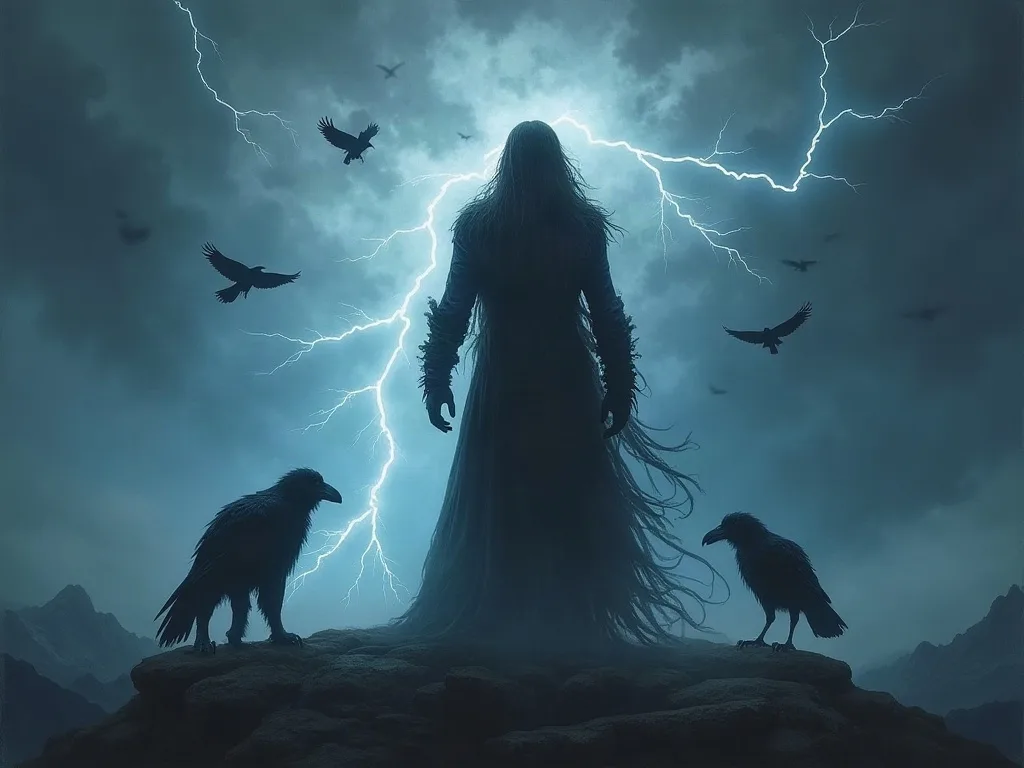
Loki: The Aesir's Most Dangerous Ally
The Norse trickster appears by name in some of the oldest surviving Eddic poetry, and his role in the Prose Edda, written down by the Icelander Snorri Sturluson around 1220 CE, is both indispensable and catastrophic.
Loki is not the god of lies in the Eddas. He is something harder to categorize. He helps the gods build Asgard's walls (then sabotages the arrangement). He retrieves Thor's stolen hammer, Mjolnir (by cross-dressing and seducing a giant). He fathers the wolf Fenrir, the Midgard Serpent Jormungandr, and Hel, the ruler of the underworld, three beings who will help destroy the cosmos at Ragnarok. He also cuts off the golden hair of Sif, Thor's wife, for no obvious reason, then replaces it with hair spun from real gold by the dwarves of Svartalfheim, thus accidentally giving the Aesir some of their greatest treasures: Thor's hammer, Odin's spear Gungnir, the ship Skidbladnir.
That double motion is essential. Loki breaks, then repairs, but never cleanly. The repair always contains a seed of the next disaster.
His trajectory moves from useful chaos to genuine malice. In the Lokasenna, a poem in the Poetic Edda (probably composed between the 9th and 12th centuries), Loki crashes a feast of the gods and systematically accuses each of them of cowardice, sexual misconduct, or treachery. He does not lie. Every accusation lands because it is true. He is eventually captured and bound beneath the earth, a serpent dripping venom onto his face, until Ragnarok releases him.
The binding of Loki echoes a pattern scholars of comparative mythology call the detained trickster: the figure whose powers become too dangerous and who must be contained, but who cannot be destroyed, because the world needs what he carries. Loki's release at Ragnarok is not the story of chaos winning. It is the story of transformation being total. The old cosmos ends; a green new earth rises from the sea.
Thor and the Giants is the context inside which Loki's tricks make sense. Strip out the trickster and Thor is only a hammer. Add Loki and the mythological cycle becomes a living argument about power, trust, and consequence.
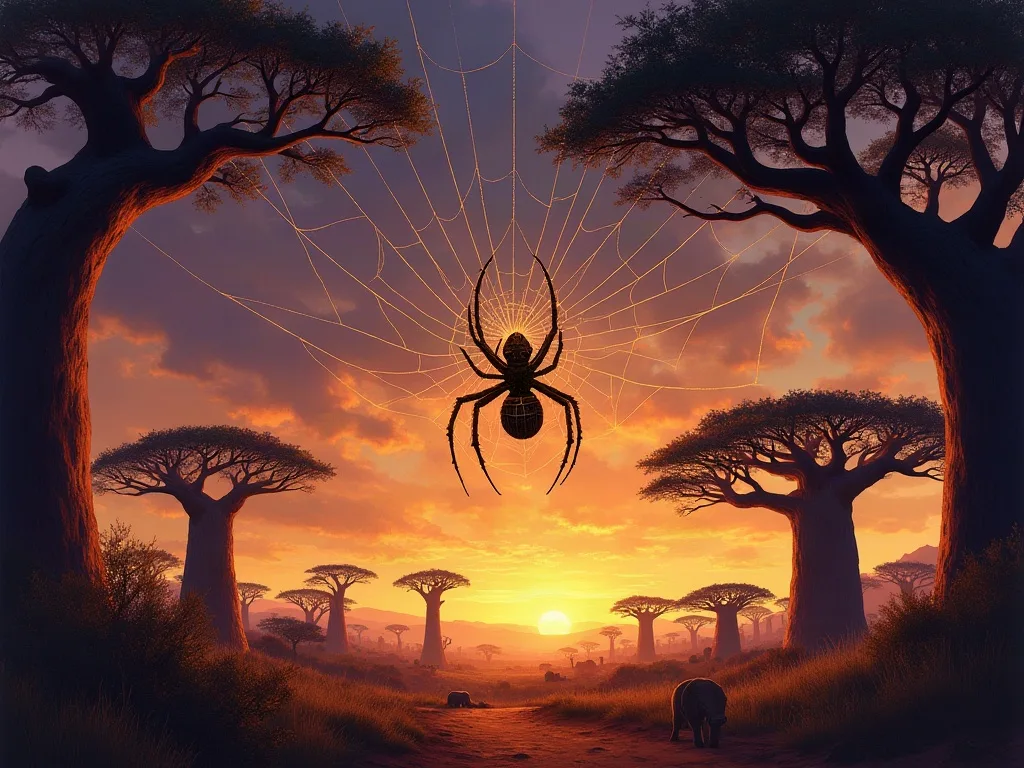
Anansi: Who Bought All the Stories
Anansi is a spider. He is also a man. He is also the son of Nyame, the sky god of the Akan people of Ghana, the Ivory Coast, and the broader Akan diaspora that spreads through the Caribbean and the American South via the transatlantic slave trade.
The core Anansi myth, told across dozens of variants in West Africa and in the Caribbean traditions where it survived slavery, goes like this: Nyame owns all the world's stories. No story belongs to anyone else. Anansi goes to Nyame and asks to buy them. Nyame sets an impossible price: Anansi must bring him Onini the python, Osebo the leopard, and the Mmoboro hornets, creatures no one has caught. Anansi does all three, using a different trick each time. He flatters Onini into measuring himself against a branch, then ties him to it. He lures Osebo into a pit. He tricks the hornets into sheltering inside a gourd and stops up the mouth. Nyame hands over all the stories. They now belong to Anansi, and through Anansi, to every human being who tells one.
This is the founding myth of storytelling itself. Every tale you have ever heard, Anansi paid for it.
What makes Anansi distinct among the four tricksters is the absolute absence of violence. He never fights. He out-thinks. His weapons are patience, observation, and the perfectly placed word. In many Ghanaian and Caribbean versions he is also lazy, greedy, and occasionally cruel, which is part of the point. The stories do not present him as a moral exemplar. They present him as reality: intelligence without ethics produces wonder and damage in equal measure.
The Anansi tradition also survived genocide. The Anansi tales crossed the Middle Passage because they could be told without props, without priests, without temples. A story is portable. Scholars of African diaspora literature, including Robert Pelton in his 1980 study "The Trickster in West Africa," document how Anansi stories functioned as coded resistance, a way for enslaved people to transmit values of cunning, adaptability, and survival when direct resistance was lethal.
In Jamaica, Anansi becomes Anancy. In the American South, some folklorists see echoes of the spider-trickster in Brer Rabbit, who uses identical tactics: feigned weakness, misdirection, and the turning of an enemy's strength against itself.
Coyote: Creator Who Keeps Getting It Wrong
Coyote is not one trickster. He is hundreds. The Coyote figure appears across more than thirty distinct Native American traditions, from the Navajo and Zuni of the Southwest to the Nez Perce of the Plateau to the Ohlone of California. Each telling is its own tradition. Treating them as one unified myth flattens enormous cultural diversity, and scholars including Jarold Ramsey (in "Coyote Was Going There," 1977) and Barre Toelken have spent careers arguing against that flattening.
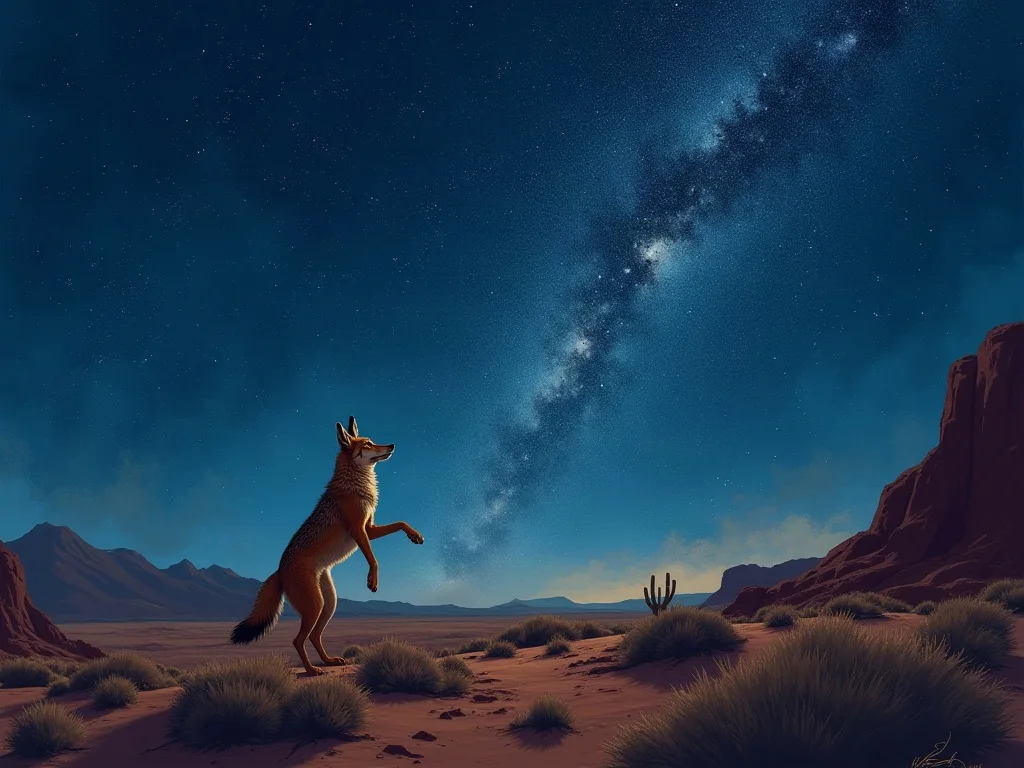
With that warning in place: a family of shared features does run through many Coyote stories. Coyote is often a creator figure or at minimum a transformer, someone who shaped the world in its early, unfinished state. In Nez Perce tradition, Coyote kills the monster Kamiah, which has swallowed all the animals, and cuts the world up into the different peoples of the earth. In Navajo tradition, Coyote scatters stars across the sky when the Holy People are placing them carefully and deliberately, producing the Milky Way and introducing randomness into the celestial order.
That act of scattering is a precise image of the trickster's function. Order proceeds. The trickster scatters. The result is more beautiful and more dangerous than the original plan.
Coyote also dies, repeatedly, and comes back. Death does not stick to him. In several California Miwok and Maidu stories, Coyote is the one who accidentally (or not) introduced death to humanity. He argued against permanent death during the making of the world, then lost a relative to it, tried to reverse the decision, failed, and so grief and death became permanent. He is both the cause of the problem and its first victim.
This is a particular kind of trickster theology. Coyote does not transcend suffering. He suffers more than anyone, partly because he keeps making the same mistakes. His comedy is inseparable from his pathos. He is the divine fool in the deepest sense: the figure who holds the audience's laughter and their grief at the same time.
The comparison with Loki and Ragnarok here is sharp. Both tricksters introduce irreversible loss into the world. Loki fathers the beings that will end the cosmos. Coyote introduces death. Neither intends the full consequence. Neither is punished in proportion to the result. The world simply continues, marked by what the trickster did.
Eshu-Elegba: The God Who Makes Communication Possible
Eshu, also called Elegba, Legba, or Exu depending on the tradition and region, is an orisha, one of the divine powers in the Yoruba religious system that originated in what is now southwestern Nigeria and Benin. The Yoruba tradition is one of the world's most internally consistent theological systems, with a complex cosmology, an elaborate divination system called Ifa, and a sophisticated priesthood. Eshu-Elegba is not a minor figure inside that system. He is structurally indispensable.
No other orisha can receive a prayer, a sacrifice, or a divination without Eshu's permission. He is the gatekeeper between the human world and the divine one, between ile (the earth) and orun (the heavens). Every Yoruba ceremony begins with an offering to Eshu. Without him, nothing gets through.
This is the key difference from Loki, Anansi, and Coyote: Eshu is not a marginal figure tolerated by a suspicious establishment. He is the linchpin. The other orishas need him. The system would stop without him.
The trickster element shows up not in his structural position but in his behavior within stories. In many odu Ifa narratives, Eshu causes conflict between two friends by wearing a hat that is black on one side and white on the other, so that each friend reports a different color and they argue until they fight. When asked why he did it, Eshu explains: sowing discord is his nature, and besides, the two friends needed to learn that perspective is not truth. The lesson is real; the method is cruel; the teacher takes no responsibility for the injuries.
His relationship to language runs even deeper than Anansi's or Loki's. The Yoruba word for the mouth, enu, connects etymologically to Eshu in some scholarly analyses (the linguist Rowland Abiodun has discussed this connection). Speech is Eshu's domain. He invented it, or he controls access to it, depending on which story you read. A lie and a prayer both go through him.
Eshu traveled with the Yoruba diaspora into Brazil, Cuba, Haiti, and Trinidad. In Candomble (Brazil) and Santeria (Cuba), his name is Exu or Eleggua. He remains the first orisha greeted in every ceremony. The Atlantic slave trade tried to erase Yoruba religion; instead, it transplanted it, and Eshu arrived on three continents.
Eshu (Yoruba)
- Structurally central: ceremonies cannot begin without him
- Gatekeeper of all communication between humans and gods
- Causes conflict as a teaching tool, not pure malice
- Survived diaspora; worshipped actively today in Candomble and Santeria
- Associated with crossroads, thresholds, and speech
Loki (Norse)
- Structurally marginal: an outsider giant-blood tolerated by the Aesir
- Causes disruption that the gods must then manage
- Moves from useful chaos to destructive malice across the mythological arc
- Worship ceased after Christianization of Scandinavia (c. 1000 CE)
- Associated with fire, shape-shifting, and the spoken oath
Why Every Culture Builds a Trickster
The cross-cultural persistence of this figure is not a coincidence, and it is not the result of cultural diffusion (Akan people and Norse people did not share stories). The most convincing explanation is structural.
Every organized society creates rules: rules about who may speak, what may be said, which roles are fixed, which categories must not be mixed. These rules are necessary. They make cooperation possible. But they also create blind spots. The rigid structure cannot see its own absurdities, its own cruelties, its own contradictions.
The trickster is the figure the culture invents to keep looking at what the rules forbid it to see. He crosses gender lines (Loki becomes female; some Coyote stories involve sex-change) when the culture over-invests in gender fixity. He exposes the pretensions of the powerful (Loki at the feast; Anansi outwitting kings) when hierarchy becomes oppressive. He carries death into the world (Coyote, Loki) when the culture needs to process the terror of mortality.
Anthropologist Mary Douglas, in "Purity and Danger" (1966), argued that pollution and taboo figures are always found at the borders of categories, where things blur and the system's logic breaks down. The trickster lives exactly there. He is the sacred shape of the border itself.
This also explains why tricksters are morally ambiguous. A sanitized trickster, one who is simply mischievous and harmless, teaches nothing. The version that actually works is the one who causes real harm, real grief, and real transformation. Loki kills Baldr, the most beloved of gods. Coyote brings permanent death. Anansi acquires stories by methods that include deception and cruelty toward other creatures. Eshu starts wars between neighbors. These are not wholesome figures. They are true ones.
The Trickster as Sacred Dissident: Loki, Anansi, Coyote, Eshu in Modern Thought
The four tricksters have had very different afterlives.
Loki became a Marvel superhero, or antihero, played by Tom Hiddleston in a billion-dollar film franchise. The MCU version is softer and more sympathetic than the Eddic original (he is never the horse who gives birth to Sleipnir in a Disney film), but the emotional logic is preserved: an outsider using intelligence where others use strength, always at the edge of catastrophe. The fact that the character resonated globally suggests that the trickster structure is immediately legible across cultural contexts.
Anansi was revived powerfully in literature. Neil Gaiman's novel "American Gods" (2001) and its companion "Anansi Boys" (2005) give the spider-god a contemporary American voice, sharp-dressed and sharp-tongued. Gaiman's Anansi is recognizably the same figure as the one in Akan oral tradition: he wins through story, he takes what he wants, and he is both charming and ruthless. The novels also engage honestly with the diaspora history, rooting Anansi in the specific geography of the Middle Passage and Black Atlantic identity.
Coyote remains central to contemporary Native American literature. Writers including Sherman Alexie (Spokane/Coeur d'Alene) and Leslie Marmon Silko (Laguna Pueblo) use Coyote as a lens for examining survival, colonialism, and cultural resilience. In Silko's "Ceremony" (1977), Coyote's capacity to make mistakes and keep going becomes an argument for why Native traditions survived what they survived. The trickster's immunity to permanent death is, in this reading, a theology of persistence.
Eshu-Elegba is actively worshipped. This is not metaphor or revival. The Yoruba diaspora religions, Candomble with several million practitioners in Brazil, Santeria with comparable numbers in Cuba and the United States, and Ifa itself recognized by UNESCO in 2005 as an Intangible Cultural Heritage, maintain living ritual traditions in which Eshu is propitiated at every ceremony. He is the only one of the four tricksters whose cult never died.
That distinction matters for anyone thinking about these figures comparatively. Loki, Anansi, and Coyote are mythological figures encountered primarily through texts, performances, and cultural memory. Eshu is a divinity with active priests, specific feast days, specific colors (black and red, or red and black, depending on the lineage), specific foods, and specific rhythms played in his honor. The trickster, in that tradition, did not become literature. He stayed sacred.
Frequently Asked Questions About Trickster Gods Across World Mythology
Frequently asked questions
Are Loki, Anansi, Coyote, and Eshu all considered 'gods' in their own traditions?
Not exactly in the same sense. Loki in the Norse Eddas is an ambiguous figure: he travels with the Aesir but is not universally called a god, and some scholars classify him as a divine being of giant (Jotun) descent. Anansi is the son of the sky god Nyame, making him a semi-divine intermediary. Coyote is typically a primordial being or transformer rather than a god in the strict sense, a pre-human power who shaped the world. Eshu is unambiguously one of the Yoruba orishas, divine powers subordinate to the supreme being Olodumare, and he is actively worshipped today. The word "god" carries heavy Greek and Christian baggage; each tradition has its own category system.
Did these trickster traditions influence each other, or did they develop independently?
The evidence strongly points to independent development. Norse and Yoruba traditions had no meaningful contact before the 16th century CE, and Coyote stories predate any African or European contact with the Americas by thousands of years. The parallel features, shape-shifting, boundary-crossing, language as a weapon, the introduction of death or disorder, are better explained as convergent responses to universal social needs than as borrowing. Paul Radin's 1956 "The Trickster" was the first major comparative argument for this position, and subsequent scholars including Lewis Hyde ("Trickster Makes This World," 1998) have refined it considerably.
What is the difference between a trickster and a devil or evil spirit?
The key distinction is creative productivity. A devil or evil spirit in traditions that have such a figure (Satan in Christianity, Ahriman in Zoroastrianism) opposes creation and seeks destruction or domination. The trickster causes disorder that generates something new: stories, tools, fire, death, language, laughter. Loki's schemes inadvertently give the Aesir their greatest treasures. Anansi buys knowledge for all of humanity. Coyote's mistakes shape the world into the form we recognize. Even Eshu's conflict-sowing carries a teaching. Evil spirits want nothing to exist; tricksters want everything to exist, including the messy parts.
Why are so many tricksters associated with animals?
Animal tricksters are found on every continent partly because animals visually represent the category crossings that define the trickster's role. A spider is tiny, patient, and traps things far larger than itself. A coyote lives at the edge of human settlements, eating what it can, surviving everything. A raven (another major trickster figure in Northwest Coast traditions) is black, loud, and fond of shiny objects. The animal body is a shorthand for a set of behaviors. It also lets the storyteller keep a safe distance: "the coyote did this" is less accusatory than "a human being did this." Animal tricksters can embody what is uncomfortable about human selfishness and cunning without forcing the audience into direct self-recognition.
How does Hermes from Greek mythology compare to these four tricksters?
Hermes shares every structural feature of the trickster. He is the boundary-crosser par excellence, the only Olympian who travels freely between the world of the living and the underworld. He steals Apollo's cattle as an infant and lies about it with spectacular brazenness. He invents the lyre and trades it to Apollo to escape punishment. He is the god of thieves, merchants, and travelers, all people who operate at the edges of fixed categories. The main difference from Loki is that Hermes is fully integrated into the Olympian system, rather than being its potentially fatal outsider. He does not have a Ragnarok equivalent, a moment where his disruptive energy turns terminally against the structure he serves.
What is the best primary source to read for each trickster?
For Loki, the Prose Edda of Snorri Sturluson (c. 1220 CE) is the fullest account; the Poetic Edda, especially the Lokasenna and Thrymskvida, gets closer to the older oral tradition. For Anansi, Harold Courlander's "A Treasury of African Folklore" (1975) collects many canonical versions, and the Akan oral sources are documented through the work of folklorist Kwesi Yankah. For Coyote, Jarold Ramsey's "Coyote Was Going There" (1977) is an excellent curated anthology of Pacific Northwest versions, with tribal attribution taken seriously. For Eshu, the primary source is the odu Ifa divination corpus itself, vast and largely oral; Wande Abimbola's "Ifa: An Exposition of Ifa Literary Corpus" (1976) makes it accessible in English.
The Trickster's Unresolved Question: Chaos or Conscience?
Scholars still disagree about what the trickster fundamentally is.
Lewis Hyde's influential book "Trickster Makes This World" (1998) reads the trickster as an agent of creative disruption, essentially positive, the force that prevents culture from calcifying into mere repetition. For Hyde, Loki and Anansi and Coyote are the gods of necessary change. Without them, nothing new could enter the world.
Carl Jung read the trickster as a shadow archetype, the repressed contents of the collective unconscious expressing themselves in disguised form. In this reading, the trickster carries what the culture cannot consciously acknowledge: its violence, its selfishness, its appetite. Worshipping the trickster is a way of knowing the shadow without being destroyed by it.
Wande Abimbola and other scholars working from inside the Yoruba tradition argue that this Western psychological framing misses Eshu entirely. Eshu is not an archetype of the unconscious. He is a specific divine being with a specific liturgical role, a specific biography in the odu, and a specific relationship to Orunmila, the orisha of wisdom and divination. The comparative framework is useful, Abimbola concedes, but it risks making all tricksters interchangeable when the theological specifics are what actually matter.
That tension is the most honest place to leave this comparison. Loki, Anansi, Coyote, and Eshu rhyme with each other across four continents and four radically different cosmological systems. The rhyme is real. But each figure is also irreducibly himself, shaped by his own world, serving his own people's specific need, playing his own notes inside a much larger music that no single tradition owns.
The spider who bought all the stories. The fire-god who fathered the end of the world. The animal who scattered the stars and regrets nothing. The gatekeeper without whom no prayer arrives. Each one is asking the same question in a different language: what does order owe to the things it cannot contain?
The answer, across four traditions and thousands of years of telling, seems to be: everything.
Free 25-page sample
Want the whole story?
Take the first 25 pages free. If it pulls you in, the full edition is yours as an instant PDF download, with a paperback on Amazon for selected titles.

Mythology
The World Mythology Book: The Gods, Heroes and Myths of Every Culture
The Gods, Heroes and Myths of Every Culture, in One Volume
The whole of world mythology in a single volume: Greek, Norse, Egyptian, Japanese, Hindu, Celtic, Slavic, Mesoamerican and African myths gathered side by side, each drawn from the primary sources.