
Twin Myths Across Cultures: The Universal Story of the Divine Pair
From the Aztec Quetzalcoatl and Xolotl to the Norse Freyr and Freya, twin myths appear in nearly every tradition on Earth. Why does humanity keep telling this story?
Contents
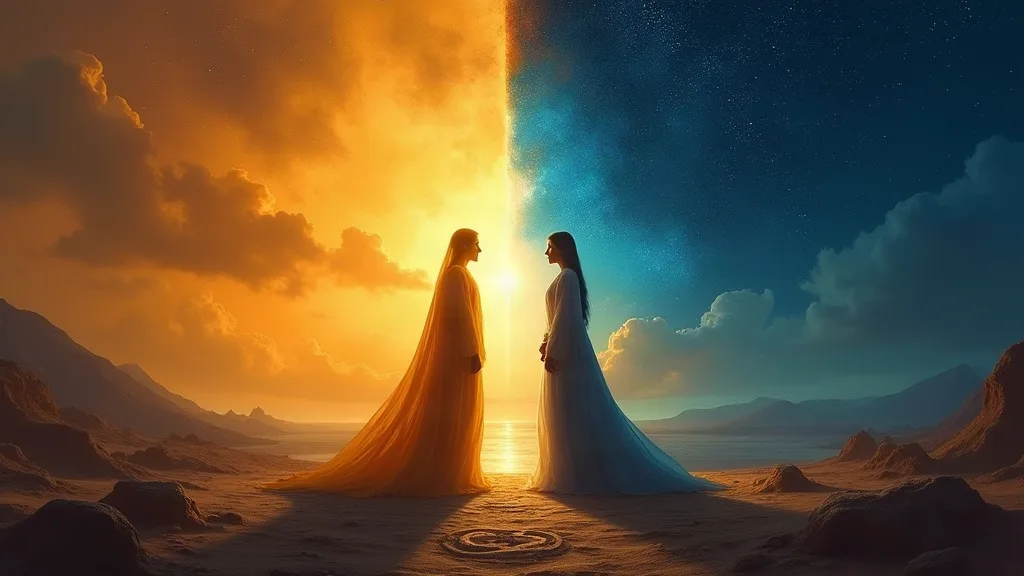
Before the first city rose, before writing carved meaning into clay, two figures walked side by side through the human imagination. They were born together. They divided the world between them. Sometimes they loved each other with a devotion that bent the laws of heaven. Sometimes they destroyed each other with a ferocity that split the cosmos in half. Every culture with a mythology seems to have reached, independently, for the same image: two beings from one origin, mirror and opposite, inseparable and irreconcilable.
Twin myths across cultures are not a coincidence of folklore. They are one of the most persistent narrative structures humanity has ever produced, appearing from the rain forests of Mesoamerica to the frozen longhouses of Scandinavia, from the river valleys of the ancient Near East to the plains of sub-Saharan Africa. Scholars of comparative mythology, including Georges Dumézil, Claude Lévi-Strauss, and David Leeming, have all pointed to twinship as a near-universal motif, a story the human mind returns to again and again because it does something no single hero can do: it dramatises duality itself.
This article follows the twin archetype across eight traditions, listens to what each version says about life and death, creation and chaos, the sacred and the profane, and asks why the double keeps appearing at the exact moment a culture needs to explain what holds the universe together.
The Oldest Twins: Mesopotamia and the Division of the Cosmos
The oldest written twin stories come from ancient Mesopotamia. The Sumerian Descent of Inanna, recorded on clay tablets around 1900 BCE from even older oral sources, contains one of the first mythological pairs defined by radical opposition: Inanna, goddess of love and sky, and her sister Ereshkigal, queen of the underworld. They are not twins by birth in every version, but they function as twins structurally, two faces of a single divine power split between the living world and the dead one.
The Babylonian Enuma Elish, the creation epic written down around 1200 BCE, frames the cosmos itself as a division of a primordial body. The god Marduk slays Tiamat, the salt-water dragon, and splits her in two. Her upper half becomes the sky; her lower half becomes the earth. Creation here is the severing of a pair. The universe is born from a body that had to be broken apart, not because one half was evil and the other good, but because two halves holding the same space could not both survive.
This is the first pattern: twins as cosmic complementaries, whose separation is the act of creation. You find it echoed across every tradition that follows.
Hunahpu and Xbalanque: The Hero Twins of the Maya
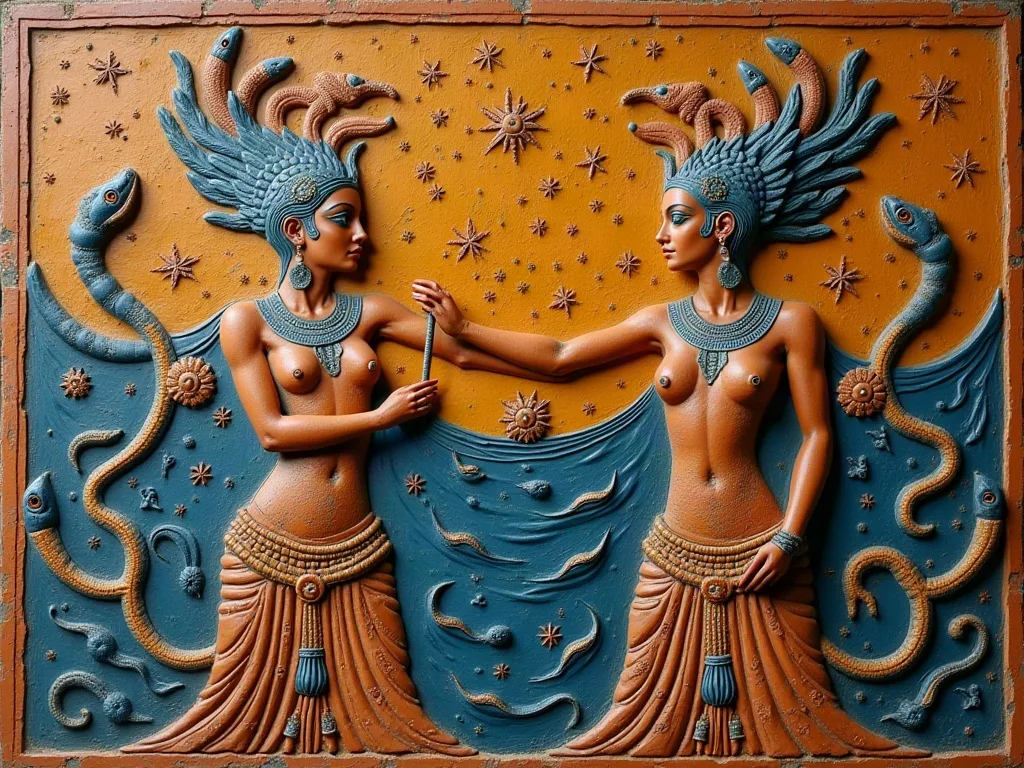
No twin myth is more elaborately developed than the story of Hunahpu and Xbalanque in the Popol Vuh, the K'iche' Maya creation text written down in the mid-sixteenth century from centuries-older oral tradition. The hero twins are conceived in extraordinary circumstances: their father and uncle, themselves a set of twins named One Hunahpu and Seven Hunahpu, were killed by the lords of Xibalba (the Maya underworld, pronounced "shee-BAL-bah") after losing a ball game. A severed head spat into the hand of a young woman named Xquic, who became pregnant with Hunahpu and Xbalanque.
The twins grow up as tricksters, athletes, and hunters. The lords of Xibalba summon them, just as they summoned their father, expecting an easy victory. But Hunahpu and Xbalanque have studied the traps. They survive the House of Cold, the House of Fire, the House of Bats (where Hunahpu loses his head and Xbalanque fashions a replacement from a gourd). They play the ball game with a decapitated head for a ball. They die and resurrect. They die and resurrect again. At last, they destroy the lords of death, avenge their father, and ascend into the sky as the sun and the moon.
What makes this story structurally remarkable is that the twins are not opposites in moral terms: both are clever, both are brave. Their duality is operational. One acts; the other improvises. One is captured; the other engineers the escape. The Popol Vuh uses their complementarity not to represent good versus evil but to represent the two types of intelligence any impossible situation demands: planning and adaptation. Their story also contains the deepest resurrection logic in Mesoamerican myth: death can be defeated, but only by something that was already born from death.
You can read more about the underworld they descend into at Xibalba, the Maya Underworld, and trace their full lineage through Maya mythology.
Romulus and Remus: When the Twin Becomes a Founder's Crime
The Roman twin story moves in the opposite emotional direction. Romulus and Remus are suckled by a she-wolf, raised by a shepherd, and grow up to found a city. But one city cannot have two kings. Romulus kills Remus. Rome rises from that act.
The Roman historian Livy, writing around 27 BCE in his Ab Urbe Condita ("From the Founding of the City"), treats the fratricide with a certain political clarity: Romulus crosses the line Remus drew in the earth, Remus mocks it, and Romulus strikes him dead. Livy does not celebrate the killing. He records it as the terrible necessary act that defined what Rome would be: a city born from violence, structured by law, and haunted by its own origin.
The political philosopher Jean-Pierre Vernant noted that the Romulus-Remus myth works as a founding charter. The twins represent two legitimate but incompatible claims. Because only one can be true, the city requires a singular authority, and that authority is purchased by blood. Every Roman law, every Roman institution, carries the trace of a murder that had to happen before anything else could begin.
This is the second pattern: the twin who dies makes the surviving twin's power possible. The dead twin is not a villain but a sacrifice, sometimes willing, always necessary.
Hunahpu and Xbalanque (Maya)
Both twins survive death through cooperation. Their bond is the mechanism of triumph. Twinship is a resource. They defeat an external enemy (the lords of Xibalba) rather than each other. Both ascend: they become the sun and moon, cosmic presences that endure. The myth teaches that complementary intelligences together overcome what neither could face alone.
Romulus and Remus (Roman)
Only one twin can survive because the world they inhabit has room for only one king. The enemy is internal: rivalry between equals who share the same blood and the same claim. One falls: Remus dies, Rome rises, and the wound is built into the city's foundations. The myth teaches that legitimate authority requires a singular source, even if the price is catastrophe.
Freyr and Freya: The Norse Twins Who Held Fertility and War Together
In Norse mythology, Freyr and Freya are the twin children of Njord, the Vanir god of the sea. They are among the most important deities in the Norse pantheon, and their twinship is not incidental. They embody the two faces of abundance: Freyr governs the fertility of the land, the harvest, the peace that lets crops grow; Freya governs desire, magic (seidr, the shamanic practice), gold, and the slain warriors she takes to her hall Folkvangr.
The Eddas, the thirteenth-century Icelandic texts that preserve the main corpus of Norse myth, describe Freyr and Freya through their possessions more than through shared stories. Freyr owns the ship Skidbladnir, which can sail any sea and fold into a pocket; Freya owns the necklace Brisingamen, won through four nights with the four dwarves who made it. He is associated with sunlit fields; she is associated with tears that fall as gold. He ends in sacrifice at Ragnarok, giving his sword away for love and dying unarmed; she weeps at the disappearance of her husband Od, and her grief fertilises the earth.
Their twinship is a structural argument: the warmth that makes grain grow and the desire that drives human action are not opposites but the same life-force expressed in two registers. You cannot have one without the other. The Norse tradition understood this so clearly that it placed the twins at the centre of the Vanir tribe, the gods of nature and plenty who had to be absorbed into the Aesir, the warrior gods, before the cosmos could function. The union of Aesir and Vanir after their war mirrors the union Freyr and Freya embody on a personal scale.

The Ashvins: Vedic Twin Horsemen at the Edge of Dawn
The Rigveda, the oldest surviving Sanskrit text (composed roughly between 1500 and 1200 BCE), opens many of its hymns with prayers to the Ashvins, the divine twin horsemen who ride across the sky at dawn. Their name comes from the Sanskrit ashva, meaning horse. They are physicians of the gods, sailors, rescuers of the drowning, healers of the blind and the lame. Wherever someone is trapped between life and death, the Ashvins arrive in their golden chariot.
The Ashvins do not represent cosmic opposites in the way that Romulus and Remus do. Their power lies precisely in their unity. Together, they constitute a single healing force that no single deity could provide. The Vedic scholar Wendy Doniger has argued that the Ashvins represent the transitional moment itself, the crack between night and day, between death and recovery, between the divine and the human, a space that can only be inhabited by two figures who are simultaneously the same being and two separate ones.
Their myth carries a class tension that gives it political bite. The priestly texts debate whether the Ashvins deserve soma (the sacred ritual drink) because they are healers who work with mortal bodies, which some priests considered polluting. The twins keep winning their right to drink soma by performing miraculous cures: they restore sight to the seer Chyavana, return the severed head of the god Dadhichi, revive drowned sailors. Their twin nature, their double movement between sacred and profane, is precisely what makes them indispensable and precisely what makes the priestly establishment uncomfortable with them.
Set and Horus: Egyptian Twinhood Without a Birth
Egyptian mythology rarely calls Set and Horus twins outright, but their mythological relationship is structurally identical to the twin pattern. Set is the uncle, Horus the nephew, but they are matched so precisely in power, temperament, and cosmic function that Egyptologists since the work of Henri Frankfort in the 1940s have read them as two halves of a divided divine unity.
Set, the god of storms, the desert, and foreign lands, murders his brother Osiris and scatters the body. Horus, the son of Osiris and Isis, spends his childhood in hiding and his adulthood in combat with Set, fighting for the throne of Egypt. The Contendings of Horus and Set, a papyrus from around 1150 BCE preserved in the Chester Beatty Papyri, records the legal battle before the gods in comic, earthy detail: Set and Horus race stone boats that Set cheats on; Set attempts to humiliate Horus; Horus takes the crown.
But the story does not end with Set simply defeated. In the older Pyramid Texts (funerary inscriptions from around 2400 BCE), both Set and Horus appear together on the body of the pharaoh, one on each side, as if the king embodied both simultaneously. The two gods are the two crowns of Egypt, the two lands of Upper and Lower Nile. The pharaoh rules by containing both. The twin logic here is royal: legitimate kingship is not the victory of one principle over another but the ongoing management of their tension.
This is the third great pattern: twins as the two halves of a single sovereign power, which cannot function if either half is permanently destroyed.
Castor and Pollux: Mortality Split Between Two Bodies
The Greek myth of Castor and Pollux (the Dioscuri, "sons of Zeus") is the most explicit treatment of mortality as the twin's defining problem. Castor was mortal, son of the Spartan king Tyndareus; Pollux was immortal, son of Zeus who visited their mother Leda as a swan. They were inseparable as soldiers, horsemen, and protectors of sailors. When Castor died in battle, Pollux refused to live without him. He asked Zeus to let him share his immortality. Zeus agreed, with conditions: the brothers would alternate, one living in the upper world while the other descended to Hades, switching every day.
The poet Pindar, writing in the fifth century BCE, describes this arrangement in his Nemean Odes with extraordinary tenderness. Pollux in the underworld, Castor walking the earth. Castor in the underworld, Pollux in the light. Neither fully present, neither fully absent. They are the constellation Gemini, the twin stars that ancient sailors used to navigate: present enough to steer by, far enough to remind you that what you love is always partly somewhere you cannot reach.
The Dioscuri myth is the most human of all the twin stories because it takes mortality seriously, not as a problem to solve but as a condition to share. The two brothers cannot both be alive at the same time. They make the best of an impossible arithmetic. Sailors prayed to them because they understood the half-light: one foot in safety, one foot in the deep.
You can trace the full mythology of the Dioscuri through Greek mythology and compare their star symbolism with Gemini constellation myths.
African Twins: The Nommo and the Dogon Vision of Cosmic Balance
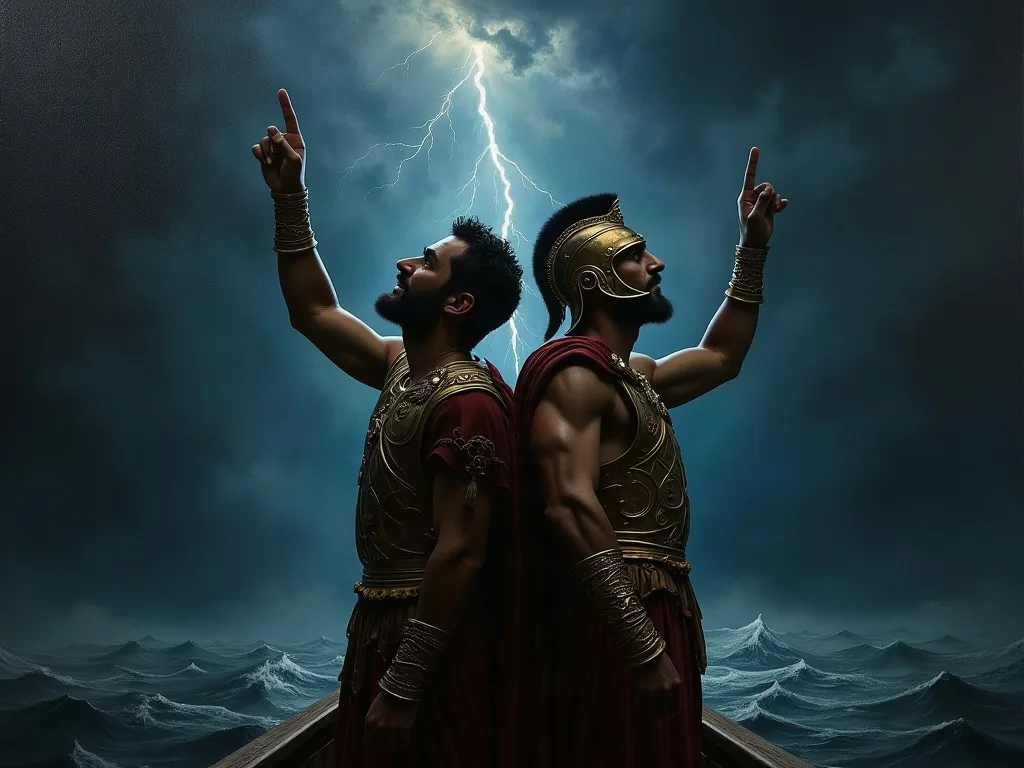
The Dogon people of Mali preserve one of the most elaborate twin cosmologies on Earth. In Dogon belief, as recorded in the 1930s through ethnographer Marcel Griaule's long conversations with the elder Ogotemmeli, the world was created by Amma, the supreme god, who fashioned the first beings in pairs. The ideal cosmic state is twinness itself: every soul is born with a twin soul, one male and one female component, which must be brought into balance through ritual and life.
The Nommo are the primordial water spirits, amphibious, serpentine, and crucially, born as twins. They are the pattern on which all life is modelled. When the first ancestor was born with an incomplete twin, the fabric of the cosmos tore slightly. Every Dogon ritual, every mask, every granary door carved with symbolic figures, is an attempt to repair that original asymmetry and return to the fullness of the paired state.
What makes the Dogon vision distinctive among twin myths is its insistence that twinness is the norm, not the exception. Singleness is the aberration. A person born alone is a person who has lost their twin at some earlier cosmic moment. The work of life is recovery, restoring the double that should have been there from the start.
Among the Yoruba of Nigeria, twins (ibeji, "born double") are so sacred that when one dies in infancy, a carved wooden figure called an ere ibeji is made to house the twin's soul. The living twin carries and cares for the figure as if caring for a sibling. This is not metaphor. The Yoruba believe the dead twin's spirit needs the same food, warmth, and attention as any living child. The figure is bathed, clothed, offered palm oil and kolanuts. Twinship, in Yoruba practice, does not end at death. It is a relationship that death cannot dissolve.
The Shape-Shifters: Twins as Tricksters in Native American Traditions
Among many Indigenous nations of North America, the twin myth takes a trickster form. The Iroquois (Haudenosaunee) tell of Sapling and Flint, twin grandsons of the Sky Woman who fell through a hole in the upper world and created the earth. Sapling made the land gently curved, the rivers flowing both ways so canoes could travel easily; Flint made it rocky, thorny, full of rapids. Each undid some of what the other built. The result was the actual landscape: not a paradise, not a wasteland, but a world shaped by two competing generosities.
The Navajo Nation preserves the story of Monster Slayer and Born for Water, the twin sons of Changing Woman and the Sun, who travel to their father's house to receive weapons and use them to rid the world of the great monsters that had made human life impossible. Monster Slayer is the aggressive one, the fighter; Born for Water is the thoughtful one, who sometimes holds his brother back from destroying things that should be left alive. Together they form a complete moral agent: courage tempered by judgment.
The Zuni tell of the Ahayuta, twin war gods who are also playful children, constantly disobeying their grandmother and getting into trouble. They kill monsters but also cheat at gambling and cause floods. They are not wholly heroic or wholly mischievous. They are both, at once, because the twin structure allows a myth to contain contradiction within a single story: two voices, two impulses, one body of action.
Why the Twin Keeps Appearing: What Comparative Mythology Tells Us
The persistence of twin myths across cultures is not random. Claude Lévi-Strauss argued in his 1955 essay "The Structural Study of Myth" that myths work by mediating contradictions that cannot be resolved in real life: life and death, nature and culture, male and female. The twin is the perfect structural tool for this because it literalises the contradiction: two beings who share an origin but cannot share a world.
Georges Dumézil, studying Indo-European mythology across multiple decades of work published between the 1930s and 1970s, identified a recurring divine twin structure he called the "warrior pair," two complementary fighters whose combination exceeds what either could accomplish alone. He saw echoes of this in the Vedic Ashvins, the Roman Romulus and Remus, and the Norse Freyr-Freya pairing.
More recently, the anthropologist David Leeming's Oxford Companion to World Mythology (2005) catalogued twin myths as one of twelve near-universal mythological patterns, noting that the specific content (who wins, who dies, who ascends) varies enormously while the underlying structure (a single origin producing two opposed but interdependent beings) remains constant.
The psychological reading offered by Carl Jung placed twins in the framework of the Shadow: the other self that the ego cannot admit. Twins in myth are the imagined shape of the self's own darkness and its own completion, the part of you that chose the other road.
But perhaps the plainest explanation is also the truest. Twins are real. Every culture has seen them. A child born with another child, sharing a face, dividing a single fate. The fact that two such children can be so different, one cautious and one reckless, one who lives and one who dies, one who becomes a king and one who becomes a ghost, gives the imagination its most vivid available symbol for the fact that the world contains opposites, and that those opposites came from the same source.
Frequently Asked Questions About Twin Myths Across Cultures
Frequently asked questions
Are twin myths found in every culture on Earth?
Nearly every documented mythology includes at least one significant twin narrative. Folklorist Stith Thompson's Motif-Index of Folk-Literature (1955) classified twin stories across Indigenous American, African, South Asian, Oceanic, and European traditions. While no cultural universal is truly absolute, the twin motif is among the most widely distributed narrative structures in world mythology, rivalled only by flood myths and creation stories.
Why do so many twin myths involve one twin dying?
The structural logic of many twin myths requires one twin to disappear so that the other's identity and authority can be established. In traditions from Rome (Remus killed by Romulus) to the Maya (the father-twins killed before Hunahpu and Xbalanque are born), the dead twin's absence creates the conditions for the survivor's power. Claude Lévi-Strauss argued that this pattern mediates the real-world impossibility of two equally valid claims occupying the same space: one must yield so the other can act.
What is the difference between divine twins and the Hero Twins of the Maya Popol Vuh?
Most divine twins (the Ashvins, the Dioscuri, Freyr and Freya) represent cosmic or natural forces in balanced opposition. The Maya Hero Twins, Hunahpu and Xbalanque, are explicitly heroic figures: they have a quest, enemies to defeat, and a resurrection arc that mirrors later themes in Mesoamerican thought. They are divine but also narrative protagonists in a way that distinguishes them from the more symbolic twin pairs of other traditions.
What do the Yoruba ere ibeji figures tell us about how African cultures understood twinship?
The ere ibeji wooden twin figures of the Yoruba reveal a belief that twinship is not a biological accident but a permanent spiritual condition. When one twin dies, the surviving twin and the family do not simply mourn: they commission a carved figure and care for it as if the twin were still alive, feeding it, dressing it, and keeping it warm. This practice implies that the bond between twins persists beyond physical death and that the universe itself is out of balance if the pair is not maintained.
Is there a connection between twin myths and the astronomical symbol of Gemini?
Yes. The constellation Gemini, visible from most of the Northern Hemisphere, was identified with twin figures in both Greek and Babylonian astronomy. The Greeks associated it with Castor and Pollux, the Dioscuri, whose story of shared immortality maps directly onto the dual stars of the constellation. Babylonian star lists from around 700 BCE called the same stars Mash-tab-ba-gal-gal, "the great twins," associated with the twin gods Meshlamtaea and Lugalirra. The astronomical doubling likely reinforced the mythological one, giving twin stories a nightly reminder carved into the sky.
Did any traditions see twins as bad omens rather than sacred figures?
Yes, and this tension is part of what makes the twin myth complex. Some West African and Central African societies historically treated twin births as dangerous or inauspicious, requiring ritual to manage the excess spiritual power the pair embodied. Among some Bantu-speaking peoples, twins were considered to belong partly to the spirit world, their double nature making them liminal, powerful, and potentially destabilising. The Yoruba reverence for twins and the Dogon ideal of cosmic twinness represent one cultural response to this anxiety; the rituals of containment practised elsewhere represent another. Both responses confirm that twins provoked unusually intense reflection on the boundary between the human and the sacred.
How the Twin Myth Lives in Modern Storytelling
The twin archetype did not stop at the borders of ancient religion. It migrated. It mutated. It turned up in places that seem secular but carry mythological DNA.
The twentieth century's most influential twin stories are often framed as science fiction or fantasy, but they follow the structural logic mapped above with surprising precision. Ursula K. Le Guin's novel The Tombs of Atuan (1971) pairs a girl raised as a death goddess with a stranger from the upper world; her liberation is a twin separation, the severing of a false double to find a true self. J.R.R. Tolkien's Silmarillion gives the twin sons of Feanor a complicated fraternal bond that echoes Romulus and Remus more than it echoes the Eddas. George Lucas built Star Wars around a pair of twins separated at birth whose reunion is the hinge of the entire saga's moral resolution.
What these modern stories inherit from the ancient traditions is not the specific imagery (no wolf nurses, no ball games in the underworld) but the structural insight: that the self is not singular, that every person contains a double, that the tension between two natures is where the deepest human stories happen. The twin myth is a technology for thinking about duality, one that no single-protagonist story can replicate.
In academic mythology studies, the twin motif has gained fresh attention through the lens of cognitive anthropology. Pascal Boyer's research on Why Religion is Natural (2001) and Harvey Whitehouse's work on ritual transmission both touch on the ways paired figures reduce cognitive load in oral traditions: two complementary characters are easier to remember and transmit than a single character with contradictory traits. The twin may partly persist because it is a memory-efficient structure as much as a spiritually resonant one.
But that mechanical explanation and the spiritual one do not cancel each other. The Maya storytellers who memorised the Popol Vuh through generations knew what they were carrying. The Yoruba carvers who shaped each ere ibeji figure knew what they were making. The Roman historians who recorded Romulus's act of fratricide with such unease knew they were looking at something that could not be softened. The twin myth is efficient because it is true, not to a single fact, but to the shape of the thing the human mind keeps bumping against: that we are never only one thing, and that our other half is always, in some direction, either walking beside us or waiting in the dark.
Explore more cross-cultural mythological patterns through Norse creation myths and the dualities embedded in Aztec cosmology.
Free 25-page sample
Want the whole story?
Take the first 25 pages free. If it pulls you in, the full edition is yours as an instant PDF download, with a paperback on Amazon for selected titles.

Mythology
The World Mythology Book: The Gods, Heroes and Myths of Every Culture
The Gods, Heroes and Myths of Every Culture, in One Volume
The whole of world mythology in a single volume: Greek, Norse, Egyptian, Japanese, Hindu, Celtic, Slavic, Mesoamerican and African myths gathered side by side, each drawn from the primary sources.