

Vegvisir: The Viking Compass and Its True Meaning Across Cultures
The Vegvisir is an eight-pointed runic symbol from Norse tradition believed to guide travelers through storms and spiritual darkness. Learn its authentic origins, real meaning, and why modern seekers are drawn to it.
Contents
A Norse traveler stands on a cliff in winter darkness. Snow whips sideways. The sea below is invisible. No stars. No landmarks. The Vegvisir, carved or carried, becomes more than decoration in that moment: it becomes a prayer inscribed in geometry. This eight-pointed figure, whose name means "that which shows the way" in Old Norse, embodies something deeper than navigation alone. It is a symbol of finding direction when no direction is clear.
The Vegvisir sits at the intersection of Norse mysticism, practical wayfinding, and modern spiritual hunger. Yet its story is complicated by time, translation, and the gap between historical evidence and what contemporary culture wants the symbol to mean. Understanding it requires separating documented lore from later construction, while respecting what the symbol genuinely conveyed to those who carried it.
The Historical Origins of the Vegvisir
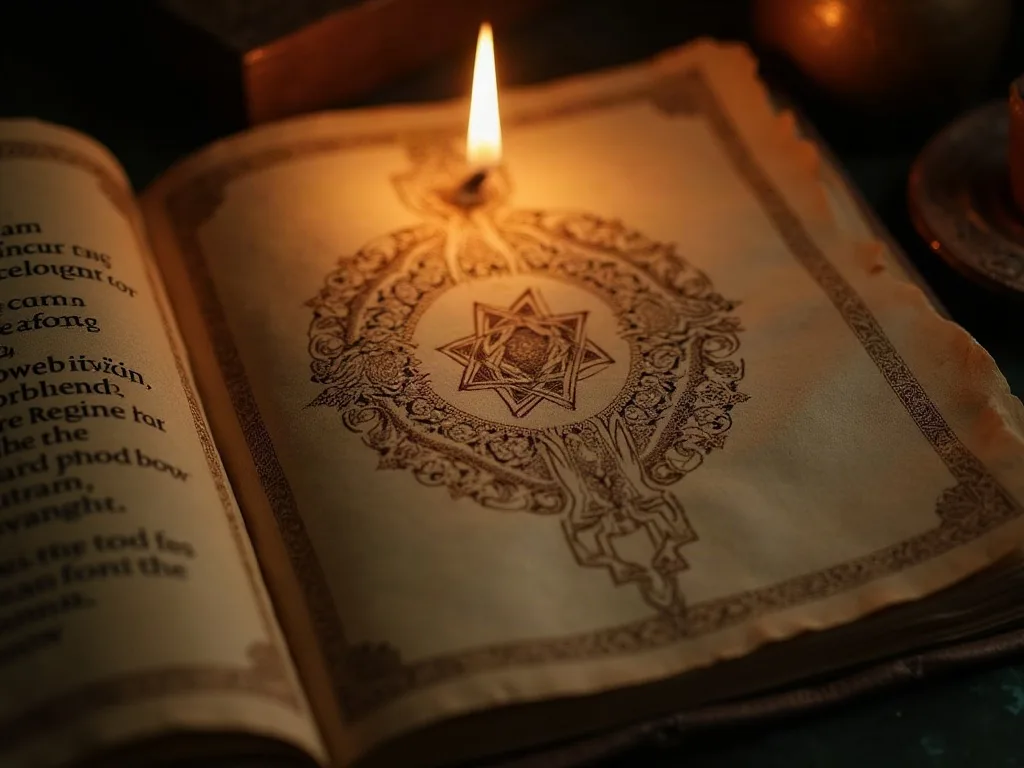
The word Vegvisir appears in one primary source: the Huld Manuscript, an Icelandic grimoire (a book of magical knowledge) copied in the 1860s but claiming to preserve much older material. The manuscript describes the Vegvisir as a runic stave, one among many protective and navigational symbols in Norse magical practice. The eight-pointed star it depicts was understood as a protection against getting lost, particularly at sea or in darkness.
This is crucial: the Vegvisir we see today comes not from Viking Age carvings or runestones, but from 19th-century Iceland. The Huld Manuscript is our only contemporary textual reference. No archaeological evidence from the Viking Age (roughly 793-1066 CE) directly confirms the symbol's use by seafarers. This doesn't mean it's fabricated, but it means the Vegvisir as we know it has traveled through layers of Icelandic folk preservation, 19th-century revival, and modern reinterpretation.
The manuscript credits the symbol to Norse magical tradition, and given Iceland's cultural continuity with Norse beliefs, the attribution is plausible. But the Vegvisir we can verify is a 19th-century document, not a 9th-century artifact.
What the Eight Points Really Represent
Norse cosmology saw the world arranged in cardinal and intercardinal directions. The eight points of the Vegvisir align with these eight directions: north, south, east, west, and the diagonals between. Each point, in some interpretations, corresponds to a Vegvisir rune variant carved into the manuscript, each bearing different protective qualities.
The symbol's power, in Norse thinking, wasn't mechanical (like a compass needle). It was sympathetic magic: the rune resonated with the traveler's will and the land's inherent pathways. Knowing these eight directions meant knowing every route home. The Vegvisir thus became a shorthand for a kind of wayfinding knowledge that combined geographical awareness with spiritual alignment.
In the Huld Manuscript, the Vegvisir appears among other staves and symbols used for healing, protection, and navigation. The context matters. This wasn't a casual decoration but part of a living magical literacy, where runes and symbols carried specific, understood functions. A traveler carrying or carving a Vegvisir wasn't just saying "I want to find my way"; they were activating a known tradition of magical protection.
Norse Wayfinding and the Practical Context
Norse seafarers were among the world's greatest navigators without magnetic compasses. They used the sun, stars, bird behavior, water color, and wave patterns. The sagas mention "bearing stones" (sunstones, possibly spar crystal) that worked by polarization. They knew the positions of constellations and memorized coastlines across oceans.
The Vegvisir, understood in this context, was less a physical navigation tool and more a spiritual assurance during the kind of passage that killed even skilled sailors. Medieval crossings to Iceland, Greenland, and beyond were lethal. The symbol offered what practical seamanship couldn't: a psychological anchor and a magical invocation of safe passage.
This ritual dimension is essential. Norse seafaring combined empirical knowledge with religious devotion. The Vegvisir wasn't alternative to navigation; it was complementary. A skilled sailor would use their knowledge and trust the symbol's protection equally.

The Vegvisir and Other Norse Protective Symbols
The Vegvisir doesn't stand alone in Norse magical practice. The Helm of Awe (Ægishjálmur), another eight-pointed symbol, served similar protective functions. Some scholars suggest the Vegvisir and Helm of Awe may be related or even variant names for overlapping concepts. Both symbols appear in the Huld Manuscript among protective staves.
The Helm of Awe is described as a physical helmet worn in battle, granting the wearer overwhelming power and terrifying presence. The Vegvisir, by contrast, emphasizes guidance and wayfinding. Yet the visual and functional overlap suggests a shared magical grammar: eight points, radial symmetry, protection through alignment with cosmic order.
Other important Norse protective staves include the Tiwaz rune (associated with courage), Algiz (protection), and Sowilo (the sun and clear path). Each served specific purposes in Norse folk magic. The Vegvisir, then, is part of a larger symbolic alphabet, not a standalone rune.
From Manuscript to Modern Tattoo: The Symbol's Journey
What makes the Vegvisir powerful in the 21st century is precisely what creates historical ambiguity. The 1860s Huld Manuscript was rediscovered and circulated during Iceland's independence movement (Iceland gained sovereignty in stages, culminating in 1944). The symbol became a marker of Icelandic cultural identity, a bridge to pre-Christian Norse heritage.
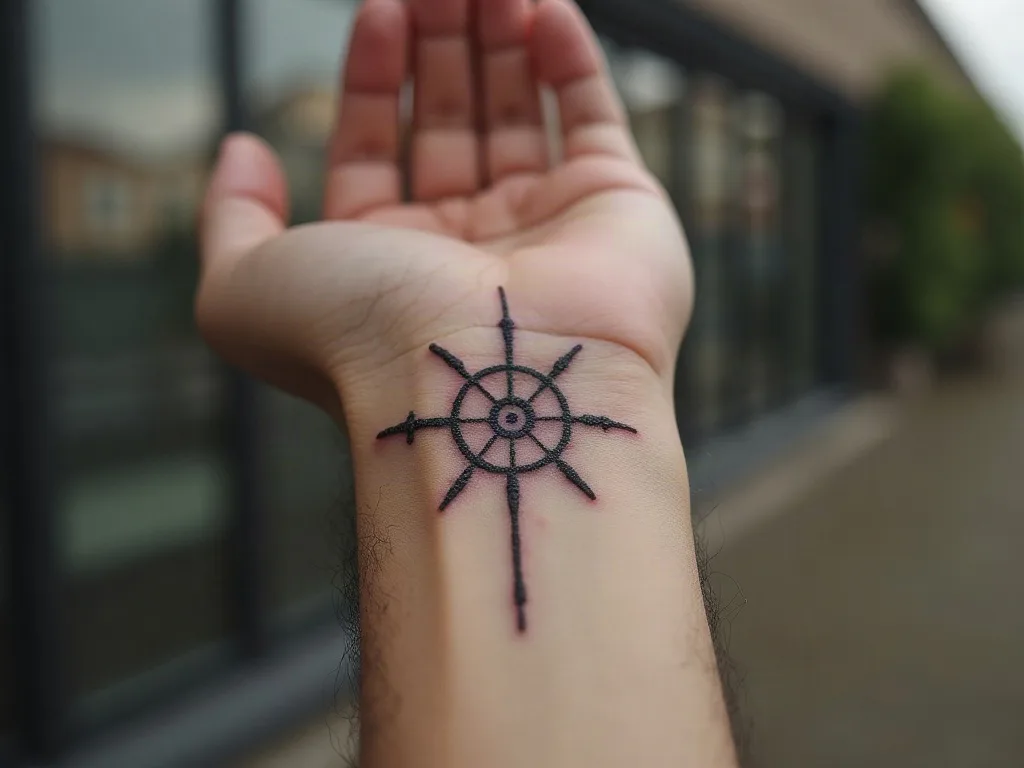
In the late 20th century, the Vegvisir entered global tattoo culture. Its geometric beauty and simple meaning (direction, protection) appealed to modern seekers. It became shorthand for "finding your own path," a spiritual metaphor far removed from the manuscript's specific maritime context. Online occult communities expanded its associations: some claim it grants psychic navigation, others invoke it for inner clarity during crisis.
This modern reinterpretation isn't false, but it's a translation. The historical Vegvisir offered protection and direction in specific, mortal circumstances. The contemporary Vegvisir carries all of that plus abstract spiritual meaning. Both are real; they're just different languages using the same eight points.
The Vegvisir as a Tattoo Symbol: Intent and Meaning
Modern people ink the Vegvisir for three primary reasons: genealogical connection (Norse or Scandinavian ancestry), spiritual navigation (finding one's path in life), and aesthetic resonance (it's visually striking).
For those with Norse heritage, the symbol carries identity weight. It says: "I carry my ancestors' knowledge." This is legitimate. Iceland and Scandinavia have genuine continuity with Norse culture, and symbols like the Vegvisir are part of that living heritage.
For the broader tattoo community, the Vegvisir functions as what folklorists call a "floating symbol": it carries meanings assigned to it by the wearer and their circle. Someone getting a Vegvisir tattoo to mark a career transition or spiritual awakening isn't misusing it; they're participating in an old tradition of symbols meaning what their users need them to mean.
The risk lies in severing the symbol from its origins entirely and treating it as a timeless, universal sign. It's not. It's Icelandic, rooted in a specific tradition, and its power partly derives from that specificity. Honoring that context while embracing modern meaning is the balance.
The Vegvisir Across Cultures: Compass Symbols in Other Traditions
The impulse to create symbols for wayfinding and protection appears across cultures. The Dharma wheel in Hinduism and Buddhism uses eight points (the Eightfold Path), serving guidance and spiritual alignment. Islamic geometric patterns often incorporate eight-fold symmetry as an expression of cosmic order. Celtic knotwork, while not explicitly compass-like, served protective functions similar to the Vegvisir.
The compass itself, invented in China and transmitted to the Islamic world and Europe, was partly a response to the same human need: finding direction in vastness. Yet the Vegvisir predates or parallels the magnetic compass's European adoption, suggesting that the deep human hunger for wayfinding symbols transcends any single cultural origin.
This cross-cultural resonance partly explains the Vegvisir's modern appeal. In a world of competing directions, constant change, and spiritual uncertainty, an ancient symbol promising safe passage speaks to something real. The fact that it comes from a specific tradition (Norse Iceland) makes it more meaningful, not less. It has weight precisely because it's rooted.
Scholarly Debates and Open Questions
Norse magical practice, as recorded in manuscripts like the Huld, is a contested field. Some scholars argue these texts represent genuine survival of pre-Christian Norse belief. Others contend they're largely medieval or early modern invention, using Norse language and imagery to create authority for contemporary magical systems.
The Vegvisir falls into this gray zone. The symbol exists in a 19th-century text claiming older sources. No runestones or Viking Age artifacts explicitly depict it. The word Vegvisir itself appears nowhere in Old Norse literature outside the Huld Manuscript and its derivatives. This doesn't disprove its antiquity, Iceland's oral traditions were remarkably stable, but it means we can't verify it in the way we verify, say, the Runes or references to Odin.
Contemporary scholars like Stephen Flowers (who has translated and studied Icelandic magical texts) treat the Vegvisir with cautious respect: plausible as a folk symbol, possibly ancient, but documented only late. The responsible position is to acknowledge both the symbol's cultural significance and the limits of historical certainty.
The Psychology of Direction Symbols
Why do direction symbols persist across time and culture? Humans have an intrinsic need for orientation, both physical and psychological. Getting lost triggers a primal anxiety. Finding one's way triggers relief and triumph. Symbols that promise safe passage tap into this deep structure.
The eight-pointed Vegvisir, in particular, offers psychological completeness. Eight directions mean no blind spot. The traveler invoking or carrying it isn't just asking for a path; they're invoking total coverage, omni-directional protection. This speaks to a fear many feel in modernity: that there's a direction we haven't considered, a hidden risk we've missed.
Modern psychology might call this a form of magical thinking, but it's not baseless. The act of consulting a symbol, of intentionally aligning oneself with its geometry and meaning, can catalyze focus and intention. The Vegvisir, as a tattoo or a talisman, becomes a conversation between the conscious intention (I want to find my path) and the unconscious wisdom (I trust that the eight directions will hold me). That conversation is real, even if the rune's literal magical power isn't.
The Vegvisir and Modern Norse Revivalism
Since the 1970s, Norse revivalism has taken many forms: Heathenry (modern pagan reconstructionism), academic Norse studies, tattoo culture, and esoteric traditions. The Vegvisir has benefited from this renewed interest. It appears on tattoo designs, amulets, pendants, and artwork. Some modern Heathens incorporate it into personal rituals or meditation practice.
This modern use can either honor or distort the symbol, depending on context. Someone learning about Norse tradition, researching the Huld Manuscript, and thoughtfully choosing to carry a Vegvisir as part of that practice is engaging authentically. Someone using it as a trendy symbol with no awareness of its origins is engaging differently. Neither is wrong outright, but the former carries more integrity.
The challenge for practitioners is intellectual honesty: understanding what we actually know (the symbol appears in a 19th-century Icelandic manuscript), what we plausibly infer (it may reflect older oral tradition), and what we're projecting (our own spiritual needs and cultural hunger). Respecting those distinctions while still finding meaning in the symbol is the mature approach.
The Vegvisir in Art, Literature, and Modern Spirituality
The Vegvisir has entered contemporary creative culture. Artists, writers, and musicians incorporate it into works exploring Norse themes, wayfinding, and spiritual seeking. The symbol's visual simplicity makes it adaptable: it can appear on a sword hilt in a fantasy novel, as a central motif in abstract art, or as a logo for a navigation app seeking Norse-inspired branding.
In esoteric circles, some practitioners claim the Vegvisir has protective or energetic properties beyond the psychological. These claims aren't empirically verifiable, but they're genuine experiences within those communities. A person meditating on the Vegvisir and reporting clarity, protection, or guidance is describing a real internal process, even if the mechanism isn't literally a rune's invisible power.
This distinction matters. The symbol works, in many cases. It works because meaning is real, intention is real, and symbols are powerful containers for both. The Vegvisir's historical specificity (it's rooted in a real tradition) gives it more power, not less, than a symbol invented from whole cloth.
Vegvisir Variants and Related Symbols
The Huld Manuscript includes multiple versions of protective staves, some labeled Vegvisir or Vegvisir-adjacent. These variants differ slightly in how the eight points are drawn or in additional runic inscriptions. Some versions include runes within the star; others are purely geometric.
The relationship between these variants and the central eight-pointed Vegvisir remains debated. Are they all versions of the same protective concept? Are some specialized variants (one for sea travel, one for land, one for spiritual journey)? The manuscript itself doesn't always clarify.
This ambiguity is actually valuable. It suggests the Vegvisir wasn't a fixed symbol handed down unchanged but a living, evolving tradition. Norse magicians may have adapted and personalized it. This fluidity contradicts the idea of a single "true" Vegvisir, but it aligns with how oral and magical traditions actually work.
Frequently Asked Questions About the Vegvisir
Frequently asked questions
Is the Vegvisir mentioned in ancient Viking Age sources?
No. The Vegvisir appears only in the Huld Manuscript, an Icelandic grimoire copied in the 1860s. It may preserve older oral tradition, but we have no direct archaeological or runestone evidence of the symbol from the Viking Age itself. This doesn't mean it's fabricated, but rather that its documented history begins in 19th-century Iceland, not the Viking Age.
Did Vikings actually use the Vegvisir to navigate?
Unlikely, as a physical navigation tool. Norse seafarers used the sun, stars, wave patterns, and bird behavior to navigate. The Vegvisir, as described in the Huld Manuscript, is a magical symbol meant to invoke protection and safe passage spiritually, not a practical compass. It complemented rather than replaced practical seamanship.
What does each of the eight points represent?
The eight points align with the eight cardinal and intercardinal directions in Norse cosmology: north, south, east, west, and the four diagonals between them. In some interpretations, each point carries a different protective rune or quality, though the Huld Manuscript doesn't specify a single definitive scheme. Modern practitioners sometimes assign their own meanings to the points.
Is it appropriate to get a Vegvisir tattoo if I'm not Norse or Icelandic?
Yes, with the caveat that honoring the symbol's origins enriches the choice. The Vegvisir is part of human heritage, documented and studied openly. Getting it means engaging respectfully with that history, understanding it comes from Norse Iceland, and recognizing what it meant to those people. Using it without awareness of its context is less meaningful but not culturally appropriative in the way, say, sacred religious symbols might be.
How does the Vegvisir compare to the Helm of Awe?
Both are eight-pointed protective symbols from Norse tradition, documented in the Huld Manuscript. The Helm of Awe emphasizes battle prowess and overwhelming presence, while the Vegvisir emphasizes wayfinding and protection from getting lost. They likely share magical roots, but serve different purposes. Some scholars suggest they may be variants of a common protective concept.
Can the Vegvisir symbol help me spiritually or psychologically?
That depends on your relationship to it. If you meditate on it, carry it, or tattoo it with intentionality and understanding of its origins, it can function as a powerful reminder of your desire for clarity and direction. The symbol works because meaning is real and intention is real, even if the literal magical mechanism isn't provable. The Vegvisir's connection to an actual cultural tradition gives it more psychological weight than a symbol made up from nothing.
The Vegvisir's Place in the Modern Mythological Landscape
The Vegvisir exemplifies how ancient symbols navigate into contemporary life. It arrives to us through layers: Icelandic oral preservation, 19th-century manuscript documentation, 20th-century cultural revival, and 21st-century global tattoo and spiritual culture. At each stage, it accumulates meaning while remaining rooted in its origins.
This trajectory isn't unique. The runes themselves underwent similar journeys. The Norse gods were nearly forgotten after Christianization, then recovered through sagas, then revived through scholarly study and modern Heathenry. The Vegvisir is part of this larger resurgence of Norse culture and symbolism in a world hungry for connection to deeper, older patterns.
What distinguishes the Vegvisir is its function as a bridge between the historical and the personal. It originated as a magical protective symbol in a specific tradition. It now functions, for many, as a personal emblem of inner navigation. Both meanings are valid. The historical meaning gives the personal meaning weight; the personal engagement keeps the symbol alive.
The eight points continue to resonate. In a world of information overload, moral ambiguity, and spiritual uncertainty, the promise of a symbol that shows the way remains powerful. The fact that the Vegvisir comes from Norse tradition, documented in a grimoire, used by Icelandic folk healers, and now carried by millions of people across the world, tells us something essential about how humans make meaning: we inherit, adapt, personalize, and pass forward. The compass doesn't have to be magnetic to point true.
Free 25-page sample
Want the whole story?
Take the first 25 pages free. If it pulls you in, the full edition is yours as an instant PDF download, with a paperback on Amazon for selected titles.

Mythology
The World Mythology Book: The Gods, Heroes and Myths of Every Culture
The Gods, Heroes and Myths of Every Culture, in One Volume
The whole of world mythology in a single volume: Greek, Norse, Egyptian, Japanese, Hindu, Celtic, Slavic, Mesoamerican and African myths gathered side by side, each drawn from the primary sources.