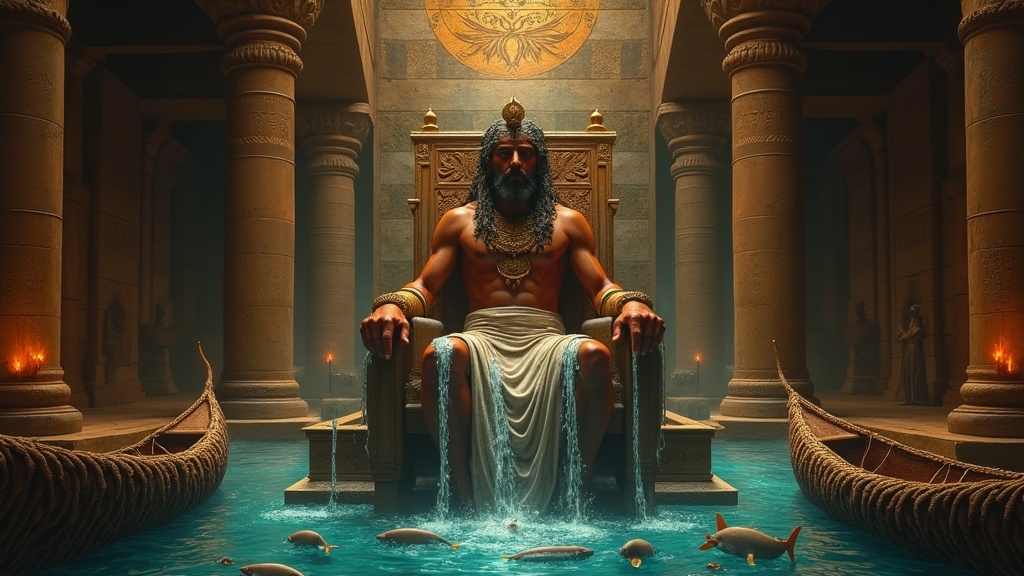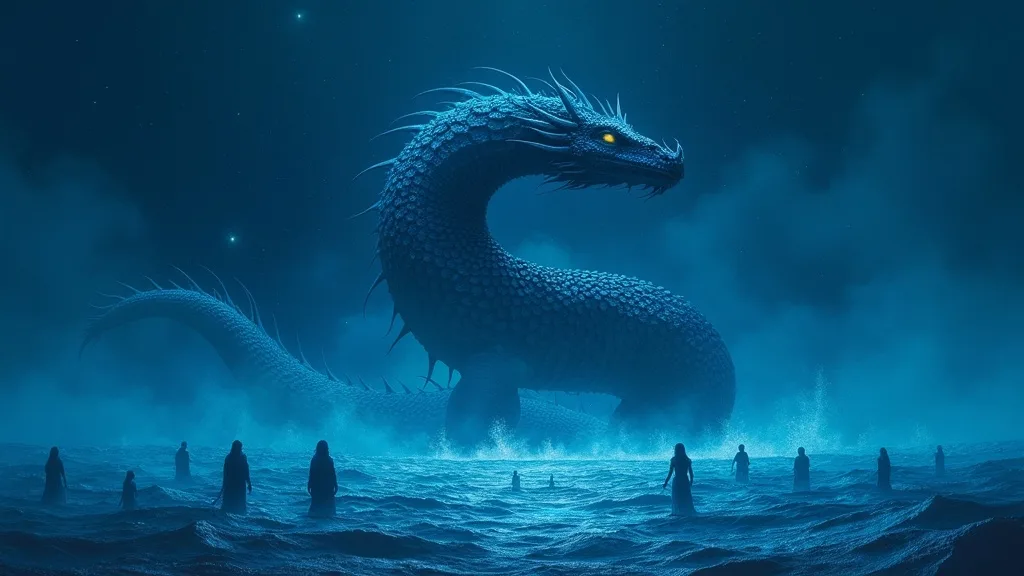
Tiamat: Primordial Chaos Dragon of Babylonian Myth
Tiamat is the salt-water abyss who births creation itself, then wages war against the gods who rose from her body. Her defeat by Marduk reshapes the cosmos forever.
Contents
Before there was sky or dry land, before any god had a name, there was salt water. Her name was Tiamat, and she lay mingled with the sweet freshwater of Apsu in an undifferentiated dark. No reed had been formed, no marshland appeared. The two primordial waters coiled together, and from that coiling, the first gods were born.
She was not evil at the start. She was the ocean itself, vast, generative, indifferent. The Babylonian creation epic known as the Enuma Elish opens with her not as a monster but as a mother, the body of the world before the world had edges.
The Salt Water Before Time: Tiamat's Nature and Origins
Tiamat: Primordial Chaos Dragon is one mythology's most precise metaphors for what precedes structure. Her name derives from the Akkadian tâmtu, meaning "sea" or "deep water," cognate with the Hebrew tehom, the "deep" that appears in Genesis 1:2 when "darkness was upon the face of the deep." Scholars including W.G. Lambert and A.R. Millard, who produced the authoritative 1969 critical edition of the Enuma Elish, have traced this linguistic thread across Semitic traditions, finding Tiamat's shadow in Genesis, in the Ugaritic sea-god Yam, and in the Egyptian chaos-waters Nu.
She is described in the Enuma Elish as a dragon (usumgallu, "great serpent") only after her transformation into an adversary. Before that moment, she is simply the primordial salt sea, a body so large that when the younger gods danced and shouted inside her, their noise disturbed her rest like waves stirred by wind. This is the first friction in existence: motion inside stillness, youth inside age, sound inside silence.
Her consort Apsu, the freshwater abyss, grows enraged at the noise and plots to destroy the young gods. Tiamat at first refuses. "Why should we destroy what we ourselves have made?" she asks in the oldest tablets. Her reluctance here is important. She is not the instigator of violence. That role belongs to Apsu, who is killed by the clever god Ea (also called Enki) before he can act. When Apsu dies, Tiamat's grief and rage finally turn her toward war.
The Army of Monsters Tiamat Raised
After Apsu's death, Tiamat does something no deity in the poem does before her: she creates an army from her own body. Eleven kinds of monsters take shape at her command.
- Bashmu, the venomous serpent
- Mushussu, the horned dragon (depicted on the Ishtar Gate of Babylon, glazed in blue and gold)
- Lahmu, the hairy hero
- Ugallu, the great storm-demon
- Uridimmu, the mad lion
- Girtablullu, the scorpion-man
- Umu dabrutu, violent storms
- Kululu, fish-men
- Kusarikku, bull-men
She crowns her champion, the god Kingu, with the Tablet of Destinies, a divine artifact that confers supreme authority over the cosmos. Kingu becomes her general and, in some readings, her new consort. The act of giving him the Tablet is a challenge to the entire divine order: whoever holds it controls fate itself.
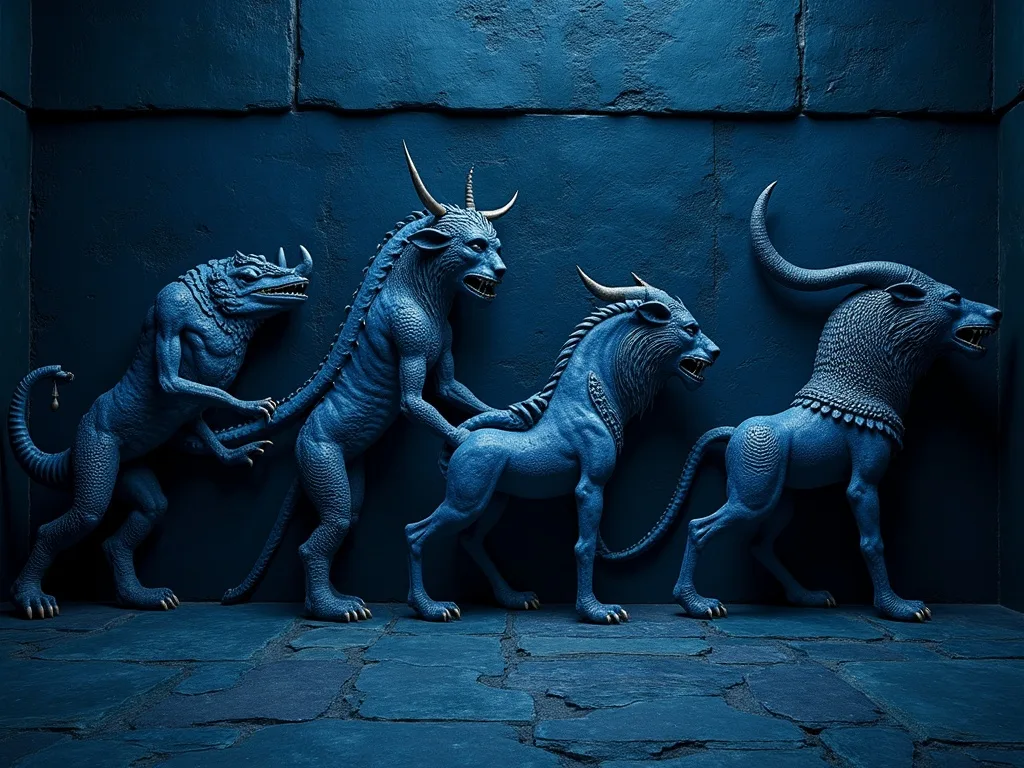
This army reads not as arbitrary nightmare but as a taxonomy of the margins, the places where human order frays. Scorpion-men guard the edges of the world. Bull-men stand at thresholds. Fish-men belong to the boundary of water and land. Tiamat's forces are the creatures of in-between spaces, the zones where Babylonian cities ended and the wild began.
The Gods Who Failed: Anu, Ea, and the Search for a Champion
The divine assembly panics. The god Anu, lord of the sky, is sent to negotiate with Tiamat. He turns back before reaching her, overwhelmed. Ea, who had killed Apsu with such clever ease, also refuses to face her. The older generation of gods has no answer to a mother enraged at the killing of her consort and the disruption of her peace.
The solution arrives through Marduk, Ea's son, the young storm-god of Babylon. He is described as exceptional from birth: four eyes, four ears, fire blazing from his lips when he speaks. He is a god built for spectacle. But he sets a condition before agreeing to fight. He demands that if he defeats Tiamat, the assembly grant him supremacy over all other gods permanently.
The gods agree. They test him first by setting a constellation in the middle of their circle and asking him to destroy it with his word, then restore it. He speaks, and it vanishes. He speaks again, and it returns. His authority over creation is confirmed through language, through magic, through the very medium in which the Enuma Elish was composed and recited.
Marduk arms himself with the four winds, a net, a spear, lightning, and a special weapon called the imhullu, the "Evil Wind." He mounts his storm-chariot. When he faces Tiamat, she opens her mouth to swallow him. He drives the imhullu into her open throat. The wind fills her body. She cannot close her jaws. He drives his spear through her belly and splits her in two.
Creation From a Corpse: The Cosmogony Inside the Dragon
Here the myth achieves its strangest and most powerful move. Marduk does not simply discard the body of Tiamat: Primordial Chaos Dragon. He builds the world from it.
From her skull, he makes the earth. From her eyes, he opens the Euphrates and the Tigris. From her tail, he lifts the sky. He stretches her skin across the heavens like a canopy, to hold back the upper waters. From her spittle, he makes clouds. Her breasts become mountains. The Enuma Elish is explicit and anatomical: the cosmos is a body, and it is a female body, specifically the body of the oldest being who ever existed.
This is not metaphor in the decorative sense. It is ontology. The Babylonians who built Esagila, Marduk's great temple at Babylon, lived inside a cosmos that was literally Tiamat. The rivers that watered their fields ran from her eye sockets. When rain fell, it was her spittle. The sky holding back the ocean was her hide. Creation did not happen beside her; it happened through her and from her.
Marduk then creates human beings from the blood of Kingu, who is executed for instigating the war. Humans are made from the blood of a rebel, a detail that gives Babylonian anthropology a distinctly ambivalent edge: people carry within them the blood of one who defied cosmic order, yet they exist to serve the gods and free the Annunaki from menial labor. The guilt is structural, baked into flesh.
Tiamat as Dragon: The Visual and Ritual Record
The image of Tiamat as a primordial chaos dragon was not simply literary. It entered the visual vocabulary of Mesopotamia and left traces that archaeologists are still piecing together.
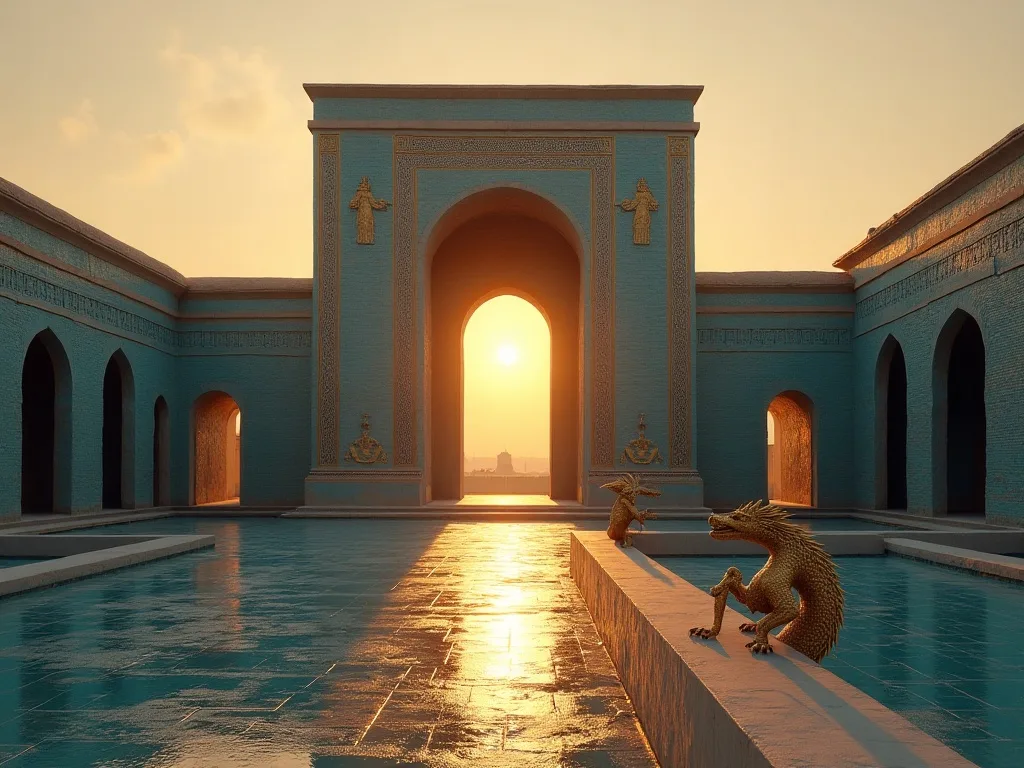
The mushussu dragon, Tiamat's own creation, appears on the Ishtar Gate of Babylon (built under Nebuchadnezzar II, circa 575 BCE) as a long-bodied creature with the head of a horned serpent, the forelegs of a lion, and the hindlegs of a bird of prey. This creature became associated with Marduk himself, a strange recursion: the god of order adopting the iconography of chaos's own offspring.
The Enuma Elish was performed during the Akitu festival at the start of the Babylonian year, in the month of Nisan (roughly March-April). Priests recited the full text over multiple days. The king ritually re-enacted Marduk's defeat of Tiamat, affirming that cosmic order was not a fixed state but a victory that had to be won again each year. Tiamat's chaos was not abolished at creation; it was held back, and the holding required constant ceremony.
This ritual logic explains why Tiamat remained culturally active long after her physical defeat in the narrative. She was the permanent backdrop against which order existed. Marduk's authority was only legible against the memory of what he had overcome.
Tiamat Across Traditions: Tehom, Leviathan, and the Indo-European Dragon
The parallels between Tiamat and other ancient chaos-serpents are too consistent to be accidental. Comparative mythologists, drawing on the work of Calvert Watkins in How to Kill a Dragon (1995), have identified a recurring pattern across Indo-European and Semitic traditions: a heroic god battles a serpentine or aquatic chaos-monster to establish cosmic order. The Sanskrit Indra defeats Vritra, the dragon blocking the rivers. The Hittite storm-god Tarhunt slays Illuyanka. The Ugaritic Baal fights Yam and Lotan. The Hebrew Yahweh strikes Leviathan and Rahab.
None of these parallels require direct borrowing in every case. Some show clear Babylonian influence (the Ugaritic texts were written in a city, Ras Shamra, whose scribal culture had strong Mesopotamian ties). Others may reflect a common mythological grammar, the intuition that order is not self-evident but must be wrested from something larger and older.
The Hebrew tehom, appearing in Genesis 1:2 without definite article and without explanation, reads in context as something every ancient reader would already recognize. Tiamat's name echoed through it. The biblical text does not narrate a combat, but the suppression of the older combat myth is itself legible, a monotheistic redaction of a polytheistic original.
The Leviathan of the Hebrew Bible and the Ugaritic Lotan (whose name means "coiling") are the closest kin to Tiamat in the Semitic world: multi-headed, sea-dwelling, ultimately subject to divine power but not quite destroyed. In the Book of Job, Yahweh boasts of having formed Leviathan. In Psalm 74, he crushes Leviathan's heads and gives the creature as food to desert creatures. The myth oscillates between creation and combat, never fully settling.
The Feminine Chaos: Scholarly Debates Around Tiamat's Gender
Few questions about Tiamat have generated more scholarly heat than this one: does her myth encode a specifically feminine chaos against which a masculine order defines itself?
The feminist reading, developed by scholars including Anne Baring and Jules Cashford in The Myth of the Goddess (1991), argues that the Enuma Elish stages a patriarchal takeover. Tiamat as primordial mother-goddess is defeated and dismembered by a male warrior-god, her body converted into raw material for a world now governed by male deities. This reading connects Tiamat to broader patterns: the supplanting of Inanna by male-centered pantheons, the reduction of the Great Mother to either monster or inert matter.
The counter-argument, advanced by scholars like Tikva Frymer-Kensky in In the Wake of the Goddesses (1992), resists this framing. Frymer-Kensky points out that Tiamat in the text is not a goddess of any prior religion being overthrown; she is a cosmogonic metaphor that was probably always described in these terms. The Enuma Elish is not a revision of an earlier Tiamat-worship; there is no archaeological evidence for a Tiamat cult. She was never a goddess to be prayed to. She was a force to be conceptually organized.
Both readings illuminate something real. The text does use a female body as the raw material of creation, and that choice is not ideologically neutral. But the text also gives Tiamat the longest uninterrupted speech of any figure in the poem, more than Marduk. Her refusal to act against the young gods when Apsu first plots is presented without irony, even with something like dignity.
Tiamat in the Modern Mythological Imagination
The dragon-goddess did not stay in Nineveh. Tiamat: Primordial Chaos Dragon has had one of the most productive afterlives of any ancient figure in modern culture.
In tabletop role-playing, the five-headed dragon queen Tiamat, introduced in Dungeons and Dragons in 1974, is the direct descendant of the Babylonian original, though filtered through decades of high-fantasy convention. Each head represents a chromatic dragon type, a translation of the eleven-monster army into game mechanics. The name retained its ancient weight even when the theology behind it was stripped away.
In serious literature and philosophy, Tiamat appears in Jordan Peterson's reading of the Enuma Elish in Maps of Meaning (1999), where she represents the "Great Mother" of chaos in a Jungian framework, nature as both creator and devourer. This reading has been contested by Babylonists who find the Jungian overlay anachronistic, but it demonstrates how the myth's central tension, creation from destruction, order from chaos, body from cosmos, continues to generate new interpretive frameworks.
The poet Enheduanna, the Akkadian high priestess who composed hymns to Inanna around 2300 BCE and is the earliest named author in human history, worked within a world where Tiamat's defeated waters were the theological ground of every prayer she wrote. The ocean of chaos was not behind these poets; it was underneath them, the floor of everything.
Frequently Asked Questions About Tiamat the Babylonian Chaos Dragon
Frequently asked questions
What exactly is Tiamat in Babylonian mythology?
Tiamat is the primordial salt-water ocean in Babylonian cosmology, described in the creation epic known as the Enuma Elish. She is not simply a monster; she is the undifferentiated matter from which the universe originates. Her body, after her defeat by the god Marduk, literally becomes the sky, the earth, and the rivers of Mesopotamia.
Is Tiamat related to the biblical concept of the deep (tehom)?
Linguistically, yes. The Hebrew word tehom, meaning "the deep" or "abyss" as used in Genesis 1:2, shares a root with the Akkadian tâmtu from which Tiamat's name derives. Scholars like Hermann Gunkel argued in 1895 that Genesis preserves a suppressed version of the Babylonian combat myth. The connection is widely accepted in comparative Semitic philology, though the degree of direct literary borrowing remains debated.
Why does Marduk use Tiamat's body to create the world?
The cosmogony in the Enuma Elish follows a logic in which nothing new is created from nothing: everything comes from what already existed. Since Tiamat was the oldest and largest existing being, building the cosmos from her body was the only available material. It also established a permanent connection between the physical world and the primordial chaos: the sky holds back water because it is Tiamat's own hide, stretched to perform that function.
Was Tiamat actually worshipped as a goddess in ancient Babylon?
No. Unlike Marduk, Ishtar, Ea, or Anu, Tiamat had no dedicated cult, no temple, no priests, and no festival in her honor. She appears in the Enuma Elish as a cosmogonic principle, not a deity of worship. Scholars such as Tikva Frymer-Kensky have used this absence to argue against interpreting the text as the overthrow of a pre-existing goddess religion.
How does Tiamat's myth differ from other ancient chaos monsters like Leviathan?
Tiamat is unique in being both the origin of all things and the enemy of order, a duality most other chaos-serpents do not carry. Leviathan in the Hebrew Bible is powerful and ancient but is not the primordial substance of creation. The Ugaritic Lotan is similarly a sea-monster to be defeated, not a cosmogonic mother. Tiamat's creative role before her defeat gives the Babylonian myth a structural complexity the others lack.
What does the Akitu festival have to do with Tiamat?
The Akitu was the Babylonian New Year festival, celebrated over eleven days in the spring month of Nisan. A central element was the ritual recitation of the Enuma Elish by priests, with the king symbolically re-enacting Marduk's victory over Tiamat. The festival encoded the belief that cosmic order required active, annual renewal. Tiamat's chaos was not a past event but an ever-present pressure that only ceremony and divine kingship could hold in check.
The Dragon at the Edge of Every Map
Every civilization that built cities also built its version of what the city was not. Tiamat is Babylon's answer to that question, stated with a clarity no other tradition quite matches. She is not simply the enemy of order. She is the substance order is made from.
The Mesopotamian scribes who inscribed the Enuma Elish on clay tablets worked in a world defined by two rivers, the Euphrates and the Tigris, flowing out of chaos into cultivated land. Every flood that destroyed their fields was Tiamat pressing against the sky that was her own skin. Every clear night when the constellations Marduk had placed held their positions was the victory being re-confirmed. The myth was not an explanation of the past; it was a description of the present, a present in which chaos and order were not opposites but cohabitants, one built from the other, permanently in tension.
The modern word "dragon," when it reaches back through Old French and Latin draco to Greek drakon and further to the ancient Semitic image of the coiling sea-serpent, carries Tiamat's shadow whether the speaker knows it or not. She was the first named chaos monster in recorded literature. She was also the first named mother of everything.
Free 25-page sample
Want the whole story?
Take the first 25 pages free. If it pulls you in, the full edition is yours as an instant PDF download, with a paperback on Amazon for selected titles.

Mythology
The World Mythology Book: The Gods, Heroes and Myths of Every Culture
The Gods, Heroes and Myths of Every Culture, in One Volume
The whole of world mythology in a single volume: Greek, Norse, Egyptian, Japanese, Hindu, Celtic, Slavic, Mesoamerican and African myths gathered side by side, each drawn from the primary sources.