Ea (Enki): God of Wisdom and Fresh Waters
Ea, known to the Sumerians as Enki, ruled the subterranean freshwater ocean and held the sacred tablets of fate. Craftsman of humanity, trickster of the gods, and keeper of civilization's blueprints.
Contents
The stylus struck clay before the first city rose from the mud of southern Mesopotamia. Somewhere in that act of inscription, the ancient scribes felt the presence of Ea (Enki): God of Wisdom and Fresh Waters, breathing intelligence into the marks. He was already old when Babylon named him Ea. He had been Enki to the Sumerians for at least a thousand years before that, lord of the abzu, the sweet-water ocean believed to lie beneath the earth, feeding every spring, every irrigation canal, every well that kept the river cities alive.
He did not rule through thunder or war. His weapon was me (the Sumerian word for the sacred decrees of civilization: kingship, priesthood, music, the art of the smith, sexual desire, descent to the underworld, and dozens more). He held them, catalogued them, and occasionally lost them in compromising circumstances. That combination of supreme knowledge and very human vulnerability made Enki the most narratively rich deity in the entire Mesopotamian pantheon.
The myths that survive on cuneiform tablets from Nippur, Ur, and Eridu converge on a single portrait: a god who thinks faster than he acts, who saves humanity not through brute strength but through lateral ingenuity, who whispers the solution through a wall of reeds when the rules forbid him to speak outright.
Enki and the Architecture of the Universe

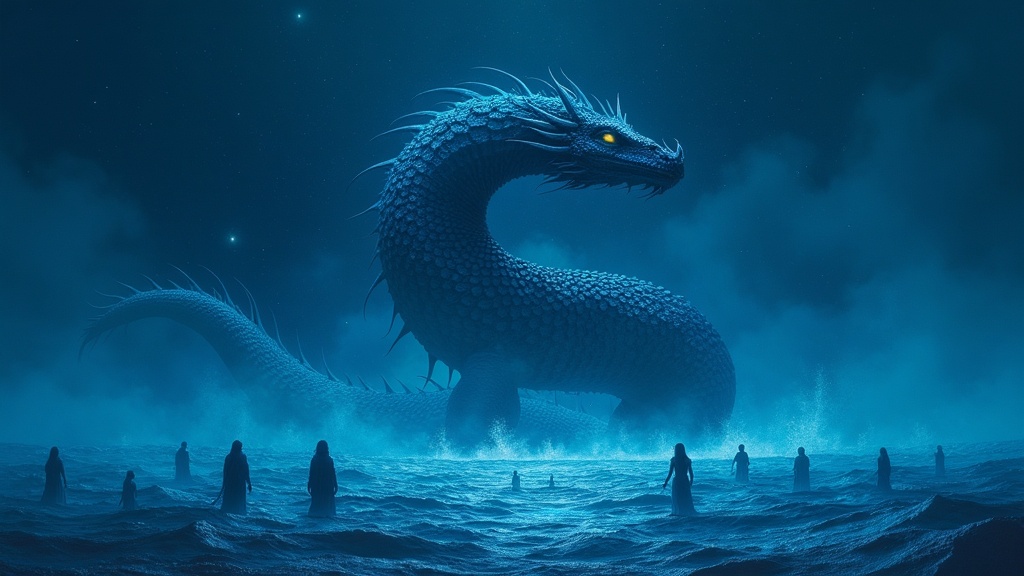
Before humanity appeared, the Sumerian cosmos needed structural work. The Enuma Elish, the Babylonian creation epic recited on the fourth day of the Akitu New Year festival, places Ea at the story's first dramatic turning point. When the monstrous Tiamat rallies her army of chaos-dragons, it is Ea who acts first, not Marduk. He recites a spell that puts Apsu, the primordial freshwater father, into a deep sleep, then kills him and builds his temple directly on Apsu's body. The E-abzu is thus literally founded on the corpse of the first male principle of water. That architectural act is also a claim: Ea owns the subterranean waters now, by conquest and by construction.
In the older Sumerian myth "Enki and the World Order," he sails through the known world in his magur boat assigning functions to every river, every grain field, every trade wind. He appoints a deity to oversee each domain, but he never surrenders the abzu itself. The poem is almost bureaucratic in its precision, listing rivers, canals, marshes, cities, and their patron administrators one by one. Read it slowly and you realize it is actually a cognitive map of southern Mesopotamia, coded into theology. The Tigris and Euphrates do not simply run; Enki fills them with sparkling water, makes them run "like the great mother cow," and designates them as sources of life. The tablets are explicit that the rivers' fertility is an ongoing gift, renewed each season by his presence beneath the earth.
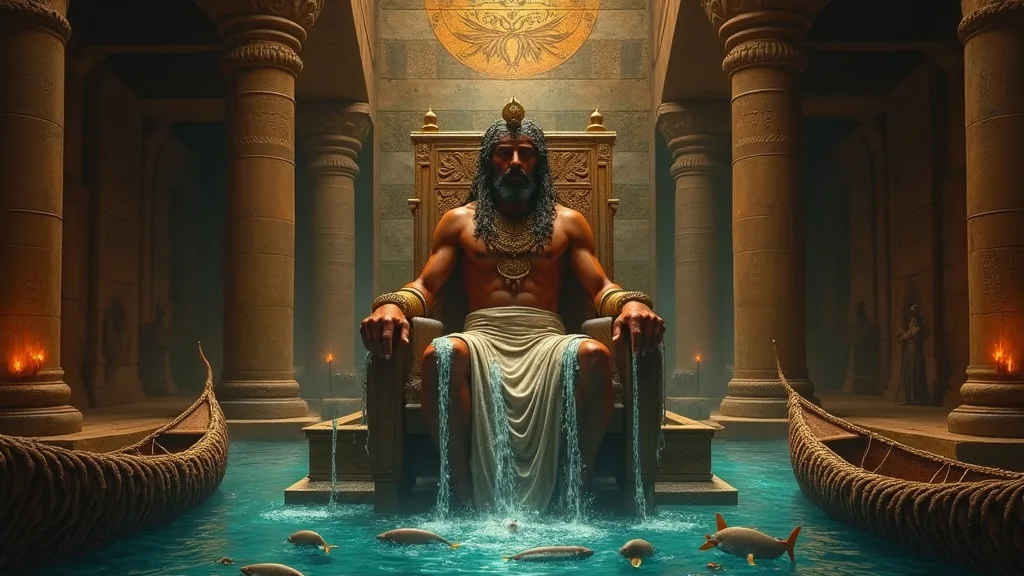
His blue-green iconography fits this role perfectly. Cylinder seals from the Akkadian period (roughly 2334-2154 BCE) show him seated on his throne with streams of water pouring from his shoulders, fish swimming in those streams. Sometimes the streams carry the me tablets with them, the codes of civilization riding the current into human hands.
The Theft of the Me: When the Trickster Loses His Own Trick
One of the most beloved Sumerian compositions is the myth known as "Inanna and Enki," and it turns Ea's cleverness against him. Enki, flush with beer and good humor, invites Inanna to his temple at Eridu. He offers her, one by one, the me: over a hundred divine decrees ranging from lordship to the art of the cult prostitute to the descent into the underworld. She accepts each one. He gives more. Then he sobers up.
What follows is a comedy of escalating panic. Enki sends his vizier Isimud and successive waves of monsters to intercept Inanna's Boat of Heaven as she ferries the me back to her city of Uruk. Each assault fails. Inanna docks at Uruk with every last tablet. When she presents them to her city, civilization in all its complexity spreads through the streets.
The myth has puzzled scholars for decades. Is it a polemical text, written in Uruk to assert political primacy over Eridu? Is it an allegory for the historical transmission of Sumerian cultural forms from the southern marshes northward up the river? Both readings hold up. What remains constant is the portrait of Enki: a god whose generosity, loosened by beer, outpaces his calculation. He is the source of all civilized knowledge, but he cannot hold it indefinitely. It flows, like the abzu itself.
Enki's Role in the Creation of Humanity
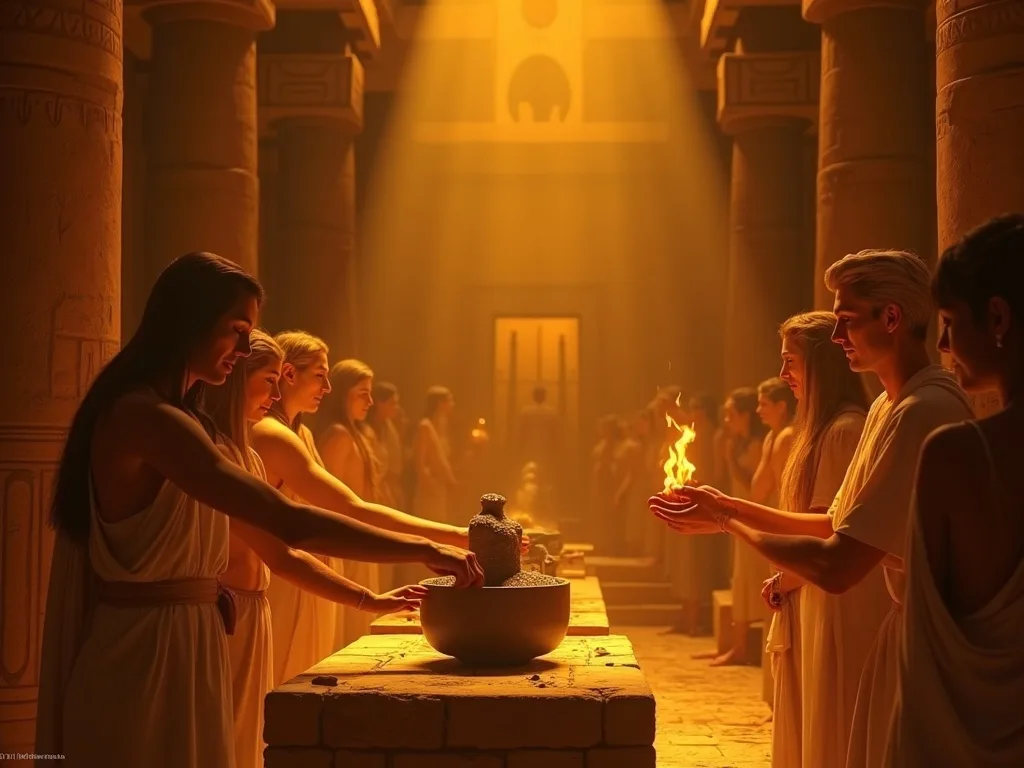
The question of who made humanity has multiple Mesopotamian answers, but Enki's version, preserved in the myth "Enki and Ninmah," is the most detailed and the most morally layered. The lesser gods, the Igigi, are exhausted from digging canals. They go on strike. Enki, sleeping in the abzu, is woken by his mother Namma, who tells him to find a solution. He wakes, thinks, and devises the plan: take lullu, the clay from the top of the primordial ocean, shape it with the birth goddess Ninmah, and animate it with divine essence. The new beings will do the digging.
What makes this myth worth sitting with is what comes next. After the creation, Enki and Ninmah drink too much beer and hold a contest: Ninmah creates disabled or marginal humans (the blind, the infertile, the one who cannot hold back urine), and Enki must find each a place in society. He succeeds each time, finding them roles. Then Enki creates his own defective beings, and Ninmah cannot fix them. The point is not triumphalism. It is a theology of imperfection: humanity is clay animated by divine breath, and some of that clay will always come out crooked. The god of wisdom accepts this. He builds the accommodation into the system.
The later Babylonian myth "Atrahasis" weaves Ea (his Akkadian name) even deeper into humanity's story. When the gods decide to send the great flood to reduce the noise of overpopulation, Ea is the one who cannot let humanity die. He circumvents the divine decree by whispering to a wall of reeds, knowing that the wall stands beside the house of Utnapishtim (the Babylonian Noah figure called Atrahasis, "the exceedingly wise"). The wall hears. Atrahasis hears through the wall. Ea has technically kept his oath to the other gods: he told no human. He told a wall. The flood comes; the boat survives. Humanity lives because a god found the gap in the rules.
The Flood Narrative and the Whispering Wall
The flood episode in Atrahasis predates the Epic of Gilgamesh by several centuries and gives Ea his most morally complex moment in Babylonian literature. The council of the Anunnaki, pressured by Enlil, god of wind and storms, resolves to flood the earth. The decree is unanimous. Ea has agreed.
Then he finds the loophole.
Ea (Enki) goes to Atrahasis's reed house. He does not address the man. He speaks to the wall: "Wall, listen to me. Reed fence, pay attention to my words." The instruction that follows is precise: build a boat of specific dimensions, waterproof it with bitumen, load animals, grain, and family, seal the hatch. Atrahasis, understanding exactly what he has overheard through the wall, executes the plan.
The narrative device is not merely clever. It reflects a deep Mesopotamian legal sensibility, the idea that an oath's binding force depends on exactly who is addressed. Ea remains technically innocent while saving the species he helped create. When the flood subsides and Enlil discovers survivors, he rages at Ea, who defends himself with a logic that is theological, ecological, and almost lawyerly: humanity serves the gods through ritual and sacrifice; to exterminate them entirely would be to cut off the divine supply chain. Proportion, Ea argues, should govern punishment. Plague, famine, or infertility can reduce the population without erasing it. Enlil, reluctantly, accepts this framework.
This argument is one of the oldest surviving articulations of the principle that punishment must be proportional to offense. It comes not from a human lawgiver but from the mouth of a god of wisdom addressing an assembly of the divine.
The Name Debate: Enki, Ea, and the Sumerian-Akkadian Transition
Scholars distinguish carefully between Enki and Ea because the two names carry distinct etymological histories. Enki is Sumerian: en (lord) plus ki (earth), making him "Lord of the Earth" - though his domain is specifically the earth's waters beneath. Ea is his Akkadian name, possibly derived from Sumerian E-a ("House of Water") or, in one alternative reading, connected to a Semitic root meaning "knowing." The latter would make "Ea" itself a title of wisdom rather than a personal name.
By the Old Babylonian period (2000-1600 BCE), when Akkadian had largely displaced Sumerian as the administrative language of Mesopotamia, Ea carried full theological sovereignty. He absorbed Enki's attributes wholesale: the abzu, the me, the role of divine craftsman, the association with magic and incantation. The two names appear together in ritual texts, sometimes hyphenated, sometimes used interchangeably within a single hymn.
His son Marduk inherits much of this wisdom portfolio in the Babylonian tradition. The Enuma Elish carefully positions Marduk as Ea's pupil and heir: Ea teaches him, initiates him, and then steps back as Marduk defeats Tiamat and becomes the supreme god of the Babylonian state pantheon. The theological politics are transparent: Babylon's civic deity had to surpass the older southern cities' gods. But even in that supremacy narrative, Ea remains the source. The wisdom flows from him downward.
Enki (Sumerian)
Cult center: Eridu, the oldest Sumerian city, with the sacred E-abzu pool
Primary domain: The abzu (subterranean freshwater ocean) and the me (decrees of civilization)
Key myths: "Enki and the World Order," "Inanna and Enki," "Enki and Ninmah"
Associates: Ninhursag (earth mother), Inanna (rival and beneficiary), Namma (his mother)
Character emphasis: Trickster, generative craftsman, slightly chaotic wisdom figure
Ea (Babylonian)
Cult center: The E-abzu survives in Babylonian ritual; temples at Eridu, Babylon, and Assur
Primary domain: Wisdom, magic, incantation (āshipu priests invoked him before rituals), craft
Key myths: Atrahasis flood epic, Enuma Elish (supporting role), Epic of Gilgamesh Tablet XI
Associates: Marduk (son and heir), Damkina (wife), Nabu (grandson of knowledge)
Character emphasis: Lawgiver, ethical mediator, divine craftsman who shapes worlds
Ea as the Patron of Scribes, Healers, and Magicians
In daily Babylonian life, Ea was not an abstract cosmic figure. He was the god you invoked before performing an exorcism. The āshipu priest, the specialist in ritual magic and healing, recited Ea's name at the opening of nearly every incantation in the corpus now called Maqlu ("Burning"), a multi-tablet sequence of anti-witchcraft rituals that dates to at least the late second millennium BCE. The logic was clear: Ea knows the hidden structure of reality. To invoke him is to align your own knowledge with his.
Scribal culture extended this connection. Cuneiform writing itself was seen as a gift of the abzu. The edubba, the Sumerian scribal school, taught students the myth of Enki granting writing to humanity alongside all the other me. A scribe who mastered the signs was, in a sense, participating in the divine ordering of the world. The same god who shaped humanity from clay also shaped language from signs. Both acts involved taking formless material and encoding intelligence into it.
Healers operated under similar patronage. Medical diagnosis texts from Nineveh's library (assembled under the Assyrian king Ashurbanipal in the seventh century BCE) open with invocations of Ea and his son Marduk. The physician's knowledge is Ea's knowledge, delegated. The healer is not curing by human skill alone but channeling wisdom that originates in the abzu.
The Goat-Fish: Ea's Animal Symbol and Its Cosmic Reach
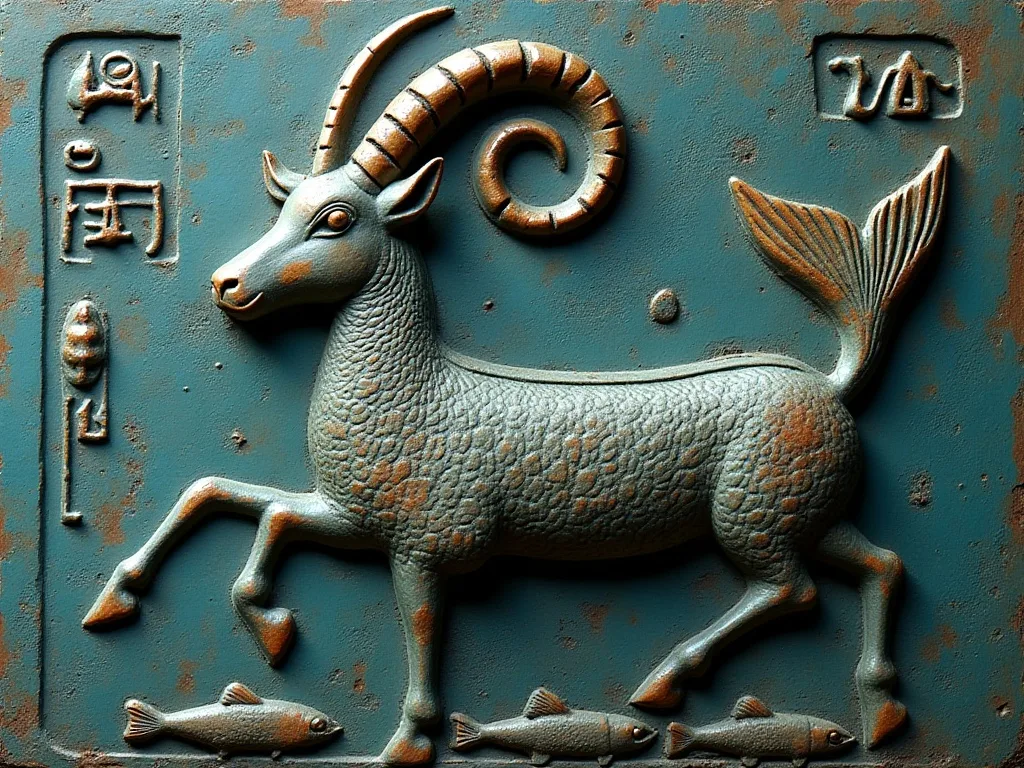
Ea's iconic animal is the suhurmašu, the goat-fish: a creature with the foreparts of a goat and the tail of a fish. It appears on boundary stones (kudurru), cylinder seals, temple reliefs, and the star catalogs that would eventually feed into the Greek zodiac system. The constellation we call Capricorn, the sea-goat, descends directly from this Babylonian symbol. The MUL.APIN star catalog, compiled around 1000 BCE, names the constellation SUHUR.MASH.KU, the goat-fish, and associates it with Ea's domain.
This is not a trivial genealogy. Babylonian astronomical knowledge, transmitted through Assyrian scribal networks to Greek scholars working in the Hellenistic period, carried the goat-fish symbol into Western astrology, where it survived for over two thousand years. Every horoscope column that prints a Capricorn symbol carries a residue of Ea's theology, stripped of its context but still geometrically descended from the abzu.
The goat-fish itself encodes a cosmological idea: Ea inhabits the boundary between the water world beneath and the earth world above. The fish tail belongs to the abzu; the goat body climbs the rocky slopes of the terrestrial world. His nature is liminal. He crosses from depth to surface, from the hidden order of the cosmos to its visible surface, carrying wisdom upward the way a spring carries water from underground to the surface of the land.
Ea in the Epic of Gilgamesh and the Long Afterlife of His Myths
The Epic of Gilgamesh, the most complete version of which was inscribed on twelve tablets in Nineveh around 650 BCE (though older versions circulate from at least 2100 BCE), gives Ea a brief but decisive appearance. When Gilgamesh seeks immortality and finds his way to Utnapishtim, the flood survivor explains how he received his warning: through the wall, through the voice of Ea. The great epic's climactic revelation, that death is humanity's portion and only the gods live forever, rests on an act of Ea's compassion. He saved Utnapishtim; that survival story is what Gilgamesh finds at the end of the world. Even the hero's ultimate failure to achieve immortality is shaped by the god who once whispered hope through a reed fence.
The me that Enki catalogued, all those decrees of civilization, read like a blueprint for what was worth preserving. Music is on the list. The cult of the temple prostitute is on the list. The descent to the underworld is on the list. These are not accidental inclusions. The scribes who curated the mythology were also archivists of culture. To name a me was to argue for its importance. Enki held all of them, which meant the god of wisdom was also the ultimate cultural conservator.
His influence reached outward through time. The later Phoenician tradition preserved a figure called Kothar-wa-Khasis, a craftsman god with clear Ea-like attributes. Some scholars see Ea's lineage in the Hebrew figure of Yahweh as a god who shapes humans from clay and grants wisdom, though the theological differences are profound. Closer structurally is the Greek Prometheus, who steals fire (a form of civilizing knowledge) from the gods and gives it to humanity, then suffers for it. Enki never suffers as Prometheus does, but the impulse is identical: a divine figure chooses human survival over divine consensus. The abzu and Mount Olympus are separated by two thousand years and a thousand miles, but the shape of the story rhymes.
Questions Readers Ask About Ea (Enki)
Frequently asked questions
What is the difference between Enki and Ea?
Enki is the Sumerian name, meaning roughly "Lord of the Earth" (with specific reference to the earth's underground waters). Ea is the Akkadian name for the same deity, possibly derived from the Sumerian "E-a" (House of Water) or a Semitic root meaning "knowing." As Akkadian became the dominant written language of Mesopotamia around 2000 BCE, Ea became the standard form, but both names appear in ritual texts, sometimes in the same hymn. Theologically they are identical; historically, the Sumerian Enki is the earlier and arguably more complex literary figure.
What are the me, and why did Enki hold them?
The me (pronounced "may") are the divine decrees or blueprints of civilization in Sumerian theology. Over a hundred are listed across various texts, covering everything from kingship and priesthood to music, lying, sexual desire, the smith's craft, and descent to the underworld. Enki held them because, as lord of wisdom and the abzu, he was understood to possess the underlying structural knowledge of all ordered existence. The myth of Inanna taking them from a drunken Enki reflects the tension between the city of Eridu (Enki's home) and Uruk (Inanna's city), possibly encoding real historical transmission of cultural forms.
How did Ea save humanity from the flood without breaking his oath to the gods?
In the Atrahasis epic, Ea swore with the other gods to keep the flood plan secret from humanity. He kept his oath technically by speaking not to the man Atrahasis but to the wall of reeds beside his house. The wall "heard," Atrahasis heard through the wall, and the instructions for building the survival boat were transmitted without Ea technically addressing a human. Assyriologist W.G. Lambert, who produced the definitive modern edition of Atrahasis, called this one of the earliest examples of a legalistic loophole in world literature.
Is the zodiac sign Capricorn connected to Ea?
Yes, directly. The Babylonian constellation SUHUR.MASH.KU (the goat-fish, Ea's symbolic animal) appears in the MUL.APIN star catalog compiled around 1000 BCE. Greek astronomers, working from Babylonian sources transmitted through Hellenistic scholarship, preserved the goat-fish form and the name Capricorn (Latin: "horned goat"). The astronomical symbol survives in Western astrology today, carrying the geometric memory of Ea's liminal nature, half creature of the underground water, half creature of the terrestrial world.
What texts are the primary sources for Ea and Enki's mythology?
The main Sumerian sources are "Enki and the World Order," "Inanna and Enki" (also called "Inanna and the Me"), "Enki and Ninmah," and "Enki and Ninhursag," all preserved on tablets primarily from Nippur and dated to the Old Babylonian period (roughly 2000-1600 BCE). The Akkadian sources include the Atrahasis epic (Old Babylonian recension, ca. 1700 BCE), the Enuma Elish (likely composed around 1100 BCE), and the Nineveh version of the Epic of Gilgamesh (seventh century BCE). The ritual corpus Maqlu adds hundreds of incantations invoking Ea's power over hidden knowledge and magic.
Ea's Enduring Argument: Wisdom as the Capacity for Mercy
What separates Ea from other ancient gods of wisdom is not the breadth of his knowledge but the use he makes of it. Marduk uses power. Enlil uses force. Ea uses understanding, specifically the kind of understanding that finds the gap in the rules where mercy can fit. The whispering to the wall is his most characteristic act. He knew the decree. He knew its terms. He found the one angle from which compliance and compassion could occupy the same space.
Modern readers sometimes read that as moral cowardice, a failure to confront Enlil directly. But the Babylonian theological imagination saw it differently. Direct confrontation between cosmic powers was catastrophic, as the war between Tiamat and the younger gods had already demonstrated. Intelligence that prevents catastrophe without triggering a second one is wisdom in its most practical form. Ea models a kind of ethical improvisation: when the law is unjust, you do not break it openly if that act destroys the thing you are trying to protect. You find the angle.
The scribes of Nippur who first wrote these stories were themselves agents of a fragile civilization, people who knew that cities could be destroyed, libraries burned, the me scattered. They gave their god of wisdom the temperament that their own survival required: not heroic recklessness but precise, patient ingenuity. The abzu keeps flowing underground regardless of what happens on the surface. The freshwater finds its way up. That is, finally, what Ea (Enki): God of Wisdom and Fresh Waters means as a theological statement: knowledge, like water, cannot be permanently contained. It always finds its way through.
Free 25-page sample
Want the whole story?
Take the first 25 pages free. If it pulls you in, the full edition is yours as an instant PDF download, with a paperback on Amazon for selected titles.

Mythology
The World Mythology Book: The Gods, Heroes and Myths of Every Culture
The Gods, Heroes and Myths of Every Culture, in One Volume
The whole of world mythology in a single volume: Greek, Norse, Egyptian, Japanese, Hindu, Celtic, Slavic, Mesoamerican and African myths gathered side by side, each drawn from the primary sources.