The Epic of Gilgamesh: Humanity's Oldest Mirror
Carved into clay tablets over four thousand years ago, the Epic of Gilgamesh wrestles with immortality, grief, and what it means to be human. It remains the oldest surviving work of literary mythology the world possesses.
Contents
A King Carved in Clay
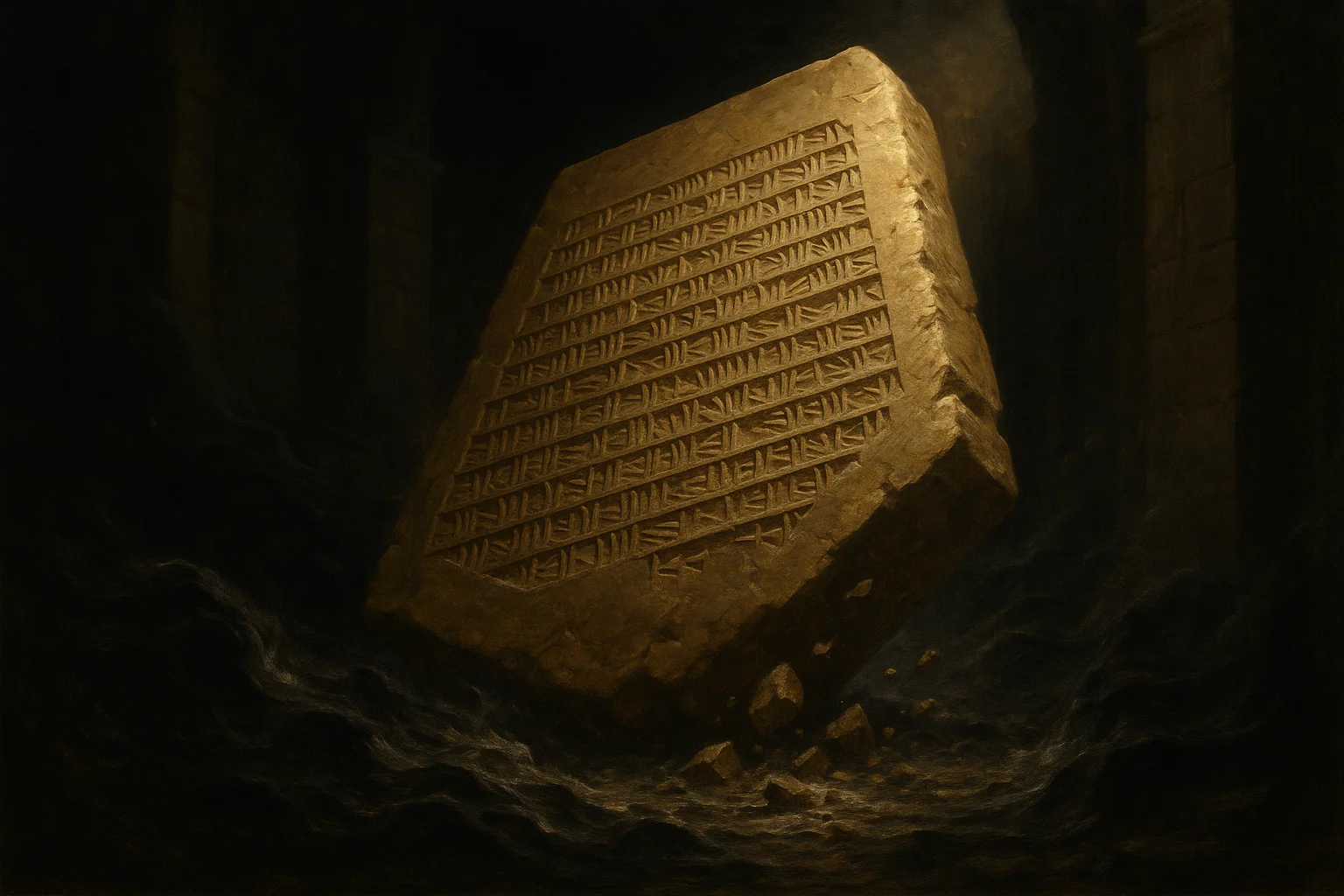
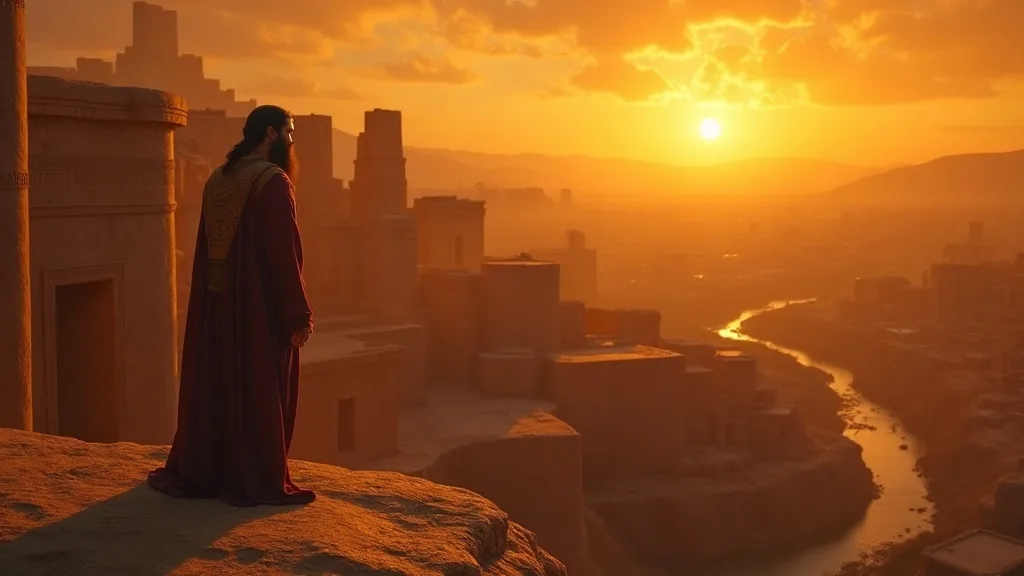
Somewhere beneath the sun-bleached tells of southern Iraq, under layers of silt that the Euphrates deposited across millennia, scribes pressed wedge-shaped marks into wet clay and told a story that would outlast every empire that followed. The Epic of Gilgamesh is not merely old. It is foundational. Its earliest fragments date to roughly 2100 BCE, and the most complete version, known as the Standard Babylonian text, was assembled by a scholar-priest named Sin-leqi-unninni around the 12th or 11th century BCE. He was, in a meaningful sense, the world's first named literary editor.
The poem opens with a boast and a dare. Gilgamesh, king of Uruk, is described as "two-thirds divine and one-third human," a man of supernatural strength and alarming appetites. He builds great walls, exhausts his people with unceasing labor, and exercises the right of the first night over new brides. The gods hear the complaints of Uruk's citizens. Their answer is Enkidu.

Enkidu and the Making of a Brother
Enkidu begins as the wild man, a figure raised among gazelles and lions on the open steppe. He knows nothing of bread, beer, or the weight of civilization. The goddess Aruru shapes him from clay and divine breath, a deliberate counterweight to the untamed energy of Gilgamesh. Where Gilgamesh is the city made flesh, Enkidu is the wilderness personified.
The transition from wild creature to civilized man is one of the poem's most psychologically acute passages. A temple priestess named Shamhat is sent to the steppe. She lies with Enkidu for six days and seven nights, and when it ends, the animals he once ran with flee from him. He has crossed a threshold he cannot recross. The gazelles sense that something has changed in him before he himself understands it.
When Gilgamesh and Enkidu finally meet, they fight first, slamming into door frames and shaking city walls, before recognizing each other as equals. The friendship that grows from that collision is tender, physical, and absolute. Ancient Mesopotamian literature did not shy from depicting the depth of male bonds. Gilgamesh weeps over Enkidu's body with a grief that echoes through every culture that has ever struggled to name the feeling of losing the person who made you most yourself.
The Cedar Forest and the Slaying of Humbaba
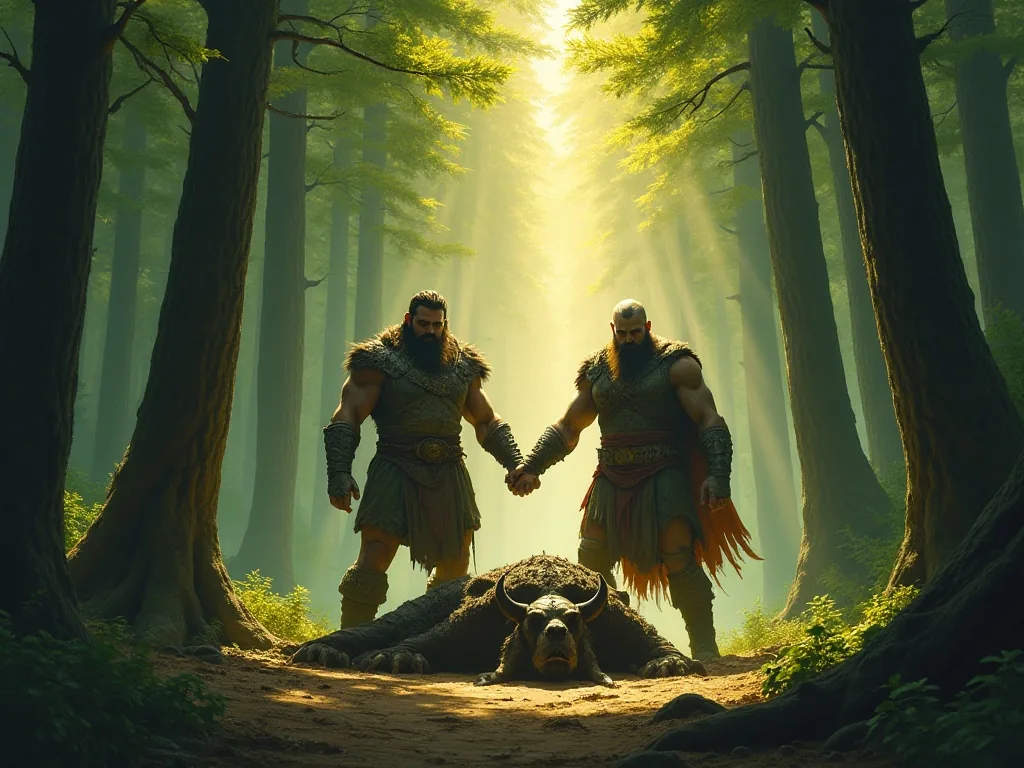
Together, the two heroes journey to the Cedar Forest, guarded by the monstrous Humbaba, appointed by the god Enlil to protect those sacred trees. Gilgamesh proposes the quest partly from the desire for glory and partly to cheat the meaninglessness he already senses waiting for him. Enkidu is afraid, and his fear is not cowardice. It is wisdom. The sun-god Shamash aids them, sending winds that bind Humbaba, and the creature begs for mercy. Enkidu urges Gilgamesh to strike anyway. They kill him.
This detail matters. The heroes are not simply righteous. They ignore a plea for mercy from a defeated enemy. Mesopotamian mythology rarely rewards its heroes without also complicating them, and the killing of Humbaba carries a cost that unfolds slowly across the remaining tablets.
The Wrath of Ishtar and the Death That Changes Everything
After their triumph, the goddess Ishtar, patron of love and war, offers Gilgamesh her hand. He refuses her, cataloguing her former lovers with almost savage precision: the shepherd turned to a wolf, the gardener Ishullanu transformed into a frog, Tammuz, the beloved, condemned to weeping year after year. The refusal is brutal in its thoroughness.
Ishtar appeals to her father Anu, and together they release the Bull of Heaven upon Uruk. Gilgamesh and Enkidu slay the Bull as well. Enkidu goes further: he tears off one of the bull's haunches and hurls it at Ishtar's face. The gods convene in the heavens. Someone must die for these insults. The sentence falls on Enkidu.
Enkidu's death is the pivot on which everything turns. He wastes over twelve days, cursing the trapper and Shamhat who drew him into civilization, before regretting those curses when Shamash reminds him of everything he has gained. He dies mid-sentence in Tablet VIII, and Gilgamesh tears his hair, strips off fine clothing, and dresses in the skins of animals. He refuses to bury Enkidu until a maggot falls from his friend's nostril. He refuses the fact itself.
The Road to Utnapishtim
Grief breaks Gilgamesh open and reveals the fear underneath. He sets out not for glory this time but for the secret of eternal life, seeking Utnapishtim, the sole human whom the gods granted immortality after the great flood. The journey takes him through the mountains of Mashu, whose twin peaks hold up the sky, past the scorpion-people who guard the solar gate, and across the Waters of Death that no living man has ever crossed.
He finds the alewife Siduri sitting at the edge of the sea, and she speaks to him one of the poem's most luminous passages. She counsels him to eat, drink, let his clothes be clean, his head washed, his child held in his embrace, his wife delighted by his touch. Scholars have compared this to the Epicurean tradition, though it predates Epicurus by more than a thousand years. The poem knew this argument before philosophy gave it a name.
Gilgamesh crosses the Waters of Death with the ferryman Urshanabi and reaches Utnapishtim on a distant shore. The old man tells him the flood story: how the god Ea warned him in a dream to build a boat, how he loaded it with his family and the seed of all living things, how the storm that the gods unleashed was so terrible that even the gods cowered at the sky wall of heaven, how a dove and a swallow and a raven were sent out to find dry land. The parallels to the later biblical flood narrative in Genesis are unmistakable and have occupied scholars since the tablets were first translated in the 1870s.
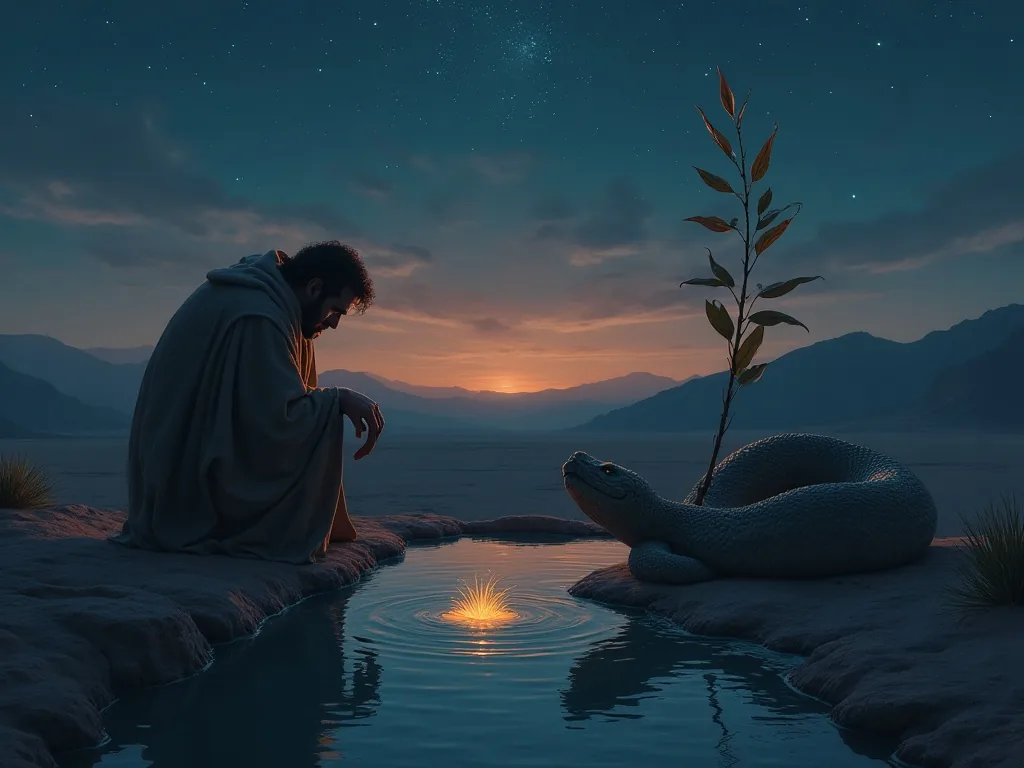
Utnapishtim offers Gilgamesh a test: stay awake for six days and seven nights. Gilgamesh fails immediately. Sleep rolls over him like a wave. Utnapishtim, taking pity, tells him of a thorny plant at the bottom of the sea that restores youth. Gilgamesh dives for it, retrieves it, names it "The Old Man Becomes Young Again." On the journey home, he sets it down beside a pool to bathe. A serpent rises, smells its fragrance, and steals it. The plant is gone. The serpent sheds its skin and vanishes. Gilgamesh sits down on the ground and weeps.
The Tablets and Their Rediscovery
The Standard Babylonian version of the epic was written across twelve clay tablets. The twelfth tablet, often considered a later addition rather than an organic part of the narrative, contains a Sumerian composition sometimes called "Gilgamesh, Enkidu, and the Netherworld," in which Enkidu's ghost returns to describe the afterlife in sparse, chilling terms. Those who have many sons fare best in the underworld. Those who died in battle are honored. Those who drowned and were never properly buried wander without rest.
The physical tablets themselves were found largely in the ruins of the Library of Ashurbanipal at Nineveh, the great collection assembled by the Assyrian king Ashurbanipal in the 7th century BCE. Austen Henry Layard and Hormuzd Rassam excavated the site in the 1840s and 1850s. George Smith, a self-taught Assyriologist working at the British Museum, was the one who first translated the flood tablet in 1872. According to contemporary accounts, when he read the flood narrative he was so overcome with excitement that he leaped from his chair and began tearing off his clothes.
The poem exists in fragments across multiple languages and time periods: Old Babylonian, Akkadian, Hittite, Hurrian. Each version shifts the emphases slightly, adding local color, adjusting divine hierarchies, reflecting the concerns of the culture that copied it. The poem traveled with merchants, diplomats, and scribal schools across the ancient Near East for more than a thousand years.
Gods, Semi-Gods, and the Sumerian King List
Gilgamesh appears not only in the poem but in the Sumerian King List, an ancient document that names the rulers of Mesopotamian city-states and assigns each a reign. Gilgamesh is listed as the fifth king of the First Dynasty of Uruk, credited with a reign of 126 years. His father is given as a demon named Lugalbanda (himself the subject of earlier heroic poems), and his mother as the divine wild cow Ninsun. The city of Uruk, ancient Erech, corresponds to the modern archaeological site of Warka in southern Iraq, one of the world's earliest true cities.
The poem is theologically rich in ways that resist reduction. Shamash, the sun-god, is consistently the friend and protector of Gilgamesh, suggesting a theology of divine patronage where the gods take personal interest in chosen humans. Enlil is stern and impersonal, responsible for the flood's devastation. Ea is clever and merciful, slipping warnings to Utnapishtim through the walls of a reed hut. Ishtar is powerful and volatile, neither wholly good nor wholly punishing. These are not allegories. They are personalities.
Gilgamesh and the Questions That Will Not Quiet
The poem does not resolve the problem it raises. Gilgamesh returns to Uruk empty-handed, without the plant, without immortality, without Enkidu. He looks up at the walls of his city, the same walls he built in the poem's opening lines, and they are his answer. The walls remain. The city remains. The text carved into the poem's prologue tablet invites the reader to trace the lapis lazuli tablet, to look at the foundation box, to read what Gilgamesh endured and learned.
The argument is not that monuments conquer death. It is quieter than that. Human works persist in forms we cannot predict. Gilgamesh himself never knew that the poem about his grief would be memorized by Hittite scribes, copied in Hurrian, buried in Nineveh, dug up by a Victorian archaeologist, translated into every major language, and studied in universities four thousand years after his walls crumbled into the desert. The serpent took the plant. Nothing took the story.
The Flood, the Friend, and the Long Conversation with Mortality
What makes the Epic of Gilgamesh endure beyond archaeology and academic study is its refusal to be comfortable. It does not promise that love protects the beloved. It does not promise that heroism earns immortality. It does not assure the grieving that their grief is temporary or instructive in a clean, redemptive sense. Enkidu dies because of choices both men made freely. The loss is real and permanent.
Siduri's advice, Utnapishtim's test, the stolen plant: each episode is a failed rescue. The poem strings these failures together not to discourage but to describe. This is what mortality feels like from the inside of a life that has loved something. The epic's extraordinary achievement is that it renders that feeling with such precision that a reader in any century recognizes it immediately, as if the clay tablet were a mirror that had been waiting, buried under the flood silt of the Euphrates, for someone to wipe it clean.
Read the full book
Want the whole story?
The complete edition is an instant PDF download here, with a paperback on Amazon for selected titles.
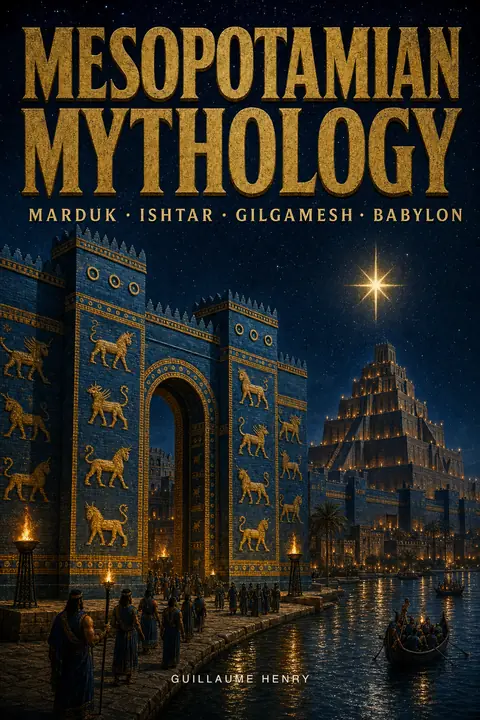
Mesopotamian
The Mesopotamian Mythology Book: Marduk, Tiamat, Ishtar and the Sacred Stories of Babylon's Cosmic Order
From Sumer to Assyria: The Gods Who Shaped Civilization
The full sweep of Mesopotamian myth from Sumer through Babylon and Assyria. Marduk's battle with Tiamat, Ishtar's descent, the Enuma Elish, and the Anunnaki who ruled before the flood.