
Enuma Elish: The Babylonian Creation Epic
The seven-tablet epic that made Marduk supreme. How Babylon rewrote creation to justify empire, tablet by tablet.
Contents
Enuma Elish is a Babylonian creation epic composed in Akkadian around the late second millennium BCE, preserved on seven clay tablets, that recounts how the storm god Marduk defeats the primordial sea goddess Tiamat and creates the cosmos from her corpse, establishing his supremacy over the older gods. The most complete version survives from the library of Ashurbanipal at Nineveh, dating to the seventh century BCE. Scholars recognize the text as both cosmogony and political theology, legitimizing Babylon's imperial dominance by elevating Marduk above Sumerian deities who predated him by a millennium.
The epic opens with a phrase that became its modern title: "When on high" (enuma elish in Akkadian). What follows is not merely a story of gods and monsters but a carefully constructed argument for why Babylon deserved to rule Mesopotamia. The text rewrites older Sumerian traditions, transferring cosmic authority from Enlil of Nippur to Marduk of Babylon, and it does so with the precision of a legal brief wrapped in mythological language.
The Seven Tablets and Their Discovery
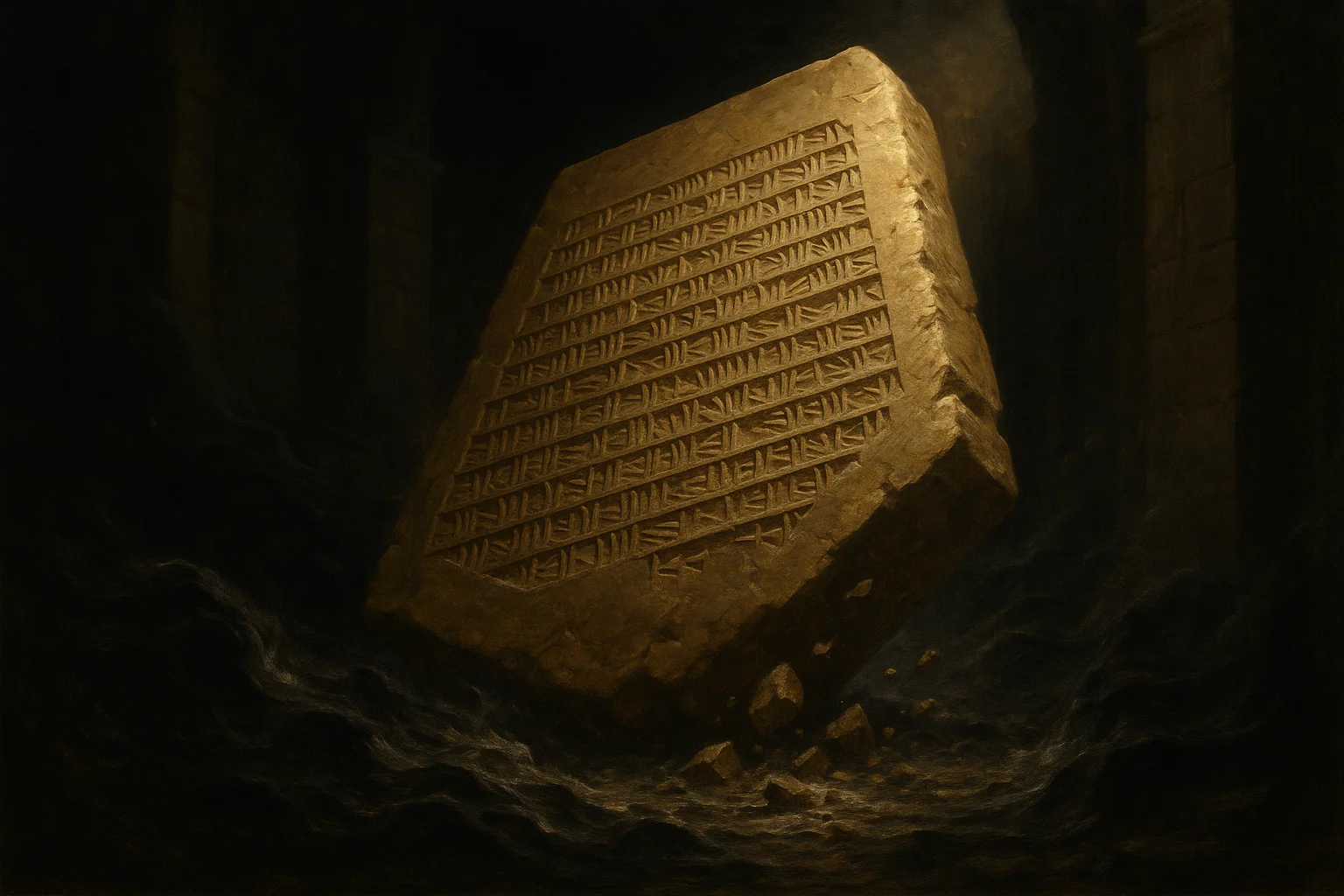
The text survives on clay tablets written in cuneiform script, the most complete copies excavated from the ruins of Nineveh in modern-day Iraq during the mid-nineteenth century. British archaeologist Austen Henry Layard and his assistant Hormuzd Rassam unearthed thousands of tablets from the palace complex, though the significance of Enuma Elish was not immediately recognized among the diplomatic correspondence and administrative records.
Ashurbanipal's Library at Nineveh
King Ashurbanipal of Assyria, who reigned from 668 to 631 BCE, assembled the ancient world's most systematic library. His scribes copied texts from across Mesopotamia, including this Babylonian epic, even though Assyria and Babylon were often rivals. The library preserved multiple versions, some with variant readings, which modern scholars use to reconstruct damaged passages. The tablets themselves are fragments, reassembled like a shattered mosaic over decades of philological work.
Dating the Composition
Linguistic analysis places the original composition between 1800 and 1100 BCE, most likely during the reign of Nebuchadnezzar I (circa 1125 to 1104 BCE), when Babylon reasserted independence after Kassite rule. Some scholars argue for an earlier date under Hammurabi (1792 to 1750 BCE), who first elevated Marduk to national prominence. The absence of the text from earlier Sumerian sites and its distinctly Akkadian vocabulary support the later Babylonian origin. No consensus exists, but the political context fits the twelfth century better than the eighteenth.
The Story: From Primordial Waters to Marduk's Kingship
The narrative structure follows a clear arc: primordial unity, divine conflict, champion's rise, cosmic order established. Each tablet advances the argument that legitimate kingship requires both martial prowess and the consent of the governed gods.
Apsu and Tiamat: The First Couple
Tablet I opens with the mingling of two primordial waters. Apsu, the sweet water beneath the earth, and Tiamat, the salt water of the sea, exist before heaven and earth have names. The text states in lines 1 to 9 that "when no gods whatever had been brought into being" and "destinies had not been fixed," these two waters mixed together. From their union emerge the first generation of gods: Lahmu and Lahamu, then Anshar and Kishar, then Anu and Ea (also called Enki). The younger gods are noisy, restless, and disruptive.
The Murder of Apsu and Tiamat's Revenge
Apsu grows weary of the clamor. He proposes to his vizier Mummu that they destroy the younger gods so he can sleep. Tiamat refuses, reluctant to annihilate her offspring. Ea, the cleverest of the young gods, learns of the plot through magic, casts a spell over Apsu, and kills him in his sleep. Ea then establishes his dwelling atop the slain Apsu's body, a detail that prefigures Marduk's later act. Tiamat, now enraged by her consort's murder, prepares for war. She creates an army of monsters: serpents, dragons, storm demons, each "sharp of tooth and unsparing of fang."
Marduk's Bargain and the Battle
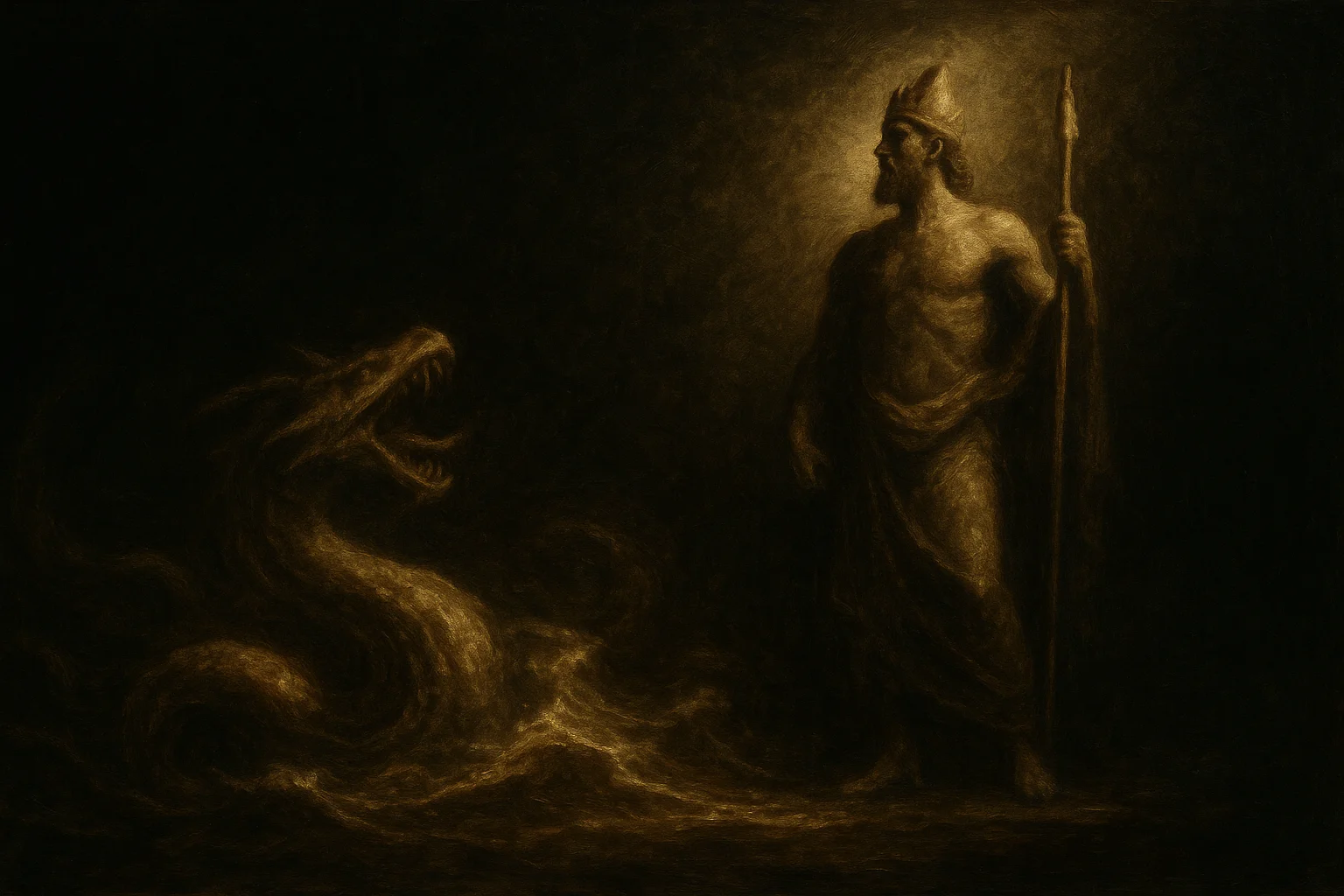
The older gods panic. Anshar sends Ea, then Anu, to confront Tiamat, but both retreat. Finally, Marduk, son of Ea, volunteers on one condition: if he defeats Tiamat, the gods must grant him permanent kingship and the authority to decree fates. The assembly agrees. Tablet IV, lines 33 to 104, describes the battle in detail. Marduk arms himself with bow, mace, lightning, and a net held by the four winds. When Tiamat opens her jaws to swallow him, he drives the winds into her belly, distending her body, then shoots an arrow through her mouth into her heart. He tramples her corpse, splits it like a dried fish, and fashions one half into the sky, the other into the earth.
"He split her like a shellfish into two parts: half of her he set up and ceiled it as sky, pulled down the bar and posted guards. He bade them to allow not her waters to escape." Enuma Elish, Tablet IV
The Creation of Heaven, Earth, and Humanity
From Tiamat's eyes flow the Tigris and Euphrates. Marduk arranges the stars as stations for the gods, establishes the calendar, and sets the moon to mark the months. In Tablet VI, lines 1 to 8, the gods complain of the labor required to maintain the cosmos. Marduk proposes a solution: create humanity to bear the burden of the gods. He slaughters Qingu, Tiamat's second consort and the instigator of her rebellion, and from Qingu's blood, Ea fashions humankind. The gods, grateful, build Marduk a temple in Babylon called Esagila and recite his fifty names in Tablet VII, each name a theological attribute or cosmic function.
Marduk's Elevation and Babylonian Politics
The text is transparent in its purpose. Marduk does not appear in Sumerian creation accounts. In the earlier Eridu Genesis, the gods Anu, Enlil, Enki, and Ninhursag create humanity without conflict or cosmic battle. Enlil, not Marduk, holds supreme authority. Enuma Elish transfers that authority by narrative fiat, justifying Babylon's political ascendancy over older cult centers like Nippur, Uruk, and Eridu.
The epic's structure mirrors a political assembly. Marduk does not seize power; he negotiates it. The gods debate, vote, and ratify his kingship. This reflects Babylonian political ideology, where kingship required both divine election and the consent of the council of elders. The fifty names in Tablet VII function as a treaty, binding the gods to Marduk's rule. Each name is a concession, a transferred attribute from an older deity. "Asarluhi," for instance, is Enki's title; by assuming it, Marduk absorbs Enki's role as patron of magic and wisdom.
The timing of the epic's composition aligns with Babylon's imperial ambitions. Under Hammurabi, Babylon became the dominant city-state in southern Mesopotamia. Under Nebuchadnezzar I, after centuries of foreign rule, Babylon reasserted independence and reclaimed the statue of Marduk from Elam. Enuma Elish provides the theological foundation for that claim: Marduk is not merely Babylon's god but the king of all gods, and therefore Babylon is the rightful center of the world.
Sumerian Roots: What Babylon Inherited and Rewrote
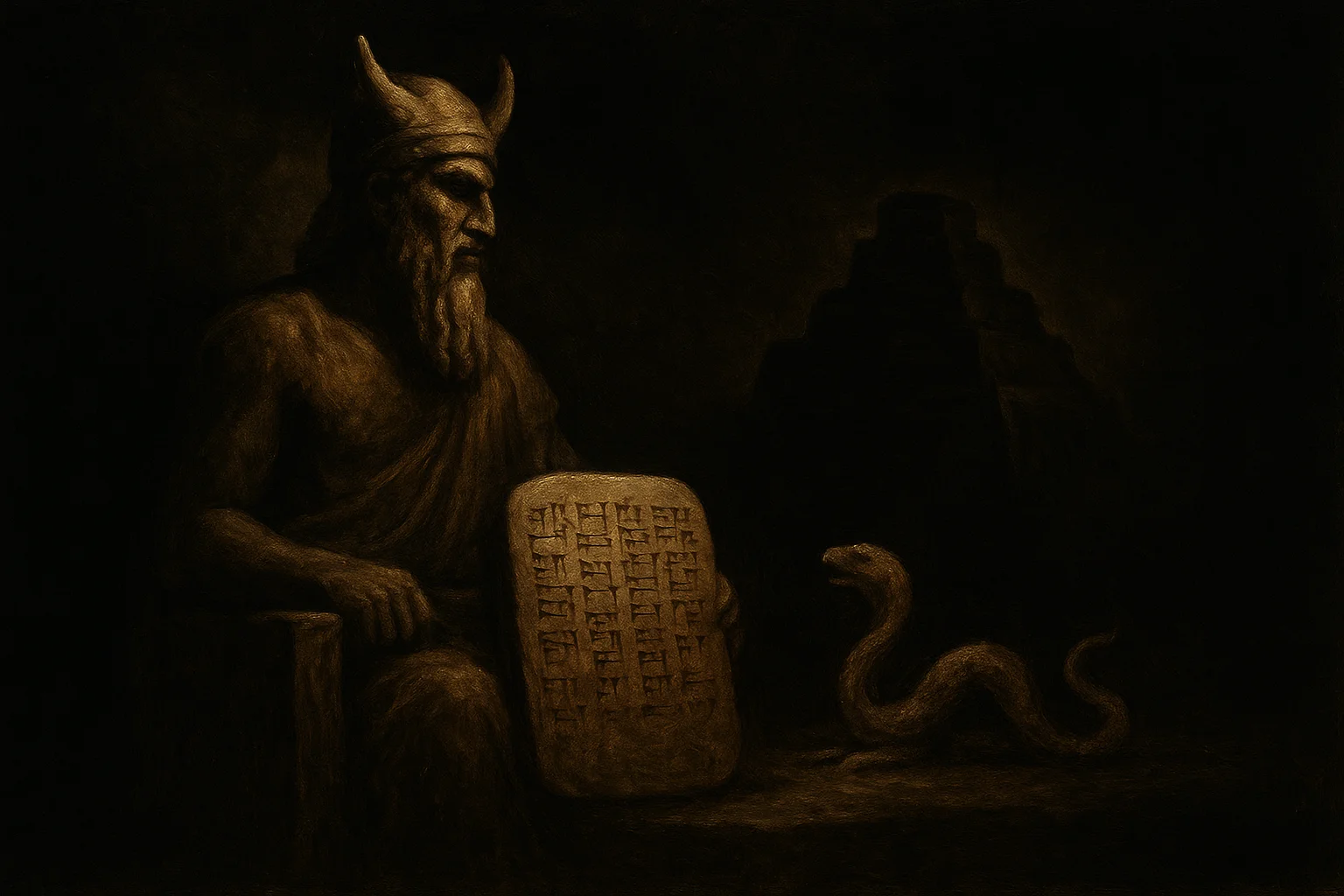
Babylonian scribes did not invent their cosmogony from whole cloth. They adapted, revised, and reframed Sumerian traditions. The Eridu Genesis, composed centuries earlier, describes the creation of humanity by Enki and the mother goddess Ninhursag, but without cosmic combat. The Atrahasis Epic, another Akkadian text predating Enuma Elish, also recounts humanity's creation to relieve divine labor, but assigns the act to Enki and the birth goddess Nintu, not Marduk.
Sumerian Tradition (Eridu Genesis)
Enki and Ninhursag create humans from clay. No primordial battle. Enlil rules the pantheon. Creation is orderly, almost bureaucratic.
Babylonian Revision (Enuma Elish)
Marduk creates humans from the blood of a rebel god after defeating chaos. Kingship earned through combat. Creation is violent, political, and contingent on Marduk's victory.
The substitution of Marduk for Enlil is the text's central innovation. In Sumerian theology, Enlil of Nippur held the Tablet of Destinies and decreed the fates of gods and mortals. Enuma Elish transfers that authority to Marduk, not by erasing Enlil but by subordinating him within the narrative. Enlil appears in the epic, but only as one voice among many in the divine assembly, no longer the supreme arbiter.
The figure of Tiamat herself may derive from the Sumerian goddess Nammu, the primordial sea who births the gods in earlier texts. But Nammu is benign, a mother without malice. Tiamat is transformed into an antagonist, a chaos monster whose defeat justifies the new order. This transformation reflects a shift in Babylonian mythology from matriarchal creation to patriarchal conquest.
Ritual Context: The Akitu Festival
The epic was not merely read but performed. During the Akitu, the Babylonian New Year festival held in the spring month of Nisannu, priests recited Enuma Elish in its entirety on the fourth day of the twelve-day celebration. The recitation took place in the temple of Marduk, with the king present, and it served both religious and political functions.
The ritual reenacted Marduk's victory. The king, as Marduk's earthly representative, symbolically defeated chaos and renewed the cosmos for another year. After the recitation, the king underwent a ritual humiliation: the high priest stripped him of his regalia, struck him on the cheek, and pulled his ears. The king then knelt and declared his innocence of wrongdoing. Only after this abasement was he reinvested with royal authority. The ritual affirmed that kingship was not inherent but granted by the gods, contingent on righteous conduct.
The Akitu also involved a procession through Babylon along the Processional Way to the Akitu house outside the city walls. Statues of the gods, including Marduk and his consort Sarpanit, were carried in a symbolic journey that mirrored Marduk's cosmic ordering. The festival concluded with a sacred marriage rite and a banquet, reinforcing the social order through shared ritual and feasting. The recitation of Enuma Elish was thus not a passive liturgy but an active renewal of the covenant between gods, king, and people.
Comparative Echoes: Theogony, Genesis, and Chaoskampf
The motif of a storm god defeating a sea monster appears across ancient Near Eastern and Mediterranean traditions. Scholars call this the chaoskampf, the battle against chaos. In Hittite mythology, the storm god Teshub battles the serpent Illuyanka. In Canaanite texts from Ugarit, Baal defeats Yam, the sea, and later the seven-headed serpent Lotan. In Greek tradition, Zeus overthrows the Titans and battles the serpent Typhon. Hesiod's Theogony, composed in the eighth century BCE, describes a succession of divine generations culminating in Zeus's kingship, a structure strikingly similar to Enuma Elish.
The parallels suggest either direct influence or a shared mythological grammar across the ancient Near East. Trade routes and diplomatic exchanges connected Babylon, Ugarit, and the Aegean. Hesiod may have encountered Mesopotamian cosmogonies through Phoenician intermediaries. The pattern recurs: an older generation of gods (Titans, Apsu and Tiamat) threatens the younger gods, who rally behind a champion (Zeus, Marduk) to establish a new order. The champion's victory legitimizes his rule.
Genesis 1, composed during or after the Babylonian Exile (sixth century BCE), inverts the logic of Enuma Elish. Where the Babylonian epic begins with two primordial waters in conflict, Genesis begins with God's spirit hovering over the waters, which are passive and obedient. Where Marduk creates through violence, the God of Genesis creates through speech. The Hebrew word tehom (the deep) in Genesis 1:2 is cognate with Tiamat, but the chaotic sea is not personified or opposed. The contrast is deliberate: Genesis asserts that creation requires no struggle, no negotiation, no cosmic battle. One God speaks, and it is so.
The dragons across traditions that populate later mythologies, from the serpent of chaos in Norse myth to the sphinx as hybrid guardian in Egypt and Greece, share ancestry with Tiamat's monstrous brood. These creatures born from primordial conflict serve as narrative obstacles, embodiments of disorder that heroes and gods must overcome to establish civilization. The pattern is older than any single text, but Enuma Elish gives it one of its earliest and most politically explicit forms.
Frequently asked questions
What is the Enuma Elish and when was it written?
The Enuma Elish is a Babylonian creation epic composed in Akkadian, most likely between 1800 and 1100 BCE, with the strongest evidence pointing to the reign of Nebuchadnezzar I around 1125 to 1104 BCE. The text survives on seven clay tablets discovered in the library of Ashurbanipal at Nineveh, dating to the seventh century BCE. It recounts how the god Marduk defeats the primordial sea goddess Tiamat and creates the cosmos from her body, establishing his supremacy over the older gods and legitimizing Babylon's political dominance.
How does Marduk defeat Tiamat in the Babylonian creation myth?
Marduk defeats Tiamat by arming himself with bow, mace, lightning, and a net held by the four winds, then driving the winds into her open mouth to distend her body and shooting an arrow through her mouth into her heart, as described in Tablet IV, lines 33 to 104. After killing her, he splits her corpse like a dried fish, fashioning one half into the sky and the other into the earth. From her eyes flow the Tigris and Euphrates rivers, and her body becomes the raw material for the ordered cosmos.
Why was the Enuma Elish recited during the Akitu festival?
The Enuma Elish was recited on the fourth day of the Akitu, the Babylonian New Year festival, to ritually reenact Marduk's victory over chaos and renew the cosmos for another year. The recitation took place in Marduk's temple with the king present, symbolically affirming the king's role as Marduk's earthly representative and legitimizing his authority through the cosmic order Marduk established. The ritual also involved the king's temporary humiliation and reinvestment, reinforcing that kingship was granted by the gods and contingent on righteous conduct.
What are the differences between Enuma Elish and earlier Sumerian creation stories?
Earlier Sumerian creation texts like the Eridu Genesis present creation as orderly and bureaucratic, with gods such as Enki and Ninhursag fashioning humanity from clay without cosmic combat, and Enlil holding supreme authority over the pantheon. Enuma Elish, by contrast, centers on violent conflict, with Marduk earning kingship by defeating Tiamat and creating humanity from the blood of a rebel god, transferring cosmic authority from Enlil to Marduk. The Babylonian text transforms the benign primordial mother Nammu into the antagonist Tiamat, shifting from matriarchal creation to patriarchal conquest.
How does Enuma Elish compare to other ancient creation myths?
Enuma Elish shares the chaoskampf motif with Hittite, Canaanite, and Greek myths, in which a storm god defeats a sea monster or primordial chaos figure to establish cosmic order, similar to Teshub battling Illuyanka, Baal defeating Yam, and Zeus overthrowing the Titans. Hesiod's Theogony, composed in the eighth century BCE, follows a similar structure of divine succession culminating in the champion's kingship. Genesis 1, composed during or after the Babylonian Exile, deliberately inverts Enuma Elish by presenting creation as effortless divine speech rather than violent struggle, with the Hebrew word tehom (the deep) cognate with Tiamat but rendered passive and obedient.
What political purpose did the Enuma Elish serve for Babylon?
Enuma Elish legitimized Babylon's imperial dominance by elevating Marduk, a god absent from earlier Sumerian creation accounts, above older deities like Enlil of Nippur, transferring cosmic authority to Babylon's patron deity and thereby justifying the city's political supremacy over older cult centers. The epic's composition likely coincided with periods of Babylonian resurgence, either under Hammurabi or Nebuchadnezzar I, when the city reasserted independence and reclaimed Marduk's statue from foreign captors. The text functions as both cosmogony and political theology, presenting Marduk's kingship as earned through merit and ratified by divine assembly, mirroring Babylonian political ideology.
Further reading on Mythologis
Read the full book
Want the whole story?
The complete edition is an instant PDF download here, with a paperback on Amazon for selected titles.
Mesopotamian
The Mesopotamian Mythology Book: Marduk, Tiamat, Ishtar and the Sacred Stories of Babylon's Cosmic Order
From Sumer to Assyria: The Gods Who Shaped Civilization
The full sweep of Mesopotamian myth from Sumer through Babylon and Assyria. Marduk's battle with Tiamat, Ishtar's descent, the Enuma Elish, and the Anunnaki who ruled before the flood.