
The Dragon Symbolism in Chinese Myth: Sovereign of Waters, Heaven, and Time
In Chinese mythology, the dragon is not a monster to be slain but a cosmic sovereign: lord of rivers, rain, and imperial destiny. Its symbolism reaches from creation itself to the bones of the earth.
Contents
A Creature Unlike Any Other
The Chinese dragon, known as lóng (龍), occupies a position in the mythological imagination that has no precise equivalent in Western tradition. Where European dragons hoard gold and breathe destruction, the lóng brings rain to parched fields, regulates the seasons, and carries the mandate of heaven on its coiled spine. It is a benevolent force first, a fearsome one second, and a symbol of cosmic order always.
The distinction matters enormously. When a Chinese emperor called himself the "Son of the Dragon" or wore robes embroidered with five-clawed dragons, he was not borrowing the iconography of terror. He was aligning himself with the generative power of the universe, with rivers that feed civilizations, with the turning of years that sustains all life. The dragon, in this tradition, is the world in motion.
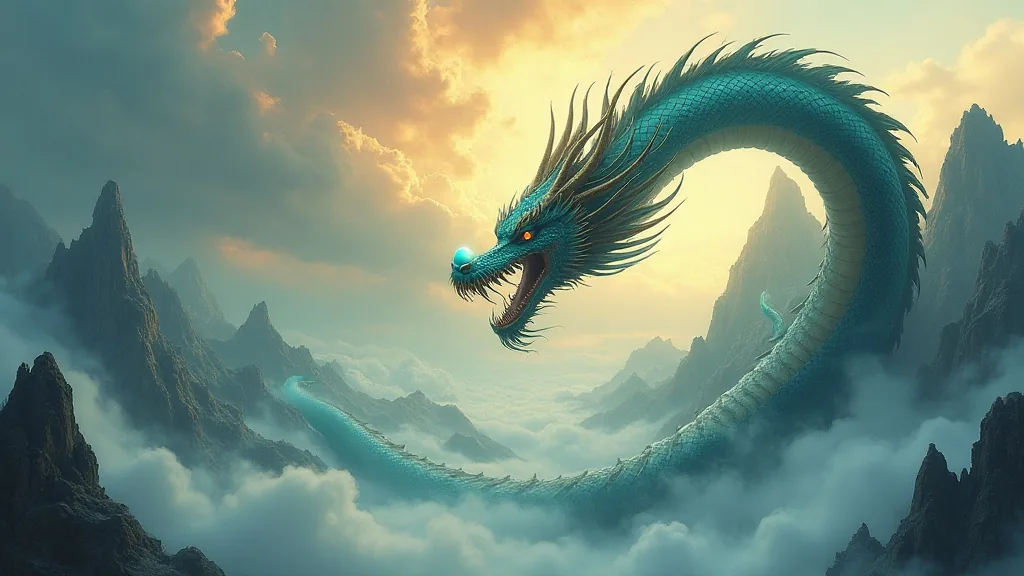
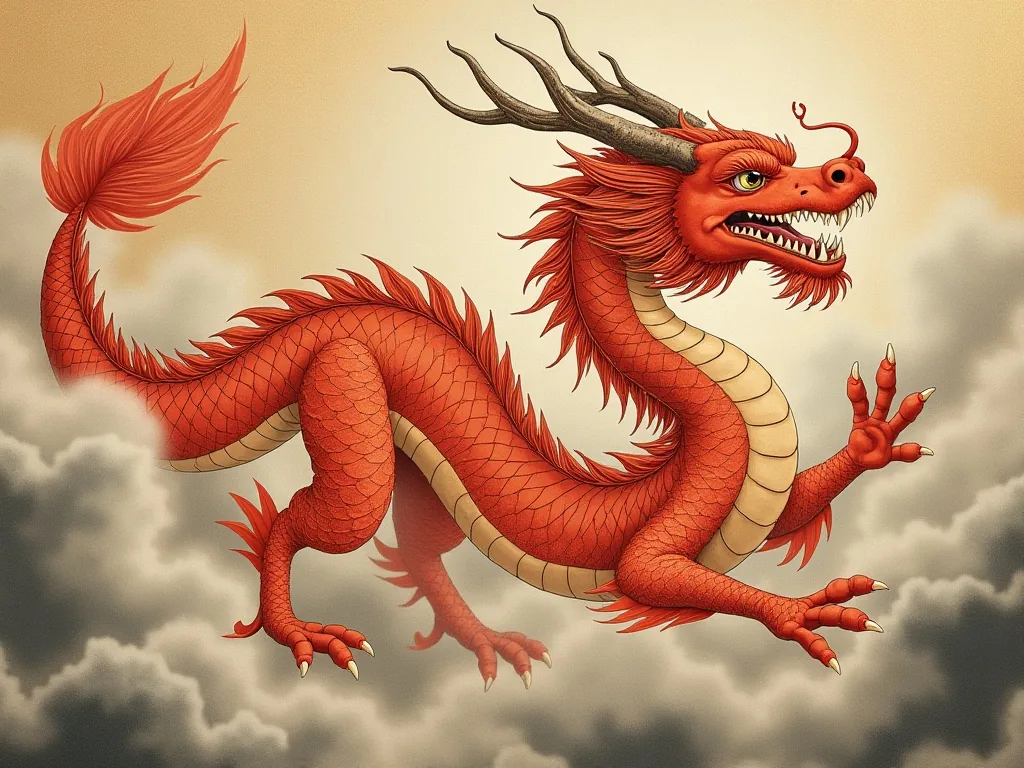
Its visual form alone encodes an entire cosmology. Classical texts describe the lóng as a composite creature: the horns of a stag, the head of a camel, the eyes of a demon, the neck of a snake, the belly of a clam, the scales of a carp, the claws of an eagle, the paws of a tiger, the ears of a cow. Each element is borrowed from a real animal considered auspicious or powerful. The dragon is therefore not one beast but a synthesis of the natural world, a living mandala of creation.
Origins: Dragons at the Birth of the World
The dragon's presence in Chinese cosmogony is ancient and multifaceted. Among the earliest mythological figures is Nüwa, the serpentine goddess who fashioned humanity from yellow earth and repaired the shattered sky. Though Nüwa is often depicted as half-human and half-serpent rather than as a dragon proper, she belongs to the same visual and conceptual lineage: the great scaled beings who precede human history and give shape to the world.
More explicitly draconic is Yinglong, the Winged Dragon, one of the oldest named dragons in Chinese myth. Yinglong served the Yellow Emperor, Huangdi, in the legendary wars against the rebel Chiyou. According to texts preserved in the Shanhaijing (Classic of Mountains and Seas), Yinglong unleashed floods to defeat Chiyou's armies, and afterward, because the winged dragon had spent so much celestial water, droughts plagued the southern lands wherever it came to rest. This myth encodes a profound ecological truth: the dragon is the rain cycle itself, and when its nature is disrupted, the land suffers.
The four Dragon Kings, the Lóng Wáng, represent the next great chapter in draconic mythology. Each rules one of the four seas surrounding the known world: the East Sea, the South Sea, the West Sea, and the North Sea. They dwell in vast underwater palaces and hold the power to grant or withhold precipitation. Heroes, gods, and emperors alike travel to their crystal halls to petition for rain during times of drought. The Dragon Kings appear throughout foundational literary epics, most famously in Journey to the West (16th century), where the East Sea Dragon King Ao Guang reluctantly surrenders his magical staff to the Monkey King Sun Wukong.
The Dragon and Imperial Power
No analysis of dragon symbolism in China can proceed without confronting the imperial dimension. From the Han dynasty onward, the dragon became inseparable from the institution of sacred kingship. The Yellow Emperor himself was said to have been born of a dragon's influence, and upon his death, a dragon descended from heaven to carry him bodily upward into immortality.
The five-clawed dragon, called the Tianlong or Celestial Dragon, was reserved exclusively for the emperor's personal iconography. Lesser nobles wore four-clawed dragons; commoners were forbidden the symbol entirely. This careful taxonomy of claws was not decorative pedantry. It was a cosmological grammar, a visual language that expressed every wearer's position in the hierarchy of heaven and earth.
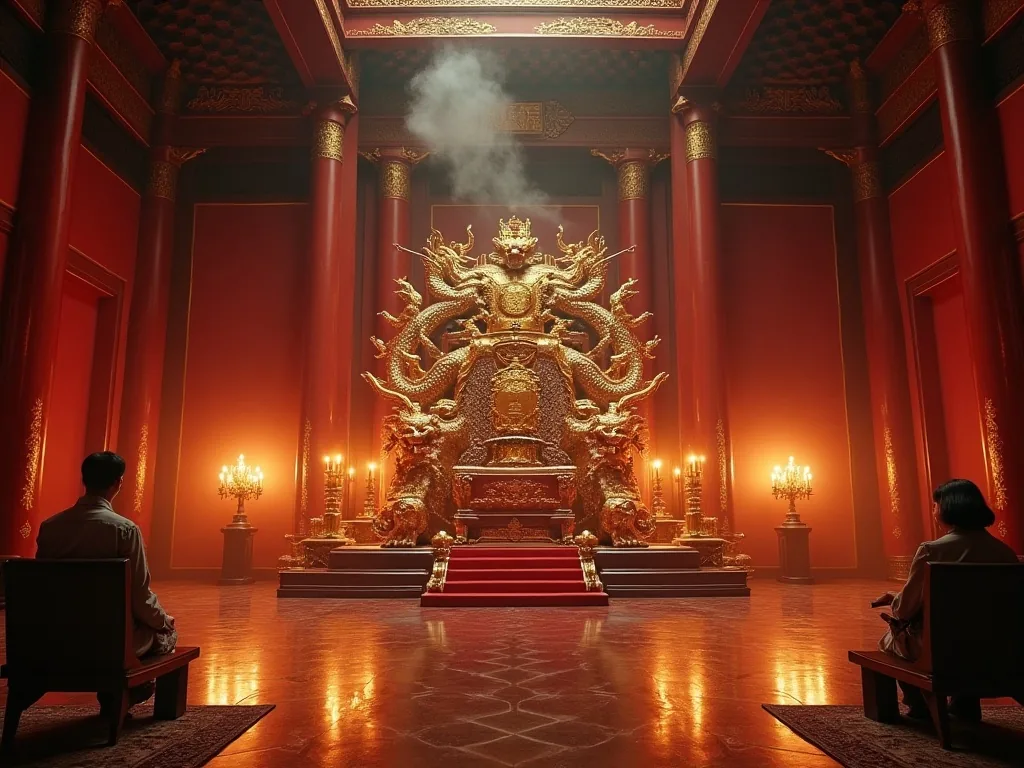
The emperor's throne was the Dragon Throne. His robes were Dragon Robes. His face, when described in court poetry, was the Dragon Countenance. The Forbidden City in Beijing is oriented along a south-north axis thought to align with celestial dragon energy, and its rooflines are punctuated with ceramic dragon figures that ward off malevolent forces. Imperial legitimacy, in the Chinese political theology that persisted for over two thousand years, was essentially a claim about one's relationship to draconic cosmic power.
Water, Rain, and the Agricultural Soul
Beyond the palace walls, the dragon's most immediate and vital symbolism was elemental: it was the master of water in all its forms. Rivers, lakes, seas, rain clouds, and even underground springs fell within its dominion. In a civilization built on rice cultivation and riverine agriculture, this was not metaphorical power. It was the power over survival itself.
Throughout Chinese history, local temples dedicated to Dragon Kings lined the banks of the Yellow River and the Yangtze. Farmers prayed to them at the start of the planting season. When floods devastated communities, local magistrates might formally reprimand a Dragon King, stripping his spirit tablet of its official title in a ceremony that blended bureaucratic order with religious sanction. The dragon, in other words, was not merely worshipped. It was held accountable, treated as a member of the cosmic civil service.
The Dragon Boat Festival, held on the fifth day of the fifth lunar month, extends this water symbolism into communal ritual. Though popularly associated with the poet Qu Yuan (c. 340 to 278 BCE), whose death by drowning is commemorated, the racing of long narrow boats decorated as dragons reaches into older water-propitiation rites. The boats were understood to awaken and honor the dragon spirits sleeping in the rivers, ensuring fertile rains for the growing season ahead.
The Pearl and the Pursuit of Perfection
One of the most recognizable motifs in dragon iconography is the flaming pearl, a luminous sphere that the dragon perpetually chases or guards. This pearl carries layered meanings across different periods and traditions. In Buddhist-influenced interpretations, it represents the wish-fulfilling jewel (cintamani), a symbol of enlightenment and spiritual perfection. In older, more purely Chinese contexts, it is the essence of the moon, or the concentrated power of thunder, or simply the dragon's own soul made visible and external.
The image of two dragons facing each other around a central pearl, a motif called "Two Dragons Playing with a Pearl," adorns temples, textiles, and porcelain across many centuries. It conveys cosmic balance, the dynamic tension of opposing forces held in harmonious relationship, an aesthetic and philosophical ideal at the heart of Chinese thought.
Dragons of the Sky and Earth
Chinese mythological tradition distinguishes several categories of dragon based on function and dwelling. The Tianlong, Celestial Dragons, support the heavens and the palaces of the gods. The Shenlong, Spirit Dragons, control wind and rain. The Fucanglong, Dragons of Hidden Treasure, coil beneath the earth guarding deposits of precious metals and ancient artifacts; their stirring is said to cause earthquakes. The Dilong, Earth Dragons, preside over rivers and streams.
This taxonomy reveals something important: the dragon is not a single symbol but a family of symbols, each calibrated to a different domain of the natural and supernatural world. The lóng permeates every level of the cosmos, from the vault of heaven to the deepest vein of ore. Nothing lies entirely outside its influence.
The Dragon in the Stars
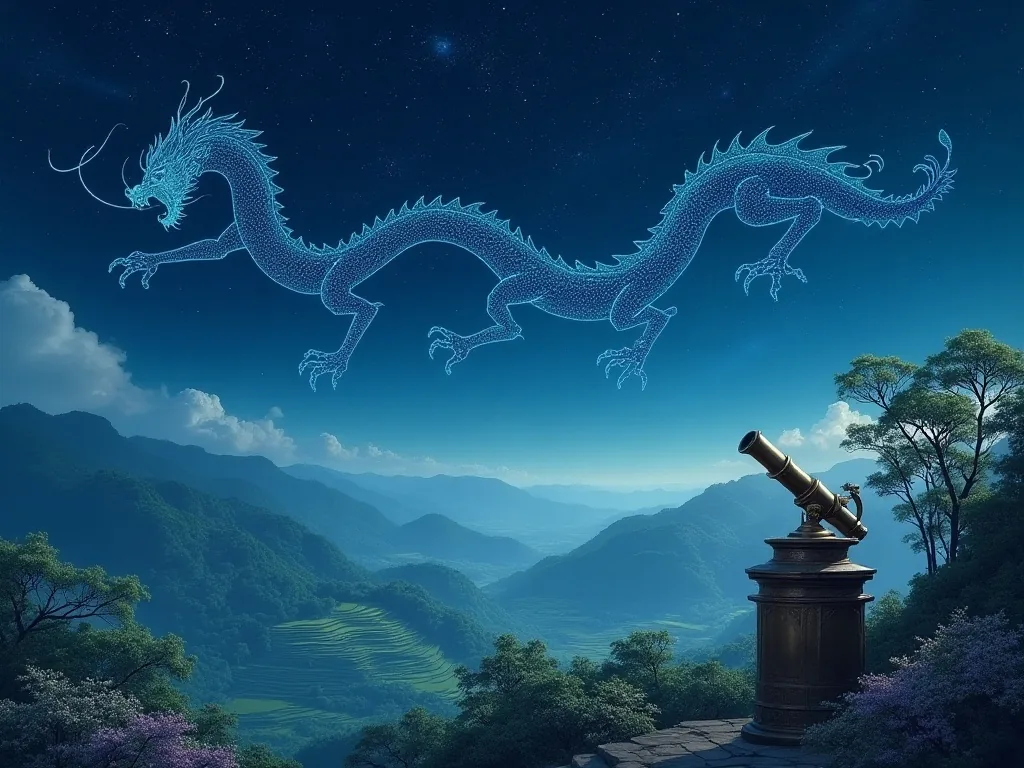
The Azure Dragon of the East, Qinglong, is one of the Four Symbols of Chinese astronomy, a system of celestial mapping that groups stars into four palace quadrants. Qinglong governs the eastern quadrant of the sky, a region associated with spring, wood (one of the five elements), and the color blue-green. The stars that compose this celestial dragon, including the constellation Jiao (Horn), trace a sinuous path across the spring sky, and their rising heralded the planting season.
This astronomical dimension binds the dragon permanently to time itself. It is not only a creature of space, of rivers and rain. It is a marker of the year's rhythm, rising and falling with the seasons, a living calendar written in light across the night sky.
The Dragon in Literature and Living Tradition
Classical Chinese literature is saturated with dragons. The Shanhaijing alone catalogs dozens of specific draconic beings tied to mountains, waters, and celestial phenomena. The Tang dynasty poet Li Bai invokes dragons in nearly mystical terms, associating them with the untameable energies of inspiration and genius. In the great Ming dynasty novel Investiture of the Gods (Fengshen Yanyi), dragons serve as mounts, weapons, and divine agents in a war between cosmic factions.
The dragon's presence in living cultural tradition is equally vigorous. The Chinese zodiac places the Dragon as the fifth sign, the only member of the twelve that is a mythological creature rather than a real animal. Children born in Dragon years are believed to inherit the creature's vitality, charisma, and luck. Dragon dances performed at Lunar New Year celebrations carry the ancient purpose of awakening propitious energies, the long undulating body of fabric and bamboo threading through city streets as a physical enactment of cosmic renewal.
In the martial arts traditions, dragon-style kung fu codifies the dragon's movement, fluid yet powerful, into a system of combat philosophy. The dragon does not fight with brute force alone. It moves like water, circles like thought, strikes like lightning.
The Dragon as Cosmic Principle
Ultimately, the dragon in Chinese mythology functions as something rarer and more sophisticated than a deity or a monster. It functions as a principle, a living embodiment of the generative, transformative energy that Chinese philosophy names qi (氣). Where qi concentrates and flows freely, life flourishes. The dragon is qi given form, given scale and claw and the smell of rain before it falls.
Geomancers practicing feng shui speak of "dragon veins," the lóng mài, pathways of favorable energy running through the landscape. Auspicious sites for homes and tombs are chosen where these veins converge. Mountains are understood as the petrified bodies of dragons, their ridgelines the spines of vast sleeping creatures whose dreaming sustains the vitality of the land above them.
This is the deepest layer of dragon symbolism in Chinese myth: not power over others, but power that is the world. The lóng does not stand apart from nature and dominate it. The lóng is what nature does when it is most fully and magnificently itself, coiling through time, breathing the seasons into motion, holding the sky and the earth in its ancient, luminous embrace.
Read the full book
Want the whole story?
The complete edition is an instant PDF download here, with a paperback on Amazon for selected titles.
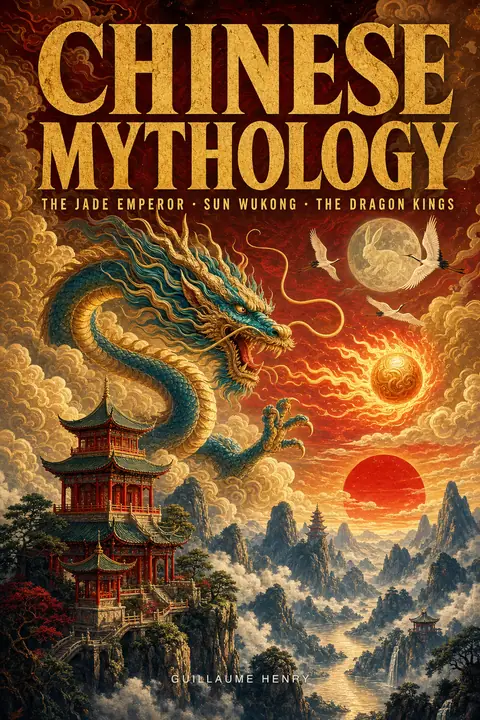
Chinese
The Chinese Mythology Book: Pangu, Nuwa, the Jade Emperor, and the Sacred Stories of the World's Oldest Living Tradition
5,000 Years of Dragons, Immortals, and the Celestial Court
From Pangu's creation to Sun Wukoku's rebellion: the unbroken mythological tradition of China, spanning the Yellow Emperor, Nuwa's clay humans, and the Jade Emperor's court.
More from Chinese
All articles
Chinese
Sun Wukong: The Monkey King and Trickster Hero
Sun Wukong, the Monkey King of Journey to the West, rebels against heaven, masters 72 transformations, and escorts a monk to India. His story explained.
Chinese
Jade Emperor: Supreme Ruler of Heaven and the Celestial Bureaucracy
The Jade Emperor governs heaven through a celestial bureaucracy mirroring imperial China. His origins, trials, and role in Daoist cosmology.