
Sun Wukong: The Monkey King and Trickster Hero
Sun Wukong, the Monkey King of Journey to the West, rebels against heaven, masters 72 transformations, and escorts a monk to India. His story explained.
Contents
Sun Wukong, the Monkey King, is the central hero of the 16th-century Chinese novel Journey to the West, a trickster figure born from a stone who rebels against heaven, achieves immortality through Daoist and Buddhist practices, and ultimately attains enlightenment as a protector of the Buddhist monk Xuanzang on a pilgrimage to India. The novel, attributed to Wu Cheng'en and published during the Ming dynasty, synthesizes centuries of oral folklore, Buddhist pilgrimage narratives, and Yuan dynasty plays into a single epic that balances comedy, cosmology, and spiritual allegory. Sun Wukong remains one of the most widely recognized figures in Chinese mythology, embodying the tension between individualism and obedience, chaos and order, rebellion and redemption.
Most treatments reduce him to a lovable rebel or a simple trickster archetype. But the Monkey King's story is layered with Daoist alchemy, Buddhist soteriology, and Confucian hierarchy, all colliding in a single character who defies heaven, mocks gods, and still finds his way to Buddhahood. The novel's structure reflects Ming dynasty anxieties about authority, merit, and the limits of self-cultivation.
Origins: Stone, Monkey, and the Flower Fruit Mountain
Sun Wukong is born from a stone egg atop the Mountain of Flowers and Fruit, nourished by heaven and earth. The first chapter of Journey to the West describes the stone as having "contained the seeds of Heaven and Earth" and absorbing the essence of sun and moon until it cracks open, releasing a fully formed stone monkey. He joins a troop of monkeys, discovers a waterfall cave behind a curtain of water, and earns the title "Handsome Monkey King" by leaping through the cascade.
The stone birth is no accident. It places Sun Wukong outside the normal cycles of birth and death, beyond the jurisdiction of the underworld registers that record mortal lifespans. He is a creature of pure potential, unbound by filial duty or cosmic hierarchy. This origin distinguishes him from human heroes and gods alike.
Disturbed by the inevitability of death, the Monkey King leaves his mountain to seek immortality. He travels across the sea on a raft, arrives at the cave of the Daoist patriarch Subhodi, and spends years learning the arts of transformation, combat, and the cloud somersault that lets him travel 108,000 li in a single leap. Subhodi eventually expels him, fearing the chaos his student will unleash, but the damage is done. Sun Wukong returns to Flower Fruit Mountain armed with powers that place him beyond the reach of heaven and hell.
The Rebellion Against Heaven
Titles, Insults, and the Heavenly Peach Banquet
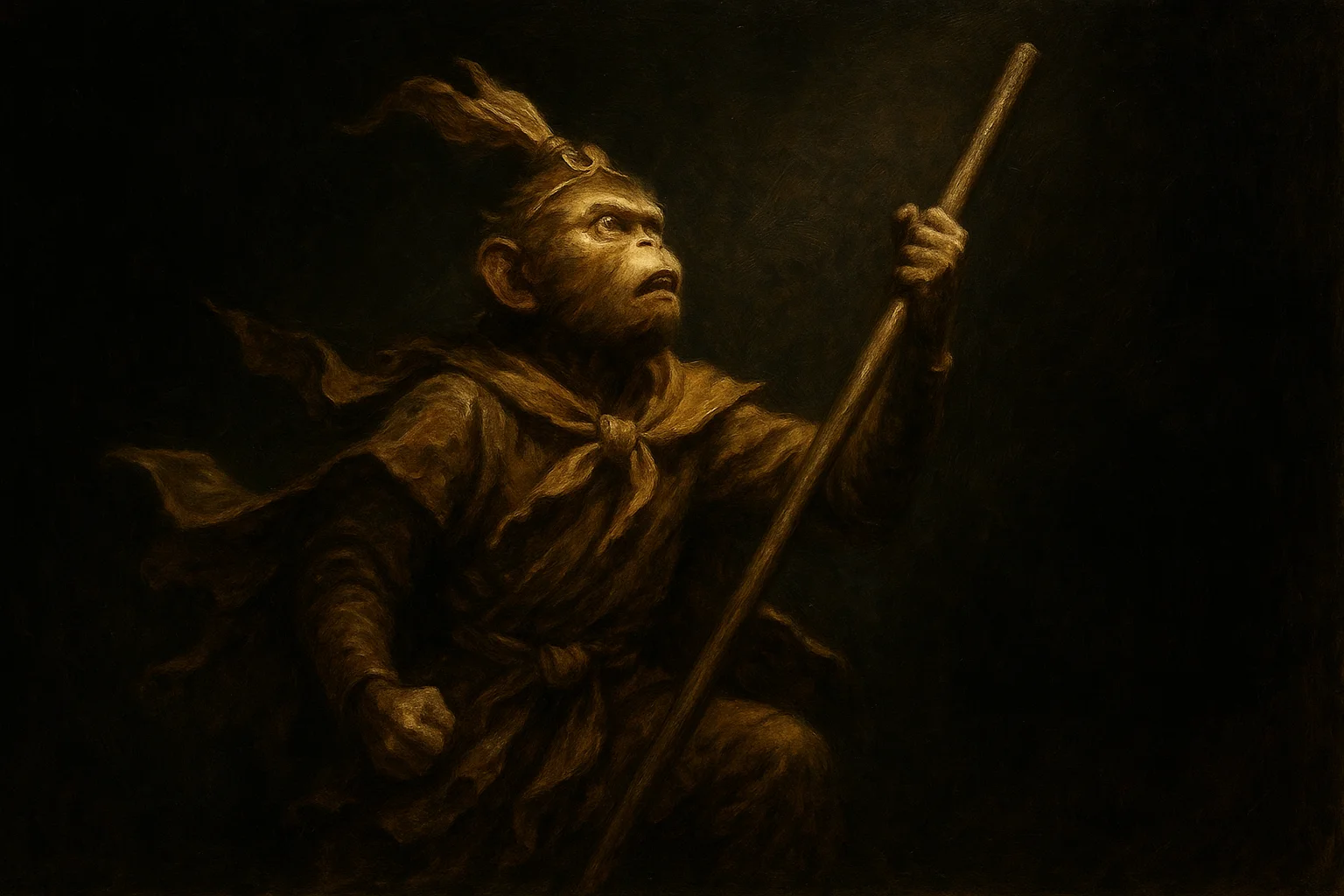
The Monkey King's rebellion begins with bureaucracy. After he storms the underworld and strikes his name from the registers of death, making himself and his monkey subjects immortal, the Jade Emperor summons him to heaven to keep him under control. Sun Wukong is given the title "Keeper of the Heavenly Horses," a lowly stable position. When he discovers the insult, he storms out, declares himself "Great Sage Equal to Heaven," and raises a banner on his mountain.
Heaven tries appeasement. The Jade Emperor grants him the invented title and assigns him to guard the Garden of Immortal Peaches. The peaches ripen every 3,000, 6,000, or 9,000 years and grant varying degrees of immortality. Sun Wukong eats them all. He then crashes the Peach Banquet of the Queen Mother of the West, devours the food and wine meant for the gods, and steals the elixir of immortality from Laozi's laboratory, consuming it in handfuls. By the time he returns to his mountain, he has achieved five or six layers of immortality through overlapping Daoist and Buddhist methods.
The Battle with the Celestial Army
The Jade Emperor sends 100,000 celestial soldiers to subdue the Monkey King. Sun Wukong defeats them. He fights the Four Heavenly Kings, the 28 constellations, and the planet deities. He multiplies himself by plucking hairs from his body and blowing on them, creating thousands of duplicates. He transforms into gods, demons, and insects to confuse his enemies. The celestial generals cannot capture him.
Heaven calls in Erlang Shen, a warrior deity with his own history of defying heaven. The two fight to a standstill, matching transformation for transformation: Erlang becomes a bird, Sun Wukong becomes a fish; Erlang becomes a fish, Sun Wukong becomes a water snake. Laozi finally intervenes, dropping his diamond snare from above and stunning the Monkey King long enough for Erlang's dog to bite him. He is captured.
Capture and the Five Elements Mountain
Heaven tries to execute Sun Wukong. They place him in Laozi's furnace to burn away his stolen immortality. After 49 days, he kicks open the furnace, his eyes now able to see through any disguise, and resumes his rampage. The Jade Emperor appeals to the Buddha.
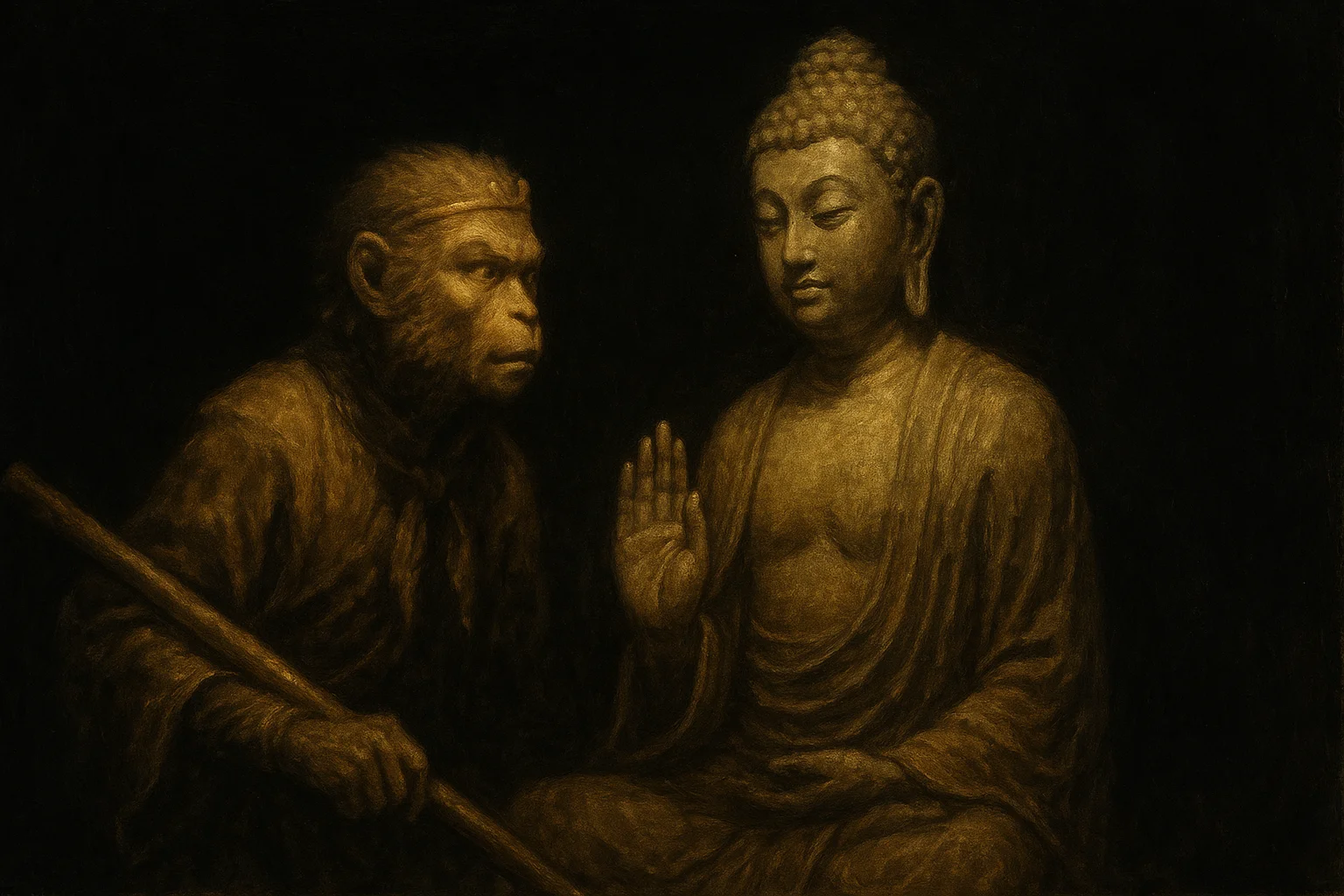
The Buddha makes a wager. If Sun Wukong can somersault beyond the Buddha's palm, he will be granted the Jade Emperor's throne. If not, he must submit. The Monkey King leaps, travels for what seems like eons, reaches five pillars he assumes mark the edge of the universe, urinates on one to mark his territory, and returns. The Buddha reveals that the five pillars were his fingers. He overturns his hand and traps Sun Wukong beneath a mountain formed from the five elements, sealing it with a strip of paper inscribed with the mantra "Om Mani Padme Hum." The Monkey King remains imprisoned for 500 years, fed iron pellets and molten copper by a local spirit, until the monk Xuanzang arrives.
Journey to the West: Disciple, Protector, and Pilgrim
The Golden Headband and Obedience
Xuanzang, a historical monk who traveled to India in the seventh century to retrieve Buddhist scriptures, becomes the narrative center of the second half of Journey to the West. The bodhisattva Guanyin recruits Sun Wukong to serve as Xuanzang's bodyguard. The Monkey King agrees, desperate for freedom. Xuanzang removes the seal, and Sun Wukong is released.
But freedom comes with conditions. Guanyin tricks Sun Wukong into wearing a golden headband that tightens whenever Xuanzang recites the "headache sutra," a spell that causes excruciating pain. The headband cannot be removed. It transforms the Monkey King from a rebel into a servant, his vast power now leashed to a fragile monk who cannot defend himself. The tension between obedience and autonomy drives much of the novel's drama.
Xuanzang is pious, naive, and frequently kidnapped. Sun Wukong is cynical, violent, and pragmatic. The two clash constantly. The monk scolds his disciple for killing demons in disguise; Sun Wukong argues that mercy toward monsters endangers the mission. The headband enforces compliance, but it does not erase the Monkey King's resentment.
Demons, Disguises, and the 81 Trials
The pilgrimage to the Western Heaven involves 81 trials, most of them orchestrated by demons who wish to eat Xuanzang's flesh, which grants immortality. Sun Wukong fights spider spirits, bone demons, ox kings, and rogue Daoist immortals. Many demons are fallen celestial beings or escaped mounts of bodhisattvas, a recurring motif that underscores heaven's imperfect control over its own agents.
The most famous episode involves the White Bone Demon, who transforms into a young woman, an old woman, and an old man to deceive Xuanzang. Sun Wukong sees through each disguise with his fiery eyes and kills all three forms. Xuanzang, convinced his disciple has murdered innocent villagers, recites the headband sutra and banishes him. Only after Sun Wukong saves him from certain death does the monk relent. The pattern repeats: rebellion, punishment, reconciliation.
"You may have great magic powers, but you are still my disciple. If you disobey, I will recite the spell, and you will know the meaning of suffering." Xuanzang to Sun Wukong, Journey to the West, chapter 27
The pilgrimage is not a hero's journey in the Western monomyth sense. It is a test of endurance, humility, and obedience. Sun Wukong does not grow stronger; he learns restraint. The novel's Buddhist framework insists that power without discipline is suffering, and that enlightenment requires submission to a higher order.
Powers, Weapons, and the 72 Transformations
Sun Wukong masters 72 transformations, allowing him to become animals, objects, or other people. He can transform individual hairs into clones, each capable of independent action. He can shrink to the size of an insect or grow large enough to touch the clouds. The transformations are not perfect: his tail often gives him away, a recurring joke in the novel.
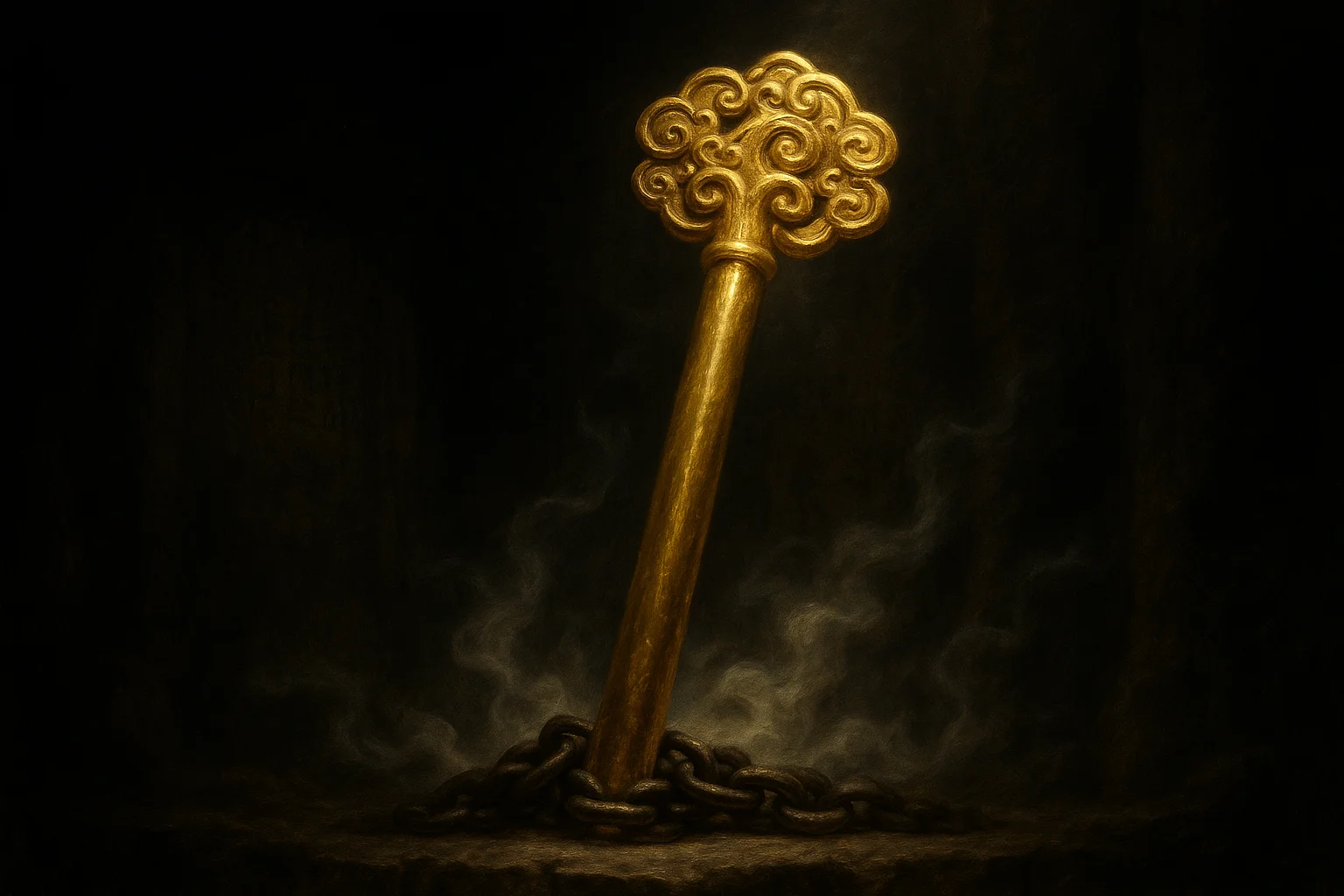
His primary weapon is the Ruyi Jingu Bang, a staff taken from the palace of the Dragon King of the Eastern Sea. It responds to his will, growing or shrinking on command, and is indestructible. He stores it behind his ear when not in use, shrunk to the size of a needle. The staff is both a symbol of his defiance and a tool of his redemption, used to protect Xuanzang rather than to challenge heaven.
Other powers include:
- Cloud somersault: travel 108,000 li (about 33,000 miles) in a single leap
- Fiery eyes and diamond pupils: see through illusions and disguises
- Invulnerability: layered immortality from peaches, elixir, and Daoist practices
- Superhuman strength: capable of lifting mountains and fighting gods
- Hair clones: pluck and animate hairs into copies of himself or other forms
These abilities place him among the most powerful figures in Chinese mythology, rivaled only by the highest Daoist immortals and Buddhist bodhisattvas. Yet the novel insists that raw power is meaningless without wisdom. Sun Wukong's strength cannot free him from the headband, and his immortality cannot grant him peace.
Trickster, Rebel, and Enlightened Buddha
Sun Wukong fits the mold of trickster figures across cultures: he defies authority, disrupts cosmic order, and uses cunning over brute force when it suits him. Like Loki in Norse myth or Anansi in West African traditions, he operates at the margins of divine society, neither fully god nor fully mortal. But unlike many tricksters, he is offered redemption.
The novel's Buddhist framework transforms rebellion into a stage of spiritual development. Sun Wukong's defiance of heaven is reframed as ignorance, his violence as attachment, his pride as delusion. The pilgrimage is his path to enlightenment, and the 81 trials are his purification. At the journey's end, the Buddha grants him the title "Victorious Fighting Buddha," a rank that acknowledges both his martial prowess and his spiritual transformation.
Early Sun Wukong (Chapters 1-7)
Seeks immortality for himself, rebels against hierarchy, values freedom above all, uses power to dominate, mocks gods and refuses submission.
Later Sun Wukong (Chapters 13-100)
Protects Xuanzang, submits to the headband, uses power to serve the mission, learns patience and restraint, earns Buddhahood through obedience.
This transformation is not universally celebrated. Some readers see the headband as a betrayal of the character's anarchic spirit, a symbol of authoritarian control dressed in religious language. Others interpret it as a necessary humbling, the taming of ego required for enlightenment. The novel supports both readings, which is part of its enduring power.
Sources and Evolution: From Folklore to Ming Novel
The figure of the Monkey King predates Journey to the West by centuries. The earliest known version appears in The Story of How Tripitaka of the Great Tang Procures the Scriptures, a 13th-century narrative in which a monkey spirit named Hou Xing assists the monk on his pilgrimage. Yuan dynasty zaju plays from the 13th and 14th centuries feature a monkey character with supernatural powers, though his role varies.
Buddhist influences are clear. The Ramayana's Hanuman, the monkey general who aids Rama, likely influenced the Chinese monkey figure through the transmission of Buddhist texts along the Silk Road. Jataka tales, which recount the Buddha's previous lives, include monkey characters who demonstrate wisdom and self-sacrifice. These elements merged with indigenous Chinese folklore about mountain spirits and Daoist immortals.
Wu Cheng'en, a Ming dynasty scholar-official, is traditionally credited with authoring Journey to the West, though the attribution is debated. The novel was published around 1592 and quickly became a cultural touchstone. It blends vernacular language with classical allusions, making it accessible to a broad audience while rewarding educated readers with layers of religious and philosophical commentary.
The novel reflects Ming anxieties about authority and merit. The Jade Emperor's heaven is a bureaucracy, complete with petty officials and arbitrary titles. Sun Wukong's rebellion can be read as a critique of a system that values rank over ability. His eventual submission, however, suggests that individual genius must be channeled through collective purpose. The tension is never fully resolved.
Legacy and Modern Adaptations
Sun Wukong has been adapted into opera, film, television, comics, and video games across East Asia and beyond. In China, he appears in Peking opera as a stock character, his acrobatic movements and painted face instantly recognizable. The 1986 Chinese television series Journey to the West remains the definitive adaptation for many viewers, airing annually during holidays.
Japanese manga and anime have reimagined the character repeatedly. Dragon Ball's Son Goku is a direct homage, borrowing the staff, the cloud, and the tail. The character appears in video games like League of Legends, Smite, and the action title Black Myth: Wukong, which sold millions of copies within days of release in 2024.
Western adaptations often strip away the Buddhist framework, emphasizing the trickster rebel over the penitent pilgrim. The 2008 film The Forbidden Kingdom and the 2010 remake of The Karate Kid both feature Sun Wukong as a symbol of martial prowess and individualism, sidelining the themes of obedience and enlightenment central to the novel.
The Monkey King's appeal lies in his contradictions. He is powerful yet imprisoned, rebellious yet redeemed, immortal yet still learning. He embodies the fantasy of absolute freedom and the reality that freedom without purpose is just another form of suffering. The story endures because it refuses to simplify him.
Frequently asked questions
Who is Sun Wukong and where does his story come from?
Sun Wukong, the Monkey King, is the protagonist of the 16th-century Chinese novel Journey to the West, attributed to Wu Cheng'en, in which he serves as the bodyguard and disciple of the Buddhist monk Xuanzang on a pilgrimage to India to retrieve sacred scriptures. His character evolved from earlier Chinese folklore, 13th-century Buddhist pilgrimage narratives, and Yuan dynasty plays, with influences from the Indian epic Ramayana and its monkey hero Hanuman. The novel synthesizes Daoist, Buddhist, and Confucian themes into a single narrative of rebellion, punishment, and redemption.
Why did Sun Wukong rebel against the Jade Emperor and heaven?
Sun Wukong rebelled against heaven after being insulted with the lowly title "Keeper of the Heavenly Horses," a bureaucratic position that belittled his immense power and self-declared status as "Great Sage Equal to Heaven." He then ate the Peaches of Immortality, crashed the Queen Mother's banquet, and consumed Laozi's elixir of immortality, achieving multiple layers of invulnerability and defying the cosmic hierarchy. His rebellion reflects a rejection of arbitrary authority and a refusal to accept a subordinate role in a system that values rank over merit.
What are the 72 transformations and what other powers does the Monkey King possess?
The 72 transformations allow Sun Wukong to change his form into animals, objects, or other people, and to create clones by plucking and animating hairs from his body, each capable of independent action. He also masters the cloud somersault, which lets him travel 108,000 li in a single leap, and possesses fiery eyes that see through illusions and disguises. His weapon, the Ruyi Jingu Bang, is a magical staff that changes size at will and weighs over 17,000 pounds, and his layered immortality makes him nearly indestructible.
How does Sun Wukong change during the pilgrimage in Journey to the West?
Sun Wukong transforms from a self-serving rebel who defies heaven into a disciplined protector who uses his power to serve the monk Xuanzang and the Buddhist mission to retrieve scriptures from India. The golden headband placed on his head by the bodhisattva Guanyin forces obedience through pain, and the 81 trials of the pilgrimage teach him patience, humility, and restraint. At the journey's end, he is granted the title Victorious Fighting Buddha, signaling his spiritual enlightenment and integration into the Buddhist cosmological order.
Is Sun Wukong a trickster god or a Buddhist hero?
Sun Wukong functions as both a trickster figure and a Buddhist hero, embodying the tension between chaos and order, rebellion and redemption, that runs throughout Journey to the West. He shares traits with trickster figures across cultures, including defiance of authority, shape-shifting, and cunning, but the novel's Buddhist framework reinterprets his rebellion as ignorance and his journey as a path to enlightenment. His final transformation into the Victorious Fighting Buddha suggests that even the most anarchic spirit can be redeemed through discipline and service.
What are the historical sources for the Monkey King legend?
The earliest known source is The Story of How Tripitaka of the Great Tang Procures the Scriptures, a 13th-century narrative featuring a monkey spirit named Hou Xing who aids the monk Xuanzang. Yuan dynasty zaju plays from the 13th and 14th centuries further developed the character, and Buddhist texts such as the Jataka tales and the Ramayana likely influenced the figure through cultural exchange along the Silk Road. Wu Cheng'en's Journey to the West, published around 1592, synthesized these earlier traditions into the definitive version of the Monkey King's story.
Further reading on Mythologis
Read the full book
Want the whole story?
The complete edition is an instant PDF download here, with a paperback on Amazon for selected titles.
Chinese
The Chinese Mythology Book: Pangu, Nuwa, the Jade Emperor, and the Sacred Stories of the World's Oldest Living Tradition
5,000 Years of Dragons, Immortals, and the Celestial Court
From Pangu's creation to Sun Wukoku's rebellion: the unbroken mythological tradition of China, spanning the Yellow Emperor, Nuwa's clay humans, and the Jade Emperor's court.
More from Chinese
All articles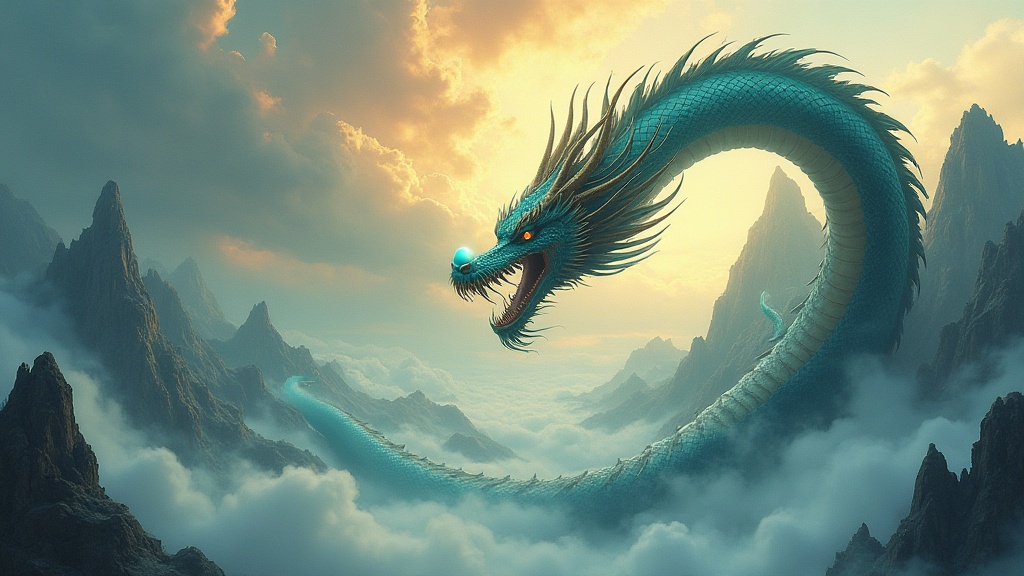
Chinese
The Dragon Symbolism in Chinese Myth: Sovereign of Waters, Heaven, and Time
In Chinese mythology, the dragon is not a monster to be slain but a cosmic sovereign: lord of rivers, rain, and imperial destiny. Its symbolism reaches from creation itself to the bones of the earth.
Chinese
Jade Emperor: Supreme Ruler of Heaven and the Celestial Bureaucracy
The Jade Emperor governs heaven through a celestial bureaucracy mirroring imperial China. His origins, trials, and role in Daoist cosmology.