
Kitsune: The Fox Spirit of Japanese Mythology
The kitsune is Japan's most storied supernatural creature: a fox of shifting form, ancient intelligence, and divine allegiance. From rice-field shrines to imperial courts, its nine tails have cast shadows across two millennia of myth.
Contents
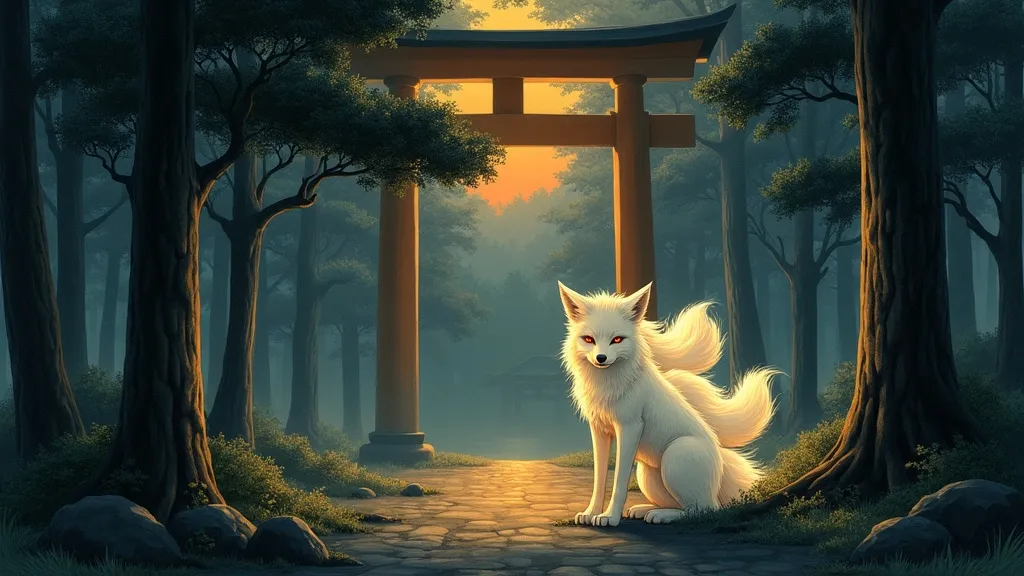
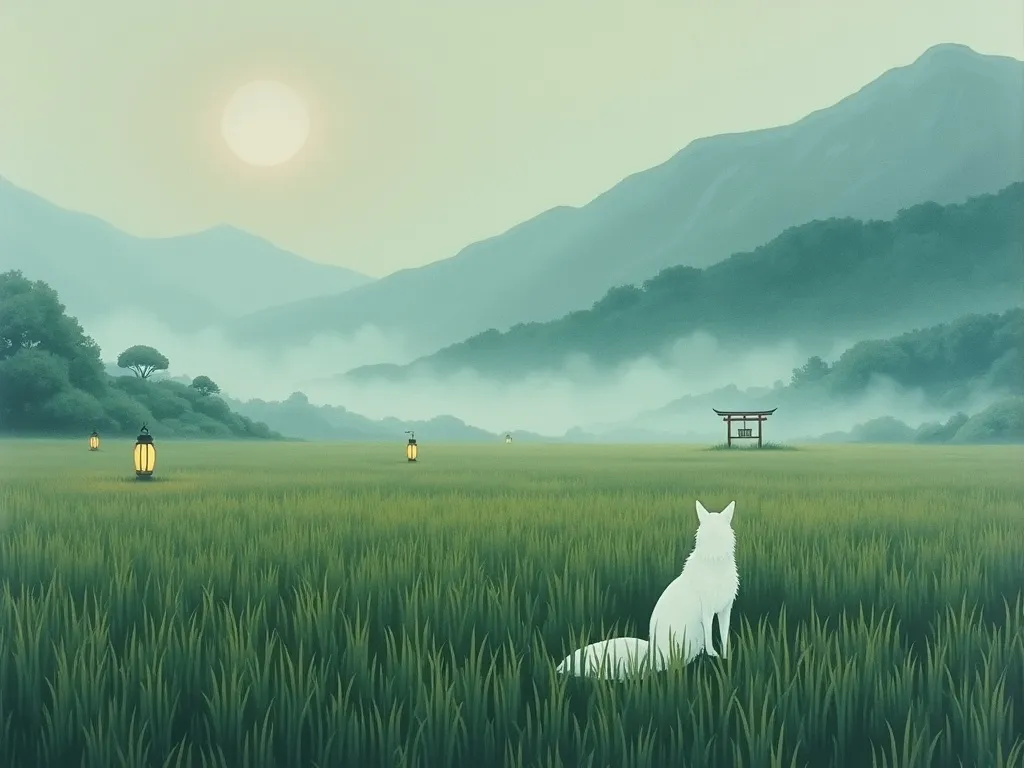
A white fox sits at the edge of a forest, watching a lantern-lit procession wind through the rice fields below. It does not move. It does not flee. It counts the torches with eyes that have watched dynasties rise and fall, and when the last torch disappears around the mountain road, it stands upright, shakes its seven tails, and takes the shape of a woman.
This is kitsune the fox spirit at its most elemental: patient, observant, liminal. Neither fully animal nor fully divine, neither reliably benevolent nor simply malicious. The kitsune occupies a specific fold in Japanese cosmology, one that no other creature quite fills. It is the messenger of the rice god Inari, the trickster that humbles proud samurai, the loyal wife who vanishes the morning her secret is discovered, and the nine-tailed celestial being that earns its place among the kami after a thousand years of practice.
Few figures in world mythology carry as many simultaneous, contradictory identities as the kitsune does. That contradiction is not a flaw in the tradition; it is the tradition's most precise statement about the nature of intelligence itself.
From Animal to Omen: The Early History of Fox Belief in Japan
The fox arrived in Japanese religious life long before the kitsune mythology crystallised into the form known today. Fox bones appear in Yayoi-period archaeological sites (roughly 300 BCE to 300 CE), where the animal lived close to the grain stores that attracted rodents and therefore attracted human settlement. That proximity bred familiarity, and familiarity, in archaic Japanese religious logic, bred the suspicion of spiritual potency. Animals that lived between the domestic and the wild were inherently suspect, inherently powerful.
Chinese literary influence accelerated this process. The Tang-dynasty encyclopaedia Youyang Zazu (ninth century CE) and earlier Han texts had already codified the huli jing, the Chinese fox-spirit, as a creature capable of seduction, shapeshifting, and spiritual accumulation across centuries of life. When these texts crossed into Japan via the Korean peninsula and the Nara-period Buddhist missions, Japanese readers absorbed Chinese fox lore and refracted it through their own animistic cosmology.
The earliest Japanese textual record of a shapeshifting fox appears in the Nihon Ryoiki (c. 822 CE), a collection of Buddhist miracle tales compiled by the monk Kyokai. It describes a fox woman who marries a man, bears him children, and is eventually exposed by the household dog before fleeing into the fields. Even in this bare early account, the core pattern is in place: the fox lives among humans in human form, forms genuine attachments, and is undone by an animal that can perceive its true nature.
The Nihon Shoki (720 CE), Japan's second-oldest chronicle, references white foxes as auspicious omens brought to the emperor's court. The whiteness mattered. White animals occupied a special register in Nara-period omen culture, marking contact between the human world and the realm of the kami. A white fox was not simply a freak of nature; it was a message.
Inari and the Sacred Fox: A Relationship Without Equal
No relationship in Japanese mythology defines kitsune the fox spirit more thoroughly than the bond with Inari, the kami of rice and prosperity. Inari shrines number around 30,000 across Japan, making Inari one of the most widely venerated kami in the entire Shinto pantheon. At every single one of these shrines, fox statues guard the entrance. The foxes are not Inari. They are Inari's tsukaishime, divine messengers and servants.
The theological relationship between Inari and the fox developed gradually across the Heian and Kamakura periods. Inari's original domain was grain, specifically rice, and the foxes that kept rodent populations down near granaries made practical, visible sense as the god's earthly agents. By the Heian period (794-1185 CE), the fox's role had extended far beyond pest control into active mediation between worshippers and the deity. A supplicant who made offerings at an Inari shrine was, in effect, asking the kitsune to carry the prayer forward.
This creates a theological layer of unusual complexity. The fox-messenger is subordinate to Inari and yet it is also the only effective intermediary. The messenger becomes, practically speaking, indispensable. The statues at Inari shrines often show the foxes holding objects in their mouths: a sheaf of rice, a scroll, a key, or a jewel. Each object encodes a specific petition. The fox with the key unlocks the rice storehouse; the fox with the jewel is associated with wish-fulfillment and spiritual illumination.
Over time, the distinction between Inari and the fox blurred in popular devotion. Some worshippers came to treat the fox statues themselves as primary objects of veneration rather than mere conduits, a development that Buddhist and Shinto clerics periodically pushed back against without much lasting success.
The Nine Tails: Ranking a Supernatural Hierarchy
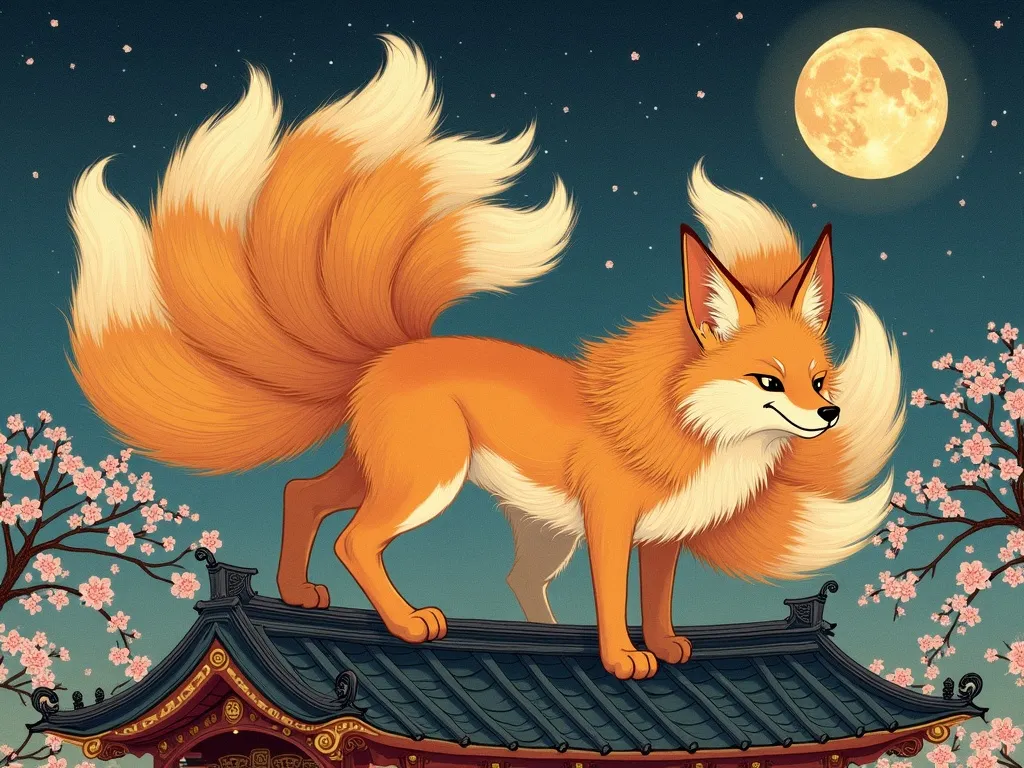
Japanese folklore built a precise internal system for classifying kitsune power, and the tail count sits at the centre of that system. A fox lives a century without special incident, then begins its supernatural life with a second tail. Each additional century of life, paired with accumulated spiritual practice, yields another tail. The math is unforgiving: a nine-tailed kitsune is at minimum nine hundred years old, and most accounts suggest the full millennium is required for the final transformation.
The transformation at nine tails is qualitative, not merely quantitative. The Genkotsu and several medieval otogi-zoshi (companion tales) describe the ninth tail as the point at which the kitsune either becomes a divine protector or a cosmic threat, depending on the moral character it has cultivated across its centuries. A kitsune with nine tails that chose a path of deception becomes something genuinely dangerous: a being with near-complete knowledge of human affairs and no remaining loyalty to human welfare. A kitsune that chose virtue becomes something close to a kami itself.
Two types of kitsune recur most consistently across the literary and religious record:
- Zenko (善狐, good foxes): Associated with Inari, white or gold in colour, benevolent toward humans and capable of granting blessings, healing illness, and driving away malevolent spirits.
- Yako (野狐, field foxes): Also called nogitsune, these are the trickster and possessing foxes. They are not simply evil but are morally unmoored, pursuing their own agendas with no particular concern for human welfare.
The nogitsune became the primary subject of kitsunetsuki (fox possession) beliefs, a phenomenon that Japanese medical and religious literature documented extensively from the Heian period through the Meiji era. A person suffering from what modern observers might classify as a dissociative or psychotic episode was frequently diagnosed as having been entered by a nogitsune. The cure involved shrine rituals, Buddhist exorcism, or, in some accounts, simply feeding the fox-spirit the foods it craved until it departed willingly.
Shapeshifting and the Art of the Perfect Human Disguise
The kitsune's power to take human form, henge in Japanese, is the engine driving the most resonant stories in the tradition. The mechanics of the transformation carry precise rules, and the vulnerabilities built into those rules generate almost every plot twist in kitsune literature.
Young kitsune are imperfect shapeshifters. They forget to hide their tail. A lantern held at the right angle casts their fox-shadow even while they walk in human form. They cannot cross running water without their disguise slipping. They flinch at the barking of dogs. They may eat too quickly, or sit in ways that betray the animal posture underneath the borrowed human body. Older, more powerful kitsune shed these tells one by one, but even the most ancient may be exposed by a mirror, which reflects their true form, or by a child, whom Japanese folk belief often held capable of perceiving what adults had been trained not to see.
The most celebrated shapeshifting narrative in the entire tradition is that of Tamamo-no-Mae, set in the court of Emperor Konoe in the twelfth century. A woman of extraordinary beauty and learning appeared at court, able to answer any question posed by scholars, astrologers, or Buddhist monks. The emperor fell gravely ill. An astrologer, Abe no Yasuchika, conducted a divination and identified the woman as the source of the malignancy. She was exposed during a ritual at which all lights were extinguished: when the flames were doused, her body itself glowed with golden light, and the court saw briefly the nine-tailed white fox beneath the silk robes before it fled north.
The story does not end there. The fleeing fox was hunted down on the Nasu plain by the warriors Miura-no-suke and Kazusanosuke, commanding a force of several hundred thousand soldiers according to the most expansive versions. When it was cornered and killed, its malevolent spirit entered a large stone, the Sessho-seki or "killing stone," which was said to emit poisonous vapors for centuries afterward. In 2022, a real stone at Nasu in Tochigi Prefecture that had been identified with this legend cracked apart naturally, reigniting online debate about what, if anything, had been released.
Kitsune as Wife, Mother, and Lost Beloved
Alongside the court intrigues and battlefield hauntings, the kitsune tradition preserves some of Japanese mythology's most quietly devastating love stories. These narratives follow a distinctive shape: a fox woman enters human domestic life through marriage, loves genuinely and fully, raises children who inherit a dual nature, and is eventually discovered and forced to leave.
The most famous of these is the Kuzunoha story, preserved in otogi-zoshi manuscripts from the Muromachi period and later dramatised in Kabuki and bunraku puppet theatre. A man rescues a white fox from hunters at the Shinoda forest in Izumi province. He later marries a woman named Kuzunoha, who is the fox in human form repaying his kindness. She bears him a son, Abe no Seimei, who grows up to become the most celebrated onmyoji (court diviner) in Japanese history. When the household child glimpses her true fox-shape in a moment of unguarded grief, Kuzunoha knows the bond is broken. She leaves a poem brushed on the sliding screen:
If you long for me, come find me - at the root of the cryptomeria in Shinoda forest, Izumi.
She vanishes. The son, Abe no Seimei, grows up to serve the imperial court with powers that his half-fox nature amplified rather than diminished. Abe no Seimei's mythology became its own tradition of onmyodo lore, with the kitsune mother as the source of his supernatural gift.
These stories resist simple moral categorisation. The fox wife is not a villain who deceives. She is a being who chose love across a species boundary and sustained it until the boundary reasserted itself. The children she leaves behind are not damaged by the dual inheritance; they are made extraordinary by it.
Kitsune Fire, Fox Weddings, and the Phenomenology of the Supernatural
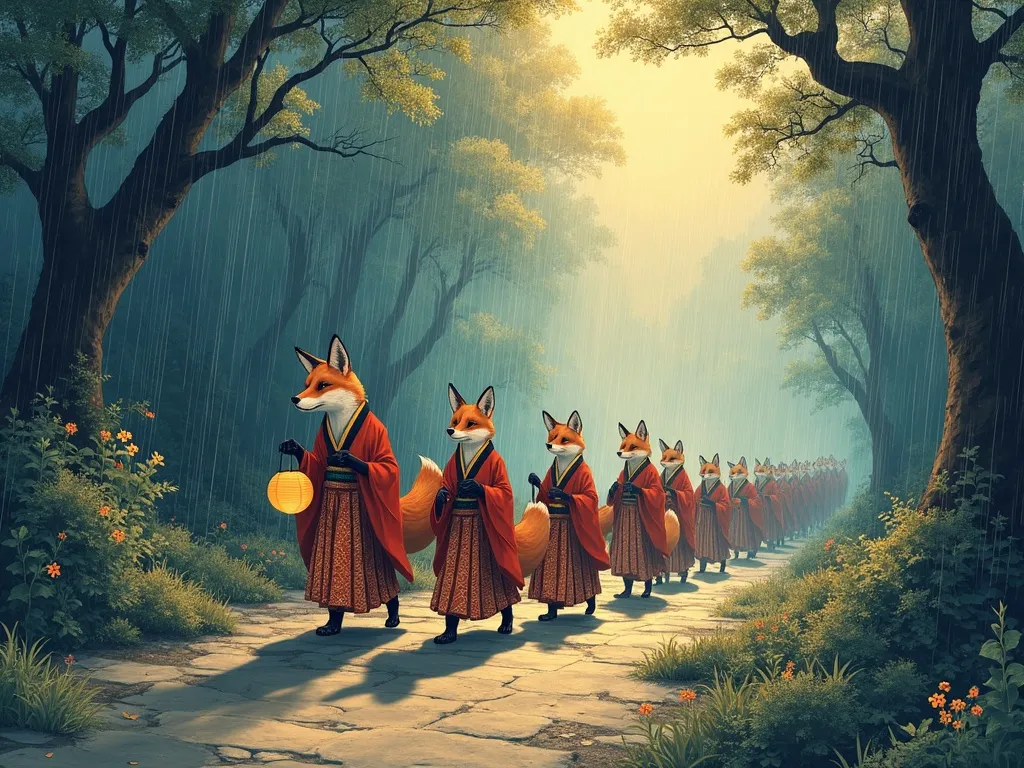
Several specific supernatural phenomena in Japanese folklore are attributed directly to kitsune activity. Kitsunebi, or "fox fire," describes the mysterious lights that appeared over marshes, mountain roads, and rice fields at night. Modern observers would recognise these as bioluminescent fungi, gas ignition from decomposing matter, or optical illusions caused by atmospheric conditions. For centuries of Japanese observers, they were the lanterns of fox processions or the breath of kitsune gathering for ritual purposes.
The kitsune no yomeiri, "fox wedding," describes the phenomenon of sunshowers: rain falling while the sun is fully visible. In many parts of Japan, this was said to occur when foxes were holding a wedding procession. The cultural reach of this belief extended across class lines. Samurai diaries from the Edo period record the phrase matter-of-factly when noting unusual weather; woodblock prints depict fox processions in formal Heian court dress, carrying paper lanterns through simultaneous rain and sunshine.
Kitsune also appear in the kaidan tradition of ghost and monster stories that flourished in the Edo period (1603-1868 CE). Collections such as Ugetsu Monogatari by Ueda Akinari (1776) and the encyclopaedic Konjaku Gazu Zoku Hyakki by Toriyama Sekien include kitsune among the yokai (supernatural creatures) ranked by behaviour and habitat. In this taxonomic tradition, the kitsune occupies an unusual position: it belongs among the yokai by virtue of its shapeshifting and mischief, but it also belongs among the kami-adjacent beings by virtue of its connection to Inari. No other yokai holds both memberships simultaneously.
Cross-Cultural Echoes: Fox Spirits Beyond Japan
The kitsune is not without relatives. The Chinese huli jing (狐狸精) shares the core attributes of longevity, shapeshifting, and seduction, and the textual influence clearly ran from China into Japan during the Nara and Heian periods. But the two traditions diverged sharply in their moral frameworks. The huli jing is, in classical Chinese literature, almost exclusively predatory toward men, draining their life force through sexual encounter. The kitsune, by contrast, includes a robust tradition of genuinely benevolent and loving foxes, particularly in the Inari context. The Inari messenger fox has no real Chinese equivalent.
The Korean kumiho (구미호, nine-tailed fox) shares the nine-tail structure and the shapeshifting, but Korean folk tradition treats the kumiho almost without exception as malevolent, a creature that eats human livers and hearts to become permanently human. The pathos and moral ambiguity so central to Japanese kitsune stories is largely absent from classical Korean fox-spirit material.
The comparison illuminates something specific about Japanese religious culture: the willingness to hold the sacred and the dangerous inside the same figure, to make the messenger of a rice god also a potential possessor of human minds, to let the trickster be a grieving mother. That capacity for sustained moral ambiguity is one of Shinto animism's most distinctive features, and the kitsune is its clearest embodiment.
The tengu, another avian-lupine creature straddling the sacred and the monstrous in Japanese mythology, shares some structural DNA with the kitsune: both are connected to specific mountain or forest zones, both can teach or destroy humans depending on circumstances, and both appear as ambiguous helpers to heroes in classical literature.
Kitsune in the Modern Imagination: From Noh Stage to Global Pop Culture
The kitsune's afterlife in contemporary culture is extensive and still accelerating. Within Japan, the figure never lost cultural currency the way many classical yokai did after the Meiji restoration pushed Western rationalism to the centre of public life. Inari shrines continued to receive millions of visitors. Kitsune masks remained staples of matsuri (festival) culture. The image of the white fox at the red torii gate became one of the most immediately legible icons of Japanese spiritual landscape.
The global circulation of kitsune imagery accelerated through manga, anime, and video games from the 1980s onward. The nine-tailed fox appears in Naruto as the tailed beast Kurama, reframing the ancient mythology within a ninja action narrative but preserving the core attributes: immense power, ambiguous alignment, and a relationship with a human host that mirrors the possession stories of the kitsunetsuki tradition. The Tale of Princess Kaguya, Studio Ghibli-adjacent productions, and countless visual novel games have drawn on kitsune lore for atmosphere and character architecture.
This globalisation has had an interesting scholarly side-effect. Readers outside Japan now arrive at primary sources like the Nihon Ryoiki or the Kuzunoha puppet plays having already metabolised a version of the kitsune mediated through gaming and animation. The encounter with the older tradition is not corrupted by this prior exposure; it is, for many readers, genuinely deepened. They recognise the nine-tail hierarchy, then discover its theological grounding. They know the fox wife story, then find the original poem on the sliding screen.
The kitsune fox spirit survived the Meiji modernisation, the post-war secular turn, and the digital age not by becoming simpler but by revealing new facets in each new medium. That adaptability was always part of the creature's mythology. A being that can take any form is, by definition, impossible to make obsolete.
Frequently Asked Questions about Kitsune the Fox Spirit
Frequently asked questions
What is the difference between a kitsune and a nogitsune?
Both terms refer to fox spirits in Japanese mythology, but they describe different moral orientations. Kitsune in its broadest sense covers all supernatural foxes. Within that category, zenko (good foxes) serve Inari and act benevolently toward humans, while nogitsune or yako (field foxes) are morally unmoored tricksters. The nogitsune is specifically associated with kitsunetsuki, the possession of human minds, and appears repeatedly in Edo-period medical and religious texts as the cause of mental disturbance.
Why do Inari shrines have fox statues if Inari is not a fox?
The fox statues at Inari shrines represent tsukaishime, divine messengers who carry prayers between worshippers and the kami Inari. The theological distinction matters: the fox is Inari's servant and intermediary, not Inari itself. However, this distinction blurred significantly in popular devotion during the Edo period, and many worshippers came to treat the fox statues as primary objects of veneration. The objects held in the statues' mouths encode specific petitions: a key for the storehouse, a scroll for scholarship, a jewel for wish-fulfillment.
Who is Tamamo-no-Mae and why does her story matter?
Tamamo-no-Mae is the most famous villainous kitsune in Japanese literature, a nine-tailed fox in the guise of a beautiful court woman who caused Emperor Konoe to fall mysteriously ill in the twelfth century. After being exposed by the astrologer Abe no Yasuchika, she was hunted across Japan and killed at the Nasu plain. Her spirit was said to inhabit the Sessho-seki (killing stone), which poisoned everything around it for centuries. The story fuses real historical figures (the astrologer Abe no Yasuchika was a genuine Heian court official) with supernatural narrative, making it one of the clearest examples of kitsune mythology embedded in quasi-historical record.
What is kitsunetsuki, and how was it treated?
Kitsunetsuki (狐憑き) is fox possession: the belief that a nogitsune could enter a human body and control their behaviour, producing symptoms ranging from speaking in strange voices to violent convulsions. Japanese religious and medical literature treated it seriously from the Heian period through at least the Meiji era. Treatments included shrine rituals at Inari or Fushimi Inari Taisha, Buddhist exorcism prayers, and in folk practice, leaving out food offerings the fox was believed to desire, such as tofu and fried bean curd (aburaage), to coax voluntary departure.
Is the kitsune mythology connected to real foxes in Japan?
Yes, concretely and ecologically. The Japanese red fox (Vulpes vulpes japonica) was present throughout the Japanese archipelago and lived in proximity to agricultural settlements, particularly near rice paddies where rodents were plentiful. The fox's nocturnal habits, its eerie calls, its intelligence in evading traps, and the occasional albino specimens (which became white-fox omens) all fed directly into the mythology. The folk belief in kitsunebi (fox fire) also has a natural basis: foxes have been observed near bioluminescent fungi and marsh gas phenomena in areas where the lights were reported.
How does the kitsune compare to the Chinese huli jing?
Both the kitsune and the Chinese huli jing share a common ancestry in early East Asian fox lore and the belief that foxes accumulate spiritual power over centuries of life. Chinese textual influence on Japanese fox mythology during the Nara and Heian periods is well-documented. However, the traditions diverged significantly. The huli jing in classical Chinese literature is predominantly predatory, draining human vitality through seduction. The kitsune encompasses a far wider moral range, including genuinely loving and loyal figures like the Kuzunoha fox wife. The Inari-messenger tradition has no direct Chinese equivalent.
The Killing Stone, the Cracked Rock, and the Myth That Never Closed
In March 2022, a basalt rock in the Nasu highlands of Tochigi Prefecture split cleanly along a pre-existing crack. The rock, roughly the size of a small car, sat at the site long associated with the Sessho-seki, the killing stone into which Tamamo-no-Mae's spirit was said to have been sealed after her death on the Nasu plain. Local news carried the report. Social media in Japan and internationally carried it further, with the question hovering visibly: had the nine-tailed fox escaped?
The geological explanation was straightforward. Freeze-thaw cycles expand water inside stone fractures until the rock yields. The crack had been visible for years. But the volume of public attention the story received, across demographics that do not typically engage with classical mythology, pointed to something the scholarly literature on kitsune had been noting for decades: kitsune the fox spirit does not behave like a closed mythological system. It remains open, ready to absorb new events and re-narrate them within its ancient framework.
This is structurally unusual. Many mythological creatures become museum pieces, studied precisely because they no longer intersect with lived experience. The kitsune intersects continuously. The Inari shrine network is actively maintained and visited. Fox possession language persists in Japanese idiom. The nine-tail hierarchy circulates through global gaming culture with enough fidelity that a teenager in São Paulo can arrive at Fushimi Inari Taisha with genuine prior knowledge of what the fox statues mean.
Scholars of Japanese religion, including Noriko Reider and Michael Dylan Foster in their respective surveys of yokai culture, have argued that the kitsune's durability comes precisely from its refusal to be pinned to a single function. It is too divine to be merely a monster. It is too mischievous to be merely a deity. It is too loyal to be merely a predator. It is too intelligent to be merely an animal. Every tradition that has tried to reduce it to one of these categories has eventually had to make room for the others.
The fox at the edge of the rice field is still counting torches. It has been counting them for over a millennium of recorded human attention, and the count is nowhere near finished.
Free 25-page sample
Want the whole story?
Take the first 25 pages free. If it pulls you in, the full edition is yours as an instant PDF download, with a paperback on Amazon for selected titles.

Japanese
The Japanese Mythology and Yokai Book: Amaterasu, Susanoo, Kami, and the Sacred Stories of Japan
Amaterasu, Susanoo, Yokai, Kami, and the Sacred Stories of Japan
The Kojiki, the Nihon Shoki, and the bestiaries of Toriyama Sekien. Every kami, every yokai, every ghost story.
More from Japanese
All articles
Japanese
Izanagi and Izanami: The Creation Myth That Built the Japanese Islands
Before Japan existed, two deities stood on a bridge of heaven and stirred the primordial sea. The story of Izanagi and Izanami is the most elemental creation myth in the Shinto tradition.

Japanese
Susanoo the Storm God: Chaos, Courage, and the First Poem in Japanese Myth
Banished from heaven, mourned by the seas, and celebrated as the slayer of an eight-headed dragon, Susanoo stands as the most turbulent and deeply human figure in the Japanese pantheon.

Japanese
Amaterasu: The Sun Goddess Who Hid the World in Darkness
Amaterasu, the Japanese sun goddess, rules the High Plain of Heaven and holds the cosmos together. Her retreat into a cave nearly extinguished all light - and her return reshaped the divine order forever.