
Izanagi and Izanami: The Creation Myth That Built the Japanese Islands
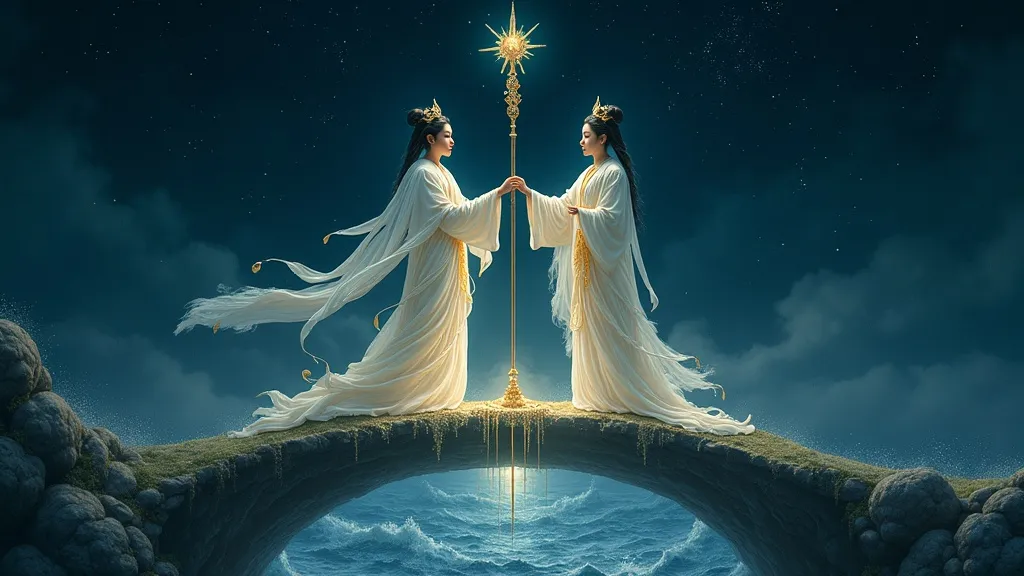
Before Japan existed, two deities stood on a bridge of heaven and stirred the primordial sea. The story of Izanagi and Izanami is the most elemental creation myth in the Shinto tradition.
Contents
The jeweled spear descended through clouds and struck nothing. Below the Floating Bridge of Heaven, Ame-no-Ukihashi, there was only konton - primordial chaos, a churning brine without shore or bottom. Izanagi pressed the spear down. He stirred. When he lifted the shaft free, the brine that dripped from its tip congealed into the first island: Onogoro-jima, the self-coagulating land. He and Izanami descended to it, and the world began.
This is not a distant cosmological abstraction. The izanagi and izanami creation myth, recorded in the Kojiki (712 CE) and the Nihon Shoki (720 CE), is a story with a house, a pillar, a wedding, a death, and a divorce so catastrophic it invented mortality itself. It is at once a creation account, a love story, and one of the oldest descents into an underworld in Asian literature.
What makes it endure is not its cosmic scope but its intimacy. Two newly-made deities, charged by the heavenly council to solidify the drifting earth, figure out how to create land, how to marry, and how to grieve, one calamity at a time.
The Heavenly Commission and the Spear of Separation
Before Izanagi and Izanami received their task, a series of primordial deities had already self-generated in the High Plain of Heaven, Takamagahara. These formless kami appeared and dissolved without shaping anything. Izanagi and Izanami were different: they were the first paired deities, the first to carry both masculine and feminine principle, and they were given agency.
The heavenly assembly handed them the jeweled spear, Ame-no-Nuboko, and commanded them to solidify the drifting land. The tool is significant. A spear is not a pen or a word; creation here is physical, tactile, even violent. The act of stirring the sea recalls ancient ideas about separation: order emerging from chaos not by divine speech but by motion.
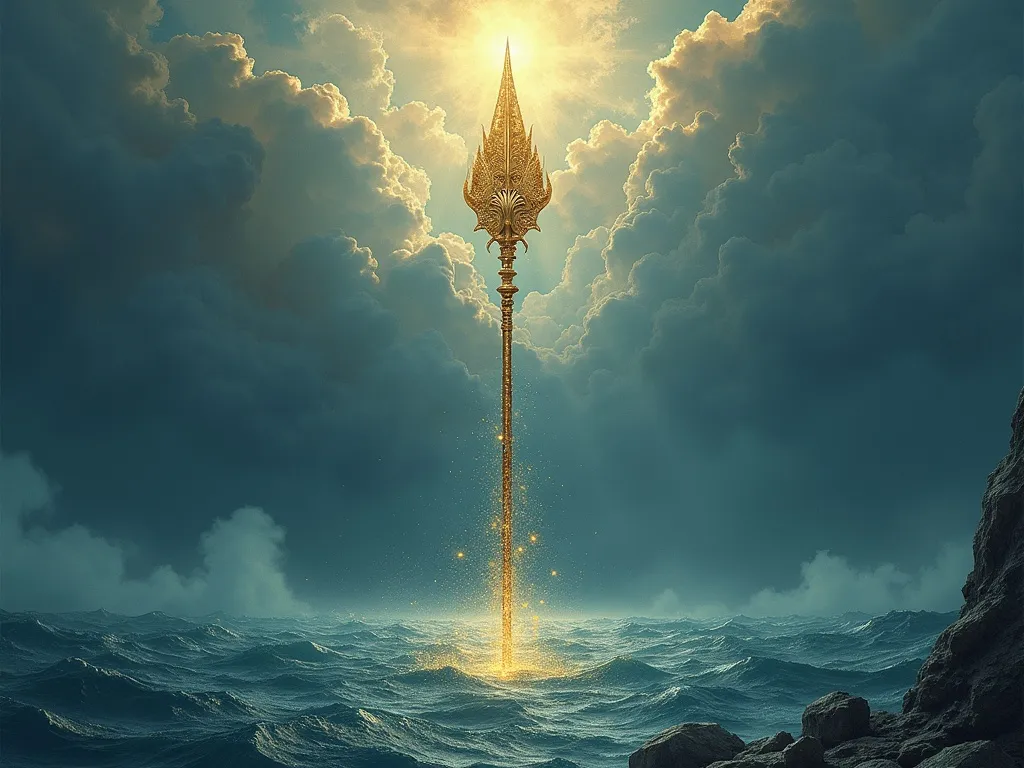
When Onogoro-jima rose from the spear-drip, the two deities established it as their marital pillar island. They erected miwabashira, a sacred pillar at its center, and walked around it in opposite directions. When they met, Izanami spoke first, admiring Izanagi. A son was born, Hiruko - the leech-child, boneless and formless. They set him adrift in a reed boat. A daughter, Awashima (foam island), followed, equally unformed.
The heavenly council was consulted. The verdict: Izanami had spoken first at the pillar. In the ritual order of Shinto cosmology, the male principle had to initiate. They repeated the ceremony, this time Izanagi speaking first, and the islands poured forth.
This detail has attracted enormous scholarly debate. Some read it as a patriarchal correction written into the myth retroactively, perhaps during the seventh-century state-building period when the Kojiki was being compiled. Others argue the pillar ritual reflects genuine archaic marriage customs. What neither reading disputes is the structural outcome: the error had to be named, corrected, and the whole act repeated. Even the gods could make a flawed beginning.
The Birth of the Eight Islands and the Kami of Land
From their corrected union came the Oyashima-kuni, the "eight great island countries," which the Kojiki identifies as the main islands of the Japanese archipelago. The sequence in the Kojiki runs: Awaji, Iyo (Shikoku), Oki, Tsukushi (Kyushu), Iki, Tsushima, Sado, and finally Yamato (Honshu). This is not a geologically accurate catalog; it is a mythological charter of territory, a divine deed of ownership for the islands that would become Japan.
After the land came the kami themselves. Izanagi and Izanami generated deity after deity: the sea god Watatsumi, the wind god Fujin, the mountain kami, the valley kami, the wood gods, the field gods. The pair were not merely creating geography; they were populating an animist world in which every natural feature carried divine presence.
The count in the Nihon Shoki differs slightly from the Kojiki's, and scholars like Donald Philippi and Motoori Norinaga have spent considerable energy on these discrepancies. The Nihon Shoki presents multiple "one account says" alternatives for nearly every episode, suggesting the compilers knew they were working with variant traditions rather than a single canonical text.
The Death of Izanami and the Birth of Fire
The mythological pivot arrives without ceremony. Izanami gives birth to Kagutsuchi, the god of fire. The birth kills her. The fire scorches her as he passes through, and she sickens and dies.
Her death is catalytic. Izanagi, overcome with grief, draws his sword and kills Kagutsuchi, slicing the fire god into eight pieces. Each fragment becomes a new volcanic kami. This is a theology of fire: destructive, generative, irreversible. Kagutsuchi's creation caused death; his death caused mountains.
Izanami descends to Yomi, the underworld, literally "the land of the dead" or "the darkness," a realm beneath the earth whose geography the Kojiki describes as accessible through a cave in the land of Izumo. This is the same Izumo associated with the great shrine Izumo Taisha, one of the oldest and most important shrine complexes in Japan, where Okuninushi would later rule before being displaced by the heavenly deities.
Izanagi follows. He goes to bring her back.
The Descent into Yomi: A Shinto Orpheus Story
The parallel with Greek mythology is immediate and often noted. Like Orpheus descending for Eurydice, or Persephone held in Hades, Izanagi crosses into the underworld seeking his beloved. But the mechanics differ sharply from the Greek model.
Izanagi in Yomi
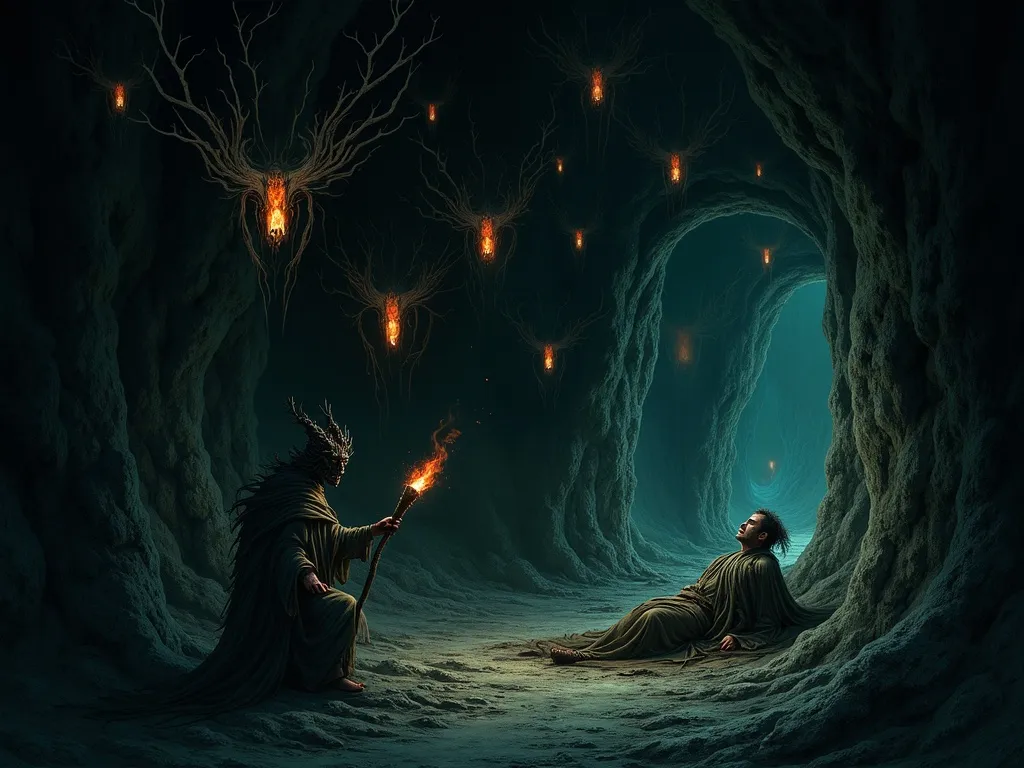
Izanagi descends of his own initiative, driven by grief, with no divine permission. He is told by Izanami to wait and not look at her while she negotiates with the gods of Yomi. He breaks the prohibition by lighting a comb-tooth as a torch. He does not fail through love of song but through the ordinary human reflex of wanting to see.
Orpheus in Hades
Orpheus descends with the implicit permission of the gods, granted through his music. He is instructed not to look back. He fails at the final threshold, through longing. His punishment is loss; Eurydice returns to Hades and Orpheus is eventually torn apart by Maenads.
When Izanagi's makeshift torch flares to life inside Yomi, he sees Izanami: rotting, maggot-covered, monstrous. Eight thunder deities have hatched from her decomposing body. The Kojiki names them: Oikadzuchi at her head, Honoikadzuchi at her chest, and so on through every part of her corrupted form. The description is unflinching. Japanese myth does not look away from physical death.
Izanami, shamed by being seen in her pollution, screams. The shikome, hag-demons of Yomi, pursue Izanagi. He runs. He flings his black headdress; it becomes a cluster of grapes. The shikome stop to eat. He flings a comb; it becomes bamboo shoots. He throws peaches at the demons following behind. Each improvised obstacle is mythologically significant: grapes, bamboo, peaches all carry apotropaic power in Japanese and broader East Asian tradition, where peaches in particular were long used in purification rituals.
Izanami herself joins the pursuit, sending the eight thunder kami and then 1,500 warriors of Yomi after him. Izanagi reaches the slope that divides Yomi from the living world, Yomotsu Hirasaka, and rolls a boulder across the entrance. Husband and wife face each other across the stone.
What follows is the mythological origin of death. Izanami says: I will strangle 1,000 people each day. Izanagi answers: I will bring 1,500 new births each day. The exchange is quick, plain, and absolute. Death and birth are born simultaneously, in a moment of mutual threat between estranged spouses. From that boulder forward, the dead stay dead.
Izanagi's Purification and the Birth of the Solar Pantheon
Izanagi emerges from Yomi filthy with its pollution, kegare. He goes to the river Ahaji-no-shima and strips, casting off garments and jewelry. Each item he removes generates a new deity. His clothes become gods; his accessories become gods; the mud itself becomes gods. This is a creation sequence embedded inside a purification ritual.
The climax is the washing of his face. When he washes his left eye, the sun goddess Amaterasu is born. When he washes his right eye, the moon god Tsukuyomi appears. When he washes his nose, Susanoo, the storm god, is born.

Izanagi assigns dominion. Amaterasu receives the High Plain of Heaven, Takamagahara. Tsukuyomi receives the night. Susanoo receives the seas. This single act of face-washing produces the three most powerful kami in Shinto cosmology, and it does so not through a deliberate creative act but through a bath taken out of necessity. Pollution, in this theology, is not merely the opposite of purity: it is generative. Even Yomi's contamination, once cleansed, becomes divine potential.
Amaterasu, born from this purification, is the ancestor of the imperial line in Japanese myth. The Kojiki traces an unbroken genealogy from her to the legendary Emperor Jimmu, and by ideological extension, to the imperial house that commissioned the Kojiki in the first place. The political dimension of this creation myth is not subtle, but it does not diminish the mythological force of the story. The two layers exist simultaneously: theological cosmology and state legitimation, woven inseparably in 712 CE.
Symbolic Architecture: Pillars, Pollution, and Separation
Several structural patterns run through the izanagi and izanami creation myth that scholars of religion have found particularly rich.
The pillar as world-axis. The miwabashira around which the deities walk at their marriage is a cosmological center, a point that organizes space around it. Mircea Eliade's concept of the axis mundi maps neatly here, though the Kojiki never makes the symbolism explicit. The pillar is simply used, a ritual object whose meaning the original audience apparently required no explanation for.
Pollution (kegare) as cosmic boundary marker. Izanami becomes polluted through death. Izanagi becomes polluted through contact with death. The mythology treats kegare not as moral failing but as ontological contamination, a condition that separates the living from the dead, the pure from the impure. Shinto purification ritual (misogi and harae) derives its doctrinal grounding directly from Izanagi's river bath. Every purification rite at a Shinto shrine is, in a sense, a re-enactment of that post-Yomi washing.
The prohibition and its violation. The looking taboo appears twice: Izanami breaks a speaking-order at the pillar, and Izanagi breaks a seeing-prohibition in Yomi. Both violations are irreversible and cosmically consequential. The pattern suggests a theology in which certain thresholds, once crossed, cannot be uncrossed. Ignorance or accidental transgression does not mitigate the consequence.
Separation as the generative act. Every key moment in the myth involves a separation: land from sea, living from dead, pure from impure, husband from wife, heaven from earth. The kami themselves are separated from formlessness by the spear. Japan is separated from the ocean by the spear-drip. The living world is separated from Yomi by the boulder. Creation, in this cosmology, is fundamentally an act of division, not assembly.
Regional Echoes and Cross-Cultural Parallels
The izanagi and izanami creation myth does not exist in a vacuum. Scholars of comparative mythology, from Motoori Norinaga in the eighteenth century to more recent comparativists like Matsumae Takeshi, have traced connections and parallels with mainland Asian traditions.
The Nihon Shoki's opening lines, where chaos is compared to an egg that separates into heaven and earth, closely echo Chinese cosmogonical imagery found in the Huainanzi and the Pangu creation narrative. The stirring of a primordial ocean with a divine instrument has loose parallels in Hindu churning myths, most famously the Samudra Manthan where Vishnu and the asuras churn the cosmic ocean with Mount Mandara. These parallels do not imply direct borrowing; they suggest that the motif of order-from-stirring was a broadly shared cosmological intuition across ancient Asia.
The descent to the underworld is the most obvious point of cross-cultural comparison. From Inanna's descent in Sumerian tradition to Orpheus in Greek myth to Izanagi's journey into Yomi, the pattern of a living figure crossing into the land of the dead to recover someone lost appears across cultures that had no demonstrable contact. The Japanese version is distinctive in its physicality: the rotting body, the improvised escapes with fruit and combs, the boulder barrier. It is less elegiac than the Orpheus myth and more visceral than Inanna's.
The creation myth of Izanagi and Izanami also has a notable formal parallel in the Ryukyuan tradition of the Okinawan islands, where the paired deities Amamikyu and Shiniriku descend from heaven to create the islands of the Ryukyu chain, with similar structural elements: a divine couple, a heavenly commission, the creation of land and then of people. Whether this reflects a shared ancestral tradition or later cross-influence remains debated among scholars of Japanese and Ryukyuan religion.
The Myth in Ritual Practice and Shinto Theology
This myth is not merely historical. Shinto practice at major shrines keeps it structurally alive.
At Izumo Taisha in Shimane Prefecture, the entrance to the cave of Yomotsu Hirasaka (identified with a specific coastal site in Izumo) is still visited as a sacred place. The shrine complex at Izumo has housed rituals connecting the world of the living to the realm of the dead for centuries. Every October, according to Shinto tradition, all the kami of Japan gather at Izumo for the Kannazuki, the "month without gods," leaving the rest of the country temporarily de-deified. The choice of Izumo as the gathering place is inseparable from its mythological role as the borderland between Yomi and the living world.
The purification ritual misogi, performed by entering a body of running water, is explicitly grounded in Izanagi's post-Yomi bath in every mainstream Shinto doctrinal account. When a Shinto priest pours water over their hands before ritual, they are re-enacting a myth.
Harae (formal ritual purification) operates on the theology of kegare that the Izanami story establishes. Death, childbirth, blood, and contact with corpses all generate kegare in Shinto thought. Each category traces its power to the moment Izanami died giving birth to Kagutsuchi and descended into Yomi.
The Myth's Reception in Modern Japan and Global Culture
The izanagi and izanami creation myth has found a sustained afterlife in contemporary Japanese culture, particularly in anime and manga, where the visual grammar of Yomi, its dark tunnels, its grotesque inhabitants, its boulder-sealed exit, appears repeatedly.
Hideaki Anno's Neon Genesis Evangelion draws heavily on Shinto and Kabbalistic symbolism; two key artificial beings in the series are named Lilith and Adam but their structural roles parallel Izanami (the corrupted maternal figure) and Izanagi (the figure who must confront and separate from her). The series never makes the connection explicit, but it is legible to Japanese viewers attuned to the mythology.
Junji Ito's horror manga, particularly works like Gyo and Uzumaki, operate on a theology of kegare that owes something to the Yomi episode: physical corruption as spiritual contamination, the seen body as the source of horror, the inability to look away.
Internationally, the myth has received serious scholarly attention in Donald Philippi's 1968 English translation of the Kojiki, still a standard reference work, and in Noriko Reider and Faye Kleeman's more recent studies of Japanese supernatural narrative. For readers coming from Western classical tradition, the comparison with Persephone is often most useful as a starting point, even if the Izanami story goes further: Persephone's return is possible; Izanami's is not.
Frequently Asked Questions About the Izanagi and Izanami Creation Myth
Frequently asked questions
What is the primary source for the Izanagi and Izanami myth?
The two main sources are the Kojiki (712 CE), compiled under imperial order by Ono Yasumaro, and the Nihon Shoki (720 CE). The Kojiki is the older and more mythologically focused text; the Nihon Shoki includes variant versions of key episodes and situates the myth more explicitly within a Chinese-influenced cosmological framework. Both texts were compiled during the Nara period as part of a project to legitimize the imperial line.
Why did Izanagi's look at Izanami in Yomi cause such catastrophic consequences?
In Shinto theology, the prohibition against seeing Izanami's corpse is rooted in the concept of kegare, ritual pollution generated by death and decomposition. By lighting his torch, Izanagi violated the boundary between the realm of the living and the transformative processes of death, exposing both himself to kegare and Izanami to shame. The act was irreversible because, in the myth's logic, some thresholds cannot be re-crossed. The consequence, Izanami's fury and the establishment of death as a permanent feature of human life, follows directly from the transgression.
What is the connection between the Izanami myth and the Shinto purification ritual misogi?
After fleeing Yomi, Izanagi bathed in a river to cleanse the kegare he had acquired in the underworld. This act is the mythological charter for misogi, the Shinto ritual of purification through immersion in running water. The Kojiki describes the bath in detail, noting that each item Izanagi removed became a new deity. The birth of Amaterasu, Tsukuyomi, and Susanoo from the washing of his eyes and nose makes the purification rite simultaneously cosmogonic: cleansing and creation are the same act.
How does Yomi in the Izanagi and Izanami myth compare to other underworld traditions?
Yomi shares structural features with the Greek Hades (a realm of the dead beneath the earth, accessible through a specific geographic portal) and the Mesopotamian kur (a dark, dust-filled realm). Unlike Hades, Yomi has no distinct moral geography in the early texts: no Elysium, no Tartarus, no judgment of souls. It is simply the place where decomposition happens, polluted and avoided. The boulder that Izanagi rolls across its entrance at Yomotsu Hirasaka functions similarly to the river Styx as an uncrossable boundary, but where Styx separates through water, Yomotsu Hirasaka separates through stone and spoken threat.
Is there a feminist or gender-critical reading of the Izanagi and Izanami myth?
Several scholars, including Noriko Reider and Michael Ashkenazi, have noted that the myth contains a structural demotion of Izanami. She begins as an equal co-creator, speaks the marriage vow at the pillar, and is punished for speaking first. Her death, her corruption, and her ultimate role as the goddess who sends death into the world represent what some scholars read as a mythological encoding of patriarchal anxieties about female creative and destructive power. Others argue that Izanami in Yomi retains enormous agency: she is not a passive victim but an active figure who threatens, commands demons, and ultimately forces the cosmological bargain that determines mortality. Both readings can be sustained from the Kojiki text itself.
Where is the cave entrance to Yomi said to be located?
The Kojiki places Yomotsu Hirasaka, the slope connecting the living world to Yomi, in the land of Izumo, in what is now Shimane Prefecture on the Sea of Japan coast. A specific site, the Iya Shrine near the coastal caves at Higashiizumo, is traditionally identified as the location. The broader Izumo region has been associated with the dead and with the gathering of kami since at least the Nara period, making it a zone of concentrated mythological significance in the Japanese religious landscape.
The Boulder That Still Stands: Unresolved Questions in Izanagi and Izanami Scholarship
The izanagi and izanami creation myth is one of the most studied texts in Japanese religious history, and yet several questions remain genuinely open.
The status of Hiruko, the leech-child, is one. Set adrift as a failure, Hiruko disappears from the Kojiki's main narrative. Later traditions, from the Heian period onward, identify Hiruko with Ebisu, one of the seven gods of fortune, a smiling deity of fishermen and commerce. If that identification is accepted, then the "failure" of the first creation was not discarded but absorbed, given a new role, integrated into the pantheon rather than erased. What the Kojiki presents as rejection, popular religion quietly rehabilitated. The tension between those two readings has never been formally resolved in Shinto doctrine.
The question of Izanami's status after the boulder is equally provocative. She is named in some later texts as Yomotsu Ōkami, the great deity of Yomi, a ruler of the dead rather than merely a resident. This transformation from co-creator to chthonic goddess follows a pattern found in other traditions (Persephone, Inanna, Ereshkigal) where the feminine principle, once associated with generative creation, becomes the guardian of death. Whether this represents a deep structural archetype or a coincidence of cosmological logic is a question that comparative mythology has been raising for a century without settling.
What is not in question is the myth's structural completeness. It covers creation of land, creation of divine beings, the origin of death, the nature of the underworld, the mechanics of purification, and the genesis of the sun. It does all of this with two characters, a spear, a pillar, a torch, a comb, and a boulder. That economy of means is part of what makes the Shinto creation narrative so resilient: it carries maximum cosmological weight in a remarkably spare frame, and every prop in it is still legible in Japanese ritual and landscape today.
Free 25-page sample
Want the whole story?
Take the first 25 pages free. If it pulls you in, the full edition is yours as an instant PDF download, with a paperback on Amazon for selected titles.

Japanese
The Japanese Mythology and Yokai Book: Amaterasu, Susanoo, Kami, and the Sacred Stories of Japan
Amaterasu, Susanoo, Yokai, Kami, and the Sacred Stories of Japan
The Kojiki, the Nihon Shoki, and the bestiaries of Toriyama Sekien. Every kami, every yokai, every ghost story.
More from Japanese
All articles
Japanese
Kitsune: The Fox Spirit of Japanese Mythology
The kitsune is Japan's most storied supernatural creature: a fox of shifting form, ancient intelligence, and divine allegiance. From rice-field shrines to imperial courts, its nine tails have cast shadows across two millennia of myth.
Japanese
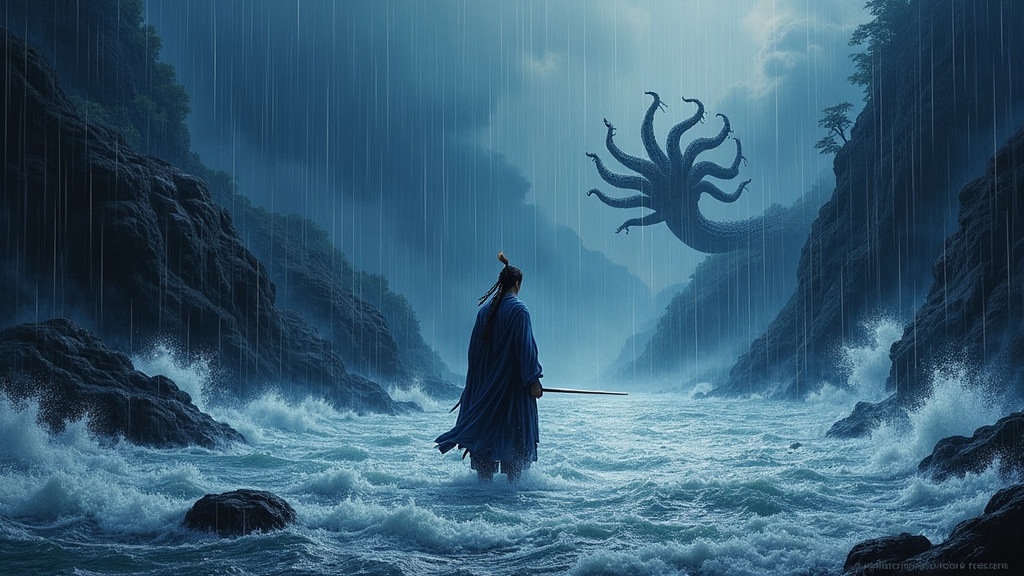
Susanoo the Storm God: Chaos, Courage, and the First Poem in Japanese Myth
Banished from heaven, mourned by the seas, and celebrated as the slayer of an eight-headed dragon, Susanoo stands as the most turbulent and deeply human figure in the Japanese pantheon.
Japanese
Amaterasu: The Sun Goddess Who Hid the World in Darkness
Amaterasu, the Japanese sun goddess, rules the High Plain of Heaven and holds the cosmos together. Her retreat into a cave nearly extinguished all light - and her return reshaped the divine order forever.