
Guru Granth Sahib: The Eternal Living Guru
More than a sacred text, the Guru Granth Sahib is the living, breathing spiritual sovereign of the Sikh faith, a revelation woven from 1,430 pages of divine poetry, music, and mystical light.
Contents
A Scripture Unlike Any Other
Most religious traditions draw a clear line between their founders and the books left behind. In Sikhism, that line does not exist. The Guru Granth Sahib is not a memorial to ten human Gurus; it is the eleventh, and the eternal. When Guru Gobind Singh, the tenth Sikh Guru, concluded his earthly mission in 1708, he made a declaration that would reshape the spiritual architecture of an entire civilization. He announced that the compiled scripture would henceforth serve as the permanent, living Guru of the Sikh people. No successor of flesh and bone would ever follow.
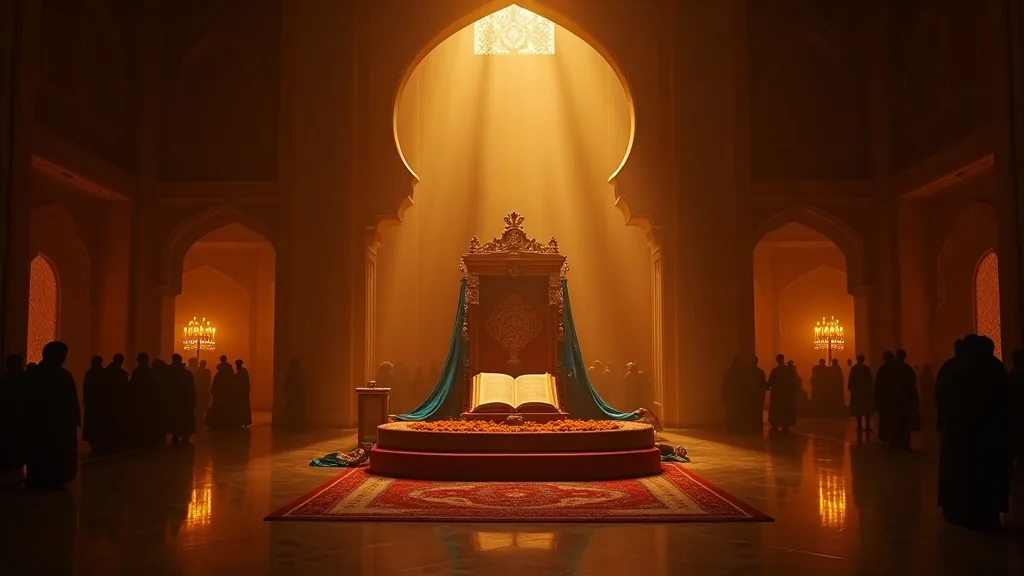
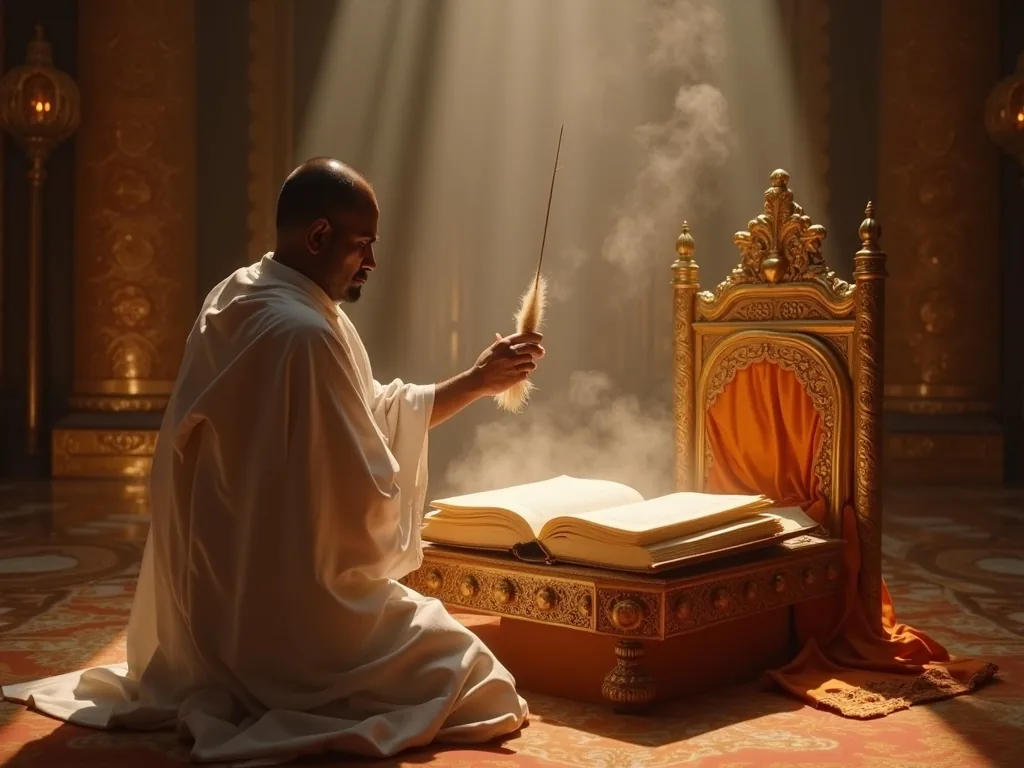
This was not a poetic gesture. It was a theological revolution. The Guru Granth Sahib is treated today with every honor accorded to a living sovereign: it rests on a throne (the Takht), is awakened each morning in a ceremony called Parkash, is put to rest at night in the Sukhasan ritual, and is fanned with a chauri (a whisk of white yak hair or nylon) as a mark of royal respect. In the Golden Temple of Amritsar, as in every Gurdwara across the world, the scripture occupies the highest seat in the room. Every human being, regardless of rank, bows before it.
The Architecture of Divine Sound
The Guru Granth Sahib contains 1,430 pages (called angs, meaning "limbs," not "pages," because a scripture that is a living being has limbs, not pages). It is organized not by author or chronology, but by musical measure. The primary organizational principle is the raag, a classical Indian melodic framework. Thirty-one raags structure the text, each one carrying its own emotional and spiritual atmosphere: Raag Bilaval evokes clarity and joy, Raag Bhairav carries the gravity of dawn and devotion, Raag Kedara breathes longing and surrender.
This is not incidental. In Sikh theology, Shabad (the divine Word) is not merely text to be read; it is sound to be inhabited. The Guru Granth Sahib is, at its core, a musical scripture. Its verses are sung, not recited. A trained musician-priest called a Granthi or a Ragi gives voice to the compositions, allowing the raag to carry the meaning into the listener's body as vibration before it arrives in the mind as concept.
The Mul Mantar: Seed of the Cosmos
The scripture opens with the Mul Mantar, a foundational statement composed by Guru Nanak Dev Ji, the first Sikh Guru:
Ik Onkar, Sat Naam, Karta Purakh, Nirbhau, Nirvair, Akal Murat, Ajuni, Saibhang, Gur Prasad.
Translated: One Universal Creator, Truth is the Name, Creative Being Personified, Without Fear, Without Hatred, Beyond Time, Unborn, Self-Existent, Known by the Guru's Grace.
In thirteen words, Guru Nanak dismantled the architecture of fear-based religion: a God without vengeance, without rivals, beyond birth and death, approachable only through grace. This mantar (sacred formula) seeds the entire scripture. Every subsequent composition, regardless of its author, is an elaboration of these thirteen words.
Voices Across Faiths and Centuries
One of the most extraordinary features of the Guru Granth Sahib is its radical inclusivity of authorship. The scripture contains compositions by six of the ten Sikh Gurus (Guru Nanak, Guru Angad, Guru Amar Das, Guru Ram Das, Guru Arjan Dev, and Guru Teg Bahadur), but it also preserves the voices of Hindu bhakti saints and Muslim Sufi mystics whose poetry aligned with the Sikh vision of the formless divine.
Kabir, the 15th-century weaver-poet of Varanasi who defied both Hindu orthodoxy and Islamic convention, contributes some of the most electrifying verses. Ravidas, the leatherworker-saint of Benares, adds his own radical devotional poetry. Sheikh Farid of Pakpattan, a 12th-century Sufi master, speaks in verses of such devastating simplicity that they feel carved rather than composed. Namdev, the cloth-printer from Maharashtra, and Trilochan, Sain, Dhanna, Pipa, and Beni further enrich the polyphonic texture.
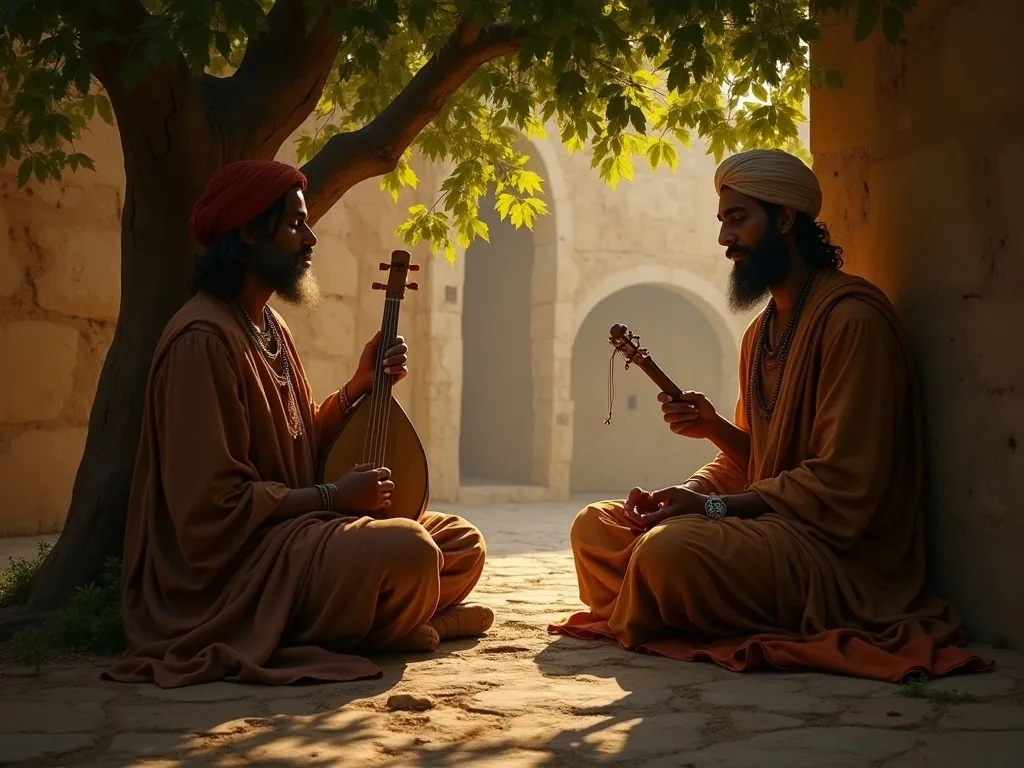
This deliberate act of curation by the Gurus, especially by Guru Arjan Dev Ji who compiled the first version (the Adi Granth) in 1604, made a theological statement that still resonates: divine truth does not belong to a single community, caste, or confession. The voice of a Muslim mystic and a low-caste Hindu saint sits beside the verse of a Sikh Guru with no hierarchy of placement, only the organizing grace of raag.
The Compilation at Ramsar
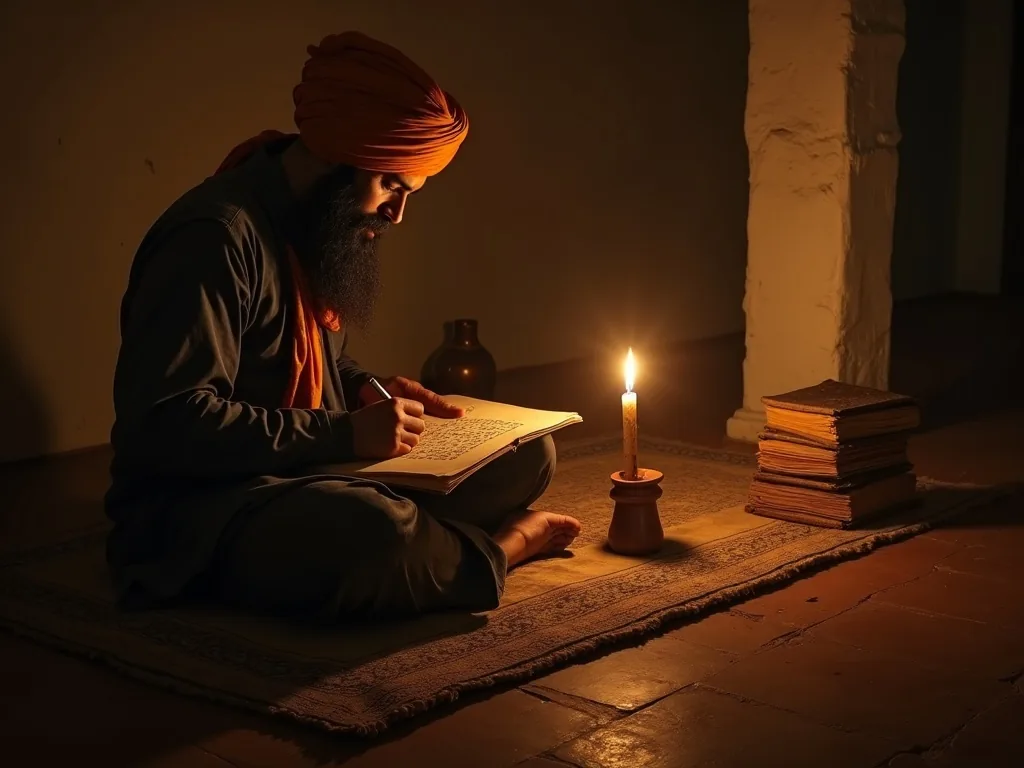
Guru Arjan Dev Ji compiled the Adi Granth at the sacred pool of Ramsar in Amritsar between 1601 and 1604. Bhai Gurdas, a highly revered Sikh scholar and poet, served as the scribe. The process was not passive transcription; it involved careful discernment, distinguishing authentic compositions from forgeries that had begun circulating under the Gurus' names. The result was installed in the newly completed Harmandir Sahib (the Golden Temple) in 1604, with Baba Buddha Ji appointed as the first Granthi, the custodian-priest who would read from it daily.
A century later, Guru Gobind Singh added the compositions of his father, Guru Teg Bahadur, and finalized the scripture in its present form, investing it with Guruship at Nanded (in present-day Maharashtra) before his death.
The Ceremony of Living Presence
The rituals surrounding the Guru Granth Sahib are not symbolic performances; they enact a continuous theology. The scripture is never placed on the floor. It travels under a canopy. When it is carried, the congregation stands. A Hukamnama, the daily divine command, is taken by opening the scripture at random each morning, and that passage guides the spiritual focus of the day for Sikhs worldwide. The Hukamnama from the Golden Temple each morning is broadcast digitally and followed by millions across continents.
The full, uninterrupted reading of the entire scripture, called an Akhand Path, takes approximately 48 hours and is performed by a relay of readers at moments of celebration, crisis, or communal need. Families gather for weddings, funerals, and the birth of a child not merely to observe but to sit in the presence of the living Guru. The Anand Karaj (Sikh wedding ceremony) consists entirely of the couple circumambulating the Guru Granth Sahib four times as Guru Ram Das's hymn, the Lavan, is sung, each round deepening the commitment of the soul to the divine before cementing the bond between two people.
Language as Sacred Geography
The Guru Granth Sahib is written in a script called Gurmukhi, which Guru Angad Dev Ji standardized in the 16th century. The word Gurmukhi means "from the mouth of the Guru." Yet the languages contained within the script are numerous: Punjabi, Braj Bhasha, Sanskrit, Persian, Sindhi, Marathi, old Hindi dialects, Multani. This multilingual texture reflects the Gurus' deliberate refusal to sanctify any single linguistic tradition above others.
Sanskrit had long been the exclusive domain of Brahminical learning. Persian was the prestige language of Mughal courts and Islamic scholarship. By weaving both into a scripture written in a script accessible to ordinary people, the Gurus democratized sacred language. Literacy in Gurmukhi became a form of spiritual enfranchisement, a way for farmers, merchants, weavers, and warriors to read the divine word without priestly intermediaries.
The Japji Sahib: Dawn's First Hymn
The first extended composition in the scripture is the Japji Sahib, authored by Guru Nanak. It consists of a prologue, 38 pauris (stanzas), and an epilogue, and it addresses questions that most religious traditions deflect: How does one become truthful? What is the nature of divine creation? What happens after death?
Guru Nanak does not answer these questions with dogma. He answers with image and paradox. The divine is described as one who "having created the creation, watches over it." Truth is not achieved by intellectual argument but by living in alignment with Hukam, the divine order that pervades all things. The final stanzas of the Japji describe five Khands (spiritual realms): Dharam Khand (the realm of duty), Gian Khand (knowledge), Saram Khand (effort and beauty), Karam Khand (grace), and Sach Khand (the realm of truth). This is not a geography of afterlife but a map of interior transformation.
The Living Guru in a Digital World
Since the 20th century, the Guru Granth Sahib has been printed in a standardized edition of exactly 1,430 angs. Every printed copy in the world, from Amritsar to Auckland, is identical in pagination. Digital platforms now carry the full text with translations in dozens of languages. The SikhiToTheMax database and the official SGPC (Shiromani Gurdwara Parbandhak Committee) portal make the entire scripture searchable, annotated, and audible.
Yet none of this digitization has changed the ceremonial protocols. A PDF cannot receive a Hukamnama. A screen is not covered with silk and placed on a Takht. The tension between the scripture's universal accessibility and its irreducible physical sanctity is one the Sikh community navigates with thoughtfulness. Gurdwaras that broadcast live readings ensure the camera never faces the congregation below the level of the scripture. The Guru remains, always, the highest point in the room.
Between Text and Presence: A Theology of the Word
In the Christian tradition, the Word became flesh in the person of Jesus. In Islam, the Quran is the direct, uncreated speech of God, a verbal miracle. The Guru Granth Sahib occupies a theologically distinct position: it is neither a record of a divine incarnation nor a verbatim divine dictation. It is the accumulated resonance of souls who achieved union with the formless divine and transmitted that experience in the only medium capable of carrying it: Shabad, the sacred sound-word.
Guru Nanak articulated this in his own verse: "The Shabad is the Guru, and the soul that is attuned to it is the disciple." The scripture is the Guru not because God dictated it, but because the divine Jot (divine light) that illuminated Guru Nanak passed through each successive Guru like a single flame lighting another candle. That flame was then crystallized into the Shabad, and the Shabad became permanent. The Guru Granth Sahib is, in this sense, frozen light: every raag a different frequency, every pouri a different wavelength, all of it still burning for anyone who reads, sings, or simply sits in its presence.
Sacred Sovereignty and Human Equality
The installation of the Guru Granth Sahib as the eternal Guru was also a radical political act. By vesting supreme authority in a scripture accessible to all, Guru Gobind Singh denied that authority to any single person, lineage, priest, or state. No pope, no caliph, no hereditary Guru could claim ultimate spiritual jurisdiction over the Sikh people. The scripture itself became the constitution of the Panth (the Sikh community).
This has had profound social consequences. In a society stratified by caste, the Guru Granth Sahib contains the voices of saints born into the lowest social positions. Ravidas, born into the Chamar (leather-worker) community, speaks with the same authority as any Brahmin. Kabir, possibly of Muslim weaver descent, sits beside Guru Nanak with no asterisk of qualification. To sit in the presence of the Guru Granth Sahib is to sit in a space where every human hierarchy collapses. The langar (community kitchen) that accompanies every Gurdwara, where everyone eats together regardless of background, is the social expression of what the scripture encodes theologically: in the presence of the one divine light, there are no higher and lower tables.
Read the full book
Want the whole story?
The complete edition is an instant PDF download here, with a paperback on Amazon for selected titles.
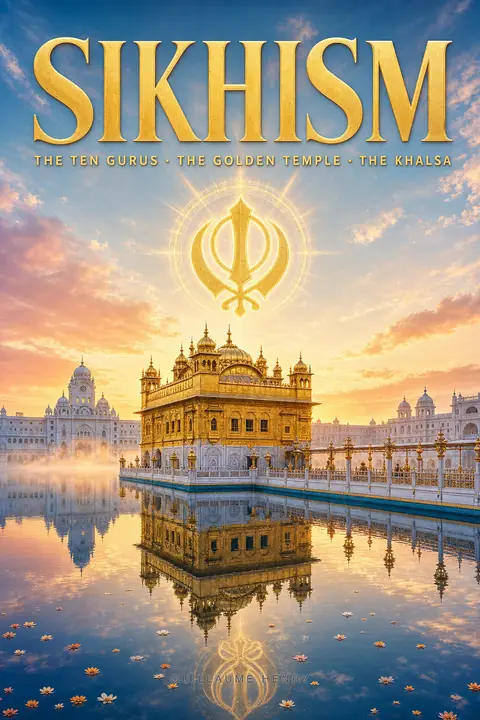
Sikhism
The Sikhism Book: The Ten Gurus, the Golden Temple, and the Teachings of the Khalsa
The Ten Gurus, the Guru Granth Sahib, and the Path of the Khalsa
A clear, respectful introduction to the world's fifth-largest religion: Guru Nanak and the line of ten Gurus, the one formless God, the Golden Temple at Amritsar, the eternal scripture of the Guru Granth Sahib, and the founding of the Khalsa. The history, teachings, and beliefs of a living faith.