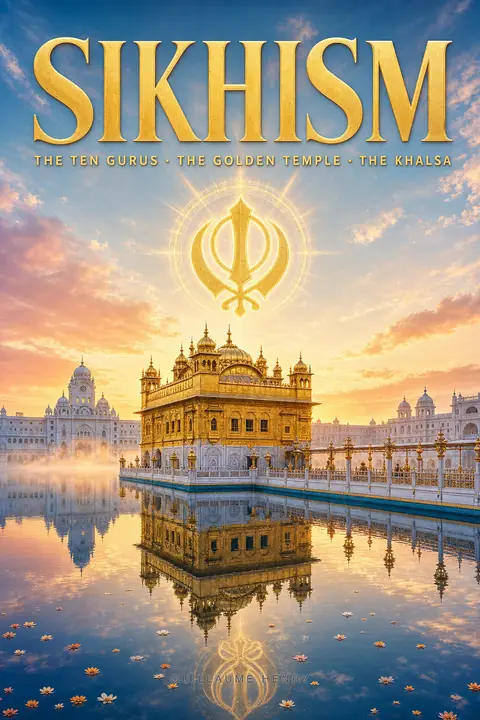
Sikhism
From the luminous teachings of Guru Nanak to the living scripture of the Guru Granth Sahib, Sikhism offers one of the world's most profound and humane spiritual visions. Discover its origins, theology, and living practice.
Browse Sikhism
The Birth of a Living Faith
In the fertile river plains of the Punjab, sometime around 1469 CE, a child was born in the village of Rai Bhoi Ki Talwandi, known today as Nankana Sahib in present-day Pakistan. His name was Nanak, and the tradition that grew from his life and teachings would eventually become the world's fifth-largest religion: Sikhism, with roughly 25 to 30 million adherents worldwide.
Sikhism is not a mythology in the classical sense. It does not centre on a pantheon of warring deities or a cosmogonic drama played out between rival supernatural forces. Yet it possesses a rich sacred imagination, a deep narrative tradition, and a theology that engages directly with the oldest questions human beings have asked: Who made this? What are we for? How should we live together?
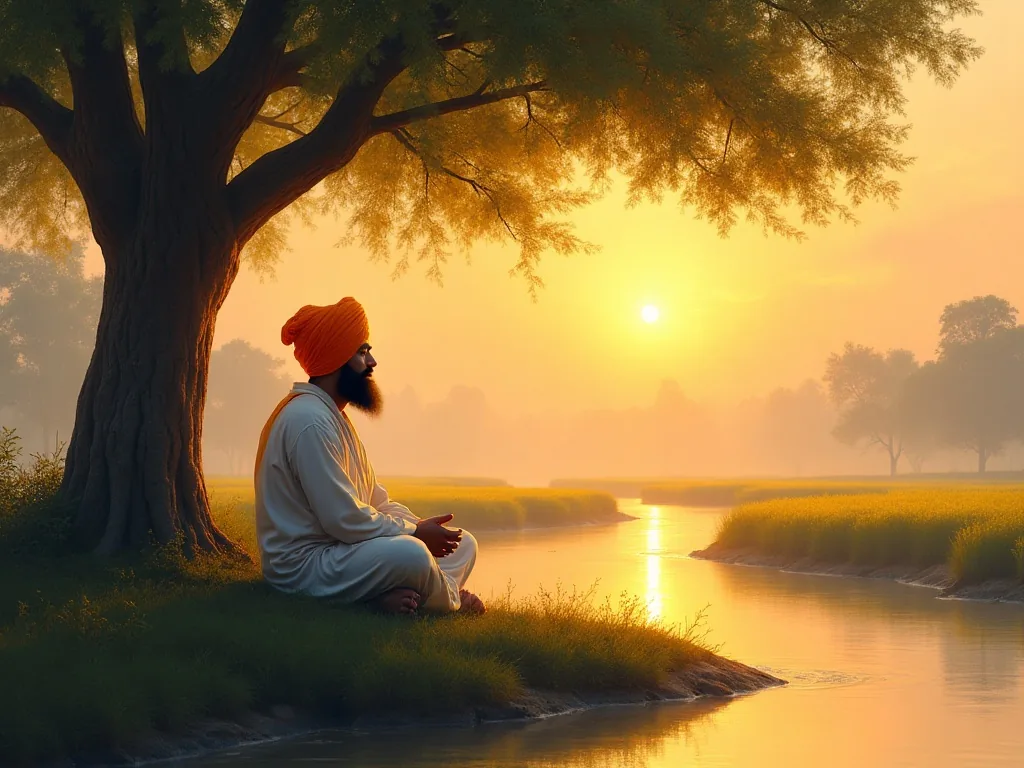
To approach Sikhism with the care it deserves, one must begin at its source: the singular, world-changing experience of Guru Nanak Dev Ji on the banks of the Bein streamlet, where, according to the Janam Sakhis (hagiographic accounts of his life), he disappeared beneath the water for three days and emerged transfigured, announcing simply: "There is no Hindu, there is no Muslim."
The Ten Gurus: A Chain of Light
Sikhism was shaped across two centuries by ten human Gurus, each considered a vessel for the same divine light rather than a separate spiritual authority. The Guruship, in Sikh theology, is a single flame passed from wick to wick.
Guru Nanak Dev Ji (1469-1539)
Nanak's life was marked by four great journeys, called Udasis, which carried him from the Arabian Peninsula to Tibet, from Sri Lanka to the Himalayan foothills. Everywhere he debated, composed, and sang. His compositions, recorded later in the Adi Granth, are among the most sublime devotional poetry in any language. His central teaching was the absolute Oneness of the Divine, expressed in the opening formula of Sikh scripture: Ik Onkar, "One Being Is."
The Succession
The Guruship passed through nine successors, each contributing to the tradition's theological and institutional development:
- Guru Angad Dev Ji (1504-1552): Standardised the Gurmukhi script, giving the Punjabi language a devotional written form.
- Guru Amar Das Ji (1479-1574): Established the langar system, the free community kitchen that remains one of Sikhism's most revolutionary social institutions.
- Guru Ram Das Ji (1534-1581): Founded the city of Amritsar and commissioned the pool known as Amrit Sarovar (Pool of Nectar).
- Guru Arjan Dev Ji (1563-1606): Compiled the first authoritative Sikh scripture, the Adi Granth, and built the Harmandir Sahib (later called the Golden Temple). He was martyred by the Mughal Emperor Jahangir, becoming the first Sikh martyr.
- Guru Hargobind Ji (1595-1644): Armed the community, wearing two swords symbolising Miri (temporal authority) and Piri (spiritual authority). He built the Akal Takht, the seat of temporal Sikh authority, directly opposite the Harmandir Sahib.
- Guru Har Rai Ji (1630-1661): Known for his compassion and his vast medicinal gardens; maintained peace while preserving the community's military readiness.
- Guru Har Krishan Ji (1656-1664): Became Guru at age five; renowned for tending to smallpox victims in Delhi before dying of the disease himself.
- Guru Tegh Bahadur Ji (1621-1675): Martyred by Emperor Aurangzeb for defending the religious freedom of Kashmiri Hindus. He is called the "Shield of Faith."
- Guru Gobind Singh Ji (1666-1708): The tenth and final human Guru, who transformed the community most dramatically through the founding of the Khalsa.
The Khalsa and the Five Kakaars
On the spring festival of Vaisakhi in 1699 CE, at Anandpur Sahib, Guru Gobind Singh Ji summoned a vast gathering of Sikhs. In an act that still reverberates through Sikh identity, he asked for five volunteers willing to give their heads. Each stepped forward into a tent, and each emerged alive, transformed. These five, the Panj Pyare (Five Beloved Ones), became the founding members of the Khalsa, the community of initiated Sikhs.

The Guru baptised them with Amrit (sweetened holy water stirred with a double-edged sword) and received baptism from them in return, dissolving the boundary between Guru and disciple. He gave the Khalsa five articles of faith, the Panj Kakaars or Five Ks, each beginning with the Punjabi letter "K":
- Kesh: Uncut hair, symbolising acceptance of God's creation as it is.
- Kangha: A wooden comb, representing cleanliness and order.
- Kara: A steel bracelet, a reminder of the eternal, unbroken nature of divine will.
- Kachera: A specific undergarment, denoting moral restraint and readiness.
- Kirpan: A ceremonial sword, representing the duty to protect the innocent.
Men received the surname Singh (Lion) and women Kaur (Princess), erasing caste appellations in a single stroke.
At the end of his life, Guru Gobind Singh Ji made a declaration of enormous consequence: the lineage of human Gurus would end with him. The eternal Guru of the Sikhs would henceforth be the scripture itself, the Guru Granth Sahib Ji.
The Guru Granth Sahib: Scripture as Living Presence
No other major religion treats its scripture quite as Sikhism treats the Guru Granth Sahib. It is not merely a holy book. It is accorded the full reverence due to a living Guru. In every Gurdwara (Sikh house of worship), the scripture rests on a raised throne (Takht), sheltered by a ceremonial canopy (Palki), fanned with a Chaur Sahib (a whisk of fine hair), and put to rest at night in a dedicated chamber.
The Guru Granth Sahib spans 1430 pages in its standard printed form and contains approximately 5,894 hymns (Shabads). Its authors are astonishingly diverse. The six Sikh Gurus who composed within it are joined by Hindu Bhakti saints such as Kabir, Ravidas, Namdev, and Trilochan, and Muslim Sufi figures including Sheikh Farid. This interfaith breadth is not incidental; it is a doctrinal statement about the universality of devotion.
The language of the text is a sacred composite: Punjabi, Hindi, Sanskrit, Arabic, Persian, and several regional dialects interweave in a texture that is simultaneously local and cosmic. The hymns are organised not by author but by raag, the classical Indian melodic frameworks in which they are meant to be sung. Music, in Sikhism, is not decoration. The practice of Kirtan, singing the sacred hymns, is itself a form of meditation and divine encounter.
Core Theological Concepts
Waheguru and Ik Onkar
The divine in Sikhism is addressed most often as Waheguru, a term of wonder that translates roughly as "Wondrous Illuminator." The Divine is radically monotheistic: formless (Nirankar), without gender, beyond the cycle of birth and death, the source and ground of all existence. The famous Mool Mantar, the root formula opening the Guru Granth Sahib, sets this out with lapidary precision: one being, truth by name, creator, without fear, without enmity, timeless, self-existent, realised through the grace of the Guru.
Haumai and the Human Problem
The central spiritual obstacle in Sikh theology is Haumai, a term blending "I" and "am" that designates the ego, the false sense of separate selfhood that keeps a person locked in cycles of pride, attachment, and suffering. The five Vikars (vices) of Haumai are lust (Kaam), anger (Krodh), greed (Lobh), attachment (Moh), and pride (Ahankaar).
Naam, Simran, and Seva
Liberation comes through three interwoven practices:
- Naam Simran: Constant remembrance and repetition of the Divine Name.
- Kirtan and Sangat: Devotional singing within the holy congregation.
- Seva: Selfless service to others, considered worship in practical form.
The langar, the free communal kitchen that feeds anyone regardless of faith, caste, or status, is Seva made architecture. The Golden Temple's langar in Amritsar feeds between 50,000 and 100,000 people daily, making it one of the largest free kitchens on Earth.
Sacred Spaces and the Gurdwara
The word Gurdwara means "gateway of the Guru." Every Gurdwara, from the grandest to the humblest village hall, shares the same essential features: the Guru Granth Sahib enthroned at its centre, the langar kitchen at its side, and its doors open on all four sides to symbolise welcome from every direction.
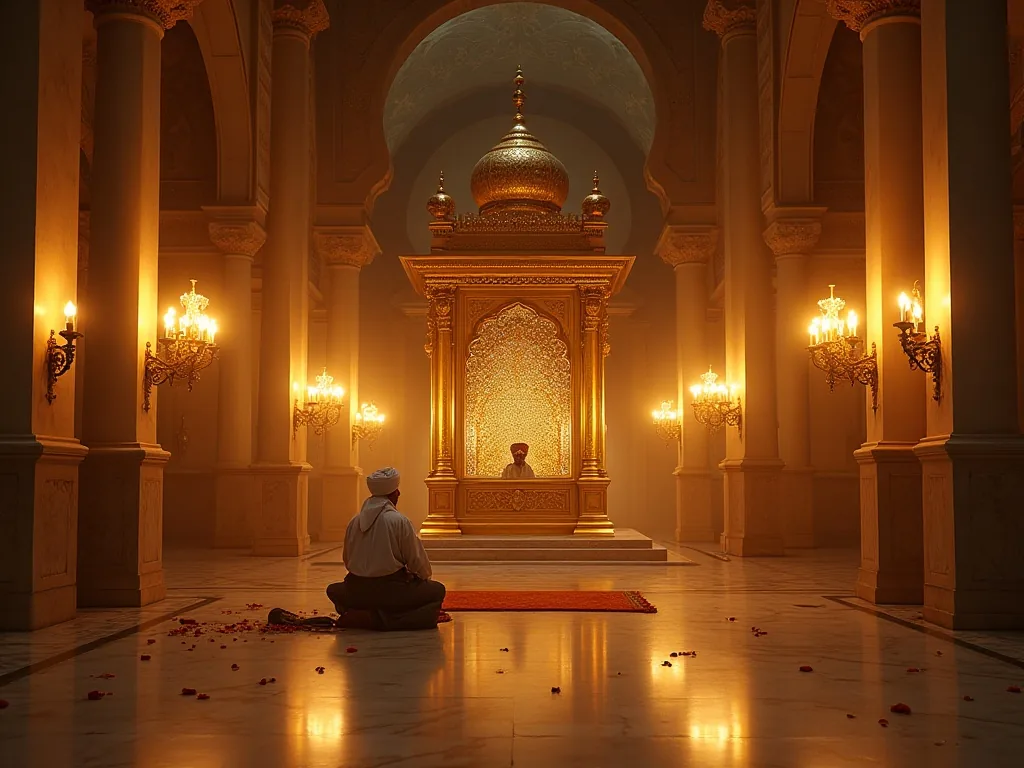
The most sacred Gurdwaras are known as the Takhts (Thrones), five in total:
- Akal Takht, Amritsar: The supreme seat of temporal Sikh authority.
- Takht Sri Patna Sahib, Patna: Birthplace of Guru Gobind Singh Ji.
- Takht Sri Kesgarh Sahib, Anandpur Sahib: Where the Khalsa was founded.
- Takht Sri Hazur Sahib, Nanded: Where Guru Gobind Singh Ji passed from the world.
- Takht Sri Damdama Sahib, Talwandi Sabo: Where Guru Gobind Singh Ji finalised the Guru Granth Sahib.
Beyond India, Gurdwaras have become anchors of Sikh identity in diaspora communities across the United Kingdom, Canada, the United States, and East Africa, places where the langar has often provided essential food to non-Sikh communities during times of crisis.
Sikh Festivals and the Nanakshahi Calendar
Sikh sacred time is governed by the Nanakshahi Calendar, reformed in 1999 and adopted formally in 2003, which fixed the dates of Sikh festivals to specific solar dates rather than allowing them to float with the lunar Hindu calendar.
Key observances include:
- Gurpurabs: Anniversaries marking the births and martyrdoms of the Gurus. The Gurpurab of Guru Nanak Dev Ji, celebrated in late autumn, is the most widely observed.
- Vaisakhi (April 13/14): New Year and the anniversary of the founding of the Khalsa in 1699. Celebrated with enormous processions called Nagar Kirtans.
- Bandi Chhor Divas: The Sikh celebration coinciding with Diwali, commemorating Guru Hargobind Ji's release from Gwalior Fort and his insistence that 52 imprisoned Hindu princes be freed alongside him.
- Hola Mohalla: Established by Guru Gobind Singh Ji as an alternative to Holi, featuring martial arts demonstrations, mock battles, and poetry competitions at Anandpur Sahib.
The Sikh Diaspora and the Modern World
The Punjab was partitioned between India and Pakistan in 1947, a catastrophe that uprooted millions of Sikhs from ancestral homes. The trauma of Partition and the 1984 anti-Sikh pogroms following the assassination of Prime Minister Indira Gandhi remain raw wounds in community memory.
Yet the diaspora that emerged has carried Sikh values into every corner of the world. The principle of Chardi Kala, "ever-rising spirit," a posture of optimistic resilience regardless of circumstance, has proven a remarkable cultural resource for communities navigating displacement, discrimination, and change.
Sikh philosophy also speaks with surprising directness to contemporary concerns. Its radical egalitarianism, its rejection of caste hierarchy centuries before it became fashionable in Western ethics, its insistence on the equal spiritual standing of women, and its vision of the divine as entirely beyond gender all position it as a tradition with much to offer contemporary moral reflection.
The Ardas: A Prayer That Holds History
Every Sikh gathering ends with the Ardas, a standing congregational prayer of distinctive structure. Its opening passages are fixed, invoking each of the ten Gurus by name and recalling the sacrifices of the Sikh martyrs, those who were "sawn asunder," "scalped," "broken on the wheel," whose memory the prayer carries forward into the present. The middle section is customised to the occasion. The closing returns to a fixed formula asking for the welfare not of Sikhs alone but of all humanity: Nanak Naam Chardi Kala, Tere Bhane Sarbat Da Bhala ("Nanak, with Naam and ever-rising spirit, may all of creation be blessed by Your will").
It is a prayer that does not separate devotion from history, the personal from the collective, or the community from the whole of suffering humanity. In that refusal to separate, it captures something essential about the Sikh vision: a faith that insists the sacred and the world are not two different places.
Recent in Sikhism
2 entries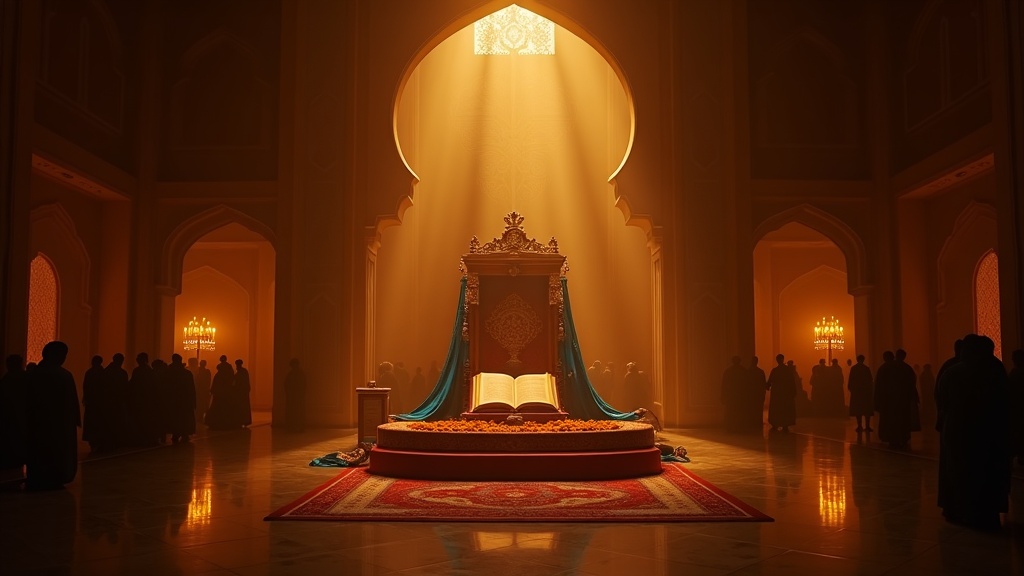
Sikhism
Guru Granth Sahib: The Eternal Living Guru
More than a sacred text, the Guru Granth Sahib is the living, breathing spiritual sovereign of the Sikh faith, a revelation woven from 1,430 pages of divine poetry, music, and mystical light.

Sikhism
Guru Nanak: Founder of Sikhism and First Guru
Born in 1469 in the Punjab, Guru Nanak walked out of a river three days after vanishing and declared that there is no Hindu, no Muslim. His life rewrote the spiritual map of South Asia forever.