The Morrigan: Goddess of War and Fate in Celtic Myth
Shape-shifter, crow, battle-queen, prophetess: the Morrigan is the most complex war deity in the Celtic world, weaving fate into every clash of iron.
Contents
A crow lands on the shoulder of a dying king. It does not screech or flee. It watches. That single image captures the essence of the Morrigan goddess of war and fate better than any catalogue of attributes ever could. She is not merely present at the battlefield; she is the battlefield's meaning, the unseen current that decides which way the tide of spears breaks.
Her name appears across the great cycles of Irish mythology: the Ulster Cycle, the Mythological Cycle, and above all in the saga of the two battles of Mag Tuired. She is called Mór Rígan in Old Irish, a compound that scholars have parsed in at least two ways: "great queen" or "phantom queen." Both readings are correct. She is regal in authority and terrifying in aspect, and she moves between those two registers with the ease of someone who has spent eternity at the border between the living and the dead.
She carries no single weapon. Her power is a subtler, older thing: prophecy, transformation, the stirring of battle-rage in warriors, and the cold presence that settles over a man the moment the gods have decided he will not leave the field alive.
The Triple Goddess: Badb, Macha, and the Phantom Queen
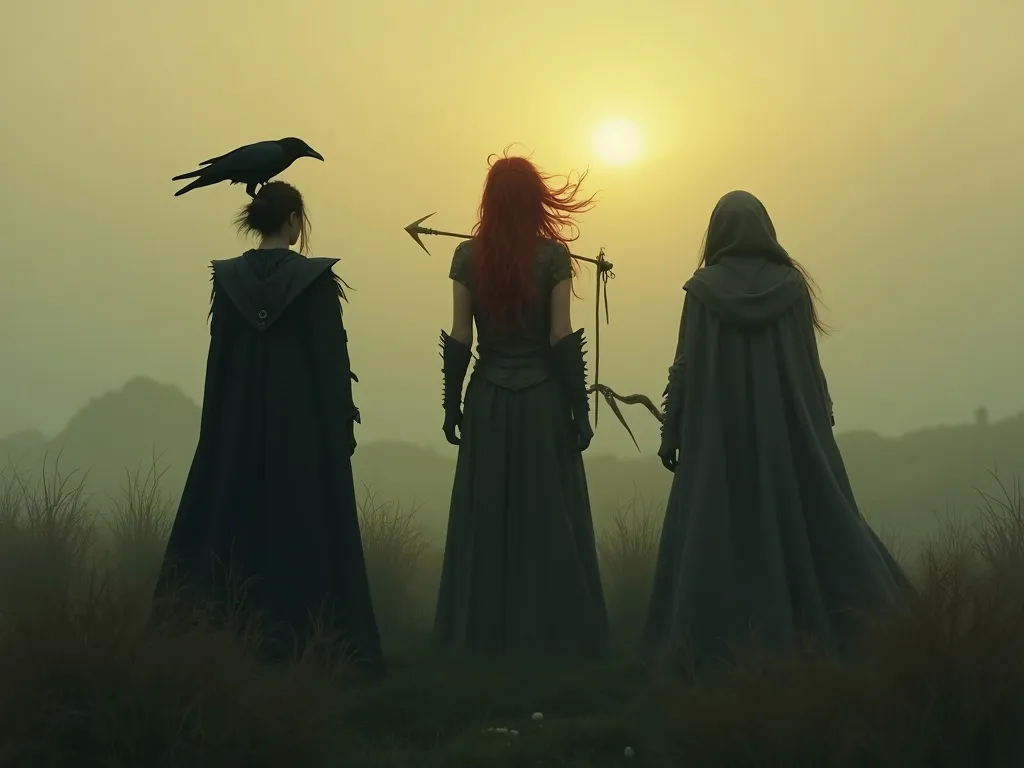
Irish mythology rarely allows its most powerful figures to exist as simple, singular entities. The Morrigan belongs to a collective known as the three Morrigna, a triad whose members shift depending on the source but whose core remains stable.
Badb is the crow-goddess of battle, whose scream over a host signals mass death. Her name is cognate with a word meaning "scald-crow" or "boiling," evoking the chaotic boil of a melee. At the second battle of Mag Tuired, Badb delivers a rousing prophecy of victory that rings with intoxicating rhythm in the original Old Irish, cataloguing the richness that peace will bring after the Fomorian enemy falls.
Macha is the most territorially grounded of the three. She is bound to the land of Ulster in a way the others are not, appearing in multiple distinct myths: as a goddess who races horses while heavily pregnant, as a warrior-woman who defeats the sons of a king, and as a sovereignty figure who gives her name to Emain Macha (modern Armagh). Her suffering at the hands of Ulster's men becomes the curse that fells the province's warriors at their hour of greatest need.
Nemain, whose name suggests panic or frenzy, represents the madness that sweeps through a battle line, the unreasoning terror that turns a disciplined warband into a rout. She appears briefly but intensely in several saga texts, her cry alone enough to kill men on the spot.
The figure called simply "the Morrigan" often subsumes all three, acting as sovereign over the collective. The medieval Irish compilers who preserved these texts found her plurality awkward, so she appears sometimes alone, sometimes as one of three, sometimes as all three simultaneously. This is not inconsistency. It reflects a theological logic in which war is never one thing: it is panic, it is slaughter, it is the claim the land makes on those who defend or desecrate it.
The Morrigan and Cu Chulainn: A Prophecy Refused
The most dramatically compelling episode in the Morrigan's mythological career is her confrontation with Cu Chulainn, Ulster's greatest warrior, described at length in Táin Bó Cúailnge (the Cattle Raid of Cooley) and in the shorter text Tochmarc Emire.
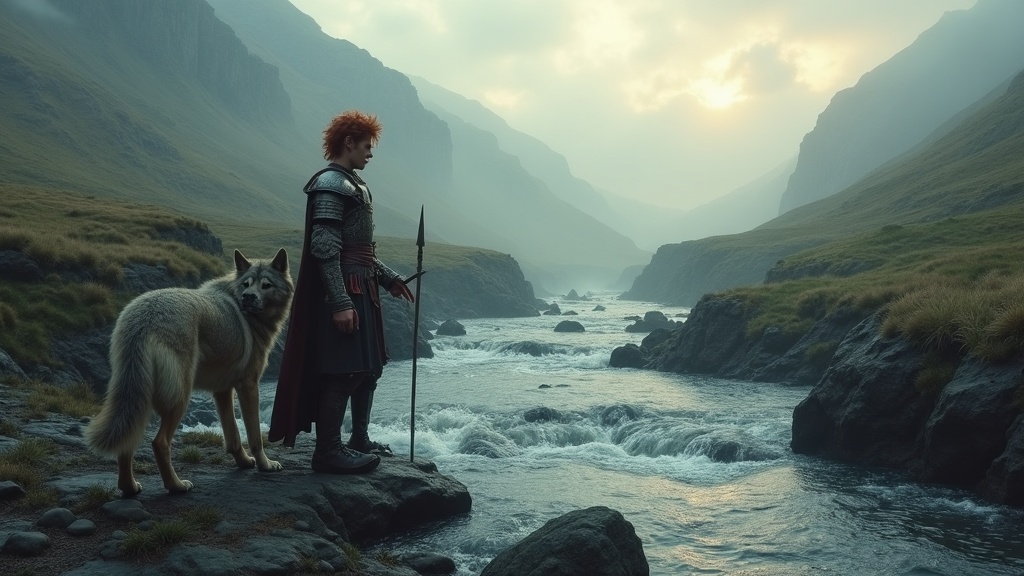
She approaches him first as a beautiful woman, offering alliance and love. Cu Chulainn, absorbed in his martial identity, refuses her. He does not recognise who she is, or perhaps refuses to acknowledge it. The refusal is catastrophic. She promises to hamper him during his forthcoming fights: she will become an eel and tangle his feet in a ford, a wolf-she driving cattle across his path, a white, red-eared heifer leading a stampede against him. He defeats each transformation, injuring her each time, though he does not know he is striking the same being.
The reconciliation scene that follows is quietly devastating. The Morrigan appears to Cu Chulainn as a lame old woman milking a cow with three teats. He asks for milk; she gives it, and with each sip he offers a blessing. Each blessing heals one of the wounds he unknowingly inflicted. By the time the cup is empty, she is whole again, and he is bound to her in a way he still does not fully comprehend.
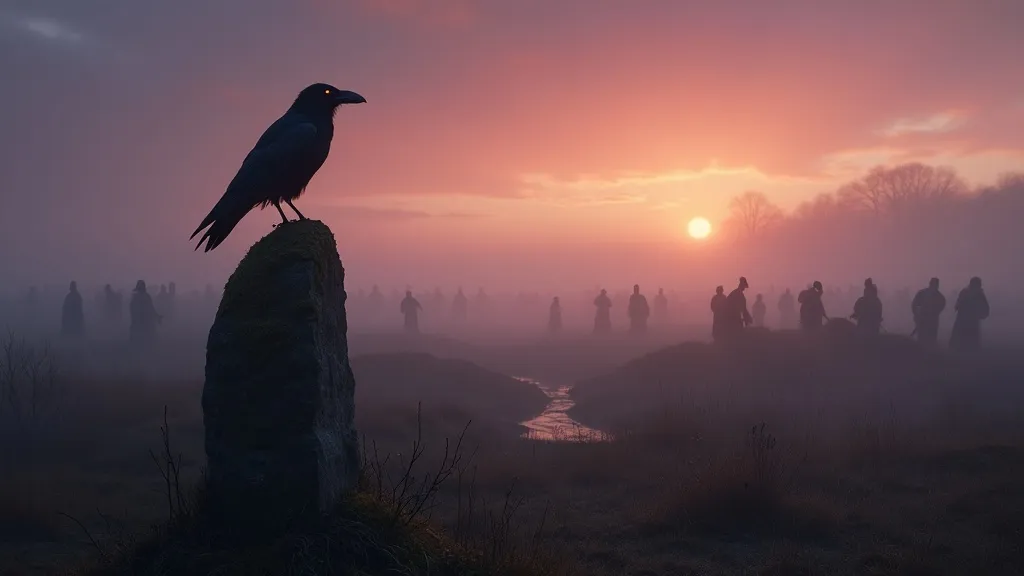
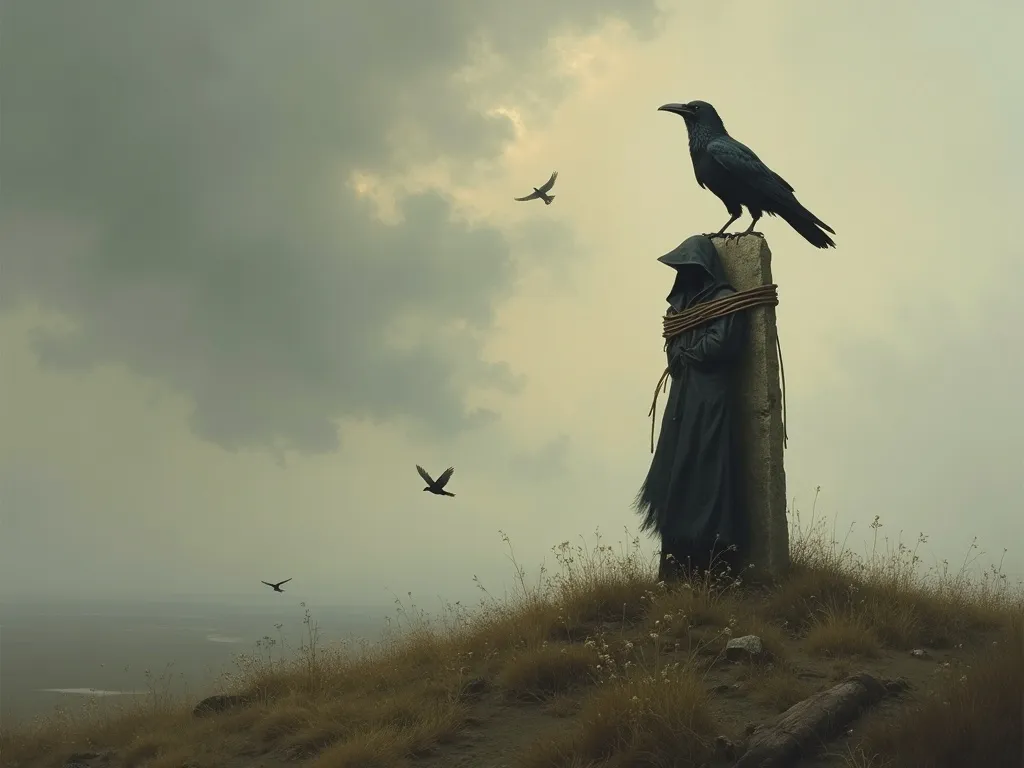
She does not destroy Cu Chulainn immediately. She is not that simple. She gives him warnings before his final battle, washing his bloody armour at a ford - the bean nighe (washing woman) motif that persists in Scottish folklore as the harbinger of death. When he refuses to heed her omens and rides to his doom anyway, she perches as a crow on the standing stone to which he has lashed himself so he may die on his feet. His enemies only dare approach when they see the crow settle.
The Morrigan's relationship with fate is not the cold indifference of a mechanical universe. She offers chances. She warns. She tests. The tragedy of Cu Chulainn is that he is constitutionally incapable of accepting any sovereign authority over his own will, including hers.
Sovereignty, Sex, and the Land's Claim
In Irish mythology, the right to kingship flows through a ritual union between the prospective king and the goddess of sovereignty, a figure who often appears first as a hag and transforms into a radiant woman once the king embraces her. The Morrigan operates within this tradition while breaking several of its rules.
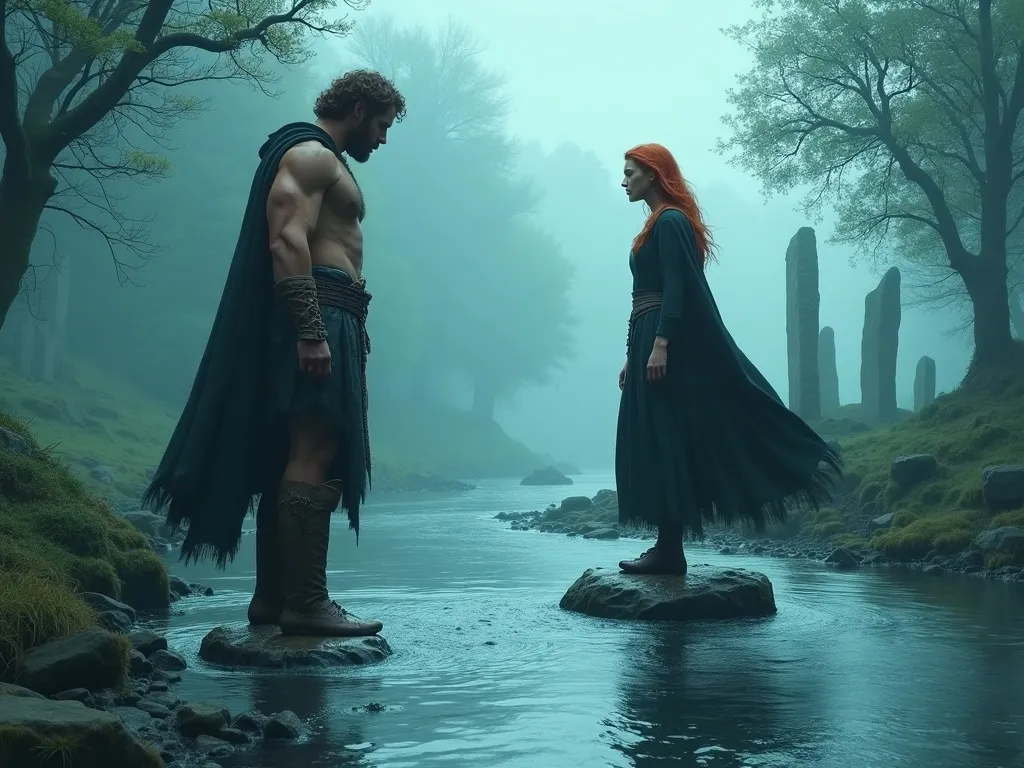
Her union with the Dagda on the feast of Samhain, described in Cath Maige Tuired (the Battle of Mag Tuired), is one of the most striking scenes in the entire corpus. She straddles a river, one foot on each bank; the Dagda approaches and they couple in the water. She then shares with him the military intelligence he needs: the location of the Fomorian king Indech and the fighting forces he has gathered. The encounter is simultaneously erotic, political, and tactical. The Morrigan here is less a passive grant-er of sovereignty than an active strategic partner.
The Dagda is the chief of the Tuatha De Danann, the divine race who hold Ireland before the Milesians arrive. His coupling with the Morrigan is a cosmic alignment between the powers of vitality and the powers of fate and war. After Samhain, the two great battles of Mag Tuired proceed, and the Morrigan's intervention is decisive: she tangles the Fomorian king Indech in bonds of magic and pours two handfuls of his blood into a river, draining him before the battle even begins in earnest.
Her role in sovereignty extends to the land itself. When Ireland is threatened, her desire is for Ireland's survival. She is not partisan in a petty sense; she is loyal to the principle of rightful kingship, and she punishes those who undermine it. This is why her rejection by Cu Chulainn carries such weight: he denies the sovereignty figure herself, and in doing so seals the fate she had promised to avert.
Shape-Shifting and the Crow's Eye
The Morrigan's ability to shift forms is not a party trick. It is a statement about the nature of war and fate: both are unstable, both require the capacity to see from multiple angles simultaneously.
Her signature animal form is the badb catha, the battle-crow or hooded crow, a bird that genuinely flocks to battlefields - not out of any mythological instinct, but because carrion follows combat. The ancient Irish watching crows pick over a field of the dead would have seen the goddess there, impartially assessing the result. This is a rare case where myth and natural history reinforce each other precisely.
She also appears as:
- A red-maned heifer during the cattle raid narrative
- An eel in the ford episode with Cu Chulainn
- A wolf driving cattle
- An old woman milking a three-teated cow (the healing scene)
- A beautiful young woman (her first approach to Cu Chulainn, and her approach to the Dagda)
- A washer-woman at the ford (bean nighe), seen by those about to die
Each form corresponds to a specific function. The crow surveys and judges. The eel and the wolf test and impede. The beautiful woman tests willingness to accept sovereignty. The hag tests willingness to accept mortality and its gifts. No single form is more "real" than another. The Morrigan is fully present in all of them.
The bean nighe tradition deserves particular attention because it migrated so strongly into Scottish Gaelic folklore that it effectively separated from its Irish parent and took on an independent life. The Highland bean nighe retains the washing-at-the-ford imagery and the death-prophecy function, but the explicit link to the great goddess of war fades. Comparative folklorists like Anne Ross, writing in Pagan Celtic Britain (1967), traced these threads back with considerable care, establishing the continuity even where the names changed.
The Morrigan at Mag Tuired: War Made Divine
Cath Maige Tuired, preserved in the manuscript tradition from roughly the ninth century onward, is the primary text for understanding the Morrigan as a fully operational war goddess rather than a figure who merely haunts battles from the edges.
The two battles of Mag Tuired are the founding wars of mythological Ireland. In the first, the Tuatha De Danann defeat the Fir Bolg. In the second, they face the Fomorians, a more ancient and threatening power. The Morrigan's role in the second battle is threefold.
First, she provides intelligence, as discussed: her union with the Dagda yields the tactical information that shapes the campaign. Second, she actively participates in the battle, using her powers to demoralize and magically weaken the Fomorian host. Third, after the battle ends in Tuatha De victory, she delivers a great victory prophecy in which the land itself rejoices: rivers flow with fish, forests fill with game, the earth rewards those who defended it. The text then pivots abruptly. She delivers a second prophecy: of the end of time, a future age when all these goods will disappear, when summer will come without flowers and cows will give no milk. The contrast is extraordinary. The same figure who sings of abundance turns without transition to announce cosmic exhaustion. This is the Morrigan's most honest self-revelation: she contains both the promise of sovereignty and the inevitability of its dissolution.
Scholars including Proinsias Mac Cana, in his Celtic Mythology (Thames and Hudson, 1970), have identified this double-prophecy as one of the most structurally significant passages in all Irish mythological literature. It places the Morrigan at a scale beyond any individual battle; she oversees the entire arc of a civilisation.
Fate-Weaving Across Celtic Traditions
The Morrigan goddess of war and fate does not exist in complete isolation from other Indo-European fate-traditions. Comparative mythology finds strong structural parallels worth considering carefully.
The Norse Valkyries - Choosers of the Slain - perform several of the Morrigan's functions: they appear on battlefields, they carry the dead to the afterlife, they have prophetic knowledge. The weaving of fate imagery appears in both traditions: the Norse poem Darradarljod, embedded in Njals saga, describes Valkyries weaving on a loom strung with entrails and weighted with severed heads. The Morrigan's power over fate takes different form, working through prophecy and direct magical intervention rather than literal weaving, but the underlying theological structure - female supernatural figures who determine who dies and who survives combat - is close enough to suggest a shared inheritance from proto-Indo-European religion.
The Morrigan (Irish Celtic)
- Appears as crow, eel, wolf, hag, beautiful woman
- Issues individual prophecies to named warriors
- Has active agency: intervenes in battles through magic
- Embodies sovereignty of the land, not just fate in battle
- A single figure (or triad) with cosmic scale
- Engages in erotic and political alliances with male gods
Valkyries (Norse)
- Appear as swan-maidens, armoured women, ravens
- Select the slain en masse per Odin's decree
- Act as messengers and executors of divine will
- Tied to Valhalla's warrior-afterlife economy
- A collective of named individuals (Brynhildr, Skuld, Gondul, etc.)
- Some engage in relationships with heroes (Brynhildr and Sigurd)
The Morrigna also invite comparison with the Hindu Kali, though the parallel is looser. Kali shares the battlefield presence, the association with blood and death, the terrifying aspect concealing a deeper protective function, and the garland of severed heads as ornament. Both figures resist easy demonisation: they are neither simply evil nor simply benevolent. They are what war requires: honest about its cost, sovereign over its outcome.
The Morrigan's Afterlife in Medieval and Modern Culture
The manuscripts that preserve the Morrigan's stories were written by Christian monks in medieval Ireland, and the tension is visible. The compilers of texts like Lebor Gabala Erenn (the Book of Invasions) treated the Tuatha De Danann as historical figures who preceded the Gaels, gradually rationalising them from gods into supernatural humans. The Morrigan survived this process better than many of her peers, perhaps because her functions were too specific and too dramatically necessary to strip away cleanly.
She persists in the folklore record well into the post-medieval period, chiefly through the bean nighe tradition and through localised stories of the banshee (Old Irish ben side, "woman of the fairy mound"). The Irish banshee, who wails to announce a death in certain families, is structurally descended from the Morrigan's prophetic and death-announcing functions, though the terrifying scale has contracted to a domestic grief-ritual. The banshee mourns; the Morrigan judges.
Modern reception has been vigorous and varied. She appears in Yeats's play The Only Jealousy of Emer (1919), where her influence over Cu Chulainn is explicitly staged as a competition for the hero's soul. In contemporary fantasy literature she has become one of the most heavily adapted Celtic figures: Neil Gaiman's American Gods (2001) gives her a significant cameo, and his novel The Ocean at the End of the Lane (2013) draws on her sovereignty-goddess logic more obliquely. Feminist theologians from the 1970s onward reclaimed her as a symbol of female power operating outside patriarchal permission, a reading that has genuine mythological grounding even if it selects certain aspects over others.
What the modern receptions often miss is her ambivalence. She is not a feminist icon who simply empowers women and warriors. She warned Cu Chulainn repeatedly and he died anyway. She offered alliance and was refused. The Morrigan's power over fate is real, but it is not unlimited, and her tragedies are as real as her triumphs. That complexity is what keeps her alive across fourteen centuries of storytelling.
Frequently asked questions about the Morrigan goddess of war and fate
Frequently asked questions
Is the Morrigan the same as the Banshee?
They share a lineage but are not identical. The banshee (from Old Irish ben side, "woman of the fairy mound") is a contracted, domesticated form of the death-prophecy function that the Morrigan exercises at a cosmic scale. The banshee announces death to specific Irish families; the Morrigan determines and announces death on battlefields involving kingdoms and civilisations. Medieval and post-medieval folklore gradually separated the two, though specialist scholars like Patricia Lysaght have traced the structural continuity in her study The Banshee: The Irish Supernatural Death-Messenger (1986).
What does the name 'Morrigan' actually mean?
The Old Irish compound Mór Rígan yields two plausible readings: "great queen" (from mór, great, and rígan, queen) or "phantom queen" (if mór is read as a reflex of an older form meaning phantom or spectre). Both readings appear in scholarly literature, and the ambiguity is likely deliberate: she is a queen whose authority is supernatural, invisible, and lethal. Neither translation cancels the other.
Did the Morrigan fight directly in battles, or only influence them?
Both. At the second battle of Mag Tuired, described in Cath Maige Tuired, she provides pre-battle intelligence, uses magic to weaken the Fomorian king Indech, and participates in the battle's unfolding through direct supernatural intervention. With Cu Chulainn, she acts through transformation and harassment rather than open combat. Her power is most fully expressed through prophecy and fate-shaping, but she is not a passive figure: she takes sides, makes alliances, and acts.
Why did the Morrigan pursue Cu Chulainn so persistently?
The simplest answer is that she offered him sovereignty, in the full political and mythological sense of that word, and he refused it. In Irish tradition, a king or hero's relationship with the sovereignty goddess determines whether his reign will be fertile and successful or barren and doomed. Cu Chulainn's rejection of the Morrigan is not just personal rudeness; it is a structural rejection of the very principle that legitimates heroic power. She pursues him because the myth requires the consequences of that refusal to play out fully.
Is the Morrigan related to Morgan le Fay in Arthurian legend?
The relationship is debated but credible. Morgan le Fay shares several attributes: she is a shape-shifter, a supernatural woman of great power, associated with death, healing, and the island of Avalon, and she stands in an ambiguous relationship to the king (Arthur) that parallels the Morrigan's relationship with Cu Chulainn. The Arthurian tradition drew heavily on earlier Celtic narrative material as it passed through Welsh and Breton intermediaries before reaching the French romancers. Scholars including Roger Sherman Loomis argued for direct mythological descent; others see parallel developments from shared Celtic substrate rather than a single line of transmission. The resemblance is too precise to be coincidence.
Does the Morrigan appear in Welsh mythology as well as Irish?
She does not appear by name in Welsh mythology, but cognate figures exist. Rhiannon, the supernatural woman of The Mabinogion who arrives on a horse no one can outrun and suffers an unjust punishment involving false accusations of child-murder, shares structural elements with Macha (one of the Morrigan's triple aspects). The Welsh gwragedd annwn (women of the Otherworld) perform analogous functions in some narratives. Celtic mythological traditions across Ireland, Wales, and Brittany drew from a shared reservoir of themes and figures, even when the specific names and stories diverged.
The Unresolved Question: Goddess, Sovereignty Figure, or Something Older?
Scholarship has not fully settled what the Morrigan fundamentally is. Three broad positions exist in the academic literature, and none has decisively won.
The first position, associated with scholars like Proinsias Mac Cana and Alwyn and Brinley Rees (in their foundational Celtic Heritage, 1961), treats her as a sovereignty goddess whose war functions are secondary to her primary role as the personification of the land's claim on those who rule it. On this reading, the battle-crow and the death-prophecy are manifestations of sovereignty's darker requirements: the land must be defended, and defence means death.
The second position, associated with comparative mythologists working within the Indo-European framework, treats her as a reflex of a proto-Indo-European war-goddess type, parallel to the Vedic Kali and the Norse Valkyric collective. The crow, the blood, the battle-field presence, the prophetic authority - these cluster in ways that suggest an archetype older than the Celtic languages themselves.
The third position, taken by more recent scholars including Máire Herbert, resists the neat categories and insists on reading the Morrigan from within her specific Irish textual context, not as a universal archetype but as a figure whose complexity is precisely that of the medieval Irish literary imagination: sophisticated, theologically layered, and irreducible to any single explanatory scheme.
All three positions have merit. The Morrigan resists resolution because she was designed to resist it. A goddess who oversees the whole arc of civilisation, from its first wars to its eventual exhaustion, cannot be pinned to a single function without losing what makes her essential. The crow settles on the shoulder of the dying king, and it watches. It does not explain itself. It does not need to.
Read the full book
Want the whole story?
The complete edition is an instant PDF download here, with a paperback on Amazon for selected titles.

Celtic
The Celtic Mythology Book: The Tuatha Dé Danann, Cú Chulainn, the Morrigan, and the Sacred Stories of Pre-Christian Ireland and Wales
Gods, Heroes, and the Four Treasures of Eriu
The mythology of the Celts before Christianity: the Tuatha Dé Danann, Cú Chulainn's war-feats, the Mabinogion's enchantments, and the bog cauldrons that survived the centuries.