
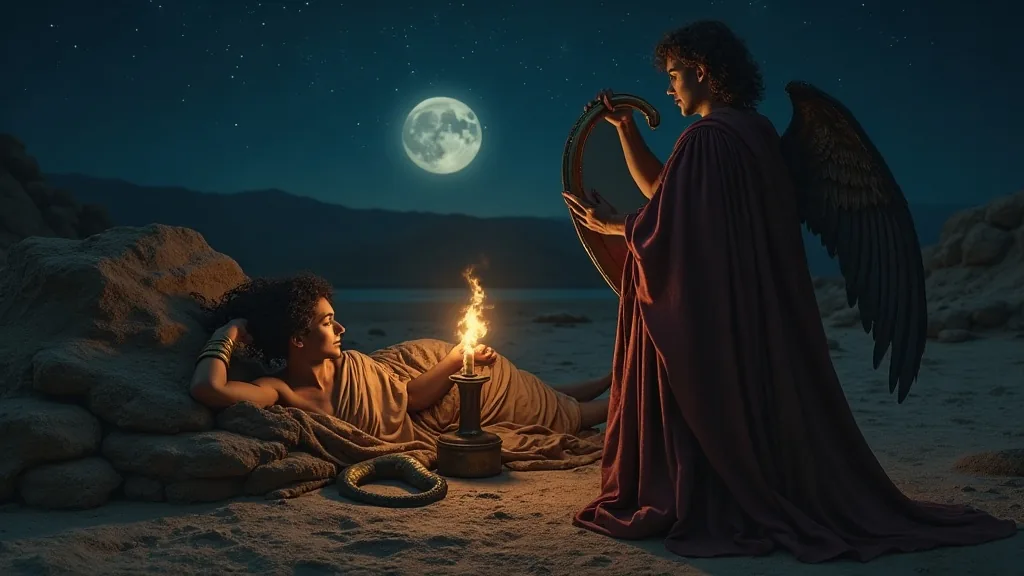
Medusa the Gorgon: Monster, Martyr, and Mirror of Greek Fear
Medusa the Gorgon turns stone every eye that meets hers, yet her own story is one of transformation, divine violence, and enduring power. Here is the full myth, from serpent hair to severed head.
Contents
The shield is polished to a mirror's finish. Perseus holds it at an angle, watching a reflection of something that cannot be watched directly. Coiled serpents writhe where hair should be. Wings fold against a sleeping back. The face is the face of a woman who has not been a woman in a very long time. He swings the bronze sickle. The neck opens. From the wound, a winged horse rises into the morning air.
That single scene, carved into temple pediments from Corfu to Sicily, compressed everything ancient Greeks wanted to say about beauty made monstrous, about danger that must be approached sideways, about the hidden fertility inside destruction. Medusa the Gorgon is one of the oldest and most contested figures in Greek mythology: part chthonic terror, part wronged mortal, part generative force whose blood spawned two miraculous creatures. She demands a second look.
The Three Gorgons and Their Origins
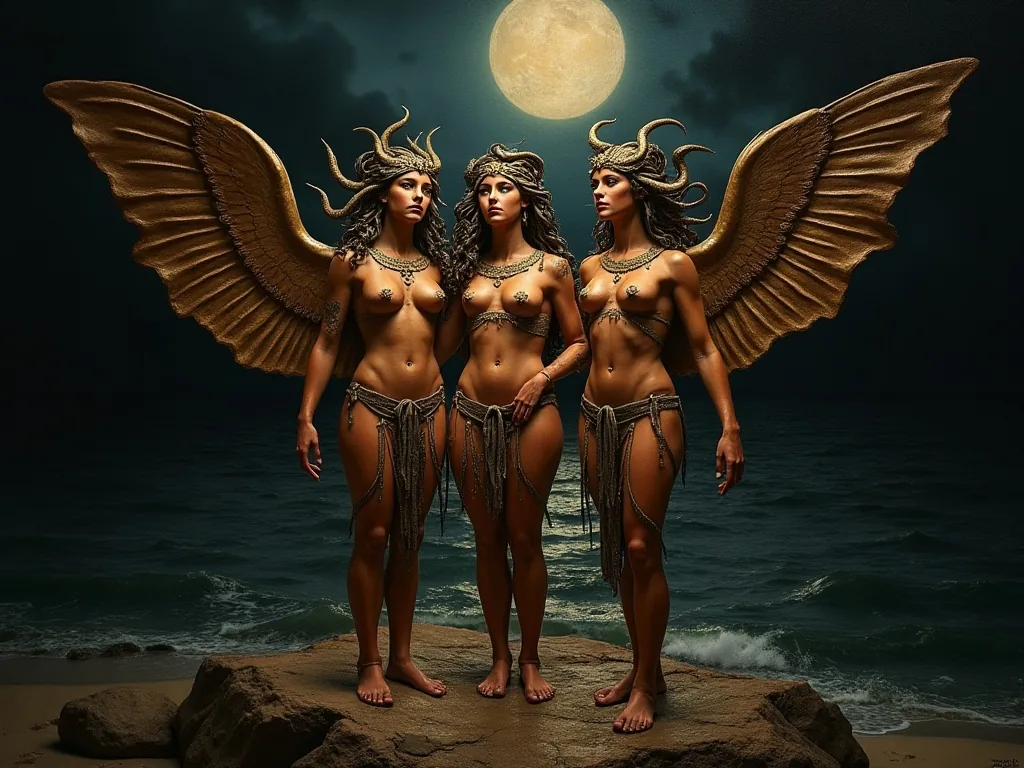
The word Gorgon derives from the Greek gorgos, meaning "terrible" or "fierce," and the sisters carry that epithet completely. Stheno (the Mighty), Euryale (the Wide-Roaming), and Medusa (the Guardian or Ruler) are the daughters of the sea deities Phorcys and Ceto, the same primordial pair who produced the Graeae, the Hesperides' serpent Ladon, and the monstrous Echidna. The Gorgons belong, genealogically and spiritually, to a stratum of Greek mythology older than the Olympian order, the deep-sea darkness before Zeus and his siblings reorganised the cosmos.
Hesiod's Theogony (c. 700 BCE) places the Gorgons near the edge of the world, "beyond the famous stream of Ocean, near Night, where the Hesperides sing." This geography matters. The Gorgons live at the boundary between the living world and whatever lies beyond it. Herodotus, writing in the fifth century BCE, placed them in Libya. Later mythographers settled on various wild western or underworld-adjacent locales, all of which served the same symbolic function: they exist at the threshold.
The iconography solidified over centuries. Archaic Greek art (roughly 700-480 BCE) depicted the Gorgon face, the gorgoneion, as a frontal mask: wide eyes, protruding tongue, boar tusks, sometimes wings. The image functioned as an apotropaic device, a ward against evil. It appeared on shields, on the breastplate of Athena, on city gates, on household pottery. The monster's face was, paradoxically, a protector.
Medusa Before the Curse: Ovid's Radical Reframing
The oldest tradition treats Medusa as simply monstrous from birth. Hesiod does not explain how she became what she is; she simply is. The turn toward a biographical Medusa, a creature with a human past, arrives with Ovid in his Metamorphoses (8 CE).
Ovid's Medusa was once a mortal woman of extraordinary beauty, celebrated above all for her hair. Poseidon (in Ovid's text, Neptune) desired her and violated her inside the temple of Athena. Athena, furious at the desecration of her sacred space, transformed Medusa's beautiful hair into serpents, so that anyone who looked upon her would be turned to stone.
This version has generated enormous controversy among scholars, and for good reason. It shifts the moral weight dramatically. The petrifying gaze becomes not an innate monstrosity but a punishment administered to a victim, not to a perpetrator. Ovid writes with characteristic irony: the goddess of wisdom punishes the woman for being violated in her own temple. The transformation is simultaneously a disfigurement and an armoring: no man can ever look at Medusa again without being destroyed.
Hesiodic Medusa
Born a Gorgon among Gorgon sisters. Monstrousness is innate, part of her nature as a child of Phorcys and Ceto. Her death is simply the hero's task, not a moral reckoning.
Ovidian Medusa
Born mortal and beautiful. Transformed by Athena after Poseidon's assault in her temple. Her monstrousness is inflicted, her petrifying power a form of involuntary self-defense.
Neither reading cancels the other. Greek mythology operated in layers, archaic cult practice, classical literature, Hellenistic revision, Roman adaptation, each adding sediment without erasing what came before. Both Medusas coexist in the tradition.
Perseus, the Winged Sandals, and the Killing Blow
The myth of Perseus and Medusa is among the oldest Greek hero narratives, pre-dating the Homeric epics in some of its motifs. King Polydectes of Seriphos, wanting to remove Perseus so he could pursue Perseus's mother Danae, sends the young hero on what is intended to be a suicide mission: retrieve the head of Medusa the Gorgon.
The gods equip him for the task. Athena provides a polished bronze shield to use as a mirror. Hermes gives him a harpe (a curved sickle-sword), winged sandals, and directions to find the Graeae. Hades contributes a cap of invisibility. The Graeae, three ancient crones who share a single eye and a single tooth between them, are tricked by Perseus into revealing the Gorgons' location; he snatches their eye mid-pass and refuses to return it until they comply.
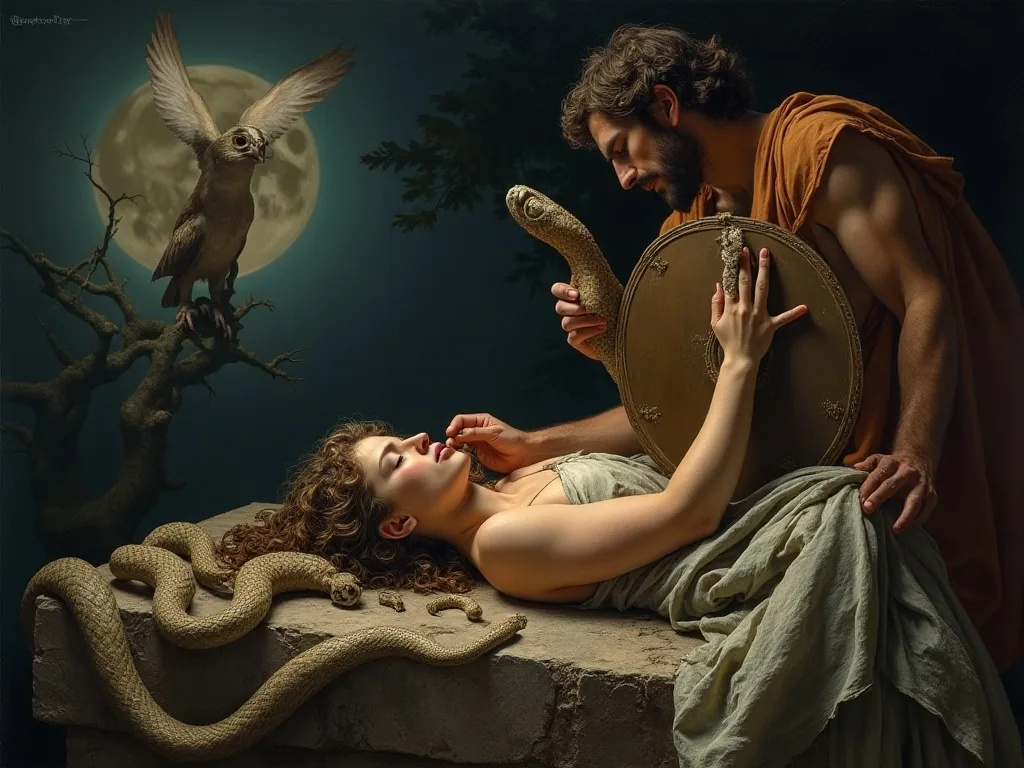
Perseus finds Medusa sleeping. He uses Athena's shield as a mirror, looking only at her reflection so her gaze cannot reach him. The harpe falls. He takes the head and seals it in the kibisis, a special bag that Hermes had provided. Two creatures burst from Medusa's severed neck: Chrysaor (golden sword), a warrior-giant, and Pegasus, the winged horse. Both are the children of Poseidon, conceived before the transformation and released only in death.
On his flight home, drops of Medusa's blood fall into the Libyan desert and become venomous snakes, explaining a feature of North African geography that puzzled ancient travelers. Perseus later uses the head as a weapon, most famously against Atlas (turning him to stone, and thus creating the Atlas Mountains), against the sea monster Cetus threatening Andromeda, and against Polydectes himself.
Finally, Perseus gives the head to Athena, who embeds the gorgoneion in her aegis, or her shield, depending on the source. Medusa continues to protect, even in death.
The Gorgoneion: Apotropaic Power and the Frontal Face
What is perhaps strangest about Medusa the Gorgon in Greek visual culture is how eagerly her image was reproduced and worn by the very people she was supposed to terrify. The gorgoneion, the frontal Gorgon face, appears on:
- The aegis of Athena and Zeus in sculpture and vase painting
- Greek military shields, particularly among Spartan hoplites
- The breastplate (the lorica) of the statue of Augustus from Prima Porta, proof of the motif's endurance into Rome
- Mosaic floors, doorways, and tomb entrances throughout the Mediterranean
- Coins minted in several Greek city-states, including Neapolis (modern Naples)
The logic is precise. The Gorgon's gaze petrifies: it stops movement, it fixes and destroys. Placed on a shield, on armor, on a threshold, the same power repels attackers and evil spirits. The most dangerous thing becomes the most effective guardian. This is the apotropaic inversion: the monster's face becomes a protective mask.
Scholars such as Jean-Pierre Vernant have analyzed the gorgoneion as an image of the "other face," the face of death itself rendered visible. In Greek thought, you cannot look at the sun, the face of a god, or the face of the Gorgon directly; all three represent categories of overwhelming, annihilating reality. The polished shield that Perseus uses is not just a tactical trick; it is a philosophical statement about how mortals must approach what exceeds them.
Symbolic Layers: What Medusa Reflects
The myth accumulates symbolic meaning the way a reef accumulates coral.
The Petrifying Gaze and the Limits of Vision
The gaze that turns flesh to stone is, at one level, a metaphor for the paralysis of terror. Greek tragedy and philosophy return obsessively to the danger of seeing too much: Tiresias goes blind from seeing Athena bathing, Actaeon is destroyed for seeing Artemis, Semele is incinerated for seeing Zeus in full divine form. Medusa belongs to this cluster. The taboo against direct sight is simultaneously a religious boundary (some things belong to the divine world only) and a psychological insight about how overwhelming certain experiences are.
Blood, Venom, and Medicine
Medusa's blood is ambivalent. Athena collects some of it, giving one vial to Asclepius, the healer. The blood from Medusa's left side kills; the blood from her right side heals and even raises the dead. This duality runs through the Greek understanding of pharmakon, the word Plato uses in the Phaedrus, which means simultaneously poison and remedy. The same substance, from the same source, depending on context. Medusa the Gorgon is, at her core, a figure of radical ambivalence.
The Decapitation and the Hero's Ordeal
Perseus's method, indirect sight, delegation of the killing blow, systematic use of divine gifts, is a template for how Greek heroes handle the uncanny. Direct confrontation with Medusa would destroy the hero. The myth insists that wisdom, represented by Athena's shield, is the prerequisite for courage. This distinguishes Perseus from a brute-force champion and aligns him with the tradition of clever Greek heroes like Odysseus.

Medusa Across Cultures and Through Time
The Gorgon's face does not belong to Greece alone. Comparable apotropaic face-imagery appears in Mesopotamian lamassu guardians, in Aztec depictions of Coatlicue, and in the wrathful protector deities of Tibetan Buddhism. The specific mechanism differs, but the function converges: monstrousness placed at a threshold to guard what lies beyond it.
In the Renaissance, Medusa became a symbol of prudence over passion. Caravaggio painted her severed head (1596-1597) with an expression of pure shock rather than rage, as if she has only just become aware of her own monstrousness in the mirrored shield. Cellini's bronze Perseus with the Head of Medusa (1545-1554) in the Piazza della Signoria in Florence was commissioned by Cosimo de' Medici as a political allegory: the hero standing over the monster was, for Florentine viewers, a statement about order over chaos.
Modern reception has dramatically inverted the moral valence. Feminist scholarship from the 1970s onward, particularly Patricia Klindienst Joplin's work on Ovid and Hélène Cixous's 1975 essay "The Laugh of the Medusa," reclaimed Medusa as a symbol of female power punished and then stolen, her severed head displayed as a trophy by a masculine heroic order. This reading does not falsify the ancient myths; it excavates a layer that was always there. Ovid's Medusa was already making this argument in 8 CE.
Contemporary fiction, comics, video games, and YA novels have pushed further. Rick Riordan's Percy Jackson series gives Medusa the Gorgon an entire small business and a grudge against the Olympians. Natalie Haynes's Stone Blind (2022) retells the myth entirely from Medusa's point of view. The snake-haired figure who was once pure threat has become, in the twenty-first century, an emblem of survival under conditions that were never fair.
The ancient Greeks put her face on their shields because they believed her power was real and transferable. The twenty-first century puts her image on protest signs and book covers because readers believe the same thing: that what she represents, the punished, the beautiful, the dangerous, the unfairly blamed, carries a charge that has not yet been discharged.
Frequently Asked Questions About Medusa the Gorgon
Frequently asked questions
Was Medusa always a monster, or was she originally human?
The answer depends on which source you consult. Hesiod's Theogony (c. 700 BCE) presents her as born monstrous, one of three Gorgon sisters. Ovid's Metamorphoses (8 CE) describes her as a mortal woman transformed by Athena after Poseidon assaulted her in Athena's temple. Both traditions are legitimate parts of the mythological record; Greek mythology never resolved them into a single authoritative version.
How did Perseus avoid being turned to stone by Medusa?
Perseus used a polished bronze shield given to him by Athena as a mirror, looking only at Medusa's reflection while approaching her as she slept. This indirect sight allowed him to locate and behead her with the harpe (curved sword) provided by Hermes without making direct eye contact. The strategy is explicitly described in Pindar's Pythian Odes and elaborated in Ovid and later sources.
What were the creatures born from Medusa's blood?
When Perseus severed Medusa's head, two beings emerged from her neck: Pegasus, the winged horse, and Chrysaor, a warrior said to be born holding a golden sword. Both were fathered by Poseidon before Medusa's transformation. Pegasus later became the steed of the hero Bellerophon, who rode him to fight the Chimera; Chrysaor became the father of the three-bodied giant Geryon.
Why did Athena punish Medusa rather than Poseidon?
This question is posed in Ovid's account and has no clean answer within the text. Ovid seems aware of the irony; some scholars read it as deliberate authorial critique. Within the logic of Greek religious thinking, Athena's temple was her sacred precinct, and its defilement demanded a response from the goddess herself. Poseidon, as a major Olympian, was largely beyond mortal reach or divine sanction. The myth reflects a pattern in Greek thought in which divine power operates according to its own internal hierarchies rather than consistent moral logic.
What is the gorgoneion and why was it so widely used?
The gorgoneion is the frontal face of the Gorgon, reproduced as an apotropaic symbol throughout the Greek and Roman world. It appeared on shields, armor, coins, pottery, thresholds, and temples. The logic was apotropaic inversion: the same power that destroys enemies when they look directly at Medusa is harnessed to repel evil when the face is worn as a guardian image. Athena incorporated it into her aegis, making it one of the most widely recognized symbols in ancient Mediterranean art.
Is there a connection between Medusa and North African mythology?
Herodotus (c. 440 BCE) located the Gorgons near Libya, and the myth includes details that appear to explain Libyan geography: drops of Medusa's blood falling into the Sahara desert became the region's many venomous snakes. Some scholars, including Michael Astour, have proposed connections between the Gorgon tradition and pre-Greek North African cults, possibly involving snake-goddess imagery. The evidence is speculative but the geographic clustering in the mythological tradition is real.
Medusa in the Twenty-First Century: An Unresolved Debate
The most active scholarly and cultural argument about Medusa the Gorgon today is not about the ancient sources. It is about who owns the interpretation.
Classical scholars debate whether Ovid's transformation narrative was always embedded in earlier Greek oral tradition and simply not recorded, or whether it was a genuine Roman-era innovation. The absence of the "violated mortal" motif in pre-Ovidian Greek sources is striking. Pindar, Apollodorus, and the fifth-century tragedians treat Medusa as a creature to be slain, with no sympathy extended and no backstory offered. Ovid's version may represent a specifically Roman sensibility: the Metamorphoses is full of assault narratives, and Ovid seems persistently alert to the violence that underlies divine mythology in ways his Greek predecessors were not.
The feminist reclamation project beginning in the 1970s drew heavily on Ovid, and it has been enormously productive, generating some of the most significant literary responses to ancient myth in the past fifty years. But it also raises a genuine methodological question: when modern readers treat the Ovidian version as the "true" version because it is morally more coherent, are they doing interpretive justice to the full tradition, or are they selecting the source that fits a pre-existing argument?
The ancient Greeks who painted the gorgoneion on their shields would have found both debates puzzling. For them, Medusa the Gorgon was not a symbol to be decoded or a victim to be rehabilitated. She was a power, dangerous, real, and transferable. The face on the shield worked because the power in the face was genuine. The entire mythological apparatus around her (the hero's quest, the divine gifts, the reflected gaze, the magical blood) was a way of saying that this kind of power does not simply go away when you cut off its head. It goes into the shield. It goes into the temple. It keeps watching.
That endurance, that refusal to stay dead, is perhaps the most consistent thing about her across three millennia of interpretation.
Free 25-page sample
Want the whole story?
Take the first 25 pages free. If it pulls you in, the full edition is yours as an instant PDF download, with a paperback on Amazon for selected titles.
Greek
The Greek Mythology Book: Zeus, the Olympians, the Heroes, and the Sacred Stories of Ancient Greece
Zeus, the Olympians, the Heroes, and the Sacred Stories of Ancient Greece
The complete guide to Greek mythology from Hesiod's Theogony to Homer's epics. Every Olympian, every hero, every descent to the underworld.
More from Greek
All articles
Greek
The 12 Labors of Heracles: Every Trial, Every Monster, Every Meaning
From the Nemean Lion to the cattle of Geryon, the 12 labors of Heracles were punishment, pilgrimage, and myth-making on an epic scale. Here is every trial laid bare.

Greek
The Minotaur of Crete: Bull, Labyrinth, and the Price of Hubris
Half man, half bull, born from a queen's impossible desire: the Minotaur of Crete is one of Greek mythology's most haunting figures, a creature whose story cuts to the heart of shame, sacrifice, and the limits of royal pride.

Greek
The Trojan War Origins: Discord, Desire, and the Apple That Broke the World
Before a single spear was thrown at Troy, a golden apple rolled across a banquet table and three goddesses made demands of a mortal shepherd. The seeds of the Trojan War were sown in divine vanity, a stolen bride, and a promise no one could keep.
Greek
Athena: Goddess of Wisdom, War, and the Crafts of Civilization
Born fully armed from the skull of Zeus, Athena presided over wisdom, strategy, and the arts that make civilization possible. Meet the Olympian who shaped the ancient Greek world.