

The Trojan War Origins: Discord, Desire, and the Apple That Broke the World
Before a single spear was thrown at Troy, a golden apple rolled across a banquet table and three goddesses made demands of a mortal shepherd. The seeds of the Trojan War were sown in divine vanity, a stolen bride, and a promise no one could keep.
Contents
The banquet for Peleus and Thetis was the grandest wedding the gods had attended in an age. Every Olympian had been invited, the wine flowed from golden craters, and the air above Mount Pelion smelled of ambrosia and pine. Then Eris, goddess of discord, arrived uninvited at the threshold. She had been left off the guest list deliberately, and she repaid the insult with precision: she rolled a single golden apple into the hall, inscribed with three words. Kallisti. For the fairest.
Three goddesses reached for it at once. Hera, queen of the Olympians. Athena, grey-eyed daughter of Zeus. Aphrodite, who had risen from sea-foam and never been denied a prize of beauty. Each declared herself the rightful owner. Zeus, with unusual wisdom, refused to judge. He pointed instead toward the slopes of Mount Ida, near the city of Troy, where a young shepherd named Paris tended his flocks, unaware that his past held a secret and his future held a war.
The trojan war origins are rarely a single spark. They are a slow accumulation of divine politics, mortal ambition, broken oaths, and the peculiar Greek conviction that beauty itself is a force capable of toppling kingdoms. What begins with a goddess's wounded pride ends, ten years later, with the greatest city of the Bronze Age in flames.
The Wedding of Peleus and Thetis

The union of Peleus, a mortal king of Thessaly, and Thetis, a sea-nymph (Nereid) of enormous power, was itself a product of divine anxiety. An oracle had declared that any son born to Thetis would surpass his father in greatness. When the prophecy named a mortal as the father, it removed the threat to Zeus's own throne, because the resulting child would be great but mortal. That child was Achilles, the hero whose wrath would later consume the Iliad.
The wedding on Mount Pelion gathered the Olympians, the Muses, and the centaur Chiron, Achilles's future tutor. It is one of the rare intersections in Greek myth where divine and mortal worlds sit at the same table, and the atmosphere is described in ancient sources as one of extraordinary joy. That joy was the precise condition Eris required to make her disruption devastating. Happiness at a threshold amplifies discord; the ancient Greeks understood this in their bones.
The apple Eris threw is sometimes called the Melos Eridos, the Apple of Discord. It does not appear in Homer's Iliad directly; the judgment of Paris is referenced obliquely, and its fuller narrative comes from the Cypria, one of the lost poems of the Epic Cycle, and from later sources including the Bibliotheca attributed to Apollodorus. The apple set in motion what scholars of Greek myth call a chain of aitia, causative episodes, each one requiring the next.
The Judgment of Paris
The trojan war origins hinge on the moment when three goddesses descended to a mortal shepherd on the slopes of Mount Ida. Each offered Paris a bribe, because even the Olympians understood that a judgment this charged could not be rendered on pure aesthetic merit.
Hera offered him dominion: the greatest kingdom on earth, power over men and armies. Athena offered him skill and wisdom in war, the capacity to be remembered as the greatest warrior of his generation. Aphrodite offered him the most beautiful mortal woman alive: Helen, daughter of Zeus and Leda, already married to Menelaus, king of Sparta.
Paris chose Aphrodite.
The choice is sometimes read as simple lust, but ancient commentators also read it as a choice of erotic over political excellence, a prioritisation of personal desire over civic duty. Hera's anger at being passed over became one of the most persistent engines of the war: she favored the Greek coalition throughout the ten years of fighting, driving her divine interventions with the memory of that snubbed beauty. The Iliad itself opens not at the beginning of the war but in its tenth year, yet Hera's fury is as fresh as the day Paris made his choice.

Who Was Paris Before the Judgment?
Paris (also called Alexandros, a name meaning something like "defender of men") was not an ordinary shepherd. He was a prince of Troy, son of King Priam and Queen Hecuba. Before his birth, Hecuba dreamed she gave birth to a flaming torch that burned Troy to the ground. The seers of Troy interpreted the dream as a warning: this child would bring ruin. Priam ordered the infant exposed on the slopes of Mount Ida, left to die.
He survived. A shepherd found and raised him. He grew up tending flocks, beautiful, skilled with a bow, ignorant of his royal blood. By the time Aphrodite sent him to Sparta to collect his prize, he was still technically a shepherd, though the gods had already decided his trajectory. His return to Troy before the war began, and his recognition by Priam, created the second crisis: the family knew what the prophecy had said, and many counselors urged they send him away. Hecuba and Priam could not do it. That failure of will made everything else possible.
Helen, Menelaus, and the Oath of the Suitors
Helen is one of the most mythologically complex figures in the Greek tradition. Her divine parentage (Zeus fathered her by coming to Leda in the form of a swan) gave her a beauty that functioned less like a human quality and more like a cosmological force. She had been abducted once before, as a girl, by Theseus, and recovered by her brothers, the Dioscuri. By the time she came of age, every significant king in Greece wanted to marry her.
Her mortal father Tyndareus faced a genuine political crisis: awarding Helen to any one suitor would make enemies of the rest. The Ithacan king Odysseus offered a solution: before the choice was announced, all suitors would swear a binding oath to defend the chosen husband's marriage rights if they were ever violated. Tyndareus agreed. Helen married Menelaus. The oath, devised to prevent conflict, became the legal and moral instrument that made war inevitable when Paris arrived in Sparta.
The nature of what happened next is itself a subject of ancient debate. Homer's Iliad treats Helen in Troy as abduction or at minimum coercion. Herodotus, in his Histories, suggests Helen never went to Troy at all, that she sheltered in Egypt with King Proteus while a phantom double accompanied Paris. The lyric poet Stesichorus, struck blind for blaming Helen in an early poem, later wrote his Palinode recanting the accusation, attributing the phantom story to divine will. The playwright Euripides adapted this version in his play Helen. The question of Helen's agency, whether she was a victim, a willing partner, or an embodied force of fate, was never resolved by the ancients, and remains an active scholarly dispute today.
Helen in the Iliad
Helen is physically present in Troy throughout the war. She stands on the walls identifying Greek heroes for Priam in the famous Teichoskopia scene. She mourns Hector. She expresses ambivalence about Paris, longing occasionally for Menelaus and Sparta. Her presence is real and her beauty operates as a tangible cause.
Helen in Herodotus / Euripides
Helen never reaches Troy. A divine phantom, an eidolon, travels with Paris while the real Helen waits chastely in Egypt. This version removes Helen's moral culpability entirely and relocates the war's cause in divine manipulation. The Greeks and Trojans die for an image, a ghost of a woman who was never there.
The Mobilisation of Greece
When Menelaus discovered that Paris had taken Helen (and a substantial share of the palace's treasure) back to Troy, he went immediately to his brother Agamemnon, king of Mycenae and the most powerful ruler in the Greek world. Agamemnon agreed to lead the expedition. The oath of Tyndareus was invoked, and the kings of Greece were called to assemble at Aulis, a harbor in Boeotia, with their ships and armies.
The mobilisation itself generated fresh mythological crises. Odysseus, bound by the oath but reluctant to leave his wife Penelope and infant son Telemachus, feigned madness, plowing a field and sowing it with salt. The hero Palamedes exposed the pretense by placing the infant Telemachus before the plow; Odysseus swerved to avoid his son, betraying his sanity. He never forgave Palamedes.
Achilles was hidden by his mother Thetis, disguised among the women at the court of King Lycomedes on the island of Skyros, because a prophecy had told Thetis that her son would die young if he went to Troy. Odysseus found him by spreading out weapons among the women's gifts and watching who reached for the spear. Achilles, never capable of resisting a blade, revealed himself.
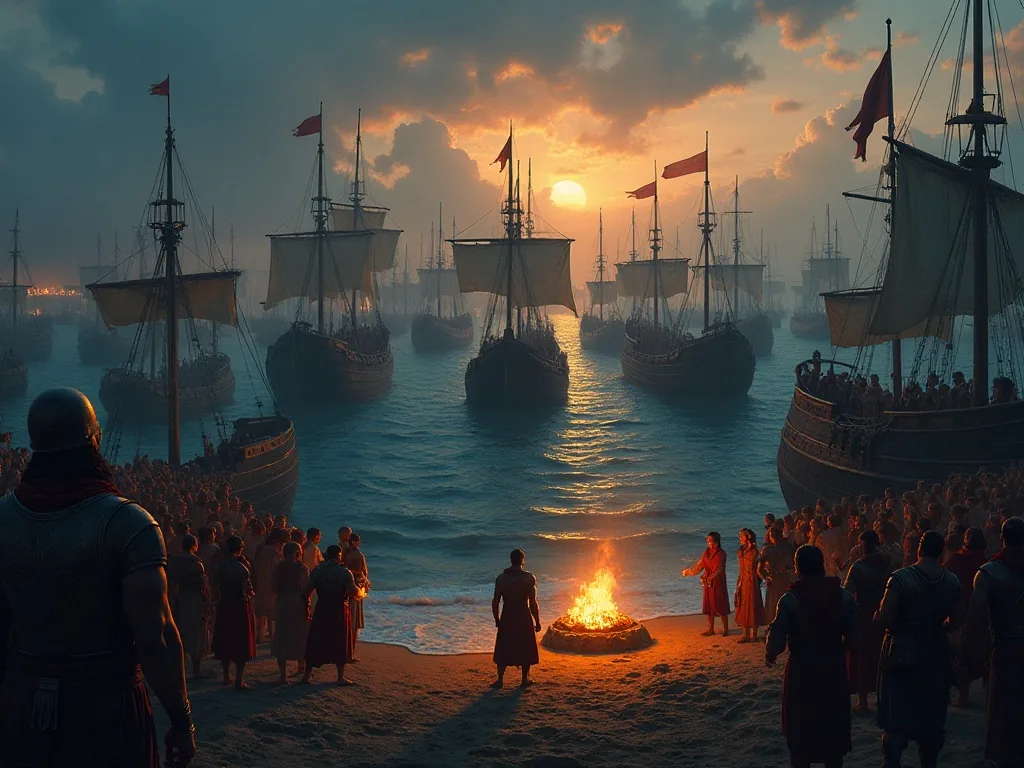
The fleet could not sail from Aulis because Artemis had stilled the winds, angry at Agamemnon for boasting he could hunt better than she could. Her price for restoring the winds was the sacrifice of Agamemnon's daughter Iphigenia. Agamemnon paid it. This act would haunt his homecoming and seed the next cycle of myth, the House of Atreus tragedies, but at Aulis it functioned as a final terrible threshold: the war had now consumed an innocent before the ships even sailed.
Divine Alignments and the Shape of Fate
By the time the fleet left Aulis and the thousand ships moved toward the Troad, the divine world had already sorted itself into two hostile camps. Hera and Athena backed the Greeks, their pride still raw from the judgment on Mount Ida. Aphrodite supported Troy and her chosen mortal. Apollo, who had a deep connection to Troy and its royal family, sided with the Trojans and would later guide the arrow that killed Achilles. Poseidon, despite his own ancient grievance against Troy involving Laomedon, shifted his alignments through the war.
Zeus officially maintained a position of painful impartiality, honoring a promise to Thetis that the Greeks would suffer until Achilles was properly respected by Agamemnon. But the Iliad's Zeus is also a figure watching the deaths of heroes he loves, including his own son Sarpedon, aware that fate has already written the ending and that his power cannot entirely override it.
Achilles would become the war's central figure, but the trojan war origins make clear that the war did not belong to him. It belonged to a wedding, an apple, a shepherd's choice on a hillside, a beautiful woman, and a sworn oath that bound two dozen kings to a cause none of them fully wanted. Homer understood this. He opened the Iliad with the word menin, wrath, pointing to Achilles, but the deeper wrath in the poem belongs to Hera, still burning from the day a shepherd on Mount Ida looked at Aphrodite and said: you are the fairest.
The city of Troy itself, known also as Ilion or Ilium, was real. Heinrich Schliemann's excavations at Hisarlik in modern Turkey from 1871 onward identified a site with multiple layers of occupation, one of which, Troy VIIa, shows evidence of violent destruction around 1180 BCE, roughly consistent with the traditional dating. Whether this represents the historical kernel of the mythological tradition remains debated. What is not debated is that the Greeks treated the story as historical memory, and that Homer's Iliad and Odyssey became the foundational literary and moral texts of Western antiquity.
The trojan war origins are not merely a prelude to a war story. They are a complete cosmological argument: that beauty creates obligation, that divine pride operates at the scale of human catastrophe, and that the exclusion of discord from any celebration simply ensures its return with greater force.
The Trojan War in Modernity and Unresolved Debates
The origins of the Trojan War have never stopped generating questions, and the twentieth and twenty-first centuries have sharpened several of them.
Was There a Historical Basis?
The Linear B tablets discovered at Mycenae and Pylos (deciphered by Michael Ventris in 1952) revealed a sophisticated Bronze Age administrative world that matches several features of the Homeric poems: the political geography, the names of some heroes, the economy of chariotry and bronze weapons. Scholars like Martin West and Joachim Latacz have argued for a genuine historical event underlying the myth, a Greek assault on a wealthy city controlling the Hellespont and its trade routes. Others, including Gregory Nagy, emphasise that the Homeric tradition is an oral-poetic achievement that crystallized over centuries and cannot be read as historical chronicle.
The Feminist Retellings
Since at least the late twentieth century, and with growing intensity in contemporary fiction, the Trojan War's origin story has been retold from the perspectives of figures like Helen, Hecuba, Cassandra, and Thetis. These retellings do not invent new details so much as they foreground what was always present in the ancient texts: the war was decided for women and largely without their consent. Cassandra, daughter of Priam and gifted with true prophecy that no one believed, warned Troy what Paris would bring. She was right every time. The ancient myth already contained this critique; contemporary literature simply moved it from margin to center.
The Cycle Beyond Homer
The Iliad and Odyssey are the only fully surviving poems of the Epic Cycle, but ancient summaries of the lost Cypria, Aethiopis, Little Iliad, Iliou Persis, and Nostoi preserve the outlines of a much larger story. The Cypria specifically covered the origins of the war, from the wedding of Peleus and Thetis through the first nine years of fighting. Its loss means that the canonical account of the apple, the judgment, and the oath survives primarily through later prose mythographers rather than the archaic hexameter tradition that the Greeks themselves would have known first. The reconstruction of the Epic Cycle from fragments remains one of the liveliest fields in classical scholarship.
Frequently asked questions about the Trojan War origins
Frequently asked questions
What exactly started the Trojan War according to ancient sources?
Ancient sources, including the summary of the lost Cypria preserved by Proclus and the Bibliotheca attributed to Apollodorus, point to a sequence: the wedding of Peleus and Thetis, the Apple of Discord thrown by Eris, the Judgment of Paris on Mount Ida, and Paris's subsequent abduction (or seduction) of Helen from Sparta. The oath sworn by Helen's suitors to Tyndareus provided the legal framework that obligated the Greek kings to go to war.
Did Homer actually describe the Judgment of Paris in the Iliad?
Homer references the Judgment obliquely in the Iliad, particularly in Book 24 where Hera explains her hatred of the Trojans, and in Book 11. But he does not narrate the judgment scene directly. The full story of the apple and the three goddesses appears in the Cypria, a now-lost poem from the Epic Cycle, and in later mythographers like Apollodorus. Homer assumes his audience already knows the backstory.
Was Helen a willing participant in going to Troy?
This was disputed in antiquity itself. Homer's Iliad presents her as physically in Troy but emotionally conflicted. Herodotus in his Histories (Book 2) reports an Egyptian priestly tradition that Helen never reached Troy and remained in Egypt while a phantom accompanied Paris. The lyric poet Stesichorus and later Euripides in his play Helen adopted this phantom tradition. The question of Helen's agency remains an open interpretive problem and was deliberately left unresolved by the Greeks.
Why did the Greek fleet get stuck at Aulis before the war began?
According to sources including Aeschylus's Agamemnon and Euripides's Iphigenia at Aulis, the goddess Artemis calmed the winds at Aulis because Agamemnon had either accidentally killed a sacred deer or boasted of his hunting skill. She demanded the sacrifice of his daughter Iphigenia as the price for releasing the fleet. Agamemnon complied. This act became the seed of the revenge plot that killed Agamemnon on his return from Troy.
Is there archaeological evidence for a historical Trojan War?
Heinrich Schliemann identified the site of ancient Troy at Hisarlik in Turkey in the 1870s. Later excavations, particularly by Manfred Korfmann, confirmed that Troy VIIa (destroyed around 1180 BCE) shows signs of violent conflict. Linear B tablets from Mycenaean sites confirm a sophisticated Bronze Age world matching aspects of the Homeric geography. However, whether this represents the historical event behind the myth, or simply one of many conflicts at that location, remains debated among classicists and archaeologists.
Why did Zeus refuse to judge which goddess was fairest?
Ancient sources suggest Zeus refused because all three contenders were his close relations: Hera was his wife, Athena his daughter, and Aphrodite his daughter by Dione in some traditions. To choose one was to make enemies of the other two, with unpredictable consequences for cosmic order. Delegating the judgment to the mortal Paris was both an act of political wisdom and, as events proved, a catastrophic outsourcing of divine responsibility.
Free 25-page sample
Want the whole story?
Take the first 25 pages free. If it pulls you in, the full edition is yours as an instant PDF download, with a paperback on Amazon for selected titles.
Greek
The Greek Mythology Book: Zeus, the Olympians, the Heroes, and the Sacred Stories of Ancient Greece
Zeus, the Olympians, the Heroes, and the Sacred Stories of Ancient Greece
The complete guide to Greek mythology from Hesiod's Theogony to Homer's epics. Every Olympian, every hero, every descent to the underworld.
More from Greek
All articles
Greek
The 12 Labors of Heracles: Every Trial, Every Monster, Every Meaning
From the Nemean Lion to the cattle of Geryon, the 12 labors of Heracles were punishment, pilgrimage, and myth-making on an epic scale. Here is every trial laid bare.

Greek
The Minotaur of Crete: Bull, Labyrinth, and the Price of Hubris
Half man, half bull, born from a queen's impossible desire: the Minotaur of Crete is one of Greek mythology's most haunting figures, a creature whose story cuts to the heart of shame, sacrifice, and the limits of royal pride.

Greek
Medusa the Gorgon: Monster, Martyr, and Mirror of Greek Fear
Medusa the Gorgon turns stone every eye that meets hers, yet her own story is one of transformation, divine violence, and enduring power. Here is the full myth, from serpent hair to severed head.
Greek
Athena: Goddess of Wisdom, War, and the Crafts of Civilization
Born fully armed from the skull of Zeus, Athena presided over wisdom, strategy, and the arts that make civilization possible. Meet the Olympian who shaped the ancient Greek world.