Nineteen Day Feast: Community Gathering and Worship in the Bahá'í Faith
The Nineteen Day Feast is the beating heart of Bahá'í communal life: a monthly gathering that weaves prayer, governance, and fellowship into a single sacred rhythm practiced by hundreds of thousands worldwide.
Contents
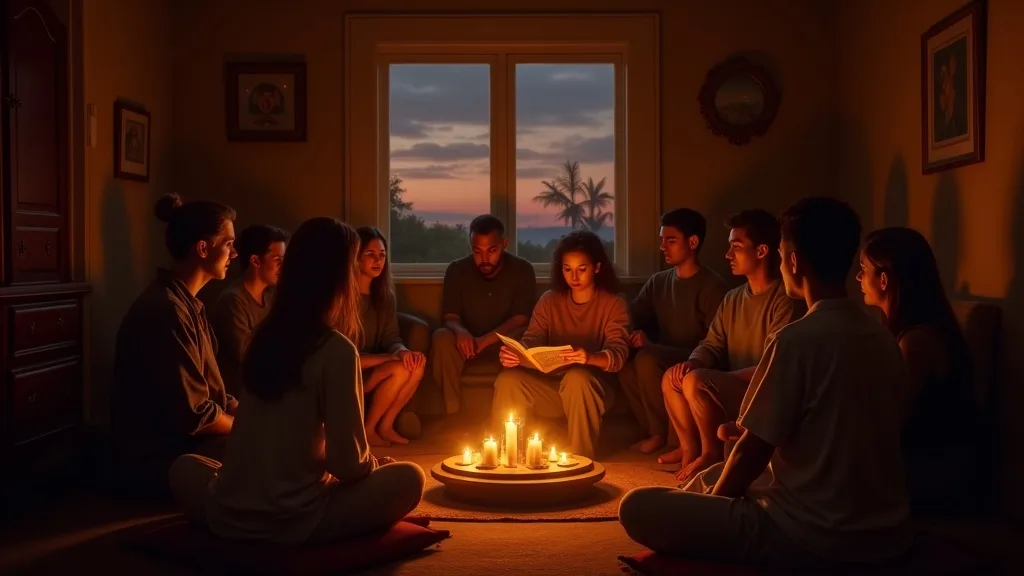
The room settles into a particular kind of quiet just before the opening prayers begin. Someone might be seated cross-legged on a carpet, another perched on a folding chair, a third resting an arm on a windowsill. What unites them is not a shared language or nationality, but the specific date on the Bahá'í calendar: the first day of a new month, nineteen days after the last time they gathered in exactly this way.
The Nineteen Day Feast: community gathering and worship at its most essential is this: a monthly assembly where the local Bahá'í community devotes time to prayer, to the reading of scripture, to collective decision-making, and to sharing food and conversation. It is simultaneously liturgical and democratic, intimate and universal. No clergy presides. No single voice dominates. And yet the structure holds across every continent where Bahá'ís gather, from Tehran apartment blocks before the Islamic Revolution silenced them to village halls in rural Samoa.
The Feast is not ancient in the sense that the Vedic yajnas or the Greek thusia sacrifices are ancient. Bahá'í worship is a nineteenth-century revelation, and its institutions were shaped with deliberate attention to modernity. But the impulses it channels, the desire for a community that is both spiritually nourished and politically self-determining, are as old as human settlement.
The Bahá'í Calendar That Makes the Feast Possible
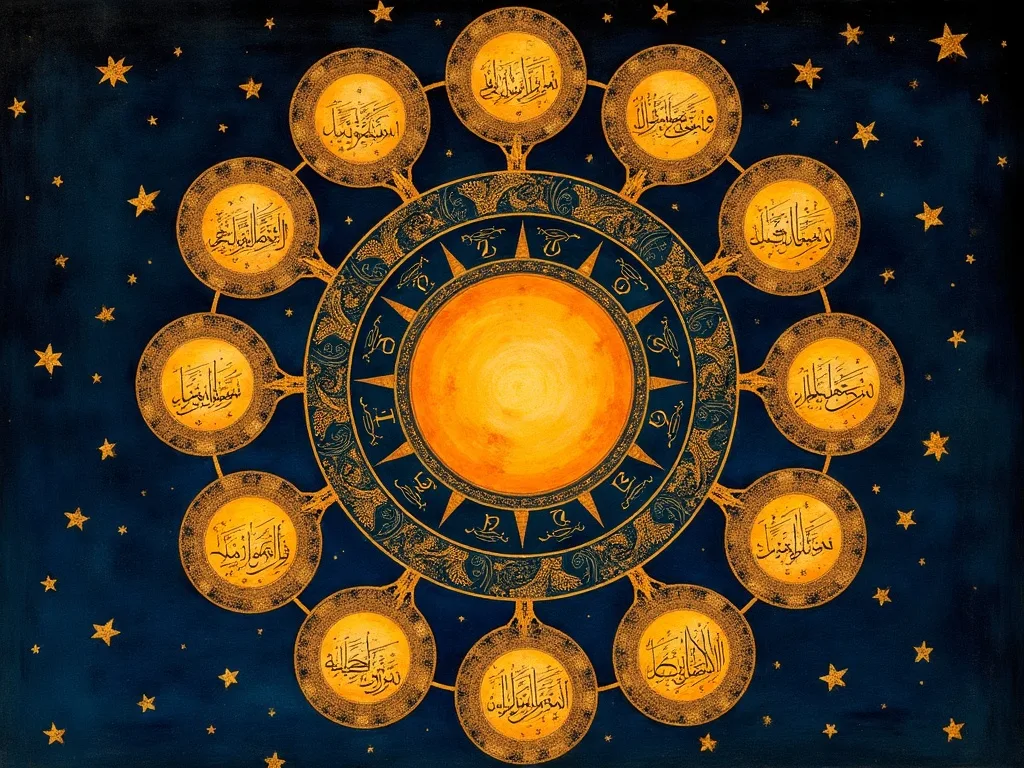
Before the ritual itself can be understood, the calendar behind it demands attention. The Bahá'í calendar, called the Badí' calendar (Badí' meaning "wondrous" or "new" in Arabic), was devised by the Báb, the forerunner prophet of the Bahá'í Faith, and ratified by Bahá'u'lláh. It divides the solar year into nineteen months of nineteen days each, producing 361 days. The remaining four days (five in a leap year) are the Ayyám-i-Há, intercalary days of hospitality and charity that precede the month of fasting.
Each of the nineteen months bears a name drawn from an attribute of the Divine: Bahá (Splendour), Jalál (Glory), Jamál (Beauty), 'Azamat (Grandeur), and so on through to 'Alá' (Loftiness), the fasting month. The months rotate through the seasons because the Bahá'í New Year, Naw-Rúz, falls on the spring equinox (March 20 or 21 in most years), an ancient Persian celebration that Bahá'u'lláh adopted and spiritually re-consecrated.
The first day of each month is when the Feast falls. Communities do not pick a convenient Saturday, though the gathering itself can be hosted on the nearest suitable evening if the first day lands mid-week. The calendar is the architecture of the rhythm, and the Feast is its heartbeat.
The nineteen-day cycle is not arbitrary. Numerology in the Báb's theology carries weight: nineteen represents the letters of the Arabic phrase Bismi'lláhu'l-Bahiyyu'l-Abhá ("In the Name of God, the All-Glorious, the Most Luminous") and mirrors the nineteen disciples of the Báb known as the Hurúf-i-Hayy (Letters of the Living). The number eighteen plus the Báb himself equals nineteen; unity built from individual luminaries.
Origins in the Kitáb-i-Aqdas and the Ministry of 'Abdu'l-Bahá
The legal foundation of the Feast sits in a single injunction from the Kitáb-i-Aqdas, Bahá'u'lláh's book of laws revealed during his imprisonment in Akka (in present-day Israel). The relevant passage is characteristically brief: Bahá'u'lláh calls upon the host of the gathering to "offer to those who come, water or some other form of beverage," and designates the first day of each month as the occasion. The simplicity is striking. No elaborate rubric, no hierarchical roster of who speaks when. The elaboration came through time and guidance.
'Abdu'l-Bahá, Bahá'u'lláh's son and the appointed interpreter of his writings, clarified the Feast's threefold purpose in his letters and conversations with early Western Bahá'ís visiting Palestine. He described the gathering as a moment for the spirit to be refreshed through prayer, for the community to conduct its affairs through consultation, and for hearts to be bound together through conviviality. The structure did not arrive as a fixed liturgical order but crystallized through community practice and successive guidance from the Universal House of Justice, the international governing body of the Bahá'í Faith elected in Haifa.
The Feast's democratic nerve is especially significant. In a religious tradition that has no professional clergy, the local Bahá'í community governs itself through an elected nine-member body called the Local Spiritual Assembly. The Feast is the single most important channel through which ordinary community members communicate with that body, offering concerns, suggestions, and reflections that the Assembly is obliged to take seriously.
The Three Segments: Devotion, Consultation, and Fellowship
The Nineteen Day Feast: community gathering and worship follows a sequence that every Bahá'í community in the world recognises, even if the cultural expression varies enormously from one place to another.
The Devotional Segment
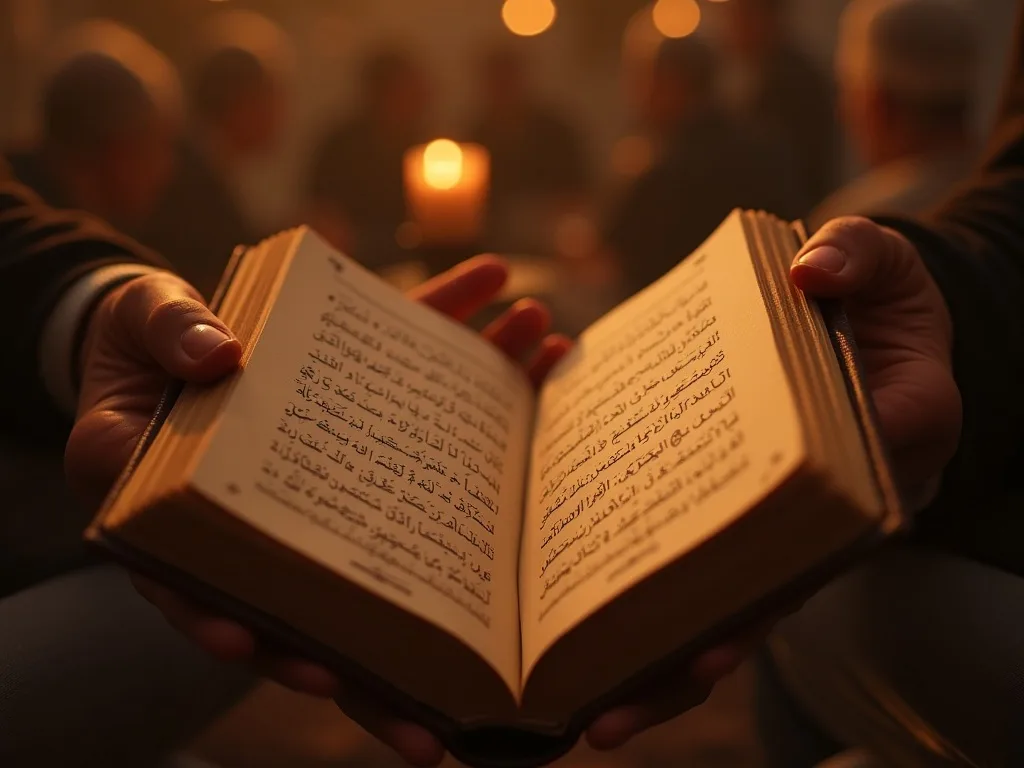
The opening portion is reserved entirely for prayer and the reading of scripture. There is no sermon, no pastoral commentary, no explanation offered. Selections from the writings of Bahá'u'lláh, the Báb, and 'Abdu'l-Bahá are read or chanted, sometimes in the original Arabic or Persian, sometimes in local translation. Music is often woven in: a choir in West Africa might sing a Bahá'í prayer in Yoruba; a small group in rural Colorado might read in quiet voices with a guitar playing beneath.
No single individual is appointed as worship leader in the way a priest or imam would be. The host, who may be a family or an individual, prepares the devotional program, but the readings themselves can be offered by anyone present. This absence of a clergy class is not an accident or an oversight; it is a theological principle. Bahá'u'lláh explicitly prohibited the establishment of a priestly caste, believing that intermediaries between the individual soul and the Divine had historically accumulated institutional power at the expense of genuine spiritual inquiry.
The writings read during this segment are among the most beautiful in the Bahá'í corpus. The Tablet of Ahmad, the Long Obligatory Prayer, the Fire Tablet (Lawh-i-Qad-Ihtaraqa'l-Mukhlisún) with its oceanic imagery of spiritual longing: these texts carry freight beyond their literal meaning. Bahá'í devotional life treats prayer not as petition to a transactional deity but as an orientation of the self toward an unknowable reality. The prayers are meant to transform the one who says them.
The Administrative Segment
After the devotional program closes, the mood shifts, though without rigidity. The Local Spiritual Assembly presents its reports to the community: news of Bahá'í institutions at the national and international level, local projects underway, challenges the Assembly is navigating. Then the floor opens to community members.
This is where the Feast earns its place as something genuinely unusual in religious practice worldwide. Community members may offer suggestions about deepening activities, about teaching the Faith to new seekers, about social action projects, about the logistical life of the community. The Assembly is not bound to act on every suggestion, but it is bound to read and acknowledge every written input. The Universal House of Justice has written that the Feast should be a place where "the voice of every member of the community is heard."
Consultation in the Bahá'í sense has its own principles. Ideas, once offered, are released to the group; they belong to the consultation, not to the speaker. Disagreement is welcomed. The goal is not consensus through social pressure but the emergence of truth through the friction of earnest perspectives. A community wrestling honestly in the administrative segment of a Feast is doing something the Bahá'í writings describe as spiritually meritorious in itself, not merely instrumentally useful.
The Social Segment
The third portion is, on the surface, the simplest: food, tea, conversation. The host provides refreshments. Children run. Visitors who are not Bahá'í but have been invited (the Feast is generally open to seekers and guests, though this varies by community practice and local guidance) encounter the community in its most relaxed register.
But the social segment is not an afterthought. Bahá'u'lláh's original injunction was specifically about offering drink to those who come. The act of eating together across lines of race, nationality, and class is read, within Bahá'í theology, as a visible sign of the unity the Faith proclaims. Many Bahá'í communities are notably diverse by the demographics of their surrounding society, and the shared meal carries this symbolic weight without needing to announce it.
The Feast Across Cultures: One Structure, Infinite Expressions
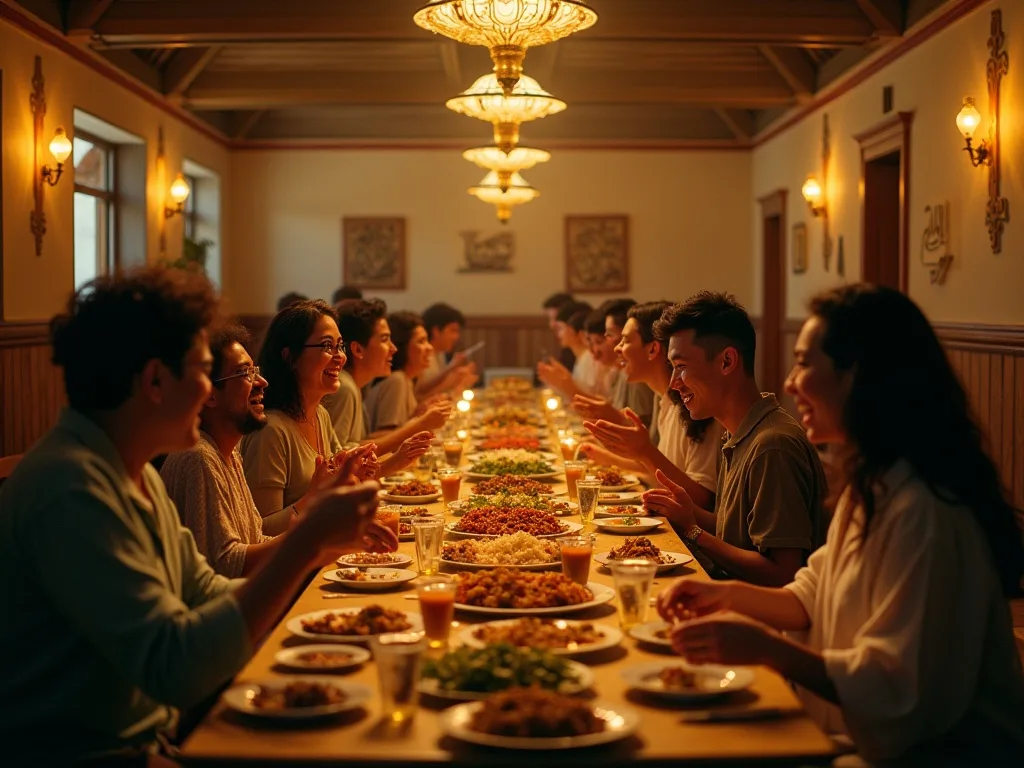
A Nineteen Day Feast in Tehran in 1979, held quietly in a private home weeks before the Islamic Republic moved to execute prominent Bahá'ís, looked nothing like a Feast in Chicago's South Side or a gathering in rural Papua New Guinea. The structural bones are identical. The cultural flesh is entirely local.
In Persian-speaking communities, the devotional segment often includes chanting in Arabic, a practice inherited from Islamic devotional traditions that early Bahá'ís knew intimately. The particular cadence of Quranic recitation inflects the way Bahá'í prayers sound when intoned in Persian, even though Bahá'í scripture is theologically distinct from the Quran.
In Indigenous communities in the Americas who have embraced the Bahá'í Faith in significant numbers, the Feast has incorporated traditional musical forms and community governance practices that resonate with the administrative segment's emphasis on collective consultation. Scholars like Robert Stockman and Loni Bramson have documented how the Feast's flexibility enabled a genuinely indigenous Bahá'í culture to emerge in places like Bolivia and among the Lumbee people of North Carolina.
In communities facing persecution, the Feast has taken on a quality of resistance and solidarity that amplifies every prayer. Iranian Bahá'ís, barred from universities and formal employment since 1979, have conducted Feasts in conditions of documented surveillance. The Universal House of Justice has addressed these communities with specific letters acknowledging their suffering while affirming the Feast's non-negotiable importance.
The Bahá'í teachings on racial unity connect here in a particular way. The principle that racial prejudice is the most challenging spiritual disease facing the American Bahá'í community, articulated by 'Abdu'l-Bahá during his 1912 North American tour and repeated in the 1938 letter The Advent of Divine Justice, means that the integrated Feast is not merely a pleasant gathering. It is an enacted argument against a persistent social failure.
Sacred Time and the Rhythm of Bahá'í Communal Life
The Feast operates inside a larger ecology of Bahá'í practice. There are daily obligatory prayers (salát in Arabic, namáz in Persian): the short, medium, and long obligatory prayers, each with specific physical postures not unlike salah in Islamic practice. There is the nineteen-day fast during the month of 'Alá', a period of abstinence from food and drink between sunrise and sunset that recalls the Ramadan fast in form while carrying Bahá'í-specific theological meaning.
The Feast does not replace these individual practices; it gathers them. The individual who prays alone each morning and fasts through March arrives at the Feast as someone already shaped by a spiritual discipline. The communal prayer of the Feast adds a dimension that solitary practice cannot: the particular intensity of hearts moving together.
In the Bahá'í framework, sacred time is not reserved for special calendrical peaks like Christmas or Diwali. Every Feast, every month, is equally sacred. There is no "high holy day" structure that would create a liturgical hierarchy within the calendar. This flattening of sacred time is deliberate: Bahá'u'lláh's vision is of a world in which the spiritual and the mundane interpenetrate at every moment, not only during annual festivals.
The feasts of Ridvan (the twelve-day celebration of Bahá'u'lláh's declaration of his mission in the garden of Ridvan outside Baghdad in April-May 1863) and Naw-Rúz are the great communal celebrations of the year. But neither replaces the Feast. They occupy a different register: jubilant, commemorative, outward-facing. The Nineteen Day Feast is interior, recurring, quietly essential.
Comparison: The Feast and Other Monthly/Weekly Communal Rituals
Nineteen Day Feast (Bahá'í)
- Monthly cycle governed by the Bahá'í Badí' calendar
- No ordained clergy; rotating host family or individual
- Three distinct segments: prayer, consultation, fellowship
- Community governance integrated into the ritual itself
- Open to guests and seekers in most communities
- No standardised sermon; scripture reading by participants
Friday Jumu'ah Prayer (Islam)
- Weekly cycle; Friday midday, prescribed by the Quran (Surah 62)
- Led by an imam who delivers the khutbah (sermon)
- Single devotional register: prayer and sermon
- Governance structures entirely separate from the prayer ritual
- Generally restricted to Muslims; non-Muslim guests observe but do not participate
- Standardised structure across Sunni and Shia traditions, with regional variation
The comparison with the Quaker meeting is equally instructive, though structurally inverted. Quaker worship (unprogrammed meeting for worship) is entirely silent waiting, with no pre-prepared scripture or agenda, until the Spirit moves someone to speak. The Bahá'í Feast has a prepared devotional program and an explicit administrative agenda. Both traditions, however, reject a clergy class and locate spiritual authority in the gathered community rather than in an ordained individual.
The sangha assemblies of Theravada Buddhist communities, particularly in Southeast Asia, share the Feast's integration of community governance with devotional life. Monks and laypeople meeting to discuss the affairs of the monastery reflect a similar principle, though the hierarchical distinction between ordained sangha and laity has no parallel in the Bahá'í structure.
Misconceptions and Scholarly Debates Around the Feast
One persistent misconception is that the Feast is a potluck dinner with prayers attached. The administrative segment, which can be the most demanding part of a Feast when a community is grappling with real challenges, tends to be invisible in popular descriptions. Scholars of new religious movements, including Juan Cole and Denis MacEoin, have noted that the Feast's administrative dimension makes it unlike almost any other regular communal ritual in a major world religion: it is simultaneously a liturgy and a town hall.
A second debate concerns the Feast's relationship to gender equality. The Bahá'í Faith affirms the full equality of men and women as a core principle, and the Feast is conducted without gendered seating or gendered roles. Women serve on Local Spiritual Assemblies, read prayers, chair consultations. This is often noted by scholars as one of the Feast's distinguishing characteristics relative to many traditional religious assemblies worldwide.
A third, more internal debate concerns the degree to which the Feast's openness to non-Bahá'í guests should be encouraged. The Universal House of Justice's guidance has evolved on this point, and individual communities handle it differently. Some communities explicitly invite seekers to every Feast; others treat the administrative segment as appropriate only for enrolled members and ask guests to join for the devotional and social portions. The tension here is real: the Feast is both an inward-facing community institution and an outward expression of a universalist teaching.
Some scholars of religion, including Nader Saiedi in his close reading of Bahá'u'lláh's writings, have argued that the Feast's tripartite structure encodes a theology of the human person: the devotional segment addresses the spirit, the administrative segment addresses the social self, the fellowship addresses the body and its need for nourishment and touch. Whether or not this reading was in Bahá'u'lláh's intention, it gives the ritual a coherence that its apparent simplicity might obscure.
The Feast in the Twenty-First Century: Digital Communities and New Challenges
The COVID-19 pandemic forced Bahá'í communities worldwide to conduct Feasts over video platforms for the first time since the institution's founding. The Universal House of Justice issued guidance permitting virtual Feasts while making clear that in-person gathering remains the ideal. The experiment revealed something that practitioners mostly already knew: the social segment cannot be replicated by a screen. The sharing of food, the physical warmth of an integrated room, the moment when someone new meets someone who has been Bahá'í for forty years over a plate of dolmeh or cornbread: none of this survives digital mediation intact.
The growth of Bahá'í communities in the Global South, particularly in sub-Saharan Africa, Southeast Asia, and Latin America, has brought the Feast into contexts where local languages have no prior Bahá'í literature and where the Badí' calendar had to be introduced alongside the first prayers in translation. The resilience of the structure in these settings has been documented by sociologists including Michael McMullen, who studied the Atlanta Bahá'í community, and by anthropologists working in Bolivia and among Pacific Islander communities.
The Feast also intersects with the Bahá'í community-building framework known as the "institute process," developed from the 1990s onward under guidance from the Universal House of Justice. Study circles, children's classes, and devotional gatherings (smaller and more frequent than the Feast) now create a web of communal activity around the monthly gathering. The Feast remains the central node, but the surrounding network has thickened.
Frequently Asked Questions About the Nineteen Day Feast
Frequently asked questions
Who is allowed to attend the Nineteen Day Feast?
Enrolled Bahá'ís are the primary participants, particularly for the administrative segment. The devotional and social portions are generally open to interested seekers, friends, and guests, though individual communities may handle this differently based on guidance from their Local Spiritual Assembly. The Universal House of Justice has described the Feast as a community institution whose full meaning is best experienced by those committed to the Faith.
Why is there no priest or minister leading the Feast?
Bahá'u'lláh explicitly prohibited the establishment of a professional clergy in the Bahá'í Faith, a prohibition recorded in the Kitáb-i-Aqdas. The reasoning is theological: each soul is held responsible for its own independent investigation of truth. An intermediary class would inevitably accrue institutional power and, in Bahá'í analysis, repeat the clerical corruptions that have historically distorted other religious traditions. The host of the Feast prepares the program, but any participant may offer prayers or readings.
What happens during the administrative segment of the Feast?
The Local Spiritual Assembly reports on community activities, national and international Bahá'í news, and ongoing projects. Community members then offer suggestions, concerns, and proposals in an open consultation. These contributions, particularly if submitted in writing, must be read and acknowledged by the Assembly. The segment is governed by Bahá'í principles of consultation: ideas belong to the group, not the speaker; disagreement is encouraged; the goal is the emergence of truth rather than social harmony maintained through silence.
How does the Feast relate to the Bahá'í calendar?
The Feast takes place on the first day of each of the nineteen months in the Bahá'í Badí' calendar. Since the year has nineteen months of nineteen days, there are nineteen Feasts per year. Each month is named for a divine attribute, and the Feast opens that month. The calendar was designed by the Báb and confirmed by Bahá'u'lláh, with the Gregorian year alignment (Naw-Rúz on the spring equinox) ensuring that the calendar tracks the solar year while remaining distinct from both the Gregorian and Islamic lunar systems.
Is the Nineteen Day Feast mandatory for Bahá'ís?
Attendance is strongly encouraged but not legally obligatory in the way that the daily obligatory prayers are. The Universal House of Justice has described the Feast as the "foundation of the new World Order" at the local level, indicating its centrality. Persistent absence is understood as a spiritual loss for the individual and a weakening of the community, rather than a sin incurring formal sanction.
How does the Feast differ from Bahá'í devotional gatherings held at other times?
Devotional gatherings (held in homes, community centers, or public spaces as part of the institute process) are typically open to all, focus solely on prayer and music, and carry no administrative component. The Nineteen Day Feast is the only Bahá'í institution at the local level that combines prayer, governance, and fellowship in a single structured gathering, and it is the primary forum through which local communities govern themselves.
The Feast as a Living Argument for a New Kind of Community
The deepest claim the Nineteen Day Feast makes is not liturgical. It is social. A room where people pray together, govern themselves together, and eat together without a professional intermediary between them and the sacred, without a hereditary elite managing the food, without a formal barrier between worship and politics: this is a claim about what human community can be.
Bahá'u'lláh wrote in the Gleanings that the earth is one country and humankind its citizens. The Feast is one of the few places on the planet where that statement is acted out monthly, at the scale of a neighbourhood, with real stakes. The administrative consultation can get heated. The devotional readings can move people to tears. The social segment can be awkward when strangers first meet across chasms of background. None of this is hidden or smoothed over. The Feast is not a performance of unity but a practice of it, unfinished, imperfect, renewed every nineteen days.
For scholars of religion, the Feast represents a genuinely novel institutional form: a ritual that is simultaneously liturgy, assembly, and communal meal, conducted without ordained leadership, inside a tradition that is only 180 years old and already practiced on every inhabited continent. For the Bahá'í sitting in that settling room before the opening prayer begins, the theory matters less than what comes next: the first words spoken in a language that reaches past language, and the particular silence that follows.
Read the full book
Want the whole story?
The complete edition is an instant PDF download here, with a paperback on Amazon for selected titles.

Bahai
The Bahá'í Faith Book: Its History, Teachings, and Beliefs
History, Teachings, and Beliefs
A clear introduction to the youngest of the world's independent religions: the Báb and Bahá'u'lláh, the principle of the oneness of humanity, the progressive revelation of the prophets, and a faith that crossed the world in a century and a half.