
Bahá'u'lláh: Prophet-Founder of the Bahá'í Faith
Bahá'u'lláh founded the Bahá'í Faith in 19th-century Persia, claiming to fulfill prophecies across traditions. His life, exile, and writings examined.
Contents
Bahá'u'lláh (1817–1892) was the Persian prophet-founder of the Bahá'í Faith, who claimed to be the fulfillment of messianic prophecies across Judaism, Christianity, Islam, and other religions, and whose writings establish a theology of progressive revelation linking all prophetic traditions across cultures. Born Mírzá Ḥusayn-'Alí Núrí in Tehran, he declared his mission in Baghdad in 1863 and spent the final 24 years of his life imprisoned in Ottoman Palestine. His central works, the Kitáb-i-Íqán and the Kitáb-i-Aqdas, form the scriptural foundation of a faith now practiced by an estimated five to eight million people worldwide.
Most treatments of Bahá'u'lláh approach him as a modern reformer or humanitarian philosopher. That misses the architecture. He positioned himself explicitly within a prophetic lineage stretching from Abraham through Moses, Jesus, Muhammad, and the Báb, claiming not to replace but to renew the same eternal covenant. His theology is mythological in the precise sense: it reinterprets sacred narratives across traditions as chapters in a single unfolding story.
Birth, Name, and Early Life in Persia
Mírzá Ḥusayn-'Alí was born on 12 November 1817 in Tehran to a family of the Iranian nobility. His father, Mírzá Buzurg, served as a minister in the court of Fatḥ-'Alí Sháh Qájár. The family traced its lineage to the Sassanian dynasty and held estates in the province of Núr in Mázindarán, from which the surname Núrí derives. The title Bahá'u'lláh, meaning "Glory of God" in Arabic, was adopted later and appears in his writings from the Baghdad period onward.
He received no formal schooling. Accounts from his youth describe a young man who declined a government post offered by his father's connections and instead devoted himself to the care of the poor and to private study of Persian and Arabic texts. By his early twenties he had acquired a reputation in Tehran for learning and generosity. He married Ásíyih Khánum in 1835; they had three children who survived to adulthood, including 'Abdu'l-Bahá, who would later succeed him.
The Persia of his youth was Shiʿa Muslim, and messianic expectation ran high. The year 1844 held particular significance in Islamic eschatology: one thousand lunar years after the disappearance of the Twelfth Imam. It was in this climate that a young merchant from Shiraz, Siyyid 'Alí-Muḥammad, declared himself the Báb, the Gate, and announced the imminent appearance of "He Whom God shall make manifest."
The Báb, the Bábí Movement, and First Imprisonment
Bahá'u'lláh became a follower of the Báb in 1844, though the two never met in person. The Bábí movement spread rapidly across Persia, and with it came violent persecution. The Báb's claim to be the Qá'im, the promised one of Shiʿa Islam, was viewed as heresy by the clerical establishment and a political threat by the Qájár state. Thousands of Bábís were killed in pogroms between 1848 and 1852.
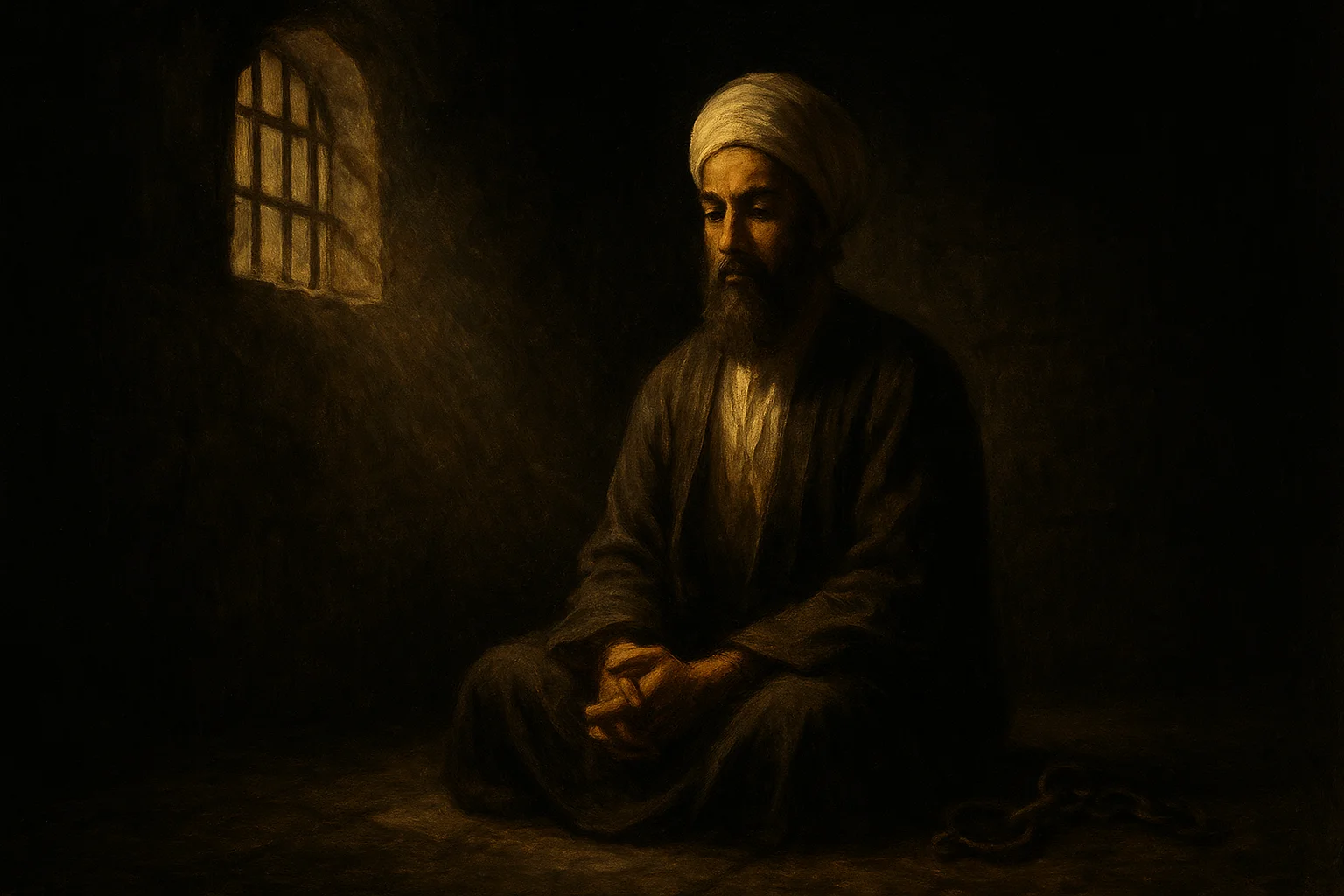
Bahá'u'lláh emerged as a prominent defender and organizer of the community. He did not take up arms during the uprisings at Shaykh Tabarsí and Nayríz, but his prominence made him a target. In August 1852, after a failed assassination attempt on the Shah by two Bábís, the government arrested Bahá'u'lláh and imprisoned him in the Síyáh-Chál, the Black Pit, a subterranean dungeon in Tehran. He was chained in darkness for four months. It was here, he later wrote, that he received the first intimation of his mission.
"During the days I lay in the prison of Ṭihrán, though the galling weight of the chains and the stench-filled air allowed Me but little sleep, still in those infrequent moments of slumber I felt as if something flowed from the crown of My head over My breast, even as a mighty torrent that precipitateth itself upon the earth from the summit of a lofty mountain." Bahá'u'lláh, Epistle to the Son of the Wolf
He was released in December 1852 on condition of exile. The Persian government, under pressure from the Russian legation, banished him to Baghdad, then part of the Ottoman Empire.
The Declaration in the Garden of Ridván
Bahá'u'lláh arrived in Baghdad in April 1853. The Bábí community was fractured, leaderless after the Báb's execution in 1850, and riven by internal disputes. Bahá'u'lláh spent two years in the mountains of Sulaymaniyyah in self-imposed retreat, then returned to Baghdad in 1856 to restore order and coherence to the community. His leadership was informal but effective. By the early 1860s, the Persian and Ottoman authorities had taken notice.
In 1863, under pressure from the Persian government, the Ottoman Sultan ordered Bahá'u'lláh to Constantinople. Before departing Baghdad, Bahá'u'lláh spent twelve days in a garden on the banks of the Tigris River, a site now known as the Garden of Ridván. It was here, in April 1863, that he declared to a small group of companions that he was the one foretold by the Báb: "He Whom God shall make manifest."
The declaration was not public in the modern sense. No manifesto was issued. But those present understood the claim: Bahá'u'lláh was not merely a successor to the Báb but the fulfillment of a prophetic cycle that included Moses, Jesus, and Muhammad. The twelve days in the garden are commemorated annually by Bahá'ís as the Ridván Festival, the holiest period in the Bahá'í calendar.
Exile: Baghdad, Constantinople, Adrianople, and Acre
Bahá'u'lláh's life after 1853 is a geography of exile. Each move was imposed by state authorities seeking to contain a movement they saw as politically destabilizing. Each city became a stage for revelation.
The Baghdad Years and the Kitáb-i-Íqán
The Baghdad period, 1853 to 1863, produced some of Bahá'u'lláh's most important early writings. Chief among them is the Kitáb-i-Íqán, the Book of Certitude, written in 1861 in response to questions posed by an uncle of the Báb. The text is a theological argument for progressive revelation: the idea that God sends messengers in successive ages, each renewing the same eternal truth in forms suited to the maturity of humanity.
The Kitáb-i-Íqán reinterprets biblical and Quranic prophecy through this lens. It argues that terms like "return," "resurrection," and "Day of Judgment" are symbolic, not literal. When Christians await the return of Christ, they await not the physical body of Jesus but the spiritual reality he embodied, which appears anew in each prophet. The book draws heavily on Islamic exegesis but applies its method to Jewish and Christian scripture as well.
The text also addresses the problem of rejection. Why do religious communities fail to recognize the new messenger when he appears? Bahá'u'lláh's answer: attachment to literal interpretation, clerical authority, and the comfort of inherited tradition. The same dynamic that led Jews to reject Jesus and Christians to reject Muhammad now leads Muslims to reject the Báb and Bahá'u'lláh.
Final Imprisonment in Acre
After brief stays in Constantinople (modern Istanbul) and Adrianople (modern Edirne), where tensions within the Bábí community led to a final break with Bahá'u'lláh's half-brother Mírzá Yaḥyá, the Ottoman authorities exiled Bahá'u'lláh to the prison city of Acre in 1868. He was 51 years old. He would remain in Acre and its environs for the rest of his life.
Acre was a penal colony, a walled city on the coast of Palestine notorious for disease and harsh conditions. Bahá'u'lláh and his family were confined first to the citadel, then to a caravanserai, and later to a house within the city walls. The conditions were severe: two of Bahá'u'lláh's companions died within the first year. Yet it was here, in confinement, that he wrote the bulk of his major works and sent epistles to the kings and rulers of Europe and the Middle East, including Queen Victoria, Napoleon III, Czar Alexander II, and Pope Pius IX.
These letters are remarkable for their tone: not petitions but summonses. Bahá'u'lláh addresses the monarchs as a prophet addressing temporal power, warning them of the consequences of injustice and calling them to recognize his mission. Most ignored the letters. Napoleon III is said to have thrown his in the fire.
The Kitáb-i-Aqdas and the Architecture of Law
The Kitáb-i-Aqdas, the Most Holy Book, was revealed in Acre around 1873. It is Bahá'u'lláh's book of laws, the central legal text of the Bahá'í Faith. Written in Arabic, it addresses matters of worship, personal conduct, inheritance, marriage, and the structure of Bahá'í institutions. It also abolishes certain practices: monasticism, confession to clergy, the veiling of women, and the concept of ritual impurity.
The laws are framed not as arbitrary commands but as expressions of a divine order suited to the age of humanity's collective maturity. Some laws are universal; others are described as provisional, to be adapted by future institutions as conditions change. The text establishes the principle of the Universal House of Justice, an elected body with authority to legislate on matters not explicitly covered in scripture.
The Kitáb-i-Aqdas also contains mystical and prophetic passages. It announces the coming of a future revelation, one thousand or more years hence, and warns against any claim to prophethood before that time. This is the doctrine of the Covenant: Bahá'u'lláh's authority is to be followed by that of his appointed successor, 'Abdu'l-Bahá, and then by the institutions he established, not by new prophets.
Islamic Sharia
Derived from Quran, Hadith, and centuries of jurisprudential interpretation by scholars; no single legislative body with authority to adapt law.
Bahá'í Law
Codified in the Kitáb-i-Aqdas; interpreted by 'Abdu'l-Bahá and Shoghi Effendi; legislated on by the Universal House of Justice with explicit authority to adapt.
Progressive Revelation and the Prophetic Lineage
The doctrine of progressive revelation is the theological spine of Bahá'u'lláh's writings. It holds that religious truth is not static but unfolds across history through a succession of divine messengers. Each messenger, or Manifestation of God, reveals teachings suited to the capacity and needs of the age. The differences between religions are not contradictions but reflections of context.
Bahá'u'lláh identifies a lineage of Manifestations: Abraham, Moses, Krishna, Zoroaster, Buddha, Jesus, Muhammad, the Báb, and himself. The list is not exhaustive; other figures are acknowledged, and future Manifestations are promised. The essential unity lies not in identical doctrine but in the spiritual reality each embodies: knowledge of God, moral transformation, and social renewal.
This framework allows Bahá'u'lláh to claim fulfillment of messianic prophecies across multiple traditions without invalidating those traditions. He is the return of Christ for Christians, the Shah Bahram for Zoroastrians, the tenth avatar for some Hindus, and the Qá'im for Shiʿa Muslims. The claim is not syncretism but synthesis: all prophecies point to the same recurring event, the appearance of a new Manifestation.
- Prophecies are symbolic, not literal: "clouds" mean doubts, "stars falling" means clerical authority collapsing.
- Each Manifestation abrogates the law of the previous one but affirms its spiritual core.
- Rejection of a new Manifestation is the norm, not the exception, in religious history.
- The interval between Manifestations varies; no fixed calendar governs divine revelation.
The Hidden Words, a short collection of aphorisms revealed in Baghdad, distills this theology into devotional form. Written in Arabic and Persian, it presents ethical and spiritual teachings as the voice of God speaking directly to the soul. The text draws on Sufi, biblical, and Quranic idioms but reframes them within Bahá'u'lláh's vision of human nobility and divine love.
Death, Succession, and the Covenant
Bahá'u'lláh died on 29 May 1892 at Bahjí, a mansion outside Acre where he had been allowed to live under house arrest in his final years. He was 74. His burial site, the Shrine of Bahá'u'lláh, is the holiest place in the Bahá'í world and the Qiblih, the point toward which Bahá'ís face in prayer.
Before his death, Bahá'u'lláh appointed his eldest son, 'Abdu'l-Bahá, as his successor and the sole authorized interpreter of his writings. This appointment is formalized in the Kitáb-i-Aqdas and in Bahá'u'lláh's will, the Kitáb-i-'Ahd. The Covenant is explicit: no one may claim independent authority to interpret Bahá'u'lláh's writings or to receive new revelation. This provision was intended to prevent the schisms that had fractured earlier religious movements.
It did not entirely succeed. Mírzá Muḥammad 'Alí, Bahá'u'lláh's second son, challenged 'Abdu'l-Bahá's authority and formed a small breakaway group. But the vast majority of Bahá'ís remained loyal to 'Abdu'l-Bahá, and the Covenant held. Shoghi Effendi, 'Abdu'l-Bahá's grandson, later served as Guardian of the Faith from 1921 to 1957, translating Bahá'u'lláh's writings into English and systematizing Bahá'í administration.
Bahá'u'lláh in Comparative Perspective
Placing Bahá'u'lláh within the history of prophecy reveals both continuity and rupture. Like Muhammad, he claimed to receive revelation over decades and codified it in written form. Like Jesus, he reinterpreted inherited scripture and challenged religious authority. Like Moses, he delivered law. But unlike any of these figures, he explicitly framed his mission as one link in a chain, not the final word.
The prophetic model Bahá'u'lláh presents has more in common with the cyclical cosmologies of Hinduism and Buddhism than with the linear eschatologies of Judaism, Christianity, and Islam. Yet he retains the monotheistic insistence on a personal God who acts in history. The result is a theology that resists easy classification.
Scholars of comparative religion have noted parallels between Bahá'u'lláh's progressive revelation and the perennial philosophy of Aldous Huxley or the prisca theologia of Renaissance humanism. But Bahá'u'lláh's framework is not philosophical speculation; it is rooted in specific scriptural claims and prophetic authority. He does not argue that all religions teach the same truths. He argues that all religions are successive chapters in a single revelation.
The symbolic interpretation of prophecy that Bahá'u'lláh employs has precedents in Islamic tafsir, Jewish midrash, and Christian allegory. But he applies it systematically across traditions. When Revelation speaks of dragons in mythology or the sphinx as symbol, Bahá'í exegesis reads these not as mythological creatures but as ciphers for spiritual realities: ego, ignorance, the lower self. This hermeneutic extends even to figures like vampire folklore, which some Bahá'í commentators interpret as metaphors for souls that drain spiritual vitality from others.
Frequently asked questions
What is the Garden of Ridván and why is it significant to Bahá'ís?
The Garden of Ridván is the site in Baghdad where Bahá'u'lláh declared his prophetic mission in April 1863, announcing to his companions that he was "He Whom God shall make manifest," the figure foretold by the Báb and the fulfillment of messianic prophecies across multiple religious traditions. The twelve days he spent in the garden before departing for Constantinople mark the most sacred period in the Bahá'í calendar, commemorated annually as the Ridván Festival. The declaration was not a public proclamation but a private communication to a small group, yet it established the theological foundation of the Bahá'í Faith.
What are Bahá'u'lláh's most important writings?
Bahá'u'lláh authored over 15,000 tablets and letters during his 40 years of exile and imprisonment, but two works are considered foundational: the Kitáb-i-Íqán (Book of Certitude), written in 1861, which explains the theology of progressive revelation and reinterprets biblical and Quranic prophecy, and the Kitáb-i-Aqdas (Most Holy Book), revealed around 1873, which establishes the laws and institutions of the Bahá'í Faith. Other significant works include the Hidden Words, a collection of ethical and mystical aphorisms, and the Epistle to the Son of the Wolf, one of his final major tablets summarizing his teachings.
How does Bahá'u'lláh connect to earlier prophets like Moses, Jesus, and Muhammad?
Bahá'u'lláh taught that all major prophets are Manifestations of God who reveal the same divine reality in forms suited to their age, a doctrine called progressive revelation. He identified himself as the fulfillment of messianic prophecies across Judaism, Christianity, Islam, and other traditions, claiming to be the return of Christ for Christians, the Qá'im for Shiʿa Muslims, and the figure foretold by the Báb. Rather than replacing earlier prophets, he positioned himself as the next chapter in a single unfolding revelation, arguing that differences between religions reflect historical context, not contradiction.
What happened to Bahá'u'lláh after his declaration in 1863?
After declaring his mission in Baghdad in 1863, Bahá'u'lláh was exiled by Ottoman authorities first to Constantinople, then to Adrianople, and finally in 1868 to the prison city of Acre in Palestine, where he remained under house arrest for the rest of his life. Despite harsh conditions, he wrote the bulk of his major works in Acre, including the Kitáb-i-Aqdas, and sent epistles to the rulers of Europe and the Middle East calling them to recognize his mission. He was eventually allowed to live in a mansion outside the city walls at Bahjí, where he died in 1892.
How did Bahá'u'lláh's teachings differ from Islam and Christianity?
Bahá'u'lláh retained the monotheism of Islam and Christianity but rejected the finality of Muhammad's prophethood and the exclusive divinity of Jesus, teaching instead that all prophets are successive Manifestations of a single God. He abolished Islamic practices like veiling, ritual impurity, and jihad, and reinterpreted Christian concepts like resurrection and the Second Coming as symbolic rather than literal. His Kitáb-i-Aqdas established new laws on marriage, inheritance, and worship, and he introduced the concept of an elected legislative body, the Universal House of Justice, with authority to adapt religious law to changing conditions.
What is the Covenant in Bahá'í belief and why does it matter?
The Covenant refers to Bahá'u'lláh's explicit appointment of his son 'Abdu'l-Bahá as his successor and the sole authorized interpreter of his writings, formalized in the Kitáb-i-Aqdas and his will, the Kitáb-i-'Ahd. This provision was designed to prevent schisms by establishing a clear line of authority and prohibiting any new claims to prophethood for at least one thousand years. The Covenant held despite challenges from Bahá'u'lláh's half-brother Mírzá Yaḥyá and later from his son Mírzá Muḥammad 'Alí, preserving the unity of the Bahá'í community through the leadership of 'Abdu'l-Bahá and later Shoghi Effendi.
Further reading on Mythologis
Read the full book
Want the whole story?
The complete edition is an instant PDF download here, with a paperback on Amazon for selected titles.

Bahai
The Bahá'í Faith Book: Its History, Teachings, and Beliefs
History, Teachings, and Beliefs
A clear introduction to the youngest of the world's independent religions: the Báb and Bahá'u'lláh, the principle of the oneness of humanity, the progressive revelation of the prophets, and a faith that crossed the world in a century and a half.