
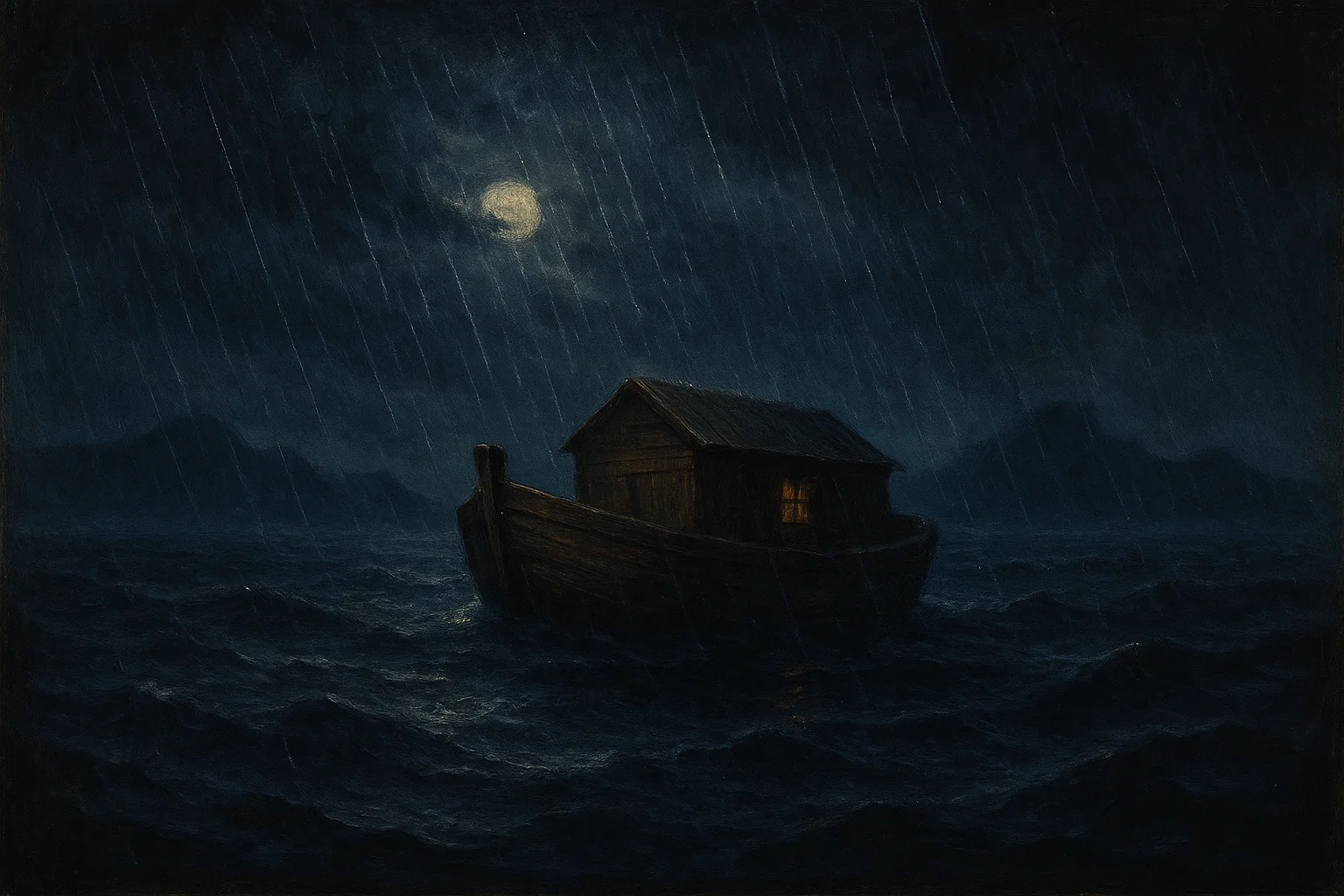
Flood Myths Across Cultures
Flood myths appear in Mesopotamia, Greece, India, Mesoamerica, and beyond. A comparative look at primary sources, patterns, and what they reveal.
Contents
Flood myths across cultures are narratives found on every inhabited continent in which divine forces destroy humanity through rising water, typically sparing a single family or small group who survive to repopulate the earth. The oldest recorded version appears in the Sumerian Eridu Genesis (circa 1600 BCE) and the Akkadian Atrahasis Epic, predating the biblical account by centuries. These stories function as reset narratives, explaining how the present human order emerged from divine dissatisfaction with an earlier creation.
The structural similarities are striking: a deity warns a chosen survivor, the survivor builds a vessel, the flood destroys the rest of humanity, and the remnant repopulates the world through sacrifice or divine instruction. Yet the theological stakes and cultural contexts differ sharply. Some floods punish human noise or violence; others serve as cosmic housekeeping. The question is not whether these stories share a single historical origin, but what they reveal about how societies imagine divine justice, human fragility, and the conditions for starting over.
The Pattern and Its Reach
Flood narratives appear in the mythologies of Mesopotamia, the ancient Near East, Greece, India, China, Mesoamerica, and across indigenous traditions in North America, Australia, and the Pacific. The geographic spread is broad enough that early comparative mythologists assumed a single Ur-flood, either a historical event encoded in collective memory or a story carried by migrating populations. Neither explanation holds cleanly.
The structural pattern is consistent but not universal. Most traditions include a divine warning delivered to a single righteous or favoured figure, the construction of a vessel or refuge, the survival of animals or seeds, and a ritual act of thanksgiving or sacrifice after the waters recede. Some stories, like the Popol Vuh account, omit the vessel entirely. Others, like certain Aboriginal Australian flood traditions, lack the moral framing of divine punishment. The pattern is real, but it bends.
What unites these narratives is their function as boundary markers between ages. They belong to the same narrative family as creation myths and apocalypse narratives, stories that explain discontinuity in the cosmic order. The flood is a reset button, not an ending.
Mesopotamia: Gilgamesh and the Atrahasis Tradition
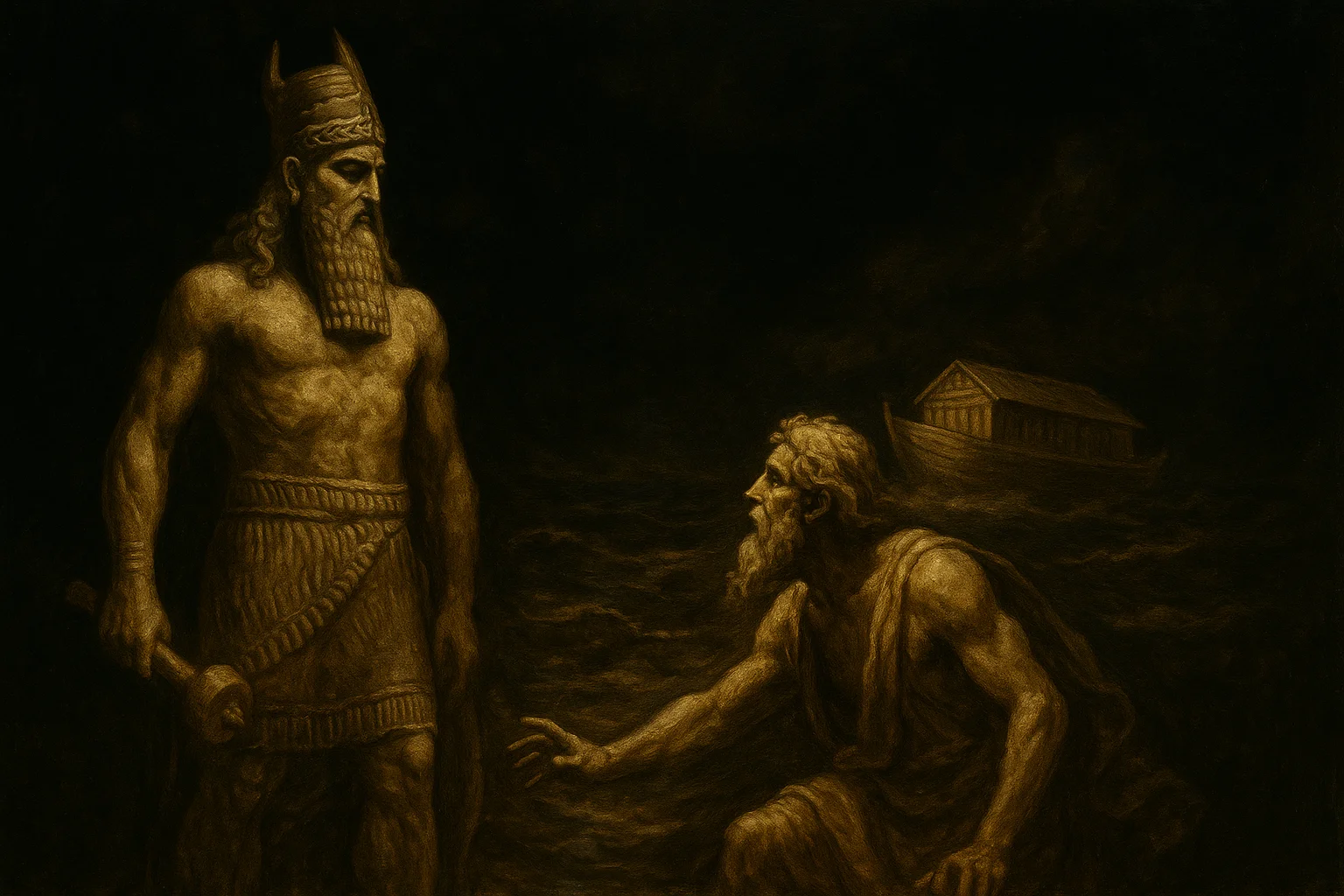
The Epic of Gilgamesh, in its Standard Babylonian version, preserves the oldest detailed flood account in Tablet XI. Utnapishtim, the flood survivor, recounts how the god Ea warned him of the assembly's decision to destroy humanity. He builds a cube-shaped vessel, coats it with bitumen, and loads it with his family, craftsmen, and animals. The storm lasts six days and seven nights. When it ends, the boat grounds on Mount Nimush. Utnapishtim releases three birds: a dove, a swallow, and finally a raven that does not return.
The earlier Atrahasis Epic (circa 1700 BCE) explains the motive. Humanity has multiplied and grown noisy, disturbing the sleep of the gods. The senior deity Enlil decides on annihilation. Ea, bound by oath not to warn humans directly, speaks to the wall of Atrahasis's reed house, allowing the man to overhear. The flood is not punishment for sin but a solution to overpopulation and noise pollution.
"The country was as noisy as a bellowing bull. The god grew restless at their racket, Enlil had to listen to their noise." Atrahasis Epic, Tablet II
After the flood, the gods regret the destruction. Enlil is furious that anyone survived, but Ea defends his decision. The solution is not another flood but population control: infant mortality, celibate priestesses, and childless women. The narrative treats the flood as a one-time event whose recurrence must be prevented by structural adjustments to human society.
The Biblical Flood: Genesis and Its Layers
Genesis 6 through 9 presents a flood narrative with clear literary debts to Mesopotamian tradition but reframed within Israelite monotheism. God sees that human wickedness has filled the earth and decides to "blot out" humanity. Noah, a righteous man, is instructed to build an ark of gopher wood, coat it with pitch, and bring aboard his family and pairs of every animal. The flood lasts forty days and nights, though the waters prevail for 150 days. The ark comes to rest on the mountains of Ararat. Noah releases a raven and then a dove three times; the third time, the dove returns with an olive leaf.
The parallels to Gilgamesh are unmistakable: the divine warning, the vessel coated with pitch, the grounding on a mountain, the bird test. Scholars since the nineteenth century have noted that Genesis appears to combine two sources, the Yahwist and the Priestly, which differ on details like the number of animals (two of each versus seven pairs of clean animals) and the flood's duration. The redaction is visible but does not obscure the theological shift.
Where Atrahasis blames noise, Genesis blames moral corruption. Where the Mesopotamian gods panic and regret, the God of Genesis acts with deliberate justice and establishes a covenant afterward. The rainbow becomes a sign that the earth will never again be destroyed by flood. The narrative is less about divine caprice and more about the terms of relationship between creator and creation.
Greece: Deucalion, Pyrrha, and the Stones That Became People
Deucalion, son of Prometheus, survives the flood sent by Zeus to destroy the Bronze Age of humanity. Warned by his father, Deucalion builds a chest and takes refuge with his wife Pyrrha. The flood lasts nine days. When the waters recede, the chest grounds on Mount Parnassus. Deucalion and Pyrrha offer sacrifice to Zeus and pray for guidance on how to repopulate the earth.
The oracle instructs them to throw the bones of their mother behind them. Deucalion interprets "mother" as Gaia, the earth, and "bones" as stones. They comply, and the stones thrown by Deucalion become men; those thrown by Pyrrha become women. Ovid in Metamorphoses 1.253-415 elaborates the scene with characteristic detail, describing how the stones soften, take form, and retain a hardness that marks human endurance.
Apollodorus in Library 1.7.2 offers a more compressed version but includes the same core elements: divine wrath, the chest, the mountain, the stones. The Greek flood lacks the animal-saving detail of Genesis and Gilgamesh, focusing instead on the mechanism of repopulation. The story also appears in Plato's Timaeus 22a-23d, where an Egyptian priest tells Solon that Greece has been destroyed by flood and fire multiple times, forgetting its own past each time.
India: Manu, the Fish, and the Satapatha Brahmana
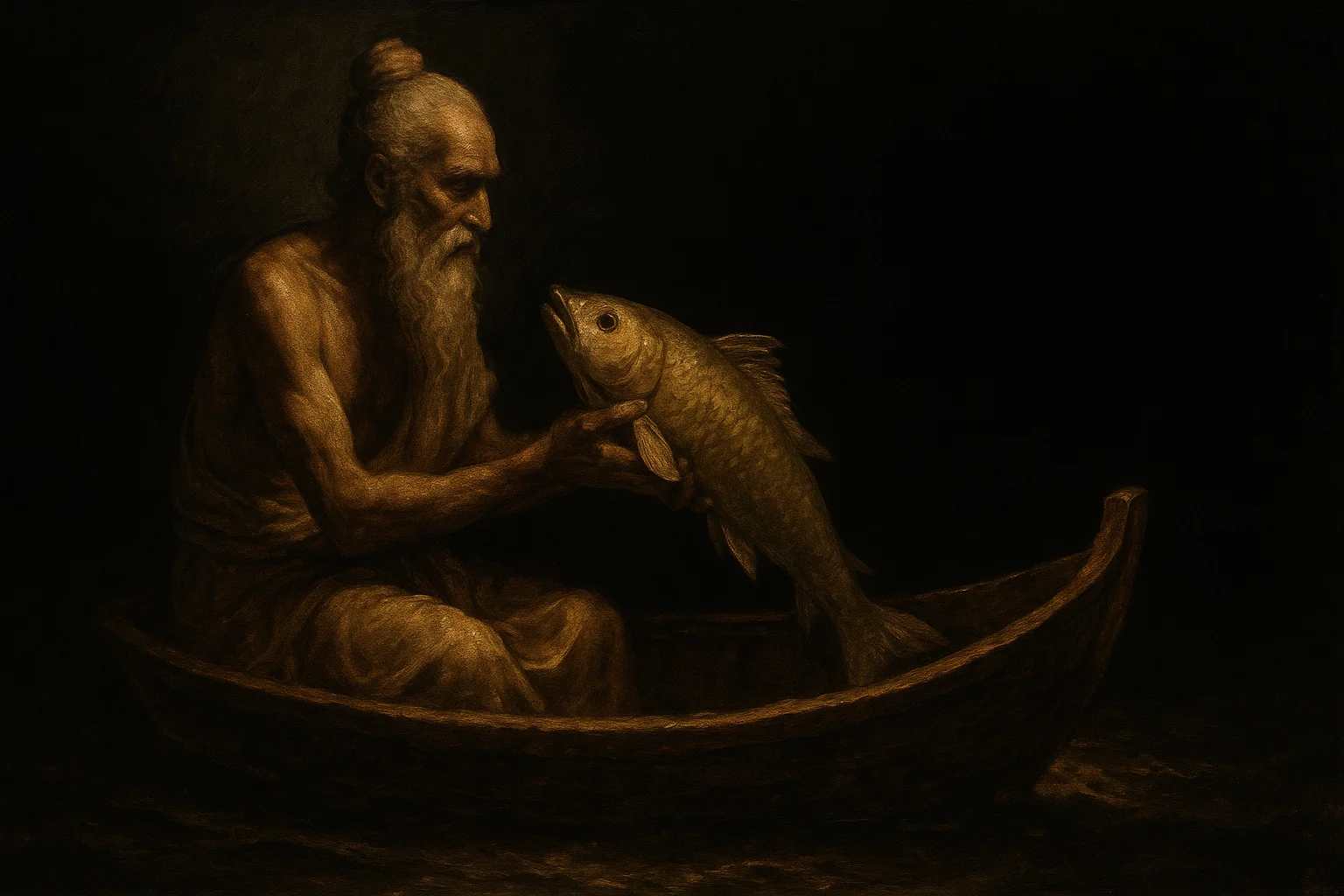
The Satapatha Brahmana 1.8.1, a Vedic prose text composed around the eighth century BCE, recounts how Manu, the first man, finds a small fish that begs for protection. Manu raises the fish in a jar, then a pond, then the river, until it grows too large and must be released into the ocean. The fish, revealed as the god Matsya (an avatar of Vishnu in later tradition), warns Manu of a coming flood and instructs him to build a ship.
When the flood arrives, the fish returns, now enormous, with a horn on its head. Manu ties the ship's rope to the horn, and the fish tows him to safety on a northern mountain. Alone, Manu performs sacrifice and austerities. A woman named Ida emerges from his offerings, and together they become the ancestors of humanity.
The Indian account shares the warning and vessel motif but replaces the bird test with the towing fish and introduces a sacrificial origin for the new human race. The flood is less about divine anger and more about cosmic cycle. The Brahmana treats it as a periodic event, part of the rhythm of creation and dissolution that structures Vedic cosmology.
Mesoamerica: The Popol Vuh and the Destruction of Wooden People
The Popol Vuh, the K'iche' Maya creation text recorded in the sixteenth century but preserving older oral traditions, describes multiple failed creations before the present age of maize people. In Part I, the gods fashion humans from wood. These wooden people walk, talk, and multiply, but they lack memory, reverence, and the ability to nourish the gods through worship.
The gods decide to destroy them. A flood of resin descends from the sky. The wooden people's own possessions turn against them: grinding stones crush their faces, cooking pots burn them, dogs and turkeys attack. Those who survive flee to the trees and become monkeys. No vessel is built. No survivor is chosen. The destruction is total, making way for the successful fourth creation from maize dough.
The Popol Vuh flood differs structurally from the Mesopotamian and biblical traditions. There is no ark, no animal pairs, no single family spared. The narrative is less interested in continuity between ages and more focused on the gods' iterative process of creation. The flood is one tool among many, not the centrepiece. Yet the function is the same: clearing the stage for a better humanity.
Mesopotamian Flood (Atrahasis)
Motive: human noise disturbs the gods. Survivor chosen by Ea. Vessel built and loaded with animals. Gods regret destruction and institute population controls.
Mesoamerican Flood (Popol Vuh)
Motive: wooden people fail to worship. No chosen survivor. No vessel. Total destruction by resin flood and rebellion of objects. Survivors become monkeys.
Structural Elements: What the Stories Share
Despite geographic and theological differences, most flood myths cluster around a small set of narrative moves. These are not proof of a single origin but evidence of how humans structure stories about catastrophe and renewal.
Divine Warning and the Chosen Survivor
In nearly every tradition with a survivor, that figure receives advance warning from a deity or divine intermediary. Utnapishtim hears Ea through the wall. Noah receives direct instruction from God. Deucalion is warned by Prometheus. Manu is told by the fish. The warning separates the survivor from the doomed majority and establishes the theological stakes: survival is not luck but divine favour or righteousness.
The survivor is rarely chosen for heroism in the sense of hero's journey narratives. Utnapishtim is wise. Noah is righteous. Deucalion is pious. Manu is attentive. The qualities are passive virtues, obedience and moral alignment rather than martial prowess or cleverness associated with trickster gods.
The Vessel and the Remnant
The ark, chest, or ship is the most recognizable element. Its construction is often described in technical detail: dimensions, materials, waterproofing. The vessel becomes a microcosm, preserving not just human life but the seeds of the old world's diversity. Genesis specifies animals. Gilgamesh includes craftsmen. The Greek and Indian versions focus on the human pair.
The vessel is also a threshold, a boundary between the world that was and the world that will be. It floats above the drowned earth, suspended in time. When it grounds on a mountain, the new age begins. The mountain itself is often named: Ararat, Nimush, Parnassus. The geography anchors the myth in the real world, even as the event transcends history.
Repopulation and Sacrifice
After the flood, the survivor must repopulate the earth. The mechanisms vary. Noah's family simply multiplies. Deucalion and Pyrrha throw stones. Manu performs sacrifice and receives Ida. The Popol Vuh skips the repopulation of wooden people entirely and moves to the maize creation.
Sacrifice is nearly universal. Utnapishtim offers incense, and the gods gather "like flies" around the sweet savour. Noah builds an altar and sacrifices burnt offerings; God smells the pleasing odour and vows never to curse the ground again. The sacrifice signals gratitude, re-establishes the covenant between human and divine, and sanctifies the new beginning. It is the ritual counterpart to the flood's violence.
Theories of Origin: Shared Memory, Independent Invention, or Diffusion
Three broad explanations compete. The first is historical memory: the myths encode a real catastrophic flood, possibly regional events like the Black Sea deluge hypothesis or widespread river flooding in Mesopotamia. The second is independent invention: human societies living near water naturally imagine and fear inundation, and similar environmental pressures produce similar stories. The third is diffusion: the story originated once, likely in Mesopotamia, and spread through trade, migration, and conquest.
None fits perfectly. The Mesopotamian and biblical accounts are clearly related through textual borrowing or shared tradition. The Greek version may reflect Near Eastern influence during the Bronze Age. But the Indian and Mesoamerican floods show no plausible contact with the Near East at the time of their composition. The structural similarities are better explained by shared narrative logic than by shared history.
Floods are universal disasters. Rivers overflow, storms surge, coastlines erode. A society that depends on water for survival will also fear its excess. The myth does not require a single Ur-event. It requires only the human capacity to imagine total destruction and the theological need to explain why it did not happen again.
Some scholars, following Mircea Eliade, argue that flood myths belong to a broader category of apocalypse narratives that imagine the end of an age and the conditions for renewal. Others, like Bruce Lincoln, emphasize the political function of these stories: legitimating the present order by framing it as the survivor of divine judgment. The flood is not just a story about water. It is a story about who gets to inherit the earth.
Frequently asked questions
Why do so many cultures have flood myths?
Many cultures have flood myths because flooding is a universal natural disaster that threatens agricultural societies dependent on rivers and coasts, and because the narrative structure of total destruction followed by renewal serves theological and political functions across traditions. The myths explain discontinuity between ages, legitimate present social orders as divinely sanctioned, and articulate the terms of relationship between humans and gods. The structural similarities likely result from both shared environmental pressures and independent narrative invention rather than a single historical event or origin point.
What is the oldest recorded flood myth?
The oldest recorded flood myth is the Sumerian Eridu Genesis, dating to approximately 1600 BCE, followed closely by the Akkadian Atrahasis Epic from around 1700 BCE. Both predate the biblical account in Genesis by several centuries. The Atrahasis version, in which the gods destroy humanity because of overpopulation and noise, directly influenced the flood narrative in the Epic of Gilgamesh, Tablet XI, which was widely copied and translated across the ancient Near East.
How does the Epic of Gilgamesh flood story compare to the Bible?
The Epic of Gilgamesh flood story in Tablet XI shares numerous structural details with Genesis 6 through 9: a divine warning, a vessel coated with pitch, the survival of a family and animals, the grounding on a mountain, and a bird test involving multiple releases. The key difference lies in motive and theology. In Gilgamesh, the gods destroy humanity because of noise and later regret the decision, while in Genesis, God acts out of moral judgment against human wickedness and establishes a covenant promising never to flood the earth again. The parallels suggest textual borrowing or shared tradition.
Are flood myths evidence of a real historical event?
Flood myths are not reliable evidence of a single global historical flood, but they may preserve memories of regional catastrophic flooding events such as river overflows in Mesopotamia or coastal inundations. The geographic distribution of flood narratives is too broad and the structural variations too significant to support a single Ur-event. Most scholars view the myths as independent responses to universal environmental threats combined with theological needs to explain cosmic resets. Some regional floods, like the Black Sea deluge hypothesis, have been proposed as partial inspirations, but no consensus exists.
What do flood myths reveal about ancient societies?
Flood myths reveal how ancient societies understood divine justice, human fragility, and the terms of cosmic order. They function as boundary markers between ages, explaining why the present world differs from a prior creation and legitimating current social structures as divinely ordained. The choice of survivor, the reasons for destruction, and the mechanisms of repopulation reflect each culture's values: righteousness in Genesis, wisdom in Gilgamesh, piety in Greece, attentiveness in India. The myths also demonstrate shared narrative strategies for processing catastrophe and imagining renewal.
Do all flood myths involve a single survivor and a boat?
Not all flood myths involve a single survivor and a boat. While the Mesopotamian, biblical, Greek, and Indian traditions feature a chosen survivor who builds a vessel, the Mesoamerican Popol Vuh describes a flood of resin that destroys wooden people with no survivor or ark, and the remnants become monkeys. Some indigenous Australian and Pacific flood traditions lack the moral framing of divine punishment and focus instead on landscape formation or ancestral migration. The vessel and sole survivor are common motifs but not universal requirements of the genre.
Further reading on Mythologis
Read the full book
Want the whole story?
The complete edition is an instant PDF download here, with a paperback on Amazon for selected titles.
Mythology
The World Mythology Book: The Gods, Heroes and Myths of Every Culture
The Gods, Heroes and Myths of Every Culture, in One Volume
The whole of world mythology in a single volume: Greek, Norse, Egyptian, Japanese, Hindu, Celtic, Slavic, Mesoamerican and African myths gathered side by side, each drawn from the primary sources.