
Trickster Gods Across Cultures
Loki, Anansi, Coyote, Hermes: why do trickster gods appear in every tradition? A comparative study grounded in primary texts and pattern.
Contents
Trickster gods appear across nearly every major mythological tradition as figures who violate boundaries, deceive other deities, steal sacred objects, and disrupt cosmic order, yet simultaneously enable creation, deliver culture to humanity, and mediate between divine and mortal realms. They share core traits: shape-shifting, transgression of social and natural law, association with thresholds and crossroads, and a refusal to align neatly with good or evil. The pattern recurs from Norse Loki to West African Anansi, from Greek Hermes to the Monkey King of Chinese tradition, suggesting these figures address a structural need in how cultures conceptualize change, ambiguity, and the limits of order.
Most surveys list tricksters by culture without explaining what makes the archetype cohere or why it appears so persistently. The answer lies not in superficial mischief but in function: tricksters operate at the joints of cosmology, where categories blur and transformation becomes possible. They are rarely simple villains or heroes. They create and destroy in the same gesture.
What Makes a Trickster God
The term "trickster" entered comparative mythology through anthropologist Paul Radin's 1956 study of the Winnebago cycle, but the pattern predates the label by millennia. A trickster is not defined by pranks alone. The archetype clusters around boundary violation, appetite without restraint, and the paradox of creative destruction.
Boundary Crossers
Tricksters move between realms that other figures cannot. Hermes guides souls to the underworld and returns. Loki shifts between god and giant, male and female, ally and enemy. Anansi bridges sky god and human village. Eshu stands at every crossroads in Yoruba cosmology, determining which messages reach which gods. These are not mere messengers. They inhabit the threshold itself.
This positioning grants them unique power. They see both sides of every divide: order and chaos, sacred and profane, life and death. Where Thunder gods enforce cosmic law and Mother goddesses sustain it, tricksters test its edges.
Ambiguity and Appetite
Tricksters are creatures of excess. They eat too much, seduce indiscriminately, lie reflexively. Loki's hunger for chaos grows until it devours the world at Ragnarök. Coyote's sexual appetite in Plains and Plateau traditions leads to both new landforms and catastrophic mistakes. Sun Wukong consumes the peaches of immortality not from need but from boundless greed.
This appetite extends beyond the physical. Tricksters crave transformation, novelty, disruption. They cannot leave things as they are. The result is moral ambiguity: the same act that brings fire to humanity may also unleash death, as in many Prometheus-adjacent figures across creation myths.
Creation and Destruction in One Figure
Many tricksters participate directly in cosmogony. Coyote in some Maidu traditions releases the first humans from a basket against the creator's plan. Anansi in Akan tradition purchases the sky god's stories and scatters them across the earth. Loki's children include both the wolf that will devour Odin and the serpent that encircles the world. The trickster does not create ex nihilo like a high god, but through theft, accident, or subversion.
This dual function distinguishes tricksters from simple villains or chaos monsters. They are necessary. Without Loki's interference, the gods would lack their greatest treasures. Without Hermes' theft of Apollo's cattle, there would be no lyre. The pattern suggests that order alone is sterile; transformation requires transgression.
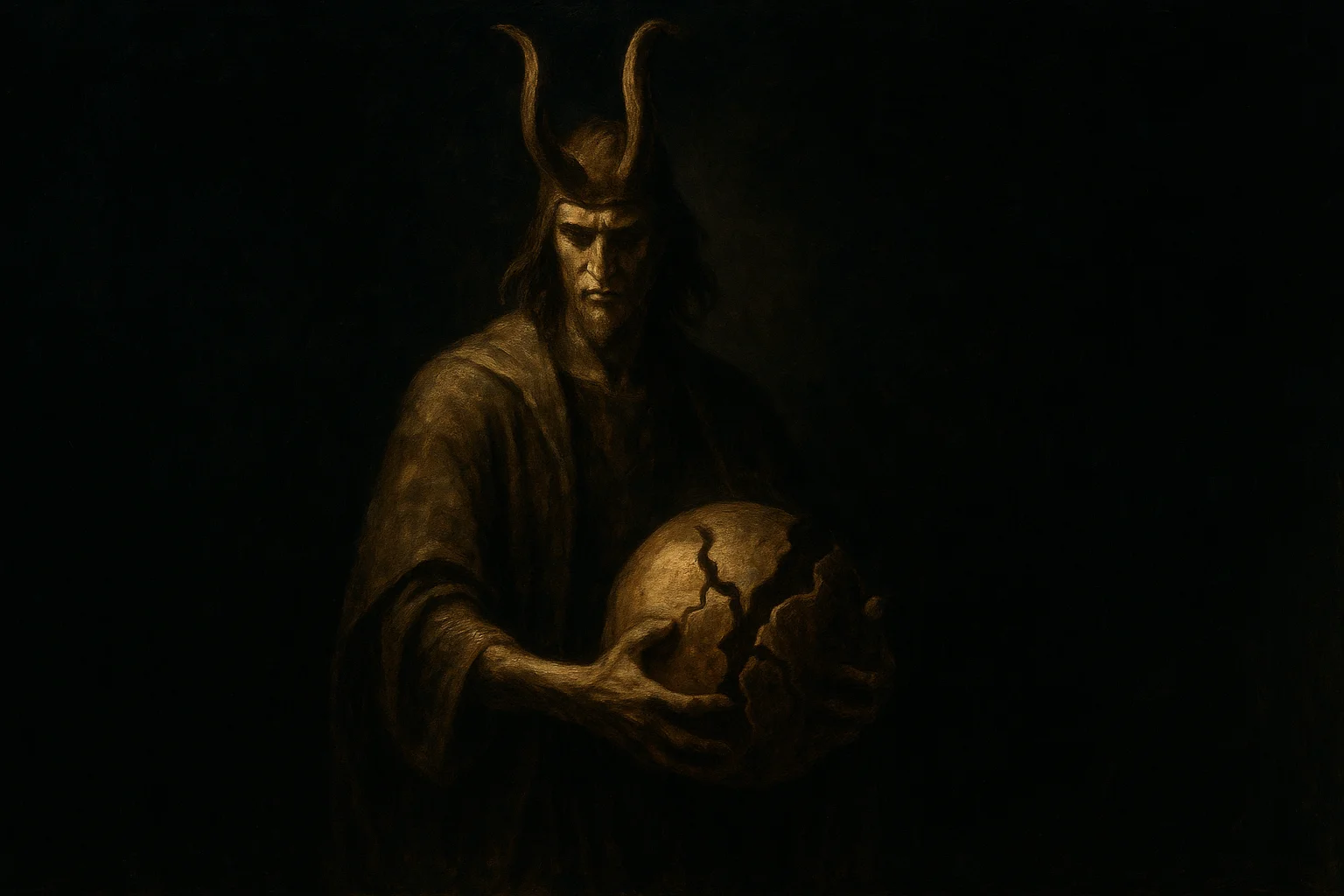
Loki: The Norse Trickster Who Breaks the World
Loki occupies a unique position in the Norse pantheon: neither fully god nor giant, neither wholly ally nor enemy until the final breaking. Snorri Sturluson's Prose Edda, Gylfaginning 33, calls him "the origin of deceits and the disgrace of all gods and men." Yet the same sources show him solving as many problems as he creates.
He is a shape-shifter without peer. He becomes a mare to lure away a giant's stallion, giving birth to Odin's eight-legged horse Sleipnir. He takes the form of a salmon, a fly, an old woman. His children by the giantess Angrboða include Fenrir the wolf, Jörmungandr the world-serpent, and Hel, ruler of the underworld. Each will play a role in the gods' destruction during apocalypse narratives at Ragnarök.
The Poetic Edda's Lokasenna presents him at his most corrosive: gate-crashing a divine feast, he systematically insults every god and goddess, exposing their hidden shames and hypocrisies. The poem reads like a catalogue of divine failings, with Loki as prosecutor. His final crime, engineering the death of Baldr through trickery, severs his last tie to the Aesir. They bind him beneath the earth with serpent venom dripping onto his face until he breaks free to lead the giants against Asgard.
Loki differs from most tricksters in his trajectory toward pure enmity. Where Anansi or Coyote remain ambiguous, Loki's arc bends toward apocalypse. Some scholars read him as a late addition to the pantheon, a narrative device to explain how the gods' own actions seed their destruction. Others see him as the necessary shadow of order, the agent through which the cosmos renews itself through fire.
Hermes: Greek Messenger, Thief, and Psychopomp
The Homeric Hymn to Hermes opens with an infant god, born at dawn, playing the lyre by midday, and stealing Apollo's cattle by evening. Hermes invents the lyre from a tortoise shell, then uses it to charm his way out of punishment. Apollo, furious at the theft, drags the child before Zeus, who laughs and brokers a deal: Hermes keeps the lyre, Apollo gets the cattle, and Hermes becomes the gods' messenger.
This origin story encodes his nature. He is the god of boundaries and their violation: thresholds, roads, commerce, theft, language, and the passage between life and death. Hermai, the stone pillars marking boundaries in the Greek world, bear his name. He guides souls on underworld journeys, a role that places him at the ultimate threshold.
Unlike Loki, Hermes integrates fully into the Olympian order. He serves Zeus loyally, delivers messages, escorts heroes. Yet his trickster nature persists. Apollodorus' Library 3.10.2 recounts how he steals Hera's cattle while she sleeps, then helps Perseus behead Medusa by lending him winged sandals. He is simultaneously the gods' most reliable servant and their most accomplished thief.
"Hermes, guide and giver of good things, you who haunt the house and the fold, I sing of you, the luck-bringer." Homeric Hymn to Hermes, opening lines
His Roman equivalent Mercury carries similar traits but emphasizes commerce and eloquence over theft. The shift reflects Roman pragmatism: a trickster domesticated into the patron of merchants.
Anansi: West African Spider and Keeper of Stories
Anansi the spider dominates Akan and Ashanti oral tradition in what is now Ghana, and his stories traveled with the transatlantic slave trade to the Caribbean, where he becomes Anancy in Jamaica and Aunt Nancy in the American South. R.S. Rattray's Akan-Ashanti Folk-Tales, published in 1930, records dozens of cycles in which Anansi outwits stronger animals, gods, and humans through cunning rather than strength.
In one widespread cycle, Anansi approaches Nyame, the sky god, to purchase all the world's stories. Nyame sets an impossible price: Anansi must capture the python, the leopard, the hornet, and a fairy. Through cleverness, Anansi traps each one. He tricks the python into measuring itself against a pole, then ties it in place. He digs a pit for the leopard, then pretends to rescue it while binding it. He pours water on the hornets' nest, offers them shelter in a gourd, and seals it. The fairy he captures with a tar-baby trap, a motif that appears in multiple African and African-diaspora traditions.
Nyame, impressed and perhaps alarmed, grants Anansi ownership of all stories. This is why, in Akan tradition, every tale is an Anansesem, a spider story, even when Anansi does not appear in it.
Anansi (Akan)
Physically weak, uses intelligence and deception to overcome stronger opponents; stories emphasize survival and subversion of power hierarchies.
Coyote (Plains traditions)
Physically capable but impulsive; stories often feature bodily humor and sexual appetite; Coyote's failures teach as often as his successes.
Anansi's role in the African diaspora carries additional weight. Enslaved peoples used his stories to encode resistance, to model survival through wit in contexts where open defiance meant death. The trickster becomes a figure of resilience, his cunning a tool against overwhelming power.
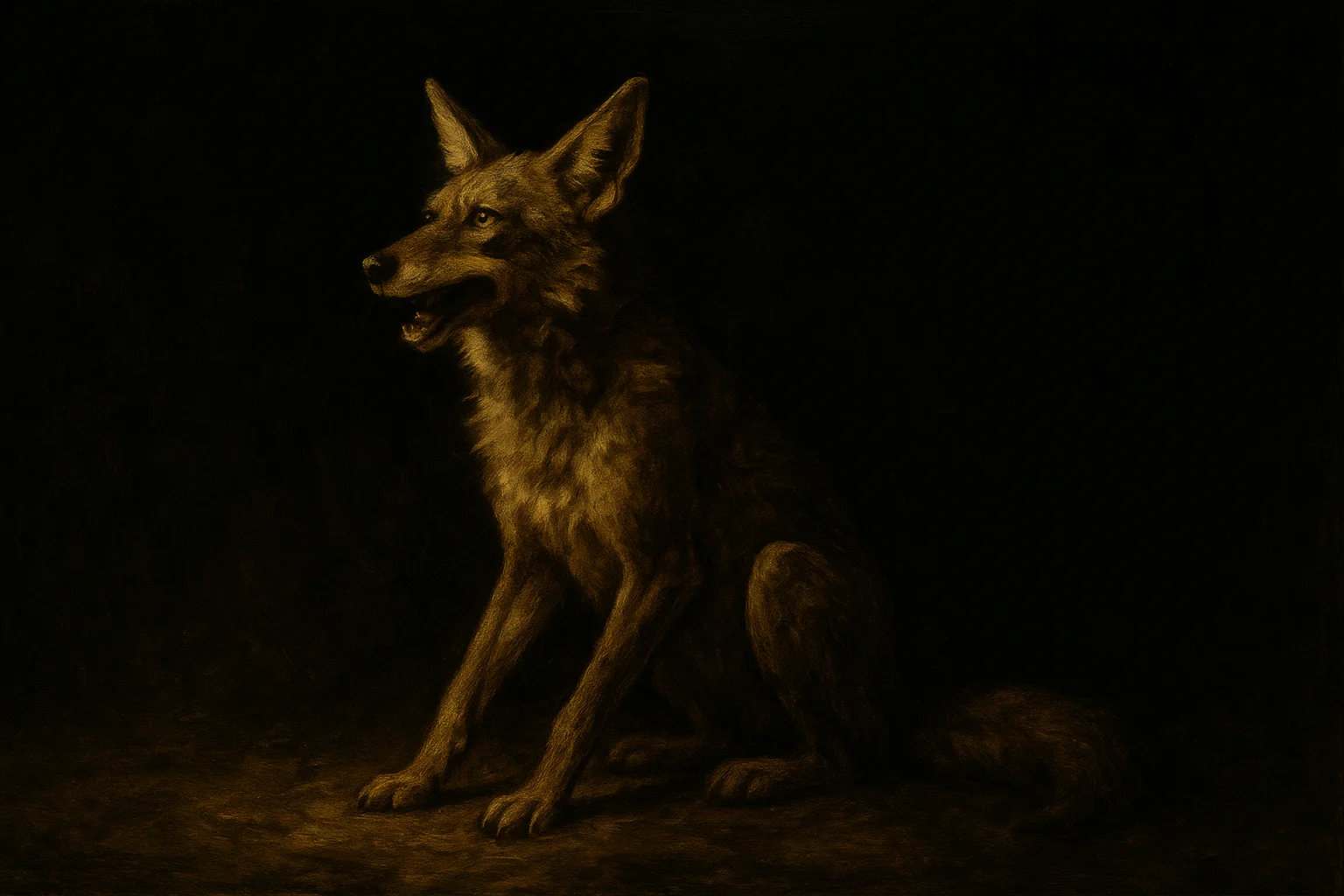
Coyote: North American Transformer and Fool
Coyote appears across dozens of Indigenous North American traditions, from the Pacific Northwest to the Great Plains, with significant variation. In some cycles he is a creator or transformer figure, shaping the landscape and establishing the conditions for human life. In others he is a fool, a glutton, a figure of obscene comedy whose mistakes explain why the world is imperfect.
Barre Toelken's recordings of Navajo Coyote stories emphasize his role as a boundary figure between the Holy People and humans. Coyote introduces death into the world, sometimes through carelessness, sometimes through necessity. In one Nez Perce cycle recorded by Jarold Ramsey, Coyote releases salmon into the Columbia River by breaking open a dam, ensuring humans will have food but also creating the dangerous rapids that drown fishermen.
Many Coyote stories are explicitly sexual and scatological, featuring detachable genitals, shape-shifting seductions, and bodily functions as plot points. These elements are not juvenile but cosmological: Coyote's body, like his behavior, refuses boundaries. He represents appetite and physicality in their rawest forms.
The variation across traditions makes generalization difficult. Coyote is not a single figure but a pattern repeated and adapted. What remains constant is his liminality: he is neither wholly animal nor wholly divine, neither creator nor destroyer, neither wise teacher nor utter fool. He is all of these, depending on the story and the teller's purpose.
Sun Wukong: The Monkey King Who Defied Heaven
Sun Wukong, the Monkey King, dominates the sixteenth-century Chinese novel Journey to the West by Wu Cheng'en. Born from a stone egg on the Mountain of Flowers and Fruit, he masters Taoist magic, learns the 72 transformations, acquires a staff that can change size at will, and declares himself equal to Heaven itself.
His rebellion against the Jade Emperor is pure trickster chaos. He eats the peaches of immortality, drinks the elixir of eternal life, defeats Heaven's armies, and forces the celestial bureaucracy to negotiate. The Buddha finally traps him under a mountain for five hundred years. His punishment ends only when he agrees to accompany the monk Xuanzang on a pilgrimage to India, serving as bodyguard and, gradually, as student of Buddhist discipline.
Sun Wukong differs from Western tricksters in his trajectory toward enlightenment. The novel is structured as a spiritual journey, with each demon they encounter representing an obstacle to wisdom. The Monkey King's transformation from chaos agent to protector mirrors the Buddhist path from ignorance to awakening. Yet his trickster nature never fully disappears. He remains impulsive, proud, and quick to violence, even as he learns restraint.
His popularity in East Asian culture rivals that of any deity. He appears in opera, film, television, and video games, always recognizable by his golden headband, his staff, and his refusal to bow. He represents the possibility of transcendence through struggle, the idea that even a chaotic trickster can achieve enlightenment without losing his essential nature.
Eshu and Legba: Yoruba Gatekeepers of Fate
Eshu in Yoruba tradition and his Fon equivalent Legba occupy a unique position among tricksters: they are not peripheral figures but essential intermediaries in every religious act. No prayer reaches the orishas without passing through Eshu. No divination works without his consent. He is the divine messenger, the opener of roads, the guardian of crossroads, and the agent of fate's unpredictability.
Wande Abimbola's translations of Ifa divination verses present Eshu as both enabler and obstacle. He rewards those who honor him with offerings and punishes neglect with confusion and misfortune. One verse describes how Eshu made two friends quarrel by wearing a hat that was red on one side and black on the other, walking between them so each saw a different color. When they argued about the stranger's hat, Eshu revealed himself and reminded them that truth depends on perspective.
This story encodes Eshu's philosophical function. He does not lie, but he reveals how context shapes perception. He is the principle of uncertainty, the reminder that the universe is not fixed but contingent on choices, offerings, and the alignment of forces beyond human control.
- Eshu must receive offerings before any other orisha in Yoruba ritual
- He is associated with the number three and with crossroads, thresholds, and markets
- In diaspora traditions (Santería, Candomblé, Vodou), he syncretizes with Catholic saints but retains his trickster nature
- Legba in Fon and Vodou tradition is often depicted as an old man with a cane, emphasizing his role as gatekeeper rather than chaos agent
Eshu's integration into religious practice distinguishes him from most tricksters. He is not a figure in stories alone but an active presence in daily life, invoked at every ritual, blamed for every accident, thanked for every fortunate coincidence. He is the trickster as theological necessity.
Why Tricksters Recur: Pattern and Function
The recurrence of trickster figures across unrelated traditions suggests they address a structural need in how cultures conceptualize change, ambiguity, and the limits of order. They are not relics of primitive thought but responses to genuine cosmological problems.
First, tricksters explain imperfection. If the gods are wise and powerful, why is the world flawed? The trickster provides an answer: because transformation requires transgression, because order alone is sterile, because the necessary agents of change cannot be controlled. This is why so many tricksters introduce death, scarcity, or suffering alongside their gifts. The world is imperfect because it is dynamic.
Second, tricksters model adaptability. In contrast to the rigid hierarchies of dying-and-rising gods or the cyclical patterns of flood myths, tricksters demonstrate survival through flexibility. They shape-shift, lie, steal, seduce, and betray because these strategies work when strength and piety fail. For marginalized groups, this makes the trickster a figure of identification and hope.
Third, tricksters occupy the conceptual space between categories. Anthropologist Mary Douglas argued that things which violate classification systems are often treated as sacred or polluted. Tricksters are both: they are divine but transgressive, creative but destructive, necessary but dangerous. They inhabit the joints of cosmology, the places where one category bleeds into another.
The pattern appears in hero's journey narratives as the shapeshifter or threshold guardian, the figure who tests the hero's readiness to cross into the unknown. It appears in ritual as the clown or sacred fool who inverts social norms to reveal their arbitrariness. It appears in philosophy as the skeptic who questions every certainty.
Tricksters recur because cultures need figures who can operate outside the rules, who can bring back what is forbidden, who can laugh at the gods and survive. They are the narrative embodiment of the idea that order is always provisional, that boundaries exist to be tested, and that transformation is never clean.
Frequently asked questions
What defines a trickster god across different mythologies?
A trickster god is defined by boundary violation, moral ambiguity, shape-shifting or deception, and the ability to create or destroy through transgression rather than direct power, operating as a mediator between cosmic order and chaos, gods and mortals, or life and death. These figures typically possess insatiable appetites, refuse alignment with pure good or evil, and enable cultural transformation through theft or subversion. They appear in nearly every major tradition because they address the cosmological problem of change within ordered systems.
Why do so many cultures have trickster figures in their pantheons?
Trickster figures recur across cultures because they serve a structural cosmological function: explaining imperfection in creation, modeling adaptability and survival through cunning, and occupying the conceptual space between rigid categories like divine and mortal, order and chaos, or life and death. They are not evidence of cultural diffusion but independent responses to shared narrative and philosophical needs. Cultures require figures who can operate outside normal rules to bring forbidden knowledge, test boundaries, and enable transformation that rigid hierarchies cannot accommodate.
How does Loki differ from other trickster gods?
Loki differs from most tricksters in his trajectory toward irreversible enmity with the gods and his role in triggering cosmic destruction at Ragnarök, whereas figures like Anansi, Hermes, or Coyote remain morally ambiguous but integrated into their respective cosmologies. He has no archaeological evidence of worship, suggesting he functions as a narrative device rather than a deity who received cult practice. His children include monsters destined to destroy the gods, and his final betrayal through Baldr's murder severs all ties, making him unique among tricksters in his complete transformation from ambiguous ally to apocalyptic enemy.
What role does Anansi play in West African and Caribbean tradition?
Anansi serves as the keeper and distributor of all stories in Akan tradition after purchasing them from the sky god Nyame through cunning, making every tale an Anansesem or spider story regardless of whether he appears in it. In the African diaspora, particularly in Caribbean and American contexts, Anansi's stories encoded resistance and survival strategies for enslaved peoples, modeling how intelligence and deception could overcome overwhelming power when direct confrontation was impossible. He remains a figure of cultural identity and resilience, emphasizing wit over strength and subversion over submission.
Are trickster gods always male?
Most prominent trickster gods are male, but exceptions exist, and many male tricksters engage in gender transgression through shape-shifting or pregnancy, as when Loki becomes a mare and gives birth to Sleipnir. Female trickster figures appear in some traditions, though they are less common in the canonical pantheons recorded by early ethnographers and classical sources. The gender pattern may reflect the biases of source preservation rather than the traditions themselves, and the trickster's defining trait is boundary violation, which includes gender boundaries.
Do tricksters serve a moral or cosmological function?
Tricksters serve primarily cosmological rather than moral functions, operating as agents of necessary change, mediators between incompatible categories, and explanations for imperfection within ordered creation. They are morally ambiguous by design, neither models of virtue nor pure villains, because their role is to enable transformation through transgression that the established order cannot accommodate. Some traditions, like the Buddhist framework of Journey to the West, impose moral development onto the trickster figure, but even there Sun Wukong's essential nature persists beneath his acquired discipline.
Further reading on Mythologis
Read the full book
Want the whole story?
The complete edition is an instant PDF download here, with a paperback on Amazon for selected titles.
Mythology
The World Mythology Book: The Gods, Heroes and Myths of Every Culture
The Gods, Heroes and Myths of Every Culture, in One Volume
The whole of world mythology in a single volume: Greek, Norse, Egyptian, Japanese, Hindu, Celtic, Slavic, Mesoamerican and African myths gathered side by side, each drawn from the primary sources.