
The Hero's Journey: Mythology's Universal Pattern
Joseph Campbell's monomyth mapped a recurring pattern in myth. We trace its origins, test it against primary sources, and weigh its limits.
Contents
The Hero's Journey is a narrative pattern identified by Joseph Campbell in his 1949 book The Hero with a Thousand Faces, which proposes that myths across cultures follow a common structure: a hero leaves home, undergoes trials and transformation, and returns with knowledge or power to benefit the community. Campbell called this the monomyth and divided it into seventeen stages across three acts: departure, initiation, and return. The pattern draws on earlier work by Otto Rank, Lord Raglan, and Vladimir Propp, who each catalogued recurring motifs in hero tales, birth legends, and folktales.
The monomyth has shaped modern storytelling in film, literature, and games, but it has also drawn criticism for flattening cultural difference and privileging male, quest-driven narratives. Testing the pattern against primary sources reveals both its descriptive power and its limits.
What Campbell called the monomyth
Joseph Campbell argued that hero myths from cultures as distant as Mesopotamia, Greece, India, and Mesoamerica share a common skeleton. He called this the monomyth, a term borrowed from James Joyce's Finnegans Wake. Campbell was not claiming that every myth follows the pattern exactly, but that the structure recurs often enough to suggest something universal about human storytelling and psychology.
He divided the journey into three acts and seventeen stages, though he acknowledged that individual myths omit, reorder, or compress steps. The pattern is descriptive, not prescriptive. Campbell's work was influenced by Jungian psychology, particularly the idea of archetypes: recurring symbols and figures that emerge from the collective unconscious. The hero represents the ego's journey toward individuation, and the trials represent psychological obstacles.
The book became a touchstone for screenwriters, novelists, and game designers in the late twentieth century, particularly after Christopher Vogler adapted it into a practical guide for Hollywood. That popularization also amplified its weaknesses.
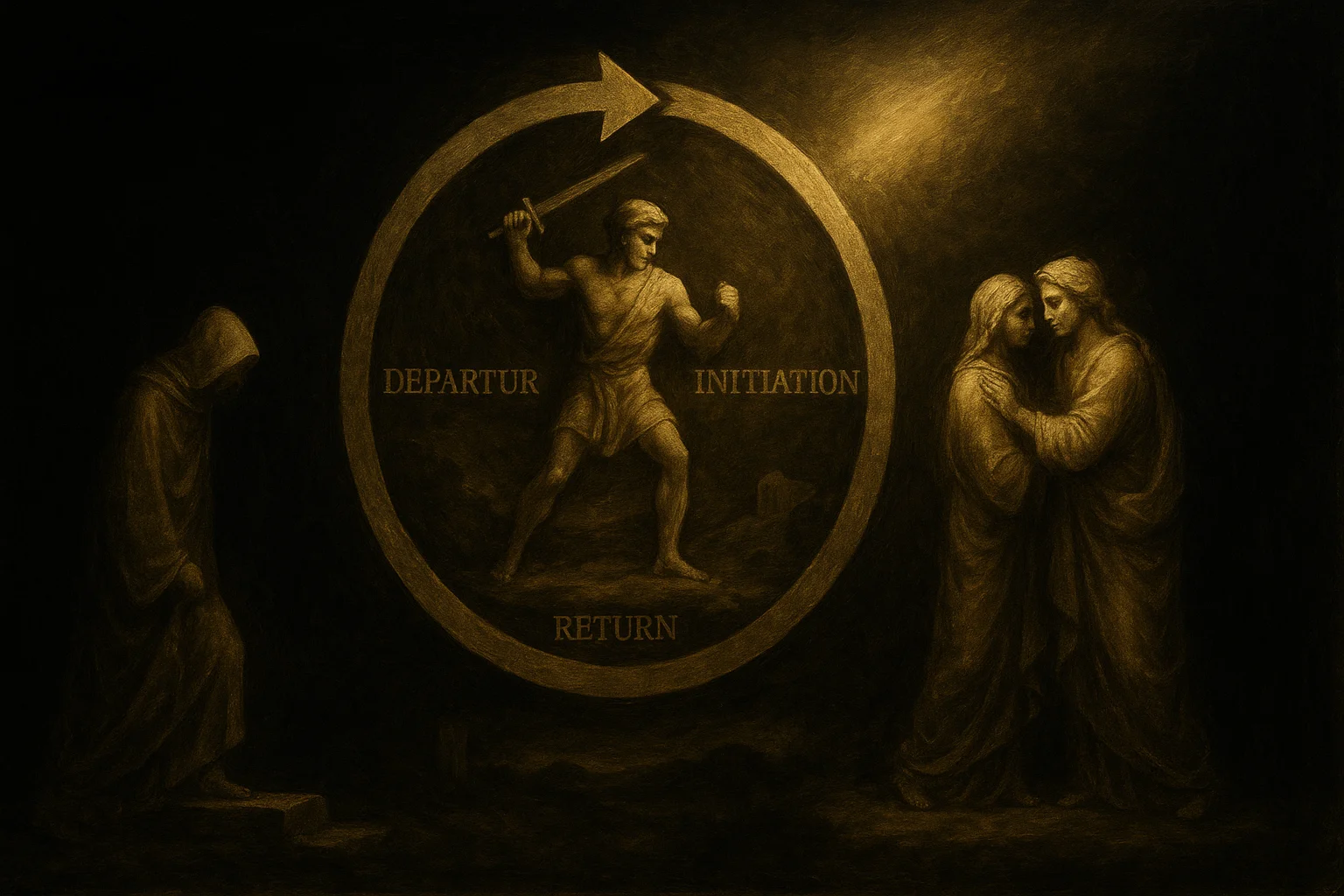
The seventeen stages: departure, initiation, return
Campbell's seventeen stages are not rigid checkboxes. Some myths skip steps, others repeat them, and a few reverse the order entirely. What follows is the canonical sequence as Campbell described it.
Departure: the call and the threshold
The hero begins in the ordinary world, often unaware of their destiny. A herald or event delivers the call to adventure: a crisis, a prophecy, a summons. Gilgamesh receives his call when Enkidu dies and he confronts mortality. Odysseus is called home by the gods after the fall of Troy.
The hero often refuses the call at first, out of fear, duty, or doubt. Campbell saw this refusal as a moment of hesitation before transformation. A mentor or supernatural aid appears to provide guidance, a weapon, or a charm. Athena aids Odysseus; Shamash gives Gilgamesh courage.
The hero then crosses the threshold into the unknown, leaving the familiar world behind. This is a one-way passage, often guarded by a threshold guardian: a figure who tests or challenges the hero's resolve. The crossing marks the boundary between the known and the mythic.
Initiation: trials, allies, and the abyss
Once across the threshold, the hero enters a realm of tests. Campbell called this the road of trials: a series of challenges that prepare the hero for the central ordeal. Allies and enemies appear. The hero may meet a goddess or temptress, figures who represent union or distraction.
The deepest point of the journey is the abyss, what Campbell called the belly of the whale or the supreme ordeal. The hero faces death, literal or symbolic, and must surrender the ego to be reborn. Gilgamesh fails to stay awake for seven nights and loses the plant of immortality. Odysseus descends to the underworld journeys to consult Tiresias in Book 11 of the Odyssey.
If the hero survives, they receive a boon: knowledge, a weapon, enlightenment, or reconciliation with a divine force. Arjuna receives the vision of Krishna's universal form in Chapter 11 of the Bhagavad Gita. The Hero Twins defeat the lords of Xibalba and are transformed into the sun and moon.
Return: the gift and the refusal
The hero must now return to the ordinary world, but the return is often harder than the departure. Campbell identified the refusal of the return: the hero, transformed, may not want to go back. Gilgamesh returns empty-handed but wiser. Odysseus longs for Ithaca but is delayed by gods and monsters.
The hero crosses the return threshold and becomes master of two worlds, able to move between the sacred and the profane. The final stage is freedom to live: the hero integrates the lessons of the journey and shares the boon with the community. This is the gift that justifies the ordeal.
Where the pattern came from: Rank, Raglan, and Propp
Campbell did not invent the idea of a universal hero pattern. He synthesized earlier work by psychoanalysts and folklorists who had already noticed recurring structures in myth and tale.
Otto Rank, a student of Freud, published The Myth of the Birth of the Hero in 1909. Rank catalogued the birth legends of figures like Moses, Oedipus, Romulus, and Siegfried, and found a common sequence: the hero is born to royal or divine parents, threatened as an infant, exposed or hidden, rescued and raised by humble foster parents, and eventually reclaims their destiny. Rank interpreted this as a projection of the child's Oedipal conflict with the father.
Lord Raglan, a British anthropologist, extended Rank's work in The Hero: A Study in Tradition, Myth and Drama (1936). Raglan proposed a twenty-two-point pattern covering the hero's birth, reign, and death. He tested it against figures like Oedipus, Theseus, and King Arthur, and concluded that the closer a figure matched the pattern, the less likely they were historical. Raglan's pattern emphasizes kingship and ritual more than Campbell's psychological arc.
Vladimir Propp, a Russian formalist, analyzed Russian folktales in Morphology of the Folktale (1928) and identified thirty-one narrative functions that appear in a fixed sequence. Propp's functions include the hero's departure, the donor who provides a magical agent, the villain's defeat, and the hero's marriage or ascension. His work was structural, not psychological, and influenced later narratology.
Campbell absorbed all three and added Jungian psychology, comparative religion, and his own reading of global myth. The result was a synthesis that emphasized transformation and return, not just birth or kingship.
Testing the pattern against primary sources
The monomyth's claim to universality depends on how well it fits actual myths. Four examples from different traditions show both the pattern's strengths and its gaps.
Gilgamesh and the search for immortality
The Epic of Gilgamesh, composed in Akkadian around 1800 BCE, follows a king who loses his companion Enkidu and sets out to find eternal life. Gilgamesh crosses the threshold when he leaves Uruk and enters the wilderness. He meets allies, including the ferryman Urshanabi, and faces trials in the mountains of Mashu and the waters of death.
In Tablet X, Gilgamesh reaches Utnapishtim, the flood survivor, who tells him the story of the deluge and sets him a test: stay awake for seven days. Gilgamesh fails. He is given a second chance, a plant of rejuvenation, but a serpent steals it. He returns to Uruk without immortality but with acceptance of mortality and pride in his city's walls.
The pattern fits reasonably well. Gilgamesh departs, faces trials, descends symbolically into death, and returns transformed. But his return is not triumphant. He brings no boon except wisdom, and the epic ends with resignation, not mastery.
Odysseus: the long road home
Homer's Odyssey, composed in the eighth century BCE, is often cited as a near-perfect example of the monomyth. Odysseus is called home after the Trojan War, but Poseidon delays him. He crosses the threshold when he leaves Calypso's island and enters the open sea.
Books 9 through 12 recount his trials: the Cyclops, the Lotus-Eaters, Circe, the Sirens, Scylla and Charybdis. He descends to the underworld to consult the prophet Tiresias, a classic abyss moment. He returns to Ithaca disguised, reclaims his throne by slaughtering the suitors, and is reunited with Penelope.
The fit is strong. Odysseus departs, endures trials, descends, returns, and restores order. But the Odyssey is also a homecoming tale, not a quest for transformation. Odysseus does not change; he reasserts who he was. The pattern describes the structure but misses the tone.
Arjuna in the Bhagavad Gita
The Bhagavad Gita, part of the Mahabharata and composed between the fifth and second centuries BCE, presents a different kind of hero. Arjuna stands on the battlefield of Kurukshetra, paralyzed by doubt. He does not depart on a physical journey; his journey is inward.
Krishna, his charioteer and divine guide, becomes the mentor. The trials are philosophical: Arjuna must reconcile duty, violence, and devotion. In Chapter 11, Krishna reveals his universal form, a vision of cosmic destruction and creation. This is the abyss: Arjuna confronts the divine and his own insignificance.
Arjuna does not return in the monomyth sense. He fights the battle, but the Gita ends with his acceptance, not his transformation of the world. The pattern struggles here because Arjuna is static, not questing. His journey is contemplative, not heroic in Campbell's terms.
The Hero Twins in the Popol Vuh
The Popol Vuh, the K'iche' Maya creation myths recorded in the sixteenth century, tells of Hunahpu and Xbalanque, who descend to Xibalba, the underworld, to avenge their father. They are called by the lords of death, who challenge them to a series of trials in houses of darkness, blades, cold, jaguars, fire, and bats.
The twins use cunning and magic to survive. Hunahpu is decapitated but restored. They defeat the lords by allowing themselves to be burned and ground to dust, then resurrect and perform the same trick on their enemies. They ascend as the sun and moon, bringing light to the world.
The pattern fits well: departure, trials, death and resurrection, return with a cosmic boon. But the twins are a pair, not a lone hero, and their journey is as much about trickery as transformation. Campbell's monomyth privileges the individual, and the Popol Vuh resists that framing.
Campbell's monomyth
Emphasizes the lone hero's psychological transformation through departure, ordeal, and return. Privileges male quest narratives and individual agency.
Propp's folktale functions
Describes a fixed sequence of thirty-one narrative events in Russian tales, including the hero's departure, the donor's gift, and the villain's defeat, without psychological interpretation.
What the monomyth describes well, and what it misses
The monomyth captures a real pattern in many hero myths: the movement from home to unknown, the ordeal, the return. It works well for quest narratives, especially those centered on a male protagonist who undergoes physical and spiritual trials. Gilgamesh, Odysseus, and the Hero Twins all fit, with adjustments.
But the pattern has limits. It struggles with myths where the hero does not return, like the stories of dying-and-rising gods such as Osiris or Persephone, whose journeys are cyclical, not linear. It does not account for trickster gods like Loki or Anansi, whose narratives are episodic and resist transformation. It marginalizes female protagonists, whose stories often involve endurance, weaving, or negotiation rather than departure and combat.
Campbell himself acknowledged that not every myth fits. He wrote in The Hero with a Thousand Faces that the monomyth is a "composite picture" and that individual myths "will not conform in every detail." Critics, including feminist scholars and postcolonial theorists, have argued that Campbell universalized a Western, patriarchal narrative and ignored myths that center community, cyclical time, or non-heroic virtues.
The monomyth also flattens cultural specificity. The trials of Odysseus reflect Greek values of cunning and endurance; the trials of Arjuna reflect Hindu concepts of dharma and devotion. Reducing both to the same pattern risks missing what makes each tradition distinct.
"The hero ventures forth from the world of common day into a region of supernatural wonder: fabulous forces are there encountered and a decisive victory is won: the hero comes back from this mysterious adventure with the power to bestow boons on his fellow man." Joseph Campbell, The Hero with a Thousand Faces (1949)
Why the pattern endures in modern storytelling
Despite its limits, the monomyth remains influential in film, literature, and game design. George Lucas credited Campbell's work as a direct influence on Star Wars, and screenwriting manuals like Christopher Vogler's The Writer's Journey have codified the pattern for Hollywood. The structure offers a clear arc, emotional beats, and a sense of inevitability that audiences find satisfying.
The pattern also resonates with psychological models of growth and transformation. Campbell's stages map loosely onto rites of passage studied by anthropologists like Arnold van Gennep and Victor Turner: separation, liminality, and reincorporation. The hero's journey mirrors the process of leaving adolescence, undergoing trials, and returning as an adult.
But the pattern's success in modern media has also reinforced its biases. Blockbuster films and fantasy novels tend to favor lone heroes, clear villains, and linear quests, sidelining ensemble narratives, ambiguous morality, and non-Western story structures. The monomyth has become a template, not a lens, and that has narrowed the range of stories told.
Scholars continue to debate whether the pattern reflects something universal about human cognition or whether it is a product of specific historical and cultural conditions. Comparative work on flood myths across cultures, mother goddesses, and apocalypse and end-of-the-world myths suggests that some motifs do recur widely, but the reasons remain contested.
Frequently asked questions
What are the three main stages of the Hero's Journey?
The three main stages of the Hero's Journey are departure, initiation, and return. In the departure, the hero receives a call to adventure, often refuses it, meets a mentor, and crosses a threshold into the unknown. The initiation involves trials, allies, enemies, and a supreme ordeal or abyss where the hero confronts death or transformation and receives a boon. The return requires the hero to bring the boon back to the ordinary world, often facing a refusal to return or a final threshold, and ultimately integrating the lessons of the journey to benefit the community.
Did Joseph Campbell invent the Hero's Journey?
Joseph Campbell did not invent the Hero's Journey but synthesized earlier scholarship by Otto Rank, Lord Raglan, and Vladimir Propp, who each identified recurring patterns in hero myths, birth legends, and folktales. Rank's 1909 work focused on the hero's birth and childhood, Raglan's 1936 study proposed a twenty-two-point pattern for hero kings, and Propp's 1928 analysis of Russian folktales identified thirty-one narrative functions. Campbell combined these structural insights with Jungian psychology and comparative religion to create the monomyth, a seventeen-stage pattern emphasizing psychological transformation and return.
Which myths follow the Hero's Journey pattern most closely?
The Odyssey follows the Hero's Journey pattern most closely, with Odysseus departing from Troy, enduring trials including the Cyclops and Circe, descending to the underworld, and returning to Ithaca to reclaim his throne. The Epic of Gilgamesh also fits well, with Gilgamesh departing after Enkidu's death, facing trials in the wilderness, failing the test of immortality, and returning with wisdom. The Hero Twins in the Popol Vuh descend to Xibalba, survive trials, die and resurrect, and ascend as the sun and moon. Arjuna in the Bhagavad Gita fits less well, as his journey is inward and contemplative rather than a physical quest.
What are the main criticisms of Campbell's monomyth?
Critics argue that Campbell's monomyth privileges male, Western, quest-driven narratives and marginalizes myths centered on female protagonists, community, cyclical time, or non-heroic virtues. Feminist scholars note that the pattern does not fit stories of endurance, negotiation, or transformation through relationship, which are common in myths featuring goddesses or heroines. Postcolonial theorists argue that Campbell flattened cultural specificity by reducing diverse traditions to a single template. Structurally, the monomyth struggles with episodic trickster tales, myths where the hero does not return, and ensemble narratives where transformation is collective rather than individual.
Why is the Hero's Journey still used in modern films and novels?
The Hero's Journey remains popular in modern storytelling because it provides a clear narrative arc with emotional beats, a sense of transformation, and a satisfying return that audiences find compelling. George Lucas credited Campbell's work as a direct influence on Star Wars, and screenwriting manuals like Christopher Vogler's The Writer's Journey codified the pattern for Hollywood. The structure also resonates with psychological models of growth and rites of passage, mirroring the process of leaving adolescence, undergoing trials, and returning as an adult. However, its success has also reinforced biases toward lone heroes and linear quests, narrowing the range of stories told in mainstream media.
How does the Hero's Journey relate to other universal myth patterns?
The Hero's Journey shares structural similarities with other recurring myth patterns, including underworld journeys, dying-and-rising god myths, and rites of passage studied by anthropologists. Like thunder gods across cultures, the hero often wields or receives a powerful gift that restores order. The pattern overlaps with cyclical myths of death and rebirth but differs in its emphasis on linear progression and individual transformation. Comparative studies of myth motifs suggest that while some patterns recur widely, the reasons remain debated: they may reflect universal human cognition, shared historical diffusion, or independent invention under similar social conditions.
Further reading on Mythologis
Read the full book
Want the whole story?
The complete edition is an instant PDF download here, with a paperback on Amazon for selected titles.
Mythology
The World Mythology Book: The Gods, Heroes and Myths of Every Culture
The Gods, Heroes and Myths of Every Culture, in One Volume
The whole of world mythology in a single volume: Greek, Norse, Egyptian, Japanese, Hindu, Celtic, Slavic, Mesoamerican and African myths gathered side by side, each drawn from the primary sources.