
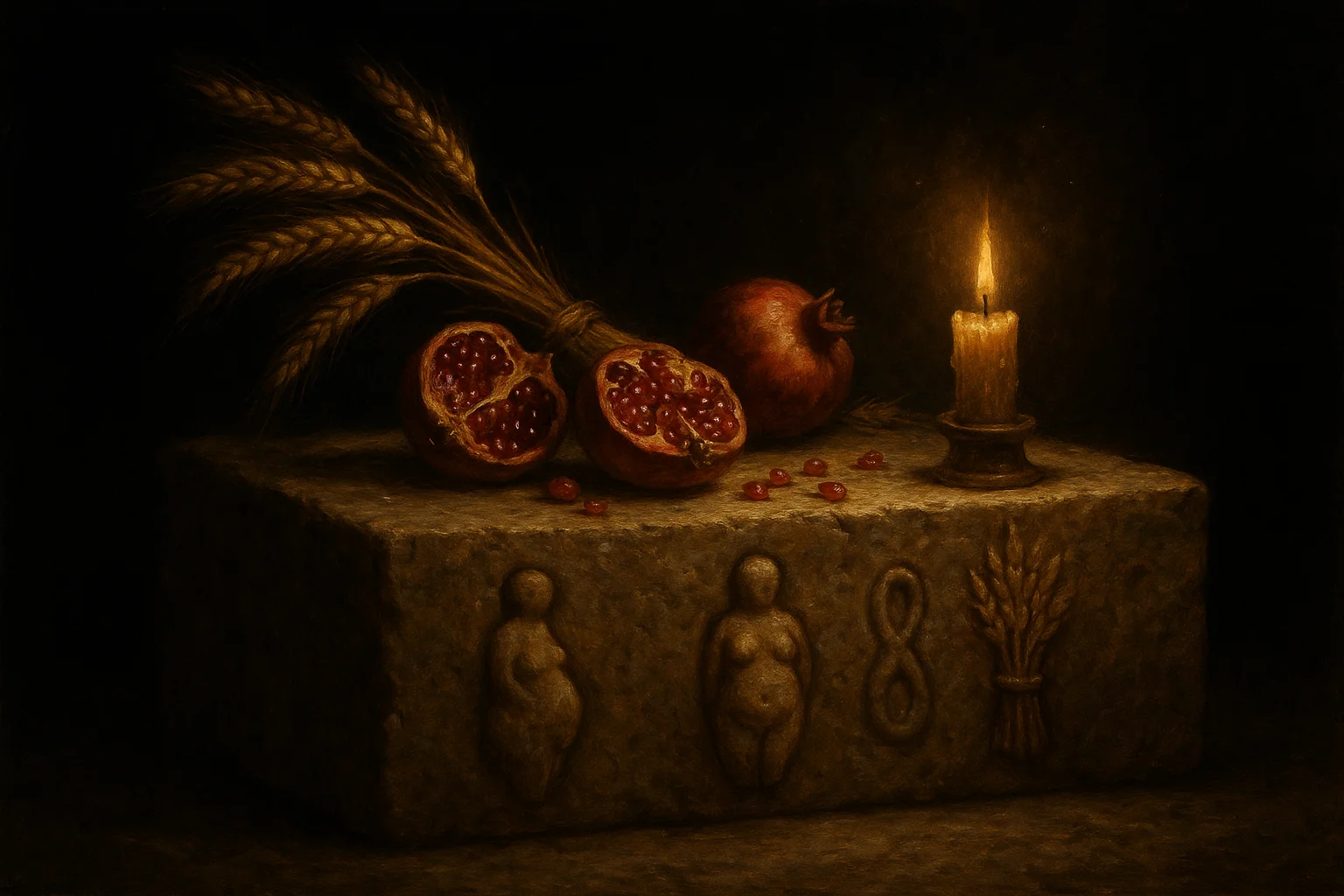
Mother Goddesses Across Cultures
From Gaia to Coatlicue, mother goddesses embody creation, fertility, and sovereignty. A comparative study grounded in primary sources.
Contents
Mother goddesses across cultures encompass a diverse range of divine figures including primordial creators who birth the cosmos, fertility deities who govern agriculture and reproduction, ancestral protectors who safeguard lineages, and earth personifications who embody the physical world. The category is not uniform: Gaia generates the Greek pantheon from her own substance, while Demeter governs grain cycles without cosmogonic function. Modern scholarship has often conflated these distinct roles, projecting a single archetype onto figures whose primary texts describe radically different powers and purposes.
The term "mother goddess" carries more ambiguity than most comparative categories. Some figures mother the gods themselves. Others mother humanity, or crops, or specific royal lines. A few do all three, while others fit the label only because nineteenth-century interpreters needed them to.
What Makes a Mother Goddess
Creator versus Nurturer
The distinction matters. A goddess who births the world operates differently from one who ensures the barley grows. Gaia in Hesiod's Theogony 116-138 emerges after Chaos and immediately produces Ouranos, the sky, from herself alone, without sexual union. She is origin, not caretaker. Her motherhood is cosmogonic: the gods and Titans descend from her substance. Demeter, by contrast, governs the grain cycle and mourns her daughter in the Homeric Hymn to Demeter, but she does not create the earth or its first inhabitants. Both are mothers. Neither is interchangeable.
Fertility goddesses manage what already exists. They ripen crops, ease childbirth, ensure livestock breed. Creator-mothers generate existence itself. The two roles sometimes overlap in a single figure, but the primary texts usually clarify which function takes precedence. When they do not, later tradition often blurs them.
The Problem of Projection
Nineteenth and early twentieth-century scholarship, influenced by Frazer and the myth-and-ritual school, sought a universal Great Mother behind all female deities. The evidence rarely cooperated. Many goddesses labeled "mother" in modern summaries bear no maternal epithet in their own cultures. Others are called mother in a political or metaphorical sense: Athena is sometimes "mother of Athens" without bearing children. Isis becomes "mother of the king" as a function of her role as the throne itself, a point Plutarch notes in De Iside et Osiride when he explains her name derives from the word for seat.
The problem is not that mother goddesses do not exist. The problem is assuming they all mean the same thing.
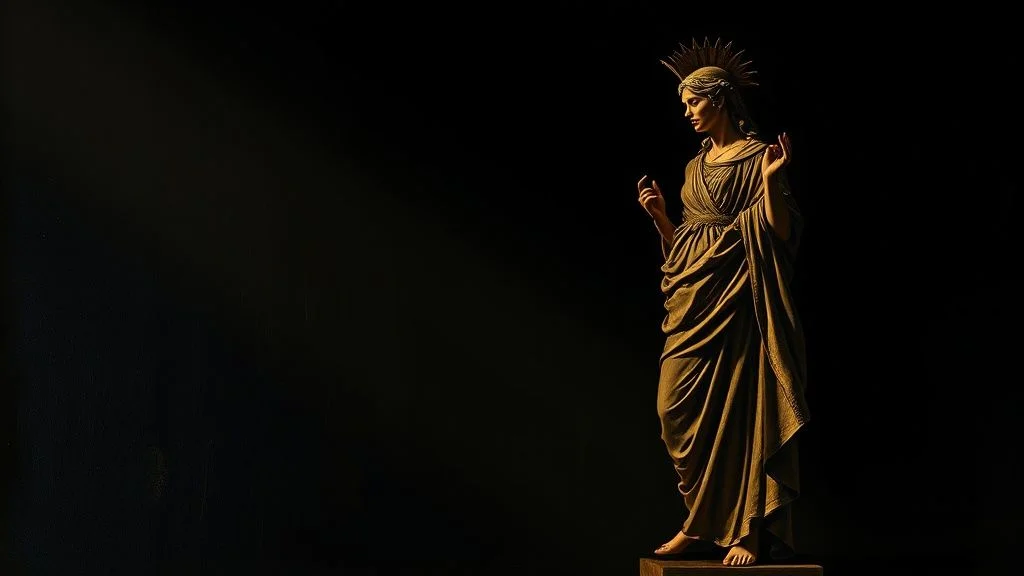
Greek and Roman Traditions
Gaia: Earth as Origin
Hesiod's Theogony places Gaia third in the order of being, after Chaos and before Eros. She is "wide-bosomed," a phrase that emphasizes capacity rather than tenderness. She generates Ouranos, the Ourea (mountains), and Pontos (sea) by herself. Then she mates with Ouranos and produces the twelve Titans, the Cyclopes, and the Hundred-Handers. When Ouranos imprisons her children back inside her body, she forges a sickle and persuades her son Kronos to castrate his father. The blood from that wound, falling on Gaia, produces the Erinyes, the Giants, and the Meliae nymphs.
She is not gentle. She is generative and ruthless, the foundation of the cosmos and the instigator of its first war. Her motherhood is geological and political, not affectionate. Later creation myths across the Mediterranean borrow her structure: a primal female figure whose body becomes the material of the world.
Rhea and Demeter: Continuity and Grain
Rhea, daughter of Gaia, continues the maternal line but with a shift in function. She bears the Olympian gods to Kronos, then saves Zeus from being swallowed by substituting a stone. Hesiod's Theogony 453-506 describes her as protector of divine succession, not cosmic origin. She ensures continuity, not creation.
Demeter governs grain and the seasons. The Homeric Hymn to Demeter recounts her search for Persephone and her withdrawal of fertility from the earth in grief. Her motherhood is relational and cyclical: she mourns, withholds, negotiates, restores. She does not birth the earth. She makes it fertile or barren depending on her emotional state. The hymn treats her as a force of agricultural order, not cosmogonic origin. Roman Ceres inherits this role without alteration.
Ancient Near East and Egypt
Tiamat: Primordial Chaos
The Babylonian Enuma Elish, Tablet I, opens with Tiamat and Apsu, salt water and fresh water, mingling to produce the first gods. Tiamat is the primordial ocean, not a personified earth. When the younger gods disturb Apsu with their noise, he plots their destruction. Tiamat initially resists, but after Apsu's death she becomes the antagonist, birthing monsters to avenge him. Marduk kills her, splits her body, and fashions the heavens and earth from her corpse.
"He split her like a shellfish into two parts: half of her he set up and ceiled it as sky." Enuma Elish, Tablet IV
Her motherhood is violent and involuntary in its final form. She generates gods willingly, then monsters as weapons, then becomes raw material for creation myths that require her death. She is origin and obstacle, mother and victim. The text does not sentimentalize her.
Isis: Throne and Resurrection
Isis in Egyptian tradition is not a creator goddess. She is the sister-wife of Osiris, mother of Horus, and the embodiment of the throne. Plutarch's De Iside et Osiride explains that her name means "seat" and that she represents the legitimacy of kingship. She reassembles Osiris after Set dismembers him, uses magic to conceive Horus, and protects her son through his childhood. Her motherhood is active and political: she ensures succession and continuity.
Later Hellenistic and Roman texts expand her role into a universal mother figure, but the earlier Egyptian sources treat her as protector of the royal line and guarantor of resurrection. She shares some functional overlap with dying-and-rising gods through her role in Osiris's return, but she herself does not die and return. She is the agent of resurrection, not its subject.
Hindu Traditions
Prithvi: The Earth Herself
Prithvi, the earth goddess in Vedic tradition, appears in the Rigveda 5.84 as the consort of Dyaus, the sky. Together they form a cosmic pair, mother earth and father sky, who generate life between them. She is invoked for stability, nourishment, and support. The hymns address her as broad, patient, and sustaining, but not as a cosmogonic origin in the same sense as Gaia. She is the surface on which life occurs, not the substance from which gods emerge.
Her role is ecological rather than genealogical. She bears plants, animals, and humans, but the texts do not trace the lineage of the gods back to her body. She is mother in the sense of provider and ground, not progenitor of divine hierarchy.
Devi and Her Forms
The Devi Mahatmya, composed around the sixth century CE, presents Devi as the supreme power who manifests in multiple forms: Durga the warrior, Lakshmi the prosperous, Sarasvati the learned, and Kali the destroyer. She is called the mother of the universe, but her motherhood is abstract and ontological. She does not bear children in narrative time. She is the Shakti, the active principle that animates all existence, including the male gods who depend on her power to act.
Gaia (Greek)
Births gods through physical generation; her body becomes the material of mountains, sea, and Titans. Motherhood is genealogical and cosmogonic.
Devi (Hindu)
Manifests as the power behind all creation; does not bear gods as offspring but enables their existence. Motherhood is ontological and non-narrative.
The distinction is philosophical. Devi is mother because nothing exists without her energy, not because she literally gestates the cosmos. The Devi Mahatmya describes her as prior to and beyond form, which makes her maternal role fundamentally different from the embodied mothers of Greek or Mesopotamian tradition.
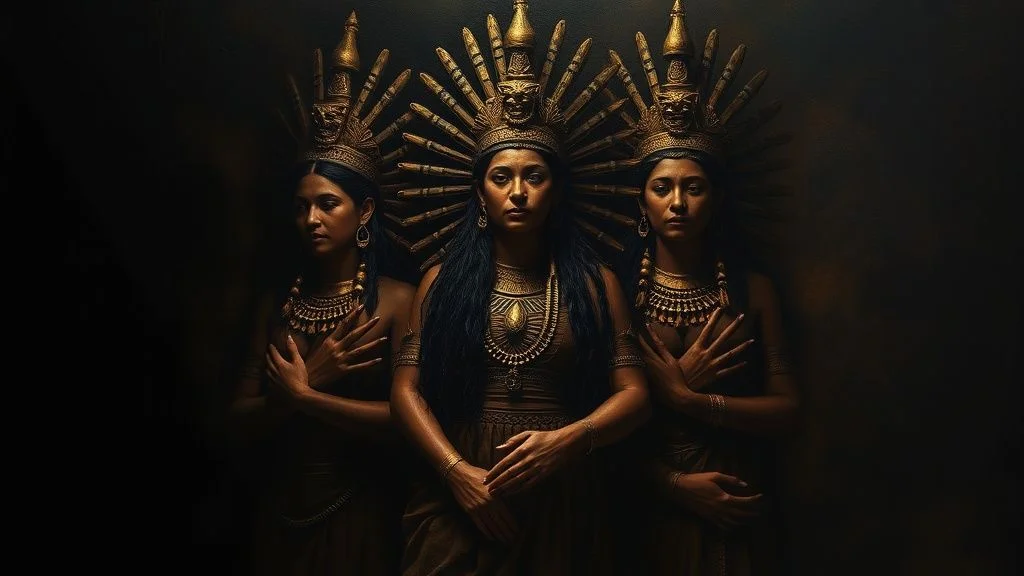
Mesoamerican Mothers
Coatlicue: Serpent Skirt and Sacrifice
Coatlicue, the Aztec earth goddess, wears a skirt of serpents and a necklace of human hearts and hands. The Florentine Codex, Book 3, recounts that she conceived Huitzilopochtli, the sun and war god, when a ball of feathers fell into her garment while she was sweeping. Her existing children, led by the moon goddess Coyolxauhqui, attempted to kill her for the perceived disgrace. Huitzilopochtli emerged fully armed and dismembered his sister, casting her head into the sky to become the moon.
Coatlicue is both life-giver and devourer. Aztec cosmology treats the earth as a mouth that consumes the dead and births new life from their remains. She is not nurturing in any sentimental sense. She is the cycle itself: generation, sacrifice, consumption, renewal. Her motherhood is inseparable from death, a pattern that recurs in Mesoamerican thought and distinguishes these traditions from Mediterranean models.
Ixchel: Moon and Midwifery
Ixchel, the Maya moon goddess, governs childbirth, weaving, and medicine. She is associated with water, fertility, and the lunar cycle. The Popol Vuh, Part I, does not feature her prominently, but colonial-era sources and iconography depict her as an aged midwife or a young woman with a rabbit, the Maya symbol of the moon. She is a mother in the practical sense: she assists births, not cosmogonies.
Her role is technical rather than mythic. She ensures safe delivery and the continuation of lineages, which makes her maternal function social and biological rather than cosmic. She is invoked by women in labor, not by priests reciting creation myths.
Norse and Celtic Figures
Norse tradition offers no single mother goddess equivalent to Gaia or Tiamat. Jord, the earth, is the mother of Thor by Odin, but she plays no active role in the Prose Edda's Gylfaginning. Frigg, Odin's wife, is the mother of Baldr and a figure of foreknowledge, but she does not create or govern the earth. The Vanir goddess Freyja is associated with fertility, but her primary roles are war, magic, and sexual sovereignty, not motherhood.
The Norse cosmos in Gylfaginning emerges from the body of Ymir, a male giant, not a mother goddess. The cow Audhumla licks Buri, the first god, from the ice. Maternal imagery appears, but it is fragmented and non-central. The cosmogonic role belongs to Odin and his brothers, who kill Ymir and shape the world from his corpse, a pattern closer to Marduk and Tiamat than to Gaia's self-generation.
Celtic sources are even more fragmented. The Morrigan is a war goddess associated with sovereignty and fate, sometimes called a mother of gods in later interpretations, but the surviving Irish texts do not emphasize her maternal role. Danu, named as the mother of the Tuatha Dé Danann, appears only in genealogies, not in narrative. The evidence is thin, and much of what is called Celtic mother goddess tradition comes from Roman-era interpretations of local deities, not from pre-Christian Irish or Welsh sources.
Both traditions resist the mother goddess category more than they confirm it. The figures exist, but they do not dominate cosmogony or myth in the way Gaia, Tiamat, or Coatlicue do. This absence is itself informative. Not every mythology places a mother at the origin.
Patterns and Departures
Several patterns emerge across the traditions surveyed. First, creator-mothers tend to be primordial: they exist at or near the beginning of time and generate the next tier of gods from their own substance. Gaia, Tiamat, and Coatlicue all fit this model. Second, fertility and agricultural goddesses govern cycles, not origins. Demeter, Isis, and Ixchel ensure continuity, not cosmogony. Third, maternal benevolence is not universal. Coatlicue devours, Tiamat births monsters, Gaia plots patricide. The category "mother" does not imply gentleness.
- Primordial mothers generate gods and cosmos from their bodies
- Fertility mothers govern agriculture, childbirth, and seasonal renewal
- Ancestral mothers protect lineages and ensure legitimate succession
- Some figures combine roles; others occupy only one
- Modern scholarship has often conflated these distinct functions into a single archetype
The departures are equally telling. Norse and Celtic traditions do not center maternal figures in cosmogony. Hindu Devi is ontologically maternal but not narratively so. Isis is political and magical, not cosmogonic. The category breaks down under scrutiny, which does not mean it is useless. It means the label must be applied with precision, and the sources must be allowed to speak for themselves.
Comparative mythology benefits from recognizing both pattern and exception. The mother goddess exists as a cross-cultural type, but only when the term is defined carefully and applied to figures whose primary sources actually describe maternal functions. Lumping all female deities into the category flattens the evidence and obscures the distinct roles these figures play in their own traditions. Gaia is not Demeter. Tiamat is not Isis. Coatlicue is not Ixchel. Each deserves to be read on her own terms, in her own texts, without the burden of representing all divine femininity.
The comparative method works best when it clarifies difference as much as similarity. Mother goddesses across cultures share some structural features, but they diverge in function, temperament, and theological importance. Some create. Some nourish. Some destroy. Some do all three. The task is not to reduce them to a single archetype but to understand what "mother" means in each tradition and why those meanings matter.
Frequently asked questions
What defines a mother goddess in mythology?
A mother goddess is defined by her role in generating, nurturing, or protecting life, whether cosmic, agricultural, or genealogical, and the specific function varies widely across traditions. Some, like Gaia and Tiamat, birth the cosmos and gods from their own substance, making them cosmogonic creators. Others, like Demeter and Isis, govern fertility cycles, ensure agricultural abundance, or protect royal lineages without creating the world itself. The term is not uniform and must be applied with attention to what each culture's primary texts actually describe, not to modern assumptions about universal feminine archetypes.
Are all mother goddesses benevolent protectors?
Mother goddesses are not universally benevolent; many combine nurturing and destructive functions, and some are explicitly violent or vengeful in their primary sources. Coatlicue devours the dead to generate new life, Tiamat births monsters to destroy the younger gods, and Gaia orchestrates the castration of her consort Ouranos. The association of motherhood with gentleness is a modern projection, not a feature of ancient texts. Many mother goddesses embody the full cycle of life and death, creation and consumption, without moral softening.
How do creation goddesses differ from fertility goddesses?
Creation goddesses generate the cosmos, gods, or fundamental elements of existence from their own substance, often at the beginning of time, while fertility goddesses govern ongoing cycles of agriculture, childbirth, and seasonal renewal without cosmogonic origin roles. Gaia births the Titans and the earth itself in Hesiod's Theogony, making her a creator. Demeter, by contrast, controls the grain cycle and causes famine or abundance depending on her emotional state in the Homeric Hymn to Demeter, but she does not create the earth. Some figures, like Devi in Hindu tradition, combine both roles, but the distinction is usually clear in the primary texts.
Which primary texts describe mother goddesses?
Primary texts describing mother goddesses include Hesiod's Theogony for Gaia and Rhea, the Homeric Hymn to Demeter for Demeter, the Babylonian Enuma Elish for Tiamat, Plutarch's De Iside et Osiride for Isis, the Rigveda for Prithvi, the Devi Mahatmya for Devi, the Florentine Codex for Coatlicue, and the Prose Edda's Gylfaginning for Norse figures like Jord and Frigg. These sources vary in genre, date, and theological purpose, and they describe maternal roles with significant differences in function and emphasis. Reading them directly reveals the diversity that modern summaries often obscure.
Has modern scholarship misread ancient mother goddess figures?
Modern scholarship, particularly in the nineteenth and early twentieth centuries, often projected a universal Great Mother archetype onto diverse goddesses whose primary texts describe distinct and sometimes incompatible roles. Influenced by Frazer and the myth-and-ritual school, scholars sought a single maternal figure behind all female deities, but the evidence rarely supported this. Many goddesses labeled "mother" in modern works bear no maternal epithet in their own cultures, and others are called mother in metaphorical or political senses unrelated to biological generation. Recent scholarship has moved toward more precise, source-based analysis that respects the differences between traditions.
What role do mother goddesses play in cosmogony versus agriculture?
Mother goddesses in cosmogony generate the fundamental structure of the universe, including gods, earth, sky, and primordial elements, often from their own bodies, while those in agriculture govern the fertility of crops, livestock, and human reproduction within an already-existing world. Gaia and Tiamat are cosmogonic: their bodies become the material of creation. Demeter and Ixchel are agricultural: they ensure harvests and safe childbirth but do not create the cosmos. Some figures, like Coatlicue, bridge both roles by embodying the earth as both origin and ongoing cycle. The distinction clarifies whether a goddess is invoked for cosmic origins or for practical survival.
Further reading on Mythologis
Read the full book
Want the whole story?
The complete edition is an instant PDF download here, with a paperback on Amazon for selected titles.
Mythology
The World Mythology Book: The Gods, Heroes and Myths of Every Culture
The Gods, Heroes and Myths of Every Culture, in One Volume
The whole of world mythology in a single volume: Greek, Norse, Egyptian, Japanese, Hindu, Celtic, Slavic, Mesoamerican and African myths gathered side by side, each drawn from the primary sources.