
Underworld Journeys: Descents to the Land of the Dead
Katabasis across cultures: Greek, Norse, Mesopotamian, and Mesoamerican descents to the land of the dead. Primary sources, motifs, and what the living sought.
Contents
Underworld journeys, known in Greek as katabasis, are mythological narratives in which a living hero or deity descends to the realm of the dead and returns, crossing a boundary ordinarily reserved for the deceased. These stories appear across cultures, from Mesopotamia to Mesoamerica, and share recurring motifs: the threshold guardian, the psychopomp guide, and the prohibition that tests the traveler. The descent serves purposes ranging from retrieving the dead to consulting prophetic shades, and the return marks the hero as transformed by knowledge unavailable to ordinary mortals.
The pattern recurs with such regularity that scholars recognize it as a distinct narrative type within the hero's journey. Yet each tradition inflects the descent differently, revealing what a culture believes about death, knowledge, and the permeability of cosmic boundaries. The Greek Orpheus seeks his wife; the Sumerian Inanna submits to her sister's laws; the Maya Hero Twins play ball with death itself.
What Is a Katabasis?
The term katabasis derives from Greek kata (down) and bainein (to go), and it denotes a descent to the underworld by someone still alive. The journey is temporary. The traveler crosses a boundary that separates the living from the dead, enters a space governed by different laws, and must negotiate passage back. Unlike dying-and-rising gods, who undergo death and rebirth as part of seasonal or cosmic cycles, the katabatic hero remains mortal throughout.
The motif appears in oral and written traditions across continents. Scholars including Mircea Eliade have noted that the descent often functions as an initiation, a symbolic death that grants the hero knowledge or authority unavailable on the surface. The underworld is not merely a place of punishment or reward; it is a repository of truth, memory, and prophecy.
The Greek Descents: Orpheus, Heracles, and Odysseus
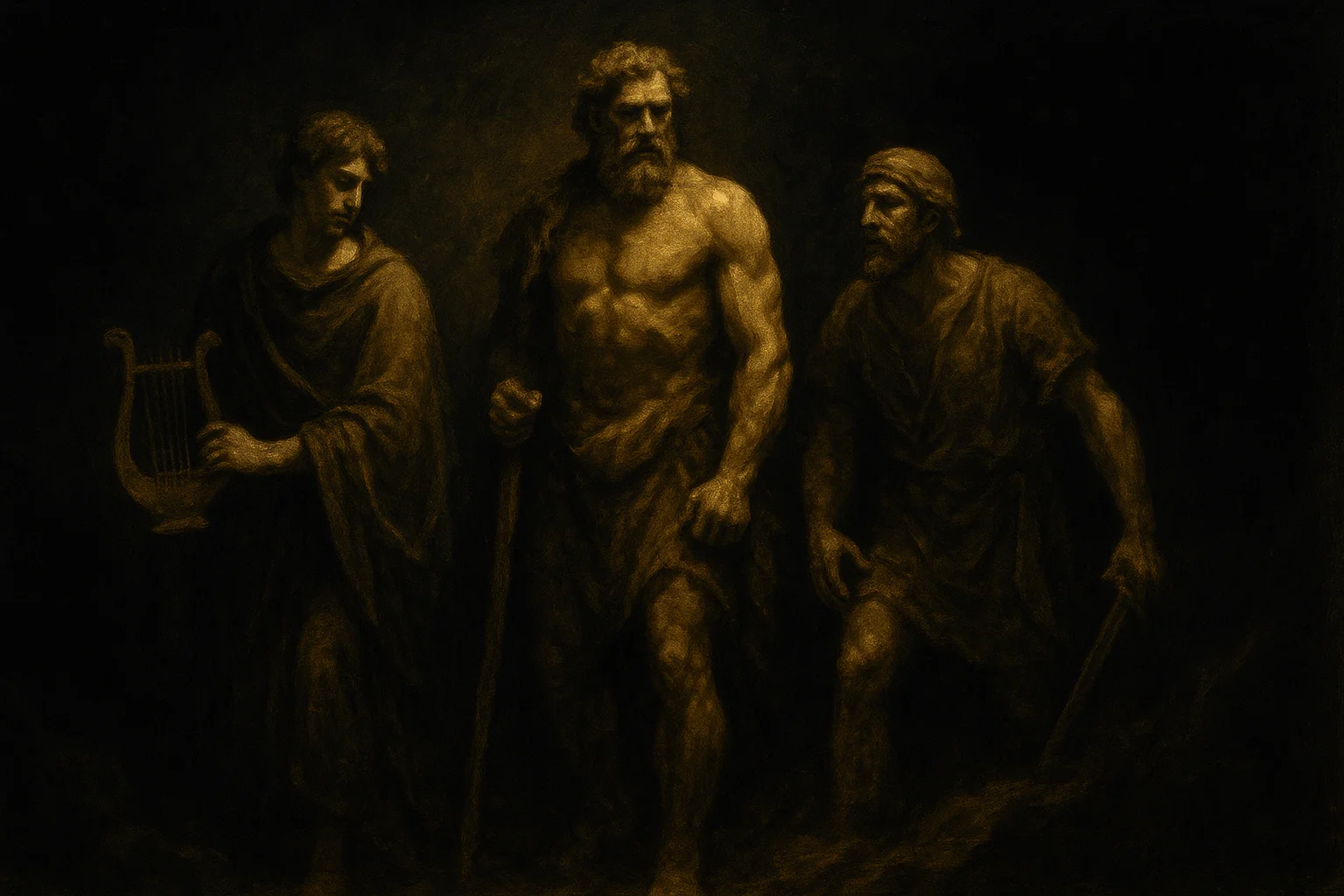
Greek myth preserves multiple katabasis narratives, each with distinct motives and outcomes. The three most prominent descents belong to Orpheus, Heracles, and Odysseus, and together they illustrate the range of reasons a mortal might risk the journey.
Orpheus and the Limits of Love
Orpheus, the Thracian poet whose lyre could charm stones, descends to retrieve his wife Eurydice after her death by snakebite. Ovid recounts the episode in Metamorphoses Book 10: Orpheus charms Persephone and Hades with his song, and the gods of the dead agree to release Eurydice on one condition. He must not look back at her until both have reached the upper world.
"He took the path that rises back to the world above, she following behind him, for Hades had imposed this condition. And now they had almost reached the threshold of the upper world, when he, fearing she might fail and eager to see her, turned his eyes. Instantly she slipped back." Ovid, Metamorphoses 10.55-59
The backward glance is the pivot. Orpheus loses Eurydice a second time, and this loss is final. The story encodes a prohibition common to many katabasis tales: the traveler must obey a rule that seems arbitrary but tests trust, patience, or submission to divine authority.
Heracles and the Twelfth Labour
Heracles descends to capture Cerberus, the three-headed hound guarding the gates of Hades, as the twelfth and final labour imposed by King Eurystheus. Apollodorus records in Library 2.5.12 that Heracles is initiated into the Eleusinian Mysteries before the descent, a detail suggesting that ritual preparation was considered necessary for those who would cross the threshold alive.
Heracles wrestles Cerberus into submission without weapons, a feat that demonstrates physical supremacy over death's guardian. Hades permits the capture on condition that Heracles return the hound unharmed. The labour is not about retrieval or consultation but proof: Heracles must demonstrate mastery over the boundary itself.
Odysseus Consults the Shades
In Odyssey Book 11, Odysseus sails to the edge of the world and performs a blood sacrifice to summon the shades of the dead. He does not fully enter Hades; instead, the dead come to him, drawn by the blood that temporarily restores their consciousness. The prophet Tiresias instructs Odysseus on how to reach Ithaca, and Odysseus speaks with his mother, fallen comrades, and famous women of old.
This is a katabasis of consultation. Odysseus seeks knowledge unavailable among the living, and the underworld functions as an archive of memory and prophecy. The dead retain what they knew in life, and some, like Tiresias, possess foresight that transcends mortal limits.
Mesopotamian Journeys: Inanna and Gilgamesh
Mesopotamian literature preserves two major underworld journeys, both predating the Greek texts by more than a millennium. The motifs differ in emphasis, but the threshold, the guide, and the return remain central.
Inanna's Descent to the Seven Gates
Inanna, the Sumerian goddess of love and war, descends to the underworld ruled by her sister Ereshkigal. The text known as The Descent of Inanna, preserved on cuneiform tablets from the early second millennium BCE, describes how Inanna passes through seven gates, surrendering a piece of her regalia at each threshold until she stands naked and powerless before Ereshkigal.
Ereshkigal kills Inanna and hangs her corpse on a hook. Three days later, Inanna's minister Ninshubur appeals to the gods, and Enki fashions two beings who descend to retrieve her. They restore Inanna with the food and water of life, but the underworld demands a substitute. Inanna returns to find her consort Dumuzi seated on her throne, and she sends him below in her place.
The narrative shares structural elements with dying-and-rising gods, but Inanna's descent is voluntary and her return conditional. The story encodes themes of cosmic balance: the underworld cannot be cheated, and every return requires an exchange.
Gilgamesh and the Search for Utnapishtim
Gilgamesh, king of Uruk, journeys to the edge of the world to find Utnapishtim, the sole human granted immortality after surviving the flood. The journey in Tablets 9 and 10 of The Epic of Gilgamesh takes him through the mountain guarded by scorpion-beings, across the waters of death, and into the presence of Utnapishtim, who tells him that immortality is not for mortals.
Gilgamesh's descent is not to the underworld proper but to a liminal space where the boundaries of life and death blur. He seeks knowledge of eternal life, and what he learns is that death is inevitable. The journey transforms him from a king obsessed with immortality into one who accepts mortality and returns to build enduring works.
Norse Hel and the Living Who Enter
The Norse underworld Hel is presided over by a goddess of the same name, daughter of Loki. The Prose Edda, compiled by Snorri Sturluson in the thirteenth century, records one major katabasis: Hermóðr's ride to retrieve Baldr after the god's death.
In Gylfaginning 49, Hermóðr rides Odin's eight-legged horse Sleipnir for nine nights through dark valleys until he reaches the river Gjöll, crossed by a bridge thatched with gold. The guardian Móðguðr questions him, and Hermóðr explains his mission. He finds Baldr seated in the place of honour, and Hel agrees to release him if all things in the world weep for him.
The condition is not met. One giantess, Þökk, refuses to weep, and Baldr remains in Hel until Ragnarök. The story shares the conditional-release motif with Orpheus, and it underscores a Norse cosmological principle: even the gods cannot reverse fate. The descent fails not because the hero errs but because the cosmos will not bend.
Norse cosmology also features world trees and vertical geography that structure access to different realms, including Hel, which lies beneath one of Yggdrasil's roots.
Mesoamerican Xibalba: The Hero Twins and the Lords of Death
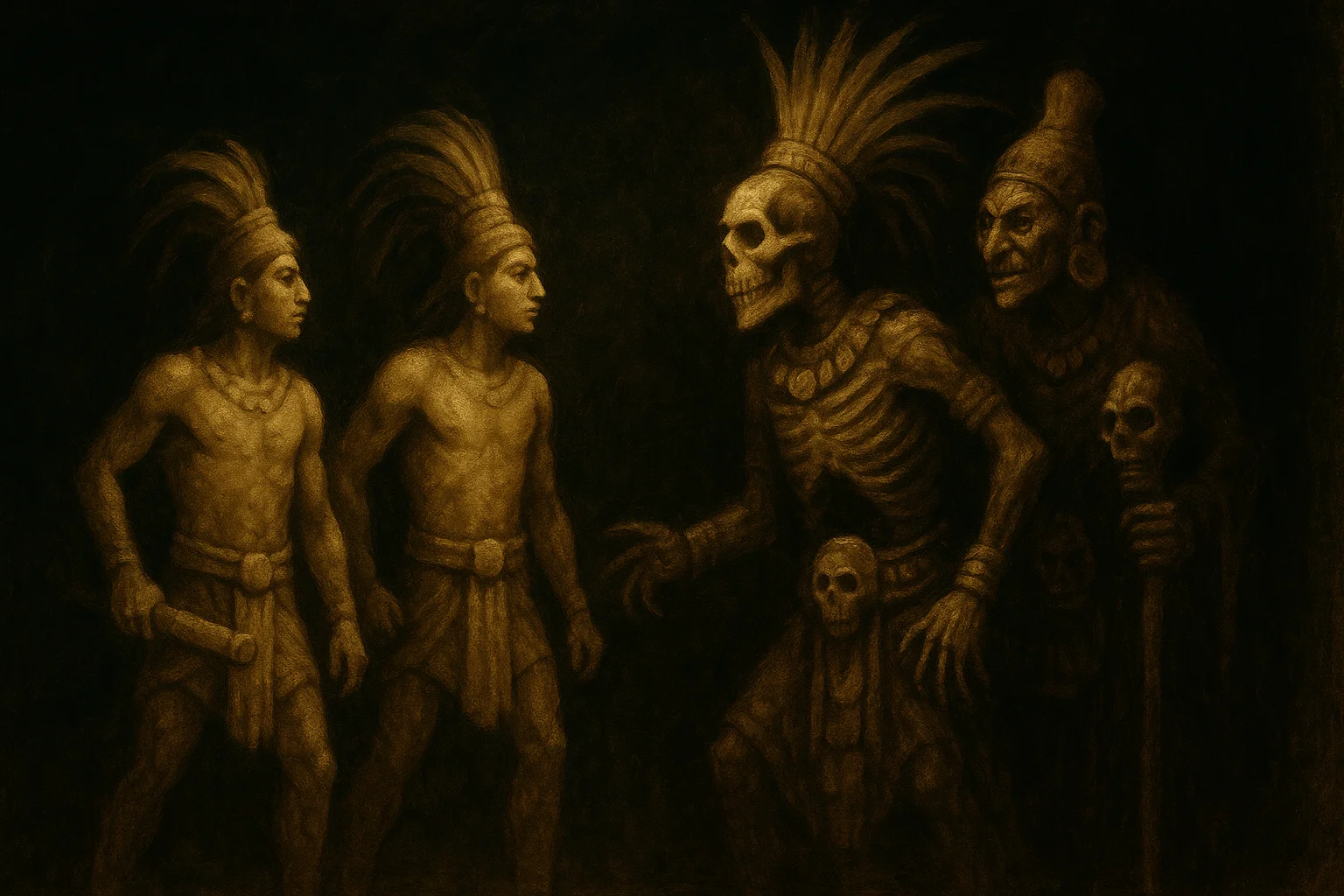
The Popol Vuh, the creation narrative of the K'iche' Maya compiled in the sixteenth century from older oral traditions, recounts the descent of the Hero Twins, Hunahpu and Xbalanque, into Xibalba, the underworld ruled by the Lords of Death.
The twins are summoned to Xibalba to play the Mesoamerican ballgame after their father and uncle were killed there. Part III of the Popol Vuh describes a series of trials in houses of jaguars, fire, blades, cold, and bats. The twins outwit the lords at every turn, and when Hunahpu is decapitated during the ballgame, Xbalanque replaces his head with a squash and later restores the original.
The twins eventually allow themselves to be burned and ground into powder, which is thrown into a river. They resurrect as fish-men, perform miracles, and trick the lords into requesting their own deaths. The twins kill the lords and do not resurrect them, breaking the power of Xibalba.
This katabasis is unique in its emphasis on trickery and cosmic reordering. The twins do not seek knowledge or retrieve the dead; they defeat death itself, at least temporarily, and their victory enables the creation of the current world. The narrative shares thematic ground with trickster gods, who disrupt and remake cosmic order.
Greek Orpheus
Descends for love, fails due to backward glance, returns alone and mourns.
Maya Hero Twins
Descend to avenge and outwit death, succeed through trickery, transform the cosmos.
Shared Motifs: Threshold, Guide, and Return
Despite differences in theology and narrative outcome, underworld journeys share structural elements that recur across cultures. These motifs suggest common human concerns about death, boundaries, and the limits of mortal agency.
The Threshold and Its Guardian
Every katabasis involves crossing a boundary, often marked by a river, gate, or bridge. The Greek Styx, the Norse Gjöll, the seven gates of Inanna's descent: each threshold is guarded by a figure who questions or challenges the traveler. Charon ferries the dead across the Styx but demands payment. Móðguðr guards the bridge to Hel. The gatekeeper of each of Inanna's seven gates strips her of power.
The threshold is not merely geographical. It represents the separation between life and death, and crossing it requires negotiation, payment, or submission. The guardian enforces the rules of passage and ensures that the living do not enter lightly.
The Guide or Psychopomp
Many descents involve a psychopomp, a guide who conducts souls or instructs the living traveler. Hermes plays this role in Greek myth, leading souls to the underworld and sometimes assisting heroes. The Sibyl guides Aeneas through the underworld in Virgil's Aeneid. Gilgamesh is ferried by Urshanabi across the waters of death.
The guide possesses knowledge of the underworld's geography and laws. Without this knowledge, the traveler risks becoming trapped. The psychopomp is a mediator, someone who exists between worlds and can move freely where mortals cannot.
The Prohibition and the Backward Glance
The broken taboo is a recurring motif. Orpheus looks back. Lot's wife looks back at Sodom in the Hebrew Bible and turns to salt. Izanagi lights a torch in the underworld and sees his wife Izanami's decayed body, breaking the prohibition and fleeing in horror, as recorded in the Kojiki.
The prohibition tests obedience and trust. It also serves a narrative function: the failure to obey creates tragedy and reinforces the boundary between life and death. The backward glance is a moment of doubt, and doubt is incompatible with the absolute conditions the underworld imposes.
Why the Living Descend
The motives for descent vary, but they cluster around a few recurring themes. Love drives Orpheus. Duty compels Heracles. Knowledge draws Odysseus and Gilgamesh. Cosmic necessity sends Inanna and the Hero Twins.
In each case, the descent is a test. The hero must prove worthy, either by strength, cunning, obedience, or sacrifice. The underworld is a place of revelation, where truths hidden from the living become visible. Tiresias tells Odysseus his fate. Utnapishtim tells Gilgamesh that immortality is beyond reach. Anchises shows Aeneas the future of Rome.
The return is as important as the descent. The hero brings back knowledge, proof, or transformation. Even when the mission fails, as with Orpheus, the journey changes the traveler. The katabasis marks the hero as someone who has crossed the ultimate boundary and returned, a feat that grants authority and separates the hero from ordinary mortals.
These narratives also intersect with broader mythological themes, including creation myths that describe cosmic ordering, apocalypse narratives that imagine the world's end, and mother goddesses like Demeter, whose grief over Persephone's descent to Hades explains the seasons in the Homeric Hymn to Demeter.
Frequently asked questions
What is a katabasis in mythology?
A katabasis is a narrative in which a living hero or deity descends to the underworld, crosses the boundary separating life from death, and returns to the world of the living, often transformed by the journey or bearing knowledge unavailable to ordinary mortals. The term comes from Greek and appears in myths across cultures, including Mesopotamian, Norse, and Mesoamerican traditions. The descent typically involves threshold guardians, psychopomp guides, and prohibitions that test the traveler's obedience or resolve.
Which heroes descended to the underworld in Greek myth?
The most prominent Greek heroes who descended to the underworld are Orpheus, who sought to retrieve his wife Eurydice; Heracles, who captured Cerberus as his twelfth labour; and Odysseus, who consulted the prophet Tiresias and the shades of the dead in Odyssey Book 11. Theseus and Pirithous also descended, intending to abduct Persephone, but they were trapped until Heracles freed Theseus. Aeneas, in Virgil's Aeneid, descends to meet his father Anchises and learn Rome's destiny.
How does Inanna's descent differ from Greek underworld journeys?
Inanna's descent to the Sumerian underworld involves a goddess, not a mortal hero, and she is stripped of her power at seven gates before being killed by her sister Ereshkigal, then resurrected three days later with divine intervention. Unlike Greek heroes who descend for specific goals and return largely unchanged in status, Inanna's journey requires a substitute, and her consort Dumuzi takes her place in the underworld. The narrative emphasizes cosmic balance and the inevitability of exchange, themes less prominent in Greek katabasis stories.
What role does the guide or psychopomp play in underworld journeys?
The psychopomp is a guide who conducts souls to the underworld or assists living travelers in navigating its geography and laws, ensuring safe passage across boundaries that mortals cannot cross alone. In Greek myth, Hermes serves this role; the Sibyl guides Aeneas; Urshanabi ferries Gilgamesh across the waters of death. The guide possesses knowledge of the underworld's rules and often mediates between the living traveler and the gods or guardians of the dead, making the journey possible.
Why do mythological heroes journey to the land of the dead?
Heroes descend to the underworld for love, as Orpheus does to retrieve Eurydice; for knowledge, as Odysseus consults Tiresias and Gilgamesh seeks Utnapishtim; for proof of prowess, as Heracles captures Cerberus; or for cosmic necessity, as Inanna submits to underworld law and the Hero Twins defeat the Lords of Death. The journey tests the hero and often grants transformation, authority, or revelation unavailable in the world of the living. Even failed descents, like Orpheus's, mark the hero as exceptional.
What are the common motifs in underworld descent narratives?
Common motifs include the threshold, often a river, gate, or bridge guarded by a figure who challenges the traveler; the psychopomp guide who knows the underworld's geography and laws; and the prohibition or taboo, such as the backward glance, that tests obedience and often causes failure. The descent involves crossing a boundary between life and death, and the return requires negotiation, sacrifice, or divine permission. These motifs recur across Greek, Mesopotamian, Norse, and Mesoamerican traditions.
Further reading on Mythologis
Read the full book
Want the whole story?
The complete edition is an instant PDF download here, with a paperback on Amazon for selected titles.
Mythology
The World Mythology Book: The Gods, Heroes and Myths of Every Culture
The Gods, Heroes and Myths of Every Culture, in One Volume
The whole of world mythology in a single volume: Greek, Norse, Egyptian, Japanese, Hindu, Celtic, Slavic, Mesoamerican and African myths gathered side by side, each drawn from the primary sources.