
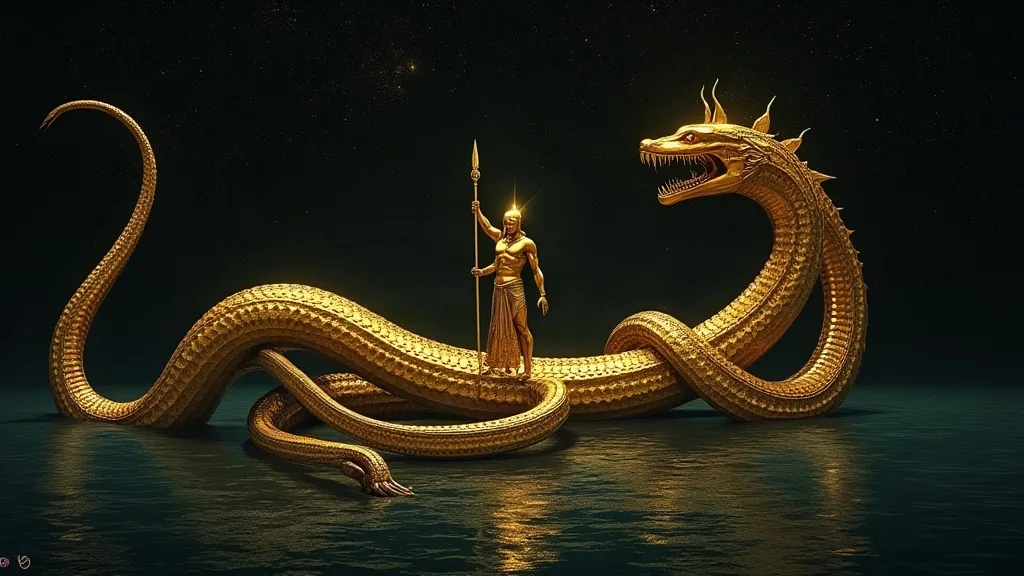
Apophis: The Serpent of Chaos in Egyptian Mythology
Apophis, the immense serpent of chaos, embodied all that threatened cosmic order in ancient Egypt. Discover the myth, the nightly battles with Ra, and the eternal struggle between creation and destruction.
Contents
The sky darkens. A ship moves across the void, carrying the sun god inside. Then something stirs in the underworld. A coil. A hiss. A serpent so vast it wraps around the universe itself begins to move toward its prey. This is Apophis, and every night in Egyptian belief, the war between light and the abyss begins again.
Apophis (also spelled Apep or Aapep in Egyptian texts) was not merely a monster in the Egyptian pantheon. He was the principle of chaos itself, the anti-god, the force that had no desire to be worshipped and no place in the cosmic order. Where Ra, the sun god, represented creation, renewal, and divine law, Apophis embodied the void that pressed against reality from all sides.
The serpent's story is one of eternal recurrence: he could never be killed for good, only defeated again and again, night after night, for all time. The Egyptians did not imagine a final victory over chaos. Instead, they believed in perpetual struggle, in the daily renewal of the world through divine combat. Without Apophis, there would be no story. Without the battle, creation would be meaningless.
Origins and Nature of Apophis
The Egyptians had no single creation myth. The Pyramid Texts, inscriptions carved inside royal tombs from around 2400 BC, offer one strand of the story. Another thread runs through the Book of Coming Forth by Day, often called the Book of the Dead, composed over centuries and compiled in the New Kingdom (1550-1070 BC). In these sources, Apophis emerges as a dark counterpoint to creation itself.
According to some accounts, Apophis was born from the sweat or spittle of Neith, the mother goddess. Other versions say he simply was, that he represented the primordial chaos (nun, the watery nothingness) that existed before the world took shape. Unlike most Egyptian gods, who had temples, priests, and offerings, Apophis received no prayers. People spoke spells against him, not to him. He existed outside the cosmic order entirely.
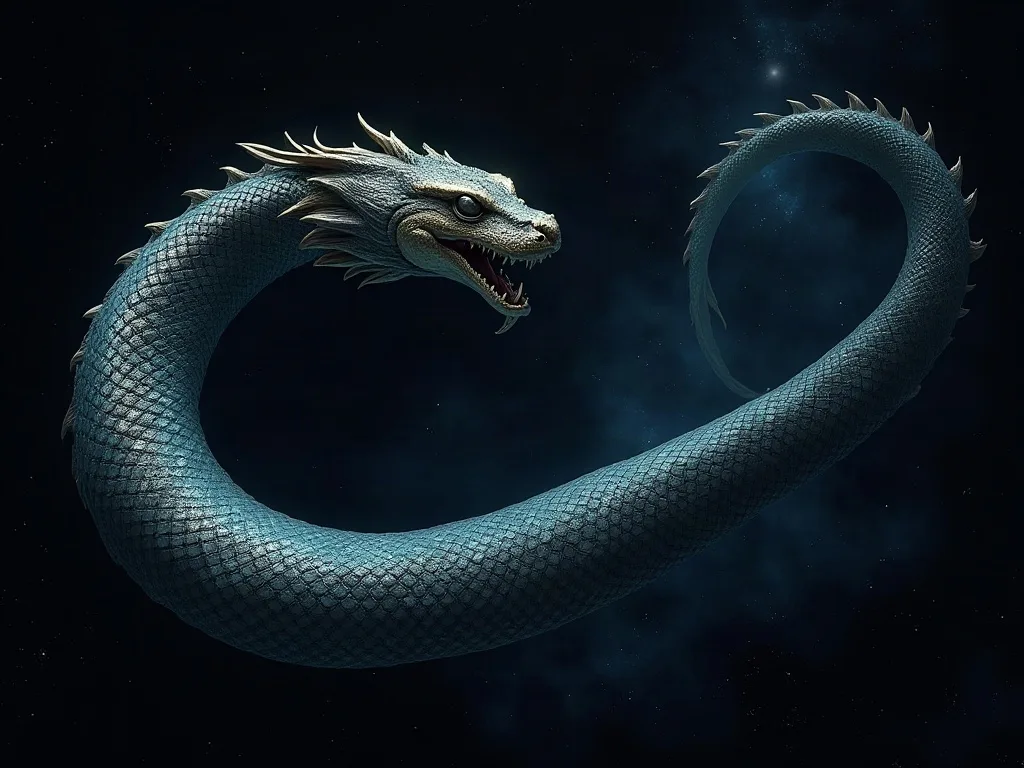
The serpent's body defied comprehension. Ancient texts describe him as so immense that he could swallow the entire solar boat in a single gulp. His scales were harder than any metal. He had no eyes, but he could see. He had no ears, but he could hear. In some depictions, he has multiple heads, or his form stretches across the entire underworld. The visual confusion itself was part of his nature: chaos resists clear definition.
Ra's Nightly Battle Against Apophis
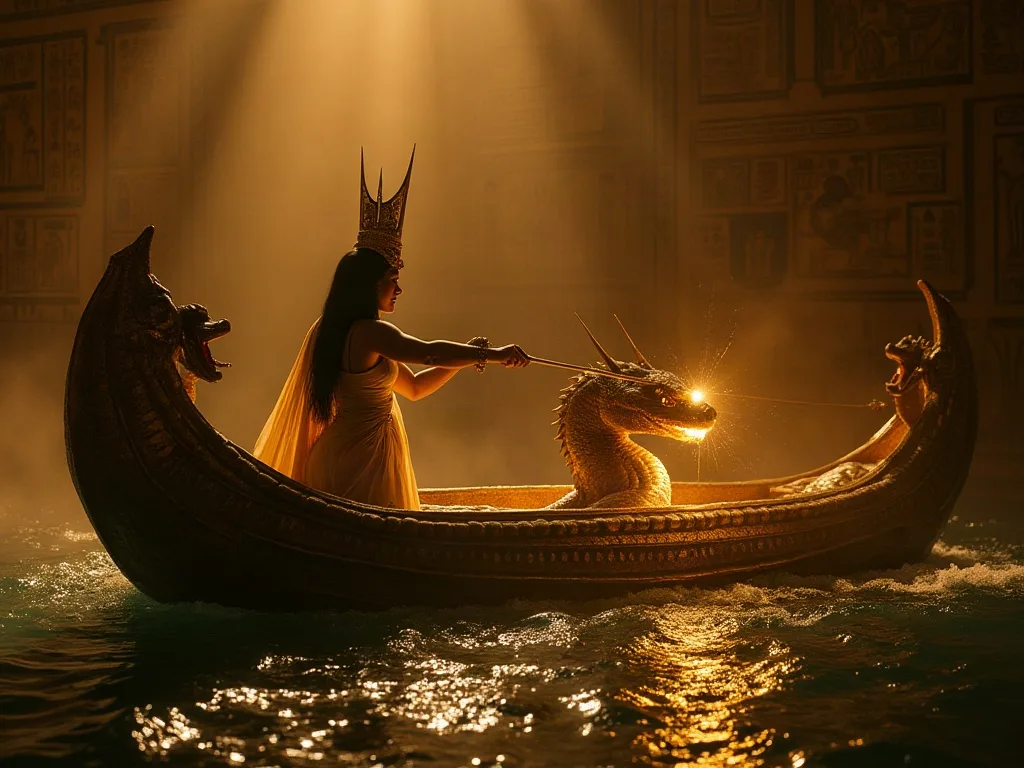
The daily cycle of the sun was never simple in Egyptian belief. Ra did not simply rise and set. Each night, he died and entered the Duat (the underworld, pronounced "doo-aht"), traveling through the twelve hours of darkness in his boat, the Mandjet, pulling himself through a perilous journey beneath the earth.
In the deepest part of this journey, in a place called the Lake of Fire, Apophis awaited him. The serpent had only one goal: to stop the sun's journey, to prevent dawn, to plunge the world into eternal darkness. Each night, as Ra's boat approached, Apophis struck.
The battle was violent and uncertain. Apophis would coil around the solar boat, crushing it. He would try to swallow Ra whole. The sun god could not face him alone. Instead, a crew of gods and protective spirits traveled with Ra. Set, the god of storms and deserts, who was himself violent and unpredictable, took the front of the boat and held a spear called the iam-khefau (the spear of transformation). When Apophis attacked, Set thrust the spear into the serpent's mouth and body, wounding him, driving him back.
Other gods joined the combat. Thoth, the ibis-headed god of wisdom and writing, would speak words of power and magic to weaken the serpent. Isis, the great magician, would cast protective spells. Horus, the falcon-headed son of Osiris, would fight alongside his father's enemies when the survival of creation hung in balance. Even the pharaoh, in ritual texts, was described as assisting Ra, magically stabbing Apophis to protect the realm.
Each night, Apophis was defeated. But he was never destroyed. The texts speak of him being "cut to pieces" and "burned in fire," but by the next night, he was whole again, ready to attack once more. This endless cycle was simply the way the world worked. Creation required this eternal vigilance.
The Symbolism of Apophis: What He Represented
Apophis was far more than a monster tale told to explain why the sun rose each day. The serpent embodied every force that threatened Egyptian society and cosmic order.
He represented sickness. The venom in his fangs could bring plague and disease. Egyptians would speak protective spells against Apophis when someone was ill, understanding his malice as literally spreading through the body.
He represented death and disorder. While Osiris, the god of death, governed a predictable, eternal afterlife for those who lived righteously, Apophis represented cessation, non-being, the erasure of everything that made life meaningful. To be consumed by Apophis was to be annihilated, to cease to exist even in the afterlife.
He represented foreign invasion and military defeat. When enemies threatened Egypt's borders, priests would speak of them as servants or embodiments of Apophis. The serpent was the stranger, the force outside the law, the chaos that civilization held at bay through order, hierarchy, and divine justice (ma'at).
Most importantly, he represented the possibility that creation could fail. The Egyptians understood that the universe was not guaranteed to continue. Without Ra's nightly journey and the gods' constant battle, the sun might never rise. Crops might wither. The Nile might never flood. Civilization might collapse. Apophis was the principle that made renewal necessary. He was why the world needed gods, and why the gods needed daily ritual, prayer, and sacrifice from human hands.
Ra (Creation and Order)
Worshipped daily with temples and offerings; associated with life, light, and the daily renewal of creation; defeated his enemies but allowed them to continue existing; ruled according to divine law (ma'at).
Apophis (Chaos and Dissolution)
Received no temples or prayers, only protective spells; embodied non-being and annihilation; had no desire for followers; sought the total cessation of creation; represented the void before and after ordered reality.
Magical Defenses Against Apophis
The Egyptians did not rely on the gods alone to defeat Apophis each night. Ordinary people participated in the cosmic struggle through ritual and magic. The texts that survive reveal a society deeply committed to actively fighting chaos.
The Book of Apophis, a collection of spells found in tombs and temples, contains specific incantations designed to harm the serpent and weaken him. These were not requests to the gods; they were heka (magic), a force that could work independently of divine will. Priests would perform these spells daily, especially during the dangerous hours of night.
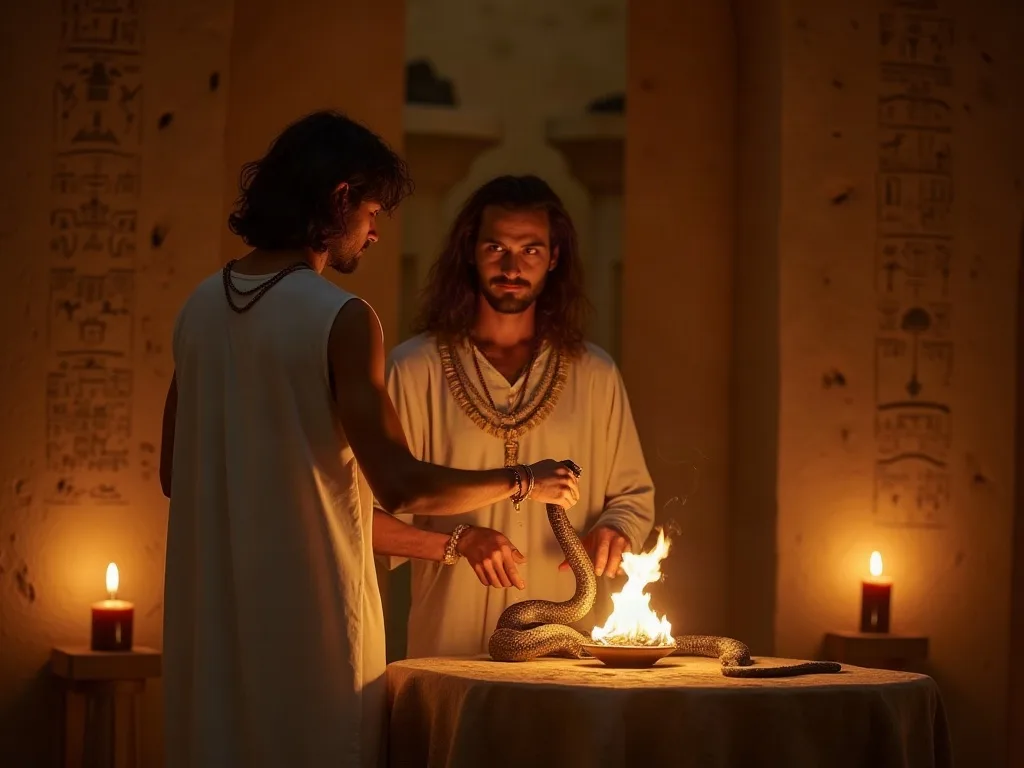
One spell reads: "I repel the serpent Apophis. He is bound, his mouth is sealed." Another: "His bones are broken, his flesh is consumed, his joints are scattered." The Egyptians believed that by speaking these words with intention, and by accompanying them with ritual actions like stabbing figurines of the serpent or burning his image, they could actually harm Apophis in the underworld. The magic traveled downward, through the layers of reality, and weakened him just enough for Ra to prevail.
Protective amulets featuring the shen (an ancient Egyptian symbol of infinity and protection) or the image of Set fighting Apophis were worn by the living to guard against the serpent's influence during sleep and in times of vulnerability. Funerary texts describe elaborate protections for the deceased, who would face Apophis on their journey to the afterlife.
Some rituals took on almost absurd specificity. In certain temple ceremonies, priests would create a wax figure of Apophis, speak the names of enemies into it, and then cut it apart and throw the pieces into fire. The act was understood to be genuinely destructive; the chaos embodied in the figure, whether the serpent or the enemy, was literally being unmade.
Apophis Across Dynastic Periods
The Egyptian civilization lasted nearly three thousand years, and Apophis endured as a central figure throughout. However, his role and his names shifted slightly across different periods and regions.
In the Old Kingdom (2686-2181 BC), when pyramid texts were composed, Apophis appears as a more shadowy figure, less named and less defined. He is sometimes called Nak, the inert one, or simply the serpent of darkness.
By the Middle Kingdom (2055-1650 BC), his mythology had crystallized. He became Apep, a name possibly derived from the verb meaning "to slither." Spells against him became standardized. His role in the nightly war with Ra was fully developed.
In the New Kingdom (1550-1070 BC), during the reigns of great pharaohs like Thutmose III and Ramesses II, temples dedicated extensive walls to the story of Ra and Apophis. The Book of the Dead spells against the serpent proliferated. Kings took titles referencing their magical power over Apophis. Thutmose III was called "he who harpoons Apophis." The pharaoh's ritual role as a cosmic protector intensified.
By the Late Period and into the Ptolemaic era (when Greeks ruled Egypt), Apophis had become a figure known to Greek and Roman writers. The classical geographer Plutarch mentions him, and his mythology was preserved in demotic texts (the everyday Egyptian script, distinct from hieroglyphics).
Apophis and the Concept of Ma'at
To understand Apophis fully, you must understand Ma'at, the goddess and principle of cosmic order, justice, truth, and balance. Ma'at was not a rule imposed arbitrarily. She was the natural order that existed when creation was complete. She was what the world should be.
Apophis was the negation of Ma'at. He was isfet, or chaos, the disorder that threatened to unravel everything. Every action in Egyptian life, from temple ritual to legal judgment, from the pharaoh's rule to the farmer's harvest, was understood as a way of maintaining Ma'at and pushing back against Apophis.
When a temple priest recited spells against Apophis, he was not just protecting the sun. He was maintaining the principle that order could overcome chaos, that justice could prevail, that the world could continue to be a place where cause and effect followed predictable patterns. When a pharaoh was said to have defeated enemies, it was often framed as a defeat of Apophis. When crops grew, it was because Ma'at was strong and Apophis was weak.
This was not pessimism in Egyptian thought. It was realism. The Egyptians knew that entropy, illness, death, and disorder were real. They did not hope for a final paradise where Apophis would be gone forever. Instead, they built a civilization dedicated to the daily, hourly work of choosing order over chaos, life over death, renewal over cessation. That work never ended because it was not meant to end.
Apophis in Later Cultures and Modern Memory
When Alexander the Great conquered Egypt and the Ptolemaic Greeks took over, Apophis entered the Greek world as Apopheis or sometimes Typhon, the monstrous serpent who challenged the Olympian gods. Typhon, in Greek mythology, was similarly vast, eternally dangerous, and represented wild nature opposed to divine order. The parallels were clear, and the figure merged.
In Jewish and Christian texts, some scholars have noted echoes of Apophis in the description of Leviathan, the chaos serpent of the abyss. The pattern of a cosmic serpent that embodies pre-creation chaos and opposes divine order appears across cultures. Whether there was direct influence or simply parallel human responses to the same existential anxieties about order and entropy remains debated.
In modern Egypt, Apophis survives in folk tradition as a demon of the underworld, though the theological sophistication of the ancient serpent has faded. His name appears in Egyptian colloquial speech as shorthand for a malevolent force. In Western popular culture, Apophis has been revived as a villain in fiction, video games, and comic books, though rarely with the nuance of the original.
Frequently asked questions about Apophis the serpent of chaos
Frequently asked questions
Could Apophis ever win against Ra?
The Egyptians believed that Apophis could never permanently defeat Ra, but they did not believe it was impossible. In some magical texts, spells describe scenarios where Apophis nearly succeeds, where the sun is swallowed, where darkness nearly becomes permanent. The nightly battle was always uncertain. This uncertainty was the point: it made the renewal meaningful. If Ra's victory were guaranteed, there would be no need for ritual, no reason for humans to participate in the cosmic struggle. The possibility of failure made creation precious.
Why didn't the Egyptians simply kill Apophis once and for all?
The Egyptians understood Apophis not as a monster that could be permanently slain, but as a principle, a force of nature. Chaos cannot be destroyed; it can only be held back, managed, and fought against perpetually. To some extent, this reflected Egyptian experience: diseases could be managed but not eliminated, death could be delayed but not prevented, disorder was always pressing at the edges of organized society. Rather than seeking a false promise of final victory, Egyptian theology built a civilization around the discipline of perpetual vigilance.
Did ordinary Egyptians fear Apophis, or was he only a priestly concept?
Apophis was very real in everyday Egyptian life. Protective spells against him appear in tomb inscriptions written for private individuals, not just pharaohs. Amulets invoking protection from Apophis were worn by common people. When someone was ill, family members might perform household rituals against Apophis, believing his venom had entered the body. The serpent was taught to children as a real threat, the price of a world without divine order. Fear of Apophis was not foreign or abstract; it was the Egyptians' way of expressing anxiety about sickness, death, social collapse, and cosmic failure.
What was the relationship between Apophis and Set?
Set was a complicated figure: a storm god, a god of deserts and warfare, dangerous and unpredictable, yet essential to cosmic order. He was not evil. Despite his chaotic nature, Set consistently stood against Apophis, harpooning him and preventing the serpent's victory. Some texts suggest Set had a deep personal enmity with Apophis, a struggle within struggle. Set embodied controlled violence and necessary chaos, while Apophis embodied uncontrolled dissolution. The Egyptians needed Set to fight Apophis, which meant tolerating and honoring a god they also feared and sometimes blamed for misfortune.
Are there other chaos serpents in world mythology?
Yes. The Sumerian Tiamat, the mother of chaos in the form of a salt-water serpent, was defeated by the god Marduk in the Enuma Elish and then used as material for creation. The Vedic Vritra, a serpent of drought, was slain by the storm god Indra. In Norse mythology, Jormungandr, the world serpent, is destined to break free and trigger Ragnarok, the end of the world. These figures reflect a common human pattern: the serpent represents chaos, scale, and the pre-ordered state of the cosmos. Different cultures resolved the tension differently, but the archetypal conflict is remarkably consistent.
The Eternal War: Why Apophis Still Matters
Modern readers sometimes struggle with Egyptian mythology because it offers no final resolution, no apocalypse, no salvation. Apophis is never defeated for good. Ra will face him again tomorrow night, and the night after that, for eternity. This seems exhausting to people raised on narratives where good triumphs and evil is vanquished.
But the Egyptians understood something that modern Western culture sometimes forgets: that the work of maintaining a good world is never finished. That order must be chosen daily. That civilization is fragile and requires constant attention. That the forces opposed to human flourishing are real and will always press against the boundaries of order. That renewal is not automatic but earned through vigilance, ritual, and sacrifice.
Apophis, in this reading, is not pessimistic. He is honest. He is the price of having a world at all. And the fact that Ra continues to battle him, night after night, refusing to accept defeat even though victory is temporary, makes Ra not less heroic but more so. Every dawn is a victory. Every sunrise is earned.
Free 25-page sample
Want the whole story?
Take the first 25 pages free. If it pulls you in, the full edition is yours as an instant PDF download, with a paperback on Amazon for selected titles.

Mythology
The World Mythology Book: The Gods, Heroes and Myths of Every Culture
The Gods, Heroes and Myths of Every Culture, in One Volume
The whole of world mythology in a single volume: Greek, Norse, Egyptian, Japanese, Hindu, Celtic, Slavic, Mesoamerican and African myths gathered side by side, each drawn from the primary sources.