
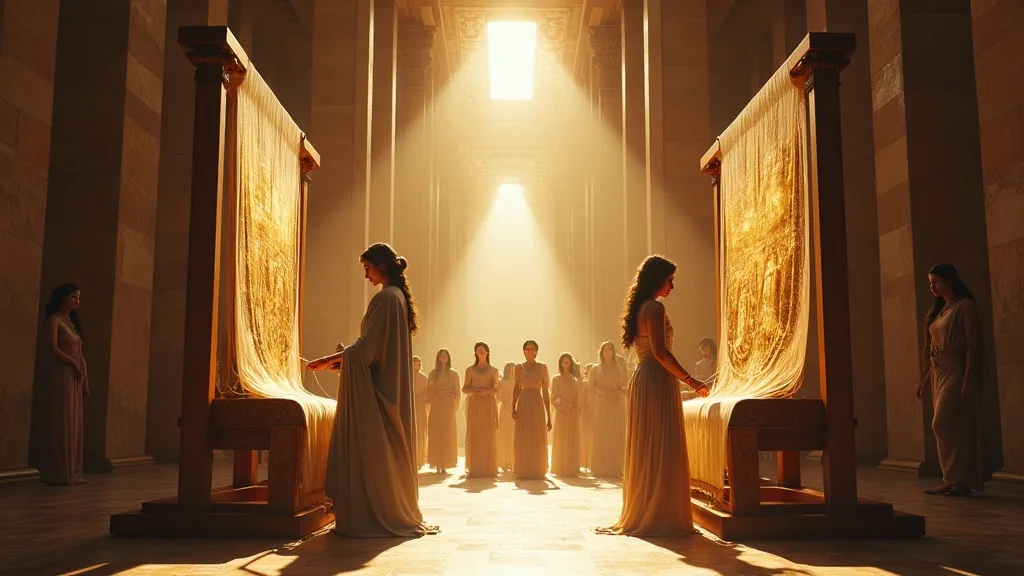
Arachne and Athena: The Weaving Contest That Created the Spider
A mortal weaver challenged a goddess. The tapestry she wove was perfect. That is what made it unforgivable. The myth of Arachne and Athena is the oldest story about the price of being right.
Contents
The girl from Lydia was not born famous. She had no divine parentage, no city walls to her name, no hero who loved her. Her father, Idmon of Colophon, dyed wool for a living, and she grew up with purple-stained hands and a spindle that never stopped moving. But the wool she spun caught the light differently. Her fingers pulled thread into shapes that left onlookers silent. Nymphs came down from Mount Tmolus just to watch. That is where the trouble started.
She said the gift came from herself. Not from any goddess. Not from Athena, who was supposed to have invented weaving, the loom, the spindle itself. Just from her own two hands and however many years of practice. People heard her say it. The rumor climbed.
A goddess heard it too.
The Mortal Who Refused to Be Humble
Arachne came from Colophon, a prosperous Lydian city on the western coast of what is now Turkey. Her exact origin matters: she was not Greek, not Athenian, not even fully within the cultural sphere where Athena commanded the most loyalty. Lydia had its own gods, its own textile traditions, its own sense of what beauty owed to whom.
Ovid tells us that her fame spread so wide that word reached the goddess herself. Athena (called Minerva by Ovid, writing in Latin) chose not to strike immediately. Instead, she disguised herself as an old woman, with grey hair and a walking stick, and went to Arachne's workroom. The disguise is important. It was a test of character before a contest of craft.
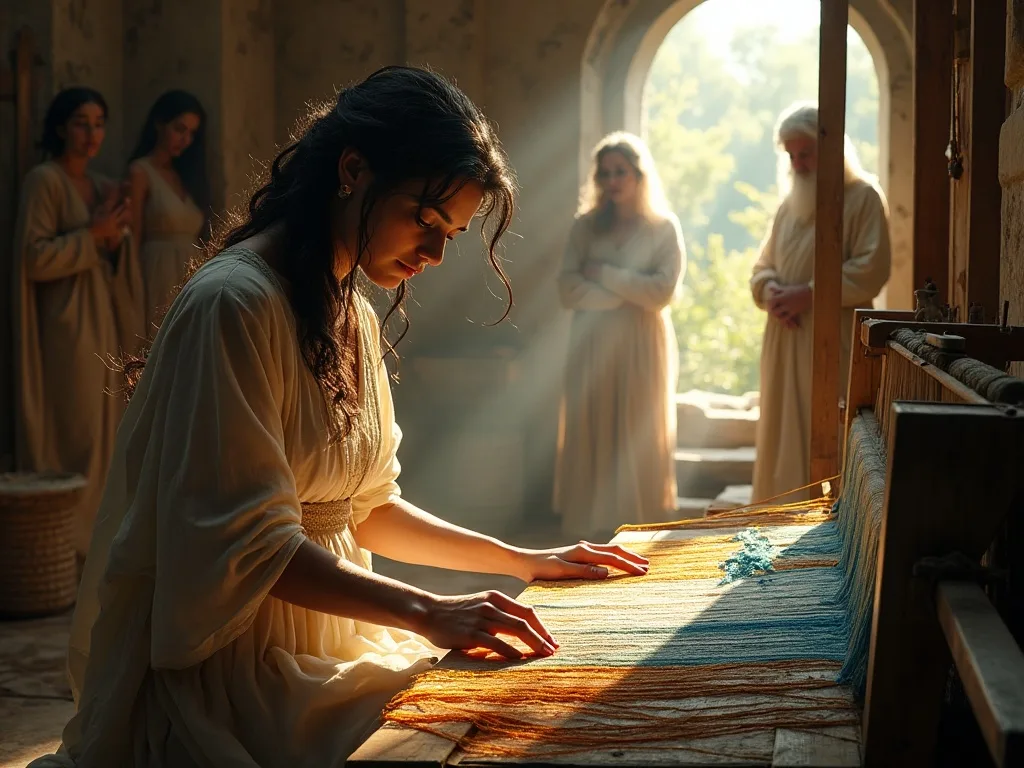
The old woman warned Arachne. Gently at first: fame is one thing, but hubris is another. Ask forgiveness from the goddess. Admit that no human hand can match a divine one. The Latin word Ovid uses is venia, meaning pardon, grace, indulgence. Arachne did not want it. She turned on the old woman with sharp words. If Athena was so confident, Arachne said, let her come in person. Let them weave side by side and let anyone watching judge the result.
At that point the old woman dropped the disguise. Ovid describes it simply: the grey hair darkened, the stoop straightened, the goddess stood there in full height. The nymphs and the women watching fell to their knees. Arachne flushed. She hesitated for a second. Then she set her jaw and reached for her loom.
Two Looms, Two Visions of the Gods
What happened next is one of the most politically charged artistic descriptions in ancient literature. Ovid does not rush past it. He spends more than sixty lines describing what each contestant wove, and the contrast is not subtle.
Athena wove a scene of her own victory: the founding contest with Poseidon over Athens. Poseidon strikes the rock with his trident and seawater gushes up. Athena plants an olive tree. The twelve Olympians sit in judgment. She wins. The city is named for her. Around this central scene she stitched four smaller panels in each corner, each one showing a mortal who challenged a deity and was punished. An explicit warning, built into the cloth itself.
Arachne wove the gods' crimes against mortals.
Her cloth showed Zeus as a swan forcing himself on Leda. Zeus as a bull carrying Europa across the sea. Zeus as a shower of gold falling on Danaë. Poseidon disguised as a river, as a horse, as a ram, taking mortal women by force or by deception. Apollo disguised as a shepherd. Dionysus as a bunch of grapes. Every scene depicted a god using divine power to deceive or overwhelm a human being. Every scene was technically perfect. The thread looked like real water. The bull's muscles shone with the tension of swimming. The gold light falling on Danaë made you feel the warmth of the metal.
Ovid writes that not even Athena herself, nor Envy personified, could find a single flaw in Arachne's work.
That sentence is worth sitting with. The goddess of craft and wisdom examined the cloth of a mortal girl and found nothing to criticize. The weaving was flawless.
Why Athena Destroyed the Cloth
Here the myth becomes uncomfortable. If the work was perfect, what justified the destruction?
Ovid says Athena struck the cloth because of what it depicted, not because of how it was made. The scenes were an offense. Arachne had used her art to put the gods' worst behavior on display, to freeze in thread what no mortal was supposed to say plainly: that the Olympians were capable of cruelty, of lust, of petty jealousy dressed up as justice.
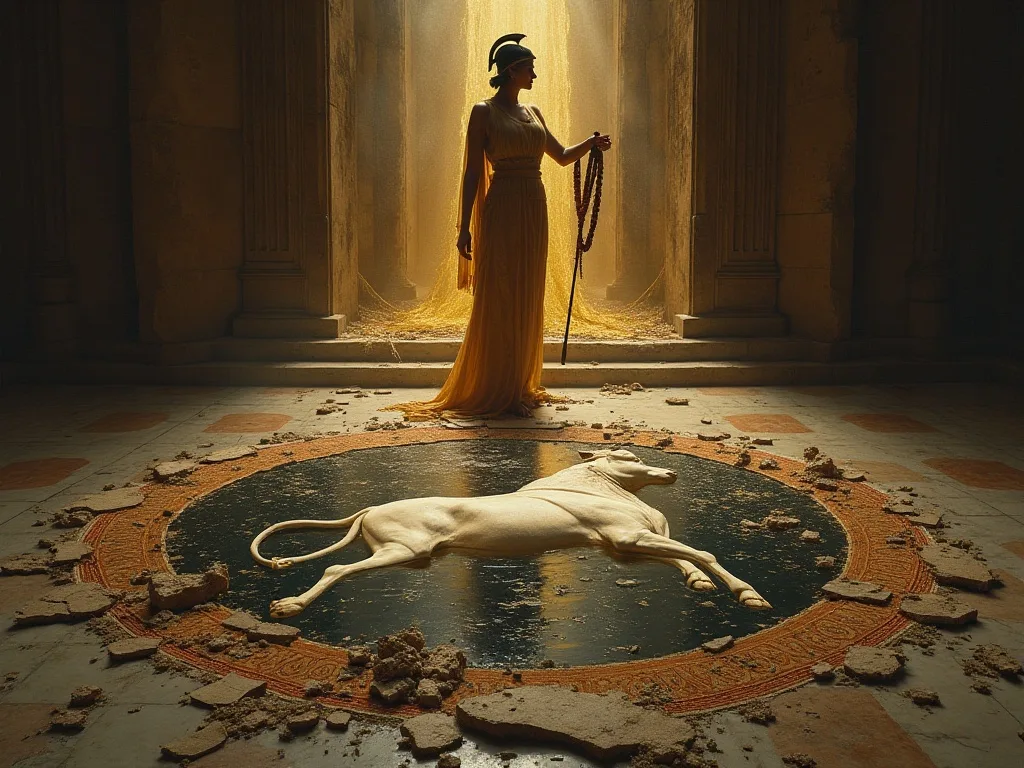
She struck the loom shuttle against Arachne's forehead as well, a blow of humiliation more than physical pain. Arachne's response was not surrender. She picked up a cord and hanged herself.
Athena stopped it. Not out of mercy, exactly, or at least not mercy alone. Ovid describes the goddess as feeling miseranda toward Arachne, something like pity, though tangled with her anger. She would not let Arachne escape into death. Instead she spoke a sentence that sounds like a gift and functions as a sentence: "Live, wicked girl. But hang. And let your entire family hang in this way, down through all generations that come after you."
She sprinkled Arachne with the juice of Hecate's herb, a plant linked to transformation and the boundary between living and dead. The body shrank. The hair fell out. The fingers curved and multiplied. The belly swelled and hardened into an abdomen from which a single thread still trailed. Arachne became a spider. She kept weaving. She has never stopped.
Reading the Myth: Three Layers of Meaning
The story works simultaneously as folklore, as religious warning, and as something sharper: a meditation on what it costs to tell the truth about power.
The folklore layer is the oldest and simplest. Ancient Greeks saw spiders spin and asked: where did that come from? The aetiology, the origin story woven into the myth, explained the spider's perpetual thread-making. The Greek word for spider, arachne (pronounced ah-RAHK-nee), simply means "spider." The name of the girl and the creature are the same word. Modern biology uses it too: the class Arachnida, spiders and their kin, carries Arachne's name into scientific taxonomy.
The religious layer concerns hubris, the Greek concept of overstepping, of placing yourself where the gods belong. Greek religion was intensely organized around the idea that mortals occupied a specific rung of existence, lower than gods in power, shorter in life, more fragile in every way. Claiming equality with a deity was not merely arrogance; it threatened the structure of the cosmos itself. Arachne's punishment follows a long line of similar warnings. Niobe boasted she had more children than Leto and lost all fourteen of them to Apollo and Artemis. Marsyas competed with Apollo on the aulos (a reed flute) and was flayed alive when he lost. The pattern is consistent: the mortal who says "I am as good as a god" is not simply corrected. The correction is catastrophic.
The political layer is where the myth grows teeth. Arachne did not simply claim skill. She deployed that skill to critique divine authority. Her cloth was an accusation in thread. Modern scholars, including Froma Zeitlin in her work on Greek visual and literary representation, have pointed to the political dimension of textile-making in ancient Greece. Weaving was a female art, largely confined to domestic space. For Arachne to turn that art into public critique of the gods was a double transgression: she stepped out of her gender's assigned sphere and out of her species' assigned humility at the same time. Athena's rage was not simply wounded pride. It was a defense of a very specific social and cosmic order.
What makes the story linger is that Arachne was right. Her cloth showed what actually happened. The myths she depicted are canonical. Zeus did those things. The gods were capable of that behavior. She was punished not for lying but for saying clearly what everyone knew and no one was supposed to say in quite that way.
Ovid's Arachne and the Question of the Narrator's Sympathy
Ovid wrote the "Metamorphoses" under the shadow of Augustus Caesar's Rome, a regime that punished writers who stepped out of line. Ovid himself was exiled in 8 AD, the same year he finished the poem, though for reasons the sources leave deliberately vague. Some scholars, including Peter Green in his translation commentary, have suggested that the Arachne episode carries a personal resonance: the artist who tells true and uncomfortable things about those in power, and pays for it.
Whether or not Ovid intended that parallel, the Latin text leans quietly toward Arachne throughout. He describes her work in far more sensory detail than Athena's. He uses warm, kinetic imagery for her weaving. He notes explicitly that the goddess could not find fault. He describes her transformation with more physical tenderness than he gives Athena's cold anger. The sympathy in the narrative is understated but present. A Latin reader in Rome would have noticed.
This is what separates the Arachne myth from a simple morality tale. A simple morality tale would show Arachne's work to be inferior, or would have her repent. Neither happens. The myth offers the punishment without manufacturing the guilt.

Arachne Across Traditions: Weavers Who Defy
The Arachne and Athena weaving contest is not the only myth in which a mortal craftsperson faces a divine rival. The pattern appears across multiple traditions, and comparing them sharpens what is unique about the Greek version.
In Norse myth, the web of the three Norns at the base of Yggdrasil weaves fate itself. Mortal weavers in Norse tradition do not compete with the Norns; they inherit their power through the Norns' gift. The relationship is not adversarial but hierarchical and gift-based. The mortal is downstream from the divine, not beside it.
In Hindu tradition, Maya means both illusion and the creative power that weaves the appearances of the world. The craftsman-god Vishvakarman (the divine architect) has no mortal rival in quite the same sense, because in the Hindu model the cosmos itself is the artwork and mortals participate in it, not against it.
In Aztec mythology, the goddess Xochiquetzal presides over weaving and feminine arts, as Athena does. The "Florentine Codex," compiled by Fray Bernardino de Sahagún in the 16th century from Nahua oral sources, describes her cult but does not preserve a contest myth of the same shape. The divine monopoly on craft exists, but no Arachne rises against it.
What makes the Greek myth distinct is the combination of three elements that rarely appear together elsewhere: the mortal wins on technical merit, the mortal loses anyway, and the audience is meant to notice the contradiction. That third element, the visible injustice left uncommented upon by any divine authority, makes the story something closer to tragedy than to fable.
Athena's Cloth
Shows the gods at their most legitimate: Athena founding Athens, divine order confirmed by the twelve Olympians. The four corners warn mortals of the consequences of challenging divine power. The imagery is hierarchical, cosmic, authoritative. Every scene shows gods winning.
Arachne's Cloth
Shows the gods at their most compromised: Zeus, Poseidon, and Apollo using disguise and power against mortal women. The imagery is specific, human-scaled, sensory. Every scene shows mortals being acted upon. Technically flawless, thematically subversive.
Arachne in Art, Literature, and Science
After Ovid, Arachne's story moved quickly through European literary and artistic tradition. Dante placed a weaving spider in Purgatorio (Canto XII, written around 1308-1320), evoking Arachne's pride as a warning to his readers. He called her the one "who lost the contest and ruined herself from grief."
Velázquez painted the scene around 1655-1660 in a canvas now in the Prado Museum in Madrid, known as "Las Hilanderas" (The Spinners). The painting works on two levels: in the foreground, women spin in a workshop; in the back, the mythological scene unfolds with Athena confronting Arachne. Art historians have debated for decades whether Velázquez sided with the mortal or the goddess. The painting offers no answer.
Edmund Spenser used Arachne in "The Faerie Queene" (1590-1596) as a symbol of elaborate, corrupt craftwork contrasted with the goddess's simple, divine order.
In the 20th century, Jorge Luis Borges wrote about the labyrinthine quality of weaving as art and trap simultaneously. The connection to Arachne is implicit but clear.
Modern taxonomy made the connection permanent. In 1757, the Swedish naturalist Carl Linnaeus formally classified spiders within the class Arachnida, cementing Arachne's name into the scientific record. Every time an arachnologist publishes a paper, Ovid's story vibrates in the footnotes.
In contemporary fiction, the myth surfaces in Neil Gaiman's "American Gods" (2001) and receives a more direct treatment in Madeline Miller's essay work and in Natalie Haynes's retellings, where Arachne is recovered as a figure of creative resistance rather than cautionary pride.
The Metamorphosis as Punishment and Persistence
What the transformation actually gives Arachne is worth examining carefully. She asked to keep weaving. The goddess ensured she would weave forever. The spider's thread is stronger by weight than steel. A spider's web can hold dozens of times its own weight, can survive wind and rain, can be spun anywhere and out of the body itself. Spiders rebuilt webs destroyed by predators or weather within hours. The punishment is also, by a logic the myth never quite states aloud, a form of inverted triumph.
Arachne the spider cannot be shamed. She does not ask permission. She does not bow. She simply weaves, in corners, in fields, between branches, in the margins of human space. The Arachne myth refuses a clean ending, and that refusal is part of what keeps it alive.
She is not redeemed. She is not restored. But she persists, thread by thread, in every web the sunlight catches.
Frequently Asked Questions about Arachne and Athena
Frequently asked questions
What is the original Greek source for the Arachne myth?
The fullest surviving version comes from Ovid's "Metamorphoses," Book VI, written in Latin around 8 AD. Ovid was Roman, not Greek, but he drew on earlier Hellenistic sources that have not survived intact. Brief references to a weaving contest appear in fragments attributed to earlier Greek poets, and Virgil mentions Arachne in the "Georgics" (Book II, 1st century BC), but Ovid's is the only complete narrative we have. Some scholars believe the story originated in Asia Minor, consistent with Arachne's Lydian origin, and entered the Greek mythological canon through cultural exchange.
Did Athena cheat in the weaving contest?
Ovid makes clear that Athena could find no fault in Arachne's work, which means she did not win on technical grounds. She destroyed the cloth and punished Arachne because of what the cloth depicted, not because of any error in the weaving itself. Whether that constitutes cheating depends on the rules you think applied. In the myth's own terms, no mortal could "win" against a deity regardless of the result, because the contest itself was the transgression. The outcome was decided before the first thread was laid.
What does the word 'arachne' mean in Greek?
In ancient Greek, arachne simply means "spider." It also carried the sense of a spider's web or cobweb. The girl's name and the creature's name are the same word. Modern science preserves this in the class Arachnida, formally named by Carl Linnaeus in 1757, which includes spiders, scorpions, ticks, and mites. Every species in that class carries Arachne's name in its classification.
Is the Arachne myth a story about hubris?
Partly, yes. Hubris, the Greek concept of catastrophic overstepping, is clearly present: Arachne claims equality with a goddess and is punished. But the myth is more ambiguous than a straightforward hubris tale, because Arachne's claim was technically correct. Her work equaled or exceeded what the goddess produced. Modern classicists, including Froma Zeitlin and Florence Dupont, have read the myth as a story about the politics of representation: Arachne is punished for what she depicted, not for how well she depicted it. That distinction makes it something more than a lesson in modesty.
Why did Athena transform Arachne into a spider rather than kill her?
Ovid describes a moment of partial pity: Athena stopped Arachne's suicide but framed the transformation as a continuation of punishment rather than mercy. The spider's eternal weaving mirrors and mocks Arachne's pride: she wanted to weave forever, to be recognized as the greatest weaver, and now she weaves forever, unrecognized, in margins and corners. Some scholars read the transformation as a double bind: Arachne cannot die, cannot rest, cannot stop doing the very thing that got her in trouble. The punishment replays the crime endlessly.
How does the Arachne story compare to other myths about mortal artists challenging gods?
The closest parallel is the myth of Marsyas, a satyr who challenged Apollo to a music contest and was flayed alive when he lost. Unlike Arachne, Marsyas is clearly described as losing the contest on merit, though even there the judgment involved divine bias. The myth of Niobe is also structurally parallel: extraordinary pride, divine competition, catastrophic punishment. What distinguishes Arachne is that she does not lose on merit. Her punishment comes despite her excellence, which places the story in a different moral register from the others.
What the Spider's Thread Says About Art and Power
The myth of Arachne and Athena the weaving contest has outlived almost every political order that told it. Augustus Caesar's Rome is gone. The temples of Athena at Colophon are rubble under Turkish soil. The looms that real Lydian women worked are dust. The spider is still weaving.
Part of why the story survives is that it refuses to resolve into a comfortable moral. The gods are shown to be capable of self-interested cruelty. The mortal is shown to be genuinely gifted and genuinely right. The punishment happens anyway. Ancient audiences sat with that discomfort. So do modern ones.
There is also something the myth says about art specifically. Arachne did not weave a lie. She wove a precise, technically perfect record of divine behavior. The closest modern analog might be an investigative journalist who publishes a perfectly documented story about someone powerful, only to find that accuracy is no protection. The record exists. The punishment still falls. But the record exists.
The Arachne myth also says something about what gets preserved. Athena's official cloth, the one showing divine order and civic founding, did not survive the centuries in anyone's memory. We know what was on it only because Ovid described it. What the myth actually handed down, what generation after generation retold and painted and staged and argued over, was the girl's cloth. The subversive one. The uncomfortable one. The one that was supposed to be destroyed.
Ovid understood that. He put the content of Arachne's cloth in sixty lines of luminous Latin and gave Athena's cloth forty-three. The weaver who told the truth gets more lines in the poem. Even there, in the most literal way, Arachne wins something.
She is still in the margins. She is still weaving. Anyone who has watched morning light catch a web in a garden has seen what Athena could not quite erase.
Free 25-page sample
Want the whole story?
Take the first 25 pages free. If it pulls you in, the full edition is yours as an instant PDF download, with a paperback on Amazon for selected titles.

Mythology
The World Mythology Book: The Gods, Heroes and Myths of Every Culture
The Gods, Heroes and Myths of Every Culture, in One Volume
The whole of world mythology in a single volume: Greek, Norse, Egyptian, Japanese, Hindu, Celtic, Slavic, Mesoamerican and African myths gathered side by side, each drawn from the primary sources.