

Eros and Psyche: The Complete Love Story, Sources, and Hidden Meaning
A mortal girl beautiful enough to rival Aphrodite. A god who falls for his own arrow. The complete myth of Eros and Psyche, told in full, with its ancient sources, symbolic layers, and why it still haunts us.
Contents
A king has three daughters. The youngest is so beautiful that sailors stop praying to Aphrodite and start leaving offerings at the girl's feet instead. Temples go cold. Altars gather dust. The goddess of love, insulted to the bone, calls her son Eros and tells him to shoot the girl with one of his arrows, binding her forever to the most miserable wretch on earth.
His name is Psyche, which means "soul" in Greek. And Eros, bow in hand, leans over her sleeping face. He grazes his own wrist on the arrow tip. He looks at her. And he is lost.
This is the opening move of one of antiquity's most complete love stories, a myth so rich with longing, jealousy, trial, and transformation that scholars have spent two thousand years arguing about what it really means. It comes to us primarily through the Roman novelist Apuleius, who embedded it inside his wild, strange prose fiction The Golden Ass (written around 160 AD), placing the tale in the mouth of an old woman comforting a kidnapped girl. Apuleius drew on older Greek oral traditions, now mostly lost, but the bones of the story are ancient. The Eros and Psyche love story is not just a fairy tale. It is a philosophical argument about what love costs and what the soul must endure to reach it.
Aphrodite's Jealousy and the Oracle's Terrible Answer
Psyche's beauty is a problem from the first page of her life. Men admire her at a distance, the way they admire a perfectly carved marble statue. They do not court her. Her two older sisters marry ordinary kings. Psyche sits in the palace, worshipped and untouched, which is its own quiet misery.
Her father, desperate, consults the oracle of Apollo at Miletus. The oracle's answer lands like a stone into still water. Psyche must be dressed in funeral clothes and left on a high, rocky cliff. She will not marry a mortal man. Her husband will be a creature so terrible that even the gods fear him. He will find her at the cliff's edge.
The family weeps, dresses Psyche in white, and carries her to the mountain as though to a burial. Then the god Zephyrus, the west wind, lifts her gently from the rock and carries her down into a hidden valley, where a palace stands that seems built from gold and sunlight. The floors are ivory. The columns are jeweled. No servant is visible, but voices speak from the air, offering food, music, warm baths.
That night, in the dark, a husband comes. He does not light a lamp. He only speaks, low and kind, and tells her she is safe, and tells her she is loved. He leaves before dawn, before she can see his face. He makes her promise, again and again, never to try to look at him.
This is the shape of her early happiness: days alone in a palace full of invisible abundance, nights with a husband who exists entirely in darkness and touch and voice.
The Sisters' Visit and the Seed of Doubt
Eros is not cruel. The arrangement is odd, but he is gentle. He warns Psyche about her sisters specifically: they will come looking for her, and if she listens to them, she will destroy what they have. Psyche misses her family. She asks Eros to let her sisters visit. He reluctantly agrees.
Zephyrus carries the sisters down into the valley. They see the palace, the gold, the abundance. They ask about the husband. Psyche, who has never seen him herself, improvises: he is young, she says, handsome, a hunter. The sisters go home and fester. Their own marriages are mediocre. This sister, the beautiful one who caused such grief, has a palace worth more than several kingdoms. The jealousy is immediate and total.
They return, and this time they work carefully. They remind Psyche of the oracle's words, the terrible creature the god foretold. They suggest the husband hides in darkness because he is a monster, a serpent perhaps, fattening her until he eats her. They tell her she should take a lamp and a knife to bed. When the husband sleeps, light the lamp, look, and if he is a beast, cut his throat.
Psyche wavers for a long time. She loves the voice in the dark. She is also genuinely afraid. In the end, she takes the lamp.

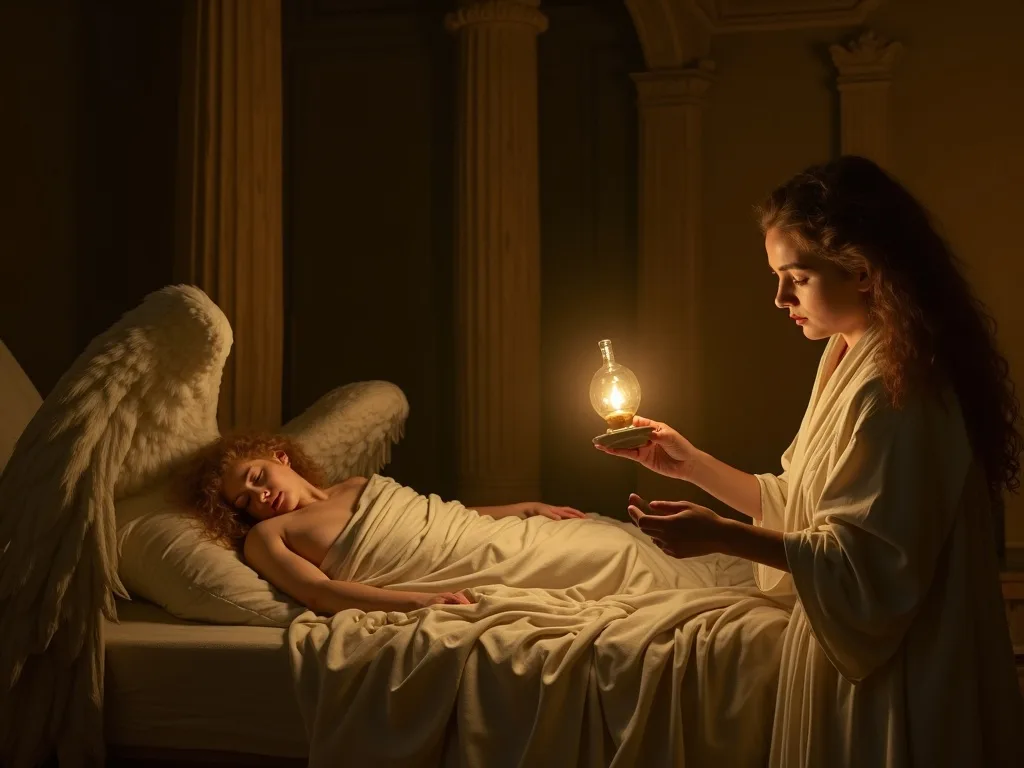
She holds the flame over the sleeping figure, ready for a monster, and she sees Eros himself. The god of love, with golden hair, white wings folded against his back, a quiver of arrows resting on the floor beside him. He is young. He is luminous. He is the most beautiful thing she has ever seen, which is saying something, given that she herself started a theological crisis.
She is so shaken that her hand trembles. A drop of hot oil falls from the lamp onto Eros's shoulder. He wakes. He looks at her, not with the fury she expects, but with something harder: grief. He tells her that love cannot live with suspicion. He spreads his wings and flies out the window.
The palace dissolves around her. She is alone on the grass.
Psyche's Search and Aphrodite's Four Trials
This is where the story turns from a fairy tale into something harder. Psyche does not sit and weep. She moves. She walks out into the world looking for Eros, knowing that Aphrodite will be between them, and she walks toward that confrontation anyway.
She tries first to find allies among the other gods. She kneels before Ceres (the Roman name Apuleius uses; in Greek, Demeter), goddess of grain. Ceres is sympathetic but cannot risk Aphrodite's anger. She sends Psyche away. Juno (Greek: Hera) does the same. No one will shelter a girl who has humiliated the goddess of love.
So Psyche presents herself to Aphrodite directly. The goddess is furious, yes, but she is also clever. She does not destroy Psyche outright. Instead she sets four tasks, each one calibrated to be impossible, each one meant to prove that this mortal is beneath her son.
The First Task: Sort the Grain. Aphrodite empties an enormous storeroom onto the floor: mountains of wheat, barley, millet, poppy seeds, lentils, all mixed together. Sort them, she says, by nightfall. An ant colony, taking pity on Psyche, organizes itself and does the work for her. Apuleius specifies the ants as instruments of divine favor, though some ancient commentators saw in them a symbol of the orderly, patient mind.
The Second Task: Fetch the Golden Fleece. Not Jason's fleece. A different challenge: Psyche must gather tufts of wool from a flock of violent, sun-maddened rams that graze by a river. They gore anything that approaches. A reed at the riverbank speaks to her, telling her to wait until midday, when the rams rest in the shade. Then she can gather the wool they have left snagged on the thorns and brambles along the fence. She does.
The Third Task: Fill a Crystal Vessel from the Source of the Styx. The river Styx, the boundary between the living and the dead, begins as a black waterfall high in the mountains, guarded by dragons. No mortal can approach it. An eagle, sacred to Zeus, takes the crystal vessel from Psyche's hands, fills it at the source, and returns it to her.
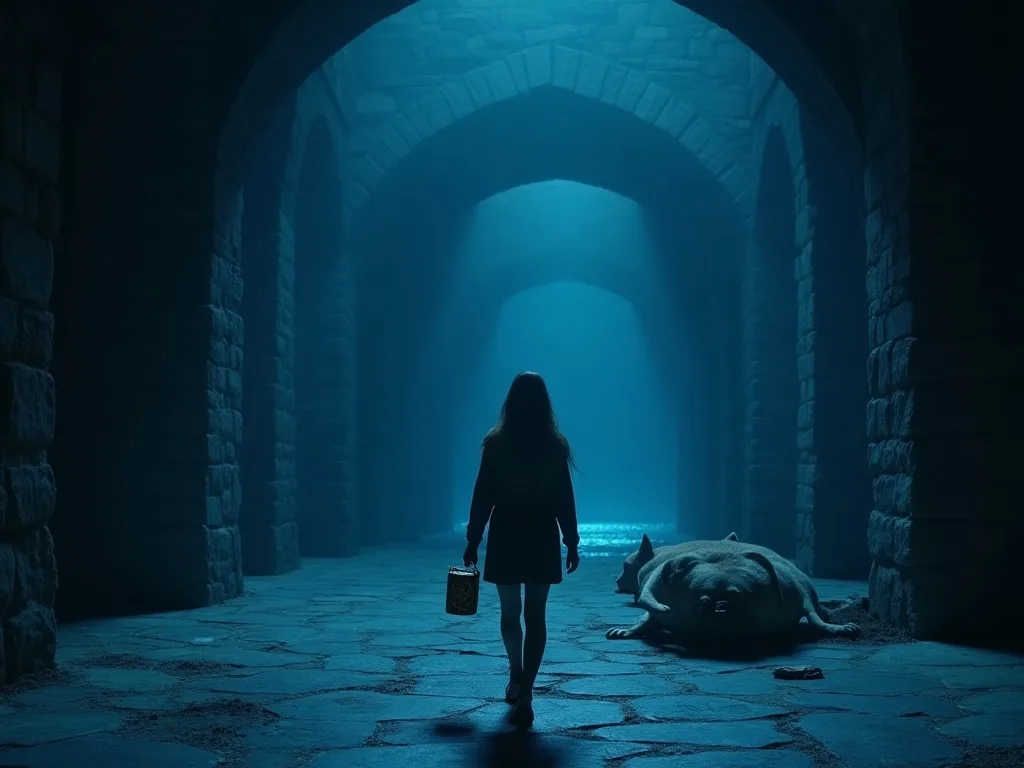
The Fourth Task: Descend into the Underworld. This is the cruelest. Aphrodite sends Psyche to the realm of Hades and Persephone with a small box and instructions to bring back a portion of Persephone's beauty ointment. No living mortal walks into the underworld and returns. This task is not difficult. It is meant to be fatal.
Psyche climbs a high tower, intending to throw herself from it, calculating that death is the only road to Hades. The tower speaks, as things do in this myth, and gives her exact instructions: the entrance at Taenarus in Laconia, the coin for the ferryman Charon, the bread-cakes to silence the three-headed dog Cerberus, how to refuse the pleas of the dying souls who will beg her for help, and most critically: do not open the box.
She does everything right. She descends. She bargains with Charon, silences Cerberus, receives the box from Persephone, and climbs back into the living world. She has done the impossible four times.
Then she opens the box.
The Box, the Sleep, and Eros's Choice
Why does she open it? Apuleius is precise about this. Psyche thinks: if she carries a little of Persephone's beauty ointment for herself, perhaps Eros will love her more when he sees her. It is a very human calculation. She has endured every trial through cleverness and courage, and she undoes herself through vanity, or longing, which in this myth are not quite the same thing.
The box contains not beauty but sleep, a dense, death-like unconsciousness. Psyche collapses on the road, motionless as a stone.
Eros, meanwhile, has been healing the burn on his shoulder in his mother's chambers, miserable, still in love. He slips out. He finds Psyche on the road. He wipes the sleep from her eyes and places it back in the box. He tells her that her curiosity will always be her downfall, which is a little rich coming from him, and he flies to Olympus to appeal to Zeus directly.
Zeus listens. He calls an assembly of the gods, reprimands Aphrodite for her extended cruelty (not harshly, but firmly), and declares that the marriage of Eros and Psyche is ratified on Olympus. Hermes brings Psyche up to the divine realm. Hebe, cupbearer of the gods, presses a cup of ambrosia to Psyche's lips. She drinks it. She becomes immortal.
The story ends with a child: a daughter born to Eros and Psyche on Olympus. Her name is Voluptas, meaning pleasure or joy.
What Apuleius Built: The Novel inside the Novel
The Golden Ass, also called Metamorphoses, is the only Latin prose novel to survive completely from antiquity. It follows Lucius, a young man accidentally turned into a donkey by a botched magic spell, through a series of chaotic adventures across Roman-era Greece. Apuleius frames the Eros and Psyche story as a fabula told by an old woman to distract a kidnapped noblewoman: a story about patience inside a story about misfortune.
This framing is not accidental. Apuleius was a North African Platonist philosopher, born around 124 AD in Madauros (present-day Algeria). He was genuinely interested in the mystery religions of his era, particularly the cult of Isis, which features prominently at the end of The Golden Ass. He almost certainly knew Greek philosophical interpretations of Eros and Psyche that were circulating in his time, readings that identified Psyche as the human soul, Eros as divine love, Aphrodite's tasks as the trials of earthly life, and the final apotheosis as the soul's philosophical ascent toward the divine.
Platonic philosophy, particularly as read through the Phaedrus and Symposium, treats Eros as the force that pulls the soul upward toward truth and beauty. The soul, winged in the Phaedrus, loses its wings through earthly embodiment. Psyche, whose name means soul, earns her immortality by enduring trials that strip away pride, fear, and finally the vanity of the opened box.
The Neoplatonist philosopher Plotinus, writing a century after Apuleius, described the soul's journey toward the One using imagery that overlaps almost exactly with the structure of Psyche's trials. Whether Apuleius was consciously encoding Platonic philosophy into a folk tale, or working from a tradition that had already fused the two, remains a genuine scholarly debate. The classicist Erich Neumann, in his 1952 psychoanalytic study Amor and Psyche, argued that Apuleius was doing both simultaneously.
The Myth's Greek Roots: What Came Before Apuleius
Apuleius is our most complete source, but he was not working in a vacuum. Greek vase paintings from as early as the 4th century BC show Eros and Psyche together, often as butterfly-winged figures. The butterfly connection is important: psyche in Greek meant both "soul" and "butterfly," and the butterfly's transformation from larva to winged creature mapped perfectly onto the soul's journey. Terracotta figurines showing a winged female figure, clearly Psyche, survive from Hellenistic sites across the Mediterranean.
The mythographer Hyginus (1st century AD) references Eros and Psyche in his Fabulae, in summary form, confirming that the story circulated independently before Apuleius. The philosopher Maximus of Tyre, a contemporary of Apuleius, mentioned Psyche as an allegory for the soul without needing to explain who she was, which suggests the audience knew the story already.
Aphrodite herself had a much older genealogy, reaching back past Homer to Near Eastern traditions, probably to the Sumerian goddess Inanna and the Phoenician Astarte. Her role as divine antagonist in this story connects to a much wider pattern in ancient mythology: the goddess of love as a destructive, demanding force as much as a generative one. Apuleius's Aphrodite is petty and cruel, yes, but she is also, in the Platonic reading, the representative of earthly desire, the kind of love that chains rather than frees.
Cross-Mythological Echoes: The Forbidden Look, the Absent God
The core structure of the Eros and Psyche myth repeats itself across mythologies in ways that are either independently invented or evidence of very deep cultural exchange. Two structural elements recur most often: the prohibition against looking, and the absent divine spouse.
In Norse mythology, the god Odin appears in disguise repeatedly, and looking too clearly at his true nature carries a price. The Valkyrie Brynhildr, cursed to sleep until a hero reaches her, mirrors the sleeping Psyche. In the Mahabharata, the river goddess Ganga makes her husband promise never to question her actions, a prohibition whose breaking destroys the marriage, structurally identical to Psyche's broken promise. In the Japanese myth of Izanagi and Izanami, Izanagi descends to the underworld to find his dead wife, and she tells him not to look at her. He lights a torch. He looks. She is rotting. He flees. The prohibition, the lamp, the revelation, the flight: the sequence maps onto Eros and Psyche in reverse, with the mortal playing the god's role.
Eros and Psyche (Greek/Roman)
Psyche lights the lamp, looks at the divine Eros, and spills hot oil. Eros flees upward, into the divine realm. Psyche must then perform impossible tasks in the earthly world to regain what she lost. The story ends with ascent and deification.
Izanagi and Izanami (Japanese)
Izanagi lights a torch and looks at the divine (now rotting) Izanami in the underworld. Izanami pursues him in fury. Izanagi flees upward, back into the living world, and seals the entrance to the underworld with a great stone. The story ends with permanent separation.
The contrast is stark. In the Greek tradition, the forbidden look destroys intimacy but opens the road to a higher love. In the Japanese tradition, the forbidden look reveals death and ends in permanent rupture. Two mythologies use identical structural grammar to reach opposite conclusions about mortality and the divine.
The beauty-and-the-beast structure, which the Eros and Psyche myth essentially invents in its complete form, resurfaces in European folklore in "Beauty and the Beast" (first published by Villeneuve in 1740 and refined by Beaumont in 1756), in Norse folktales about cursed princes, and in Celtic stories of seal-wives and swan-maidens. The folklorist Bruno Bettelheim, in The Uses of Enchantment (1976), argued that all such tales work through the same developmental anxiety: the terror of seeing and being seen fully in love.
Psyche's Curiosity as Virtue, Not Flaw
A common misreading of this myth treats Psyche's curiosity as simple disobedience, a character flaw she must atone for. Apuleius himself muddies this water by calling it curiositas, a Latin word that carried genuinely negative moral freight in Roman thought. But the structure of the story argues against this reading.
Psyche's curiosity is what drives her through every task. She does not sit passively in the ruined palace and wait for Eros to return. She acts. She goes to Ceres, to Juno, to Aphrodite herself. She descends into the underworld. Every trial she passes through is powered by the same intellectual energy that made her pick up the lamp in the first place. Her problem is never that she looks too hard. It is that at the end, exhausted and uncertain, she looks for the wrong reason: to make herself more beautiful, to secure Eros's love through appearance rather than through what she has become.
The classicist Julia Haig Gaisser, in her work on Apuleius, notes that Psyche's final mistake is not a repetition of the first but its inversion. The first look was an act of courage (even if misplaced). The last was an act of insecurity. Both have consequences. Both also lead, eventually, to transformation. The story does not punish curiosity. It rewards its properly directed version.
Eros in the Story: God as Lover, Lover as Teacher
Eros in this myth is not the chubby infant of Renaissance painting. He is the primordial Eros of Hesiod's Theogony (written around 700 BC), named as one of the first forces to emerge from Chaos itself, alongside Gaia and Tartarus. He predates the Olympians. He is older than Aphrodite, even if later myths made him her son.
In the Eros and Psyche story, he is both son and lover: Aphrodite's son by convention, Psyche's husband by choice. His decision to appeal to Zeus rather than submit to his mother's authority is a genuine act of filial rebellion, and Apuleius does not soften it. Eros contradicts Aphrodite in public, at a divine assembly, insisting that his choice of a mortal bride is binding.
His behavior during Psyche's trials is harder to defend. He does not help her. He heals in his mother's chambers while she sorts grain and walks into the underworld. Some readers find this passive; others read it as the structure the myth requires. Psyche must pass the trials herself. An Eros who intervenes would make her ascent to immortality a gift rather than an achievement. The fact that she earns her apotheosis through her own labor is exactly the point.
He finds her at the end, on the road, not because she calls for him but because his love is real and she has fallen. He wipes the sleep from her eyes. This small gesture, after all her labor, is the most intimate moment in the entire story.
The Myth's Life in Art and Literature
The story of Eros and Psyche became one of the most frequently depicted myths in Western art. The 2nd-century marble group Cupid and Psyche (Capitoline Museums, Rome), showing Eros lifting the unconscious Psyche, became the template for Canova's famous 1793 marble Psyche Revived by Cupid's Kiss (now in the Louvre). Both sculptures focus on the same moment: the body of Psyche held by the winged god, the borders of death and life and love all overlapping.
John Keats wrote his Ode to Psyche in 1819, making the myth explicitly about the act of worship itself: he builds a shrine to Psyche in his own mind, in a grove "in some untrodden region of my mind." C.S. Lewis retold the myth in his 1956 novel Till We Have Faces, told from the perspective of Psyche's sister Orual, radically reframing the story around jealousy, love, and the problem of seeing the divine.
In film, the structural bones appear in every Beauty and the Beast adaptation (including the 1946 Jean Cocteau film and the 1991 Disney version), as well as in stories about mortal-divine marriages where the mortal must prove worth through ordeal.
The myth also lives inside psychology. Carl Jung identified Psyche as an archetype of the anima, the feminine soul-principle in the male unconscious, and the trials as the individuation process: the work of becoming fully oneself. James Hillman, in The Myth of Analysis (1972), used the Psyche myth as the founding narrative for a soul-centered approach to psychological practice.
Frequently asked questions about Eros and Psyche
Frequently asked questions
What is the original source of the Eros and Psyche myth?
The most complete ancient source is Apuleius's The Golden Ass (also titled Metamorphoses), written around 160 AD in Latin. Apuleius was a Roman-era North African philosopher who embedded the story inside a larger prose novel. Greek antecedents existed in oral tradition and are referenced by the mythographer Hyginus and the philosopher Maximus of Tyre, both roughly contemporaries of Apuleius, but no complete Greek version survives in text. Vase paintings and terracotta figurines confirm the myth circulated in visual culture from at least the 4th century BC.
Why does Eros hide in darkness and forbid Psyche to look at him?
Apuleius gives a practical reason: Eros knows his mother Aphrodite would end the marriage if she found out who Psyche's husband was. But the prohibition also carries deep mythological weight. In the Platonic reading that Apuleius almost certainly encoded, divine love cannot be grasped by ordinary perception. Psyche must learn to love in the dark, by faith and voice and touch, before she is ready to see. The forbidden look is less a rule and more a description of the soul's limits before it has done its work.
What do the four tasks Aphrodite sets for Psyche represent?
Ancient Platonic and Neoplatonic interpreters read the four tasks as stages of the soul's purification. Sorting the grain represents the mind learning to distinguish and categorize. Gathering the golden fleece represents acquiring virtue through patience rather than force. Filling the crystal vessel from the Styx represents the soul confronting death and cosmic law. Descending to the underworld represents the final confrontation with mortality itself. Each task is impossible for a mortal without divine assistance, which Apuleius provides through nature (ants, a reed, an eagle, a tower), suggesting that the world itself helps a soul that moves with genuine purpose.
Why does Psyche open the box from the underworld if she knows she shouldn't?
Apuleius is explicit: Psyche opens the box because she wants some of Persephone's beauty ointment for herself, hoping to please Eros when they are reunited. After enduring four impossible tasks through courage and cleverness, she undoes herself through insecurity, specifically the fear that she is not enough. The scene works as a precise counterpart to the lamp: both acts involve taking something she should not take in order to see or be seen better. In both cases, the consequence is collapse. In both cases, Eros eventually comes.
Is there a real connection between Eros and Psyche and the Beauty and the Beast tale?
The structural link is genuine and well-documented in folklore studies. The 18th-century French tale "Beauty and the Beast" by Villeneuve (1740) and Beaumont (1756) follows the same core sequence: a young woman taken to live with a frightening or invisible creature, a prohibition that is broken through doubt rather than malice, separation, and eventual reunion through the woman's active choice to love rather than fear. Bruno Bettelheim, in The Uses of Enchantment (1976), traced this structural family explicitly. The scholars Jan Ziolkowski and Walter Crane have also mapped the transmission lines between the Apuleius text and Western European fairy tale traditions.
Does Psyche become a goddess at the end of the myth?
Yes. In Apuleius's telling, Zeus calls an assembly of the gods and declares the marriage of Eros and Psyche legitimate. Hermes escorts Psyche to Olympus, where she drinks ambrosia from a cup offered by Hebe and becomes immortal. She and Eros have a daughter named Voluptas, meaning joy or pleasure. The apotheosis is not an afterthought: it is the whole point of the myth, the argument that the soul, through genuine ordeal and genuine love, can transcend its mortal condition entirely.
The Myth That Still Has No Settled Reading
Two thousand years on, classicists, psychologists, and literary scholars continue to argue about what the Eros and Psyche love story is fundamentally about. That is not a sign of the myth's obscurity. It is a sign of its depth.
The Platonic reading, that Psyche is the soul working toward union with divine love, has the most ancient authority behind it. Apuleius was a Platonist, and the allegory is coherent and precise. But it does not exhaust the story. The Jungian reading, in which Psyche represents a feminine consciousness individuating through ordeal, adds a psychological architecture that the Platonic reading does not fully supply. C.S. Lewis's reading, in which Orual (the sister who gave Psyche the lamp) is the real protagonist, the one who loves too possessively, too blindly, too humanly, opens a moral dimension that neither Apuleius nor Plato foregrounds.
What none of these readings can fully account for is the tenderness of the myth's emotional core. Eros, a god who has the power to simply command or enchant, falls in love by accident. He chooses Psyche against his mother's direct orders. He waits for her, badly, but he waits. She endures four impossible tasks for a husband she broke faith with once. At the end, she lies unconscious on a road, and he wipes the sleep from her eyes.
That moment is not allegory. It is not philosophy. It is just love: the kind that finds the other person on the side of a road after everything has gone wrong, and reaches down.
The myth of Eros and Psyche survives because it tells the truth about what desire becomes when it survives long enough: not the first arrow, the hot oil, the collapsed palace. Not even the god at the window with his golden wings. Just a hand reaching out on a road, and the dark dropping away.
Free 25-page sample
Want the whole story?
Take the first 25 pages free. If it pulls you in, the full edition is yours as an instant PDF download, with a paperback on Amazon for selected titles.

Mythology
The World Mythology Book: The Gods, Heroes and Myths of Every Culture
The Gods, Heroes and Myths of Every Culture, in One Volume
The whole of world mythology in a single volume: Greek, Norse, Egyptian, Japanese, Hindu, Celtic, Slavic, Mesoamerican and African myths gathered side by side, each drawn from the primary sources.