
The Fall of Troy and the Wooden Horse: The Complete Story
Ten years of war. One hollow horse. The fall of Troy reshaped the ancient Greek imagination forever, and the story still burns with betrayal, cunning, and fire.
Contents
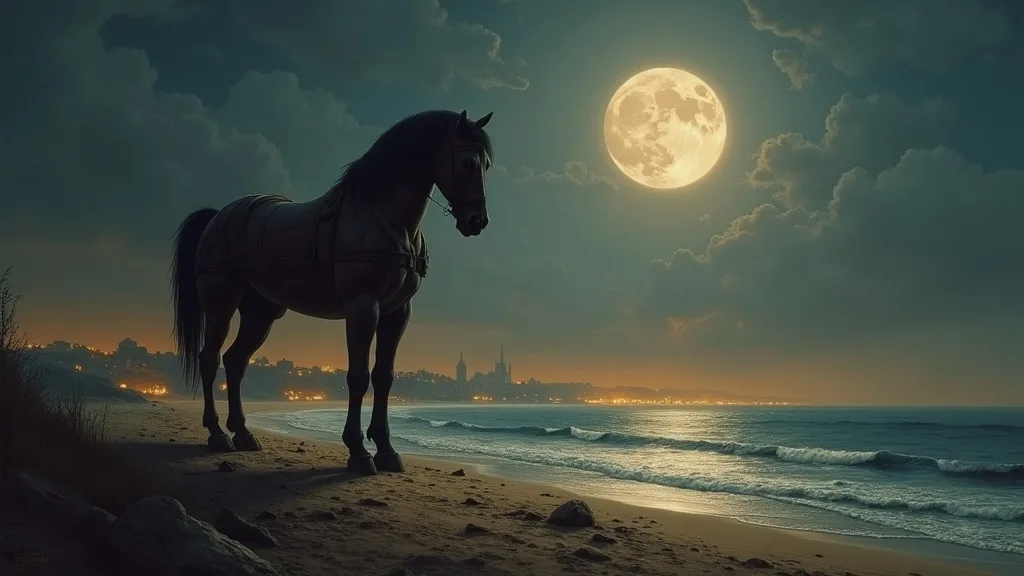
The night was quiet on the Trojan plain. The Greek ships were gone. The great encampment that had scarred the beach for ten years had vanished, leaving only ash and trampled earth. On the sand, facing the city walls, stood a single object: a wooden horse the size of a small temple, its flanks smooth, its eyes painted dark, a votive inscription carved into its side dedicating it to Athena.
The Trojans came out of their gates for the first time in a decade. They walked around the horse, touched its legs, argued about what to do with it. Some wanted it burned. One man threw a spear at its belly. Inside, pressed against each other in the dark, the greatest Greek warriors held their breath.
The fall of Troy did not come from a battering ram or a siege tower. It came from a gift.
Ten Years Before the Horse: Why Troy Was at War
To understand the horse, you need to understand the rage that built it. The Trojan War began with a wedding gift gone wrong.
At the marriage of the sea-goddess Thetis and the mortal Peleus, the goddess Eris (goddess of strife, and the only Olympian not invited) rolled a golden apple into the banquet hall. The apple was inscribed: "For the fairest." Three goddesses reached for it at once: Hera, queen of the gods; Athena, goddess of wisdom and war strategy; and Aphrodite, goddess of love and desire.
Zeus refused to judge between them. He sent the three goddesses to Mount Ida, near Troy, where a young Trojan prince named Paris was tending his father's flocks. Each goddess offered him a bribe. Hera promised power over kingdoms. Athena promised unmatched skill in battle. Aphrodite promised the most beautiful woman in the world.
Paris chose Aphrodite.
The most beautiful woman in the world was Helen, queen of Sparta, already married to King Menelaus. Paris sailed to Sparta, accepted Menelaus's hospitality, and then sailed home with Helen, taking much of the Spartan treasury with him. Whether Helen went willingly or was taken by force is a question the Greeks themselves argued for centuries. The poet Stesichorus, writing around 600 BC, went so far as to insist Helen never went to Troy at all, that only a phantom did, while the real Helen waited out the war in Egypt.
Menelaus called on every Greek king who had once competed for Helen's hand. Years earlier, the suitors had sworn an oath, devised by the clever Ithacan king Odysseus, to defend whichever man married her. Now that oath came due. A coalition of Greek forces gathered under Menelaus's brother, Agamemnon, king of Mycenae.
The Iliad, the great poem attributed to Homer (composed around the 8th century BC but drawing on much older oral tradition), picks up the war in its tenth and final year. The poet wastes no time on the cause: he opens in the middle of a quarrel between Agamemnon and Achilles, the greatest Greek warrior, over a captive woman. That quarrel drives the poem's engine. Achilles withdraws from battle. The Trojans push the Greeks back to their ships. Then Achilles's beloved companion Patroclus dies at the hand of Hector, Troy's greatest defender.
Achilles returns. He kills Hector. He drags the body around the walls of Troy behind his chariot.
The Iliad ends there, with Hector's funeral rites. Troy is still standing.
What the Iliad Leaves Out: The Cycle After Hector
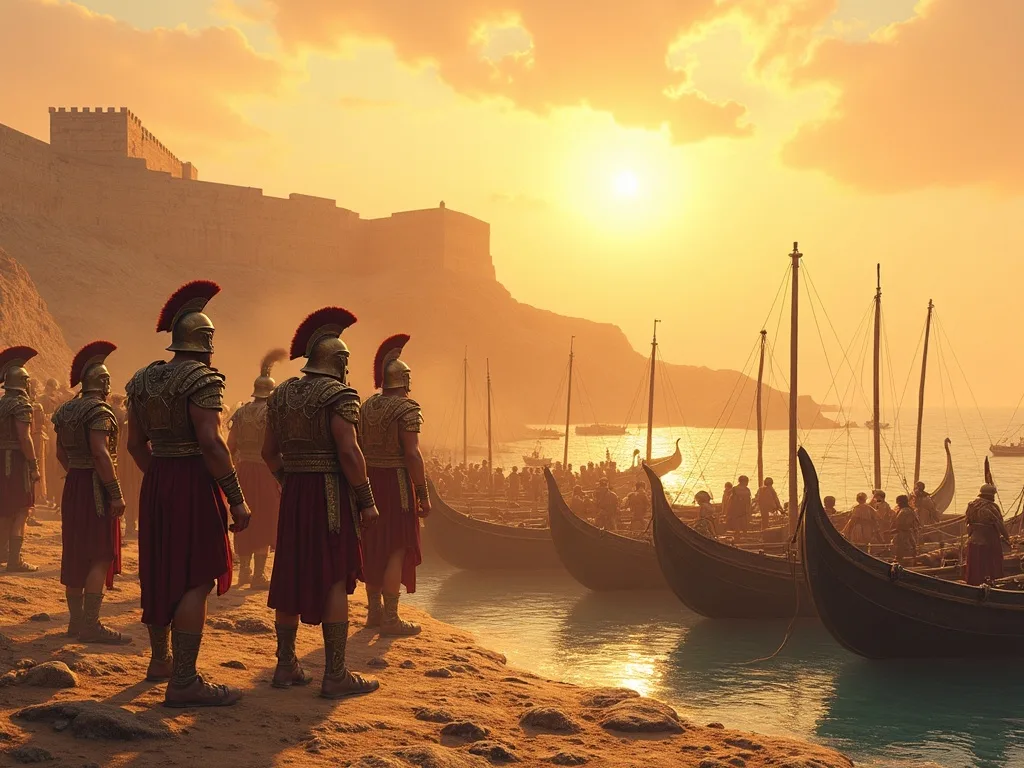
The months after Hector's death are covered not by Homer but by a series of later poems collectively called the Epic Cycle. Most of these poems survive only in summary form, recorded by a compiler named Proclus around the 2nd century AD. They tell what Homer skipped.
After Hector's death, Troy received two powerful allies. The first was Penthesilea, queen of the Amazons, a tribe of warrior women who fought on horseback. She was killed in single combat by Achilles. The second was Memnon, son of the dawn goddess Eos and king of Ethiopia, who brought an army from the east. He killed Patroclus's father Antilochus before Achilles killed him in turn.
Then the arrow came.
Paris, who had started the whole war with his choice on Mount Ida, shot Achilles through the heel, the one point where Achilles was vulnerable. The arrow was guided by Apollo, the god who had favored Troy throughout the war. Achilles died on the Trojan plain.
Without Achilles, the Greeks stalled. Two prophecies stood between them and Troy. First, Troy could not fall while it possessed the Palladium, a sacred wooden statue of Athena that had supposedly fallen from the sky. Second, the city could not fall without the bow and poisoned arrows of Heracles, which had passed to a warrior named Philoctetes, whom the Greeks had abandoned on the island of Lemnos nine years earlier because of a festering wound.
Odysseus retrieved the Palladium by sneaking into Troy in disguise, a story the Odyssey references briefly when Helen tells it at dinner years later. He also sailed to Lemnos to bring back Philoctetes, an act dramatized in a surviving play by Sophocles. Philoctetes used Heracles's arrows to kill Paris.
Troy still stood.
It was then that Odysseus had his idea about the horse.
The Invention of the Horse: Whose Idea Was It Really?
Ancient sources give the credit to different people. The most widely accepted version, drawn from Virgil's Aeneid (a Latin epic written around 19 BC that picks up exactly where the Greek tradition leaves off), names a Greek warrior and craftsman named Epeus as the builder, working under Athena's guidance. Odysseus provided the plan.
The horse was enormous. It needed to be large enough to conceal roughly twenty to forty warriors inside its hollow belly (sources vary: Virgil gives the number as "the womb of a mountain"). It was built from fir wood, according to Virgil, and built fast. The Greeks worked for three days.
Then they did something audacious. The entire Greek fleet sailed away. Not out of sight around a headland, but fully, ostentatiously gone. From Troy's walls, the Trojan lookouts saw empty water. The beach was abandoned. The encampment was burned. After ten years of siege, the enemy had simply left.
They had left the horse.
And they had left one man behind on purpose.
Sinon and the Art of the Perfect Lie
Sinon is one of the most brilliantly conceived characters in classical literature. He is barely remembered outside specialist circles, but without him the horse fails completely.
Sinon was a Greek soldier who allowed himself to be "captured" by the Trojans when they came out to investigate the horse. His story, as Virgil records it in detail, was this: the Greeks had planned to sacrifice him to guarantee their safe voyage home. He had escaped, he said. He hated Odysseus, who had arranged the sacrifice. He was a deserter, willing to betray everything.
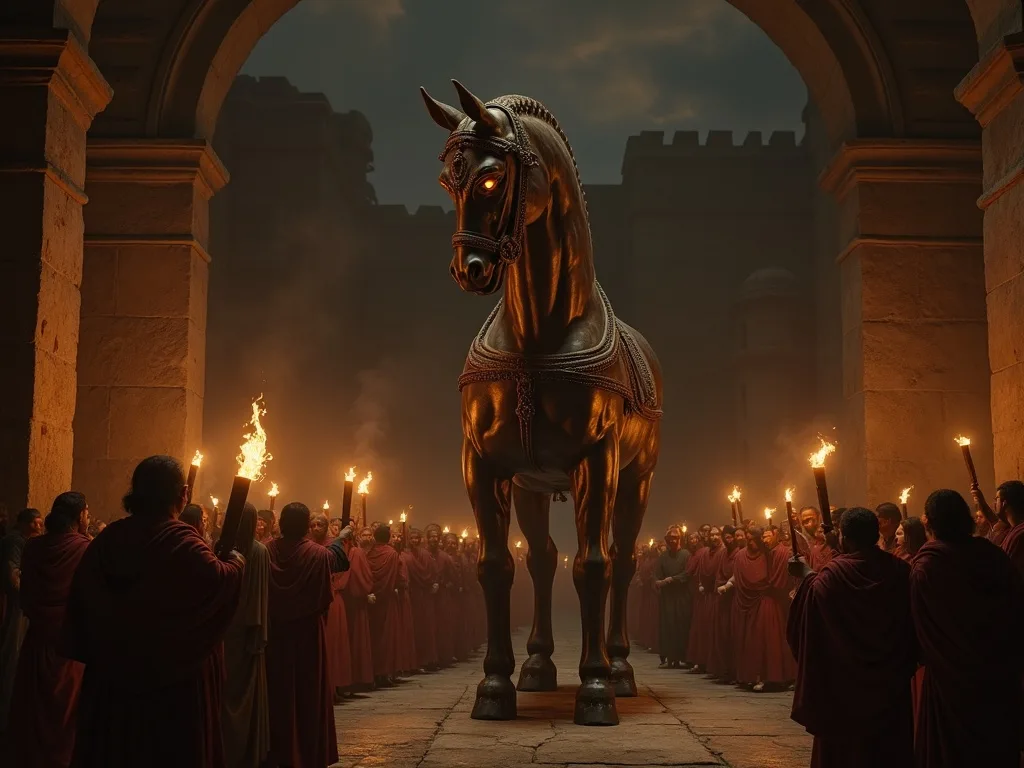
The Trojans believed him. He answered every question they had about the horse. It was an offering to Athena, he explained, built as atonement for the theft of the Palladium. It was built deliberately large so the Trojans couldn't drag it through their gates, because the Greeks feared that if Troy ever possessed it, the city would become invincible. If they destroyed it, divine punishment would fall on Troy. If they brought it inside their walls, Troy would be protected forever.
This was a lie constructed with extraordinary care. Every element addressed a Trojan fear or desire. Every answer closed off the obvious objection. Sinon had been coached by Odysseus, the man the Iliad calls polytropos, "of many turns," meaning a mind that bends around every obstacle.
Two people saw through the lie. One was Cassandra, daughter of the Trojan king Priam, a prophet cursed by Apollo to speak truth that no one would believe. She screamed that the horse was full of armed men. The Trojans ignored her. The other was the priest Laocoon, who hurled his spear at the horse's flank and shouted his famous warning: "I fear the Greeks, even bearing gifts" (timeo Danaos et dona ferentes in Virgil's Latin, which is where the phrase "beware of Greeks bearing gifts" comes from).
Then the sea intervened.
Two enormous serpents swam in from the ocean and crushed Laocoon and his two sons to death in front of the assembled Trojans. The Trojans took this as divine punishment for his impiety toward the sacred offering. They widened their gates. They built a ramp. They dragged the horse inside.
That night, they held a celebration. Ten years of war was over.
The Night Troy Burned
Sinon waited until Troy was asleep. Then he walked to the horse and gave the signal. A trapdoor or a rope, depending on the source. The warriors inside dropped to the ground, one by one.
Virgil names some of them in the Aeneid: Neoptolemus (the son of Achilles, fighting his first battle), Menelaus, Diomedes, Sthenelus, Thoas, Machaon, and Odysseus himself. Odysseus was the last one out, according to some traditions, still checking that everyone had moved safely.
The Greeks opened the city gates from inside. The fleet, which had only sailed to the nearby island of Tenedos, rowed back through the darkness. The rest of the Greek army streamed in.
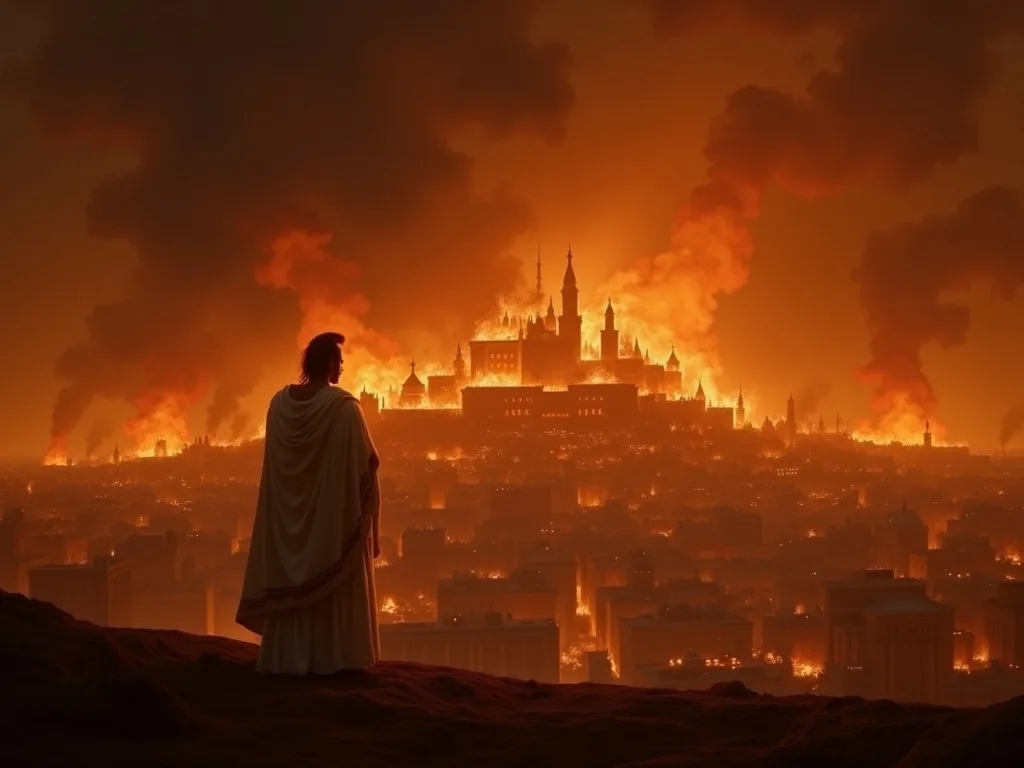
What followed was a massacre. This is not softened in the ancient sources. The Iliad's heroes, reading the Aeneid, become monsters for a night. Neoptolemus killed the aged king Priam at the altar of Zeus, an act of sacrilege that shocked even other Greeks. He also killed Priam's grandson Astyanax, Hector's infant son, throwing him from the city walls to prevent any future Trojan revenge. Menelaus found Helen and raised his sword, then looked at her face and lowered it again. She went home to Sparta.
Cassandra was dragged from the temple of Athena by the Greek commander Ajax (the Lesser Ajax, son of Oileus, not the great Ajax who had carried Achilles's body off the battlefield). This act of sacrilege inside Athena's own sanctuary angered the goddess so deeply that she punished the entire Greek fleet on its way home. Storms scattered the ships. Most of the heroes who survived Troy died trying to get back.
Odysseus wandered for ten years. Agamemnon reached home and was murdered in his bath by his wife Clytemnestra. Menelaus was blown to Egypt.
Troy was ash by morning.
Explore how Odysseus navigated his cursed journey home
What the Horse Meant to the Greeks Who Told the Story
A hollow horse filled with soldiers is, on the surface, a military tactic. But the Greeks were not primarily interested in it as a case study in deception. They were interested in it as a symbol of Odysseus, the man who invented it.
Greek culture had a deep ambivalence about cleverness. Achilles represents one pole: pure, violent, honorable, straightforwardly deadly. Odysseus represents the other: indirect, inventive, willing to lie, surviving by wit where Achilles survives by strength. The Iliad keeps these two poles in tension. Achilles gets the glory. Odysseus gets home.
The wooden horse is Odysseus at his most distilled. The Aeneid's Sinon episode is essentially a portrait of how intelligence works as a weapon: you do not attack the enemy's fortress, you attack the enemy's reasoning. You give them a story that makes it irrational to be suspicious. You make their own desire for safety into the knife that kills them.
Read more about Odysseus and the art of the cunning hero
The Romans, who inherited this story via Virgil, had a complicated relationship with it. Virgil's Aeneid tells the fall of Troy from the Trojan side, through the eyes of Aeneas, a Trojan prince who escapes the burning city carrying his elderly father on his back and leading his young son by the hand. For Virgil, Troy's fall is not a Greek triumph but a Trojan tragedy from which Rome eventually grows. The horse is not clever; it is a horror.
This shift in perspective is one of the most interesting moves in ancient literature. The same event, told from the other side, becomes a different story entirely.
Cross-Mythological Echoes: The Hollow Container of Fate
The Wooden Horse belongs to a family of mythological images that appear across cultures: the hollow object that conceals a transforming power.
In Hindu tradition, the god Vishnu takes the form of a fish to rescue the sacred Vedas, which are hidden inside a demon. The container protects what will eventually destroy the threat. In Norse myth, Odin hides inside the hall of the giant Suttungr to steal the mead of poetry, a liquid that grants divine inspiration. He escapes by transforming into a bird, a shape-shift that parallels the Greek horse's own transformation from object to army.
The story of Gideon in the Hebrew Bible's Book of Judges offers a structural parallel so close it has attracted scholarly attention. Gideon's three hundred warriors hide clay jars concealing torches. At the signal, they smash the jars simultaneously, revealing fire in the dark, and the enemy army panics and destroys itself. Concealment followed by sudden revelation followed by total destruction of the enemy.
What links these stories is not borrowing but a shared logic: the decisive moment in a great conflict arrives not through superior force but through a reversal of expectation. The enemy's confidence becomes their weakness. The Greeks spent ten years trying to take Troy by strength. One night of theater did what ten years of war could not.
See how divine tricksters operate across world mythology
Troy in Time: Was There a Real City?
For most of the 19th century, educated Europeans assumed Troy was a poet's invention. Then, in 1871, a German businessman named Heinrich Schliemann began excavating a mound called Hisarlik in northwestern Turkey. What he found stunned the scholarly world: not one Troy but nine, built on top of each other across three thousand years.
The layer archaeologists now designate as Troy VII-a (sometimes written Troy VIIa) shows evidence of violent destruction around 1180 BC. That date falls within the range when the Trojan War is traditionally placed. Burned timbers. Unburied bodies. Arrowheads. A city that ended abruptly and badly.
This does not prove the war happened as Homer described it. Homer himself was composing roughly 400-500 years after the destruction of Troy VII-a, drawing on oral tradition that had been passed down and shaped over centuries. The archaeologist Manfred Korfmann, who excavated Hisarlik from 1988 until his death in 2005, argued that the real Troy was significantly larger than previously thought, a regional power with a lower city housing several thousand people. A city worth fighting over.
The wooden horse itself is almost certainly a mythological elaboration. No wooden horse appears in any physical record from Bronze Age warfare. Some scholars, including the classical historian Michael Wood, have proposed that the horse may encode a memory of actual events: a siege device shaped like a horse (the Greek word for a battering ram, krios, means "ram" as in the animal, and siege terminology borrowed animal names), or a ship's figurehead used in some ruse, or simply the collapse of Troy through earthquake (Poseidon, who causes earthquakes, was called the "horse god"). None of these explanations has achieved consensus.
What is certain is that the story is very old. Linear B tablets, written in an early form of Greek around 1200 BC, contain personal names that appear in the Iliad. The tradition of a great war against a city across the Aegean was alive close to the time when such a war might actually have happened.
Frequently asked questions about the fall of Troy and the wooden horse
Frequently asked questions
Is the wooden horse mentioned in Homer's Iliad?
No. The Iliad ends before Troy falls, with the funeral of Hector. The wooden horse appears in the Odyssey (Book 8 and Book 11, as references in songs sung by the bard Demodocus and recalled by Odysseus himself), in the lost epic the Little Iliad (known through Proclus's summary), and most fully in Virgil's Aeneid, Book 2, where Aeneas recounts the night of Troy's fall to the Carthaginian queen Dido.
Who built the wooden horse?
According to Virgil's Aeneid and the fragments of the Little Iliad, the horse was built by the craftsman Epeus (also spelled Epeius), working under the guidance of Athena. The plan was devised by Odysseus. Epeus is otherwise obscure in Greek myth but is mentioned in passing in the Iliad as a skilled boxer.
How many Greeks were inside the wooden horse?
Sources disagree. Virgil suggests a number large enough to fill "the womb of a mountain," which has led to estimates of twenty to forty men. The mythographer Apollodorus, writing around the 1st or 2nd century AD, gives a list of names that totals around twenty-three warriors. Quintus of Smyrna, in a late epic called the Posthomerica (3rd or 4th century AD), lists twenty names. No source claims a precise number with authority.
What happened to the main Greek heroes after Troy?
Almost none of them had easy homecomings. Agamemnon was murdered by his wife Clytemnestra on the night he returned to Mycenae. Ajax the Lesser drowned after Poseidon destroyed his ship for the sacrilege against Athena's temple. Diomedes returned home to find his wife had been unfaithful and eventually settled in Italy. Odysseus wandered for ten years, facing monsters, gods, and his own crew's mistakes, before finally reaching Ithaca. Only Menelaus and Helen, blown to Egypt by storms, eventually returned safely to Sparta.
Was the Trojan War a real historical event?
Archaeological evidence at Hisarlik in northwestern Turkey confirms that a city matching the general description of Troy existed and was violently destroyed around 1180 BC, a date that aligns with traditional estimates for the war. Whether the conflict involved a coalition of Greek kingdoms, a Helen, or a horse is impossible to establish from physical evidence. Most classical historians today treat the Trojan War as containing a kernel of historical memory, possibly a genuine conflict over trade routes through the Dardanelles, heavily layered with myth over centuries of oral retelling.
Who warned the Trojans about the horse?
Two figures gave warnings that went unheeded. Cassandra, daughter of King Priam, was a prophet cursed by Apollo so that no one would believe her true predictions. She declared the horse was full of soldiers. The priest Laocoon also warned the Trojans and threw his spear at the horse's flank. Shortly after, two sea serpents emerged from the water and killed Laocoon and his two sons. The Trojans interpreted this as divine punishment for impiety and brought the horse inside the walls. The Laocoon episode is also immortalized in a famous Hellenistic sculpture group found in Rome in 1506, now housed in the Vatican Museums.
The Wooden Horse After Troy: How the Story Kept Building
The fall of Troy did not end when the fires went out. It became the starting point for almost everything that came after in classical literature, a fixed star that other stories navigated by.
Virgil wrote the Aeneid around 19 BC specifically to give Rome a Trojan origin. Aeneas, carrying his father and leading his son through the burning streets while his wife Creusa is lost in the smoke behind him, becomes the ancestor of Romulus and Remus. Troy's destruction makes Rome possible. The wooden horse thus sits at the root of Roman civilization in Virgil's telling, a dark seed from which an empire grows.
Dante placed Odysseus in Hell, in the eighth circle, among those punished for fraud. The wooden horse is the crime: a deception so effective it destroyed a city. Medieval Europe, which inherited Troy through Latin translations and adaptations rather than through Greek, generally sided with the Trojans. The English, the French, the Franks all invented Trojan ancestry for themselves in the Middle Ages, viewing the Greeks as the aggressors and the horse as a war crime.
Shakespeare used the Trojan War twice. In Troilus and Cressida, he wrote one of his darkest plays, stripping the heroes of their heroism and showing the war as a squalid affair driven by pride and lust. In The Rape of Lucrece, the wooden horse appears in a painting that the violated Lucrece stares at, finding her grief mirrored in Troy's.
The phrase "Trojan horse" has now fully detached from its myth. It names a category of malware that disguises itself as legitimate software, an enemy hiding inside an apparently useful gift. The metaphor proved durable because the psychological mechanism it describes is universal: trust exploited, appearance weaponized, a danger concealed inside the familiar.
The actual horse, made of fir wood and carpenter's ingenuity, burned with Troy or rotted on the beach. The idea of it has never stopped moving.
Free 25-page sample
Want the whole story?
Take the first 25 pages free. If it pulls you in, the full edition is yours as an instant PDF download, with a paperback on Amazon for selected titles.

Mythology
The World Mythology Book: The Gods, Heroes and Myths of Every Culture
The Gods, Heroes and Myths of Every Culture, in One Volume
The whole of world mythology in a single volume: Greek, Norse, Egyptian, Japanese, Hindu, Celtic, Slavic, Mesoamerican and African myths gathered side by side, each drawn from the primary sources.