
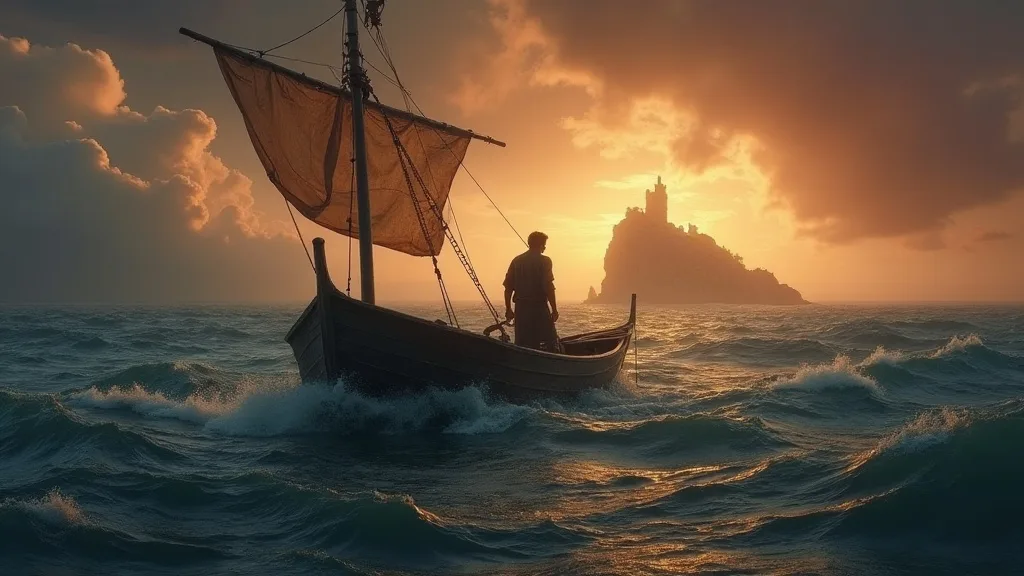
Odysseus: Hero of the Odyssey
Cunning, restless, and indestructible in will, Odysseus spent ten years trying to reach home. His story is not just about survival. It is about what it costs a man to remain himself.
Contents
The ships have left Troy in ashes. Ten years of war, and now the Greek heroes scatter across the Aegean like seeds from a broken pod. Most of them reach home within weeks. Odysseus does not reach his for another ten years.
He is not the strongest warrior at Troy. Not the tallest, not the most beautiful. Odysseus, hero of the Odyssey, is something rarer: the cleverest man in any room he enters. Homer calls him polytropos, a Greek adjective meaning "man of many turns," someone who bends with every circumstance and bounces back. That quality will save his life dozens of times. It will also cost him everything, again and again, before the last page of his story is turned.
The Odyssey, composed by Homer around 700 BC and one of the oldest complete narratives in Western literature, follows Odysseus across ten years and a dozen strange lands. But it is worth pausing before the monsters and the magic to ask: who was this man before the war? Where did he come from, and what did ancient Greeks actually believe about him?
The Origins of Odysseus: King of Ithaca
Odysseus was born on Ithaca, a rocky island off the western coast of Greece. His father was Laertes, king of the island, and his mother was Anticlea, daughter of the trickster Autolycus. That maternal grandfather matters. Autolycus was a renowned thief and oath-breaker, blessed by Hermes with the gift of cunning. Ancient Greeks traced Odysseus's slipperiness directly to Autolycus's bloodline.
Some traditions, recorded by later writers like Hyginus in his Fabulae (around 1st century AD), went further. They claimed that Sisyphus, the king condemned to roll a boulder up a hill for eternity, had seduced Anticlea before her marriage, making Odysseus the son of the craftiest mortal who ever lived. Homer himself never says this. But the rumor stuck, and in some versions of the myths, characters like Ajax hurled it at Odysseus as an insult.
Before the Trojan War, Odysseus was already known as the smartest king in the Aegean. He was the one who persuaded Achilles's mother to let her son go to Troy, tracking the young hero down where he hid disguised as a girl among women. He was the one who recruited Achilles with a clever ruse, placing weapons among gifts and watching which "girl" reached for the sword.
He married Penelope, a woman of extraordinary loyalty and intelligence who would prove his match in every way. Their son Ithymachus was only an infant when Odysseus sailed for Troy. When Odysseus finally came home, that boy was a grown man.
Troy, the Wooden Horse, and the Crime That Launched the Wandering
The Iliad, Homer's companion epic about the Trojan War, shows Odysseus as the best speaker in the Greek camp. He talks soldiers out of mutinies. He negotiates with kings. He ventures into the Trojan lines at night, on dangerous scouting missions described in Book 10, called the Doloneia. His tongue is as sharp as any spear.
But the act most associated with Odysseus at Troy does not appear in the Iliad at all. It comes from later sources, particularly Virgil's Aeneid (19 BC) and Quintus of Smyrna's Posthomerica (around 4th century AD): the Trojan Horse.
After ten years of siege, Odysseus proposed a trick. The Greeks would build a colossal wooden horse, hide their best warriors inside, and pretend to sail away in defeat. The Trojans, believing the horse a sacred offering, would drag it through their own walls. That night, the warriors would slip out and open the gates.
It worked. Troy burned. The Greeks won.
Here is the shadow side of that brilliance: the gods were watching. Poseidon, who had helped build Troy's walls, was furious. Athena, who had supported the Greeks throughout the war, was offended when Greek soldiers desecrated her temple during the sack of the city. She turned against them. She asked Poseidon and Zeus to send storms to scatter the Greek fleet going home.
Odysseus had also blinded Polyphemus, the Cyclops, who happened to be the son of Poseidon. That blinding would become the engine of all subsequent suffering. Poseidon vowed that if Odysseus ever reached Ithaca, he would arrive late, alone, and in misery.
The Wandering Years: Monsters, Witches, and the Price of Curiosity
The Odyssey is structured in a way that was bold for its time. It begins not at the start of the wandering, but ten years in, with Odysseus trapped on the island of the goddess Calypso. Homer then moves backward through the adventures in a long flashback, narrated by Odysseus himself at the court of the Phaeacians.
The wandering years form the mythological heart of the poem. Each island is a different kind of test.
The Cyclops Polyphemus (Book 9) is the most famous. Odysseus and his men enter the cave of this one-eyed giant, who traps them and begins eating them two at a time. Odysseus's escape plan is double-layered: he gets Polyphemus drunk on strong wine and blinds him with a sharpened stake, then ties his men under the bellies of sheep so they pass through the cave door undetected while the blind giant counts them by touch. When Polyphemus asks who blinded him, Odysseus had already told him his name was "Nobody" (Outis in Greek). So Polyphemus screams to his neighbors that Nobody hurt him, and they leave him alone. It works perfectly. Then Odysseus, sailing away, cannot resist shouting his real name back across the water.
That shout is not just arrogance. It is a deep human thing: the need to be known, to be credited for what you did. It costs him enormously. Polyphemus prays to his father Poseidon, and the god hears.
Circe (Book 10), the sorceress on the island of Aeaea, transforms half of Odysseus's crew into pigs. Odysseus survives because Hermes gives him a herb called moly that neutralizes her magic. He then compels her to restore his men. What happens next is sometimes glossed over: Odysseus stays with Circe for a full year, feasting and sleeping beside her. His men have to remind him they want to go home. This pattern, the magnetic pull of beautiful, powerful women who offer rest and oblivion, will repeat.
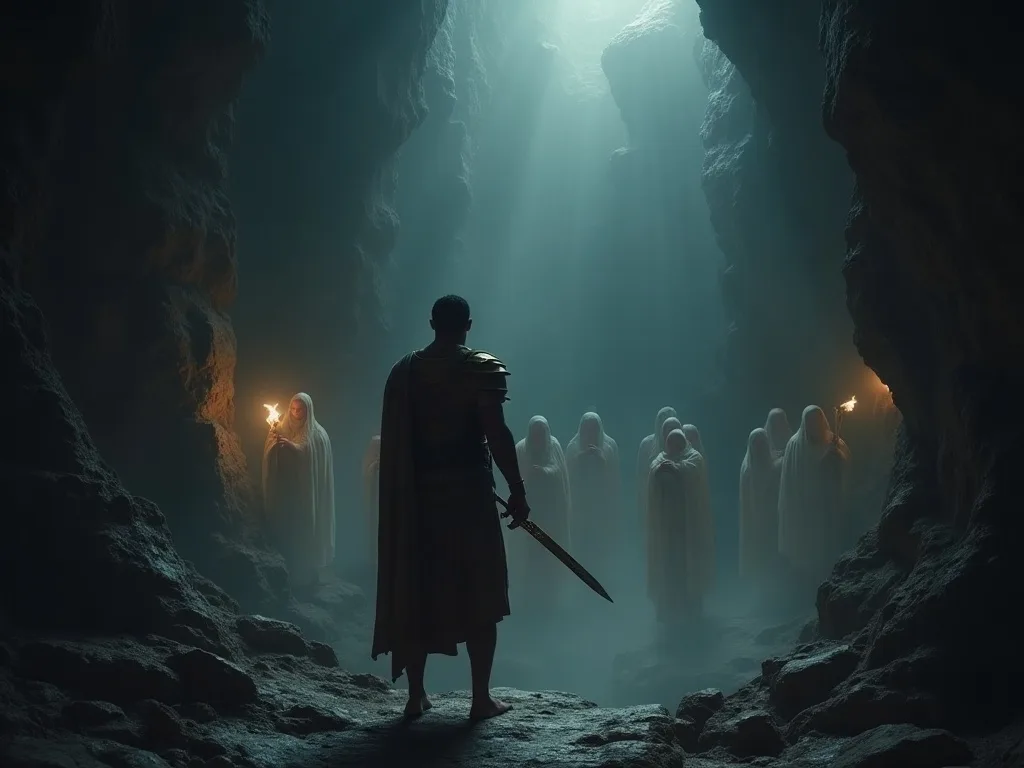
The Land of the Dead (Book 11, called the Nekuia) may be the strangest and most moving section. Odysseus sails to the edge of the world and digs a trench, filling it with the blood of sacrificed animals to summon the ghosts of the dead. He speaks with the blind prophet Tiresias, who gives him the warnings he needs. He speaks with his dead mother, Anticlea, and learns that she died of grief waiting for him. He tries three times to embrace her ghost. Each time, she slips through his arms like smoke.
The Sirens (Book 12) sing so beautifully that any sailor who hears them crashes his ship on their rocks to reach them. Odysseus, warned by Circe, has his men stuff their ears with wax and tie him to the mast. He is the only mortal who hears the Sirens' song and lives. As the ship passes, he strains against the ropes, begging to be released. His men row harder.
Scylla and Charybdis force an impossible choice: sail toward Scylla, a six-headed monster on a cliff who will snatch six sailors, or toward Charybdis, a whirlpool that will swallow the whole ship. Odysseus chooses Scylla. He watches six of his men lifted screaming into the air and eaten. He saves the ship. He never fully recovers from it.
The final catastrophe comes when his surviving men, stranded on the island of the sun god Helios, slaughter Helios's sacred cattle despite being explicitly forbidden to do so. Zeus destroys the ship. Odysseus alone survives, clinging to wreckage for nine days before washing up on Calypso's island, where the poem finds him at the start.
Calypso, Nausicaa, and the Pull of Oblivion
The goddess Calypso (whose name in Greek means "she who hides") keeps Odysseus on her island for seven years. She offers him everything: comfort, beauty, and immortality itself, if he will stay and forget Ithaca. He refuses. Every day he sits on the shore and weeps, staring at the sea. Every night he sleeps beside Calypso. The poem holds both truths without resolving them.
It is Athena who finally moves. She petitions Zeus at a moment when Poseidon is away visiting the Ethiopians. Zeus sends Hermes to tell Calypso to release Odysseus. Calypso obeys, bitterly. She points out, with some justice, that the gods allow male gods to keep mortal lovers but rage when goddesses do the same. She is right, and Homer gives her the argument without punishing her for it.
Odysseus builds a raft with his own hands, sails for seventeen days, and is wrecked by Poseidon within sight of the Phaeacian shore. He swims for two days before collapsing in the reeds, where a young princess named Nausicaa finds him. She is practical, gentle, and clearly half in love with him by the time she leads him to her father's palace.
The Phaeacians are a seafaring people who live between the human world and the divine. Their king, Alcinous, hosts Odysseus for the storytelling sequence where the wandering years are narrated. The Phaeacians then carry Odysseus home on one of their magic ships, sleeping, and deposit him on Ithaca's shore like a delivered parcel.
Ithaca at Last: The Long Reckoning at Home
Odysseus lands on Ithaca in disguise. Athena has made him look like an old beggar. He finds his house overrun by the suitors, over a hundred young men from across the islands who have moved into his palace, eaten his livestock, and spent years pressuring Penelope to declare Odysseus dead and choose one of them as her new husband.
Penelope has held them off with extraordinary resourcefulness. She told them she would choose a new husband once she finished weaving a burial shroud for Laertes, Odysseus's elderly father. Each night, she secretly unraveled what she had woven during the day. Three years passed before a maidservant betrayed the trick.
The reunion of Odysseus with his old swineherd Eumaeus, his son Telemachus, and finally with Penelope herself, is handled by Homer with great care. Penelope does not immediately recognize her husband. Or perhaps she does, and tests him. Scholars have argued about this for centuries.
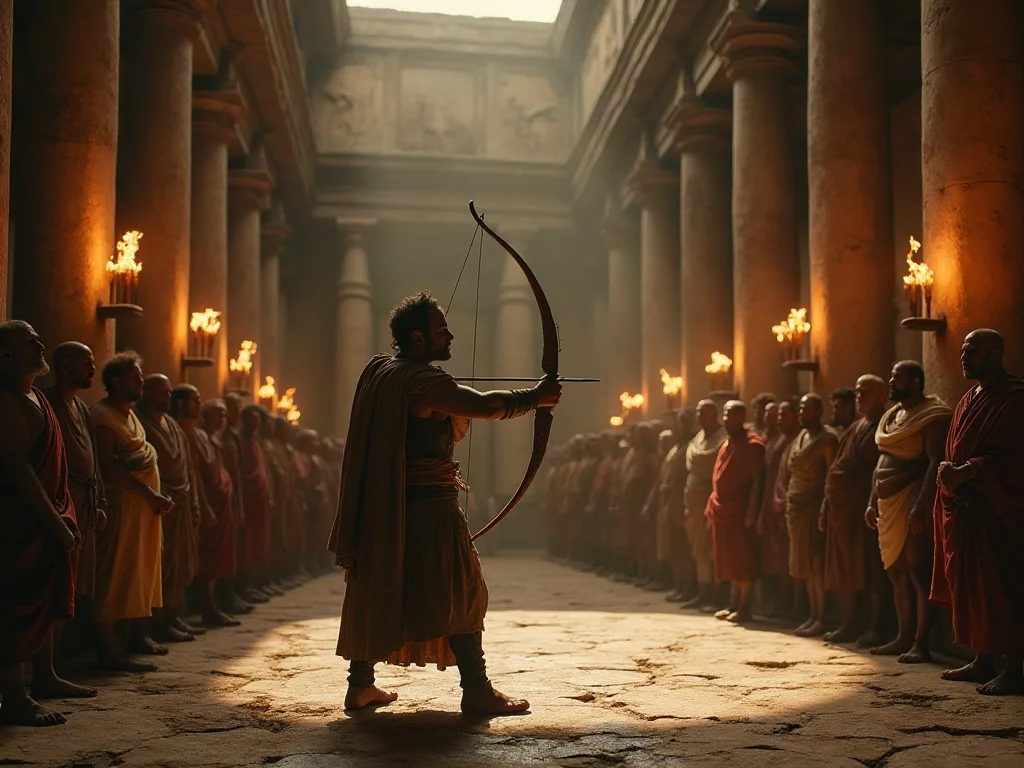
The climax comes at an archery contest. Penelope announces she will marry whoever can string Odysseus's great bow and shoot an arrow through twelve axe-heads lined up in a row. None of the suitors can even bend the bow. The beggar asks to try. He strings it, shoots through all twelve axes, and then turns the bow on the suitors.
What follows is a slaughter. Odysseus, Telemachus, Eumaeus, and one loyal cowherd kill every suitor in the hall. The unfaithful maidservants who had slept with the suitors are hanged. The violence is raw and specific, and Homer does not soften it.
Penelope still tests her husband. She tells a servant to move the marriage bed out of the bedroom. Odysseus flares up: that bed cannot be moved. He built it himself, years ago, carving its post from a living olive tree that grows through the bedroom floor. Only Penelope knows this. Only the real Odysseus could know she was lying. She weeps, and finally embraces him.
Odysseus in Myth Beyond Homer: The Tradition He Left Behind
Homer's Odyssey is only one strand of a much larger tradition. In the Epic Cycle, a collection of lost poems that surrounded the Iliad and Odyssey, Odysseus appears in darker and more morally ambiguous stories.
He is the one who exposes the infant Astyanax for killing (though versions differ). He is accused by Ajax of having stolen Achilles's armor through clever speechmaking rather than earning it by valor. Ajax's subsequent madness and suicide, told in Sophocles's play Ajax (around 450 BC), puts Odysseus at center stage as a figure who wins by words while better men die by pride.
In Sophocles's Philoctetes (409 BC), Odysseus is sent to retrieve the hero Philoctetes, who was abandoned on a desert island because of a festering wound, and whose magic bow the Greeks need to win the war. Odysseus tries manipulation and lies. The young Neoptolemus, Achilles's son, refuses to go along with the deception. The play ends with divine intervention rather than Odyssean cunning, which many readers read as a quiet critique of Odysseus's methods.
The Roman poet Virgil, writing the Aeneid around 19 BC, presents Odysseus (called Ulixes in Latin) as a villain from the Trojan perspective: the man whose trick destroyed a civilization. The Trojan hero Aeneas repeatedly names him as a scoundrel. This is a calculated reversal of the Greek tradition, and it colored European perception of Odysseus for centuries.
Dante placed Ulisse in Hell (the Inferno, written around 1308-20 AD), punished among the fraudulent counselors, for the deception of the Trojan Horse. In Dante's version, Ulisse made one final voyage past the pillars of Hercules into the forbidden Atlantic, driven by insatiable curiosity, and was destroyed by God for the transgression. It is one of the most powerful retellings ever written of a character who appears in no Greek source doing this.
Tennyson's poem Ulysses (1833) reimagines him as an old king restless in retirement, rallying his aged sailors for one last voyage: "to strive, to seek, to find, and not to yield." The line became a kind of secular prayer for Victorian adventurers, and it completely inverts Odysseus's deepest goal in Homer, which was to stop wandering and come home.
Odysseus as Trickster: A Hero Who Lives by His Mind
In the landscape of Greek heroism, Odysseus is unusual. The heroes Greeks admired most were physical: Heracles who crushed monsters with his hands, Achilles who was almost invincible in battle, Ajax who stood like a wall against the Trojan army. Odysseus cannot match any of them physically. He wins by thinking.
This makes him a version of the trickster figure found across world mythologies. Loki in Norse tradition, Coyote in many Indigenous North American traditions, Anansi in West African and Caribbean folklore: these are all beings who survive by wit where strength fails, who bend rules, who sometimes cause chaos and sometimes save the world with the same gesture.
Odysseus is a more grounded version. He is not supernatural. He is just relentlessly intelligent, and determined to live. That combination makes him feel remarkably modern. Readers across 2,700 years have recognized something of themselves in him.
The question the Odyssey never quite answers is whether his cleverness is a virtue or a flaw. It saves his life. It costs his men their lives. It earns him Athena's devotion and Poseidon's hatred. It lets him survive the unsurvivable. It also sometimes makes him cruel, calculating, and hard to love.
Homer does not judge him. He presents him.
The Prophecy of Tiresias and the Journey That Never Ends
When Odysseus speaks with the prophet Tiresias in the Land of the Dead, Tiresias tells him something that most readers forget: his trials do not end with the slaughter of the suitors. After he has killed them, he must take an oar on his shoulder and walk inland until he meets people who have never heard of the sea, who will mistake the oar for a winnowing fan. There he must plant the oar and make sacrifice to Poseidon. Only then will the god's anger be appeased.
After that, Tiresias says, Odysseus will have a gentle old age, and death will come to him from the sea, soft as mist.
The Odyssey itself ends before this second journey. Odysseus has killed the suitors. Penelope has recognized him. The families of the dead suitors come seeking revenge, and a brief battle begins outside the palace, before Athena descends and orders peace. The poem ends there, mid-motion.
The walk with the oar was left for another poem, perhaps for the reader's own imagination. Odysseus is always, at some level, still moving.
Frequently asked questions about Odysseus
Frequently asked questions
What is Odysseus the god of?
Odysseus is not a god. He is a mortal hero, king of the island of Ithaca. He is closely associated with Athena, the goddess of wisdom and craft, who serves as his divine protector throughout the Odyssey. His relationship with Athena is almost like a partnership: she admires his mind, he trusts her guidance.
Why did Odysseus's journey home take ten years?
Several causes stack on top of each other. He blinded Polyphemus the Cyclops, who was Poseidon's son, and Poseidon spent a decade obstructing him with storms and shipwrecks. His own men also made fatal errors: opening the bag of winds given by Aeolus, and slaughtering the cattle of Helios. Each mistake reset the journey further back. The gods' conflicts with each other kept him moving in circles until Athena persuaded Zeus to force his release from Calypso's island.
What is the difference between Odysseus and Ulysses?
They are the same figure from different cultural traditions. Odysseus is the Greek name used by Homer. Ulixes (or Ulysses) is the Latin name used by Roman writers including Virgil and Ovid. The Roman tradition often portrayed him more negatively than the Greek one, particularly in Virgil's Aeneid, where he appears as the cunning villain who destroyed Troy. Later European literature inherited both versions, which is why the same character can seem heroic in one text and villainous in another.
Did Odysseus and Penelope actually love each other?
Homer presents their bond as genuine and deep, built on mutual intelligence rather than just sentiment. Penelope's recognition test, the secret of the olive-tree bed, only works because both of them value the specific, private knowledge they share. Odysseus weeps daily on Calypso's island for his home, and Penelope is described by Homer as weeping at night when no one can see. The reunion scene in Book 23 is one of the most restrained and moving in ancient literature.
What happens to Odysseus after the Odyssey ends?
The prophet Tiresias tells Odysseus in Book 11 that he must make one more journey: carrying an oar inland to people who have never seen the sea, plant it there, and sacrifice to Poseidon. After that, Tiresias promises, death will come to him gently from the sea in his old age. The Telegony, a lost Greek poem summarized by later writers, described Odysseus being accidentally killed by Telegonus, his son by Circe, who had come to Ithaca searching for his father.
Is the Odyssey based on a real historical journey?
Scholars do not agree. Some, including the classicist Ernle Bradford in his 1963 book, have tried to map the voyage onto real Mediterranean geography. Most modern classicists treat the wandering lands as mythological spaces rather than real places, though the Strait of Messina between Sicily and Italy is often proposed for Scylla and Charybdis. Troy itself (Hisarlik in modern Turkey) was a real city, excavated since the 1870s, and a major Bronze Age conflict around 1200 BC likely underlies the Trojan War myths.
Why Odysseus Still Unsettles Us
The heroes who are pure, who are brave and strong and die young and beautiful, are easy to admire from a distance. Odysseus is harder to keep at a distance. He lies when he needs to. He loses his men and survives. He sleeps with goddesses while his wife waits faithfully. He weeps on a beach and schemes in a palace on the same afternoon.
What makes him endure is not that he is good. It is that he is real in a way very few ancient figures manage. His flaws are structural, built into the same mind that saves him. His curiosity gets him into danger. His pride makes him shout his name to the Cyclops. His gift for language lets him manipulate people who trusted him.
The philosopher Aristotle, writing in the Poetics around 335 BC, used Homer's epics as his central examples of what great literature could do. He was interested in characters who were neither wholly good nor wholly bad, whose suffering followed from some genuine flaw in themselves. Odysseus fits that description with uncomfortable precision.
The Odyssey is not a story about a man who gets what he deserves. It is a story about a man who keeps going anyway, through loss after loss, for ten years, carrying nothing but his own stubborn identity. He is the Greek hero who survives not by being the best at fighting, but by refusing, absolutely, to stop being himself.
That refusal is what every reader recognizes. And it is why, after 2,700 years, the ships are still burning at Troy and Odysseus is still out there somewhere, rowing toward a shore that keeps receding.
Free 25-page sample
Want the whole story?
Take the first 25 pages free. If it pulls you in, the full edition is yours as an instant PDF download, with a paperback on Amazon for selected titles.
Greek
The Greek Mythology Book: Zeus, the Olympians, the Heroes, and the Sacred Stories of Ancient Greece
Zeus, the Olympians, the Heroes, and the Sacred Stories of Ancient Greece
The complete guide to Greek mythology from Hesiod's Theogony to Homer's epics. Every Olympian, every hero, every descent to the underworld.
More from Greek
All articles
Greek
The Labyrinth and the Minotaur: Crete's Most Dangerous Secret
Beneath the palace of Knossos, a king hid his shame in stone. The story of the Labyrinth and the Minotaur is a myth about power, sacrifice, and the monsters we create.

Greek
The Eleusinian Mysteries: Sacred Rites of Demeter
For nearly two thousand years, thousands of Greeks walked a sacred road to Eleusis and returned changed. The Eleusinian Mysteries promised something no other ritual could: a glimpse of what waited after death.
Greek
Hades: Lord of the Underworld
Hades rules the Greek underworld with quiet, absolute authority. Neither villain nor demon, he is the god who keeps the cosmic balance that Zeus and Poseidon could never maintain alone.
Greek
Heracles: The Greatest Greek Hero
Born of a god and a mortal woman, punished by a jealous goddess, and forced to perform twelve impossible labors, Heracles became the defining hero of ancient Greece and a symbol of human endurance that still resonates today.