
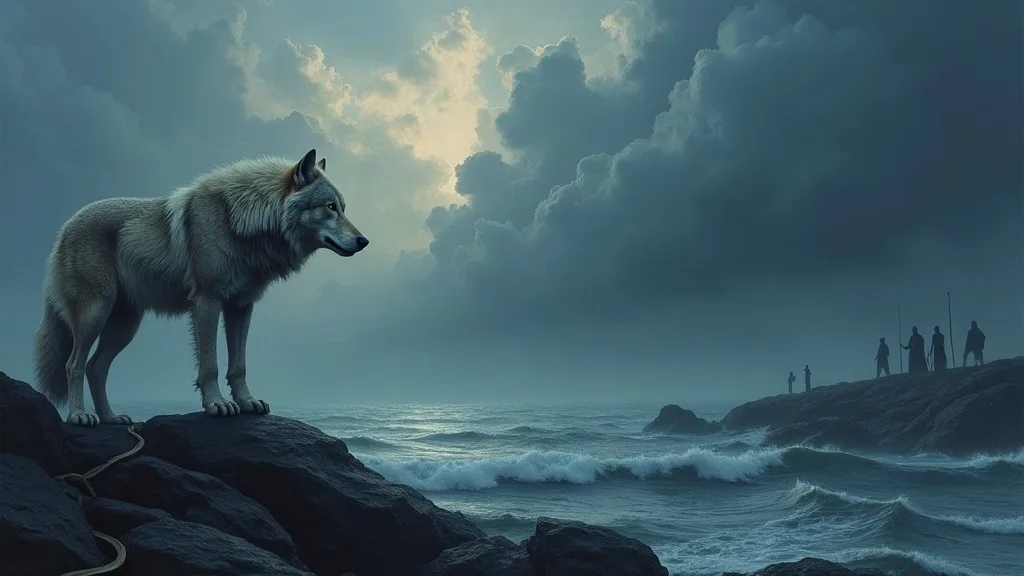
Fenrir the Great Wolf: The Beast That Will Swallow the Sun
Fenrir the great wolf stands at the center of Norse fate: bound by a silk-thin chain, destined to break free and devour Odin at Ragnarok. Explore the myth, the sources, and the cosmic stakes.
Contents
The chain is thinner than a ribbon. It looks like spun light, woven from impossible things: the sound of a cat's footstep, the beard of a woman, the roots of a mountain. A god holds it out across the cold water of the island Lyngvi, and the wolf on the shore looks at it for a long time.
Fenrir the great wolf knows something is wrong. He is the son of Loki and the giantess Angrboða, and he has grown so large that the Aesir gods already fear him. He has already snapped through two iron chains as though they were braided grass. But this third binding, this silken nothing called Gleipnir, feels different. He agrees to let the gods tie him with it, on one condition: one of them must place a hand inside his jaws as a pledge of good faith.
Only Týr steps forward. When Fenrir cannot break free and realizes the Aesir have no intention of releasing him, he bites down. Týr loses his hand. The wolf is bound. And everyone present knows, with complete certainty, that none of this is over.
Who Is Fenrir? Lineage, Birth, and the Fear He Inspired
Fenrir's family tree is, by any measure, extraordinary. His father is Loki, the shape-shifting trickster who moves between worlds and serves no single loyalty. His mother is Angrboða, whose name translates roughly as "she who brings grief," a giantess living in Jötunheimr, the realm of giants. Fenrir's siblings are equally unsettling: Jörmungandr, the world serpent coiled around the ocean floor, and Hel, the ruler of the realm of the dead.
The Prose Edda, written by the Icelandic scholar Snorri Sturluson around 1220 AD, tells us that the gods became aware of these three children and were troubled by prophecy. They knew something terrible would come from this bloodline. Odin had Jörmungandr thrown into the sea and sent Hel to rule over the dead. But Fenrir they kept among themselves, believing they could control him. Only Týr, the Eddas specify, was bold enough to feed the growing wolf.
This matters. The Aesir did not fear Fenrir because he was a stranger. They feared him because he was, in a sense, theirs. They raised him. They watched him eat and grow. And they calculated, for as long as they could, that keeping him close was safer than setting him loose in the world.
The calculation failed. Fenrir grew past all reason. Two iron fetters, Leyding and Dromi, were forged and presented to him as challenges. The Eddas describe how Leyding snapped from Fenrir's first kick, and Dromi from his second exertion. These were not weak chains. The gods made them as strong as they knew how. Fenrir simply outgrew them.
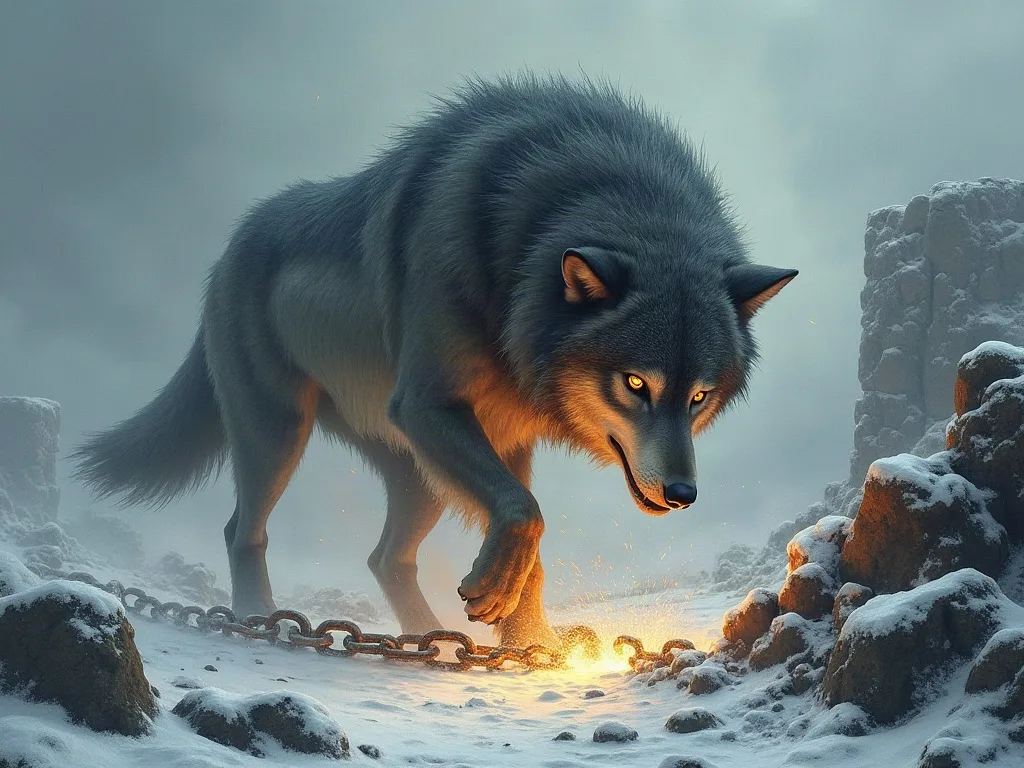
The Making of Gleipnir: What Dwarves Built From Nothing
At that point, the Aesir sent Skírnir, the messenger of the god Freyr, to the realm of the dwarves with a commission unlike any other. The dwarves, who in Norse cosmology are master craftsmen living beneath the earth in Svartálfaheimr, produced Gleipnir: a binding made from six things that do not exist.
The Prose Edda lists them precisely: the sound of a cat's footstep, the beard of a woman, the roots of a mountain, the sinews of a bear, the breath of a fish, and the spittle of a bird. Because these things are impossible, the ribbon woven from them cannot be broken by any ordinary force. The logic is elegant and strange: what has no existence cannot be undone by anything that exists.
Gleipnir looks like soft silk and weighs almost nothing. It is, in fact, the strongest thing ever made.
The gods brought Fenrir to the island called Lyngvi on a lake named Ámsvartnir. They proposed a game: could he break this ribbon as he had broken the irons? Fenrir looked at it and did not like what he saw. He said, according to Snorri, that there was no glory in snapping something so thin. If there was magic in it, he would not submit.
The negotiation that followed is one of the most quietly devastating exchanges in all Norse literature. The gods promised to release him if he could not break free. He did not believe them. He asked for a pledge. Týr placed his right hand between the wolf's jaws.
Fenrir could not break Gleipnir. The gods laughed. Then they refused to release him. Týr's hand was gone. And Fenrir, now staked to a boulder called Gjöll with a sword propped beneath his jaw to hold his mouth open, settled in to wait.
The Prose Edda says he will wait until Ragnarok.
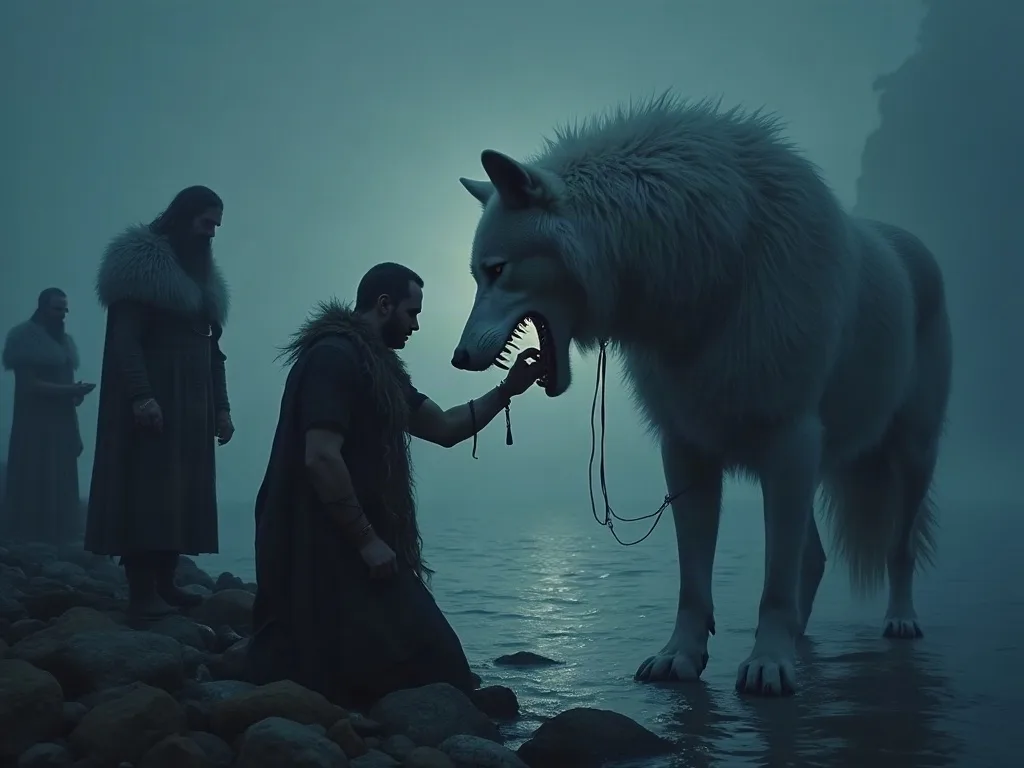
Týr's Hand and the Meaning of Sacrifice
A single detail gives the binding story its staying power: one god chose to lose something permanent so that the rest could survive a little longer. Týr is, in the oldest layers of Germanic religion, a sky god, possibly the most senior deity before Odin absorbed that role. His name is cognate with the Latin deus and the Greek Zeus, both rooted in the Proto-Indo-European word for sky or divine light. He was once, it seems, the chief god of the Germanic world.
By the time the Eddas were written, Týr had been overtaken in the divine hierarchy by Odin and Thor, but he retained one attribute no other god possessed: absolute trustworthiness. He was the god of law, of oaths, and of honorable combat. The Tuesday in the English week ("Tyr's day") still carries his name.
This makes the sacrifice precise. To bind Fenrir, the most honest god in the Norse pantheon had to participate in a deception. The Aesir had no intention of honoring their promise to the wolf. They knew it, Fenrir suspected it, and Týr confirmed it by offering his hand anyway. The right hand, specifically: the hand you extend in oaths.
Týr: Law and Trust
Týr is the god of binding agreements, legal order, and honorable single combat. His sacrifice of his right hand, the hand of oaths, represents the cost of maintaining order: law itself must sometimes bend to survive. He acts with full knowledge that he is breaking the moral code he embodies.
Fenrir: Chaos and Fate
Fenrir is shaped by fate from birth, feared before he has done anything wrong. He is not evil so much as inevitable. His anger at the deception is, by the logic of the myths, entirely just. He loses his freedom because the gods fear what he will become, not for any act he has committed.
Several scholars, including the comparative mythologist Georges Dumézil in his 1959 work Les dieux des Germains, read this episode as a mythological encoding of a juridical principle: that order sometimes costs the very thing it claims to protect. The law, to function, must occasionally violate itself.
Ragnarok: The Day Fenrir Runs Free
The Völuspá, the "Prophecy of the Seeress," is the oldest and most poetic of the Eddic sources, preserved in the Codex Regius manuscript from around 1270 AD and likely composed centuries earlier. It is a vision of the world's beginning and end spoken by a völva, a prophetess, to Odin himself. Its account of Ragnarok is spare and precise, and Fenrir the great wolf is at the center of it.
When the end begins, the wolf's chain breaks. Jörmungandr rises from the sea. Loki escapes his own imprisonment. The sky tears open and the fire giants of Múspellsheim ride south. The sun and moon go dark because Fenrir and his kin have swallowed them.
The Prose Edda's "Gylfaginning" section gives more detail. Fenrir runs with his upper jaw scraping the sky and his lower jaw dragging across the earth. He swallows everything in front of him. And at the end of that run, he meets Odin.
Odin, the Allfather, who hung nine nights on the world tree Yggdrasil for wisdom. Odin, who sacrificed his eye at Mimir's well. Odin, who knows from every prophecy exactly what is coming. He rides out anyway, carrying the spear Gungnir, and Fenrir devours him.
It is one of the most startling moments in any mythology: the chief god of a pantheon is killed, not by some terrible trick or betrayal, but eaten by an animal he helped raise.
Odin's son Víðarr avenges him. In the Eddas, Víðarr either steps on Fenrir's lower jaw and tears the wolf's mouth apart, or drives a sword through the wolf's throat. The descriptions vary slightly between the Prose Edda and the Poetic Edda, but the outcome is consistent: the wolf dies, but only after the father does.
The Norse concept of fate, wyrd or örlög, runs through every frame of this story. The binding of Fenrir does not prevent Ragnarok. It delays it. Every action the gods take against the wolf only confirms that the end they fear is coming. This is not tragedy in the Greek sense, where a flaw triggers disaster. It is something colder: a cosmos running on rails, where knowledge of the destination changes nothing.
Fenrir in the Broader Norse Cosmos: Wolves, Darkness, and the World's Edge
Fenrir is not alone in his lupine terror. The Norse mythological world contains an entire vocabulary of wolves that circle the edges of existence.
Sköll and Hati are two wolves who chase the sun and moon across the sky every day. Snorri names them in the Prose Edda, and the Grímnismál poem in the Poetic Edda confirms their pursuit. They never catch their quarry during the age of the world. At Ragnarok, they do. Whether Sköll and Hati are Fenrir's sons, as some Eddic passages suggest, or simply wolves of the same cosmic category, the image is consistent: the world is surrounded by hunger that has always been running toward it.
Geri and Freki, by contrast, are Odin's own wolves. They sit at his feet during feasts in Valhalla. He feeds them all the meat from his plate and sustains himself on wine alone. The Allfather, then, has wolves as companions just as he has the ravens Huginn and Muninn ("Thought" and "Memory"). His relationship to wolf-kind is intimate. This makes Fenrir's role as his killer carry an additional weight: it is not a monster from outside who destroys Odin, but something that shares his symbolic vocabulary.
The wolf in Norse culture is complex. It is associated with warriors (the úlfhéðnar, "wolf-coats," were a class of berserker who wore wolf pelts), with outlaws (the Old Norse word for outlaw, vargr, literally means wolf), and with chaos at the margins of order. Fenrir is the extreme expression of all three: warrior-strength beyond control, outlaw-nature that cannot be socialized, and cosmic chaos that consumes even the gods.
Cross-Mythological Echoes: Other Great Beasts at the World's End
The Norse wolf is not the only creature in world mythology who waits, chained or coiled, for the moment it will be unleashed.
In Hindu mythology, the demon Vritra, a serpent or dragon of immense size, was bound (or rather slain and thus contained) by the god Indra to release the world's waters. The structural parallel is not exact, but the motif of a vast creature whose existence threatens cosmic order, held in check by divine force, recurs.
More striking is the comparison with the Mesopotamian Tiamat, the primordial ocean-dragon of the Enuma Elish, the Babylonian creation poem from around 1100 BC. Like Fenrir, Tiamat is a pre-cosmic force of chaos associated with the time before order. Like Fenrir, she is defeated (though killed, not bound) by a younger generation of gods. Unlike Fenrir, she does not return. Norse mythology is unusual in insisting that the bound chaos comes back and wins.
The closest parallel may be the Irish Crom Cruach, sometimes depicted as a vast destructive entity contained for most of history, or certain readings of the Christian Leviathan: a great beast imprisoned in the deep whose release marks the end of time. Revelations 20:3 describes the binding of Satan "for a thousand years" with a clear understanding that the binding is temporary, the release certain.
Fenrir belongs to a global imaginative category: the great chained beast. What distinguishes the Norse version is that the beast's imprisonment is morally compromised, that the gods who bound him were not entirely in the right, and that his release is not a punishment but a fulfillment of something that was always going to happen.
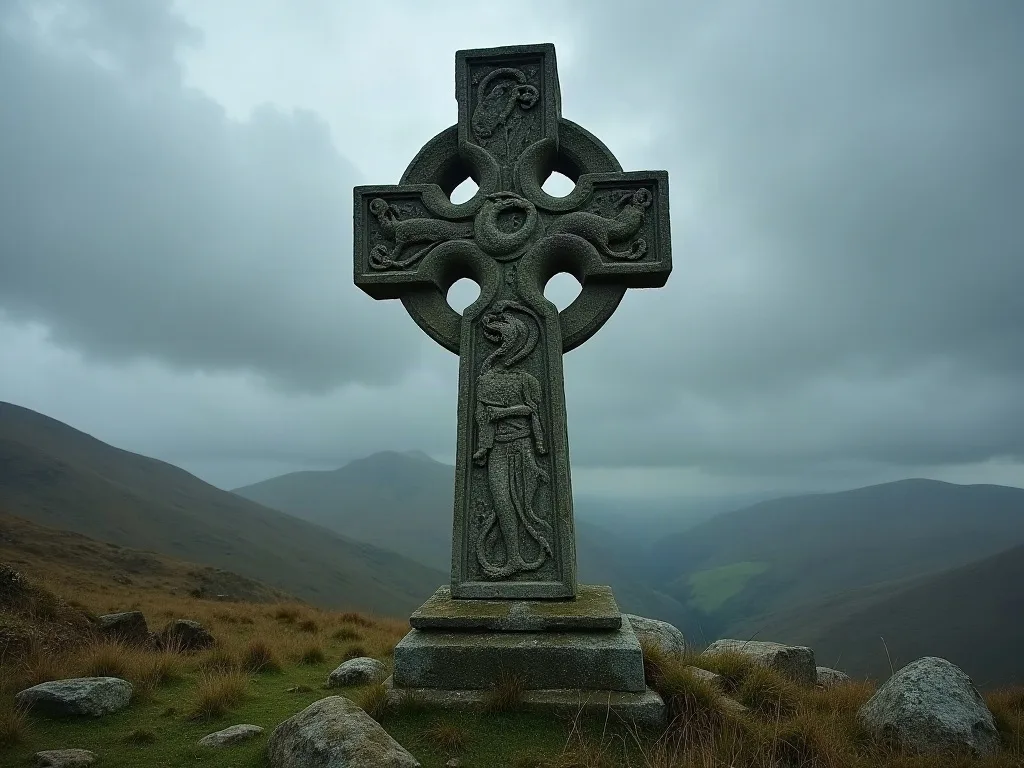
The Elder Futhark and Fenrir's Shadow in Viking Material Culture
The written sources, the Eddas, are 13th-century texts recording older oral traditions. But Fenrir's presence in Viking material culture is older and less tidy.
The Thorwald Cross, a 10th-century stone cross from the Isle of Man, is often read as showing Odin being swallowed by Fenrir, with Víðarr stepping in to avenge him. The image on the stone is damaged and interpretations vary, but the scholars John McKinnell and Rudolf Simek have each discussed the cross in the context of Christian-Norse syncretism: the stone depicts both the Norse apocalypse and, on its other face, Christian imagery. The communities that carved it apparently saw no contradiction.
The Gosforth Cross in Cumbria, England, dated to the early 10th century, also contains panels that scholars including Richard Bailey have interpreted as Ragnarok scenes, including a bound figure and a wolf motif. These carvings predate the written Eddas by more than two centuries, which suggests the core mythological narrative, wolf, binding, apocalypse, was stable and widely known long before Snorri wrote it down.
Runic inscriptions rarely name Fenrir directly, but wolf imagery appears on bracteates (small gold medallions) and helmet panels throughout the Migration Period, roughly 400-700 AD, suggesting that the wolf-as-cosmic-force was a persistent element of Germanic religious imagination before it crystalized in the Norse sources we have today.
What Scholars Still Debate About Fenrir
Not everything about Fenrir is settled, even after a century of serious academic attention.
The biggest open question is origin: is Fenrir a distinctly Norse creation, or does he reflect an older Proto-Indo-European myth of a world-devouring wolf? The scholar Jaan Puhvel argued in his 1987 Comparative Mythology that certain Indo-European traditions share a figure of the devouring canine at the world's end. Others, like the Eddic specialist Andy Orchard, are more cautious: the connections are suggestive but not proven, and the Fenrir myth as we have it is thoroughly embedded in Norse cosmological logic.
A second debate concerns moral status. Nineteenth-century readings often treated Fenrir as simply evil, the monster against whom the gods heroically fought. Twentieth and twenty-first century scholarship has pushed back on this. Margaret Clunies Ross, in her 1994 Prolonged Echoes: Old Norse Myths in Medieval Northern Society, argues that the gods' treatment of Fenrir is one of the Eddas' most pointed critiques of divine behavior: the Aesir create the conditions for their own destruction by acting unjustly against a creature who had, at the time of his binding, done nothing to deserve it.
A third, smaller debate is whether Víðarr's vengeance was part of the original myth or a later addition to soften the absolute bleakness of Odin's death. The Völuspá is not entirely consistent with the Prose Edda on this point, and some scholars read the avenging son as an optimistic editorial layer. If so, the earliest version of the Ragnarok wolf-story ends not with vengeance but with silence.
Frequently Asked Questions About Fenrir the Great Wolf
Frequently asked questions
What exactly is Fenrir the great wolf made from, and why is he so large?
Fenrir is not made from anything unusual: the Eddas simply describe him as a wolf, the son of Loki and the giantess Angrboða. His size is a function of his nature and his fate. Snorri's Prose Edda explains that the gods fed him among themselves, and he grew so fast they realized no physical chain could hold him indefinitely. His scale is mythological rather than biological: he is large enough that at Ragnarok his upper jaw touches the sky and his lower jaw drags the earth.
What is Gleipnir made of, and why can it hold Fenrir when iron could not?
Gleipnir is made from six things that do not exist: the sound of a cat's footstep, the beard of a woman, the roots of a mountain, the sinews of a bear, the breath of a fish, and the spittle of a bird. Because these things have no real existence, nothing real can break them. The logic is a kind of mythological physics: a binding made from nothing cannot be undone by anything that exists in the world. The dwarves of Svartálfaheimr crafted it on commission from the Aesir.
Why did Týr have to sacrifice his hand? Could the gods not simply lie outright?
Fenrir was not foolish. He saw through the gods' offer and refused to be bound unless one of them offered a pledge of good faith, specifically a hand placed in his jaws. If the gods released him as promised, the hand would be returned. If they did not, the god lost his hand. The Aesir needed Týr because he was the god most associated with oaths and legal trust: his pledge was the only one Fenrir might accept. Týr sacrificed his right hand, the hand of oaths and law, knowing the gods would not honor the agreement. The Prose Edda does not present this as heroic deception; it presents it as a necessary wrong.
Does Fenrir actually kill Odin at Ragnarok, or is that a later embellishment?
Both the Völuspá and Snorri's Prose Edda confirm that Fenrir kills Odin by swallowing him whole. This is not a later addition: it is one of the most consistently attested facts in the Norse eschatological tradition. Odin's son Víðarr then kills Fenrir, either by tearing his jaws apart or stabbing him through the throat, depending on which source you read. Whether Víðarr's vengeance was part of the original myth or a later softening of an even bleaker ending is an ongoing scholarly debate.
Are Sköll and Hati the same as Fenrir, or separate wolves?
They are separate wolves, though some Eddic passages suggest they may be Fenrir's offspring. Sköll chases the sun and Hati chases the moon across the sky every day, never catching them until Ragnarok. Fenrir is the wolf bound on the island of Lyngvi. The three wolves form a cluster of lupine threat around the edges of the Norse cosmos, but the Eddas treat Fenrir as distinct and supreme among them, the one whose swallowing of Odin is fated and irreversible.
Is there any equivalent to Fenrir in other world mythologies?
The structural parallel closest to Fenrir is the broad category of the "great chained beast": a chaos-force bound for an age and released at the world's end. The Christian Book of Revelation describes Satan bound for a thousand years and then loosed. Mesopotamian mythology features Tiamat, a primordial chaos-dragon contained and then killed (not released). Hindu texts describe Vritra, a vast serpent of obstruction slain by Indra. What makes Fenrir distinctive is the moral complexity of his binding: unlike most such beasts, he is arguably wronged by the gods who imprison him, and his release is not framed as evil's return but as the fulfillment of a fate that the gods themselves set in motion.
Fenrir After the Myths: From Viking Stone to Modern Imagination
The wolf did not stay inside the Eddas.
On the Thorwald Cross and the Gosforth Cross, carved by Norse settlers in Christian England around the 10th century, Ragnarok imagery including wolf scenes was placed on Christian monuments. These communities were doing something genuinely interesting: they were mapping the Norse end-of-time onto Christian eschatology, finding resonance between Fenrir swallowing Odin and the tribulations of Revelation. The two traditions, running in parallel, seemed to speak to each other.
In the 19th century, the Romantic nationalist movements of Scandinavia reclaimed the Norse myths as founding literature. Fenrir became, in this context, a symbol of the untameable: the natural force that civilization builds its walls against and never quite contains. Richard Wagner drew on adjacent Germanic sources for his Ring Cycle (1876), and while Fenrir does not appear directly, the great serpent Fafnir shares a root with the wolf's name and occupies a similar symbolic position as the beast that must be overcome.
The 20th and 21st centuries brought Fenrir into fantasy literature, role-playing games, and popular culture with a consistency that speaks to how deeply the image resonates. J.R.R. Tolkien, who was a professional scholar of Old Norse and Old English, drew on the wolf-mythology of the Germanic world for the wolves of his legendarium, particularly Carcharoth, the red-jawed wolf of Morgoth who swallows a sacred jewel and is eventually killed, echoing the Fenrir-Odin-Víðarr triangle with extraordinary precision.
In the Marvel Comics universe and its film adaptations, Fenris (a simplified version of the name) appears as a wolf of apocalyptic scale. The modern pop-culture Fenrir is usually flattened into pure monster, stripped of the moral complexity that the Eddas worked so hard to build in. But even the stripped-down version carries the original image: massive jaws, impossible to bind, waiting.
What the myth keeps insisting, across stone carvings and Eddic stanzas and fantasy novels, is that Fenrir the great wolf represents something that cannot finally be chained. Not because he is evil, but because the cosmos that bound him is impermanent. Every age of order ends. Every binding frays. The sword propped beneath his jaw will fall.
The Eddas do not end there, though. After Ragnarok, after the fires die, a new earth rises from the sea. New gods, survivors of the old order, sit on the green grass and find, among the wreckage, the golden game-pieces the Aesir once played with. The wolves are gone. The sun's daughter shines in a clean sky. Whether that is consolation or repetition, the texts leave deliberately open.
Free 25-page sample
Want the whole story?
Take the first 25 pages free. If it pulls you in, the full edition is yours as an instant PDF download, with a paperback on Amazon for selected titles.

Mythology
The World Mythology Book: The Gods, Heroes and Myths of Every Culture
The Gods, Heroes and Myths of Every Culture, in One Volume
The whole of world mythology in a single volume: Greek, Norse, Egyptian, Japanese, Hindu, Celtic, Slavic, Mesoamerican and African myths gathered side by side, each drawn from the primary sources.