
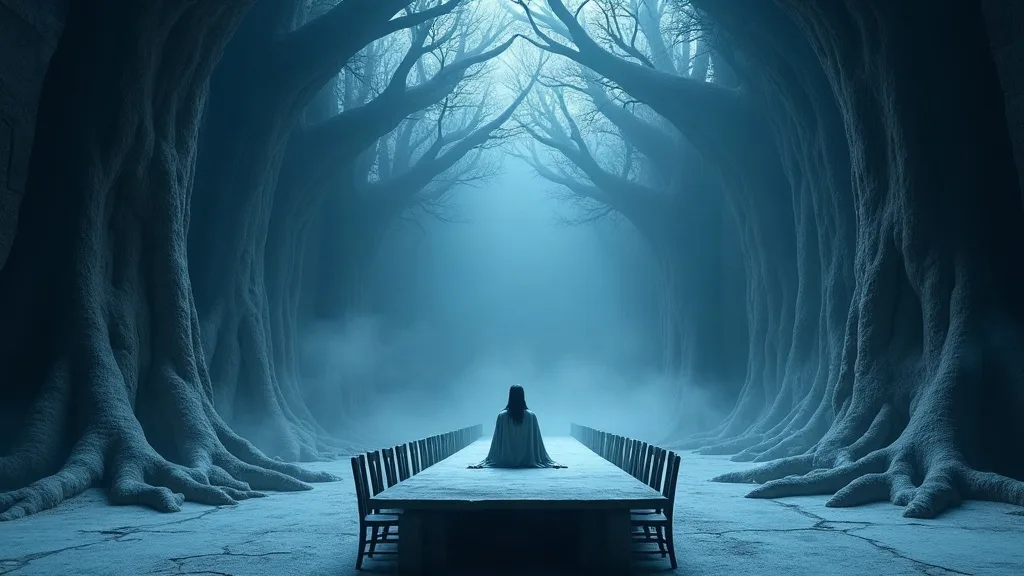
Hel, Goddess of the Dead: Ruler of the Norse Underworld
Half-living, half-corpse, Hel ruled the Norse realm of the dead with cold authority. Meet the daughter of Loki who held even the gods at her mercy.
Contents
The hall was called Éljúðnir, "Misery," and its dish was Hunger. The knife on the table was named Famine. The bed was Sick-bed, and the bed-curtain was Glimmering Misfortune. The woman who lived there had a face that was half the color of living flesh and half the blue-black of a corpse. She spoke little, moved slowly, and when Odin's messengers arrived at her gate, she did not flinch. She had something they needed, and she knew it.
Her name was Hel, and she was no mere spirit or ghost-keeper. In Norse myth, she ruled an entire realm: a vast, cold, shadow-country where almost every dead person went, gods included. The Prose Edda, written by the Icelandic scholar Snorri Sturluson around 1220 AD, gives her the starkest introduction in all the old lore. Odin himself had thrown her down from the heavens into the roots of the world, and even then she answered to no one.
She is not a villain. She is not a hero either. The Hel goddess of the dead sits in a category Norse myth rarely fills: a ruler who simply is, who enforces a law older than the Aesir, who refuses to bend even when grief comes knocking in the shape of a weeping god.
The Parentage of Hel: Born from a Giant and a Trickster
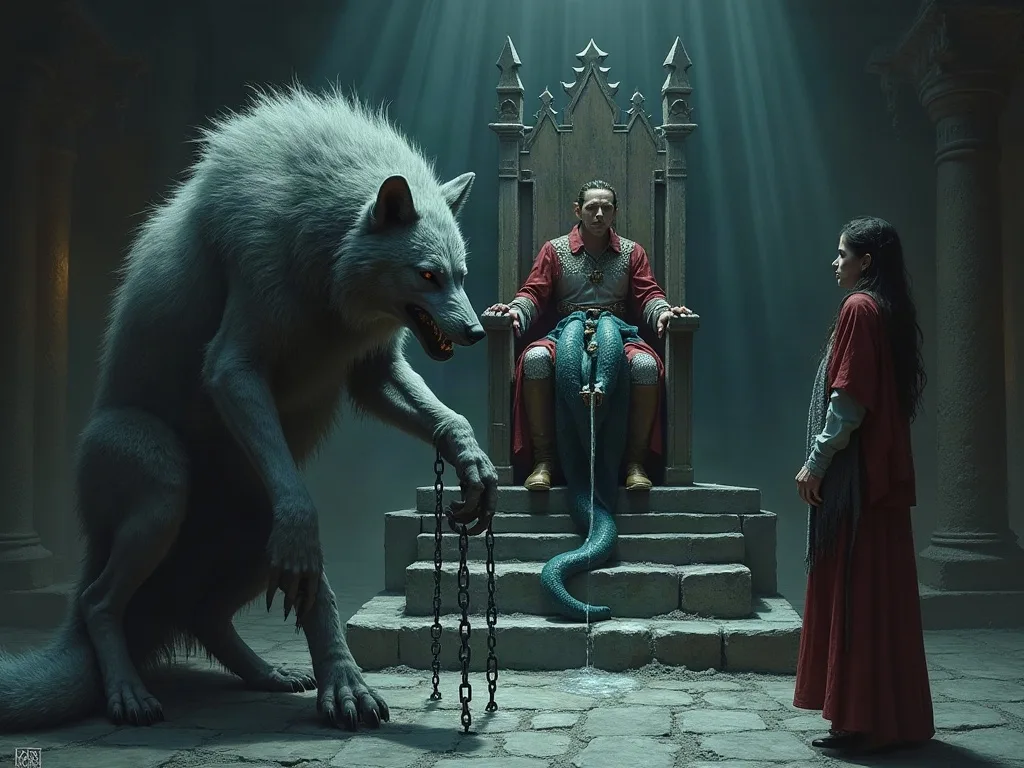
Hel was born to Loki, the shape-shifting trickster of the Aesir, and a giantess named Angrboða, whose name translates roughly as "she who offers grief." That parentage alone told the Aesir what they needed to know. Angrboða lived in Jötunheimr, the realm of the giants, and in the Prose Edda Snorri names three children she bore to Loki: the great wolf Fenrir, the world-serpent Jörmungandr, and Hel herself.
The Aesir received prophecy about these three. What that prophecy said exactly varies by source, but the gods acted swiftly. They fetched the children from Jötunheimr and brought them before Odin. Jörmungandr was thrown into the ocean encircling all the worlds. Fenrir was raised among the gods, chained after he bit off the hand of the god Tyr. Hel was cast downward.
Loki is the key to understanding why Hel exists. His blood is a bridge between the Aesir and the giants, between order and chaos. His children are not monsters in the medieval Christian sense; they are forces. Jörmungandr embodies the boundlessness of the sea. Fenrir embodies unstoppable power. Hel embodies the one certainty that even gods cannot escape: that everything which lives will stop living.
The Realm Called Hel: Geography of the Norse Afterlife
The name Hel applied both to the goddess and to the place she ruled. This doubling is not an accident. She and the realm are inseparable, the way a king and a kingdom can become synonymous in old traditions.
Her domain sat beneath Yggdrasil, the great ash tree that connected all nine worlds of Norse cosmology. The Völuspá, the Old Norse poem preserved in the Codex Regius manuscript and dated by scholars to around 1000 AD, describes it as lying in the frozen north, below the roots of the world tree. To reach it, the dead traveled the road called Helvegr, "the Hel-road," a path that ran down through dark valleys. The tenth-century skaldic poem Baldrs draumar (Baldr's Dreams) describes Odin riding this road to wake a dead seeress so she can foretell his son's death.
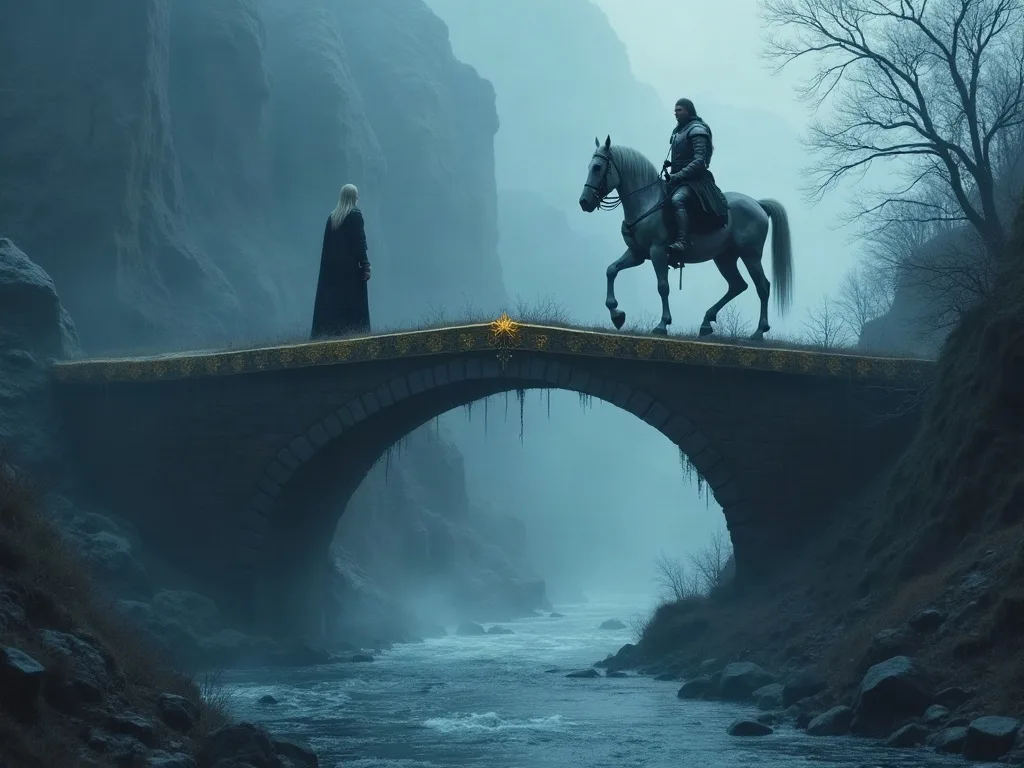
At the border of Hel's realm stood a river called Gjöll, which in Old Norse carries a sense of shrieking or clanging noise. The bridge over it, Gjallarbrú, was roofed with shining gold, and a giantess named Móðguðr guarded it. When Hermóðr, Odin's son and messenger, rode down on the horse Sleipnir to beg for Baldr's release, Móðguðr told him the road ahead was true: he should ride down and north.
Beyond the bridge stood Nágrind, the Corpse-Gate, and past that the hall Éljúðnir.
Snorri is careful to explain who came to Hel's realm and who did not. Warriors who died in battle went to Valhöll, Odin's hall, or to Fólkvangr, the field ruled by the goddess Freyja. The sea-dead went to the hall of Rán, the sea-giantess. Everyone else, which meant the vast majority of people, went to Hel. She received the sick, the old, the drowned in accidents, the men who died at home in their beds. In the old poetic phrase, to die this way was to "die of straw-death," and it carried no dishonor. Hel was not a place of punishment. It was simply where the dead were.
This is a critical distinction from later traditions. Hel is not the Norse equivalent of the Christian Hell; the similarity in sound is a coincidence of etymology, not theology. The Old English and Old Norse words share a Proto-Germanic root meaning something like "the covered place" or "the hidden place." The moral judgment came later, with Christianization, not before.
Hel's Appearance and Attributes
No detailed portrait of Hel survives in the Eddic poems themselves. The clearest physical description comes from Snorri in the Prose Edda, specifically the section called Gylfaginning (The Tricking of Gylfi), where a Swedish king disguises himself and travels to Ásgarðr to question the gods. There Snorri writes that Hel is half-black and half flesh-colored, and that her appearance is easily recognized because of it. She is described as looking downcast and grim.
Some scholars read this two-toned appearance as symbolic: one half living, one half dead. She exists at the boundary between states, neither wholly of one world nor the other. The 20th-century mythologist Hilda Ellis Davidson, in her 1943 study The Road to Hel, pointed out that this borderline quality is consistent across many figures who mediate between the living and the dead in early Germanic religion.
Her hall's furnishings, each named after a form of suffering, have sometimes been read as Snorri's moralizing overlay, a touch colored by medieval Christian ideas about death and misery. But they may also simply reflect the Norse perception that death, for most people, arrived through illness, cold, and slow decline rather than through the glory of battle.
What she is never described as, in any primary source, is cruel. She follows the laws. She keeps what is given to her. When Hermóðr arrived and asked for Baldr back, Hel answered him calmly: if every living thing in the nine worlds genuinely wept for Baldr, she would release him. It was not a refusal. It was a test. She had jurisdiction and she exercised it according to rules she did not invent.
The Death of Baldr and Hel's One Condition
The story that reveals the most about Hel's character is the death of Baldr, told in both the Prose Edda and in Baldrs draumar. Baldr, the most beloved of the gods, began having nightmares about his own death. The Aesir panicked. His mother Frigg traveled through all creation, asking every object and creature to swear an oath not to harm her son. Rocks, plants, animals, metals, diseases: all swore. She skipped mistletoe, thinking it too young and harmless to matter.
Loki found out about the exception. He tricked the blind god Höðr into throwing a dart of mistletoe at Baldr during the gods' game of testing his invulnerability. The dart struck and Baldr fell dead. He traveled immediately to Hel's realm.
The grief among the Aesir was unlike anything in Norse myth. Odin sent his son Hermóðr on Sleipnir, the eight-legged horse, to ride the Hel-road and negotiate. When Hermóðr arrived at Éljúðnir, he found Baldr sitting in the high seat. He spent the night there. In the morning he put his request to Hel directly.
Hel's response, as Snorri records it, is measured and precise. She said that if all things in the world, both living and dead, wept for Baldr, she would return him. If any single thing refused or was unable to weep, Baldr would remain.
The Aesir sent messengers across the nine worlds. Everything wept. Ice wept. Trees wept. Stones wept. Then the messengers found a giantess sitting in a cave, calling herself Þökk ("Thanks"). She refused. She said that Baldr had never done anything for her, and she would shed no tear over him. The messengers suspected she was Loki in disguise. Most scholars agree.
Baldr stayed in Hel's realm. The old sources say he will return after Ragnarök, when the world is reborn, but until then the Hel goddess of the dead holds him and she is within her rights to do so.
Hel and Ragnarök: The Dead Armies of the Final Battle
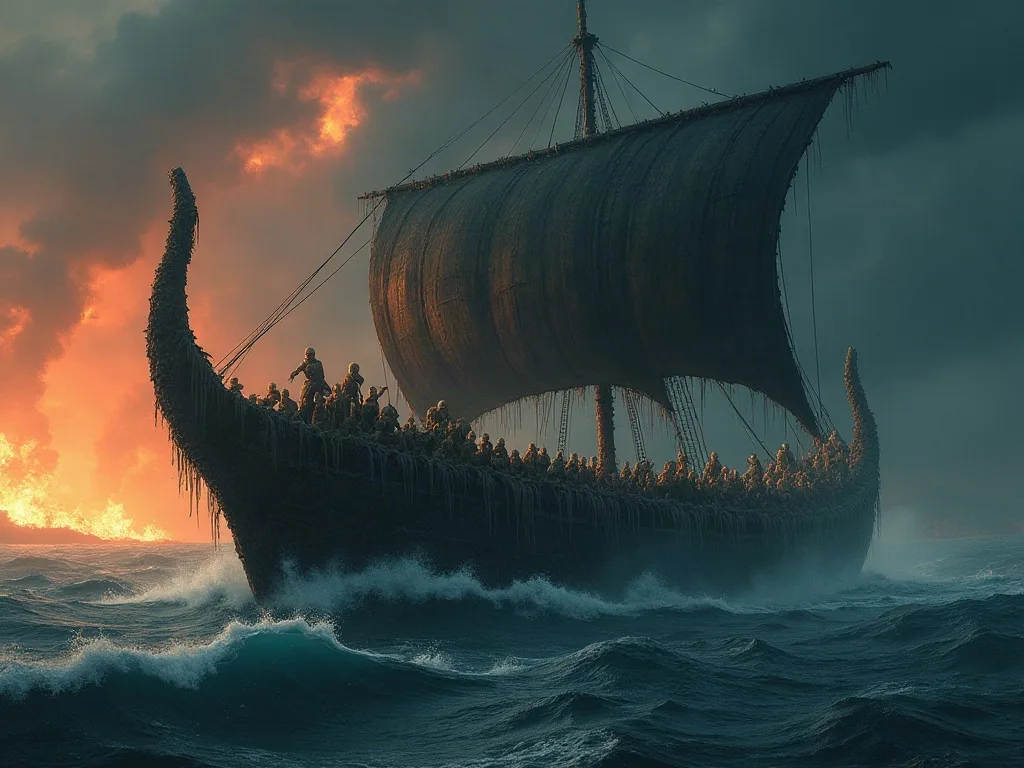
Hel appears at the edge of Ragnarök, the end of the gods, though her role is more atmospheric than active. The Völuspá describes the ship Naglfar, built from the fingernails and toenails of the dead, breaking loose from its moorings and sailing toward the battlefield. The crew it carries comes from Hel's realm.
Some later kennings in Old Norse skaldic poetry describe Hel's gate opening and the dead pouring out to join the chaos-side of the final battle. The giants, Loki's freed children, the dead of Hel's realm: all converge on the gods.
This is significant. The dead of Hel are not neutral. When the world cracks apart, they fight against the Aesir. The Hel goddess of the dead does not command them in the Völuspá explicitly, but the logic of her position is clear: she is kin to Fenrir and Jörmungandr, both of whom kill gods in the final battle. Her realm is the reservoir from which chaos draws its soldiers.
After Ragnarök, the Völuspá describes a new world rising from the sea, green and fertile. Baldr walks back from Hel's realm. The dead Hel held return to the living cosmos. Whether this means Hel herself ends or transforms is left unsaid.
Hel Across Traditions: Echoes in Other Death Goddesses
The Norse tradition did not invent the idea of a female ruler of the dead. Comparing Hel to similar figures in other mythologies reveals how widespread and deep-rooted the concept is, though each tradition shaped it differently.
Hel (Norse)
Rules the dead by Odin's decree, cast into the underworld as a child. Keeps the dead who come to her by natural law. Her realm is cold and grey but not punitive. She exercises independent judgment, as seen in the Baldr episode.
Persephone (Greek)
Rules Hades' realm by abduction and the law of the pomegranate seed. Her divided time between upper and lower worlds maps onto seasonal cycles. She intercedes for the living, as in the Orpheus myth, though ultimately holds firm. Her realm punishes the wicked at Tartarus, unlike Hel's undifferentiated realm.
The Mesopotamian goddess Ereshkigal, queen of the Kur (the Great Below), is another parallel worth noting. Like Hel, she rules a dark subterranean realm. Like Hel, she is not an evil figure but one of tremendous and ancient authority. When the goddess Inanna descends to her realm, Ereshkigal does not simply hand her back. There are laws, and she enforces them. The Sumerian text known as "Inanna's Descent to the Underworld" (preserved in tablets from roughly 1900-1600 BC) frames this in nearly identical terms to Hermóðr's visit: a living figure descends, petitions the ruler of the dead, and the outcome depends on conditions the dead-ruler alone can set.
The Hindu goddess Nirrti, goddess of death and dissolution, and the Irish Morrigan, who gathers the dead after battle, both occupy related conceptual space. None of them are Hel, but together they reveal something important: the idea of a female authority over death is very old and appears in cultures with no direct contact with Norse tradition.
Hel in Old Norse Poetry: What the Primary Sources Actually Say
The Prose Edda provides the most organized picture of Hel, but Snorri was writing roughly two centuries after the conversion of Iceland to Christianity in 1000 AD. This raises a genuine scholarly question: how much of what he describes is old pre-Christian tradition, and how much reflects his own learned synthesis?
The Eddic poems themselves, preserved in the Codex Regius manuscript from around 1270 AD but thought to record older oral tradition, use the word hel frequently as a common noun meaning "death" or "the realm of the dead." Phrases like "going to Hel" appear in the Hávamál, Fáfnismál, and multiple other poems. Whether the figure of the goddess Hel was always fully personified in the same way Snorri presents her, or whether the personification developed gradually, is debated.
The Völuspá mentions Hel's realm and the dead returning after Ragnarök, but does not describe the goddess at length. Baldrs draumar names the road to Hel and shows Odin traveling it. The Prose Edda's section on Hel in Gylfaginning is the most vivid portrait we have, which means much of what modern readers know comes filtered through Snorri's pen.
The 19th-century German scholar Jacob Grimm, in his monumental Teutonic Mythology (1835), argued that Hel was a genuine ancient figure rooted in common Germanic belief, pointing to cognates like the Old English helle and the Old High German hella as evidence that the concept predated the Norse sources by centuries. Most contemporary scholars of Old Norse religion, including Rudolf Simek in his Dictionary of Northern Mythology (1993), agree that Hel as a realm is demonstrably ancient, while Hel as a fully personified goddess may owe something to Snorri's systematizing.
How the English Word "Hell" Connects to Hel
The connection between Hel and the modern word "Hell" is real but often misunderstood. Both trace back to the same Proto-Germanic root: reconstructed as *xaljō or *halja, meaning "the hidden place" or "the covered realm." This root appears in Gothic as halja, in Old English as helle, in Old High German as hella, and in Old Norse as hel.
When Christian missionaries brought their theology into Germanic-speaking Europe, they needed a word for the place of punishment described in the New Testament. They borrowed or adapted the existing Germanic word for the realm of the dead. Over centuries, the new theological content of "Hell" as a place of eternal torment layered itself onto a word that had originally carried no such meaning.
The Norse Hel was neither paradise nor punishment. The English Hell became precisely about punishment. Same root, radically different meaning. This etymological journey is one of the clearest examples of how Christian conversion reshaped pre-existing concepts rather than replacing them outright.
Frequently Asked Questions About the Hel Goddess of the Dead
Frequently asked questions
Is Hel from Norse mythology good or evil?
Hel is neither. She enforces the natural law of death and does not judge the moral character of those who arrive in her realm. The old sources, particularly Snorri Sturluson's Prose Edda, present her as authoritative and solemn, not cruel. She operates within a system of cosmic rules. The idea of her as an evil figure comes primarily from later conflation with the Christian concept of Hell, which shares the same etymological root but a completely different theology.
Who are Hel's parents in Norse myth?
Her parents are Loki, the trickster god of the Aesir, and the giantess Angrboða, whose name means roughly "she who offers grief." Snorri Sturluson names all three of Angrboða's children by Loki in the Prose Edda: Hel, the wolf Fenrir, and the world-serpent Jörmungandr. All three were brought before Odin after a prophecy warned the gods, and each was assigned a fate: Jörmungandr to the ocean, Fenrir to be chained, Hel to rule the realm of the dead.
What does Hel look like according to Norse sources?
The only detailed physical description comes from Snorri Sturluson in the Gylfaginning section of the Prose Edda. He writes that she is half flesh-colored (living) and half black or blue-black (dead), and that her expression is downcast and grim. The Eddic poems themselves do not describe her appearance. Her hall's furnishings are each named after forms of suffering: the dish is Hunger, the knife is Famine, the bed is Sick-bed.
Did Hel release Baldr from the dead?
No. When the god Hermóðr rode to her realm to plead for Baldr's return after Loki tricked the blind god Höðr into killing him, Hel set one condition: every living and dead thing in the nine worlds had to weep for Baldr. Almost everything did. But a giantess named Þökk, widely believed to be Loki in disguise, refused to weep. Because the condition was not fully met, Hel kept Baldr. The Prose Edda and the Eddic poem Baldrs draumar both record this story.
What is the difference between Hel (Norse) and Hell (Christian)?
They share a Proto-Germanic root meaning "the hidden place," but the concepts diverge sharply. The Norse Hel received all the ordinary dead regardless of how they lived; it was not a place of punishment. The Christian Hell is specifically a place of eternal punishment for the wicked. When Germanic peoples converted to Christianity, missionaries adapted the existing word for the realm of the dead to name the place of torment in Christian theology, layering a new moral framework onto an older, morally neutral concept.
Does Hel appear in Ragnarök?
Indirectly. The Völuspá describes the ship Naglfar, built from the fingernails and toenails of the dead, setting sail for the final battle. Its cargo comes from Hel's realm. The dead of Hel join the forces of chaos alongside Fenrir, Jörmungandr, and Loki. Hel herself is not given an active role in the surviving sources, but the dead she has held are released into the final conflict. After Ragnarök, the Völuspá says, Baldr returns from her realm and the world begins again.
The Afterlife of Hel: From Edda to Modern Imagination
The centuries since Snorri Sturluson wrote the Prose Edda have not been kind to the nuance of Hel's character. Medieval Christianity compressed her into the demonic, identifying the pagan realm of the dead with the Christian place of torment. By the time Dante was mapping the circles of Hell in the early 14th century, the Norse Hel had already been absorbed into a much louder theological framework.
The 18th and 19th centuries brought a reversal. The Romantic movement across Europe rediscovered Norse myth with genuine enthusiasm. Jacob Grimm's Teutonic Mythology, Henry Wadsworth Longfellow's translations, and eventually Matthew Arnold's poetry all helped restore Hel to something closer to her original gravity. She became a figure of solemn mystery rather than simple horror.
The 20th century split her in two directions. Academic scholarship, particularly Hilda Ellis Davidson's work in the 1940s through 1990s, reconstructed her role carefully within the Old Norse religious system. Popular culture, especially video games and fantasy fiction from the 1980s onward, transformed her into a warrior queen or a scheming villain. Marvel Comics and the Marvel Cinematic Universe gave her the name "Hela" and turned her into a conquering goddess, played by Cate Blanchett in the 2017 film Thor: Ragnarok. The portrayal is visually striking but strips away precisely what makes the original figure interesting: her stillness, her law-bound authority, the fact that she does not need to conquer anything because everything already comes to her in the end.
The most honest reading of the Hel goddess of the dead is also the starkest. She rules the majority of the dead. She governs by laws she did not write but will not break. She holds the beloved Baldr and does not release him. She is not cruel; she is simply correct. In a tradition that celebrated battle-death and Valhöll's warriors as the elite, Hel quietly kept the rest. She kept nearly everyone. And she kept them until the world itself ended.
That quiet authority, that refusal to yield even to the grief of gods, is what the old sources preserve. It does not need embellishment.
Free 25-page sample
Want the whole story?
Take the first 25 pages free. If it pulls you in, the full edition is yours as an instant PDF download, with a paperback on Amazon for selected titles.

Mythology
The World Mythology Book: The Gods, Heroes and Myths of Every Culture
The Gods, Heroes and Myths of Every Culture, in One Volume
The whole of world mythology in a single volume: Greek, Norse, Egyptian, Japanese, Hindu, Celtic, Slavic, Mesoamerican and African myths gathered side by side, each drawn from the primary sources.