
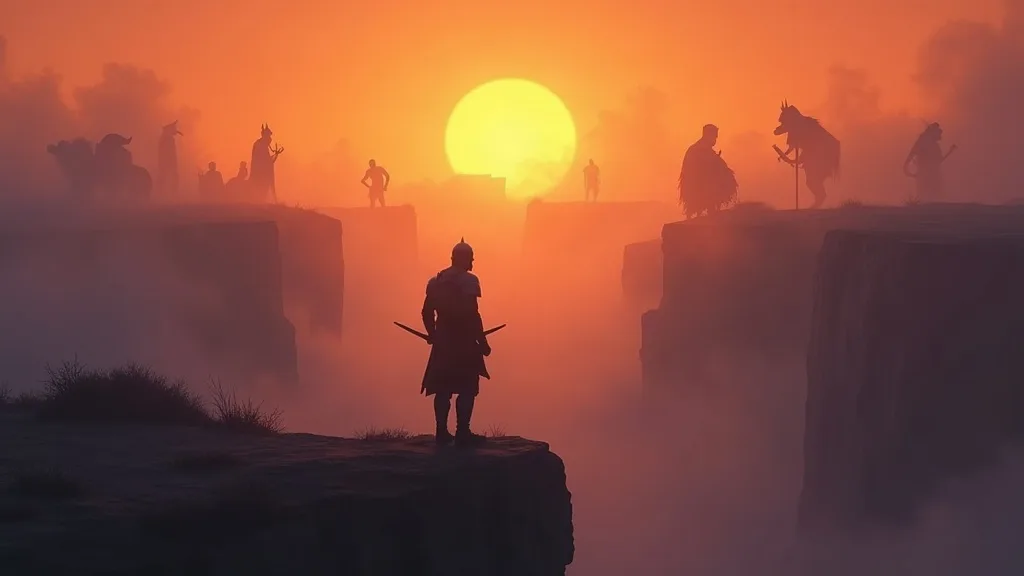
The Hero's Journey Across Mythologies: One Pattern, Infinite Worlds
From Gilgamesh to Arjuna, the hero's journey across mythologies follows a single restless pulse. Trace the pattern through eight traditions and discover what it reveals about us.
Contents
The city of Uruk is burning with restless energy. A king named Gilgamesh storms through its streets, too powerful for any man to match, too mortal to accept that truth. He picks a fight with a wild man from the wilderness, loses himself in friendship, then watches that friend die. Nothing in the palace can hold him after that. He leaves. He walks to the edge of the world. He almost finds immortality, and then loses it to a snake while he sleeps beside a river.
That story is roughly 4,000 years old. It comes from clay tablets pressed in ancient Mesopotamia. And almost every beat of it - the restless king, the crossing into wild territory, the descent, the failure, the return with hard-won wisdom - appears again in the Odyssey, in the Mahabharata, in the Popol Vuh, in the Norse Eddas, in the tales of Yoruba heroes, in the life of the Buddha. The shape recurs with a precision that is almost unsettling.
This is the hero's journey across mythologies: a narrative skeleton so deep inside human storytelling that scholars argue whether it is a cultural borrowing, an evolutionary reflex, or a truth about the structure of change itself. The answer is almost certainly all three.
What the Pattern Actually Looks Like
Campbell broke the hero's journey into three broad acts: Separation, Initiation, and Return. Inside those acts he identified roughly seventeen stages, from the call to adventure to the crossing of the return threshold. Later critics, including the folklorist Vladimir Propp working entirely from Russian fairy tales, arrived at a similar morphology from the opposite direction. Propp's 1928 "Morphology of the Folktale" isolated 31 narrative functions that recur in a fixed sequence. Neither man borrowed from the other. The convergence is the point.
The core skeleton looks like this:
- An ordinary world, with the hero inside it but not fully belonging to it.
- A call that disrupts the ordinary. Often a loss, a threat, or a stranger at the door.
- A refusal or hesitation, then a crossing into unfamiliar territory.
- A mentor or guide who hands the hero a tool, a map, or a hard truth.
- A series of trials that strip away the old self layer by layer.
- A supreme ordeal, usually involving a real encounter with death.
- A reward that cannot simply be brought back without transformation.
- A return, always partial, always complicated.
Not every myth contains every stage. Some loop back. Some begin in the middle. But the gravitational pull toward this shape is consistent enough across cultures that it demands explanation.
Gilgamesh and Enkidu: The Oldest Hero We Know
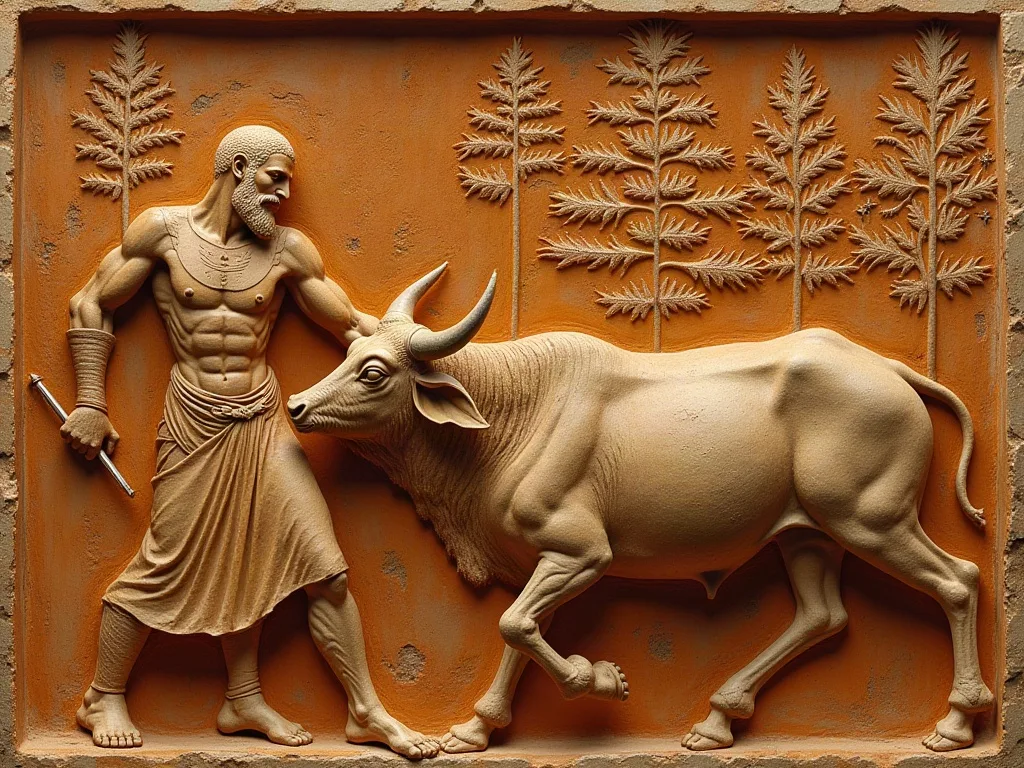
The Epic of Gilgamesh, assembled in its fullest form on twelve cuneiform tablets around 1200 BC but drawing on poems centuries older, gives us the pattern in raw, almost uncomfortable form. Gilgamesh is two-thirds divine, one-third human. The gods, tired of his arrogance, create Enkidu, a wild man raised among animals, as a counterweight. The two men fight, then bond with a ferocity that ancient readers clearly understood as love of the deepest kind.
Together they venture into the Cedar Forest and kill the monstrous Humbaba. This is the first ordeal, the crossing into danger. When Enkidu dies shortly after, punished by the gods for the pair's hubris, Gilgamesh enters the second and deeper stage: the descent into grief and the quest for immortality. He travels to the end of the earth, crosses the waters of death, and finds Utnapishtim, the only mortal ever granted eternal life. Utnapishtim gives Gilgamesh a plant from the bottom of the sea that can restore youth. A snake steals it while Gilgamesh sleeps.
He returns to Uruk with nothing but the city walls he had always had. The scholars Andrew George and Martin West both note that this failure is the point: the return gift is not immortality but the acceptance of mortality. Gilgamesh becomes a better king. The walls of Uruk, which open and close the epic, are described as a work of great craft. He had them the whole time.
Odysseus and the Long Way Home
Seven centuries after the first Gilgamesh tablets, Homer (or the tradition that crystallized under that name) produced the Odyssey, a poem about a man who spends ten years trying to get home from a war. Odysseus is famous for his cunning, not his strength. His separation is complete by the end of the Iliad: Troy has fallen, but he is not allowed to rest. The return becomes the journey.
The trials are a catalog of the psyche's dangers: the Lotus-Eaters who kill ambition, the Cyclops who represents brute power without intelligence, Circe the enchantress who turns men into pigs (a transformation that is also an invitation to stay below the human threshold), the descent to the underworld where Odysseus speaks with the dead, the Sirens who promise knowledge at the cost of life. Each trial is also a temptation to stop. His crew fails these tests one by one. He does not, mostly through stubbornness, and returns to Ithaca transformed enough to survive what waits there.
The Homeric scholar Gregory Nagy argues that the Odyssey is not primarily a story about homecoming but about recognition: Odysseus must prove he is himself, to his dog, his nurse, his wife, and finally the suitors who have taken his place. The return threshold demands as much courage as the departure.
Odysseus in Greek mythology connects to a wider constellation of Greek heroes - Perseus, Heracles, Theseus - who each walk a version of this same spiral.
Arjuna on the Field of Kurukshetra
The Mahabharata, the Sanskrit epic completed roughly between 400 BC and 400 AD, contains within it a scene that stops the entire 200,000-verse poem in its tracks. Arjuna, the greatest archer in the world, rides his chariot to the center of a battlefield and refuses to fight. He sees his teachers, cousins, and friends arrayed against him. He drops his bow. He sits down in the chariot. He weeps.
This is the refusal stage pushed to the center of the story, not the beginning. The god Krishna, acting as his charioteer, speaks to him across eighteen chapters in what becomes the Bhagavad Gita, one of the most studied philosophical texts ever written. Krishna does not argue that war is good. He argues that Arjuna must act according to his dharma (his sacred duty) without attachment to the results. The transformation the hero undergoes here is not physical but ontological. Arjuna is not asked to become braver. He is asked to understand what action actually is.
The Mahabharata scholar Alf Hiltebeitel notes that this scene deliberately echoes the moment of crisis in all hero narratives, the dark night before the ordeal, but relocates it to the inside of the mind. The battlefield is also a psychological field. The supreme ordeal is Arjuna choosing to see reality without the distortion of his own grief and preference.
Arjuna's divine guide Krishna belongs to the same mythological world as the descent stories of Shiva, another figure whose extreme encounters with death and dissolution mirror the hero's descent from the opposite direction.
Hunahpu and Xbalanque: Twins Who Trick Death
The Popol Vuh, the K'iche' Maya text recorded in the 16th century from older oral sources, tells the story of the Hero Twins: Hunahpu and Xbalanque. Their journey is one of the most formally complete versions of the monomyth anywhere in the world, and it operates on a level most Western readers find startling.
The twins are called to Xibalba (pronounced roughly "shih-BAL-ba"), the Maya underworld, by the Lords of Death who are furious at the noise the twins make playing ball above the earth. In Xibalba, they face a series of houses, each designed to destroy a different human capacity: the Dark House, the Cold House, the Fire House, the Razor House. Each chamber is a trial of perception and adaptation. The twins survive through intelligence, not strength, by identifying the puppet lords from the real ones, by refusing to sit on the stone seat that burns intruders, by navigating each test with exact, specific knowledge.
When Hunahpu is finally decapitated by the bat-god Camazotz, Xbalanque replaces his head with a gourd until dawn, a substitution that deceives death itself. They then offer themselves willingly as sacrifices, arrange for their bones to be ground and scattered into a river, and return from the water transformed and victorious. The Lords of Death are defeated not through power but through the heroes' willingness to rehearse death, to go through it voluntarily, and come back.
Mythologist Dennis Tedlock, who produced the most respected English translation of the Popol Vuh in 1985, calls this the fullest expression in any tradition of the idea that the hero must die to complete the journey. The return is literal resurrection.
Sigurd and the Dragon's Blood
Norse mythology hands the monomyth a much colder palette. Sigurd (called Siegfried in the German tradition of the Nibelungenlied) is the supreme Germanic hero: dragon-slayer, sword-bearer, doomed. The Völsunga saga, written down in Iceland in the 13th century from older Germanic material, charts his arc with the unsparing quality that marks Norse storytelling.
Sigurd's separation begins with his lineage: he is the last of the Völsung line, born after his father's death, raised by the smith Regin who has his own agenda. The mentor-with-a-hidden-motive is a Norse speciality. Regin wants Sigurd to kill the dragon Fafnir not for any hero's glory but to reclaim a cursed gold hoard Fafnir guards. Sigurd digs a pit, lies in it, and stabs the dragon from below as it passes overhead. He bathes in the blood. He accidentally tastes it and gains the ability to understand birds.
The birds warn him that Regin plans to kill him. Sigurd kills Regin first. He rides through a ring of fire to wake Brynhildr, a Valkyrie trapped in enchanted sleep. This is the reward, the hidden treasure beyond the dragon: a companion of equal power. The tragedy that follows is the cost of the return. Sigurd, under a curse from the gold, forgets Brynhildr, marries another, and is eventually killed. Both die. The pattern does not promise a happy ending. It promises transformation, and sometimes the transformation only becomes legible as loss.
Odin's own descent into wisdom through suffering maps the same architecture from the divine side: the chief of the Aesir hangs nine nights on the world tree to earn the runes, sacrificing himself to himself.
Sun Wukong: The Monkey Who Became a Buddha
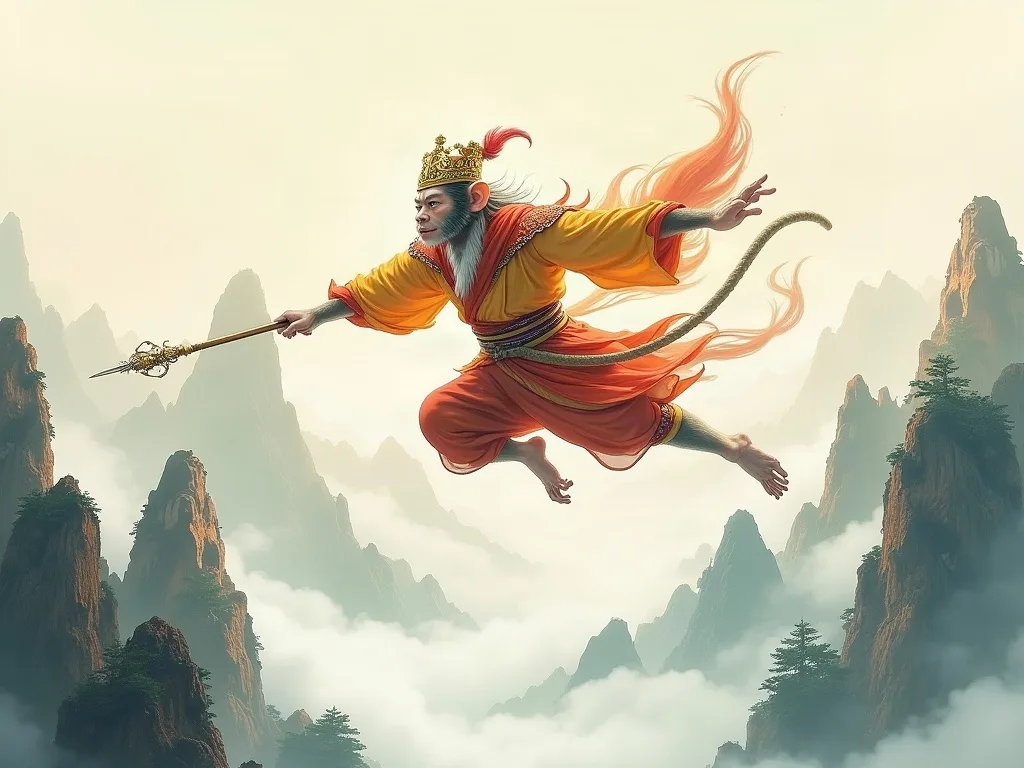
Chinese mythology adds a dimension that Western versions often underplay: the journey as comic, even irreverent, before it becomes sacred. Sun Wukong, the Monkey King of the 16th-century novel Journey to the West by Wu Cheng'en, begins his story by storming heaven, stealing immortality peaches, drinking the elixir of the gods, and making himself effectively invincible. This is the hubris phase accelerated to absurdity.
The Buddha himself defeats him, not through combat but through wisdom. He traps Sun Wukong under a mountain for five centuries. This is the Supreme Ordeal placed at the very beginning of the proper journey: five hundred years of stillness for a being made entirely of motion.
Released, Sun Wukong is assigned to protect the monk Tang Sanzang on a pilgrimage to India to fetch Buddhist scriptures. The road has eighty-one named obstacles, each a different kind of demon, illusion, or test of patience. The monkey must learn what his power is actually for. He begins as a trickster and ends as a bodhisattva, an enlightened being who serves others. The return does not bring him back to where he started. It brings him forward to something he could not have imagined at the start.
Sundiata: The Lion of Mali
West African epic tradition brings the pattern into a completely different visual and sonic world, yet the structure holds. Sundiata Keita, the 13th-century founder of the Mali Empire, is the subject of an oral epic preserved by the griots (professional oral historians) of West Africa and first transcribed in detail by the scholar Djibril Tamsir Niane in 1960 from the griot Mamadou Kouyaté.
Sundiata is born unable to walk. His mother is humiliated in the court. When he finally rises to his feet, he wrenches an iron rod into a bow with one pull, as if the earth itself were responding to something that had been held back too long. The separation follows: he goes into exile with his mother, growing up in foreign courts, learning war and politics far from his own people.
The call to return comes when the sorcerer-king Soumaoro Kante conquers Mali and his people send messengers to find him. The ordeal is not simply military. Soumaoro is a powerful douga (sorcerer) whose magic makes him nearly invulnerable. Sundiata must learn the one weakness in that armor, a rooster's spur, from Soumaoro's own wife. Knowledge defeats power. He returns, defeats Soumaoro at the Battle of Kirina, and becomes Mansa, the lord of lords.
The griot tradition insists on one detail no listener forgets: Sundiata's return is not triumphant in the usual sense. He distributes the conquered lands to his allies. The hero's reward is the ability to give away what he has won.
Why the Same Shape Keeps Appearing
Three serious explanations have competed among scholars for a century.
The first is diffusion: stories travel with trade routes, armies, and priests. The Gilgamesh flood narrative has clear echoes in Genesis. Buddhist Jataka tales about the Buddha's previous lives circulated through Central Asia and resurfaced in European fables. Some structural similarities have traceable transmission lines.
The second is independent invention: the same problems generate the same solutions. Every human society initiates its young, buries its dead, faces the unknown, and tries to understand transformation. Stories that map these processes well survive. The ones that do not, disappear. The hero's journey is a technology for processing change, and different cultures built it independently the way different cultures independently invented the wheel.
The third, championed by Jungian psychologists and by Campbell himself, is the collective unconscious: certain patterns are pre-loaded into human psychology, appearing in dreams, art, and myth without cultural transmission because they emerge from the architecture of the mind itself. This view is the most contested academically but also the hardest to dismiss entirely, given how precisely the pattern appears in contexts where borrowing is impossible.
The folklorist Alan Dundes spent much of his career arguing that Campbell's monomyth was too universal, that it flattened the specific cultural meaning of individual myths by forcing them into a single shape. This is a real criticism. The Hero Twins' willing self-sacrifice means something specific in Maya cosmology that gets distorted when translated into Campbell's vocabulary. Arjuna's paralysis means something in the context of Vedic dharma that has no equivalent in the Norse world.
Both things are true simultaneously. The pattern is real. And the specific skin each tradition puts on it is where the actual meaning lives.
The Hero's Journey Across Mythologies: What It Actually Teaches
The pattern is not a formula for success. Look at the outcomes:
- Gilgamesh comes home without immortality.
- Odysseus arrives at a home that has been partly eaten by strangers.
- Arjuna wins a war that kills everyone he loves.
- Hunahpu is decapitated mid-journey.
- Sigurd dies under a curse.
- Sun Wukong spends five centuries imprisoned before the real journey begins.
The promise embedded in the pattern is not that you will win. It is that you will be changed. The old self is the thing sacrificed in the ordeal. What comes back is someone who has looked at death, at failure, at the limit of what force can achieve, and learned something that cannot be explained to the version of themselves who left.
This is what makes the monomyth more than a storytelling template. It is an argument, repeated across 4,000 years of recorded mythology, that transformation requires descent. That the ordinary world is not enough. That the road that destroys you partway through is the same road that brings you back with something real.
Every tradition wraps that argument in its own colors: Maya darkness, Norse ice, Sanskrit dust, the bright noise of the Monkey King. The argument underneath is the same. Different peoples, looking at the same human facts of growth, loss, and survival, told themselves the same true story in a thousand different voices.
Frequently Asked Questions About the Hero's Journey Across Mythologies
Frequently asked questions
Who first identified the hero's journey as a cross-cultural pattern?
The anthropologist and mythologist Joseph Campbell gave the pattern its most influential formulation in "The Hero with a Thousand Faces" (1949), drawing on Carl Jung's theory of archetypes and examples from dozens of world traditions. However, the folklorist Vladimir Propp had already identified a similar narrative morphology in 1928 through his analysis of Russian fairy tales, working independently. Earlier comparative mythologists like James George Frazer ("The Golden Bough," 1890) had mapped related ritual patterns across cultures without framing them specifically as a hero narrative.
Is the hero's journey actually universal, or is it a Western imposition on other cultures?
This is a genuine scholarly debate. Critics like Alan Dundes argued that Campbell's framework was too broad and erased specific cultural meanings by forcing myths into a single template. The counterpoint is that the structural similarities are often too precise to be coincidental, appearing in traditions with no documented contact. The honest answer is that the pattern is widespread but not identical everywhere. The Maya, Norse, and Hindu hero narratives share a family resemblance more than a photocopy. The value is in reading both the shared skeleton and the specific cultural flesh each tradition puts on it.
What is the oldest recorded example of the hero's journey?
The Epic of Gilgamesh is the oldest narrative we have that contains most of the major stages. Its earliest components date to around 2100 BC in Sumerian poems, with the integrated Akkadian version consolidated by around 1200 BC on twelve cuneiform tablets. The Standard Babylonian version was discovered in the ruins of the Assyrian king Ashurbanipal's library at Nineveh in the 19th century and translated by George Smith in 1872, causing a sensation because of its flood narrative's similarity to Genesis.
How does the hero's journey differ between traditions that promise a triumphant return and those that end in tragedy?
The key difference is often in what the tradition treats as the ultimate value. Greek and Mesopotamian traditions tend to see wisdom or the restoration of social order as the return gift, even when the hero suffers personally. Norse mythology is more comfortable with tragedy as a form of completion: Sigurd and Brynhildr both die, but the story is not considered unresolved. Maya tradition through the Hero Twins makes death itself the instrument of return, not an obstacle to it. Hindu tradition in the Bhagavad Gita reframes the entire question: the Gita argues that the hero who understands the nature of action is beyond the category of victory or defeat altogether.
Did George Lucas really base Star Wars on Campbell's monomyth?
Lucas has confirmed in multiple interviews, including extensively in the 1999 documentary "The Mythology of Star Wars," that he read Campbell before writing the original Star Wars screenplay and consciously used "The Hero with a Thousand Faces" as a structural guide. Campbell himself watched the film and considered it a successful modern application of the pattern. This is one of the most documented cases of the monomyth moving from scholarly analysis back into active storytelling, though critics note that Lucas's version of the pattern is far more optimistic and linear than most of the ancient myths that inspired it.
Which mythological tradition has the most complex or layered version of the hero's journey?
Complexity takes different forms. The Maya Popol Vuh is perhaps the most formally complete, with the Hero Twins passing through every major stage including literal death and resurrection. The Mahabharata is the largest, with Arjuna's journey embedded inside a cosmic-scale narrative involving hundreds of heroes, divine interventions, and philosophical detours that dwarf any single reading of the monomyth. The Norse tradition produces the most psychologically austere version, where the pattern strips away every comfort and leaves the hero to face the world without consolation. The "best" version depends on what question you are trying to answer.
The Modern Afterlife of an Ancient Shape
The hero's journey did not stop in antiquity. It absorbed, mutated, and kept reappearing wherever storytellers faced the problem of showing how people change.
Shakespeare's Hamlet is a hero's journey interrupted, a prince who receives the call and cannot cross the threshold, and the play is about the catastrophic cost of that refusal. Dante's Divine Comedy from 1320 is a descent-and-return narrative so precise in its structure that Campbell analyzed it at length. The 20th century alone produced hundreds of conscious applications: from Tolkien's Frodo (whose return to the Shire is deliberately deflating, a hero who saved the world and cannot quite live in it anymore) to Ursula K. Le Guin's Ged in A Wizard of Earthsea, who descends into a shadow that turns out to be his own.
What the modern versions tend to smooth away is exactly what makes the ancient myths strange and powerful: the willingness to let the hero fail, lose, be broken, or return changed in ways that are not comfortable. Gilgamesh comes home without immortality. Arjuna's war leaves him standing among corpses. The Hero Twins literally die halfway through. The ancient storytellers understood that the ordeal has to actually cost something, or the pattern is just decoration.
The psychologist James Hollis, writing in the Jungian tradition, makes a useful distinction between the hero's journey as a story about external conquest and the same pattern as a description of psychological maturation. In the second reading, the dragon is not a monster to be killed. It is the part of the self that has hoarded treasure, which is to say, energy and potential locked away by fear. Killing it means integrating it. The gold Fafnir guards in the Norse tradition is cursed precisely because it cannot be held without being transformed by the act of holding it.
This is why the hero's journey across mythologies keeps getting rediscovered in every generation. Not because it is a useful template for blockbuster films, though it is that too. But because it describes something true about how human beings actually change: not gradually, not safely, but through crossings that cannot be undone, losses that cannot be recovered, and returns to a home that is never quite the same place you left.
The clay tablets of Uruk, the stone carvings at Palenque, the vellum manuscripts of Iceland, and the living voices of West African griots all said the same thing to the people who listened. You will have to go. You will change along the way. What you bring back will be harder to carry than you expected. And it will be exactly what your people need.
Free 25-page sample
Want the whole story?
Take the first 25 pages free. If it pulls you in, the full edition is yours as an instant PDF download, with a paperback on Amazon for selected titles.

Mythology
The World Mythology Book: The Gods, Heroes and Myths of Every Culture
The Gods, Heroes and Myths of Every Culture, in One Volume
The whole of world mythology in a single volume: Greek, Norse, Egyptian, Japanese, Hindu, Celtic, Slavic, Mesoamerican and African myths gathered side by side, each drawn from the primary sources.