
Indra, King of the Devas: The Vedic Warrior God and His Realm
Indra commands the gods of the Hindu pantheon as their king, wielding the thunderbolt and guarding the heavens. Discover how this Vedic warrior evolved from storm deity to cosmic sovereign across Hindu texts.
Contents
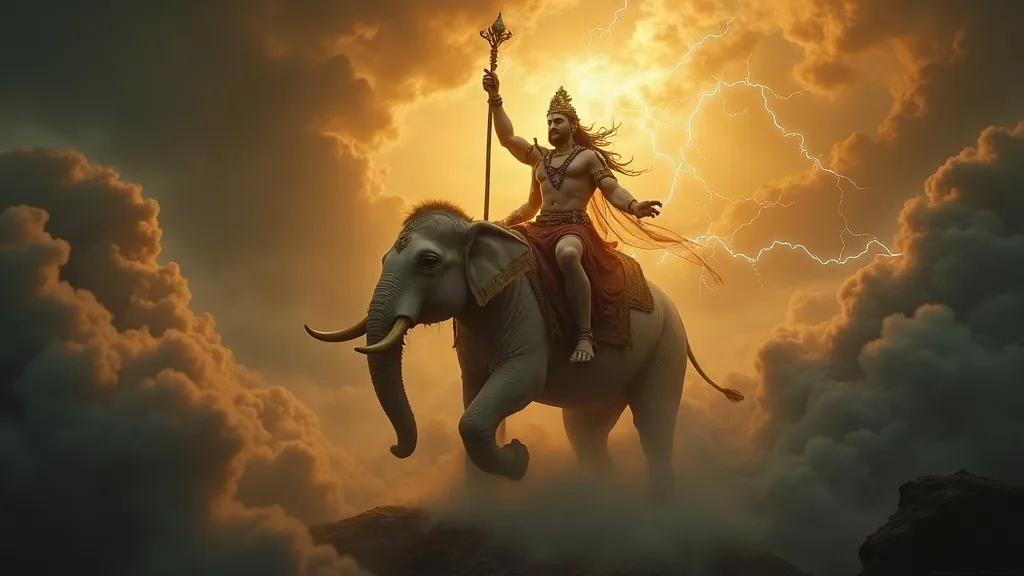
The sky splits open. Indra rides his white elephant, Airavata, while lightning crackles from his fingertips. His thunderbolt, the vajra, hums with the sound of victory. Around him swirl the other gods, lesser powers who bend to his will. This is the heaven he rules, Swarga, a realm balanced between divine order and the constant threat of chaos from demons below.
Indra, king of the Devas, stands at the center of Hindu cosmology as the warrior-sovereign who maintains the boundary between the celestial and the demonic. He is not the supreme god in later Hindu philosophy (that role belongs to Brahman), but in the oldest texts, the Vedas, Indra is the king of kings, the one who rescued the cosmos from destruction and continues to defend it. His story is one of power, hubris, redemption, and the peculiar tension in Hindu thought between absolute rule and eternal vulnerability.
The Vedic Indra: Thunder, Soma, and the First Victory
The Rig Veda, Hinduism's oldest scripture, written between roughly 1500 and 1200 BC, makes Indra the central figure of the cosmos. He appears in more hymns than any other god; the Vedic poets were obsessed with him. In these texts, Indra is explicitly called the king: indro devamandatarah, Indra the lord of the gods.
The Vedic Indra is a drinker, a warrior, a giant. He consumes vast quantities of soma, the sacred plant drink that grants immortality and strength. The Rig Veda describes him quaffing soma before battle, becoming intoxicated on its power. This is not presented as shameful; it is Indra's nature. He is muscular, red-faced, and rides through the sky in a golden chariot pulled by tawny horses. His weapon is the vajra, a bolt of lightning forged by the celestial craftsman Tvashtri. The word vajra means both thunderbolt and diamond, implying a weapon that is both destructive and indestructible.
Indra's greatest deed, celebrated in hymn after hymn, is the slaying of Vritra, a serpent demon who hoarded water and held back the rains. Vritra was not merely a monster; he represented the chaos that precedes creation, the drying force that withers the world. The demon had grown so powerful that the other gods cowered before him. Indra alone dared to challenge him.

The battle raged across three days. Vritra coiled and uncoiled, his scales glinting like mountains. Indra hurled the vajra again and again. The serpent shrieked and fell. As Vritra died, the waters he had imprisoned rushed forth, filling the rivers and watering the earth. The rains returned. The cosmos was saved.
This victory, called the Indra-Vritra conflict or vritraha (Vritra-slaying), is told and retold throughout the Rig Veda. It is the mythological model for creation itself: the defeat of chaos, the release of abundance, the establishment of cosmic order (rta, pronounced "rita"). Every year, when the monsoon rains return to India, Indra's victory over Vritra is remembered.
Swarga: The Realm of the Devas
As king, Indra rules Swarga (also spelled Svarga), the celestial realm. Swarga is not a place of pure spiritual bliss; it is a kingdom with geography, politics, and courts. It sits above the earth but below the highest, formless reality. The Devas, or gods, live there in a hierarchy beneath Indra's throne.
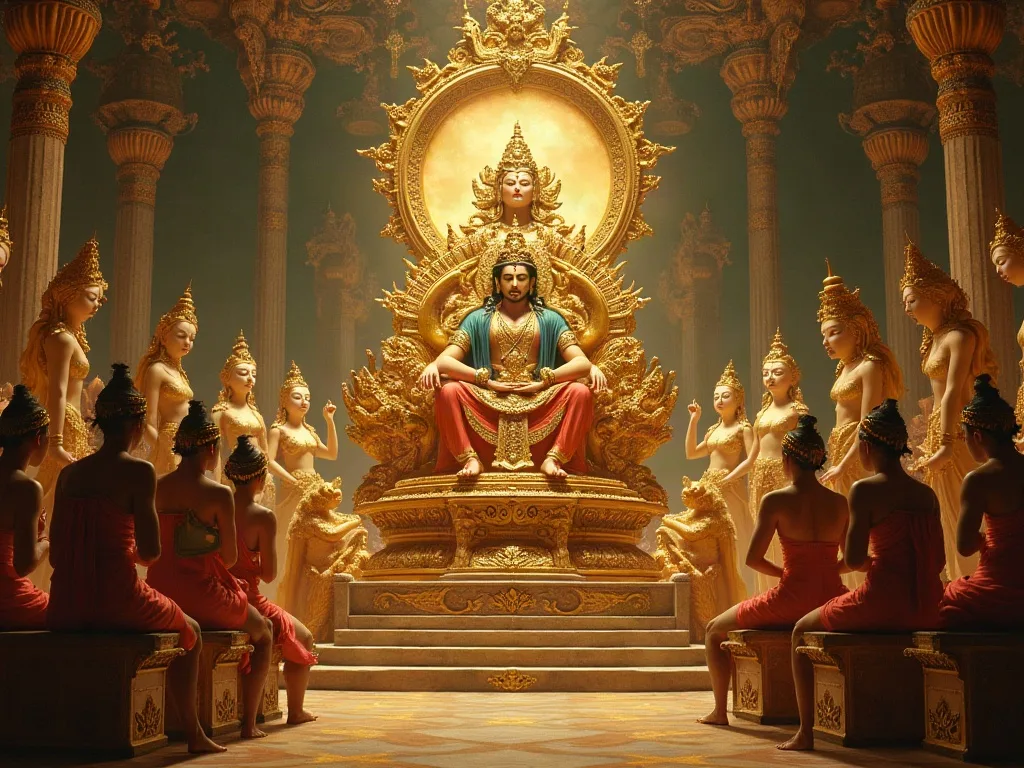
Swarga is described in the Puranas, a later set of texts compiled between the 3rd and 10th centuries AD, as a place of eternal spring, where fruit trees bear fruit year-round and flowers bloom in every color. The Indra Sabha, Indra's court, is a palace of gold and jewels. Here, the gods gather to decide the fate of mortals and demons below. Music plays constantly. Celestial nymphs called apsaras dance, their beauty said to rival that of creation itself.
Indra's throne, called the Vajrasana (the diamond seat), sits at the center of Swarga. From it, he can see the three worlds: the earth below, the celestial realm around him, and the higher planes above. Around him sit the other Devas: Agni, the fire god; Vayu, the wind god; Surya, the sun; Chandra, the moon; and many others. Each has dominion over a portion of creation. All recognize Indra as their overlord.
Significantly, Indra's kingship is not permanent or unchallenged. The Puranas tell of repeated attacks on Swarga by demons, particularly the asuras (a class of powerful demons often at war with the Devas). These incursions force Indra to rally the gods for defense. His throne has been lost and reclaimed more than once. This theme, of a king perpetually vigilant against overthrow, reflects a deeper Hindu philosophical idea: that all temporal power is unstable, that vigilance and action are necessary to maintain order.
Indra's Flaws and His Transformation
As Hindu thought evolved, Indra's character became more complex and troubling. The Puranas, while celebrating his might, also chronicle his moral failings.
One of the most notorious tales involves Ahalya, the wife of the sage Gautama. Indra, overcome with lust, disguised himself as Gautama and seduced Ahalya. When discovered, Gautama cursed Indra to bear a thousand marks of shame on his body. Indra accepted the curse; the marks became a thousand eyes, and he is sometimes called Sahasraksha, the thousand-eyed god. This story, found in the Ramayana (an epic poem compiled between the 2nd century BC and 2nd century AD), reveals a god who is powerful but not wise, divine but not good, capable of profound error.
Another crisis came from Indra's pride. After a great victory, Indra grew arrogant and neglected sacrifices and rituals. In punishment, he lost his kingship temporarily. The story varies, but in one version, the demon Namuchi rose up and defeated him. In another, Brahma (the creator god) temporarily removed his crown. These tales serve a didactic purpose: even the greatest king must remember his dependence on dharma (cosmic law) and proper conduct.
The most dramatic transformation came during the conflict with the asura Vritra-like demons in later mythology. In the Mahabharata, written between the 4th century BC and 4th century AD, Indra plays a crucial role but is frequently shown as anxious, prone to paranoia, and desperate to maintain his throne. He is powerful but unstable, more reactive than the supreme cosmic force the Vedas portrayed him to be.
This shift mirrors a larger philosophical change in Hinduism. As ideas of a single, formless absolute (Brahman) took root, the role of Indra diminished. He went from being the principal god to being one god among many, all subject to forces greater than themselves.
The Iconography of Divine Kingship
In Hindu visual art, Indra is instantly recognizable. He is typically depicted as a mature man with a commanding presence, often painted in gold or radiant colors. He rides Airavata, the white elephant, which is itself an emblem of kingship and stability. The elephant is enormous, with four tusks, and sometimes depicted with multiple heads. This image, Indra astride Airavata, appears on temple walls, in manuscripts, and in devotional art across Hindu-majority regions for over two thousand years.
Indra wears a crown, often with a crescent moon or the sun embedded in it. His thunderbolt, the vajra, is held in his hand or planted nearby. Sometimes he holds a noose called a pasa, a symbol of authority and binding power. Around him cluster smaller deities and celestial beings.
The iconography emphasizes several qualities. The white elephant represents stability and strength. The thunderbolt represents power and cosmic authority. The crown marks him as king. Yet artists often depicted Indra with a certain guardedness in his expression, a wariness that contrasts with the supreme confidence of a truly unassailable god. This subtlety reflects the theological tension: Indra is mighty, but his might is not ultimate. He rules but remains vulnerable.
Festivals and Worship in Historical Practice
Indra receives worship primarily during the monsoon season across India. The god who brought the rains remains linked to agriculture and rainfall in the popular imagination, even as philosophical Hinduism moved beyond him.
In traditional practice, prayers to Indra were offered before the onset of monsoons, asking for timely and abundant rains. Farmers understood Indra as the guardian of their crops. These prayers persist in folk religion and regional festivals, though they are less prominent in contemporary urban Hindu practice.
One significant occasion is Indra Jatra, a major festival in Nepal, particularly in the Kathmandu Valley, celebrated in September or October. The festival marks the transition between seasons and is believed to invoke Indra's blessing for good harvest. A tall, decorated pole is erected, offerings are made, and processions move through towns. Though less celebrated in India proper, the festival shows how regional Hinduism continues to invoke Indra's protective power.
The ritual offering to Indra traditionally includes soma (or in later practice, substitutes like milk or honey), which connects back to the Vedic image of Indra's consumption of the sacred drink. This continuity, from the Rig Veda to modern ritual, shows how mythological images remain embedded in religious practice even as theology evolves.
Indra Across Hindu Regions and Sects
Indra's prominence varies across Hindu traditions. In Vedantic philosophy (which emphasizes the formless Brahman), Indra is explicitly lower in the cosmic hierarchy. The great philosopher Adi Shankara, writing in the 8th century AD, taught that Indra, for all his power, remains trapped in samsara (the cycle of rebirth) and subject to maya (illusion). He is a great king, but still a king within illusion.
In Shaivism, the tradition centered on Shiva, Indra is often depicted as subservient to Shiva or as one of the eleven Rudras, Shiva's manifestations. In Vaishnavism (the tradition of Vishnu), Indra is sometimes portrayed as an ally of Vishnu or as a dependent deity who must call upon Vishnu for aid in times of crisis.
In Tamil Shaivism and other regional traditions, the name Indra (Intaran in Tamil) refers to any king or ruler, extending the mythological image into the political realm. This linguistic trace shows how deeply the concept of Indra permeated Hindu culture.
Indra in Comparative Mythology
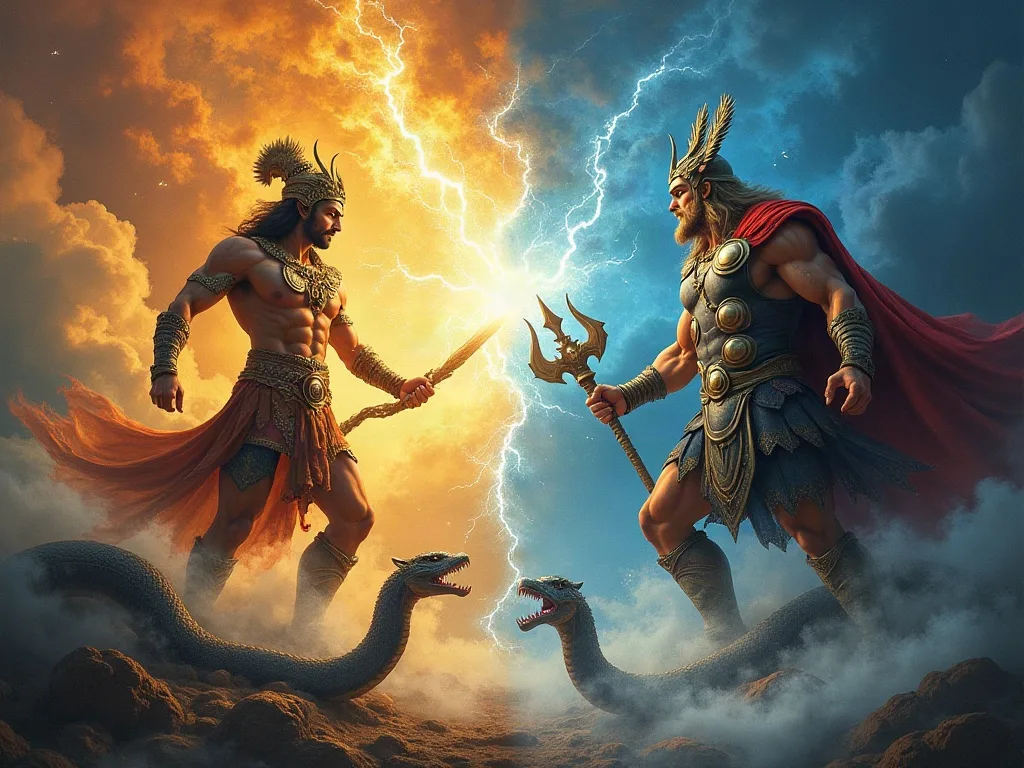
Indra shares striking similarities with storm gods in Indo-European mythologies. The Vedic Indra wielding the vajra against the serpent Vritra bears a marked resemblance to Thor in Norse mythology, who wields his hammer Mjolnir against the serpent Jormungandr. Both are red-bearded (in some depictions), thunder gods, warriors, and opponents of cosmic serpents. Some scholars suggest a common Indo-European prototype, though the myths diverged significantly in their respective traditions.
The Greek Zeus also shows structural parallels: he is king of the gods, wields a thunderbolt, and battles chaos monsters like Typhon. Yet the mythological emphasis differs. Zeus is more concerned with order through hierarchy and sexual conquest; Indra is more directly engaged with the cycle of creation and destruction.
The Hittite weather god, also a storm deity and king figure, fought a serpent called Illuyanka in a myth that has been proposed as an ancestor to both the Indra-Vritra and Zeus-Typhon stories. If so, the pattern of storm king versus serpent chaos may be very ancient, dispersed through the Bronze Age Indo-European world.
The Decline and Persistence of Indra's Cult
By the medieval period, the worship of Indra as a primary deity had largely faded. The rise of devotional theism, particularly to Vishnu and Shiva, shifted Hindu piety away from the Vedic gods toward the supreme manifestations. Yet Indra never disappeared entirely.
In temple sculpture across India, particularly in South Indian temples built between the 7th and 12th centuries, Indra appears in narrative reliefs. He is depicted attending upon the principal deity or participating in cosmic scenes. His presence signals the continuity of Vedic memory even as his role diminished.
In modern Hinduism, Indra is remembered and acknowledged, but rarely worshipped exclusively. He appears in festivals, in the recitation of mantras, and in learned discussions of Vedic texts. Scholars and pandits (Hindu priests) know him intimately. Casual practitioners may know his name and his role but do not direct prayers to him as they might to Shiva or Vishnu or the Goddess.
This decline reflects a philosophical evolution: as Hinduism developed the concept of a single, transcendent absolute (Brahman), gods like Indra were reinterpreted as manifestations or aspects of that absolute rather than independent powers. Indra became a step in a ladder of understanding rather than a destination.
Indra in Modern Scholarship and Textual Debate
Contemporary scholarship on Indra remains vigorous. Scholars debate the historical origins of Indra: Was he originally a warrior god of Indo-Aryan peoples who invaded the Indian subcontinent? Did he absorb traits from local monsoon deities? The evidence is fragmentary, and interpretations vary.
The Rig Veda itself hints at tensions in Indra's mythology. Some hymns celebrate him without reservation; others contain subtle critiques or suggest that he needed help (from the other gods, from priests, from sacrificial ritual) to defeat Vritra. Some scholars interpret these variations as evidence of competing traditions within the Vedic corpus, perhaps reflecting different tribes or priestly schools.
The relationship between Indra and Vritra has been endlessly analyzed. Some scholars see it as an allegory of seasonal cycles (Vritra = drought, Indra = rain). Others read it as a tale of cosmic order triumphing over chaos. Still others have proposed that the myth encodes the conflict between Indo-Aryan invaders and indigenous populations, with Vritra representing pre-Aryan religious traditions. These interpretations are not mutually exclusive; myths can operate on multiple levels.
The evolution of Indra in the Puranas has sparked debate about authorship and dating. When did Indra's character shift from supreme warrior to anxious ruler? Was it gradual or sudden? How much did philosophical developments (the rise of Vedanta, the concept of Brahman) influence narrative theology? These questions remain open.
Indra and the Question of Divine Immortality
A peculiar feature of Indra in Hindu mythology is that his divinity is not absolute. He can age, become ill, and face genuine threats to his life. In one tale, the asura Namuchi nearly killed him. In another, he was cursed and temporarily lost his powers. This contrasts sharply with gods in other traditions, where divinity confers absolute immortality.
This reflects a Hindu philosophical principle: even the gods are subject to the cycle of time and change. Divinity is not permanence but a heightened state of consciousness and power, temporary by cosmic standards. Eventually, the texts suggest, all worlds cycle through creation and destruction (yugas), and even Indra will face destruction and renewal.
This idea has profound implications for Hindu ethics and theology. If even Indra is not safe, then the ultimate security comes not from power or position but from spiritual enlightenment and union with Brahman. This may explain why, as Hindu philosophy matured, Indra's cult declined while worship of Brahman, Vishnu, and Shiva (understood as paths to transcendence) flourished.
Frequently asked questions about Indra, king of the Devas?
Frequently asked questions
Why does Indra drink soma, and what is soma?
Soma was a sacred plant (possibly a psychoactive fungus or extracted plant juice) that granted immortality and superhuman strength in Vedic belief. The Rig Veda depicts Indra consuming vast quantities of soma before battle; it was not forbidden or shameful but a source of divine power. The identity of soma has long been debated by scholars; it may have been an Amanita muscaria mushroom or a pressed plant juice. What matters mythologically is that soma represented divine power itself.
What is the vajra, and how is it different from other divine weapons?
The vajra is Indra's thunderbolt, forged by Tvashtri, the celestial craftsman. The word means both lightning and diamond, implying a weapon that is both destructive and indestructible. It is the weapon of supremacy in Hindu mythology; a god bearing the vajra holds ultimate power. It has no equivalent in Western mythology, though the hammer Mjolnir of Thor comes close in function. The vajra symbolizes both masculine power and illumination.
Why does Indra's worship decline in later Hinduism if he was so important in the Vedas?
As Hindu philosophy developed, particularly through Vedantic schools, the focus shifted from individual gods to a transcendent, formless Brahman. Indra, for all his might, was understood as a being within the cycle of creation and destruction, not the ultimate reality. Additionally, devotional traditions centered on Vishnu and Shiva offered more personal paths to salvation. Indra remained important theologically but ceased to be a primary object of worship.
Is Indra immortal, or can he be killed?
In Vedic texts, Indra is effectively immortal (he drinks soma and is divine), but in later mythologies, he faces genuine threats. He can be wounded, temporarily lose his powers, or be dethroned. This reflects the Hindu principle that even gods are subject to cosmic cycles and change. Only Brahman, the absolute, is truly unchanging and eternal.
How does the Indra-Vritra myth compare to similar myths in other cultures?
The storm god defeating a serpent is a pattern found across Indo-European mythologies: Thor versus Jormungandr in Norse tradition, Zeus versus Typhon in Greek mythology, and the Hittite weather god versus Illuyanka. This suggests a shared mythological heritage among Indo-European peoples, though each tradition adapted the story to its own theological needs.
What is Airavata, and why is it significant that Indra rides an elephant?
Airavata is the white elephant, Indra's mount, often depicted with four tusks and sometimes multiple heads. In Hindu symbolism, the elephant represents stability, strength, and sovereignty. The elephant is the largest land animal and was (and is) a symbol of royal power in Indian kingdoms. Indra riding Airavata emphasizes his role as cosmic sovereign. The elephant also connects to the earth and harvest, linking Indra to material fertility.
The Eternal Return: Indra in Modern Literature and Popular Culture
Though worship of Indra as a primary deity has waned, he remains a potent symbol in Hindu literature and contemporary culture. Indian poets and writers continue to invoke Indra. His image appears in films, in devotional contexts, and in works that draw on Hindu mythology.
The figure of Indra, a king who must constantly defend his throne, also carries metaphorical weight. He represents the burden of power, the anxiety of rule, and the ultimate fragility of temporal authority. Modern Hindu theologians sometimes return to Indra when discussing the paradox of divine power: how can a god be all-powerful yet vulnerable? The answer, Hindu philosophy suggests, is that all power is conditional and temporary, bound within the cycle of time. This insight remains relevant to contemporary questions about authority, leadership, and the nature of power itself.
In this way, Indra endures not as an object of daily prayer but as a figure through which Hindus continue to explore deep questions about order and chaos, strength and limitation, the visible and the transcendent.
Free 25-page sample
Want the whole story?
Take the first 25 pages free. If it pulls you in, the full edition is yours as an instant PDF download, with a paperback on Amazon for selected titles.

Mythology
The World Mythology Book: The Gods, Heroes and Myths of Every Culture
The Gods, Heroes and Myths of Every Culture, in One Volume
The whole of world mythology in a single volume: Greek, Norse, Egyptian, Japanese, Hindu, Celtic, Slavic, Mesoamerican and African myths gathered side by side, each drawn from the primary sources.