
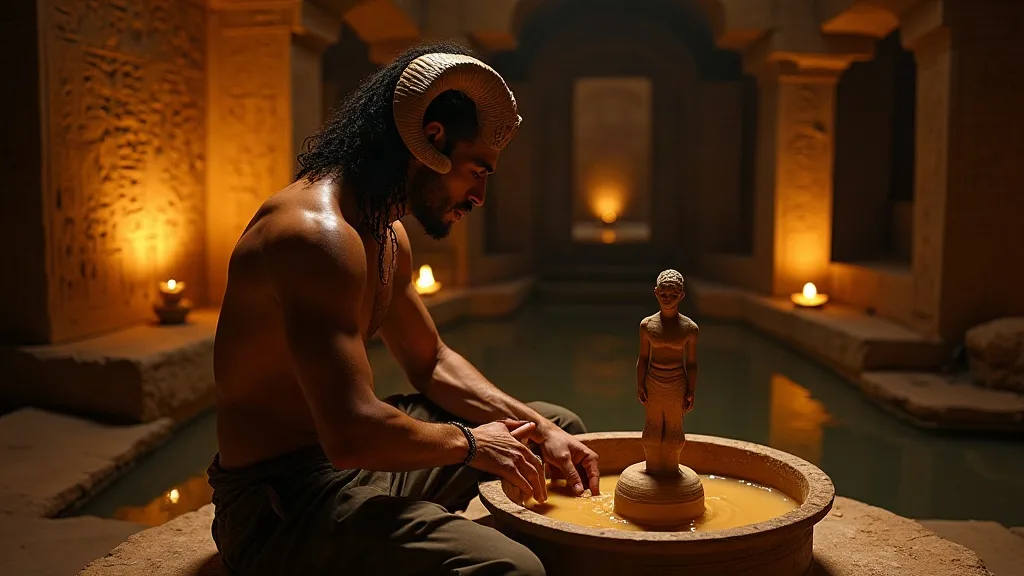
Khnum the Ram-Headed Creator: Potter of the Nile and Divine Shaper
Khnum was ancient Egypt's divine potter, depicted with a ram's head, who shaped gods and humans on his sacred wheel. Discover his role in creation, his worship at Elephantine, and why he remained one of the most enduring creator deities across three thousand years of Egyptian history.
Contents
At the southern edge of Egypt, where the Nile's current grew swift and dangerous, priests called upon Khnum to do what only he could do: shape life itself on his potter's wheel. His head was a ram's, curved horns sweeping back, his hands steady on clay that would become a child in the womb, a pharaoh, even the bodies of the gods themselves. For over two thousand years, Egyptians knew him as the great modeler, the one who worked in the unseen chambers beneath the world, crafting each soul's form before it drew breath.
This was not a god of thunder or bloodlust. Khnum the ram-headed creator worked in silence, his workshop the darkness under the mountains of Nubia, his sacred waters the cataract of the Nile. He embodied patience, skill, and the transformation of raw material into living form. His story stretches from the earliest pyramid texts to the temple walls of the Ptolemaic age, and his methods reveal how ancient Egyptians understood birth, divinity, and the shape of the soul itself.
The Iconography of Khnum: Reading the Ram
Khnum appears in art with a consistency almost no other Egyptian god matches. His body is human, muscled, and usually nude or wrapped in a simple loincloth. His head is always a ram, always the same species: the horizontal-horned ram, Ovis aries longipes, the curly-horned variety that grazed the Nile valley in antiquity. This choice was deliberate. Rams symbolized creative force and virility in Egyptian thinking; their horns spiraled outward like the unfolding of potential itself.
In reliefs and painted papyri, Khnum sits at a potter's wheel, his human hands deft, sometimes alone, sometimes with his wife Heqet (also called Hekat), a frog-headed goddess of fertility, or his daughter Anuket, the personified force of the cataract waters. On the wheel before him rests a clay figure, still rough, or sometimes already human-shaped: a child, an adult, occasionally a pharaoh being remade for eternity. His tools are simple: a potter's stick, sometimes a bowl of clay. No weapons. No cosmic struggle. Just craft.
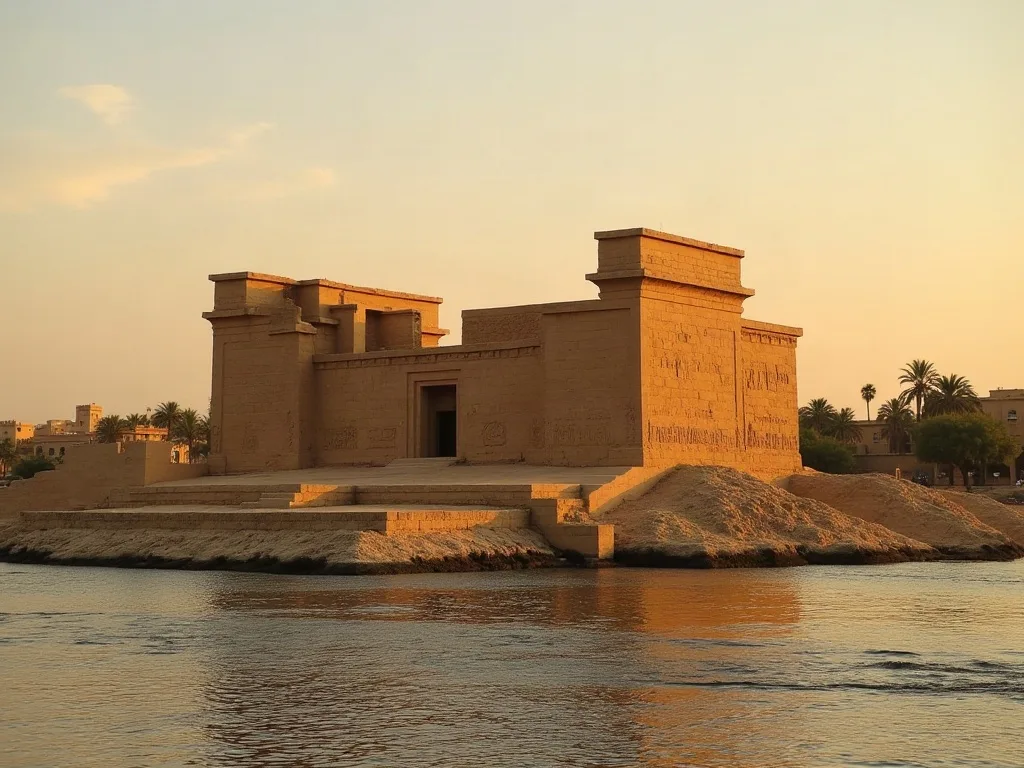
One of the most striking images comes from the Temple of Philae, south of Elephantine. There, on a wall painting still visible after two thousand years, Khnum turns his wheel while the life-giving Nile waters flow past on either side. A king stands before him, already shaped, asking for renewal. The message is unmistakable: Khnum renews what time erodes. He is the keeper of form against the chaos of formlessness.
His name itself offers a clue. In ancient Egyptian, Khnum (sometimes spelled Khnemu or Khenti-Amentiu when referring to him as an underworld guardian) may derive from a verb meaning "to knit" or "to join together." Some scholars propose it comes from kheny, meaning "to rush" or "to flow," linking him to the cataract waters of Aswan. The uncertainty suits a god of transformation: his identity, like clay, could be reshaped to fit different contexts.
Origins and the Creation of All Forms
No single Egyptian creation myth ever dominated. The tradition held multiple cosmogonies in tension, each sacred in its own right. In some, Ra created himself from the primordial waters. In others, Atum rose from the chaos and begat the world through will or generation. But when it came to the formation of individual bodies, Khnum's role was near universal.
The Pyramid Texts, inscribed inside the tombs of Old Kingdom pharaohs around 2400 BCE, mention Khnum explicitly. He appears as the one who "fashions" (khenti) the pharaoh's body, who "models" him on his wheel. One text describes Khnum shaping the pharaoh's skeleton and flesh, assembling him piece by piece. He did not create the pharaoh's ba (often translated as "soul," though closer to "active force" or "personality"); that was the work of gods like Ra. Khnum made the container. The distinction mattered: the body was material, shapeable, temporary. The divine essence was eternal. Khnum managed the boundary between them.
By the Middle Kingdom (around 2000-1700 BCE), Khnum's role expanded. Texts from the Thirteenth Dynasty describe him fashioning not just pharaohs but ordinary people in the womb. A birth scene from the Temple of Luxor (Karnak), inscribed much later but preserving earlier theology, shows Khnum at his wheel shaping the body of the young king Amenhotep III, while the god Thoth writes the child's name on a palm leaf. There: form and identity, made simultaneous, Khnum's hands the instrument.
One particularly strange myth places Khnum at the center of a creation event later in his career. According to a text from the Temple of Edfu, Khnum fashioned an egg on his potter's wheel from which hatched a bird (sometimes identified with Horus or a primordial goose). This echo of the self-created egg, the cosmic seed, suggested that even the gods themselves relied on Khnum's shaping power. Some priests advanced an even bolder claim: that Khnum had fashioned the gods themselves, including Ra. The implications were staggering. A craftsman above the cosmic order. A god whose power lay not in dominion but in the prior act of making.
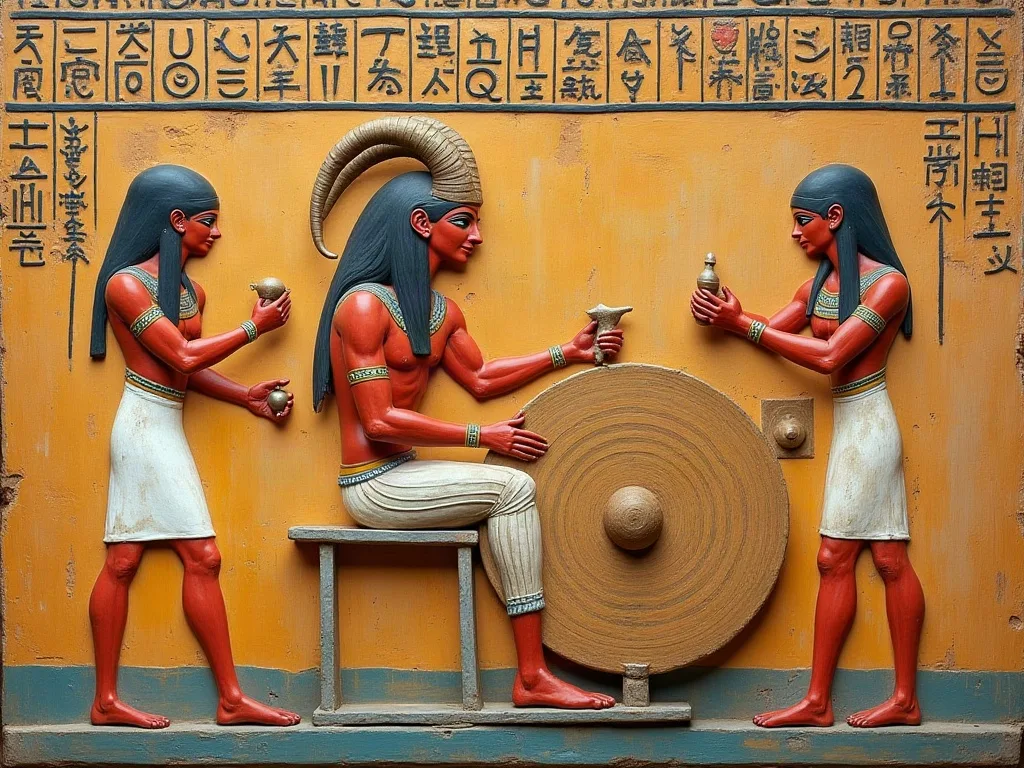
Elephantine: The Center of Khnum Worship
If Khnum had a home, it was Khnum's temple on the island of Elephantine, at Aswan in southern Egypt, where the Nile's waters tumbled through granite cataracts. The island itself became sacred ground because of those waters: the Greeks called the roaring cataracts the "elephant stones," and Egyptians believed the Nile's annual flood originated in caverns beneath Elephantine, controlled by Khnum himself.
The temple's origins are lost, but inscriptions from the Eighteenth Dynasty (1550-1295 BCE) show a substantial structure already in place. By the Ptolemaic period (305-30 BCE), when Greek rulers controlled Egypt, Khnum's temple had been rebuilt and expanded. Reliefs on its walls tell the story of Khnum's control over the inundation. In one scene, the god stands in a grotto beneath the island, directing the waters. Osiris and Satet, another Nubian goddess, flank him. Together, they regulate the flooding. Too little water meant famine. Too much meant catastrophe. Khnum's balance kept the valley alive.
Priests at Elephantine cultivated a special knowledge. They maintained records of the Nile's annual heights, measured at a nilometer, a stone column marked with measurements. These records, kept over centuries, allowed them to predict the flood and calibrate offerings and ritual. Khnum, they taught, was not capricious like a storm god. He was mathematically precise, an engineer as much as an artist. His wheel turned by natural law.
The island held another significance. Elephantine sat at Egypt's boundary with Nubia, a region that contributed both ivory and soldiers to Egypt's wealth. Khnum, as a ram-headed god, belonged to the Nubian tradition as well as the Egyptian. Nubian peoples honored him, and his temple became a point of cultural continuity across the frontier. A Nubian pharaoh could pray to Khnum at Elephantine and feel connected to Egypt's deepest spiritual claim: that order emerged from chaos, that form was sacred, and that a god with a craftsman's hands could shape even the mightiest kingdom.
The Khnum Hymns: Voices of Praise
Two formal hymns to Khnum survive, carved on temple walls and preserved in copies on papyri. They reveal how priests and poets understood his essence, and they repay careful reading.
The first, from the Temple of Esna (much further north, in Upper Egypt), opens with an act of identification. Khnum is called "Ptah of the South" (Ptah was the great creator-craftsman of Memphis, in the north). The hymn reads: "You are the potter, we are your clay. We are all the work of your hand." The comparison is exact. Just as Ptah fashioned the world through thought and will, so Khnum fashions bodies through skill. But where Ptah dwells in abstraction, Khnum kneels at the wheel, sweat on his brow, tangible and immediate.
The hymn continues, addressing the unseen work: "You create the male and the female. You join their limbs. You open their nostrils so they may breathe. You make what they need to live." The detail matters. Khnum doesn't just make bodies; he tunes them for function. He opens the mouth so the child can cry. He shapes the spine so the body can stand. This is engineering dressed as divinity.
A second hymn, from the Temple of Khnum at Philae, strikes a different note. It addresses Khnum as the eternal one, the god who existed before time, who will exist after it. But even in this cosmological language, the focus returns to the wheel: "Your hands labor ceaselessly. Your wheel turns day and night. You are wearied by your work, yet you do not rest." Here, Khnum emerges not as a god of leisure and command but as a god of labor, of steady effort, of the artisan's dedication. This would have resonated deeply with Egyptian workers, potters, and craftspeople. Their god knew sweat.
Divine Births and the Shaping of Kings
No royal birth scene in Egyptian art omitted Khnum. When a pharaoh wanted to legitimize his rule, he commissioned a temple relief showing his miraculous conception and birth, and Khnum always appeared.
The classic scene unfolds in three registers. In the first, the reigning god (often Amun, the king of the gods) seduces the queen in the form of her husband. In the second, the queen becomes pregnant. In the third, Khnum appears with his wheel. A clay figure rests on it, half-formed, taking on features. The figure's form is ambiguous, sometimes showing a tiny human body, sometimes something more abstract. Khnum's hand guides the wheel. Thoth, god of writing and wisdom, stands by with a stylus, writing the child's name and years of life on a palm leaf. Sometimes Satet or Anuket holds a ankh (the symbol of life) to the clay figure's nose.
The theology is subtle. The pharaoh's conception was divine; his body was not. His father was a god (through the king, a living god), yes, but his flesh had to be shaped. Khnum provided that flesh. In doing so, Khnum made the pharaoh human, mortal, dependent on breath and sustenance. The king ruled by divine right, but only because Khnum had first made him capable of ruling: a body, intelligent and strong, shaped for kingship.
One birth relief, from the Temple of Luxor (Karnak), inscribed under Amenhotep III around 1390 BCE, shows Khnum with exceptional care. The pharaoh-to-be on the wheel wears the royal uraeus (cobra crown) even in his clay state. Khnum's face is concentrated, the ram's eye fixed on his work. Below, attendant gods and goddesses watch: Isis and Nephthys, divine mothers; Khenti-Amentiu, the underworld guardian (sometimes identified with Khnum himself); and minor deities whose names we've forgotten.
This insistence on Khnum's presence at royal births served a political purpose. The pharaoh was not born into power through succession alone. His body itself was the work of the gods, shaped by the supreme craftsman. No rival could claim that throne without that body, and Khnum had already made it. Succession was cosmically guaranteed, written into flesh.
The Potter's Other Children: Gods and Humans Alike
Khnum's children, by some accounts, included the most essential figures in the Egyptian pantheon. His wife Heqet (Hekat), the frog goddess, bore him Anuket, the personified cataract waters. This daughter represented the life-giving flood itself, the water Khnum directed. She was depicted as a slender human woman with an antelope or gazelle's head, crowned with feathers. Together, Khnum and Anuket embodied the creative partnership: his craft, her waters. No creation without both.
In some temples, Khnum was paired with different consorts. At Philae, he joined with Satet, a huntress goddess associated with arrows and southern boundaries. The pairing suggested that Khnum's creative force was complemented by protection and precision. At Esna, further north, he was linked to various local goddesses as that temple evolved. The flexibility speaks to Khnum's role: he was a universal craftsman, capable of partnering with any feminine principle that embodied fertility or the generative act.
Beyond these named relationships, Khnum was credited with fashioning all humanity. This was not poetic license. Priests taught that every human being, from the moment of conception, was shaped by Khnum on his wheel. The soul (ka) might be eternal, granted by Ra or Thoth, but the body was Khnum's work. Slavery, servitude, illness, disability, beauty, ugliness, strength, weakness: all were aspects of Khnum's design. This doctrine had moral weight. A slave was not inherently inferior; he or she was simply shaped differently by Khnum for a different role. The body was temporary, the soul eternal. What mattered in the afterlife was the soul's purity, not the body's status. This did not eliminate slavery in Egypt, but it provided a theological counterbalance to absolute hierarchy.
The Khnum Stela: A Personal Prayer Carved in Stone
One of the most moving artifacts from the Graeco-Roman period is the Khnum Stela, a small stone tablet from around 300 BCE, kept in the British Museum. It reads like a personal petition, carved perhaps by a craftsman or merchant, addressing Khnum directly.
The stela begins with formal titles: "Khnum, the great god, lord of the cataract, maker of things, who shapes with his hands." Then it shifts into intimate address. The petitioner asks for health, a long life, safe passage through the Nile, protection of family. But the tone is one of recognition rather than demand. The petitioner acknowledges Khnum's labor. He thanks the god for the body he was given, for the ability to work and create. He asks not for wealth but for the stability to use his craft well.
At the stela's base, a carved image shows the petitioner, small and kneeling, facing an image of Khnum at his wheel. The scale difference (typical in Egyptian art) makes clear who holds power. Yet the kneeling figure is not abject. He is simply a creature shaped by Khnum, returning to acknowledge his maker with gratitude and hope.
This stela represents something important: evidence of private worship. The grand temples and royal reliefs tell us what theology the priesthood maintained. But the stela tells us that ordinary people, generations after the New Kingdom's end, still prayed to Khnum. They saw him not as a distant cosmic force but as a craftsman-god who understood labor, who shaped life with care, and who might listen to a craftsman's prayer.
Khnum and the Other Creator Deities
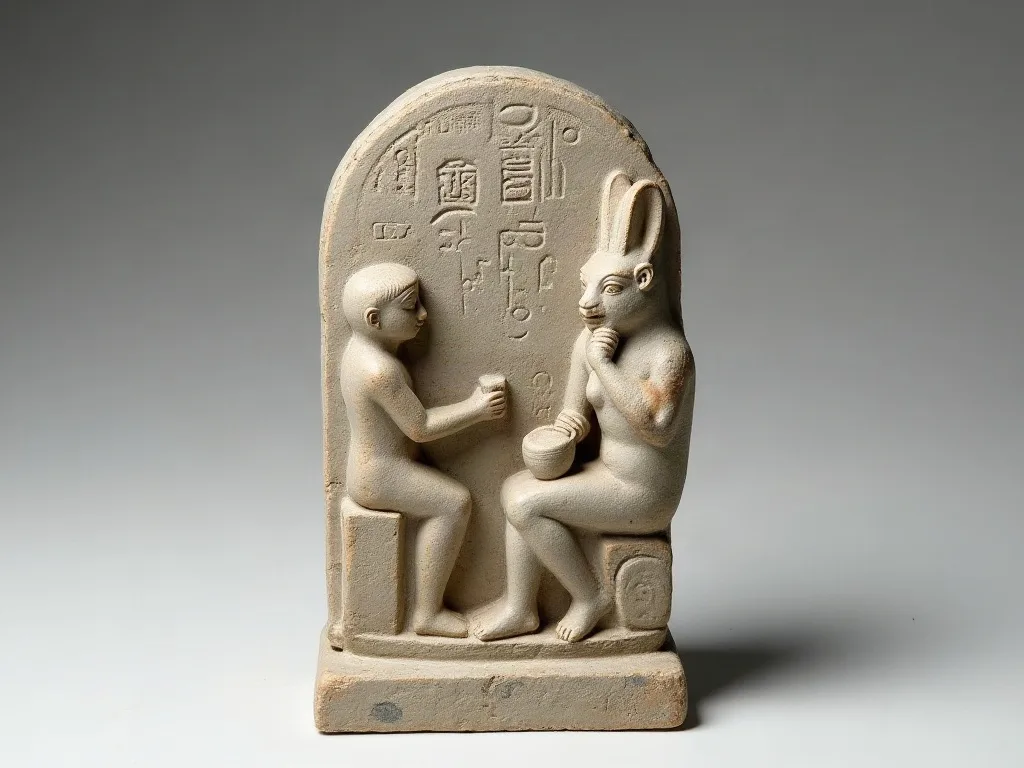
Egyptian theology never demanded that one god be the sole creator. Different regions, different periods, and different priestly schools promoted different creators. This redundancy was not a flaw; it was a feature. The gods specialized.
Ptah, based in Memphis, created through thought and speech. He conceived the world in his mind, spoke it into being. His was the power of intellect and the word.
Atum created himself from the primordial waters and then generated the other gods through various methods (in some versions, sexual; in others, by spitting or vomiting). His was the power of self-generation and cosmic solitude.
Amun, based in Thebes, was the hidden one, the king of the gods whose nature was ultimately mysterious. He generated through hidden power, in darkness, in the chamber beneath the world.
Khnum created through craft, through labor, through the shaping of individual forms. His domain was the material, the specific, the embodied. He made not the cosmos but the creatures within it. Yet in New Kingdom and later texts, Khnum's status rose. Some temples advanced the claim that he was not subordinate to Ptah or Amun but their equal, or even their superior. One hymn suggests that Ptah's thought and Khnum's hands were partners: Ptah conceived, Khnum executed. Another hints that Khnum had fashioned even Ptah himself. The competition was theological, not violent. Different schools promoted their patron deity without erasing the others.
Ptah
Creator through intellect and speech; the conceived world exists in his mind before being spoken; associated with Memphis and royal craftsmen; depicted as a mummiform figure (bound, complete); power is abstract, divine thought; creates the cosmos and the order within it.
Khnum
Creator through craft and material shaping; the made world emerges from his hands on the potter's wheel; associated with Aswan, Nubia, and the cataract; depicted as ram-headed, active, in motion; power is tangible, the skill of making; creates bodies, forms, the specific embodied beings within the cosmos.
The Afterlife Transformation: Khnum as Eternal Maker
Death was not an end in Egyptian belief; it was a transition. The body, once it ceased to breathe, had to be transformed again. And Khnum's role in that transformation was essential.
The Book of the Dead, a collection of spells and instructions for the afterlife compiled over many centuries, mentions Khnum explicitly in the context of resurrection. One text describes the deceased entering the realm of the dead and encountering Khnum at his wheel. The dead person asks to be remade, to have his or her body reformed for the next existence. Khnum examines the soul, determines its worthiness, and either reshapes it into a glorious form for eternity or refuses to shape it at all, a fate worse than death.
This is not resurrection in the Christian sense. The body was mummified, preserved through careful drying and bandaging. But the mummy was not thought to be sufficient for eternity. The ba (the active, living part of the person) and the akh (the effective, powerful spirit) needed a form in the afterlife. That form could be the mummy itself, remade and animated. Or, if the priests performed the right rituals, it could be a new body, shaped by Khnum's hand, perfect and eternal.
The Temple of Khnum at Philae contains a relief showing this process. A dead pharaoh is led before Khnum. The god examines him with the eye of a craftsman assessing material. Behind Khnum, attendant deities stand ready. If Khnum approves, they will assist in the remake. The pharaoh will enter the eternal world, not weakened by age or illness, but restored to perfect form, as he was at his prime. Khnum, the god who had shaped him at birth, shapes him again at death, but this time for eternity.
Khnum in the Greco-Roman Period: The Craftsman God Endures
When Alexander the Great conquered Egypt in 332 BCE, and his general Ptolemy established a new Greek dynasty, the old gods did not vanish. Instead, they were reinterpreted, sometimes merged with Greek equivalents, sometimes left largely intact. Khnum's case is instructive. The Greeks had no deity quite like him. Their Hephaestus was a craftsman, yes, but a blacksmith, not a potter, and his associations were different.
Instead, Khnum continued to be worshipped much as before. At Elephantine, at Esna, at Philae, the temples remained centers of pilgrimage. The Ptolemaic rulers, anxious to legitimize their rule in Egyptian eyes, commissioned new reliefs in the old style. Khnum at his wheel continued to appear on temple walls. His iconography remained unchanged: the ram head, the potter's wheel, the half-formed human body.
In the Roman period, after Octavian (later Augustus) added Egypt to the empire in 30 BCE, Khnum's worship persisted even as other cults declined. Pilgrims still came to Elephantine to ask for blessings, to request protection during the inundation, to pray for healthy children. The Khnum Stela mentioned earlier dates from this period. It shows private worship still active, still fervent, generations after Alexander.
Yet slow change was underway. As Christianity spread through Egypt in the first centuries of the Common Era, the old gods gradually faded. By the fourth century, temples closed, and priests who had maintained the rituals died without successors. Khnum, the craftsman-god, was forgotten. His wheel fell silent.
How Khnum Was Forgotten and Rediscovered
For more than a thousand years, Khnum existed only in texts and reliefs, unread and invisible to living communities. The temples crumbled. Desert sands covered the walls that bore his image. The Nile's annual flooding, once thought to be his work, was left unexplained by those who had never heard his name.
The rediscovery began with European scholars in the 18th and 19th centuries. French and British Egyptologists, arriving in the Nile valley with notebooks and cameras, began to document the temple walls. They found the ram-headed figure, cross-referenced the hieroglyphs, and started to assemble Khnum's story from fragments. By the early 20th century, the outlines of his theology were clear. The world could read about him again.
Today, Khnum remains one of ancient Egypt's most fascinating deities, precisely because his role was so specific and so material. In an age of abstract spirituality, Khnum reminds us that the Egyptians saw divinity in craft, in skill, in the patient work of making. His story continues to speak to anyone who has ever labored to make something, to shape something, to bring form out of formlessness.
Frequently asked questions about Khnum the ram-headed creator
Frequently asked questions
Why was the ram a symbol of creativity in ancient Egypt?
Rams embodied virility and generative power in Egyptian belief. The horizontal-horned variety that grazed the Nile valley became Khnum's animal because their curved horns visually suggested the unfolding of potential and creative force. Rams were also associated with fertility cults and the god Min, another generative deity. Khnum's ram head linked him to these sacred energies while also marking him as a figure of the south, closer to Nubia.
Did Khnum have direct control over the Nile's annual flood?
In temple theology, yes. Priests at Elephantine taught that Khnum controlled the cataract waters from a grotto beneath the island. He regulated the flood's height and timing. In practice, priests recorded the Nile's height with a nilometer (a marked measuring stone) to predict inundation and calibrate offerings. Khnum's "control" was understood as cosmic order, law, and precise engineering rather than arbitrary power. This reflected Egyptian confidence that nature operated according to divine pattern, not whim.
How did Khnum's role differ from Ptah's in creation?
Ptah created through thought and divine speech, conceiving the cosmos intellectually. Khnum created through craft, labor, and material shaping. Ptah was the abstract architect; Khnum was the embodied craftsman. Ptah generated the whole cosmos; Khnum shaped individual bodies. Some priestly schools eventually blended them, claiming Ptah thought the design and Khnum's hands executed it. But in essence, they represented two Egyptian understandings of how creation happens.
What happened to Khnum worship after Egypt became Christian?
Khnum's temples slowly closed as Christianity spread through Egypt from the first to fourth centuries. By the late fourth century, most pagan worship had ceased. Khnum was forgotten except as a name in ancient texts. He was not rediscovered until European scholars began documenting Egyptian temple walls in the 18th and 19th centuries. Today, he is known only through archaeology and historical study, not living worship.
Are there any other ram-headed gods in Egyptian mythology?
Khnum was the primary ram-headed god, but Amun, the king of the gods, could be depicted with a ram's head in some contexts, especially when his fertility and generative power were emphasized. This overlap reflects Amun's hidden, generative nature. However, Khnum's ram head was his defining feature, appearing consistently across three thousand years. The ram was so associated with him that he was sometimes called "the ram of the gods."
Did Khnum appear in any myth stories, or was he purely a creator deity?
Khnum had fewer narrative myths than gods like Osiris or Ra. His role was functional: the shaper, the maker. But he appeared prominently in royal birth narratives and resurrection accounts. He was invoked in spells and rituals, and hymns describe him in personal, almost domestic terms: laboring at his wheel, tireless, attentive. His "myth" is the ongoing act of creation itself, his wheel turning endlessly beneath the world.
The Wheel and the Mystery: What Khnum Still Teaches
In a world of automation and mass production, Khnum's image strikes a strange chord. A god at a potter's wheel, shaped by hand, attentive to each small detail. Not a god of efficiency or optimization, but of craft. Not a god who creates once and is done, but one whose work continues every moment, every day, in the darkness beneath conscious sight, shaping each new life.
For the ancient Egyptians, this image meant stability. It meant that the universe was not capricious, ruled by warring gods fighting over power. It was carefully made, piece by piece, by a god who knew his work. The Nile's flood came not as surprise but as the result of Khnum's intelligent regulation. A child born not by chance but by Khnum's hands, his or her form an act of divine deliberation.
Modern scholars debate details about Khnum. Was he originally a Nubian god, adopted by Egypt, or native to Aswan from the earliest times? Did the potter's wheel symbolize actual wheel pottery, or did it predate that technology, representing a more abstract power of shaping? These questions may never be fully answered. But they matter less than the core insight Khnum embodies: that creation is an ongoing work, that form matters, that the divine is present not in thunder and lightning but in the patient, precise work of making something from nothing, again and again, forever.
In the temples at Elephantine and Esna and Philae, pilgrims would have stood before his images and felt reassured. Whatever chaos raged in the world of politics and war, Khnum was at his wheel, doing his work. Every breath they drew was proof that the god still labored on their behalf. Every child born a testament to his skill. The potter-god was reason to trust that life itself was not an accident, but a made thing, shaped with care, and therefore sacred.
That vision faded when his temples closed and his priests died. But in the fragments we have recovered, in the temple reliefs that still bear his image, in the hymns that still sing his praise, Khnum's wheel has not fully stopped turning. His message remains: creation is not a moment in the distant past. It is an ongoing craft, and every living thing is proof of the divine maker's hand.
Free 25-page sample
Want the whole story?
Take the first 25 pages free. If it pulls you in, the full edition is yours as an instant PDF download, with a paperback on Amazon for selected titles.

Mythology
The World Mythology Book: The Gods, Heroes and Myths of Every Culture
The Gods, Heroes and Myths of Every Culture, in One Volume
The whole of world mythology in a single volume: Greek, Norse, Egyptian, Japanese, Hindu, Celtic, Slavic, Mesoamerican and African myths gathered side by side, each drawn from the primary sources.