

Love Goddesses Compared: Aphrodite, Ishtar, and Oshun Across Three Worlds
Aphrodite, Ishtar, and Oshun each ruled love across three civilizations. Compare their myths, symbols, and surprising parallels in this deep cross-pantheon study.
Contents
The sea foams. A woman steps out of the water, fully formed, carrying a mirror and a comb. Somewhere else, a goddess straps on armor and descends through seven gates into the land of the dead, surrendering a piece of herself at each one. And in the rivers of West Africa, a spirit who wears gold and honey moves to the sound of drumming, blessing those who love and punishing those who betray.
Three goddesses. Three civilizations separated by centuries and thousands of miles. Yet love goddesses compared across pantheons reveal something striking: humanity kept reaching for the same archetype, shaping her from whatever it had at hand. Desire, beauty, war, grief, fertility, jealousy. The goddess of love was never soft. She was the most dangerous figure in any pantheon she entered.
This is the story of Aphrodite, Ishtar, and Oshun: where they come from, what they actually do in their myths, and what it says about us that we invented all three of them.
How Ancient Cultures Built a Goddess of Love
Before comparing the three figures, it helps to understand what "goddess of love" actually meant to ancient peoples. It was never a single, clean portfolio. Love in antiquity covered desire, fertility, war, commerce, beauty, and the maintenance of cosmic order. Losing a love goddess from a pantheon was not sentimental loss; it was agricultural collapse, the end of reproduction, the freezing of the divine machine.
Each culture that built a love goddess was answering the same fundamental question: what force explains why living things want to join with other living things? The answers diverged in detail but converged in structure. The goddess of love was always:
- Older or stranger than she appeared, carrying hints of a pre-existing cosmic role.
- Capable of rage that matched or exceeded her capacity for tenderness.
- Linked to water (the sea, rivers, rain) and to metal (gold, copper, bronze).
- Both the prize in male conflicts and the orchestrator of those conflicts.
Understanding that framework makes the parallels between Aphrodite, Ishtar, and Oshun feel less like coincidence and more like independent confirmation of a deep human truth.
Aphrodite: Born from the Sea and the Blood of Heaven

Aphrodite arrives in Greek mythology with two competing origin stories, and both of them are violent. The poet Hesiod, writing around 700 BC in the Theogony (a poem cataloguing the origins of the gods), describes her birth from sea-foam that gathered around the severed genitals of the Titan Ouranos, cast into the sea by his son Kronos. She rises from that chaos, already adult, already radiant, sailing toward Cyprus on a scallop shell.
Homer tells a different story in the Iliad, making Aphrodite the daughter of Zeus and the Titaness Dione. Both versions survived in parallel. The Greeks were comfortable holding contradictory myths at once; what mattered was the goddess, not the genealogy.
What Aphrodite actually does in Greek myth is more interesting than her beauty. She brokers the Trojan War by promising Paris the most beautiful mortal woman in the world, Helen, as a bribe to win a divine beauty contest. That single act kills tens of thousands. She wounds Ares in the Iliad, arguing with the war god she sleeps with. She drives the Lemnian women to murder their husbands when they fail to honor her. She causes the Myrrha to fall in love with her own father, producing the child Adonis. The myths around Aphrodite are soaked in consequence.
Her sacred symbols include:
- The dove and the sparrow (birds associated with desire and swift movement)
- Myrtle, roses, and golden apples
- The sea and sea-foam
- The cestus, a magical belt or girdle that made anyone who wore it irresistible
Her worship was deeply practical. The city of Corinth ran a famous sanctuary where sacred prostitution (or ritual sexuality dedicated to Aphrodite) reportedly took place, though modern scholars debate the extent and nature of the practice. Sailors prayed to her as Aphrodite Pontia, "of the sea." Soldiers called on her as Aphrodite Areia, "of war." She was not a single goddess but a goddess worn differently by every city that adopted her.
Scholarly work by Walter Burkert, particularly in Greek Religion (1985), traces Aphrodite's origins to the Near East, specifically to the Semitic goddess Astarte, who is herself a cognate of Ishtar. The borrowing likely traveled through Cyprus, where Aphrodite's most important sanctuary stood, and Cyprus sat at the cultural crossroads of Greece and the Levant. The cross-pantheon love goddess comparison between Aphrodite and Ishtar, then, is not just parallel evolution. There may be a shared grandmother.
Ishtar: The Queen of Heaven Who Walked into Hell
Ishtar is arguably the oldest love goddess with a fully documented mythology. She comes from ancient Mesopotamia (the region of modern Iraq) and appears in Sumerian texts under the name Inanna, with that corpus written in cuneiform on clay tablets as early as 2100 BC. The Akkadian version, Ishtar, developed as the cultures merged and the name shifted.
The Descent of Inanna (also translated as the Descent of Ishtar to the Underworld) is one of the oldest narratives in human history. It tells how Inanna decides to attend the funeral of her sister Ereshkigal's husband in the underworld, a realm called the Kur (the "Great Below"). To enter, she must pass through seven gates. At each gate, the gatekeeper strips one of her divine symbols: her crown, her lapis lazuli necklace, her measuring rod, her breastplate, her golden ring, her pectoral, her queenly robe. She arrives in the underworld naked and powerless.
Ereshkigal, queen of the dead, kills her and hangs her body on a hook.
Without Ishtar on earth, the myths say, all desire ceases. Animals stop mating. Crops wither. Men lose interest in women. The world begins to die. The other gods scramble to bring her back, and eventually Ishtar rises, restored power by power, as she passes back through the seven gates.
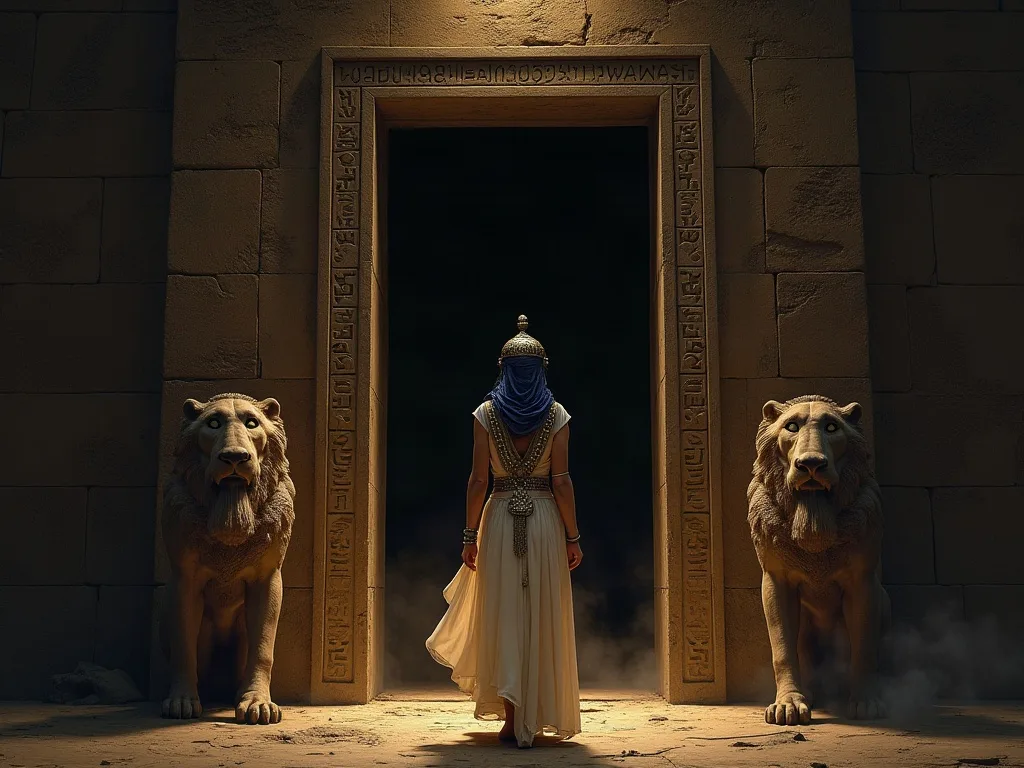
The descent narrative is not just mythology. Scholars read it as a calendrical myth explaining the dry season, when the earth withdraws its fertility, and the return of spring. But it is also something more personal: a story about a goddess who chooses to go somewhere dangerous out of an obscure sense of duty, loses everything, and comes back changed.
Ishtar's other major myth involves the hero Gilgamesh, from the Epic of Gilgamesh, arguably the oldest epic poem on earth (written down around 2100-1200 BC across multiple versions). Ishtar proposes marriage to Gilgamesh. He refuses, listing her former lovers, all of whom came to ruin. She retaliates by sending the Bull of Heaven to destroy his city. Gilgamesh and his companion Enkidu kill the bull. When Enkidu throws the bull's leg at Ishtar in contempt, the gods sentence him to death.
The story illustrates the logic of Ishtar perfectly: she is love as power. Rejecting her is not heartbreak. It is cosmic insult. The consequences are real and fatal.
Her symbols include:
- The eight-pointed star (her celestial emblem, associated with the planet Venus)
- Lions (she often stands on them)
- The double gate (referencing her descent)
- Dates, grain, and the storehouse (her connection to fertility and abundance)
The planet Venus was identified with Ishtar across much of the ancient Near East, which is why her Greek cognate Aphrodite became linked to Venus in Roman translation as well. This shared astronomical anchor is one of the strongest arguments for the genuine cultural connection between the two goddesses.
Oshun: The River That Feeds the World
Oshun comes from the Yoruba tradition of West Africa, originating in what is now Nigeria, Benin, and surrounding regions. She is one of the Orisha, a category of spirit-beings in the Yoruba religion who serve as intermediaries between humans and the supreme being Olodumare. Her tradition is not confined to Africa: through the diaspora driven by the transatlantic slave trade, Oshun traveled to Cuba (where she became a central figure in Lukumi/Santeria), to Brazil (Candomble), and across the Caribbean.
She is the Orisha of sweet water, rivers, love, beauty, and fertility. Her sacred river is the Osun River in Osun State, Nigeria, where an annual festival, the Osun-Osogbo festival (inscribed as a UNESCO Intangible Cultural Heritage), draws tens of thousands of pilgrims each year. This is a living tradition, not a dead one. Oshun is worshipped actively by millions of people across the globe today.
Her foundational myth, as preserved in the Ifa oral corpus (the Yoruba system of divination and philosophy that was also inscribed by UNESCO), tells of how the Orisha came to earth to shape the world. Olodumare sent seventeen Orisha, sixteen male and one female: Oshun. The sixteen male Orisha ignored her and tried to build the world without her input. The world began to collapse. Crops failed. People stopped being born. The cosmic project ground to a halt.
The male Orisha went to Olodumare to complain. Olodumare told them exactly what had happened: they had excluded Oshun, and Oshun had withdrawn her power. They returned to her, apologized, and honored her role. With Oshun restored to her proper place, the world began to function again.
The structural parallel to the Ishtar descent myth is remarkable. In both cases, a love goddess withdraws (whether by choice or by death), fertility and life collapse, and the other powers scramble to restore her. The goddess of love is not decorative. She is load-bearing.
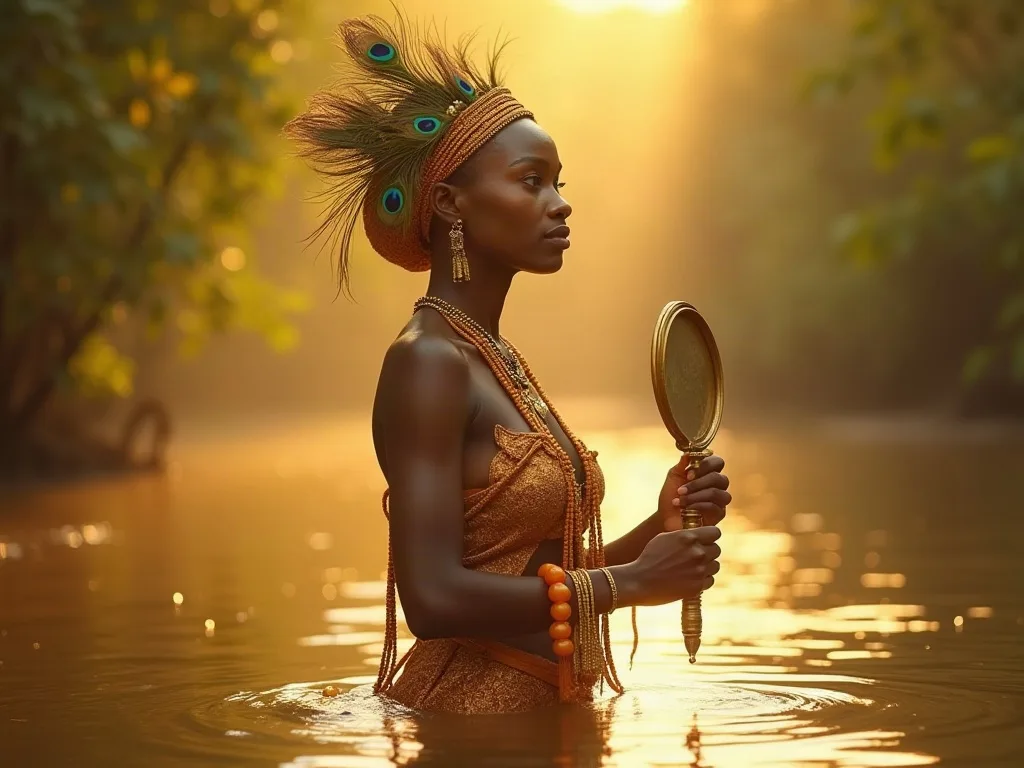
Oshun's symbols include:
- Gold and brass jewelry (she loves adornment)
- Honey (her sacred substance; offerings include honey-soaked foods)
- Yellow and amber colors
- Peacock feathers and fans
- Mirrors and combs (shared, interestingly, with Aphrodite)
- River water and fresh water fish
In the diaspora traditions, Oshun is often syncretized with Our Lady of Charity (Nuestra Señora de la Caridad del Cobre), the patron saint of Cuba. This blending happened under colonialism, when African spiritual practices needed a Catholic face for survival. But Oshun remains distinctly herself beneath that layer: warm, generous, and capable of formidable anger when disrespected.
Her warrior aspect is less prominent than Ishtar's but present. In some Ifa verses (odu), Oshun joins battles, seduces enemies, and uses her beauty as strategy. She is also a powerful healer and herbalist. The sweetness is real, but it coexists with a steely intelligence.
Shared Architecture: What All Three Goddesses Hold in Common
Now look at all three together. The convergences go well beyond the general category of "love goddess."
Water and reflection. Aphrodite rises from the sea. Ishtar crosses the underground waters. Oshun lives in rivers. All three carry mirrors. Water reflects: it shows you yourself, which is precisely what desire does. You see yourself through the eyes of the beloved.
The withdrawal that kills the world. Ishtar descends; the world dies. Oshun withdraws; the world starves. When Aphrodite is wounded in the Iliad and retreats, even Zeus points out that the damage to the cosmic order is serious. The pattern recurs because it encodes a real observation: desire keeps living systems going. Remove it, and everything slows down toward death.
Love and war as the same force. Ishtar carries weapons. Aphrodite has Ares as her lover. Oshun uses seduction as strategy in war narratives. In antiquity, the boundary between eros and conflict was thin. Both involve approach, risk, surrender, and potential destruction. The ancients mapped them onto the same goddess because they sensed the same underlying energy.
Jealousy as divine power, not divine weakness. Aphrodite's jealousy produces the Trojan War. Ishtar's rejection of Gilgamesh produces the Bull of Heaven. Oshun's anger when excluded from creation produces cosmic collapse. None of these is the behavior of a "gentle" goddess. Jealousy in a love goddess is not a character flaw to be corrected. It is the mechanism through which she enforces her domain's importance.
Gold and copper. All three are associated with golden or copper-toned metals. Oshun wears gold. Aphrodite's armor and gifts gleam. Ishtar's crown and attributes include golden symbols. The metal connection may be more than symbolic: copper and gold do not tarnish. They represent the incorruptible and the perpetually shining, qualities that desire seems to have for those inside it.
Aphrodite (Greek)
- Born from sea-foam and divine blood (Hesiod) or daughter of Zeus (Homer)
- Rules desire, beauty, and the sea
- Connected to Cyprus and Corinth as worship centers
- Causes the Trojan War through the promise of Helen
- Sacred animals: dove, sparrow
- Associated with the planet Venus
- Mirror and cestus as divine tools
- Likely borrowed from Astarte/Ishtar via Cyprus
Ishtar (Mesopotamian)
- Exists as Inanna (Sumerian) by 2100 BC, Ishtar (Akkadian) thereafter
- Rules love, war, fertility, and the planet Venus
- Descends to the underworld and returns
- Sends the Bull of Heaven when rejected by Gilgamesh
- Sacred animals: lion
- Eight-pointed star as celestial symbol
- Gateway and descent as recurring motif
- Probable ancestor of Astarte, Aphrodite, and Roman Venus
Where the Traditions Diverge: Three Distinct Visions of Love
The similarities are real. But so are the differences, and the differences are where each tradition reveals its own philosophy of what love actually is.
Ishtar's love is imperial. She does not offer love; she extends her dominion over you. Her descent into the underworld is framed as a conquest, not a grieving journey. She demands entry at each gate. She does not grieve; she commands. Mesopotamian civilization was built on hydraulic empire and strict hierarchy, and its love goddess reflects that: love as power relation, love as territory.
Aphrodite's love is aesthetic. She transforms. She makes things beautiful. Paris's choice of her is a choice of beauty over power (Hera's offer) and wisdom (Athena's offer). The Greek philosophical tradition eventually absorbed this into Plato's Symposium (around 385 BC), where Socrates argues that erotic love (eros) is the engine of philosophical ascent, the desire for beauty that drives humans toward truth. Aphrodite's love is dangerous but also luminous: it makes you see.
Oshun's love is communal. Her narrative is not about conquest or aesthetic elevation but about inclusion. When she is excluded, the collective suffers. When she is restored and honored, the collective flourishes. Her festivals are communal events. Her offerings are shared. The Yoruba tradition embeds Oshun in a web of relationships, not as a solitary power but as a necessary member of a functioning divine community. Love, in Oshun's framework, is what holds a community together, not what splits it into rivals.
These three philosophies of love are not just mythological curiosities. They map remarkably well onto psychological and social theories of love developed much later: love as power and possession, love as transcendent vision, love as relational bond. The goddesses got there first.
Legacy, Living Worship, and the Goddess in Modernity
Aphrodite became Venus in the Roman tradition, and Venus became embedded in Western art so thoroughly that it is nearly impossible to imagine European painting without her. Botticelli's Birth of Venus (1484-1486) is perhaps the most reproduced goddess image in history. She moves through Renaissance art, Baroque poetry, Rococo decorative schemes, and into contemporary culture as a shorthand for female beauty, romantic love, and the concept of the feminine itself.
Ishtar's afterlife is stranger. She largely disappeared from popular consciousness as Mesopotamian civilization collapsed, but scholars began reconstructing her mythology after the decipherment of cuneiform in the 19th century. When Assyriologist George Smith announced in 1872 that a Babylonian tablet described a great flood story paralleling the Book of Genesis, the world was stunned. Ishtar appears in that same flood narrative (the Epic of Gilgamesh) as the goddess who weeps for the humans she helped destroy. She re-entered Western consciousness as proof that Greek and Roman mythology were not the origin point but the inheritors of something much older.
Oshun has the most vibrant contemporary worship. The Osun-Osogbo festival runs every year. Millions of practitioners of Lukumi, Candomble, and related traditions maintain active devotional relationships with her. Beyonce's 2016 Lemonade album drew heavily on Oshun iconography, imagery, and narrative, sparking wide public discussion about the Orisha tradition among audiences who had never encountered it. That conversation, loud and sometimes contested, moved Oshun from the margins of Western cultural awareness toward the center in a matter of months.
The three love goddesses compared across world mythology are not museum pieces. Two of them receive active prayer today. The third shaped the visual vocabulary of Western civilization. They were never finished.
Frequently Asked Questions About Love Goddesses Across World Mythology
Frequently asked questions
Is Aphrodite the same goddess as Ishtar?
Not the same, but almost certainly related. Scholars including Walter Burkert argue that Aphrodite was borrowed from the Semitic goddess Astarte, who is herself a cognate of the Akkadian Ishtar and the Sumerian Inanna. The borrowing likely passed through Cyprus, a major trading hub between Greece and the Levant. Both goddesses share the planet Venus as a celestial body, the sea as a domain, and the eight-pointed star as a recurring symbol. The relationship is that of cultural cousins, not identical twins: each tradition transformed the shared archetype in its own direction.
Why are love goddesses so often connected to war?
Ancient peoples observed that the same energy that drives desire drives conflict: approach, vulnerability, the will to dominate or be dominated, the risk of destruction. Ishtar carries weapons alongside her love attributes. Aphrodite has Ares as her lover and causes the Trojan War. Oshun uses seduction as a military strategy in some Ifa verses. This connection is not a contradiction; it is a recognition that eros and aggression share a psychological root. Modern psychology, particularly in Freudian and Jungian frameworks, arrived at a similar conclusion thousands of years later.
What is the oldest recorded love goddess myth?
The Sumerian hymns to Inanna, preserved on clay tablets from around 2100 BC, are among the oldest written mythology on earth. The Descent of Inanna to the underworld and the Courtship of Inanna and Dumuzi predate any written Greek mythology by roughly a thousand years. The scribe Enheduanna, daughter of the Akkadian king Sargon of Akkad (who ruled around 2334-2279 BC), composed hymns to Inanna that are often cited as the earliest known authored texts in history: the first named writer in the historical record was a woman writing about a love goddess.
Is Oshun still actively worshipped today?
Yes, actively and widely. Oshun is venerated by practitioners of Yoruba traditional religion in Nigeria, as well as by followers of Lukumi (Santeria) in Cuba and the wider Caribbean, Candomble in Brazil, and related Afro-diasporic traditions across the Americas. The Osun-Osogbo festival in Osun State, Nigeria, attracts pilgrims every year and has been recognized by UNESCO. Oshun's profile in Western popular culture also grew significantly after Beyonce incorporated her iconography into the Lemonade album (2016), bringing academic and general interest to the tradition.
Why do love goddesses so often carry mirrors and combs?
The mirror appears with Aphrodite, Oshun, and in multiple other traditions (the Japanese Amaterasu, for instance, has a sacred mirror). The mirror reflects the world back at itself, which is exactly what desire does: it makes you see yourself through another's eyes. The comb is linked to the ordering of beauty, the careful labor of adornment. Both objects are associated with water surfaces, which were the original mirrors in pre-glass antiquity. The overlap between love goddesses and reflective surfaces is one of the most consistent cross-cultural patterns in mythology, suggesting a deep intuition about how desire and self-perception are connected.
How does the 'withdrawal myth' work across these three traditions?
Each tradition has a version of the story where the love goddess withdraws her power, with catastrophic consequences for the world. Ishtar dies in the underworld and all desire on earth ceases. Oshun withholds her participation in creation and fertility collapses. Aphrodite's withdrawal in Greek myth is less explicit but present: when she leaves the battlefield wounded in the Iliad, her absence registers as a problem, not a relief. The pattern encodes a real agricultural and biological observation: the seasons of fertility and the seasons of barrenness map onto a goddess who is present or absent. The myth explains the drought by saying the goddess has gone away.
The Unresolved Question: Did Humans Invent Her Once or Many Times?
Scholars still argue about whether the cross-cultural love goddess represents a single idea that spread (diffusionism) or a pattern that human minds independently generate when trying to understand desire (structuralism). The Aphrodite-Ishtar connection has strong evidence for genuine historical transmission. The Oshun parallel is more likely independent, developed within a distinct cultural and philosophical tradition without direct Near Eastern input.
Both explanations can be true at once. Some of the convergences are borrowed; others are discovered. The deeper question is why the human mind, confronted with the experience of love and desire, reaches so consistently for the same package: water, gold, beauty, rage, withdrawal, and return.
Comparative mythologist Joseph Campbell argued in The Masks of God (1959-1968) that the love goddess represents what he called the "cosmogonic" feminine: the generative principle without which nothing begins. That reading has been refined and contested since, but the core observation holds. These three goddesses sit at the origin of things, not as decorations on a completed universe but as mechanisms that keep the universe running.
Inanna's descent into the underworld changed the Mesopotamian world's understanding of what divine power means: it means risking everything. Aphrodite's role in the Trojan War changed the Greek world's understanding of beauty: it is not neutral, it is catastrophic. Oshun's exclusion and return changed the Yoruba world's understanding of community: a circle with one person missing is already broken.
Three traditions. Three rivers of thought about what love is and what it costs. They converge, they diverge, and they refuse to be reduced to a single answer. Which may be the most human thing about them.
Free 25-page sample
Want the whole story?
Take the first 25 pages free. If it pulls you in, the full edition is yours as an instant PDF download, with a paperback on Amazon for selected titles.

Mythology
The World Mythology Book: The Gods, Heroes and Myths of Every Culture
The Gods, Heroes and Myths of Every Culture, in One Volume
The whole of world mythology in a single volume: Greek, Norse, Egyptian, Japanese, Hindu, Celtic, Slavic, Mesoamerican and African myths gathered side by side, each drawn from the primary sources.