
Mjölnir Pendant Meaning and History: Thor's Hammer Across Cultures
Mjölnir, Thor's hammer from Norse mythology, has transformed from a sacred weapon into one of the world's most worn talismans. Discover its origin in Ragnarok lore, what it symbolizes today, and why millions wear it as pendant across faiths and belief systems.
Contents
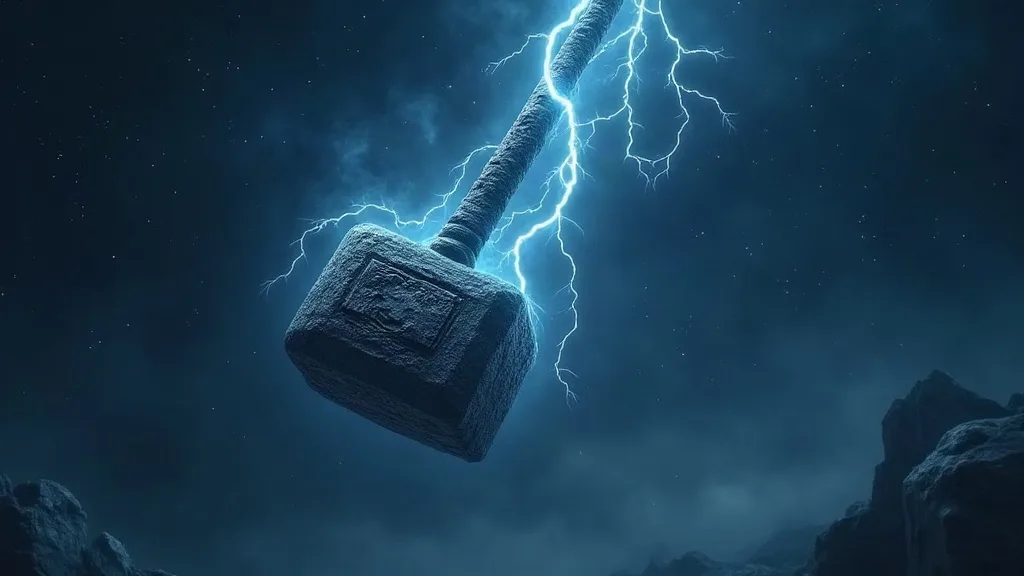
The hammer descended from the sky during Ragnarok, the Norse end-times. Thor, the red-bearded god of thunder, wielded it with one hand while it levelled giants and shook the nine worlds. That hammer was Mjölnir, and for over a thousand years, Norse people wore its symbol around their necks as protection, blessing, and defiance against chaos.
Today, Mjölnir pendants hang from chains across every continent. Historians wear them. Metalworkers wear them. Neurosurgeons wear them. The symbol has escaped the Viking Age and become something far stranger: a universal talisman that speaks to protection, strength, craftsmanship, and resilience across cultures that have no ancestral claim to Norse myth. To understand what the Mjölnir pendant means today, we must first know what it meant then, and trace the path it took from a mythic forge to the chests of millions.
The Hammer Forged in the Depths: Mjölnir's Origin
The dwarven smiths Sindri and Brokkr created Mjölnir, but not in any ordinary furnace. According to the Prose Edda, a 13th-century Norse text that preserved older poems and stories, the two brothers wagered their heads in a contest against the trickster god Loki. Loki bet he could name three treasures more magnificent than any the dwarves could forge. The stakes were absolute: if Loki lost, his head belonged to the dwarves.

Sindri entered the forge first. He threw a pig's hide into the fire and told his brother Brokkr to work the bellows without stopping, no matter what he heard. As the fire roared, Sindri left the room. Loki, determined to sabotage them, transformed into a mosquito and bit Brokkr on the arm. The dwarf flinched but kept pumping. When Sindri returned, he pulled Gullinbursti, a magical golden boar that glowed like a beacon, from the forge.
A second time, the brothers began. Sindri threw gold into the fire and again commanded his brother never to stop the bellows. Loki became a gadfly, stinging Brokkr on the neck. The pain was worse, but Brokkr held firm. From the flames came Draupnir, a ring that dripped eight new rings of pure gold every ninth night; wealth that never ended, renewal without depletion.
The third attempt was the most crucial. Sindri threw iron into the burning coals and extracted an iron pig hair, commanding Brokkr with desperate intensity: "If you fail now, everything is lost." The bellows must never stop. Loki became a mosquito once more and landed on Brokkr's eyelid, biting until blood ran down his face. The dwarf's hand wavered. For a single moment, he almost stopped the bellows. But he did not.
When Sindri removed the weapon from the fire, it was Mjölnir: a hammer with a handle of ash wood (called Grjóp), impossibly short but perfectly balanced. The head was heavier than mountains. The user could throw it across the world and it would always return to the hand. It would never fail in battle. It could shrink small enough to hide in a tunic. It was the one weapon Odin himself feared.
The contest was decided. Loki had lost the wager, but when he tried to pay his debt with his head, he argued a loophole: he had promised his head, but his neck was not mentioned in the bet. The dwarves, furious, sewed his mouth shut as punishment. Yet Mjölnir remained, passed to Thor, the strongest of the Aesir gods.
What Mjölnir Meant in the Viking Age
Norse families hung Mjölnir pendants (or mjölnisamulet) in their homes and wore them as amulets starting at least by the 10th century. The evidence is physical: archaeological digs across Scandinavia have uncovered silver and bronze Mjölnir charms buried with the dead or worn into graves, suggesting the practice was widespread and deeply personal.
The meaning was layered. First, Mjölnir was a symbol of Thor's protection. Thor was not the chief god; that was Odin, god of war, wisdom, and the gallows. But Thor was the god closest to ordinary people. He was the god of farmers, smiths, travellers, and families. When a Viking sailor or a Norse farmer wore Mjölnir, they wore a promise that Thor, muscular and honest, would shield them from the hostile frost giants and the monsters of chaos that threatened to destroy the nine worlds.
Second, the hammer was a sign of craftsmanship and skill. The Prose Edda repeatedly emphasizes that Mjölnir was forged, not found. It represents the power of human hands and will to create something that outlasts mortal life. A smith wearing Mjölnir was wearing a statement of professional identity and blessing. The tool that built the cosmos, in miniature, hung at his chest.
Third, and perhaps most potent, Mjölnir was a weapon against Ragnarok. The Norse did not believe in an eternal paradise or damnation. They believed that one day, the worlds would be consumed by fire and ice, the stars would vanish, and the earth would sink into the sea. In that final battle, Thor would face Jörmungandr, the cosmic serpent whose body wrapped around the earth. Thor would slay the serpent with Mjölnir, but die in its poison breath. The hammer, in the hands of one man, could hold back apocalypse itself, at least for a moment.
To wear Mjölnir was to say: I know the end is coming, and I will face it without fear. I trust in strength, craft, and defiance. It was an amulet of courage in the face of meaninglessness.
The Symbol Survives the Conversion: Mjölnir Through the Christian Age
Christianity arrived in Scandinavia around 1000 CE. Within a few centuries, the old gods were officially gone; the temples were burned or repurposed. But Mjölnir did not vanish.
Archaeological evidence suggests that some Norse people continued to wear Mjölnir pendants in secret or semi-secret contexts. More often, though, the symbol transformed. Mjölnir pendants began to appear alongside Christian crosses. In some cases, a cross was actually merged with the hammer shape, creating a hybrid symbol that allowed someone to honour both the old gods and the new faith simultaneously. This was not uncommon in medieval Scandinavia: people held both traditions loosely for generations.
What mattered was that the meaning of Mjölnir shifted but did not break. Instead of being a sign of worship to Thor, the hammer became a sign of cultural identity. To wear Mjölnir was to say: I am Norse. My ancestors faced down giants and the end of the world. That courage is in my blood. It became a symbol of heritage even when the religious content faded.
By the time the Victorian era arrived and European scholars began to rediscover Norse mythology in books and romantic ideals, Mjölnir had already transformed twice: from a god's weapon, to a shield against fate, to a mark of ethnic belonging. What happened next would change it again.
The Modern Revival: Mjölnir as Tattoo and Talisman
The 20th century saw a global re-invention of Norse mythology. Scholars like the translators of the Prose Edda and the Poetic Edda (older oral poems first written down in the 13th century) made the myths accessible to English-speaking audiences. Fantasy authors like J.R.R. Tolkien, who drew heavily on Norse sources, introduced millions to Asgard and the nine worlds through fiction. Heavy metal bands adopted Norse imagery as part of their visual language. By the 1980s and 1990s, Mjölnir had become a global symbol.
The reasons were diverse. For Scandinavian pagans who founded modern Heathenry and Asatru traditions in the 1970s, Mjölnir returned as a religious symbol, equivalent to the Christian cross. It appeared in temples and on altars. For metalworkers, martial artists, and rock climbers, it represented mastery of craft and the triumph of will over material. For many people with no particular connection to Norse heritage, it simply looked powerful. A hammer, sharp-edged and balanced, hung from a chain spoke to something primal: the idea that strength and skill can overcome obstacles.
Today, Mjölnir pendants are worn by:
- Heathens and Norse pagans who follow the old gods in reconstructed religions
- People exploring Scandinavian heritage and family history
- Metalworkers, blacksmiths, and artisans who see it as a professional blessing
- Athletes and martial artists who value Thor's strength and determination
- Survivors of serious illness or trauma who interpret it as a symbol of resilience
- Fantasy fans and artists influenced by Norse lore in books, games, and television
- Simply people who find the symbol aesthetically compelling and historically meaningful
The pendant has become what scholars call a "floating signifier": a symbol whose meaning depends on who wears it and why.
Mjölnir Pendant Styles and Symbolism Across Materials
Modern Mjölnir pendants vary wildly in design, but each variation carries subtle shifts in meaning.
Silver Mjölnir: Silver is the classic material, associated with the dwarves who forged the original hammer. A silver Mjölnir speaks to craftsmanship, refinement, and the idea that strength can be beautiful. Silver also carries historical weight; many Viking-era pendant fragments were found in silver. Wearing silver Mjölnir connects the wearer to centuries of precedent.
Bronze Mjölnir: Bronze is rougher, earthier, and often cheaper. It appeals to people who want the symbol without the price tag, or who prefer a more rustic aesthetic. Bronze also has a long history in Northern Europe; many ancient Celtic and Germanic artifacts were cast in bronze before silver became common.
Stone Mjölnir: Obsidian, hematite, and granite Mjölnir pendants are rarer but meaningful to people who value natural materials and grounding energy. Stone carries a sense of permanence and weight that echoes the mythic hammer's cosmic heaviness.
Gold Mjölnir: Expensive and ornamental, gold Mjölnir is typically worn by people who see the symbol as a long-term commitment or as a statement of status and confidence. It's the material that would have been most precious in the Viking Age, though few could afford it.
Enamel and Inlaid Mjölnir: Modern artisans create pendants with intricate inlay work, enamel details, or gemstones embedded in the hammer head. These pieces treat Mjölnir as fine art, suitable for someone who wears mythology as both spiritual practice and aesthetic statement.
The design also matters. Some pendants feature the hammer alone; others show runes engraved on the handle or head. Some are abstract and geometric, others highly detailed. The most common modern design shows the hammer head as a slightly flattened triangle with a short handle perpendicular to it, often inscribed with patterns that echo Viking-era metalwork.
Why Mjölnir Endures: The Psychology of Sacred Symbols
Mjölnir's persistence across a thousand years of religious upheaval, cultural change, and reinvention reveals something important about how symbols work in human consciousness.
A symbol that survives must carry multiple meanings simultaneously. It must be simple enough to understand instantly, yet deep enough to sustain reflection. Mjölnir succeeds on both counts.
At the surface level, it is immediately recognisable: a hammer, the most universal tool in human history. Every culture that has developed metalwork knows what a hammer is. It builds, breaks, protects, and creates. The symbol reads instantly across language barriers.
At a deeper level, Mjölnir carries narrative weight. To know the story of Mjölnir is to know something about fate, craftsmanship, resilience, and the idea that meaningful objects are forged through struggle and sabotage. The hammer was created during a wager where failure meant literal death. That origin story makes the symbol heavy with meaning; wearing it is like carrying the narrative.
Additionally, Mjölnir has survived a religious rupture. The shift from Norse paganism to Christianity could have erased Mjölnir entirely, the way many older symbols were destroyed or reinterpreted beyond recognition. Instead, the symbol found new contexts and new meanings while retaining something of its original power. For people today, this suggests that Mjölnir is resilient, capable of transformation without losing its essence.
Finally, Mjölnir works as a talisman because it promises something concrete: Thor's protection, the power of craft, defiance in the face of chaos. Unlike many abstract religious symbols, the hammer is an object. You can touch it, wear it, hold it. In an age when spiritual practice often feels diffuse and internal, Mjölnir offers something tactile and grounded.

Mjölnir Across Cultures: The Global Appropriation
One of the most striking phenomena of the past 40 years is how Mjölnir has transcended its Norse roots to become a universal symbol of strength and resilience. People with no Scandinavian heritage wear it. This has generated both connection and controversy.
In Iceland, the symbol remains deeply tied to national identity. Icelanders see Mjölnir as distinctly theirs; many view global Mjölnir wearing as cultural borrowing or dilution. At the same time, Icelanders are not opposed to outsiders engaging seriously with Norse mythology, and many view the global spread of Mjölnir as a form of cultural contribution.
In Scandinavia more broadly, Mjölnir has become absorbed into secular nationalism and pride. Sports teams use it. Tourism boards market it. It appears on everything from beer bottles to furniture, stripped of religious content but still carrying echoes of strength and ancestral connection.
In North America and the UK, the story is more complex. Here, Mjölnir entered popular culture through heavy metal, fantasy, and gaming. A person who wears Mjölnir may have encountered it through Marvel's Thor films, through Dungeons and Dragons, through Norse Paganism, through family heritage, or through pure aesthetic preference. The symbol has become radically pluralistic.
This has also created space for appropriation and misuse. Far-right white nationalist movements have, since the 1990s, weaponised Norse symbols including Mjölnir. They have sought to claim the Aesir gods as exclusively white, to argue that Norse culture belongs only to people of Scandinavian descent, and to use Mjölnir as a symbol of ethnic purity. This is deeply contradicted by actual Viking history: Vikings intermarried, traded, and settled across the world, from North America to the Islamic caliphates. But the appropriation is real and harmful.
Modern Heathens and scholars of Norse mythology have actively worked to reclaim Mjölnir from this misuse. Organisations dedicated to inclusive Norse Paganism explicitly reject white nationalism. They point out that mythology belongs to anyone who wants to learn it respectfully. The hammer, they argue, was forged to hold back chaos and protect communities. It should never be a symbol of exclusion.
The global meaning of Mjölnir today, then, is contested. It can mean protection and craft, heritage and strength, spirituality and art. It can also, in certain hands, mean something far darker. Context matters. Intent matters. The person wearing it matters.
Mjölnir and Modern Pagan Practice
For contemporary practitioners of Norse Paganism, Heathenry, and Asatru, Mjölnir is not merely decorative. It is a religious symbol with real spiritual weight.
In blóts (Norse ritual gatherings, pronounced roughly "bloats"), Mjölnir is often invoked to bless the space. Practitioners trace the shape of the hammer in the air as a gesture of protection and blessing, mirroring a practice documented in medieval texts. Some groups use a physical wooden or metal Mjölnir hammer as a ritual tool, passed from hand to hand to sanctify offerings.
For individual practitioners, a Mjölnir pendant is often a personal covenant. Putting on the pendant in the morning is an intentional act: I am calling on Thor's protection today. I am committing to strength and honesty. I accept responsibility for my actions. Some practitioners describe a subtle energetic shift when they wear the pendant; others simply appreciate the tactile reminder and the narrative it carries.
This represents a genuine religious practice, distinct from wearing Mjölnir as a cultural or aesthetic choice. A Heathen wearing Mjölnir is making a statement about their faith and their community belonging, much like a Christian wearing a cross or a Muslim wearing a crescent.
Mjölnir in Art, Literature, and Media
Beyond personal adornment, Mjölnir has become ubiquitous in contemporary art and media. Marvel's Thor films introduced the hammer to billions of viewers who might never read Norse mythology. In the MCU, Mjölnir is a character in itself: ancient, worthy, capable of choosing its wielder, and prone to dramatic moments.
This popularisation has both benefits and costs. It makes Norse mythology accessible and exciting. It also flattens it, removing nuance and complexity. The MCU's Thor is not the red-bearded farmer's god of the Prose Edda; he is a handsome superhero in tights. Mjölnir becomes a prop rather than a sacred object.
Yet this popularisation also drives people to seek the original myths. Many people who encounter Mjölnir through Marvel want to know the "real" story, and that curiosity can lead to deeper engagement with Norse culture and history. The symbol, in a sense, acts as a gateway.
In fantasy literature, Mjölnir appears constantly. Tolkien, who had serious scholarly knowledge of Norse mythology, incorporated Mjölnir's logic into the magical artifacts of Middle-earth; forged weapons with history and will. Contemporary fantasy authors continue this tradition. Video game developers use Mjölnir as a weapon in countless games. Each iteration adds a layer of cultural meaning to the symbol.
Frequently asked questions about Mjölnir pendant meaning and history
Frequently asked questions
Is it disrespectful to wear a Mjölnir pendant if you're not Norse?
No, provided you approach the symbol with genuine respect and curiosity. Many Heathens and scholars welcome people from any background engaging seriously with Norse mythology. What matters is your intent: are you wearing it as a cultural costume, or are you genuinely interested in the tradition it represents? If you're drawn to the symbol's meaning (protection, craft, resilience), that's a legitimate reason to wear it. What is disrespectful is wearing it as a joke or, worse, using it as a symbol of hate or ethnic exclusion.
What does the runes sometimes engraved on Mjölnir pendants mean?
The runes vary depending on the artisan and the tradition. Some pendants feature Elder Futhark runes (the oldest Norse alphabet) spelling out words like "strength" or "protection." Others use runes associated with Thor himself, like Thurisaz (the thorn rune, symbolising Thor's power and protection against chaos). If a pendant has runes, ask the maker what they mean, or research the specific rune system; not all runes carry the same meaning across different contexts.
Did Vikings actually wear Mjölnir pendants, or is this a modern invention?
Vikings did wear Mjölnir amulets, and we have archaeological evidence. Silver and bronze Mjölnir charms have been excavated from Viking-era burial sites and settlements across Scandinavia, dating back to at least the 10th century. The practice was widespread enough that it appears in multiple regions. So wearing a Mjölnir pendant today connects you to a genuine historical practice, not a modern fantasy invention.
What's the difference between Mjölnir and other Norse symbols like Valknut or Yggdrasil?
Mjölnir is Thor's weapon and a symbol of his protection; it emphasises strength, craft, and resilience against chaos. The Valknut (three interlocking triangles) is linked to Odin and warriors who die honourably in battle; it's about death, transformation, and entering Valhalla. Yggdrasil, the World Tree, represents the structure of the nine worlds and cosmic order. Each symbol carries different aspects of Norse cosmology and appeals to different values. Mjölnir is the most universally recognisable and the most tied to personal protection.
Can I wear Mjölnir if I'm Christian?
Yes. Historically, medieval Scandinavian Christians sometimes wore Mjölnir even after converting to Christianity. The symbol can coexist with other faiths if it means something personal to you beyond religion: family heritage, respect for Norse culture, admiration for craftsmanship and resilience. If you practice Norse Paganism or Heathenry as a religion, though, Mjölnir is typically understood as a religious symbol, so clarifying your own intention matters.
Which material is most 'authentic' for a Mjölnir pendant?
Silver is historically grounded; many Viking-era pendants were silver. Bronze was also used in antiquity. However, there's no single "correct" material; authenticity depends on your intentions. If you're aiming to honour the historical practice, silver or bronze are strong choices. If you're drawn to Mjölnir for its modern meaning (protection, craft, resilience), any material you connect with is valid. Choose based on what feels right to you.
Mjölnir's Future: An Enduring Symbol of Transformation
Mjölnir has survived religious conversion, cultural erasure, romantic reinvention, commercialisation, and appropriation by hate movements. It remains, worn by millions across every continent and every belief system.
This durability suggests something essential about the symbol. It speaks to human needs that transcend any single culture or era: the need for protection, the value of craftsmanship, the capacity to face chaos with courage. The hammer was forged through struggle and sabotage, and it held back apocalypse itself. For a person facing modern struggles, that resonates.
The future of Mjölnir will likely continue to be plural. It will appear in mainstream fashion. It will be worn by serious practitioners of Norse Paganism alongside casual wearers who simply like how it looks. It will be used by inclusive communities building bridges between Norse culture and the wider world, and it will unfortunately continue to be misappropriated by those seeking to narrow it into a symbol of ethnic exclusion.
What matters now is the choice of each individual wearer. When you put on Mjölnir, you are deciding what it means to you. You are joining a chain of meaning stretching back over a thousand years, but you are also adding your own story. The hammer adapts, transforms, and endures because people choose to give it new life with every wearing.
Thor's hammer remains what it has always been: a tool of creation and protection, forged through struggle, wielded against chaos, and passed from hand to hand across time.
Free 25-page sample
Want the whole story?
Take the first 25 pages free. If it pulls you in, the full edition is yours as an instant PDF download, with a paperback on Amazon for selected titles.

Mythology
The World Mythology Book: The Gods, Heroes and Myths of Every Culture
The Gods, Heroes and Myths of Every Culture, in One Volume
The whole of world mythology in a single volume: Greek, Norse, Egyptian, Japanese, Hindu, Celtic, Slavic, Mesoamerican and African myths gathered side by side, each drawn from the primary sources.