
Rama: The Ideal King in Hindu Philosophy and Epic
Rama embodies the perfect ruler in Hindu tradition: a warrior bound by dharma who renounces his throne to honor his father's vow, rescues his wife from exile across the ocean, and rules with such justice that his reign becomes a model for kingship across Asia. His story teaches that true power lies in duty, not desire.
Contents
In a palace on the banks of the Sarayu River, a prince learns that his coronation will not happen. His father, King Dasharatha, made a promise long ago to one of his wives: her son would inherit the throne instead. The prince does not rage. He does not plot. He bows, bids farewell to his mother, and walks into the forest for fourteen years, carrying nothing but his duty. This is Rama the ideal king, the central figure of the Ramayana, one of Hinduism's most sacred texts. His acceptance of exile, his rescue of his abducted wife across an impossible ocean, and his return to rule a kingdom with such flawless justice that his reign becomes a synonym for paradise, all reveal a vision of kingship rooted not in power or pleasure but in dharma, the cosmic law that holds the universe together.
The Ramayana, composed over several centuries in Sanskrit but possibly reaching its final form by around 200 BC, tells Rama's story across roughly 24,000 verses. It is not a simple adventure. It is a philosophical meditation on what kingship means, what sacrifice demands, and what it costs to live perfectly in a world that is never simple. For over two thousand years, Rama has been read not just as a hero but as a maryada purushottama, "the perfect man who upholds the boundary of dharma." He is the standard against which Hindu kings measured themselves, the ideal Hindu texts hold up to princes and citizens alike, and the embodiment of a kingship that serves others rather than itself.
The Birth of a Prince Bound by Duty
Rama enters the world not through romance but through ritual. His father, King Dasharatha of Ayodhya, is childless. He performs a great sacrifice, the Putrakamesti yagna, to ask the gods for sons. Brahma, the creator god, and other deities agree to grant him heirs. The gods themselves place a portion of their essence into a divine pot of blessed rice, which Dasharatha distributes among his three wives. From this sacred seed, four sons are born: Rama is the eldest, conceived from Vishnu's own divine spark. This is the first marker of his nature. Rama is not merely royal; he is divine made mortal, Vishnu himself taking human form to restore order to the world.
The young Rama grows in a palace surrounded by privilege, yet nothing in his early life suggests he will refuse the throne. He studies warfare, statecraft, and the scriptures. He is obedient to his father, gentle to his mother, devoted to his wife Sita. He is so ideally himself that the question of succession seems settled: Rama will rule.
Then comes the night everything changes. Dasharatha's youngest wife, Kaikeyi, remembers a boon her husband once promised her: two wishes, to be called upon at any time. She has been persuaded by her scheming maidservant Manthara to use them. Kaikeyi asks that her own son, Bharata, become king instead, and that Rama be exiled to the forest for fourteen years. Dasharatha is shattered. He promised, and a king's promise is sacred law. Rama, hearing of his father's vow, does not hesitate. This is where Rama the ideal king first reveals himself: not in conquest or ceremony, but in the moment when everything he wanted is taken away, and he chooses duty over desire.
Rama goes to his father and says simply: the promise must be kept. He asks for his father's blessing, receives it, and that night prepares to leave. His wife Sita insists on following him into exile. His youngest brother Lakshmana, who loves Rama above all else, also refuses to remain in the palace. The three walk together toward the forest, while behind them the city of Ayodhya grieves as though the sun has left the sky.

The Wanderer: Dharma in the Wilderness
For fourteen years, Rama lives in the forest, moving between ashrams (hermitages) where sages dwell. He is a warrior with a bow and sword, yet he lives the life of an ascetic. He wears bark cloth and matted hair. He speaks to saints and gods. He protects the rishis (sages) from demons who prey on them. This is not punishment masquerading as exile; it is a crucible. In the wilderness, Rama learns what kingship truly means. He learns that a ruler's power is meant to serve the weak, that strength without mercy becomes tyranny, that duty sometimes demands not to act but to endure.
It is during this exile that the central crisis of his life unfolds. One day, Sita is alone while Rama and Lakshmana hunt. A demon named Ravana, the ten-headed king of Lanka (an island realm, possibly Sri Lanka in Hindu geography), appears to her in disguise. He reveals himself, seizes her, and carries her across the ocean to his palace. This is not a small wound. Sita is not merely Rama's wife; she is a goddess herself, Lakshmi, the embodiment of wealth, fortune, and beauty. Her abduction is both personal catastrophe and cosmic violation. A demon has stolen what belongs to the divine order.
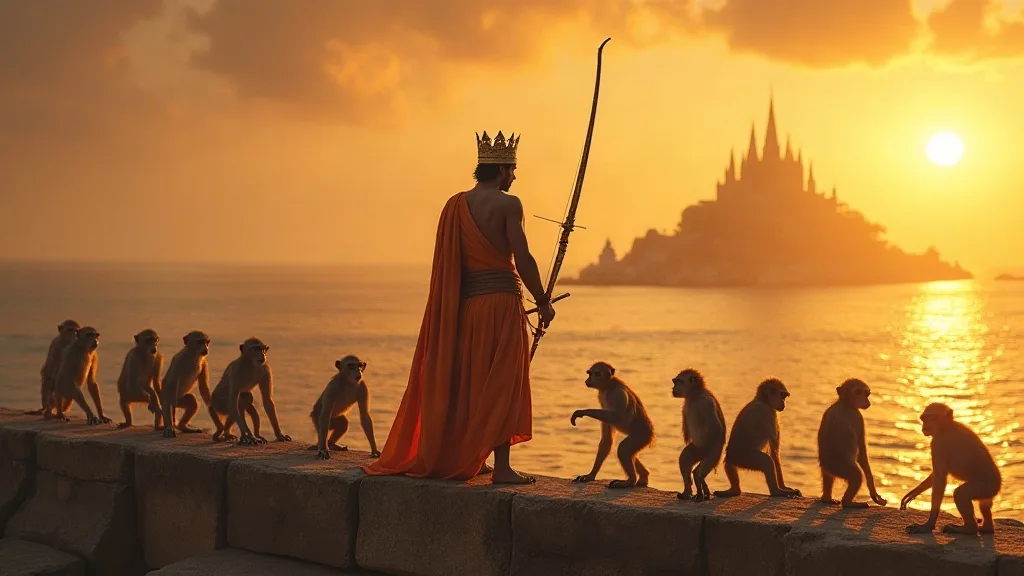
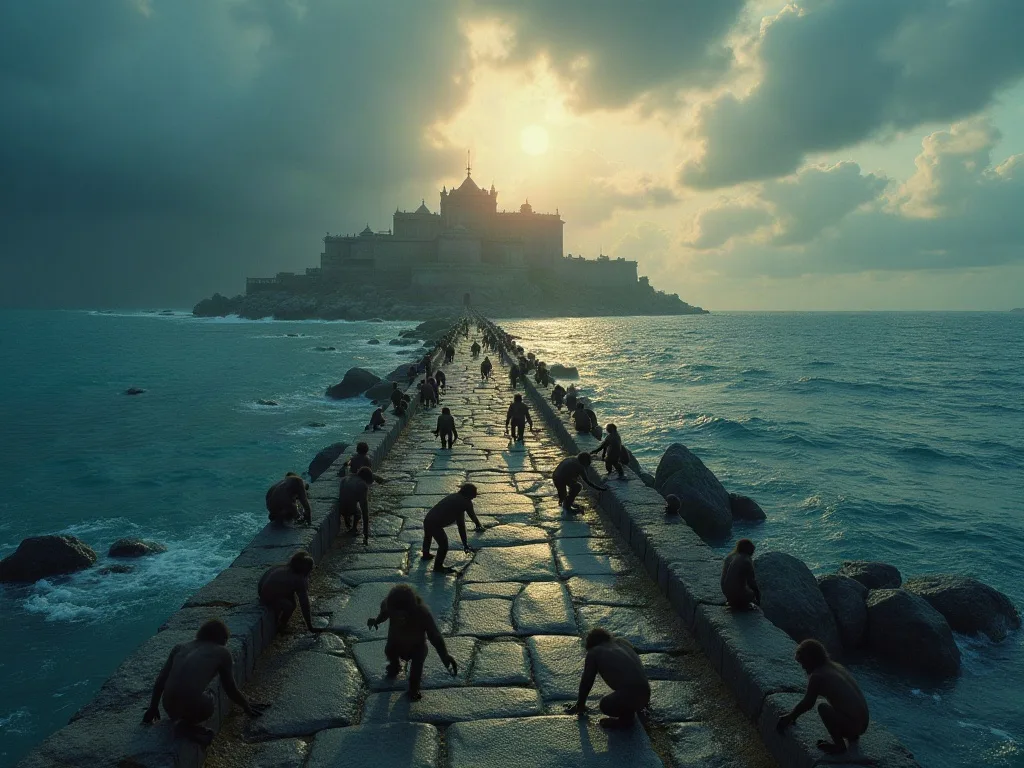
Rama's response defines the measure of his character. He does not march to war in rage. He grieves. He searches. He allies with Hanuman, the monkey general whose devotion to Rama becomes the most celebrated friendship in Hindu literature. He allies with the monkey king Sugriva. And then, when all persuasion fails, he builds a bridge of stones across the ocean. The image is stunning: an army of monkeys, each one laying stone upon stone, connecting the mainland to Lanka so that a king might reclaim what was stolen, not through magic or divine intervention, but through the labor of his allies and the unflinching resolve of his bow.
The battle that follows is not glorified as triumph. It is costly. Rama's brother Lakshmana is gravely wounded. Ravana is a figure of immense power and complexity, not a simple villain; he is a learned king, a great devotee of Shiva, and his defeat brings sorrow as well as victory. When Ravana finally falls to Rama's arrow, the sky itself grieves. This is the vision of Rama as ideal king: one who fights not for glory but for justice, who respects even his enemies, and who understands that victory is not the end of the story but the beginning of a heavier burden.
Return and the Test of Purity
Rama retrieves Sita from Ravana's palace, but the story does not end in simple reunion. When they meet, Rama asks Sita to prove her purity. During her captivity, though Ravana never violated her, she was in another man's house. The question is not about fidelity but about honor and appearance. What will the kingdom believe? What will the people whisper? Here, Rama the ideal king reveals the tragic dimension of his character. He is not simply a hero; he is a man caught between his love and his duty to his subjects.
Sita, hearing this doubt, is devastated. She asks for a fire to be lit, and she walks into it. The fire does not burn her; instead, the fire god Agni himself emerges and declares her spotless. It is a moment of vindication that also carries a wound: even divine confirmation cannot spare her from the test. This scene has been debated by Hindu theologians and contemporary readers for centuries. Some read it as Rama's moment of failure, the place where even a perfect king makes a terrible choice. Others argue that it shows Rama's submission to the dharma of kingship, where a ruler's personal desires must bow to the needs of his people's trust.
Rama and Sita return to Ayodhya. His fourteen years of exile are complete. His father has long since died, and Bharata, who was given the throne, has ruled it not as a usurper but as a regent. When Rama arrives, Bharata immediately hands the crown back and asks for forgiveness. The city erupts in celebration. The lamps are lit throughout every street and rooftop in such profusion that the festival is called Diwali, the Festival of Lights. It has been celebrated ever since, more than two thousand years later, by millions of Hindus across the world.
The Reign of Perfect Justice: Rama-Rajya
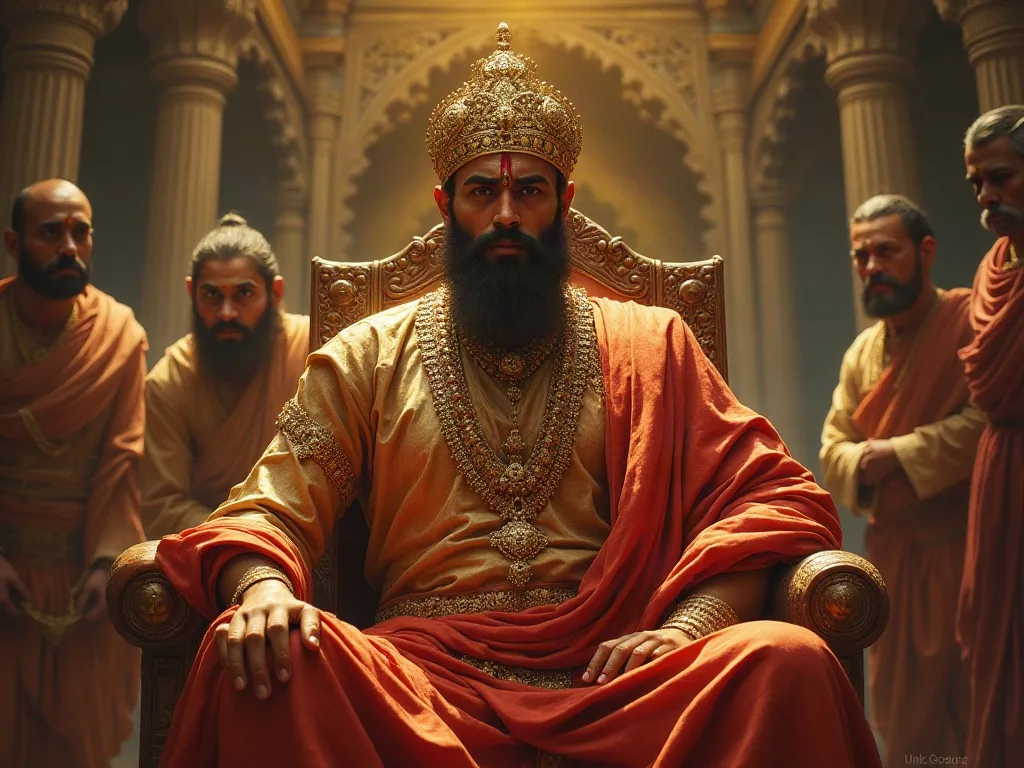
When Rama sits on the throne of Ayodhya, the texts describe a kingdom unlike any other. This is Rama-rajya, "the reign of Rama," and it becomes the Hindu ideal of perfect governance. Crops flourish. No one goes hungry. No child is born who cannot be raised by parents. No widow suffers. The blind do not stumble. The lame do not fall. It is not described as a magical prosperity but as the natural fruit of just rule, where the king himself embodies dharma so completely that order flows from his presence.
Rama institutes governance rooted in consultation. He surrounds himself with wise counselors and listens to the grievances of common people. He does not rule by decree alone but by understanding the needs and customs of his people. He protects the ascetics in their hermitages. He honors the vows of scholars. He ensures that the varna system (the ancient Hindu social order of Brahmins, Kshatriyas, Vaishyas, and Shudras) is maintained with fairness, not cruelty. He goes on royal hunts and performs great sacrifices, but every action is shaped by dharma. This is the vision that Hindu political thinkers, from the Arthashastra of Kautilya to later royal courts, held up as the standard for kingship.
Yet even this perfect reign carries a shadow. In one famous episode, a poor washerman insults his wife's fidelity. Overhearing this, Rama banishes Sita to the forest, believing that the kingdom's faith in her honor has been compromised by her ordeal at Ravana's hands. Sita, now pregnant, flees to the hermitage of the sage Valmiki, the legendary author of the Ramayana itself. There, in exile, she gives birth to twin sons, Lava and Kusha. This is another moment where Rama the ideal king confronts the limits of his perfection. He sacrifices his wife's comfort to maintain his people's faith in him. It is a choice that reveals how completely Rama has surrendered his personal will to his role.
The Divine Embodiment: Rama as Avatar
The Hindu understanding of Rama deepens when you understand what he is. He is not a hero who becomes divine through his deeds. He is Vishnu, the preserver god, in human form. This is the concept of avatar, an incarnation of divinity in mortal flesh. Vishnu descends whenever the world falls out of balance, whenever dharma weakens and adharma (disorder) rises. In the age when Ravana threatens cosmic order, Vishnu takes the form of Rama, knowing all along that he will face exile, loss, and impossible choices.
This context reframes every aspect of his story. When Rama submits to exile, he is not just a dutiful son; he is the cosmos itself submitting to its own laws. When he grieves over Sita's abduction, he is experiencing what it means to be mortal, to love, to suffer. When he chooses justice over personal happiness, he is showing that even divinity must bow to dharma. This is why Rama-worship became so central to Hindu devotional practice. He is not worshipped primarily as a warrior-god or a mountain-dweller like Shiva. He is worshipped as the god who shows what it means to be perfectly human, to honor duty above desire, to accept loss with grace.
The Ramayana itself was composed to teach this. The poet Valmiki presents the story not as entertainment but as moksha-shastri, "the scripture of liberation." To read Rama's story, to contemplate his choices, to meditate on his dharma, is to understand the structure of right action and to move closer to moksha, the liberation from the cycle of birth and death.
Rama's Legacy Across Asia
The story of Rama the ideal king did not remain confined to India. As Hindu and Buddhist merchants and travelers moved along trade routes, they carried the Ramayana with them. In Southeast Asia, the story was adopted, adapted, and woven into local traditions. The Thai Ramakien tells Rama's story with distinctly Thai characters and settings. The Cambodian Reamker reimagines the narrative with their own heroes. The Javanese Ramayana was written as a poem thousands of lines long and performed in shadow puppet theater (wayang kulit) that remains central to Javanese culture. Each region claimed Rama as their own while maintaining the core vision of his kingship as a model for justice and virtue.
In each version, something essential remains unchanged: Rama's willingness to renounce power in the name of duty, his devotion to dharma over pleasure, his compassion even in conflict. These values transcended Hindu theology and became a broadly Asian ideal of what a good ruler should be. When kingdoms in Bali built temples, they honored Rama. When Javanese poets wanted to teach princes about governance, they told Rama's story. The Ramayana became, across Asia, a manual of kingship written in mythological language.
Rama-Rajya in Modern Hindu Thought
In 20th-century India, the concept of Rama-rajya became politically charged. When Mohandas Gandhi spoke of the kind of India he hoped to build after independence, he invoked Rama-rajya, not as a theocracy but as a vision of just, non-violent governance rooted in truth and service to others. For Gandhi, Rama was not primarily a god to be worshipped in temples but a principle of right action to be embodied in politics. This is a remarkable reframing of the tradition: Rama shifts from mythology into the vocabulary of modern social change.
The concept has remained contested and lived in modern India. Some Hindu nationalist movements have invoked Rama's kingship as a template for a Hindu-majority state. Scholars and theologians have pushed back, arguing that Rama's ideal was inclusion and justice, not majoritarian rule. The 2024 consecration of a temple to Rama in Ayodhya reignited these debates. What does Rama the ideal king mean in a modern nation-state? What would his justice look like in a democracy? These questions show that his story has not settled into historical myth; it remains alive, generative, contested, and urgent.
Frequently asked questions about Rama the ideal king
Frequently asked questions
Who was Rama's real historical identity, if any?
Modern scholars debate whether Rama was based on a historical figure or is a purely mythological creation. Some theories propose he was a northern Indian prince whose story was expanded into an epic, while others argue the Ramayana is entirely literary. The texts themselves offer no historical evidence. What matters for Hindu tradition is not Rama's historical reality but his significance as a divine model for kingship and dharma. The Ramayana itself was likely composed over many centuries, reaching something like its current form by around 200 BC.
Why did Rama exile Sita if he loved her?
This remains one of the most debated moments in Hindu literature. After returning from Lanka, Rama hears a washerman insult his wife's honor. Though Sita had been entirely virtuous, her time in Ravana's captivity threatened public confidence in her. Rama chooses to banish her to maintain the kingdom's faith in his governance. Some read this as Rama's tragic failure, a place where even an ideal king makes an unjust choice. Others argue it demonstrates his complete sacrifice of personal happiness for his subjects' welfare. Contemporary Hindu thinkers remain divided on whether this choice should be celebrated or mourned.
What is Rama-rajya, and does it describe a real society?
Rama-rajya, or "the reign of Rama," is the Ramayana's vision of perfect governance. It describes a kingdom without hunger, suffering, or injustice, where every person is cared for and the law serves dharma rather than power. It is not presented as a historical society but as an ideal, a moral template for how rulers should govern. Hindu political philosophy, from the Arthashastra onward, used Rama-rajya as a standard to measure earthly kingdoms against. In modern times, Gandhi used the term to envision an India based on justice, non-violence, and service to the common good.
How is Rama different from other Hindu gods?
Rama is worshipped primarily not as a fearsome or transcendent deity but as a model of perfect human action. While Shiva dwells in meditation and Krishna teaches through philosophy and drama, Rama teaches through lived example. His story is a moksha-shastra, a teaching meant to guide readers toward liberation. He is Vishnu's incarnation, yes, but his power is expressed not through miracles but through unwavering adherence to duty, even when it costs him everything.
Why did the Ramayana spread across Asia?
The Ramayana traveled along maritime trade routes as merchants and Hindu priests moved between South Asia and Southeast Asia from roughly the first century CE onward. Local rulers adopted the story because it offered a framework for understanding kingship that was elegant, morally grounded, and adaptable to local cultures. The Thai, Cambodian, Javanese, and Balinese versions maintained the core narrative while reshaping characters and settings to reflect local values. This made Rama a pan-Asian hero, evidence of how mythology can migrate and transform while preserving its essential teachings.
Is Rama-rajya being invoked in contemporary Indian politics?
Yes, though with competing interpretations. Modern Hindu nationalists have invoked Rama-rajya as a vision of Hindu governance. Secular scholars and thinkers argue that Rama's ideal was justice and protection for all subjects regardless of caste or status, not religious majoritarian rule. The 2024 consecration of the Ram Mandir (Rama temple) in Ayodhya reignited these debates. For some, it represents a restoration of Hindu cultural pride; for others, it raises concerns about whose vision of Rama-rajya will shape the nation's future. The myth remains contested, alive, and politically consequential.
The Eternal Model of What a King Should Be
Rama's story endures not because it offers easy answers but because it poses the central problem of power. What is a king for? Is he meant to rule for his own glory, or to serve his people? When those two things conflict, which must yield? Rama suggests that true power lies in renunciation, that the greatest strength is the willingness to give up what you want for what is right. He shows that kingship is not a reward but a burden, that duty sometimes asks for more than heroism; it asks for loneliness, loss, and the sacrifice of your own heart.
This is why, two thousand years after the Ramayana was composed, temples across the Hindu world still celebrate his birth each year on the spring festival of Rama Navami. It is why his story is retold in shadow puppet theater in Java, painted on temple walls in Bali, and recited by schoolchildren across India. It is why Gandhi reached for his name when imagining a just society, and why political thinkers from every tradition still argue about what Rama the ideal king teaches us about governance, duty, and the sacrifice that justice demands.
In the end, Rama is not remembered as a conqueror or a miracle-worker. He is remembered as the king who chose to do the hard thing, to follow the law even when it broke his heart, to serve his people's trust even when it cost him everything. This is the ideal that Hindu civilization held before its own rulers, and that continues to resonate whenever the question arises: what does it mean to rule well?
Free 25-page sample
Want the whole story?
Take the first 25 pages free. If it pulls you in, the full edition is yours as an instant PDF download, with a paperback on Amazon for selected titles.

Mythology
The World Mythology Book: The Gods, Heroes and Myths of Every Culture
The Gods, Heroes and Myths of Every Culture, in One Volume
The whole of world mythology in a single volume: Greek, Norse, Egyptian, Japanese, Hindu, Celtic, Slavic, Mesoamerican and African myths gathered side by side, each drawn from the primary sources.