
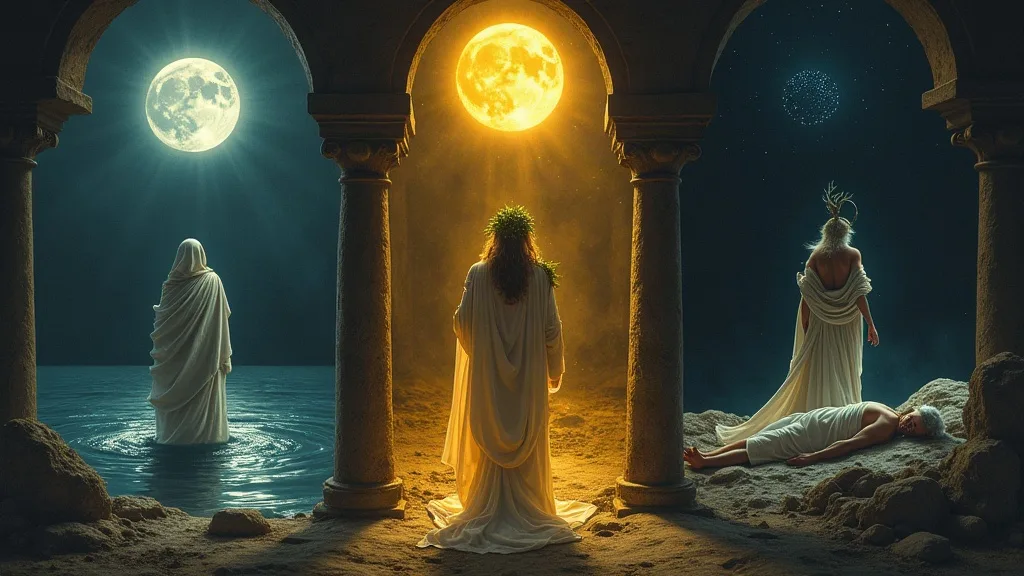
Death and Return: Osiris, Dionysus, and Baldur Across Three Mythologies
Three gods. Three deaths. Three returns. Osiris, Dionysus, and Baldur each embody the oldest human question: what survives the grave? A deep cross-pantheon study.
Contents
The body arrives in pieces. Fourteen of them, scattered across Egypt by a jealous brother, gathered one by one by a grieving wife. Across the Mediterranean, a god-child is torn apart by Titans and swallowed, only to be reborn from the thigh of Zeus. In the north, a beloved god is pierced by a sprig of mistletoe while the rest of the cosmos holds its breath, and the world goes dark.
These are not three separate stories. They are one story, told by three civilizations that never agreed on anything else. Resurrection myths carry a specific gravitational pull: they answer the question every human eventually asks, not with philosophy but with narrative. A god dies. The cosmos mourns. Something returns.
Resurrection myths featuring Osiris, Dionysus, and Baldur form one of the most debated clusters in comparative mythology. Scholars from James George Frazer to Walter Burkert have mapped the overlaps, argued over the differences, and occasionally overreached. What follows is an honest reckoning: what these three traditions genuinely share, where they diverge in ways that matter, and what those divergences tell us about the cultures that invented them.
Osiris: The God Who Made Death Habitable
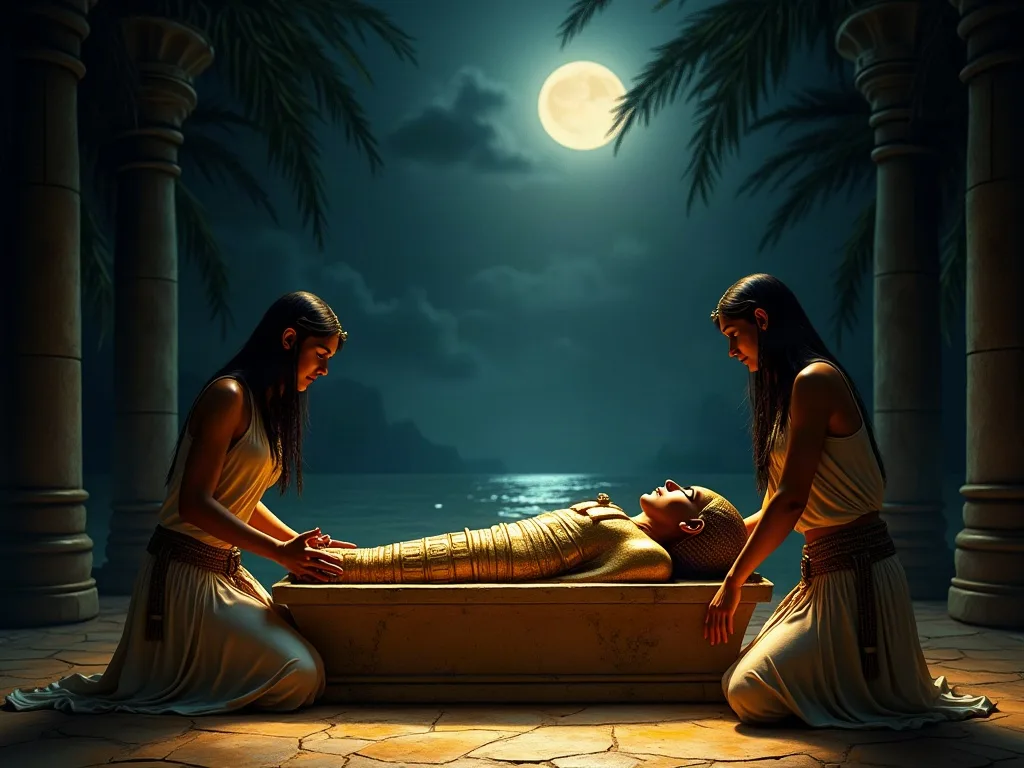
Osiris is the oldest of the three figures by a significant margin. His mythology crystallizes in the Pyramid Texts, carved into burial chambers at Saqqara around 2400 BC, making them among the oldest religious texts ever written. By the time of the Coffin Texts and the Book of the Dead, roughly a thousand years later, the story had grown into one of ancient Egypt's most elaborate theological structures.
The plot, as Plutarch compiled it in De Iside et Osiride (around 100 AD, drawing on centuries of Egyptian tradition), runs like this. Osiris rules Egypt wisely. His brother Set (the name carries connotations of desert, chaos, foreign threat) murders him and dismembers the body, scattering the pieces across the land. Osiris's wife and sister, Isis, and her sister Nephthys begin a systematic search. They find thirteen of the fourteen parts. The phallus, swallowed by a Nile fish, is lost forever. Isis fashions a replacement from gold. She reconstitutes the body, breathes life back into it long enough to conceive a child, Horus, and then Osiris descends to rule the kingdom of the dead.
That descent is the crux. Osiris does not return to the living. He becomes the lord of Duat, the Egyptian underworld, and his resurrection is horizontal rather than vertical: he moves from the world of the living to an eternal domain where he presides as judge and anchor. Every pharaoh, upon death, "became Osiris." Every ordinary Egyptian who passed the weighing of the heart in the Hall of Two Truths entered his kingdom.
The theological work Osiris's resurrection performs is therefore about death itself. Egypt was not afraid of death so much as of a bad death, a death without proper burial, without the correct spells, without a preserved body for the ka (the vital force, a concept closer to "life energy" than to "soul") to return to. Osiris, reconstituted and functional even without one original part, proved that a damaged body could still be transformed, that death was not annihilation but a transition managed by ritual care.
The figure who makes this resurrection possible is Isis, and her role deserves emphasis. She is not passive. Ancient Egyptian texts describe her as the most powerful magician in existence. The Contendings of Horus and Set, a Middle Kingdom papyrus, shows her outmaneuvering the entire divine tribunal. She uses speech, grief, and magical knowledge as active forces. Without Isis, Osiris stays scattered. The resurrection is collaborative, not miraculous.
The full mythology of Isis and her magical power reveals how her role extended far beyond mourning, into healing, protection, and political legitimacy for every Egyptian king.
Dionysus: The God Who Keeps Dying

Dionysus carries a paradox at his core. He is simultaneously the most joyful and the most violent deity in the Greek pantheon. Wine, theater, ecstasy, and civic festival on one side; torn limbs, madness, and blood on the other. That paradox is not an accident. It is the myth's entire point.
The resurrection narrative attached to Dionysus belongs to his Orphic guise, meaning the version developed and transmitted by the Orphic mystery tradition, a loose collection of religious texts and communities active in Greece from around the 6th century BC onward. The Orphic Hymns and scattered references in Plato, Pindar, and later Neoplatonists preserve the essential shape: Dionysus, called Zagreus in some accounts, is the child of Zeus and Persephone. The Titans, creatures older than the Olympian order, lure the infant with mirrors and toys. They tear him apart, boil and roast his flesh, and eat it. Zeus destroys the Titans with his thunderbolt. From their ashes, which contain a fragment of the divine child, humanity is formed.
Dionysus himself is reconstituted. In most versions, Athena saves his heart before the Titans consume it completely. Zeus swallows the heart, and Dionysus is reborn, sometimes through a mortal woman, Semele, who is destroyed by Zeus's undisguised divine radiance before she can deliver the child to term. Zeus stitches the fetal Dionysus into his own thigh and carries him to birth. Two deaths, two resurrections, sometimes three: the myth is almost extravagant in its repetition of the pattern.
What distinguishes the Dionysian version from the Osirian one is the cosmogonic consequence. Humanity itself is a byproduct of the god's death. The Titan ashes contain a spark of Dionysus, and every human being carries that spark inside a "Titanic" body, heavy with earth and appetite. Orphic theology built an entire soteriology (a system of salvation) on this idea: through ritual, abstinence, and repeated reincarnation, a person could purify the divine element and return it to its source. Gold tablets found in graves across southern Italy and Crete, dated from the 4th century BC onward, give the dead specific instructions for navigating the afterlife and claiming kinship with Dionysus.
The theater connection matters here too. Greek tragedy was performed at the festival of Dionysus, the Dionysia, held each spring in Athens. The tragic hero who suffers and falls, whose story instructs and purifies the audience, mirrors the god whose suffering generates new life. Aristotle's Poetics never quite says this directly, but the structural rhyme is hard to miss.
The figure of Persephone, whose own descent and return powers the Eleusinian Mysteries, provides the closest Greek parallel to Osiris's role as sovereign of the dead.
Baldur: The God Whose Death Breaks the World
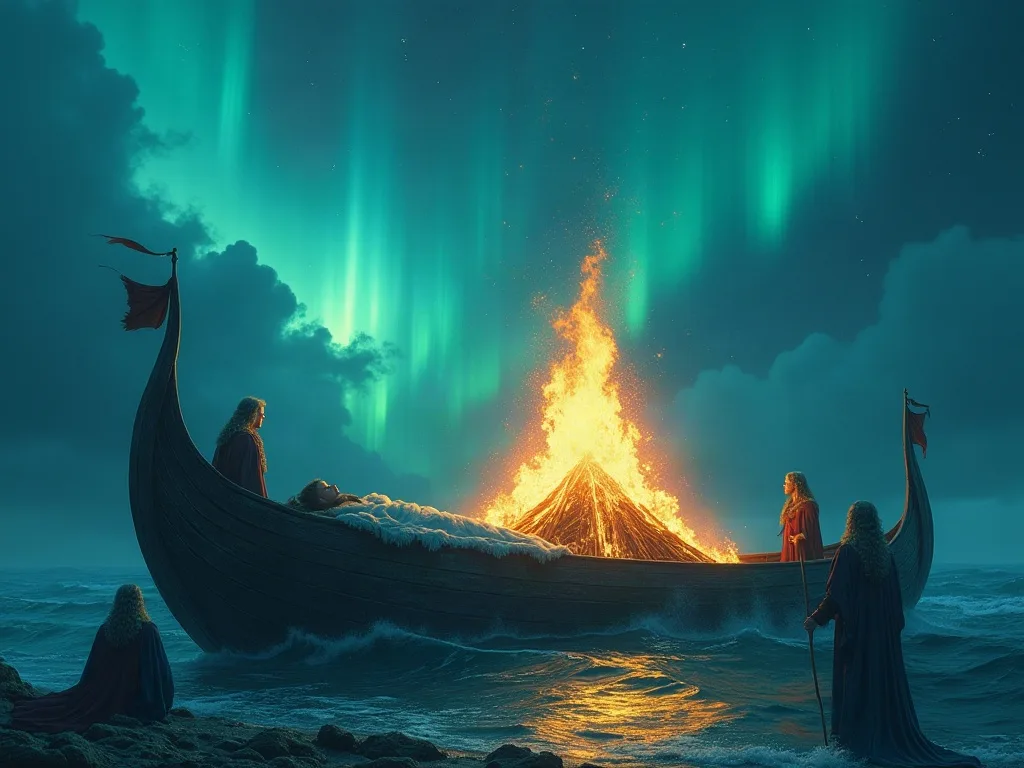
Baldur, the son of Odin and Frigg, is the most beautiful and beloved of the Aesir, the Norse gods. Every plant, animal, and stone swore an oath not to harm him, making him effectively invulnerable. The gods amused themselves by throwing weapons at him and watching them fall away harmlessly. It seemed perfect. It was, of course, a trap.
Loki, the shapeshifter whose relationship with the Aesir is always conditional, discovers that Frigg extracted no oath from mistletoe, considering it too young and harmless to bother. Loki fashions a dart from mistletoe, guides the hand of Baldur's blind brother Hodr, and Baldur dies. The Prose Edda, compiled by the Icelandic scholar Snorri Sturluson around 1220 AD from older oral and poetic traditions, describes the silence that follows as the most terrible silence ever heard among gods or men.
Frigg sends the god Hermod to ride to Hel, the cold realm ruled by the goddess Hel, to negotiate Baldur's return. The price: every being in the nine worlds must weep. Everything does weep, stone, root, bird, metal. Everything except one giantess, called Þökk ("Thanks" in Old Norse), who refuses. Most sources, including Snorri, identify her as Loki in disguise. Baldur stays in Hel.
The resurrection in Baldur's case is explicitly deferred. After Ragnarok, the catastrophic battle that destroys the current cosmos and most of its inhabitants, Baldur and his brother Hodr return to a renewed world. The Völuspá, the great Norse prophetic poem preserved in the Codex Regius (a manuscript from around 1270 AD), describes them meeting again in the green fields of a reborn earth.
This matters enormously for comparison. Baldur's resurrection is eschatological, meaning it belongs to the end of time, not to the middle of history. He does not return to function. He returns as a promise, a sign that what was lost will be recovered when the cycle completes. His death is not a lesson in how to manage mortality but a crack in the cosmic order, the first sign that Ragnarok is coming.
The difference in the agent of mourning is also striking. Isis acts. She travels, searches, magically reconstructs. Frigg negotiates, sends Hermod, sets a universal weeping as the ransom. Neither prevents the ultimate outcome, but Isis at minimum achieves a transformed Osiris. Frigg achieves nothing in the short term, and the grief of the cosmos is rendered useless by a single refusal.
The Mechanics of Comparison: What Holds, What Breaks
Comparative mythology has a long and sometimes overheated history. James George Frazer's The Golden Bough (first published 1890, expanded to twelve volumes by 1915) grouped Osiris, Dionysus, Attis, Adonis, and others under the label "dying and rising gods," seeing them all as vegetation myths: the god dies like the harvest, rises like the spring crop. The agricultural reading has genuine traction in the Osirian case (the Nile flood, sowing, and harvest are explicitly mapped onto Osiris's story in temple texts). It fits Dionysus reasonably (wine requires the grape's death and fermentation). It fits Baldur poorly; Norse mythology is not primarily an agricultural mythology, and Baldur's death triggers cosmic catastrophe rather than seasonal renewal.
Walter Burkert, in Homo Necans (1972) and Greek Religion (1985), pushed toward a more structural reading: the death of a sacred figure creates a sacrificial debt that structures community life. That reading works better across all three cases and avoids forcing agricultural metaphors where they don't grow naturally.
Jonathan Z. Smith's 1987 essay "Dying and Rising Gods" in the Encyclopedia of Religion is the sharpest scholarly corrective. Smith argued that "rising" is frequently overstated in these myths. Osiris does not rise to live among the living again; he descends to rule the dead. Baldur does not rise until the end of time. Only Dionysus, in some versions, genuinely returns to an active divine role. Smith's point: the category "dying and rising god" flattens real differences and risks turning myth into a single story with interchangeable protagonists.
The honest comparison looks like this:
What they share
- A god of high status dies violently
- The death is caused or enabled by treachery or jealousy
- A devoted figure (Isis, Athena/heart, Frigg/Hermod) acts to recover or preserve the god
- Mourning by the cosmos or community is structurally central
- The god's fate shapes the relationship between the living and the dead
- Ritual communities form around the god's story (mystery cults, funerary rites, seasonal festivals)
Where they diverge
- Osiris returns as lord of the dead, not among the living; Dionysus returns to Olympus in some versions; Baldur returns only after Ragnarok
- The agent of resurrection differs: Isis uses magic; Dionysus is reconstituted by divine will; Baldur's return depends on cosmic renewal, not individual intervention
- The cosmogonic stakes differ: Osiris's death justifies Egypt's funerary religion; Dionysus's death explains human nature; Baldur's death foreshadows the world's end
- The relationship to time is different: Osirian mythology is cyclical (Nile, harvest); Dionysian is partly cyclical, partly individual (reincarnation); Norse is linear and eschatological (Ragnarok is a one-time event)
Who Mourns, and Why That Changes Everything
Grief is the engine of all three myths. But grief does different work in each.
In the Egyptian tradition, Isis and Nephthys weeping over Osiris became a direct template for funerary practice. Professional mourners in ancient Egypt performed a ritual called Djet, imitating the gestures of the two goddesses. The Lamentations of Isis and Nephthys, a text performed during the festival of Khoiak in late autumn, shows two priestesses chanting laments across the mummified body of the deceased. The dead man is Osiris. The ritual transforms him. Grief, correctly performed, is a technology of resurrection.
In the Orphic tradition, mourning is more private and intellectual. The gold tablets don't prescribe weeping; they prescribe knowledge. The soul of the Orphic initiate must remember the right things, say the right words, choose the right spring. Grief is present in the myth (Zeus mourns Zagreus, Demeter's grief for Persephone runs parallel), but the ritual response is initiation and instruction rather than lamentation.
In the Norse tradition, the weeping of all things is the resurrection's condition, not its performance. The entire cosmos must grieve together. The single refusal of Þökk/Loki makes the grief insufficient. The lesson, if there is one, is that cosmic community is fragile: one dissenting voice, one actor outside the consensus, undoes everything. Norse mythology is deeply invested in this vulnerability. The Aesir know Ragnarok is coming. They prepare, they know the outcome, and they fight anyway. Baldur's failed resurrection is the rehearsal for that larger tragedy.
Mystery Cults, Funerary Texts, and Living Communities
Each of these myths generated real religious communities with practices that lasted centuries.
The cult of Osiris spread from Egypt across the Roman Mediterranean. By the 1st century AD, the temple of Isis at Pompeii was one of the best-maintained religious sites in the city. Lucius Apuleius's novel The Golden Ass (2nd century AD) ends with its hero being initiated into the mysteries of Isis after a series of transformations that mirror Osiris's own dismemberment and reconstitution. The Roman version of the cult celebrated the death and resurrection of Osiris publicly each year, with processions, lamentation, and a theatrical announcement of his recovery.
The Orphic Dionysian communities left physical evidence: the gold tablets mentioned above, found across southern Italy and Thessaly, dated between the 4th century BC and the 3rd century AD. Some read simply "I am a child of Earth and starry Heaven, but my race is of Heaven alone." The claim asserts the soul's divine origin and its right to a favorable reception in the underworld, grounded in the myth of Dionysus-Zagreus and the Titans.
The Norse tradition left no mystery cult in the technical sense. Scandinavian religion was communal and public, organized around the blót (a seasonal sacrifice) and the thing (the legal-political assembly). Baldur's myth was not a template for initiation. It was poetry, eschatology, and perhaps a meditation on the limits of divine protection. That said, the conversion of Scandinavia to Christianity (roughly 9th to 12th centuries AD) was partly eased by structural rhymes between Baldur and Christ that Christian missionaries were not above exploiting: the beloved son, the innocent death, the promised return.
The Norse eschatological framework, including what survives Ragnarok and what does not, shows how Baldur's resurrection fits inside a much larger cosmological architecture.
The Question Scholars Still Argue About
Did these myths influence each other? The question is both simpler and harder than it looks.
Egyptian religion and Greek religion were in sustained contact from at least the 7th century BC onward, when Greek mercenaries and traders settled at Naucratis in Egypt's Nile Delta. Herodotus, writing in the 5th century BC, visited Egypt and identified Osiris with Dionysus, writing that he considered them the same deity under different names. Modern scholars mostly reject simple identification but accept that Orphic theology, which develops in the 6th and 5th centuries BC, drew on Egyptian religious ideas, possibly including Osirian theology, through these contact zones.
Norse mythology has no documented contact with Egyptian or Greek mystery cults. The structural similarities are likely what scholars call parallel development: independent cultures arriving at similar narrative solutions to similar human problems. The problem is real: how do you live knowing that everything dies, including gods? The narrative solution is also real: a god dies, something survives, the survival is meaningful. The specific solutions differ sharply, which is precisely what makes the comparison useful rather than redundant.
There is also a more speculative thread, one associated with the work of Jaan Puhvel (Comparative Mythology, 1987) and the broader school of comparative Indo-European mythology. Greek and Norse mythologies both descend from Proto-Indo-European traditions, reconstructed by linguists from the evidence of Sanskrit, Greek, Latin, Germanic, and other related languages. Some scholars see the Dionysus and Baldur myths as sharing a common ancestor: a Proto-Indo-European narrative about a young solar or luminous deity whose death brings darkness and whose return restores light. The evidence is suggestive but not conclusive. Egyptian is not an Indo-European language, which complicates any attempt to extend that ancestor to Osiris.
Frequently Asked Questions About Resurrection Myths in Osiris, Dionysus, and Baldur
Frequently asked questions
Does Osiris actually come back to life, or does he stay dead?
Osiris is reconstituted and reanimated, but he does not return to life among the living. He descends permanently to rule Duat, the Egyptian afterlife. Every pharaoh was identified with Osiris upon death, and every justified soul entered his kingdom. The Egyptian conception of "resurrection" is transformation, not resuscitation: Osiris becomes functional in a new domain rather than returning to his old one.
What is the connection between Dionysus and the Orphic Mysteries?
The Orphic mysteries were a loose network of religious communities, active from roughly the 6th century BC through late antiquity, that built their theology around the myth of Dionysus-Zagreus. In the Orphic account, the Titans' consumption of the infant Dionysus and their subsequent destruction by Zeus meant that humanity was formed from Titan ash containing a divine spark. Orphic practice, including dietary restrictions, initiation rituals, and the recitation of special texts at death, aimed to purify that divine element and secure a favorable afterlife. Gold tablets found in graves across southern Italy, Thessaly, and Crete are the primary physical evidence.
Why does Baldur's resurrection have to wait for Ragnarok?
Snorri Sturluson's Prose Edda and the Völuspá both place Baldur's return after the destruction and renewal of the cosmos. This reflects the Norse mythological framework, which is linear and eschatological rather than cyclical: time moves toward Ragnarok, a final catastrophic battle, after which the world is reborn. Baldur's deferred return is a promise embedded in that new world. His death in the present cycle is irreversible, which underscores Norse mythology's unflinching acceptance of tragedy and its distinction from Mediterranean traditions where gods recover in historical time.
Did scholars like Frazer get the 'dying and rising gods' theory right?
Frazer's framework in The Golden Bough captured a genuine structural pattern but overstated the uniformity. Jonathan Z. Smith's 1987 critique in the Encyclopedia of Religion showed that "rising" is frequently overstated: Osiris rules the dead rather than returning to the living, Baldur waits for the end of time. Walter Burkert's structural approach, focusing on sacrificial debt and community formation rather than agricultural allegory, holds up better across all three cases. The category remains useful as a starting point, but it requires qualification the moment you look at the specific theological stakes each tradition attaches to the god's fate.
Is there a historical connection between the Osiris and Dionysus myths?
There is documented contact between Egyptian and Greek cultures from at least the 7th century BC, especially at the Greek trading colony of Naucratis in Egypt's Nile Delta. Herodotus identified Osiris and Dionysus as the same deity. Modern scholars accept that Orphic theology, which developed in the 6th and 5th centuries BC, may have absorbed Egyptian religious ideas through these contact zones. However, direct borrowing is difficult to prove, and the structural similarities may reflect independent responses to shared human questions about death and survival.
What primary sources describe these myths, and how old are they?
The oldest Osirian material appears in the Pyramid Texts of around 2400 BC, though Plutarch's De Iside et Osiride (around 100 AD) gives the most complete narrative. The Orphic Dionysus myth is preserved in scattered form across Plato's Meno and Republic, the Orphic Hymns, and Neoplatonist writers like Olympiodorus (6th century AD). The gold tablets provide physical evidence from the 4th century BC onward. Baldur's myth appears in the Völuspá (preserved in the Codex Regius, around 1270 AD) and in Snorri Sturluson's Prose Edda (around 1220 AD), both drawing on older oral tradition.
Baldur, Christ, and the Politics of Resemblance
Comparative mythology rarely stays purely academic. The structural resonance between Baldur and the Christian figure of Jesus was noticed early, exploited by Christian missionaries in Scandinavia, and later became a flashpoint in nationalist romanticism. 19th-century German and Scandinavian scholars, working in the shadow of Romantic nationalism, sometimes used the Baldur-Christ parallel to argue for the spiritual superiority of Nordic religion, or alternatively to argue that Christianity was more "natural" to Northern Europe than previously thought. Neither use was disinterested.
The resemblances are real and worth naming: the beloved, innocent son who dies unjustly; the mourning of the cosmos; the promised return after a great event. The differences are equally real: Baldur does not die for anyone in a sacrificial-substitutionary sense; his death is a cosmic accident, not a plan. His return does not redeem; it simply happens, part of the world's renewal. And Loki, who enables the death, is not a tempter in a moral sense so much as a structural necessity, the agent of entropy that makes Ragnarok possible.
The Osiris-Christ parallel, meanwhile, was argued vigorously by early 20th-century comparative mythologists and countered just as vigorously by later scholars. The similarities (a god who dies and returns, who presides over a judgment of souls, whose resurrection promises the faithful a share in immortality) are structural. The theological content differs: Osiris rules the dead because he was the first to die correctly, not because he atones for human wrongdoing.
What all three comparisons reveal, finally, is that resurrection is not a single idea. It is a cluster of related but distinct answers to the same unbearable fact: the people and things we love do not last. Each tradition shapes its answer according to what it most fears. Egypt feared a bad death, the scattered, forgotten, unpreserved body. Greece feared meaninglessness, the unexamined life, the soul that doesn't know what it is. The Norse feared the unraveling of solidarity, the one voice that refuses to weep when all the world weeps together. Each god's death and return is the myth that holds the fear in place long enough to live with it.
Free 25-page sample
Want the whole story?
Take the first 25 pages free. If it pulls you in, the full edition is yours as an instant PDF download, with a paperback on Amazon for selected titles.

Mythology
The World Mythology Book: The Gods, Heroes and Myths of Every Culture
The Gods, Heroes and Myths of Every Culture, in One Volume
The whole of world mythology in a single volume: Greek, Norse, Egyptian, Japanese, Hindu, Celtic, Slavic, Mesoamerican and African myths gathered side by side, each drawn from the primary sources.