

Sisyphus and the Eternal Boulder: The Complete Myth, Its Meaning, and Its Echoes Across Time
Sisyphus pushed a boulder uphill forever. But why? The full story, its ancient sources, its philosophical weight, and its shadow across world mythology.
Contents
The guard at the gates of the Underworld had not seen anything like it. A dead man, already processed, already assigned his place below, was walking back up toward the light. Sisyphus and the eternal boulder had not yet begun. That part comes later. First, he had to cheat death twice, humiliate a god, and drag the cosmos so far out of balance that Zeus himself had to intervene.
The story of Sisyphus is not a simple morality tale about pride and punishment. It is a myth about the limits of cunning, the nature of time, and what happens when a human mind refuses to accept the conditions of its own existence. Ancient Greek poets loved him. Philosophers seized on him. Albert Camus made him the face of the human condition in the twentieth century. None of them quite agreed on what he meant. That disagreement is the point.
Who Was Sisyphus? King of Ephyra Before the Boulder
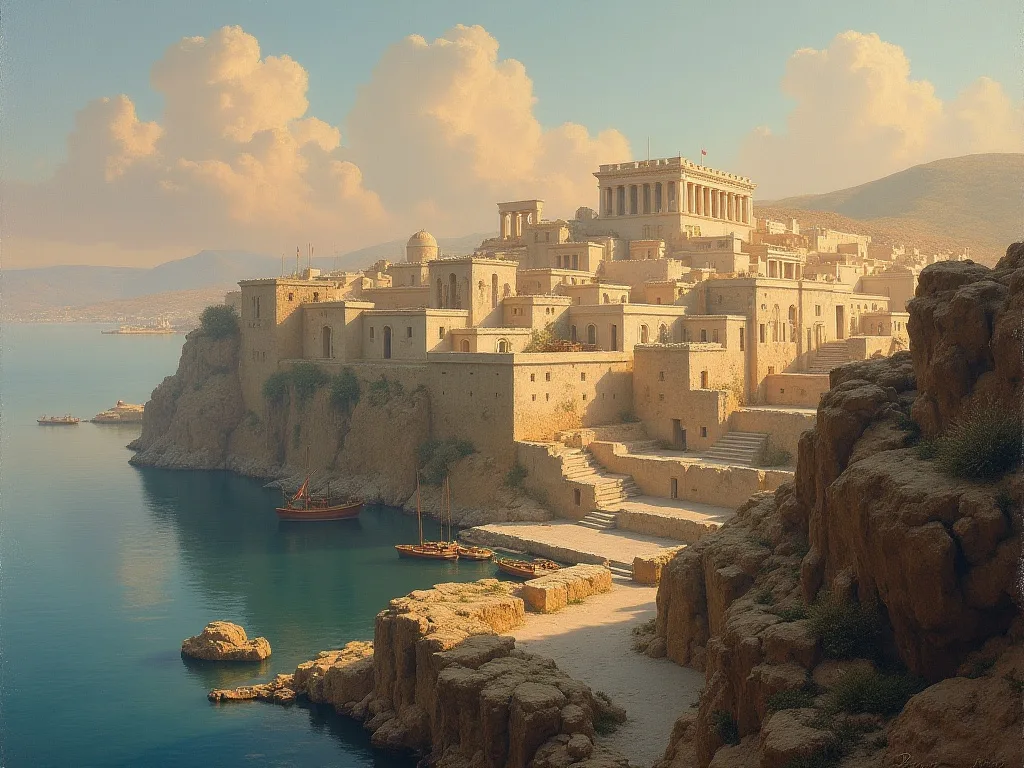
Sisyphus (in Greek, Sisyphos) was the founder and first king of Ephyra, the city that would later become Corinth. Homer, writing in roughly the eighth century BC, already presents him as the craftiest of all men ("kerdistos andrôn"), which tells us the reputation was old even then.
His parentage slots him into the first layer of Greek heroic genealogy. He was the son of Aeolus, keeper of the winds, and Enarete. That makes him a great-grandson of Deucalion, the Greek flood survivor, which places Sisyphus at the founding generation of Greek civilization. His descendants are no less striking: his son, or in some versions his grandson, was Bellerophon, the hero who tamed Pegasus and fought the Chimera.
Sisyphus built Ephyra into a maritime power. He was a trader, a schemer, a man who applied to civic life the same calculative intelligence that later got him into catastrophic trouble with the divine order. The ancient historian Thucydides, writing in the late fifth century BC, notes Corinth's early commercial dominance; Sisyphus, its legendary founder, fits that profile perfectly.
The Crimes of Sisyphus: A Sequence of Escalating Offences
The myth does not hinge on a single transgression. Sisyphus accumulated offences over a long reign, and the final punishment was the sum of all of them.
Crime 1: Betraying Zeus. Zeus abducted Aegina, daughter of the river god Asopus. Sisyphus witnessed the abduction. When Asopus came searching, Sisyphus told him everything, trading divine secrets for a guaranteed spring of fresh water at Corinth's citadel, the Acrocorinth. Zeus did not forget.
Crime 2: Killing guests. Several ancient sources, including the mythographer Hyginus writing in the first century AD, record that Sisyphus murdered travellers who sought hospitality at his court. This was xenia violation, the worst social crime in the Greek moral code. Hospitality was not courtesy; it was a sacred obligation enforced by Zeus Xenios, Zeus in his role as protector of guests. Killing a guest was effectively insulting the god himself.
Crime 3: Seducing his niece Tyro. Diodorus Siculus records that Sisyphus seduced his niece after an oracle told him that children born of the union would avenge him against his brother Salmoneus. He used his own family as an instrument of political calculation. This detail, present in several mythographers, marks him as someone who subordinates every human bond to strategic advantage.
Crime 4: Chaining Thanatos. This is the pivot of the myth, the moment Sisyphus crosses from ordinary villain to cosmic disruptor. When Thanatos (Death personified, not to be confused with Hades the god of the Underworld) came to collect him, Sisyphus somehow managed to trick and chain the god. The details vary by source. In some versions he claims he wants to demonstrate the chains to Thanatos; in others he flatters the god into a demonstration. The consequence was immediate: nobody on earth could die. Wounds gaped and would not kill. Old age advanced and could not complete its work. Sacrificial animals were cut open and would not die.
This frightened the gods. A cosmos without death is not a paradise; it is chaos. Ares, the god of war, whose whole domain depends on men dying gloriously in battle, was furious. He found Thanatos, freed him, and Sisyphus was delivered properly to the Underworld.
Crime 5: Escaping death. But Sisyphus had planned ahead. Before dying, he instructed his wife Merope to perform no funeral rites, to leave his body unburied and unmourned. In the Underworld, this counted as a grave insult. Persephone, queen of the dead, was offended. Sisyphus presented himself to her with a plausible story: he had been improperly buried, his shade had been improperly dispatched, and if she would only grant him three days above ground to arrange proper funeral rites, he would return promptly.
Persephone agreed.
Sisyphus went back up. He did not return.
He lived for many more years in Corinth, apparently delighted with himself, until old age eventually caught him a second time. The gods, by now comprehensively humiliated, ensured there was no third escape.
The Punishment Itself: What the Boulder Means
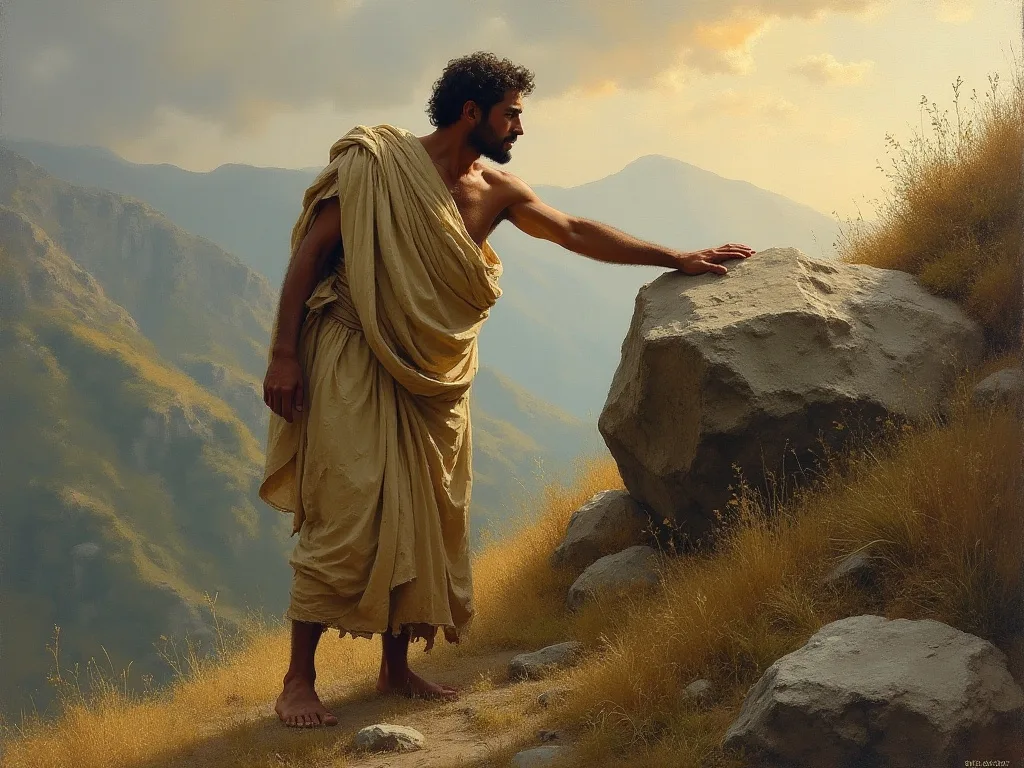
Homer describes the scene in Book 11 of the Odyssey, when Odysseus visits the land of the dead on his long journey home. He sees Sisyphus at his labour: pushing a massive boulder up a steep hill with both hands and all his body's effort, reaching the crest, and then watching the stone roll back down to the plain. Then beginning again.
Homer gives no reason for this particular punishment. He simply presents it as a fact of the Underworld landscape, as recognizable to his audience as any other standard feature. This suggests the image was already ancient and well-known by the eighth century BC.
The punishment's logic becomes apparent when you read it against the crimes. Sisyphus cheated time. He extended his life by chaining death, and then extended it again by fooling Persephone. The boulder is time itself, or rather the futility of trying to hold it back. Every ascent is another day borrowed against mortality. Every descent is the inevitability he spent his whole life denying.
There is also a spatial logic. The Underworld in Greek thought was below. To push upward was to push toward life, toward light, toward the world Sisyphus refused to leave. The stone always brings him back down. The punishment is a permanent, physical re-enactment of the lesson he refused to learn in life.

Sisyphus Across the Ancient Sources: A Timeline
Reading only one ancient source gives you a fragment. The myth accreted over roughly a thousand years of Greek and Roman literary tradition.
| Period | Source | What it adds |
|---|---|---|
| c. 700 BC | Homer, Odyssey XI | Earliest known description of the boulder punishment |
| c. 520 BC | Pindar, Olympian Odes | Confirms Sisyphus as founder of the Isthmian Games, praised as clever |
| c. 400 BC | Plato, Republic | Uses Sisyphus as shorthand for irredeemable cunning |
| c. 50 BC | Diodorus Siculus | Adds genealogy, the Tyro seduction, Merope as wife |
| c. 10 AD | Ovid, Metamorphoses IV | Brief but vivid Latin description of the eternal labour |
| c. 1st c. AD | Hyginus, Fabulae | Consolidates the full myth arc including the chaining of Thanatos |
| c. 2nd c. AD | Apollodorus, Library | Most complete mythographic summary, includes both death-cheating episodes |
Pindar is worth pausing on. He uses Sisyphus almost admiringly in places, as a figure of intelligence and civic drive. This does not mean Pindar approves of his crimes; it means the ancient Greek attitude toward mêtis (cunning intelligence) was genuinely ambivalent. Odysseus, the craftiest hero, is both celebrated and condemned throughout Greek literature. Sisyphus sits in that same contested space.
Tartarus and the Geography of Punishment
Sisyphus does not simply end up "in the Underworld." He ends up in Tartarus, the deepest pit of the Greek afterlife, reserved for those who specifically offended the gods. The Odyssey places him there alongside Tantalus, who is made to stand in water under fruit trees and reach for neither; and Tityos, whose liver is perpetually eaten by eagles because of an attack on the goddess Leto.
These are the Tartarean punishments, and they share a design principle: the crime itself becomes the structure of the suffering. Tantalus, who fed the gods human flesh, is forever tantalized by food he cannot reach. Tityos, who committed an act of bodily violation, suffers a permanent bodily violation. Sisyphus, who cheated endings, gets a task with no ending.
The Greek Underworld was not a single zone. Hesiod's Theogony, written around 700 BC, describes Tartarus as so deep below the earth that a bronze anvil dropped from the surface would fall for nine days before striking the bottom. Above Tartarus were the Fields of Asphodel for ordinary shades, and the Elysian Fields for the heroic dead. Tartarus was reserved for the truly cosmic offenders: the Titans imprisoned there after their war against the Olympians, and these few humans whose crimes bent the universe out of shape.
The Philosopher's Stone: Camus, Existentialism, and the Happy Sisyphus
In 1942, Albert Camus published Le Mythe de Sisyphe ("The Myth of Sisyphus"), a philosophical essay that became one of the founding texts of existentialist thought. His central move was audacious: he declared that we must imagine Sisyphus happy.
Camus was writing at a moment when Europe was mid-collapse. His question was not about Greek mythology but about suicide: given that life is absurd, that human effort produces no lasting meaning, why continue? His answer was Sisyphus. The boulder is the absurd condition of human existence. We work, we build meaning, the stone rolls back. What saves us, Camus argued, is the act of choosing to push again. Not because we expect the summit. Because the pushing itself is ours.
This is a radical departure from the ancient reading, where the boulder is clearly a punishment, and Sisyphus is suffering. Camus converts the punishment into a philosophy. He strips away the crime, the divine judgment, the theological architecture, and leaves only a man, a hill, and a stone.
Both readings are true to their own contexts. The ancient Greek reading depends on accepting that the gods have authority over human fate, that hubris (excessive pride or transgression against divine limits) has real consequences. Camus's reading assumes no such authority exists. The punishment, in his view, is just the human condition wearing a mythological costume.
Neither reading is more correct. They are two different questions wearing the same story.
Parallel Myths: When Other Traditions Punish Endless Labour
Sisyphus and the eternal boulder is one instance of a recurring mythological pattern: gods punishing transgression with futile, never-ending work.
Prometheus, bound to a rock on Mount Caucasus, has his liver eaten by an eagle each day. Each night it regrows. He suffers this for stealing fire from the gods and giving it to humans. The mechanism is different from Sisyphus's but the structure is identical: an endless loop that cannot be completed.
In Norse mythology, Loki is bound to a rock beneath the earth after the death of Baldr, with a serpent dripping venom onto his face. His wife Sigyn holds a bowl to catch the drops, but when she must empty it, the venom falls and Loki writhes in agony, causing earthquakes. The Eddas say this will continue until Ragnarok. Again: infinite suffering, no endpoint, directly linked to a specific transgression against the divine order.
In Hindu tradition, the cycle of samsara (the endless round of death and rebirth) operates on a cosmic scale rather than as individual punishment. But its structure echoes the same idea: existence as repetition, action generating consequence that generates more action, with no natural terminus until spiritual liberation (moksha) is achieved. The Bhagavad Gita explicitly addresses this: the warrior Arjuna is told that action itself is the trap, that clinging to the fruits of action keeps the cycle turning.
The difference is significant. Greek punishment myths are personal and juridical: a specific god punishes a specific human for a specific crime. Hindu cosmic cycles are structural: repetition is built into the architecture of existence, not imposed as sentence on an individual.
The Sisyphus pattern also appears in a gentler form in folktale traditions worldwide. The Aarne-Thompson-Uther catalogue of international folktales classifies numerous stories under what scholars call "the endless task": a character assigned work that can never be finished, as punishment or as a trick. The motif crosses cultures because it taps something genuinely universal in the human experience of time and futility.
Sisyphus in Art, Drama, and the Long Shadow of His Story
The earliest visual representations of Sisyphus at his boulder appear on Greek vase paintings from around the sixth century BC. One notable example is a black-figure amphora in the Museo Nazionale di Napoli, showing Sisyphus straining uphill while Hades or Persephone observes. The imagery stayed remarkably consistent across centuries: one man, one rock, one hill. The simplicity is part of its power.
On the Greek stage, Sisyphus appeared as a stock figure of cunning in satyr plays, the comic afterpieces that followed tragic trilogies in Athenian festivals. Aeschylus wrote a Sisyphus (now lost). Sophocles and Euripides both wrote plays featuring him. In these dramatic contexts, his cleverness was partly admired and partly mocked; the satyr plays were broadly comedic, and a man who outwitted Death made natural material.
In the Renaissance, Sisyphus became an emblem of ambition punished. Titian painted him in 1548 (the painting now hangs in the Prado in Madrid), depicting a massive figure straining under a boulder in a dark, smoky underworld. The composition emphasizes physical weight and hopelessness, a reading shaped by the period's Christian understanding of pride as a mortal sin.
In the twentieth century, the image split into two streams. One, shaped by Camus, became a symbol of heroic defiance. The other, fed by Kafkaesque bureaucracy and the experience of repetitive industrial labor, became a symbol of meaningless modern work: the monthly report that must be rewritten; the form filed in triplicate for a decision that will never arrive. Both uses are present simultaneously in contemporary visual culture, which suggests the myth is genuinely polyvalent rather than fixed in meaning.
What Sisyphus Reveals About the Greek Moral Imagination
Greek myth did not operate like a simple punishment ledger. The gods were not paragons of virtue. Zeus himself committed many of the acts the myths condemn in humans: deception, coercion, violation of trust. The difference, in the Greek moral imagination, was not virtue but position. The gods had authority over the cosmic order; humans who challenged that order were not punished for being wicked in some absolute sense, but for reaching past their designated station.
Sisyphus violated xenia (hospitality), betrayed divine secrets, and disrupted the natural order of death. Each of these is a category error: a human behaving as though he were not subject to the structures that hold the world together. His punishment restores those structures, not by making him good, but by giving him a task whose very futility embodies the limits he refused to accept.
This is what separates the Greek punishment mythology from, say, modern legal punishment. The Greeks were not rehabilitating Sisyphus. They were not even primarily expressing moral outrage at him. They were re-inserting him into the structure of things. The boulder is cosmological, not penal.
Frequently Asked Questions About Sisyphus and the Eternal Boulder
Frequently asked questions
Why did Sisyphus have to push the boulder uphill forever?
The eternal boulder is the punishment Zeus and the gods of the Underworld assigned him for a sequence of crimes: betraying Zeus by revealing Aegina's abduction, violating the hospitality code by killing guests, chaining the god Thanatos so no one on earth could die, and then twice escaping death himself through trickery. Homer describes the punishment in Book 11 of the Odyssey without explaining its internal logic, but later sources and the structure of Greek punishment mythology make clear that the endless, fruitless labour mirrors Sisyphus's lifelong refusal to accept the limits of mortal existence.
Did Sisyphus actually cheat death, and how?
Yes, twice. In the first instance he chained the god Thanatos (Death personified), preventing anyone from dying until Ares freed Thanatos by force. In the second he persuaded Persephone to grant him three days above ground to arrange proper burial rites, then simply did not return. He lived on in Corinth until natural old age claimed him a second time. Both accounts appear in Hyginus's Fabulae and Apollodorus's Library, compiled in the first and second centuries AD from older sources.
What did Albert Camus mean when he said we must imagine Sisyphus happy?
In his 1942 essay Le Mythe de Sisyphe, Camus argued that human existence is absurd: we seek meaning in a universe that offers none, we build and strive toward ends that are always undone by time and death. Sisyphus, he wrote, is the perfect image of this condition. But Camus's point was that the recognition of absurdity need not lead to despair or suicide. The act of pushing the stone back up, consciously and defiantly, is itself a form of freedom. Happiness, for Camus, comes not from reaching the summit but from fully owning the effort. He was writing against nihilism, not endorsing futility.
Are there similar myths of eternal futile punishment in other cultures?
Yes. The closest Greek parallel is Prometheus, whose regenerating liver is eaten by an eagle each day. In Norse mythology, Loki is bound beneath the earth with venom dripping on his face until Ragnarok. Hindu cosmology frames the entire cycle of samsara as an endless loop of action and consequence from which liberation (moksha) is the only exit. The "endless task" motif also appears across global folktale traditions catalogued by scholars in the Aarne-Thompson-Uther index, suggesting the image taps a near-universal intuition about the relationship between transgression, time, and futility.
Was Sisyphus related to any famous Greek heroes?
Yes. His most notable descendant is Bellerophon, the hero who rode the winged horse Pegasus and killed the Chimera. Some ancient sources make Bellerophon the son of Sisyphus through Glaucus (himself a son of Sisyphus); others make him a grandson. Sisyphus is also the great-grandson of Deucalion, the Greek flood survivor, placing him at the founding generation of post-flood humanity. His wife Merope is one of the Pleiades, the seven daughters of the Titan Atlas.
Where exactly does Sisyphus appear in the ancient sources?
Homer's Odyssey (Book 11, the Nekyia or underworld visit) is the earliest surviving description of the boulder punishment, written around the eighth century BC. Pindar mentions him in several odes from the early fifth century BC. Ovid's Metamorphoses (Book IV) gives a brief Latin description. The fullest mythographic accounts are in Hyginus's Fabulae (first century AD) and Apollodorus's Bibliotheca (second century AD). Plato references Sisyphus in the Republic as a byword for irredeemable cunning.
The Unfinished Argument: Why Sisyphus Still Rolls
The boulder never reaches the top. That is a fact within the myth. But what the boulder means has been revised in every era, and there is no sign that revision has stopped.
The twentieth century gave Sisyphus a philosophical upgrade. The twenty-first century has added another layer: he appears in debates about automation, repetitive digital labour, and what economists call "bullshit jobs" (a term the sociologist David Graeber used in his 2018 book of the same name). Work that produces reports nobody reads, fills forms that trigger no action, maintains systems whose purpose no one remembers. The boulder as modern bureaucracy has genuine explanatory power.
There is also an unresolved scholarly question about the myth's relationship to Corinthian religious practice. Ephyra/Corinth hosted the Isthmian Games, one of the four great Panhellenic athletic festivals. Pindar credits Sisyphus as the founder of those games, which gives him a surprisingly positive civic legacy. Some classicists, including Sarah Iles Johnston in her work on Greek religion and the afterlife, have suggested that the Sisyphus myth may encode older religious narratives about the cycle of seasons or the ritual defeat of death that were later re-read as punishment mythology as the Olympian order consolidated.
If Johnston's reading has merit, the boulder may be far older than Homer. It may have once meant something entirely different: not eternal futile punishment, but a seasonal cosmology, the sun rolling back each night, the year turning without rest. The Greeks inherited myths from Minoan and Mycenaean predecessors whose religious logic we understand only partially.
That ambiguity is not a weakness in the myth. It is what keeps it alive. Sisyphus and the eternal boulder survives because it accommodates every era's central anxiety: the fear that effort is pointless, the hope that it is not, and the nagging suspicion that both things might be true at the same time.
Every generation that picks up the story is, in a sense, pushing it back up the hill. And finding that it rolls down, ready to be pushed again.
Free 25-page sample
Want the whole story?
Take the first 25 pages free. If it pulls you in, the full edition is yours as an instant PDF download, with a paperback on Amazon for selected titles.

Mythology
The World Mythology Book: The Gods, Heroes and Myths of Every Culture
The Gods, Heroes and Myths of Every Culture, in One Volume
The whole of world mythology in a single volume: Greek, Norse, Egyptian, Japanese, Hindu, Celtic, Slavic, Mesoamerican and African myths gathered side by side, each drawn from the primary sources.