

Skadi: Norse Goddess of Winter, Mountains, and the Hunt
Skadi, the Norse goddess of winter and the hunt, chose skis over tears and mountains over marriage. Her myth reshapes what vengeance, independence, and the cold season actually mean.
Contents
The hall was full of gods, and she walked in wearing armor.
Skadi, the goddess of winter and the hunt, had come to Asgard not to beg but to settle a debt. The Aesir had killed her father, the giant Thjazi, and she wanted satisfaction. She got something stranger: a marriage she had to choose blind, a laugh she had to coax from a grieving heart, and a pair of eyes launched into the night sky like two new stars. By the time she left that hall, she had outnegotiated a pantheon.
That scene, recorded in the Prose Edda compiled by the Icelandic scholar Snorri Sturluson around 1220 CE, tells us almost everything worth knowing about Skadi. She is not a soft winter spirit. She is not a passive goddess waiting for spring to rescue her. She is a jotun (a giant, one of the primordial beings who predate and outlast the Aesir) who earns a seat among them and keeps it entirely on her own terms.
Who Skadi Is: Giant, Goddess, and Huntress
The name Skadi (also spelled Skaði in Old Norse, with the ð pronounced like the English "th") has been linked by scholars to a Proto-Germanic root meaning "shadow" or "harm." Some linguists, including those discussed in Rudolf Simek's Dictionary of Northern Mythology (1993), have also connected her name to the Old Norse word skadi, meaning damage or harm. Whatever the etymology, the sound of it fits: cold, sharp, final.
She is the daughter of Thjazi, a powerful frost giant who famously kidnapped Idunn and stole her apples of immortality. Thjazi met his end at the hands of the Aesir when he pursued Loki back to Asgard in eagle form and was brought down by fire at the walls of the divine city. Skadi's origin is therefore violent from the start. She grew up among mountains and glaciers, away from the warm halls of Asgard, learning to ski and hunt in terrain where nothing grows easily.
Her domain in Old Norse sources is precise and unromantic: she rules fjall (mountain terrain), deep snow, cold forests, and the northern winter. She is the patron of skiing, which in Norse Scandinavia was not a sport but a survival skill. The Prose Edda calls her öndurguð (ski-deity) and öndurdís (ski-dís, meaning a female spirit connected to fate and protection). That title places her in the same breath as the dísir, the collective female powers who watched over clans and harvests, meaning Skadi bridges the gap between raw natural force and protective guardian.
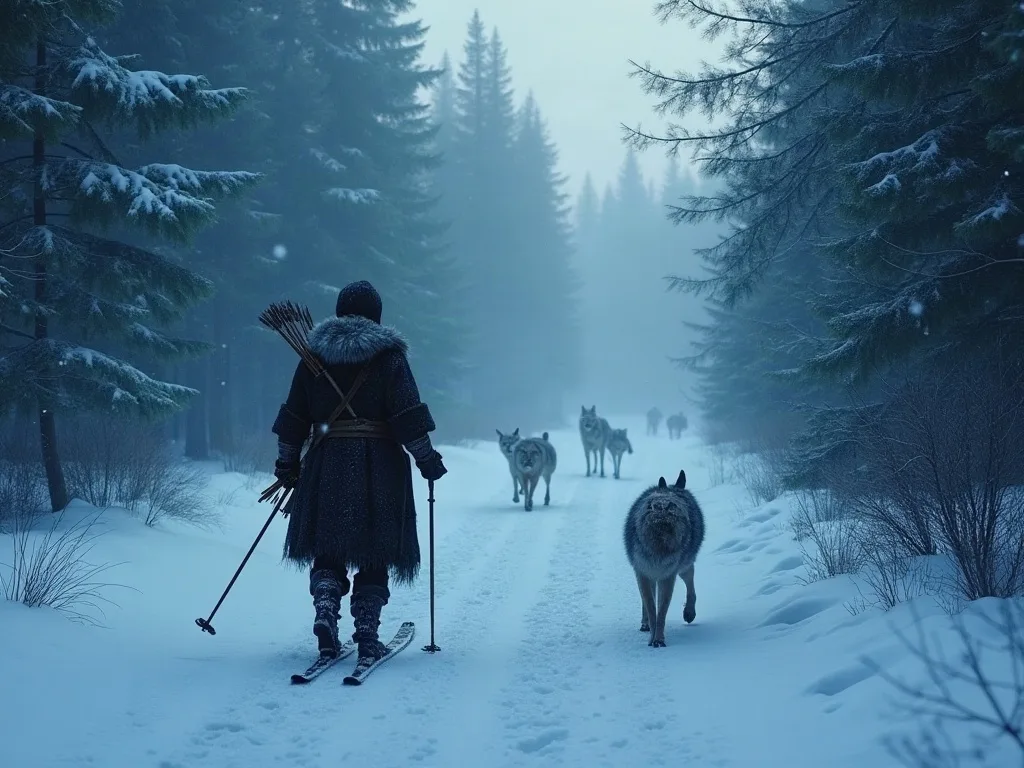
She is also listed among the Aesir in Snorri's Gylfaginning section of the Prose Edda, a remarkable status for someone born to the opposition. Poets referred to the land of Norway itself using a kenning (a compressed poetic metaphor common in Old Norse verse) built from her name: Skaðiland, "Skadi's land." That is how deeply her identity was tied to the northern landscape. She was not worshipped despite the cold. She was worshipped because of it.
The Negotiation: Skadi Walks Into Asgard
The Skáldskaparmál section of Snorri's Prose Edda gives the fullest account of what happened after Thjazi's death. Skadi put on her helmet and armor, took up her weapons, and went straight to Asgard. The gods had two choices: fight her or settle.
They chose to settle. The terms she demanded were these:
- Compensation for her father's death, the highest legal demand in Norse and Germanic law.
- A husband chosen from among the gods, but chosen blindly: she could see only the feet of each candidate, hidden behind a curtain.
- A laugh from her, which she initially thought impossible in her grief. The gods had to make her laugh as part of the peace settlement.
The husband-by-feet detail is genuinely odd, and scholars have puzzled over it. Skadi assumed that the most beautiful feet would belong to Baldr, the radiant and beloved son of Odin. She was wrong. She chose the most shapely pair of feet in the lineup, and they belonged to Njord, the Vanir god of the sea, fishing, and coastal wealth. Her second guess had been better than the first: she got a god, just not the one she wanted.
The laugh came through Loki. The trickster tied one end of a rope to a goat and the other end to his own testicles, and the resulting spectacle of pain and absurdity finally broke Skadi's composure. The episode is preserved without apology in Snorri's text. It is crude, deliberate, and it works. Grief gave way for one moment, the legal terms were satisfied, and Odin himself completed the settlement by taking Thjazi's eyes and throwing them into the heavens, where they became two stars.
The negotiation is worth sitting with. In Norse law, wergild (blood price) was a real mechanism for resolving killing between families and clans. Skadi's demands mirror actual legal custom: compensation, integration through marriage, and a symbolic restoration of the dead. Snorri was writing for a thirteenth-century Icelandic audience who understood these mechanisms from living memory. Her arrival in armor was not theater. It was a legal summons.
Skadi and Njord: A Marriage of Incompatible Worlds
The marriage did not last. This is one of the most compact and honest stories about incompatibility in any mythology.

Skadi wanted to live in her father's hall at Thrymheim, high in the mountains, surrounded by ice and howling wolves. Njord wanted the sea, the smell of salt water, the cries of gulls. They tried to compromise. Nine nights at Thrymheim, nine nights at Njord's coastal hall Nóatún.
It failed in nine lines of verse. The Prose Edda preserves a short flyting (a poetic exchange of insults or complaints) between them:
Njord: "Hateful to me were the mountains, I was not long there, only nine nights. The howl of wolves seemed to me ugly compared with the song of swans."
Skadi: "Sleep I could not on the sea-beds for the scream of birds. That gull wakes me every morning as it flies from the sea."
Two people. Two homelands. No middle ground. The marriage quietly dissolved. Snorri says Skadi returned to Thrymheim and the mountains. She is later described in the Prose Edda as skiing through the peaks and hunting game with her bow, alone, which in the text reads less like loneliness and more like satisfaction.
The failure is not presented as a tragedy. It is presented as a fact of nature: some things cannot be reconciled. Cold and salt, mountains and shore, winter and the sea.
Skadi and Loki: The Serpent and the Binding
Skadi appears again in one of the darkest episodes in Norse mythology: the punishment of Loki after he orchestrated the death of Baldr.
When the gods finally caught and bound Loki beneath the earth, Skadi was one of those who chose how the punishment would be carried out. She took a venomous serpent and hung it above Loki's face, so that its poison would drip onto his skin for an eternity. His wife Sigyn holds a bowl beneath the snake to catch the venom, but when she must turn away to empty the bowl, the drops fall, and Loki's writhing causes earthquakes.
The detail that Skadi chose this particular cruelty carries weight. Loki had helped cause her father's death by luring Thjazi with a promise and then betraying him. He had also been the one to make her laugh, which satisfied her grief in part. The relationship between Skadi and Loki runs through the whole mythological cycle as something unresolved and complicated: gratitude twisted with grievance, a debt paid but never fully forgiven.
Her role in Loki's punishment, recorded in the Prose Edda's Lokasenna and Gylfaginning sections, shows that Skadi is not a character who forgets. The mountains remember everything. Winter is patient.
Skadi's Possible Link to Scandinavia Itself
Several scholars, including Simek and the historian John Lindow in Norse Mythology: A Guide to the Gods, Heroes, Rituals, and Beliefs (2001), have raised the possibility that the name Skadi may be linguistically connected to Scandinavia itself. The root Skan- or Skað- appears in early Latin and Gothic references to the northern lands, including the Roman geographer Pomponius Mela's first-century description of a large northern island called Scadinavia.
If the connection holds, the goddess's name literally became the name of the land. She would not merely rule winter in Scandinavia: she would be the etymology of the place. This remains a scholarly hypothesis rather than a consensus, but the resonance is hard to dismiss. A jotun woman, armed, standing in snow, refusing to be absorbed by the gods who killed her father, with her name pressed into the very geography of the north.
Skadi Across Mythologies: Cold Goddesses and the Winter Hunt
Skadi is not the only winter goddess who hunts. Looking across traditions reveals patterns worth tracing.
The Greek goddess Artemis shares some of her portfolio: virginal, armed with a bow, ruling wild places, connected to mountains and cold forests, fiercely independent. Artemis is not associated with snow as such, but her space is the wild edge between civilization and the untamed world, exactly the terrain Skadi claims. Both goddesses are defined by what they refuse more than by what they accept.
The Slavic goddess Marzanna (also called Morana or Morena in various Slavic traditions) rules winter and death, and her ritual effigy is burned or drowned at the end of winter to drive the cold out. Where Skadi is active and hunting, Marzanna is more passive, an embodiment of winter's weight rather than its motion. The contrast is instructive: Skadi never represents winter as something to be expelled. She is at home in it.
The Hindu goddess Chamunda, one of the fierce aspects of Durga, hunts across cremation grounds and wears bone ornaments, occupying terrain as inhospitable and sacred as Skadi's mountains. Both figures show how traditions worldwide placed fierce, independent female power in the landscapes that ordinary life avoids.
Skadi (Norse)
- Daughter of a frost giant, born outside the divine order
- Hunts with skis and bow in mountain snow and frozen forests
- Married briefly against her preference, then returned to solitude
- Grants skiing, winter survival, and the cold hunt
- Associated with wolves, mountains, and the northern dark
Artemis (Greek)
- Daughter of Zeus, born into the divine order but choosing distance from it
- Hunts in wild forests, hills, and untamed lowlands
- Swore perpetual virginity, refused all permanent bonds
- Grants skill in archery, protection of wildlife, childbirth paradoxically
- Associated with deer, the moon, and the boundary of the wild
What links these figures across cultures is not coincidence but geography and function. Every human society living near winter had to explain it, survive it, and find a figure who embodied its logic. That figure is almost always female, almost always armed, and almost always operating at the edge of the human world.

How Skadi Was Worshipped
Direct evidence for cult practice around Skadi is fragmentary, which is typical for Norse religion. The sources are literary rather than archaeological, and most were written down after Christianization by Snorri and other Icelandic scholars who were preserving, not practicing.
What the sources suggest is this. Place names in Norway carry her name: Skadhem, and possibly Skedsmol in the Oslo region, are linked by some scholars to her cult. Hunters and skiers in northern Scandinavia almost certainly invoked her, though the precise ritual forms are lost. She appears in skaldic poetry (the complex, technically demanding court poetry of Viking Age skalds) as a reference point for winter, the north, and the hunt. That frequency of mention in poetic tradition implies she was not an obscure figure but a recognized power whose name carried immediate meaning for a Norse audience.
The dísablót, a sacrifice made to the dísir in mid-winter, may have touched on Skadi's sphere given her classification as a dís. The Ynglinga saga, one of the kings' sagas preserved in Snorri's Heimskringla, connects the dísablót to the turning of winter and the protection of the year ahead.
Skadi After the Viking Age: From Eddas to Modernity
The medieval manuscripts preserved her. The Prose Edda (around 1220 CE) is the richest single source, but the Poetic Edda, the older collection of mythological verse compiled around the same period from much earlier oral material, also names her in poems like Grímnismál and Lokasenna. In Lokasenna, Loki and Skadi exchange sharp words at a feast of the gods, and she calls him out for his role in Thjazi's death. He retorts that she was once tender toward him. The exchange is brief and loaded with history the poem does not fully explain, the mark of a myth with deep roots.
In the nineteenth century, Romantic nationalism rediscovered Skadi alongside the rest of the Norse pantheon. Norwegian painters and poets reaching for a pre-Christian identity found her figure useful: a goddess of snow who was not gentle, not domestic, and not subordinate. She fit the landscape they wanted to claim.
In contemporary paganism and Ásatrú (the modern revival of Norse religious practice), Skadi is actively honored. Practitioners invoke her during winter, before hunting seasons, and when seeking strength in isolation or grief. Her myth of armed negotiation resonates with modern readers in ways that softer goddesses do not: she set terms, held a position, and did not dissolve into the structure she entered.
Popular fiction and games have taken her up as well, though often at the cost of her complexity. The Netflix series The Last Kingdom and various video games deploy "winter goddess" archetypes that owe something to Skadi's silhouette without quite reaching her specificity. The original is always more interesting.
Frequently Asked Questions About Skadi, Goddess of Winter
Frequently asked questions
Is Skadi a goddess or a giant in Norse mythology?
She is both, which is not a contradiction in Norse cosmology. Skadi was born a jotun (giant), the daughter of Thjazi. After negotiating with the Aesir following her father's death, she married the god Njord and was counted among the Aesir herself. Norse mythology regularly shows gods and giants intermarrying and crossing categorical lines. Odin's mother Bestla was a giantess. The boundaries between jotun and Aesir were permeable, defined more by allegiance and story than by fixed biology.
Why did Skadi's marriage to Njord fail?
Snorri Sturluson preserves a short verse exchange in the Prose Edda in which both deities explain their incompatibility directly. Njord could not tolerate the howling of wolves and the absence of the sea at Thrymheim, Skadi's mountain hall. Skadi could not sleep at Njord's coastal home because of the screaming gulls. They tried nine nights each in the other's home and decided to separate. The marriage failure is not dramatized as heartbreak. It reads as a cold fact: two natures, two geographies, no compromise possible.
What is the connection between Skadi and skiing?
Skiing in Norse Scandinavia was a practical, survival-level skill, not a leisure activity. Skadi is called öndurguð (ski-deity) in the Prose Edda, one of the most direct divine associations with a specific skill in Norse mythology. The oldest surviving skis date back thousands of years in Scandinavia, and the activity was central to winter hunting and movement through snow. Associating the goddess of winter and the hunt with skiing was entirely logical: she is the figure who makes winter navigation possible.
Did Skadi have children?
Sources differ. Snorri's Prose Edda does not mention children with Njord. However, the Ynglinga saga (part of Snorri's Heimskringla) suggests Skadi later had a relationship with Odin and that several noble lineages of the north traced descent from their union. This tradition may reflect regional cult variations or deliberate genealogical myth-making by Scandinavian royal families seeking divine ancestry. It also underscores Skadi's importance: gods as powerful as Odin are her peers, not her superiors.
Is Skadi connected to the word 'Scandinavia'?
Several scholars, including Rudolf Simek and John Lindow, have noted that the root of Skadi's name and the root of Scandinavia may share a common Proto-Germanic origin, possibly related to a word for shadow, danger, or the northern lands themselves. Roman sources including Pomponius Mela (first century CE) use forms like Scadinavia for the northern peninsula. The linguistic case is plausible but not proven. If it holds, Skadi's name became literally embedded in the geography of the north long before the Viking Age.
How is Skadi different from other winter deities in world mythology?
Most winter deities in global myth are passive: they embody the season's weight, its stillness, its death-like sleep. Skadi is kinetic. She hunts, she skis, she negotiates, she punishes. She entered Asgard armed and left with legal satisfaction. Where figures like the Slavic Marzanna mark winter as something endured and then driven away, Skadi marks it as a home. She does not need saving from the cold. She is the cold, comfortable in it, skilled within it, and entirely uninterested in spring's opinion.
Skadi's Enduring Challenge: What Winter Goddesses Tell Us About Power
The myths around Skadi keep circling back to one structural tension: she belongs to a world the Aesir did not make and cannot fully control, yet she operates within their frame without submitting to it.
That is unusual in Norse myth. Giants, jotnar, are usually the opposition. They are the forces that will eventually break the world at Ragnarok. Skadi occupies neither pole cleanly. She is not an enemy. She is not domesticated. She is a jotun who negotiated her own terms of coexistence and kept them. Her marriage to Njord ended not in defeat but in mutual acknowledgment of incompatibility. Her punishment of Loki was an act of justice, not cruelty without cause. Her return to the mountains was not exile. It was a choice.
Scholars like Carolyne Larrington, in her work on Norse myth and gender, and Britt-Mari Näsström, who examined Norse goddess traditions in Freyja: The Great Goddess of the North (1995), have pointed out that Skadi's independence is exceptional even by the standards of Norse female figures. The dísir, the Valkyries, the nornir who weave fate at the base of Yggdrasil: all these female powers operate within defined functions. Skadi defines her own function.
The question she implicitly poses to the reader is the same one winter poses every year to everyone who lives in the north: will you meet it on its terms, or will you wait, shivering, for it to become something easier?
She already answered. She put on her skis.
Free 25-page sample
Want the whole story?
Take the first 25 pages free. If it pulls you in, the full edition is yours as an instant PDF download, with a paperback on Amazon for selected titles.

Mythology
The World Mythology Book: The Gods, Heroes and Myths of Every Culture
The Gods, Heroes and Myths of Every Culture, in One Volume
The whole of world mythology in a single volume: Greek, Norse, Egyptian, Japanese, Hindu, Celtic, Slavic, Mesoamerican and African myths gathered side by side, each drawn from the primary sources.