
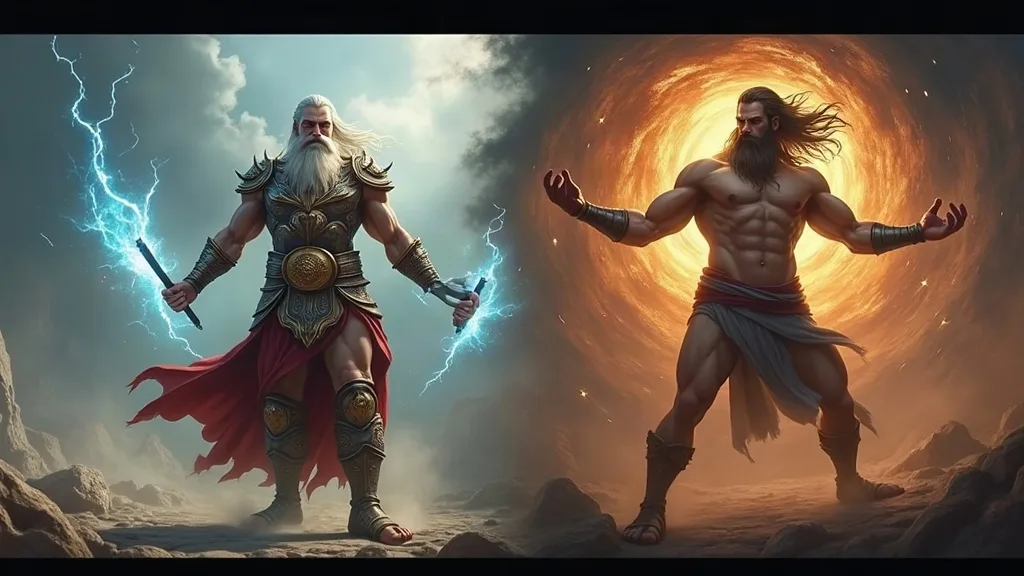
Smite Gods vs Their Real Mythology: The Truth Behind the Game
Smite reimagines gods for combat. From Zeus to Sun Wukong, the game strips myth to its core and rebuilds it for balance. Here's what the real stories say, and where Smite takes creative liberties that make the originals even more intriguing.
Contents
Smite places you in the hands of a god wielding ultimate powers, ready for battle. The moment you select Zeus or Odin or Freya, you're steering an instantly recognizable force onto the map. But the version in your hands is not the one your ancestors worshipped or the one ancient texts describe. The game makes strategic choices: it simplifies, compresses, sometimes invents. The real mythology is deeper, stranger, more troubling, and far more interesting.
This gap between game and source opens a door. Millions of players discover mythology through Smite, and many wonder: what's real, what's game-design fiction, and what secret layers exist in the actual myths? This article walks that line. For every god in Smite's roster (across Norse, Greek, Egyptian, Hindu, Japanese, Mayan, and Chinese traditions), we'll show what the game chose to keep, what it cut, and what the original sources reveal that the game's 10-second intro cinematics never touch.
How Smite Reconstructs Gods for a 5v5 Arena
The game faces a hard constraint: balance. Every god must fit into one of a handful of roles (tank, damage dealer, support, bruiser). Every ability must fit an Ultimate, four base skills, and passive bonuses. Smite's design team at Titan Forge Games makes choices that no ancient scribe ever considered. A god's kit (their moveset) becomes their "character" in a way that flattens complexity but creates immediate, intuitive identity.
Take a simple example: Ares, the Greek god of war. In the game, he wears golden armor, stuns enemies with chains, and casts a ring of fire. Competent warrior, clear purpose. The real Ares, as described in Homer's Iliad, is a coward and a bully. He charges into battle in a rage, gets wounded, and weeps. Athena, the other god of war, is the strategic thinker. Ancient Greeks saw Ares as brute force without wisdom, not the noble warrior Smite presents. The game had to choose: stay true to a messy, nuanced character, or create a visually coherent fighting archetype? It chose the latter. That choice is not bad; it's just different.
Smite operates in a tradition as old as myth itself: adaptation. Every culture that inherited a god story remixed it for their own time. When Romans conquered Greece, they took Zeus and called him Jupiter, then rewrote his myths to fit Roman values. When Buddhism spread through Asia, it absorbed local deities and gave them new roles. Smite is doing the same thing for 21st-century game players. It's just honest about it.
Greek Gods: Smite's Deepest Roster
Smite's Greek pantheon is the largest, the most recognizable, and in many ways the most distant from the source material. This makes sense: the gods of Olympus were designed for complex human drama, not arena combat.
Zeus and the Patriarch Problem
In Smite, Zeus is a mid-laner mage with lightning bolts and a guaranteed escape. He's authoritative, powerful, and straightforward. He summons lightning, drops meteors, and no enemy dares approach.
The real Zeus, from Hesiod's Theogony (a poem from around 700 BCE about the gods' origins) and Homer's Iliad (composed around the 8th century BCE), is a different beast. He's a serial philanderer who transforms into animals, showers, and bulls to seduce mortals and nymphs. He fathers an impossible number of bastards. He's paranoid (he swallows Metis, the goddess of wisdom, to prevent her from bearing a son who might overthrow him). He's petty; he punishes entire families for one person's disrespect. He's also genuinely heroic: he leads the Titans into war to establish order. The real Zeus is a complex political operator, as likely to lose control of a situation as he is to dominate it.
Smite's Zeus is the version of him that sells: mighty, in control, visually satisfying. The real Zeus is the version that taught ancient Athenians about power, consent, and the gap between authority and legitimacy. Both are powerful. They're just powerful in different ways.
Athena: Where Game and Source Align
Athena, the wisdom goddess, is one place where Smite nails the source material. She's a support hero who shields allies and counters damage. Intelligent, protective, strategic. This matches the real Athena from the Iliad and the Odyssey: she guides Odysseus, protects Telemachus, teaches mortals craft and strategy. She's never romantic, never reckless, always tactically brilliant. She has a virgin aspect in myth (no romantic or sexual element), which Smite preserves by making her asexual in character design. The game could have sexualized her (many adaptations do), but it didn't. When Smite gets a god right, it really gets them right.
Aphrodite and the Reduction of Desire
Aphrodite in Smite is a mid-laner healer who charms enemies into vulnerability and protects her team with beauty and love. The cosmetic design emphasizes sensuality; the kit emphasizes control.
The real Aphrodite is stranger. She's not just the goddess of love; she's the goddess of sexual desire, specifically. In the Theogony, she's born from sea foam after Kronos castrates Uranus; there's chaos and violence in her origin. She appears in the Iliad as petty and vain, jealous of heroes, sometimes unhelpful in combat. She's married to Hephaestus (the craftsman god, unglamorous) but sleeps with Ares (the warrior god). Her son Eros (desire itself) is portrayed as a child or a force of chaos, not a character. Ancient Greeks saw her as necessary, powerful, but also dangerous: desire can cloud judgment, destroy families, topple empires. Smite's version is gentler, more supportive, less transgressive. The source material is more frank about the cost of beauty and passion.
Hades: The Game's Best Reconstruction
Hades, the underworld god, is a mid-lane carry who summons spectral minions and pulls enemies into pits. The ability to control space and summon undead fits the mythological role: Hades is the ruler of the dead, the keeper of souls, the god who never leaves his realm. Smite even keeps Hades' key trait: he's isolated from the rest of the pantheon. The other Olympians throw parties; Hades stays below.
What the game captures is correct: Hades is not evil in the real myths. He's stern, businesslike, and bound by cosmic law. When Persephone is abducted and taken to his realm (in Ovid's Metamorphoses, around the 1st century CE), Hades treats her as his queen, not his prisoner (though earlier sources, like the Greek Hymn to Demeter, frame her descent as rape). Smite doesn't touch the Persephone story at all, which is clever: it sidesteps the ugly reality while keeping Hades himself intact. The god is powerful, separate, rule-bound, and fair. That's true to the source.

Norse Gods: Smite's Second Pillar
Smite's Norse roster draws from the Eddas: the Poetic Edda and Prose Edda, medieval Icelandic texts that preserve Norse mythology. These gods are closer to their source material than many Greek counterparts, partly because the game had less cultural baggage to fight against. Norse myth is less widely known, so there's more room to be faithful.
Odin: The Wanderer's Gambit
In Smite, Odin is a warrior who charges enemies with a spear, creates protective zones, and escapes through the air with his ravens. He's presented as noble, strategic, wise.
The real Odin, from the Poetic Edda and Prose Edda (13th-century texts preserving 10th-century and earlier traditions), is far more morally ambiguous. He's the god of wisdom, yes, but also of war, death, and magic. He hanged himself on Yggdrasil (the World Tree) for nine nights to gain knowledge of the runes. He sacrificed one eye to drink from Mimir's well of wisdom. He travels the world as a wanderer, testing mortals and kings. He's generous with knowledge but ruthless in pursuit of it. He practices seidr, a form of magic that was considered un-masculine and transgressive in Norse culture. He's not a clean hero; he's a complicated operator who trades in secrets and blood-price.
Smite's Odin is the version that works in a team arena: reliable, protective, clear. The real Odin is the version that teaches you about the cost of wisdom and the danger of power-seeking that crosses moral lines.
Freya and the Chooser of Slain
Freya in Smite is a dual-wielding warrior woman with love and beauty themes mixed with combat prowess. She summons spectral companions and is presented as fierce and sensual.
The real Freyja in Norse tradition is the goddess of love, fertility, and war. She also chooses who lives and who dies in battle: she takes half the slain warriors to her hall, Folkvangr, while Odin takes the other half to Valhalla. She owns the necklace Brisingamen (made by dwarves, desired by many). She's independent, sexually confident, travels in a chariot pulled by cats. She's not a love interest in myth; she's a sovereign power. Norse culture portrayed her as admirable, bold, and worthy of respect.
Smite's Freya emphasizes the warrior aspect and the beauty aspect together, which is historically sound. Where the game simplifies is in presenting her as sexy rather than sovereign. The real Freyja isn't trying to be attractive; she's commanding warriors, claiming the dead, and moving through the world as her own agent. That distinction matters. For a deeper look at how the Aesir and Vanir relate, see Freya and the Norse Pantheon.
Egyptian Gods: The Oldest Stories
The Egyptian pantheon in Smite is smaller but draws from texts thousands of years old: the Pyramid Texts (carved into tomb walls around 2400-2300 BCE), the Coffin Texts (2100-1800 BCE), and the Ramesside Amduat (1250 BCE), among others. These gods survived millennia of religious change and were adapted dozens of times over. Smite is just the latest iteration.
Ra and the Daily Renewal
Ra, the sun god, is a mid-lane mage in Smite who blasts enemies with solar energy and can heal allies. He's presented as radiant, all-seeing, and fundamentally good.
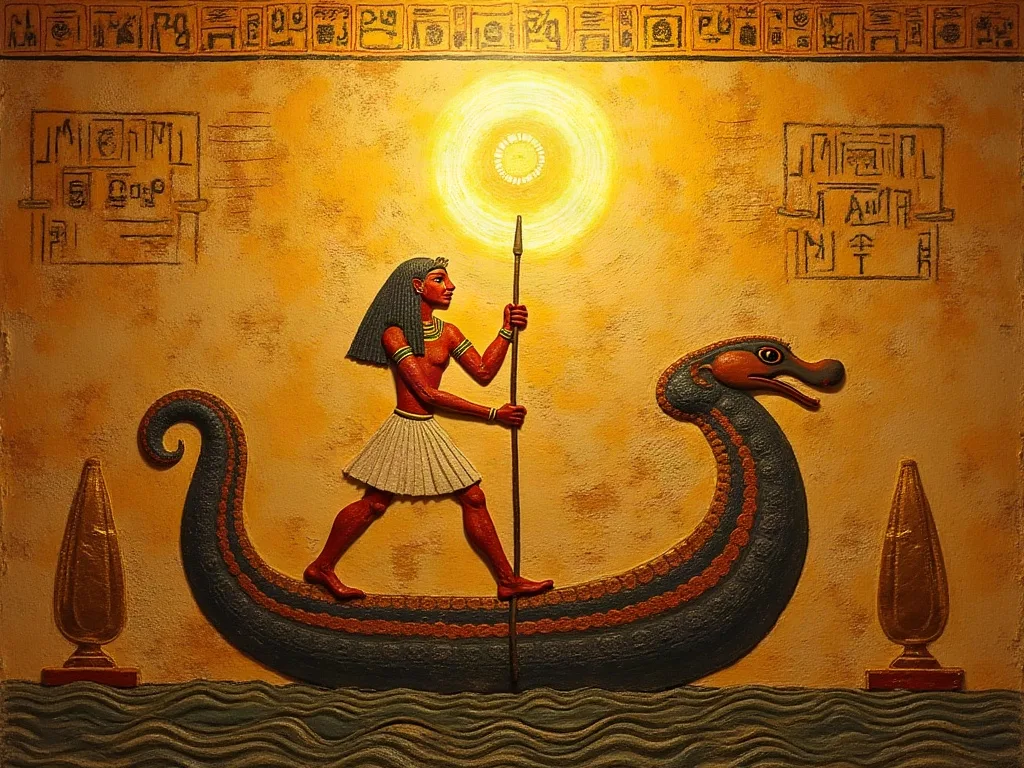
The real Ra is the sun itself, traveling daily across the sky in his solar barque (boat). Each night, he enters the underworld and must battle the serpent Apophis to be reborn at dawn. He's not perpetually triumphant; he's engaged in eternal struggle. He's also a shape-shifter: he has multiple forms (Khepri as the scarab at dawn, Ra at noon, Atum as he descends). He merged with other gods over time: Amun-Ra combines the mystery of creation with the visible sun. Ancient Egyptians didn't see Ra as a simple hero; they saw him as a constant cycle of death and rebirth.
Smite's Ra is stripped to the visual and the ability: sunlight, healing, power. The source material is more cyclical, more about process and struggle.
Anubis: The Unchanged Warden
Anubis, the jackal-headed god of mummification and the dead, is a support hero in Smite who can heal and protect. He's presented as a guardian of death, solemn and focused.
This is accurate. Anubis (Inpu in Egyptian) appears in the Pyramid Texts as the god who oversees burial and the transition to the afterlife. He's present at the Weighing of the Heart (from the Book of the Dead, recorded on papyri around 1550-1070 BCE), where the dead's heart is weighed against the feather of Ma'at (truth). Anubis doesn't judge; he presides. He's neutral and bound by law. Smite's portrayal is faithful. The god is serious, functional, and ancient. The source material is the same. Learn more about how Egyptian burial mythology shaped these traditions in The Egyptian Afterlife.
Hindu Gods: Smite's Complexity Test
Smite's Hindu pantheon is where the game faces its biggest challenge: the gods of the Mahabharata and the Ramayana are embedded in long, complex mythological narratives and appear in forms that change across texts and regions. Smite has to choose one version and commit.
Kali: Destroyer and Creator
Kali in Smite is a mid-lane assassin with rapid attacks and escape abilities, presented with dark visual language and aggression. She's fierce, fast-moving, untouchable.
The real Kālī in Sanskrit is the dark aspect of Parvati (the mountain goddess). She emerges in texts like the Devi Mahatmya (around 500 CE) to destroy demons. She's depicted as black-skinned, standing on the body of Shiva, wearing a skirt of severed arms and a necklace of severed heads. She's terrifying and necessary. She destroys what needs to be destroyed: demons, ego, ignorance. She's not evil; she's the destroyer force in the cosmic cycle (creation, maintenance, destruction). She's also worshipped as a protector and a liberator in Tantric traditions.
Smite's Kali emphasizes the warrior aspect and the speed, which fits. What the game can't easily capture is the paradox: Kali is destructive and liberating, terrible and compassionate, powerful and devoted to Shiva. The game makes her a straightforward aggressive force. The real Kali is a paradox that takes years of study to begin to understand.
Ganesha and the Remover of Obstacles
Ganesha, the elephant-headed god, is a guardian support in Smite who blocks paths and protects allies. He's presented as jovial, protective, and grounded.
Ganesha appears throughout Hindu mythology as the remover of obstacles, the god of beginnings, and the lord of small creatures. He's beloved across India and is invoked at the start of rituals. He's portrayed as wise despite (or because of) his elephant head, and as playful and gluttonous. Smite's version is warm and protective, which matches the folklore and devotional tradition. The real Ganesha is slightly more mischievous and complex: he removes obstacles, yes, but sometimes creates them as a test. Smite's version is more purely benevolent, which simplifies but also reflects how many Hindus actually approach Ganesha in daily practice.
Japanese Gods: Smite's East Asian Expansion
The Japanese pantheon in Smite draws from Shinto tradition and also incorporates figures from Japanese Buddhism and folklore. This is already a remix, since Japanese religion itself fuses multiple sources.
Amaterasu and the Sun Goddess
Amaterasu in Smite is a mid-lane mage who commands light and can make herself and allies invisible. She's presented as radiant and sovereign.
Amaterasu appears in the Kojiki (Chronicles of Ancient Matters, written around 712 CE) as the supreme sun goddess whose lineage eventually rules Japan. She's also known for withdrawing into a cave, causing the world to go dark until other gods lure her out. She's not just powerful; she's essential to the world's functioning. She's also vain: the cave episode is partly about her vanity being wounded.
Smite's Amaterasu is straightforward: powerful light, protective abilities, central to her team's function. The source material is more about cosmic significance and the power to withhold blessing. The game misses the idea that Amaterasu's absence is catastrophic, but captures her as a source of vitality and light.
Susanoo and the Storm
Susanoo, the storm god, is a mid-lane warrior in Smite with a dash ability and hard crowd control. He's presented as aggressive and strong.
In the Kojiki, Susanoo is Amaterasu's brother who behaves badly (he weeps, creates chaos, defiles her sacred space), is banished from heaven, and then descends to Earth where he slays a giant serpent and finds a sword inside it. He's powerful but undisciplined. Later traditions (particularly in Noh theater and folk belief) respect him as a protector and storm-bringer.
Smite's Susanoo emphasizes the warrior and storm-bringer aspects, which works. What the game can't capture is that Susanoo in the Kojiki is reckless and immature, at least initially. He's not malevolent; he's a cautionary tale about power without wisdom. The game makes him a capable warrior. The source material makes him earn his redemption the hard way.
Mayan and Mesoamerican Gods: Smite's Mythic Depth Challenge
Smite's Mesoamerican roster is small but draws from some of the world's most visually striking and conceptually complex mythologies: the Popol Vuh (the K'iche' Maya creation epic, recorded in the 16th century but preserving much older tradition) and the Aztec codices.
Kukulkan and the Feathered Serpent
Kukulkan in Smite is a mid-lane mage who summons tornados and serpents, presented as a cosmic force of wind and creation.
K'uk'ulkan in Maya (known as Quetzalcoatl in Aztec tradition) is the feathered serpent who appears across Mesoamerican cultures over thousands of years. In the Popol Vuh, he's one of the creator deities who shapes humans from maize. In Aztec tradition, he's the god of wind, wisdom, and the morning star. He's also associated with cycles of time and renewal. He travels between the underworld and the sky.
Smite's Kukulkan captures the cosmic and cyclical aspect: he summons natural forces and creates barriers. What the game simplifies is the god's deep connection to time and transformation. The real Kukulkan is about constant change and the cyclical death and rebirth of the world. That's harder to convey in a five-minute match, so Smite makes him a force of nature instead of a force of cosmic renewal. For more on Mesoamerican creation myths, see The Popol Vuh Explained.
Camazotz and the Bat
Camazotz, the death bat from the Popol Vuh, is a mid-lane warrior in Smite with echo and diving abilities. He's presented as a creature of night and death.
In the Popol Vuh, Camazotz is a death deity associated with the underworld, darkness, and disease. He and other death creatures test the Hero Twins (the protagonists of the Popol Vuh) when they enter the underworld. He's a real threat in the original story, not a villain but a force that must be overcome.
Smite's Camazotz is simplified to a warrior with bat-themed abilities. The source material is richer: he represents the unknown, the death that waits in darkness, the hidden threat. The game makes him a fighter. The Popol Vuh makes him an existential challenge.
Ixchel and the Moon That Heals
One major Mayan figure Smite has not yet brought to its roster is Ixchel, the jaguar goddess of the moon, medicine, and weaving. She appears in the Dresden Codex, one of the few surviving pre-Columbian Maya books, as a wise and powerful figure associated with floods, childbirth, and healing. She's often depicted as an aged woman pouring water from a jar, or as a young woman wearing a crescent moon.
What makes Ixchel so compelling is her range. She's the same goddess in her young and old forms: creative and destructive, nurturing and terrifying, associated with both the gentle art of weaving and the catastrophic force of floods. She's also connected to Itzamna, the sky lord and creator deity, as his consort, which places her at the center of Maya cosmology.
A healer-support kit for Ixchel would practically design itself. Her moon phases could drive ability cycles. Her weaving imagery could translate into barriers or web-like crowd control. Her duality (nurturing vs. destructive) fits perfectly into Smite's support-mage hybrid role. The fact that she's absent says more about name recognition than about mythological richness. For curious players, the Dresden Codex is partially available in facsimile online, and the anthropologist Raphael Girard's studies of living Maya communities offer further context.
Chinese Gods and Folklore: Smite's Latest Pantheon
Smite's Chinese roster includes both gods from classical Taoism and Buddhism and figures from Chinese folklore and legend. Sun Wukong, the Monkey King, is not technically a god in traditional Chinese religion, but he's become one of the most recognizable figures in Chinese storytelling.
Sun Wukong and the Monkey King's Evolution
Sun Wukong in Smite is a mid-lane warrior with high mobility, shapeshifting abilities, and a staff attack. He's presented as playful, powerful, and wild.
Sun Wukong is the protagonist of Journey to the West, an epic novel written by Wu Cheng'en in the 16th century (though based on earlier tales and Buddhist mythology). He's born from a stone, teaches himself martial arts, and acquires magical powers. He rebels against heaven, is imprisoned under a mountain for 500 years, and is eventually recruited to protect a Buddhist monk on a journey to India. He's clever, funny, sometimes selfish, deeply loyal once committed, and nearly invulnerable.
Smite's Sun Wukong captures the physical prowess, the playfulness, and the shapeshifting. What the game can't capture in a MOBA setting is that Sun Wukong is a spiritual journey: he starts as an ego-driven rebel and gradually learns humility and compassion. The game makes him a power fantasy. The source material is an allegory about taming the mind.
Why Smite's Changes Matter: The Design Imperative
Every god in Smite has been reshaped by a clear constraint: they must fit into a five-person team game where each role has specific expectations. A support character must protect and enable allies. A mid-laner must deal consistent damage and occupy space. A carry must scale and do high damage late-game. A tank must absorb punishment. A jungler must gank and secure objectives.
No ancient mythology was designed with these constraints. The myths grew from human experience, religious practice, artistic tradition, and storytelling. They're messy, contradictory, and deep. Smite trades depth for clarity. That's not a failure; it's a choice.
But that choice creates an opportunity. When a player encounters a god in Smite and wonders "is that what the mythology actually says?", they've started a journey. The real myths are available; they're not locked behind a paywall or a translation barrier. A player curious about Zeus can read Homer. A player drawn to Kali can find the Devi Mahatmya. A player intrigued by Kukulkan can engage with the Popol Vuh. Smite becomes a gateway.
The game also makes visible how mythology adapts. Every culture that encountered a foreign god remixed it. Romans took Greek gods and changed them. Buddhism absorbed Hindu deities. Colonial churches tried to absorb indigenous gods into the Christian pantheon. Smite is doing what humans have always done: taking a sacred story and making it relevant to the present moment.
The Gods Smite Hasn't Covered (Yet)
Smite's roster doesn't include every mythological tradition, and the absences are revealing. There's no substantial Hindu roster despite drawing a few gods (Kali, Ganesha). There's no deep African tradition coverage, though African religions have survived the diaspora and shaped world culture. There's no broad Slavic representation, no extensive Celtic coverage, no Mesopotamian gods. These aren't oversights; they reflect which mythologies have mass-market recognition in English-speaking gaming communities. But they also represent untapped depth.
The Yoruba pantheon (the Orishas) from West African tradition has the same rich complexity as the Greek pantheon and the same real-world devotional following. Oshun, the river goddess of love and fertility, governs sweet water, gold, and the delicate balance between abundance and excess. Shango, the thunder king, commands lightning and justice, his double-headed axe as iconic as Thor's hammer in any design brief. Yemaya, the ocean mother, holds the source of all water and all life. Oya rules storms, death, and transformation, commanding the winds that carry the dead. These are not figures from a dormant tradition; the Orishas survived the Middle Passage through enslavement and remain actively worshipped in Candomble, Santeria, and Ifa across West Africa, Brazil, Cuba, and the United States. They're not just historical; they're living. Smite's absence here is a missed opportunity for both representation and genuinely new gameplay archetypes.
Celtic gods like Morrigan, Brigid, and Lugh have suffered from centuries of Romantic-era mythmaking and New Age appropriation. A game that grounded them in actual medieval Irish texts (the Lebor Gabala Erenn, the Ulster Cycle) could clarify what's real and what's modern invention. Smite's Celtic roster is limited, leaving room for that work to happen elsewhere.
The deeper point: Smite's coverage map is also a map of which mythologies have institutional weight in the English-speaking world. Greek, Norse, Egyptian, and Hindu traditions have long scholarly traditions, translations in every major language, and cultural capital. Japanese and Chinese traditions have growing visibility through anime, film, and literature. Mesoamerican tradition is gaining ground through both indigenous revival and popular media interest. Smite reflects these currents, and in reflecting them, it amplifies them. That's not a problem unique to Smite; it's a problem in all media. But it's worth seeing clearly.
What the Game Gets Right
For all its simplifications, Smite does something remarkable: it forces each god into an immediate, visual, mechanical identity. That constraint is clarifying. A player who knows nothing about Zeus and spends an hour playing him learns something true: he's about power, dominance, and area control. A player who learns Athena learns about protection, strategy, and team play. A player who masters Kali learns about speed, aggression, and the power to slip away unharmed. These lessons don't contradict the source material; they just compress it.
Smite also respects the visual language of each tradition. The Norse gods look Norse. The Egyptian gods look Egyptian. The Hindu gods wear their iconographic markers. A player who encounters Anubis in the game will recognize him by his jackal head, and that visual recall might prompt them to learn more. Smite is, in this sense, a museum that moves. It's not a perfect museum, and it's designed to sell skins and battle passes. But it's also a gateway to real knowledge.
Frequently Asked Questions About Smite Gods and Real Mythology
Frequently asked questions
Is Smite's version of these gods considered canon or accurate to mythology?
Smite's versions are not canon to any actual mythology. They're game-design interpretations made to fit a five-person arena combat system. They're accurate in spirit for some gods (like Anubis and Athena) and quite loose for others (like Zeus or Kali). The real mythology is always more complex, more contradictory, and more interesting than what a game can present. Smite is a doorway, not the destination.
Why does Smite change god abilities and personalities?
Smite's designers are constrained by game balance. Every god must fit into one of five roles, and each role has specific expectations for what abilities should do. The myths grew from storytelling and religious practice, not competitive design. A mid-lane mage needs burst damage and crowd control. Zeus the serial philanderer is harder to translate into an ability kit than Zeus the lightning-wielder. The game chooses mechanical clarity over mythological nuance.
Which Smite gods are closest to their real mythology?
Athena, Anubis, and Ganesha are among the most faithful. Athena in the real myths is strategic, protective, and wise; Smite's kit (a support hero who shields and counters) matches this. Anubis is functionally the god of the dead and mummification in both the source material and the game. Ganesha is a remover of obstacles and a protector, which Smite captures. Conversely, Zeus, Susanoo, and Camazotz are much looser translations.
Which texts do scholars use to study the gods in Smite?
It depends on the tradition. For Greek gods, scholars read Homer's Iliad and Odyssey (8th century BCE) and Hesiod's Theogony (around 700 BCE). For Norse gods, the key texts are the Poetic Edda and Prose Edda, both written down in 13th-century Iceland. For Egyptian gods, the Pyramid Texts and the Book of the Dead are foundational. For Hindu figures like Kali and Ganesha, the Devi Mahatmya and the Mahabharata are essential. For Mayan figures, the Popol Vuh is the single most important source. All of these are available in English translation, and many are free online. The book recommended above is a strong starting point for Greek mythology specifically.
Can I use Smite to learn about real mythology?
Smite is an excellent starting point. If a god draws your attention in the game, you now have a name to search for. The real myths are freely available online, in translation, in books. A player curious about Kukulkan can move from Smite to the Popol Vuh in an afternoon. The game is a bite-sized introduction; the myths are the full meal. Smite works best as a curiosity-engine.
Why do some mythologies have more gods in Smite than others?
Smite's roster reflects which mythologies have the most name recognition and existing cultural weight in English-speaking game communities. Greek gods are universally recognized. Norse gods have seen a resurgence through Marvel and God of War. Japanese tradition is increasingly visible through anime. Smite's coverage follows the market, not a principle of equal representation. That means some living, practiced traditions (like Yoruba or Shinto) are underrepresented, while better-known but less practiced traditions get more space.
The Myth Continues to Adapt
Every god in Smite inherits a lineage of adaptation. Zeus was remixed by every culture that encountered Greek tradition. Amaterasu was shaped by Shinto, then Buddhism, then Japanese folklore. Kukulkan survived centuries of conquest and cultural erasure to re-emerge in modern consciousness. Smite is just the latest writer in a very long story.
What makes this moment different is scale and speed. A single game reaches millions of people worldwide simultaneously. A player in Brazil can learn about Norse mythology in real-time while a player in Japan learns about Mesoamerican tradition. The myths that once traveled along trade routes and through the mouths of travelers now spread through fiber optics and server farms.
Smite doesn't replace the real mythology any more than a movie replaces a book. But it does make the mythology visible and desirable. It asks the question: what is the god's real story? That question is the start of real learning. The myths themselves, preserved in fragments and texts and oral traditions, are waiting to answer. Smite opened the door. Walking through it is the player's choice.
The god you select in Smite is a door opening inward toward something vast. The game shows you the threshold. The mythology beyond is yours to discover.
Beyond the Game: How Players Keep the Research Alive
The learning doesn't stop when the match ends. Fan wikis like the Smite Wiki and community forums on Reddit's r/Smite carry long threads where players debate mythological accuracy, share primary source discoveries, and correct each other's assumptions. A player who encounters Ixchel in a discussion thread and asks who she really was will find other players pointing them toward the Dresden Codex or the work of Linda Schele on Maya epigraphy. That kind of peer-driven inquiry accelerates myth learning far beyond what any loading screen lore blurb can accomplish.
Speedrunners of mythology are everywhere in gaming communities. They find the gaps, the inconsistencies, the gods whose in-game bios contradict the texts, and they flag them. They build comparison lists. They start Discord channels. Some of them end up studying ancient languages or archaeology because a game lit the initial spark. The community doesn't just consume mythology; it pressure-tests it. When the game gets something wrong, players notice, and they publish the correction.
This is worth celebrating. Every tradition covered in this article, from the Aesir to the Orishas to the Hero Twins of the Popol Vuh, benefits when curious people push past the surface. The texts are old but the conversations are live. The myths outlast every medium that carries them, including this one.
Free 25-page sample
Want the whole story?
Take the first 25 pages free. If it pulls you in, the full edition is yours as an instant PDF download, with a paperback on Amazon for selected titles.

Mythology
The World Mythology Book: The Gods, Heroes and Myths of Every Culture
The Gods, Heroes and Myths of Every Culture, in One Volume
The whole of world mythology in a single volume: Greek, Norse, Egyptian, Japanese, Hindu, Celtic, Slavic, Mesoamerican and African myths gathered side by side, each drawn from the primary sources.