
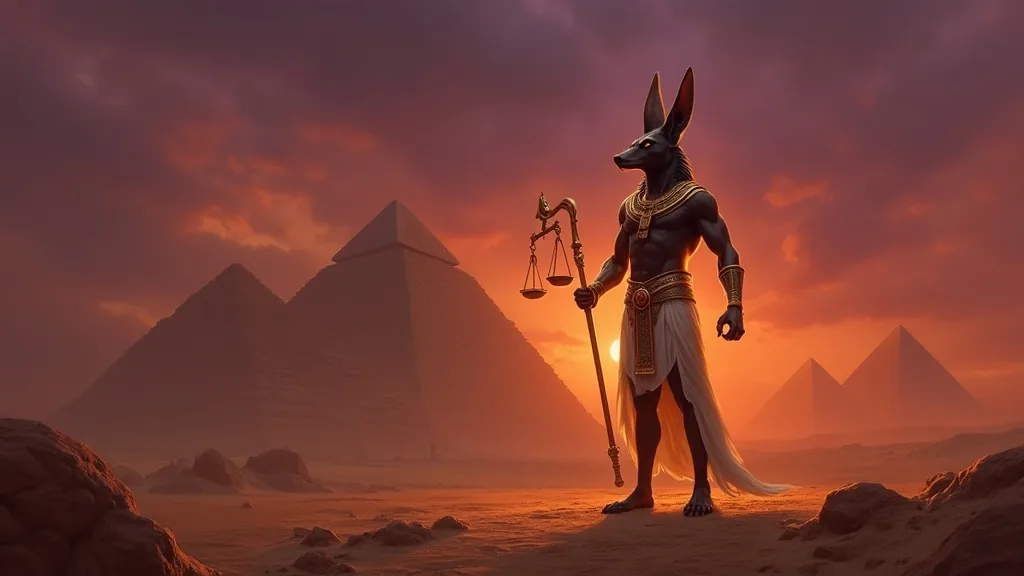
Anubis: God of the Dead, Guardian of the Scales
Anubis, the jackal-headed deity of ancient Egypt, presided over embalming, the underworld, and the judgment of souls. His is one of the oldest and most enduring divine figures in human history.
Contents
The Jackal at the Threshold
Long before Osiris came to dominate the Egyptian imagination of death, a darker, more primal figure stood watch at the border between the living and the dead. Anubis, rendered with the sleek black head of a jackal and the upright body of a man, was already ancient when the pyramid builders first raised their monuments to the sky. His name in ancient Egyptian, Inpu (or Anpu), carries connotations of royal child and decay alike, a fitting duality for a god who bridges two worlds.
He is not merely a symbol of death. He is its custodian, its craftsman, and its judge. To the Egyptians, death was not an ending but the most consequential journey a person would ever undertake, and Anubis was its indispensable guide.
Origins and Earliest Worship
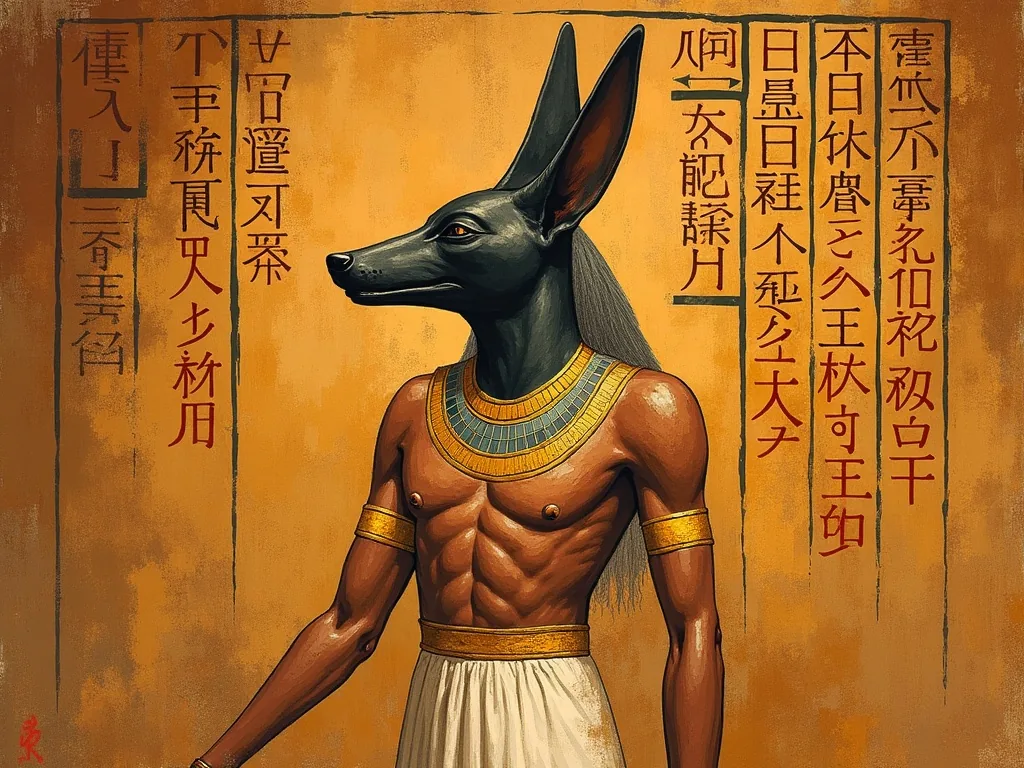
Anubis is among the oldest attested deities of the Egyptian pantheon. His worship is documented as far back as the First Dynasty (c. 3100 BCE), and his image appears in the earliest royal tombs at Abydos and Saqqara. The Pyramid Texts, carved into the burial chambers of Old Kingdom pharaohs beginning around 2400 BCE, invoke him repeatedly as the protector of the dead and the one who "binds the mummy wrappings."
The Jackal's Symbolic Power
The choice of the jackal as Anubis's animal form was not arbitrary. Jackals were commonly seen prowling the desert edges of Egyptian cemeteries, their slender silhouettes visible at dusk near the necropolis. Rather than casting them as villains desecrating the dead, Egyptian theology inverted the image: the jackal became the divine guardian, the very creature that haunted graveyards transformed into their eternal protector.
The black color of his iconography carries equal weight. In Egypt, black was not the color of evil or mourning. It was the color of the fertile Nile silt, of regeneration, of the rich earth from which new life emerged. A black jackal-headed god was therefore a god of renewal as much as a god of endings.
Parentage and Divine Lineage
The mythological parentage of Anubis shifts across sources, reflecting the fluid, layered nature of Egyptian theological tradition. In many early texts, he is the son of Ra, the solar deity, and a divine cow goddess. Later traditions, especially those interwoven with the Osirian cycle, name him as the son of Osiris and Nephthys, born of a secret union while Nephthys was disguised as her sister Isis. In this version, the infant Anubis was abandoned by his mother out of fear and later found and raised by Isis, who recognized in him a future guardian of the dead.
This Osirian lineage became the dominant narrative by the Middle Kingdom. It embedded Anubis firmly within the mythological drama of Osiris, Isis, Seth, and Horus, Egypt's most powerful cycle of death, betrayal, and resurrection.
Master of Embalming
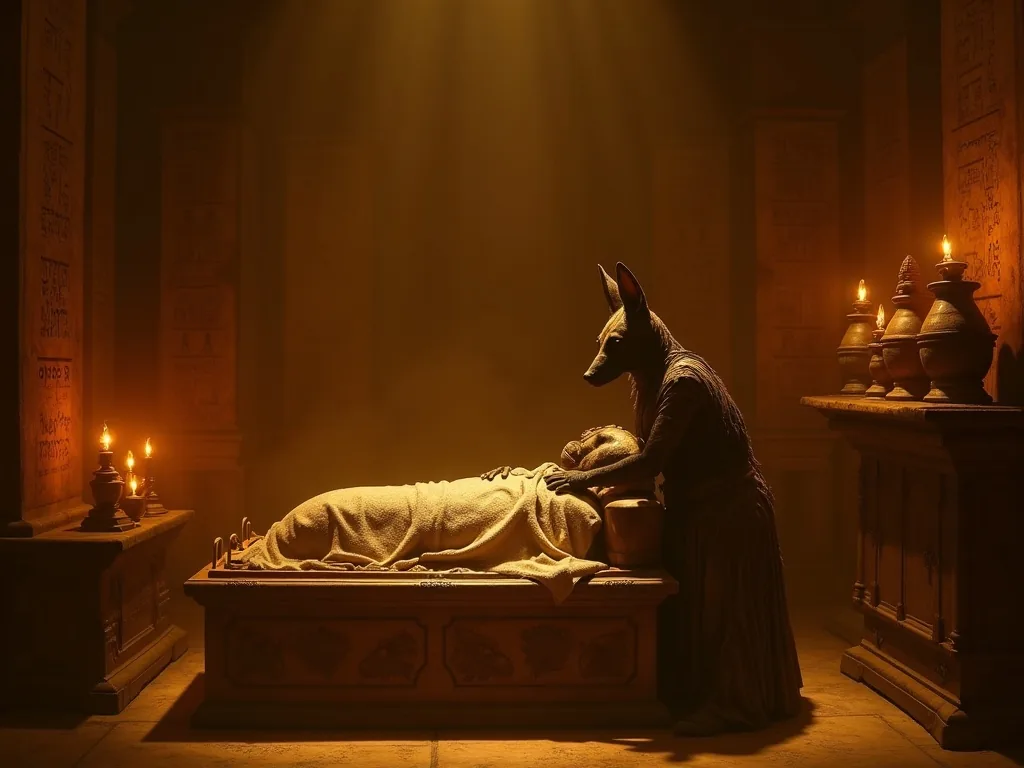
No role defines Anubis more concretely than that of embalmer. The Egyptians believed he personally invented the art of mummification, performing it first on the slain body of Osiris after Seth had murdered and dismembered him. Working alongside Isis and Nephthys, Anubis reassembled the god's body, wrapped it in linen, and through ritual and sacred knowledge restored it to wholeness. This act made Osiris the first mummy and established the template for all human burials to follow.
The Titles He Carried
The epithets assigned to Anubis in funerary texts are rich with meaning:
- Khenty-Amentiu: "Foremost of the Westerners," a title meaning foremost among the dead, since the land of the dead lay to the west where the sun set. This was one of his oldest titles, used before Osiris absorbed the same role.
- Neb-Ta-Djeser: "Lord of the Sacred Land," a reference to the desert necropolis where burials took place.
- Imy-ut: "He Who is in the Place of Embalming," a direct acknowledgment of his role in funerary preparation.
- Opener of the Ways: A guide title, indicating his function as pathfinder for the soul navigating the Duat, the Egyptian underworld.
In the embalming ritual itself, the chief priest often wore a jackal mask, physically embodying Anubis and enacting the god's protective role over the deceased.
The Weighing of the Heart
Of all the scenes in Egyptian religious art, none is more famous or more charged with moral weight than the Weighing of the Heart, depicted in stunning detail across countless papyri of the Book of the Dead.
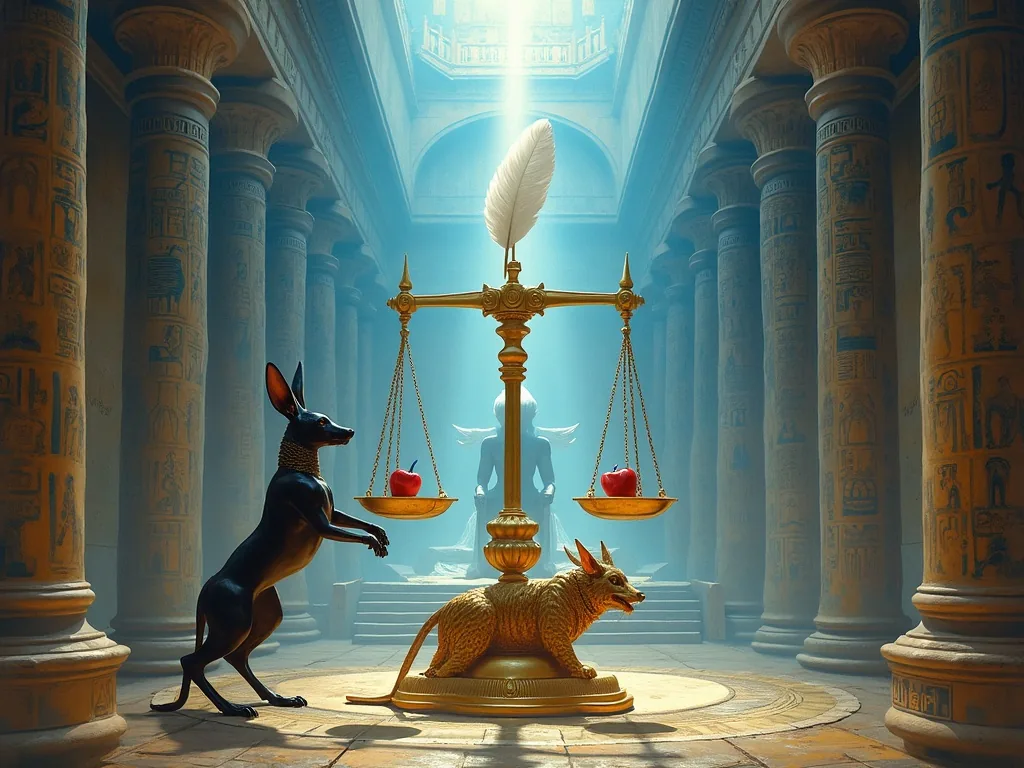
When a person died, their soul (the ba) descended into the Duat and eventually reached the Hall of Two Truths, presided over by Osiris. There, Anubis performed a solemn and precise act: he took the deceased's heart, the organ the Egyptians considered the seat of memory, emotion, and moral identity, and placed it on one side of a great golden scale. On the other side rested the feather of Ma'at, the cosmic principle of truth, justice, and balance.
Anubis monitored the scales with absolute impartiality. If the heart was heavy with sin, cruelty, and dishonesty, it outweighed the feather and was devoured by Ammit, the fearsome composite beast part lion, part hippopotamus, part crocodile, who waited nearby. This second death, the obliteration of the soul, was the most terrible fate an Egyptian could imagine. If the heart balanced with the feather, Thoth, the scribe god, recorded the verdict and the soul passed onward into the eternal paradise of the Field of Reeds.
Anubis's role here is that of a divine technician of justice. He does not judge with emotion or favoritism. He reads what the scales reveal, and the scales do not lie.
Anubis in the Book of the Dead and Funerary Texts
The Book of the Dead (more precisely, the Book of Coming Forth by Day) is a collection of spells and liturgies assembled to guide the deceased through the underworld. Anubis appears throughout its chapters, not merely as a presence but as an active participant. In Chapter 125, the famous Negative Confession scene, he stands at the scale. In other chapters, he is invoked to protect the wrapped body, to seal the tomb, and to guide the ba safely past the dangers of the Duat.
Earlier funerary compositions, including the Pyramid Texts and the Coffin Texts, also call upon Anubis extensively. These are some of the oldest religious writings in human history, and the god's persistence across them over more than two millennia speaks to how deeply his function was felt to be necessary, not peripheral.
Amulets and Funerary Objects
Archaeological evidence expands what texts describe. Small faience and bronze figurines of Anubis, typically depicting him as a recumbent jackal or as a jackal-headed man, were placed in tombs throughout Egyptian history. The canopic jars used to store the embalmed organs of the deceased were guarded by four divine sons of Horus, but Anubis was considered the overall protector of the canopic shrine.
In the tomb of Tutankhamun, discovered by Howard Carter in 1922, a magnificent gilded wooden statue of Anubis in jackal form was found crouching on a gilded shrine box, positioned at the entrance to the treasury. Wrapped in a linen shawl and oriented to face the tomb's entrance, it stood as a literal sentinel across more than three thousand years of darkness.
Anubis Across Cultures and Time
The Greeks, who encountered Egyptian religion through trade and eventually conquest, were deeply fascinated by Anubis. They identified him with their own guide of the dead, Hermes, creating a syncretic deity called Hermes-Anubis or Hermanubis, depicted with both a caduceus and a jackal head. This figure was venerated in the Greco-Roman period and appeared in temples across the Mediterranean, including in Rome itself.
Roman soldiers stationed in Egypt adopted Anubis into their personal devotional practices. Terracotta lamps and votive figurines bearing his image have been found far from Egypt, in Britain, Germany, and along the Danube frontier, carried by soldiers who had encountered his cult and brought it home.
This diffusion says something essential about the god's appeal. The idea of a fair, watchful guardian who treats every soul equally, who cannot be bribed and does not play favorites, resonated far beyond the Nile Valley. In a world where justice for ordinary people was often scarce, Anubis represented a final, incorruptible accounting.
The Living Legacy of a Death God
Today, Anubis remains one of the most recognizable figures in the entire landscape of world mythology. His image appears in museums from Cairo to New York, tattooed on skin, cast in gallery sculptures, and rendered in film and popular fiction. The 2001 film "The Mummy Returns" gave him an army. Video games, novels, and tarot decks regularly invoke his iconography.
Yet none of this saturation has diluted the original power of the myth. The questions Anubis embodies, about fairness after death, about whether a life has been lived honestly, about what it means to be weighed and found worthy, are questions that no civilization has ever stopped asking.
His jackal silhouette at the edge of the desert, watching the tombs, watching the dying light, is one of the oldest images of divine care that human beings ever conceived. The god of the dead was never a god to be feared by the righteous. He was the one presence you hoped, above all others, to find waiting when you finally crossed over.
Free 25-page sample
Want the whole story?
Take the first 25 pages free. If it pulls you in, the full edition is yours as an instant PDF download, with a paperback on Amazon for selected titles.
Egyptian
The Egyptian Mythology Book: Ra, Osiris, Isis, Anubis, and the Sacred Stories of the Pharaohs
Ra, Osiris, Isis, Anubis, and the Sacred Stories of the Pharaohs
Three thousand years of Egyptian sacred stories. The Duat, the weighing of the heart, the cult of Osiris, and the daily voyage of the sun.
More from Egyptian
All articles
Egyptian
Eye of Horus: The Protective Amulet That Watched Over the Living and the Dead
Worn by pharaohs and fishermen alike, the Eye of Horus is one of antiquity's most potent protective symbols, carrying the weight of cosmic battle, divine healing, and eternal vigilance.

Egyptian
Ra the Sun God: Egypt's Supreme Ruler of Light and Creation
Ra, the ancient Egyptian sun god, blazed at the very heart of a civilization that worshipped light as the pulse of creation itself. Discover his origins, his many forms, and the sacred journey he took across the sky and through the underworld every single day.
Egyptian
The Ankh: Egypt's Eternal Symbol of Life
The ankh is ancient Egypt's most recognizable hieroglyph, a looped cross carried by gods and pharaohs alike as the very key to immortal life. Discover its origins, meanings, and sacred legacy.
Egyptian
Egyptian Gods: Divine Powers and Sacred Authority
How Egyptian gods wielded power through cult, kingship, and cosmic order. Grounded in Pyramid Texts, temple inscriptions, and ritual practice.