
Sun Gods Across Mythologies: Ra, Helios, Amaterasu and the Sacred Fire That Never Sets
From Egypt's Ra to Japan's Amaterasu, every civilization shaped a sun deity from the same burning sky. Here is what their stories share, where they split apart, and why the sun demanded gods at all.
Contents
The sun rose this morning the same way it rose over the first human campfire. No explanation. No apology. Just that overwhelming, undeniable fact of light after dark. Ancient peoples across every continent looked at that rising arc and did the same thing: they gave it a name, a story, a face. They made it a god.
What is remarkable is not that they did this. What is remarkable is how they did it, and how differently. The Egyptian Ra rides a solar barque through the underworld each night, fighting a serpent to return at dawn. The Greek Helios steers four horses across the sky, doing a charioteer's work. Japan's Amaterasu hides in a cave and plunges the world into darkness until laughter lures her out. These are not the same story. But they share bones: the daily journey, the threat of extinction, the covenant between the sun and the living world beneath it.
Across cultures separated by oceans and millennia, sun gods across mythologies tell us something consistent about the human mind when it stares up at the sky. The specifics vary wildly. The underlying logic does not. This article works through the major solar deities one by one, then maps the patterns that connect them, the fractures that separate them, and what the scholarly record genuinely says about why the sun demanded worship at so many latitudes.
Ra: The Sun That Swallows Itself Each Night
Start in Egypt, because Egypt is where solar theology grew its deepest roots and its most elaborate theology. Ra (also written Re) was the supreme sun god of the ancient Egyptians, worshipped continuously for more than three thousand years. The earliest written sources, the Pyramid Texts from around 2400 BC, already treat Ra as the axis around which cosmic order rotates.
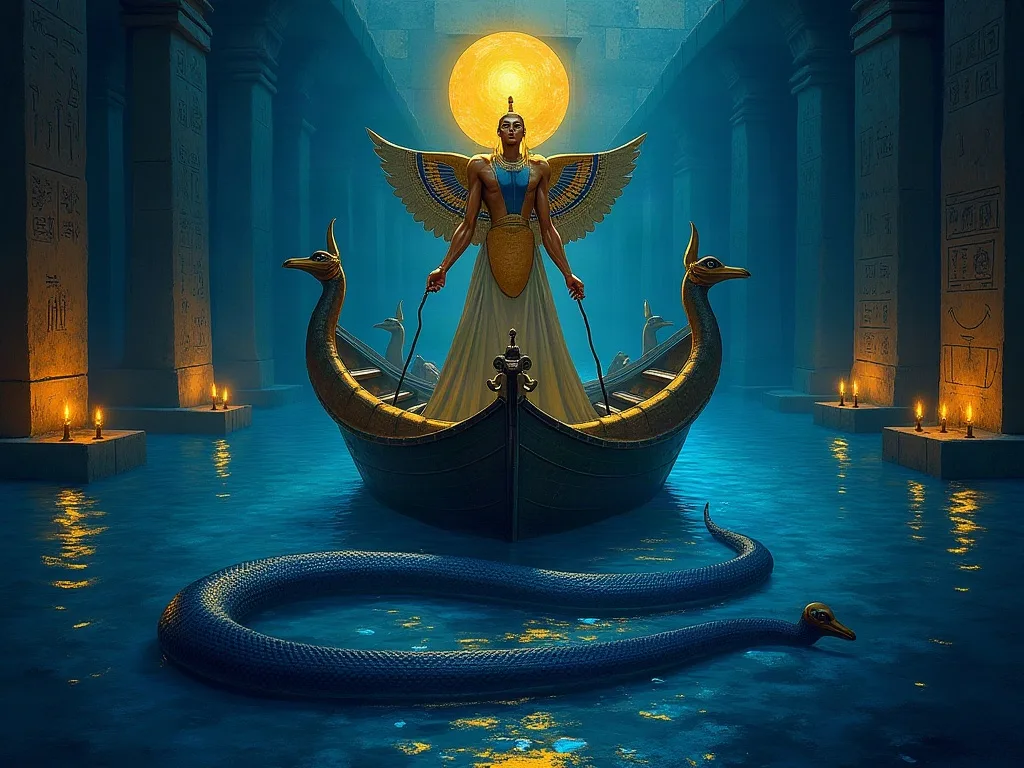
The Egyptians' cosmological logic was precise. Ra sailed each day across the sky in a vessel called the Mandjet, the "bark of millions." At sunset, he transferred to the Mesektet, the night bark, and plunged into the Duat, the underworld. Every night, a serpent named Apep (or Apophis) attacked the bark in the deep hours, trying to stop the sun's return. Ra fought, won, and rose again. This was not a metaphor. Egyptian priests performed nightly rituals in temple sanctuaries specifically to assist Ra against Apep, reciting spells from texts such as the Book of Apep to ensure the sun's return. The daily sunrise was a victory, not a given.
Ra merged with other deities in ways that reveal the sophistication of Egyptian theological thinking. His fusion with Horus produced Ra-Horakhty, "Ra-Horus of the Two Horizons," a figure whose rising at the eastern horizon merged solar power with the hawk-headed sky god. His fusion with Amun produced Amun-Ra, the hidden and the visible combined, the divine force that permeates the cosmos while also blazing visibly above it. By the New Kingdom period (roughly 1550-1070 BC), Amun-Ra was effectively the king of gods, his temples at Karnak among the largest religious complexes ever built by humans.
The most politically charged solar moment in Egyptian history came under Pharaoh Amenhotep IV, who renamed himself Akhenaten around 1346 BC and declared that only the Aten, the solar disk itself rather than any human-shaped god, was worthy of worship. He closed other temples, moved the capital to a new city, and produced the Great Hymn to the Aten, a poem whose lines echo Psalm 104 closely enough that scholars still debate the relationship between the two texts. The Aten experiment collapsed after Akhenaten's death and Ra's theology was restored, but the episode shows how politically explosive solar theology could become.
One key feature sets Ra apart from most other solar deities: his nightly death is real, not metaphorical. He does not merely set. He enters the realm of the dead, passes through twelve hours of darkness corresponding to the twelve caverns of the Duat, and is reborn each morning as the scarab-headed god Khepri, whose name derives from the word "to come into being." The morning sun, the noon sun, and the setting sun were treated as three distinct phases of the same deity. Khepri pushes the sun-disk up from the eastern horizon exactly as the scarab beetle, sacred in Egyptian culture, pushes a ball of dung across the ground. Small creature, enormous cosmological weight.
Helios and Apollo: The Greek Sun Between Myth and Metaphor
Greek solar theology is messier, and honestly, that messiness is part of its interest. The Greeks had two candidates for "sun god" and they never fully resolved the tension between them.
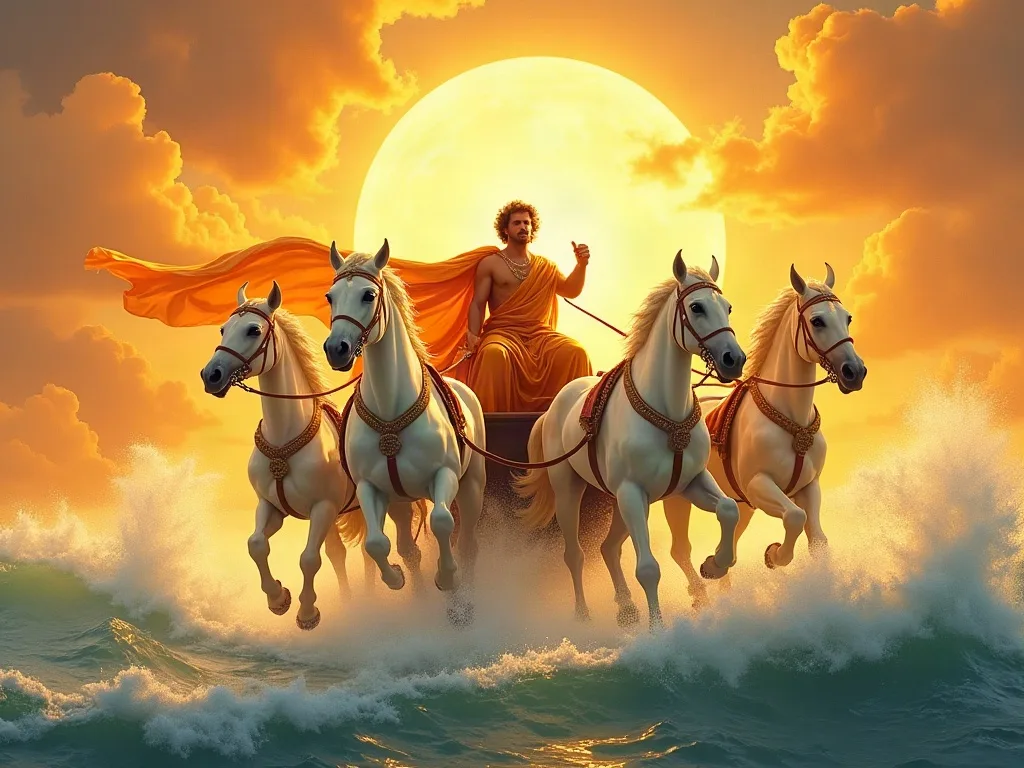
Helios was the original. Son of the Titan Hyperion and the Titaness Theia, Helios drove a chariot pulled by four fire-breathing horses, Pyrois, Aeos, Aethon, and Phlegon, from east to west each day. Homer mentions him in the Odyssey as the keeper of sacred cattle on the island of Thrinacia, cattle so holy that when Odysseus's men slaughtered them, the sun god complained to Zeus and the crew were destroyed. Hesiod's Theogony gives Helios his genealogy. He was not an Olympian, not part of the ruling council of twelve gods, just a worker: a titan doing his divine job. After his westward crossing, he sailed back east each night on a great golden cup that floated along the stream of Ocean.
His most memorable story is not his own glory but his failure. His son Phaethon, eager to prove his divine parentage, demanded the right to drive the solar chariot for a single day. Helios, unable to refuse his own son, handed over the reins. Phaethon lost control almost immediately. The horses felt an unfamiliar hand and bolted. The chariot swung too close to Earth, scorching the Sahara to desert, burning rivers, killing crops. Zeus struck Phaethon from the sky with a thunderbolt before the world was destroyed. His sisters, the Heliades, wept on the riverbank until their tears turned to amber. Ovid tells the full version in the Metamorphoses, Books 1-2, and it remains one of antiquity's great cautionary tales about children demanding what their parents cannot safely give.
Apollo is the complication. Over the course of Greek history, Apollo absorbed more and more solar associations until, by the Hellenistic and Roman periods, he was widely identified as the sun god in a way Helios never quite was. Apollo controlled prophecy, music, poetry, medicine, and order: things associated with the light of reason and clarity. The Roman poet Macrobius, writing around 400 AD, argued in his Saturnalia that virtually every god was, at some level, a solar manifestation. Apollo drove that argument more than Helios did.
The Greek case shows something important. Solar divinity is not always a clean category. A culture might distribute solar functions across multiple figures: one for the physical act of the sun's movement, another for the intellectual light the sun represents, another for its destructive heat. This fragmentation of solar meaning will reappear in other traditions.
Surya: The Sanskrit Sun and His Seven Horses
The Vedic tradition of ancient India produced one of the oldest textual records of solar worship anywhere. Surya appears in the Rigveda, a collection of hymns compiled around 1500-1200 BC, as one of the most hymned of all deities. Entire hymns (suktas) praise his journey across the sky, his seven horses pulling his chariot, his defeat of darkness, his gift of sight to the blind.
His seven horses are named, in the Vishnu Purana, after the seven colors of visible light: Aruṇa, Arogya, Bhrājat, Patangha, Nemirocis, Svarṇīra, and Vibhāvasu. Whether the number seven preceded or influenced later optical understanding of the solar spectrum is a question worth sitting with. What is certain is that Vedic thinkers connected the sun's light with completeness, with the full range of what can be seen.
Surya's daughter is Saranyu, who found his radiance so overwhelming that she created a shadow-double of herself, Chhaya (the name simply means "shadow"), to stand in her place as wife while she escaped to live in the forest as a mare. Surya eventually pursued her, transformed himself into a stallion, and the union produced divine children. The myth cycles around the unbearable intensity of pure solar light. No one, not even a goddess, can live fully in the sun's direct presence.
This motif of solar excess, of light so powerful it becomes harmful rather than life-giving, runs through several traditions. It is worth marking now, because it will recur.
Surya's role in the Mahabharata also carries political weight: he is the divine father of Karna, one of the great warriors of that epic, born from a mortal woman who unknowingly invoked him. The gift a sun god gives his mortal son is not gentleness but an armor of light, a natural golden kavacha and kundala, a breastplate and earrings that make him nearly invincible. Solar parentage in the Vedic world meant power given materially, not just symbolically.
Amaterasu: The Sun Who Withdrew and Returned
Japan's solar tradition is distinctive in one critical way. In most mythological systems, the sun is male. In Shinto theology, the sun is emphatically, powerfully female.
Amaterasu-Omikami, "the Great Divinity Illuminating Heaven," was born from the left eye of the primordial god Izanagi as he purified himself after returning from Yomi, the underworld, following the death of his wife. She rose immediately to rule the heavens. Her birth is recorded in the Kojiki (compiled 712 AD) and the Nihon Shoki (compiled 720 AD), the two foundational texts of Shinto tradition.
Her defining story is not her radiance but her withdrawal. Her brother Susanoo, the storm god, descended from the heavens grieving for their dead mother and causing such violent chaos that Amaterasu feared he meant to conquer her realm. The conflict escalated until Susanoo's behavior became so destructive, he destroyed her rice paddies, polluted her sacred weaving hall, and hurled a flayed horse through the roof, killing a weaving maiden, that Amaterasu retreated into the Ama-no-Iwato, the heavenly rock cave, and sealed herself inside. The world went dark. Crops failed. Evil spirits ran unchecked.
The eight million kami (spirits, in Shinto theology) gathered in desperation. The goddess Ame-no-Uzume began to dance, stripping off her clothing in an ecstatic, comic performance. The assembled kami burst into laughter. Amaterasu, bewildered, cracked the cave door to see what could possibly be funny at a time like this. The god Ame-no-Tajikarao reached in and pulled her fully out. Light returned.
The story is not about battle. It is about community, about the fact that the sun's return was engineered through laughter and spectacle rather than force. Shinto theology centers the relationship between humans (and kami) and the divine as one of mutual attention and mutual care. The sun withdraws when the world is hostile. Joyful celebration brings it back. This is a radically different relational model from Ra's nightly combat or Helios's daily labor.
Amaterasu is also an imperial ancestor. The Japanese imperial family traces its divine lineage directly to her, a claim embedded in the Meiji Constitution of 1889 and officially abandoned (under American occupation pressure) only in Emperor Hirohito's 1946 declaration. That is a solar theology with living political consequences less than eighty years ago.
Inti and Tonatiuh: The Americas and the Hungry Sun
The solar deities of the pre-Columbian Americas deserve their own section because they challenge a comfortable assumption: that sun gods are benevolent.
The Inca worshipped Inti, the sun god, as the divine father of the Sapa Inca (the ruling emperor). Inca cosmology held that the emperor was literally Inti's son, a claim as politically loaded as Japan's imperial solar lineage. Inti's main temple, the Coricancha in Cusco, housed a massive golden disk representing the sun, surrounded by mummies of past emperors who had, in death, rejoined their divine father. When Spanish conquistadors melted down the temple's gold in the 1530s, they were destroying the material body of a god, and an entire civilization's cosmological self-understanding with it.
The Aztec Tonatiuh is more demanding. He presides over the current cosmic age, the Nahui Ollin or "Four Movement" sun, the fifth world the gods created after four previous suns had been destroyed. The Legend of the Five Suns, preserved in the Leyenda de los Soles (compiled around 1558), describes how the gods sacrificed themselves at Teotihuacan to set this sun in motion. But Tonatiuh then refused to move unless fed human blood. He was not a gift. He was a contract. The Aztec ritual calendar, with its cycles of sacrifice, was understood as payment keeping the sun moving and the world alive.
This puts Tonatiuh at a far darker end of the solar-deity spectrum. Ra fights evil. Helios does his job. Amaterasu retreats and returns. But Tonatiuh extracts a price. The sun is not guaranteed. It has to be purchased, daily, through sacrifice. That is a mythology of genuine existential anxiety: the sun might simply stop.
Tonatiuh's place in the Aztec cosmos connects to the broader myth of the Five Suns, which frames all of existence as a series of cosmic failures waiting to be extended by ritual. It is one of the most unusual cosmological frameworks in world mythology precisely because it treats solar continuation as conditional.
Sol Invictus and the Roman Solar Turn
Rome warrants a brief stop, because the Roman case shows how solar mythology can be deliberately engineered by political authority rather than growing organically from a culture's deep past.
The Roman Sol Invictus, "the Unconquered Sun," was elevated by Emperor Aurelian in 274 AD to the status of supreme deity of the Roman Empire. Aurelian built a grand temple to Sol on the Campus Agrippae in Rome, declared December 25 Sol's birthday, and made the sun the official patron of the imperial system. His political logic was consolidation: a single supreme divine authority to match a single supreme human authority.
Sol Invictus drew on Syrian solar cult (Aurelian had just reconquered Palmyra, a major center of solar worship) and on existing Roman traditions around Helios-Sol, the Greek-Roman sun figure. The December 25 festival date is significant because early Christians, adopting the same date for Christ's birth, created a layering of solar and Christian theology that some historians argue shaped the imagery of Christ as Lux Mundi, the Light of the World. The 4th-century church father Ambrose of Milan wrote hymns using explicit solar imagery for Christ. The fusion was not accidental.
Mapping the Patterns: What Solar Deities Share Across Cultures
After walking through Ra, Helios, Surya, Amaterasu, Inti, Tonatiuh, and Sol Invictus, certain structural bones appear. Not all solar myths share all of these elements, but every tradition touches most of them.
The daily journey. Almost universally, the sun's movement across the sky is narrative. A chariot (Greece, India), a bark (Egypt), a cave exit (Japan), a lifted globe (Aztec through divine sacrifice). The sun does not simply move. It travels by means of a story.
The nightly threat. Something endangers the sun each night. Apep attacks Ra. Phaethon nearly destroys Helios's path. Amaterasu seals herself in darkness. Tonatiuh simply stops without blood. The sunrise is a relief, not an assumption. Darkness is not peaceful rest: it is the interval during which catastrophe is possible.
Solar authority over human rulership. From the Egyptian pharaoh as Ra's son, to the Japanese emperor as Amaterasu's descendant, to the Sapa Inca as Inti's child, rulers across cultures claim solar parentage. The sun's divine authority licenses human political authority. This is one of the most consistent political functions of solar mythology worldwide.
The unbearable radiance problem. Surya's wife flees him. Phaethon dies from mishandling his father's fire. Even Amaterasu's withdrawal can be read as the sun being too intense for the world to sustain without interruption. Direct, unmediated solar power overwhelms mortals. The gods themselves must manage it carefully.
Ra (Egypt)
Ra battles Apep every night to ensure the sun's return. His cycle is war: nightly combat in the underworld, nightly victory, nightly rebirth. The sun continues because Ra is strong enough to fight for it. His theology places violent cosmic struggle at the center of solar continuity.
Amaterasu (Japan)
Amaterasu withdraws voluntarily because the world has become hostile and painful. Her return is achieved not through combat but through laughter, spectacle, and communal celebration. The sun continues because the community of kami (and by extension humanity) maintains a joyful relationship with the divine.
Where the Myths Diverge: Gender, Movement, and Morality
The divergences matter as much as the parallels. Three stand out.
Solar gender. Most solar deities are male. Ra, Helios, Surya, Tonatiuh, Inti, Sol: all coded male or presented in masculine roles. Amaterasu is the most prominent exception, though she is not alone. The Germanic Sun, Sól (from the Prose Edda compiled by Snorri Sturluson around 1220 AD), is female, chased perpetually across the sky by the wolf Hati. The Hattic goddess Wurusemu was a major solar deity in Anatolia around 1600 BC. The association of the sun with masculinity is common but not universal, and the exceptions cluster in cultures where solar power is specifically linked to weaving, nurturing, and the maintenance of sacred order rather than combat.
Active vs. passive journey. Helios and Surya actively drive their chariots. Ra actively fights. But Amaterasu's withdrawal means the sun's absence is her choice, not an attack from outside. This places moral agency with the sun itself in a way that Egyptian and Greek models do not. Ra has enemies. Amaterasu has feelings. That is a fundamentally different theology of what the sun is and how it relates to the world.
Transactional vs. unconditional. The Aztec Tonatiuh requires sacrifice. Most other solar deities do not set explicit terms. Ra fights Apep for cosmic order, not as a transaction with humans. Amaterasu's return is coaxed, not purchased. Inti receives offerings but does not threaten to stop without them. Tonatiuh's explicitly transactional relationship with humanity places Aztec solar theology in a category of its own: a contract that can expire, with terminal consequences.
The Living Debate: Diffusion or Independent Invention?
Did these solar mythologies influence each other, or did they arise independently? This is one of the genuinely open questions in comparative mythology, and scholars are divided.
The diffusionist camp, influenced by thinkers like Grafton Elliot Smith in the early 20th century, argued that Egyptian solar mythology spread outward and seeded other traditions. His "heliocentric" diffusionism has largely been abandoned as methodologically unsound. The parallels between traditions are too general to prove contact, and the specific details diverge far too much to suggest copying.
The structuralist school, following Claude Lévi-Strauss and later Joseph Fontenrose, argued that solar myths share structure because human cognitive architecture is universal. All human minds face the same problem: the sun rises and sets, and this cycle demands explanation. The solutions converge because the problem is the same and human narrative logic operates within consistent parameters.
More recent comparative mythology, including the work of Bruce Lincoln and Wendy Doniger, takes a more careful middle path. Doniger's The Implied Spider (1998) argues for what she calls "deep mythology": patterns that reflect shared human experience without requiring either genetic transmission or cognitive determinism. The solar journey is a natural vehicle for narrating the daily rhythm of light and dark. The political use of solar ancestry is a natural way to legitimate power. These patterns emerge because they solve real cognitive and political problems, not because someone exported them from Egypt.
What the scholarly consensus now supports is that solar myths across cultures are partly convergent (same problem, similar cognitive toolkit) and partly historically connected in specific cases (Indo-European solar mythology almost certainly shares roots, linking Greek, Vedic, and Germanic solar traditions through the reconstructed Proto-Indo-European Dyeus who had solar attributes). The Egyptian-Levantine-Roman chain is historically documented. The Japan-India comparison is convergent, not derived.
Frequently Asked Questions About Sun Gods Across Mythologies
Frequently asked questions
Which sun god is the oldest on record?
The textual record gives the edge to the Vedic Surya and the Egyptian Ra, both attested in sources from around 2400-1500 BC. The Egyptian Pyramid Texts from roughly 2400 BC contain fully developed Ra theology, suggesting worship was already ancient by that point. Mesopotamian sources mention the Sumerian sun god Utu (called Shamash in Akkadian) in texts from around 2600-2500 BC, making him a serious contender for the earliest documented solar deity. The honest answer is that we lack written sources for most early cultures, so "oldest" really means "oldest surviving written evidence."
Why are most sun gods male when the moon is often female?
The gender coding is not universal, as the cases of Amaterasu and the Norse Sól show. But where it does occur, scholars connect it to agricultural societies that associated the sun with active, generative, fertilizing power (coded male in many ancient frameworks) and the moon with cyclic, receptive, tidal rhythms (coded female). The pairing is a cultural construction, not a biological given. Interestingly, in ancient Mesopotamia the moon god Sin (or Nanna) was male and senior to the sun god Shamash, flipping the gendered hierarchy entirely.
Is there a connection between the Egyptian Ra and the Roman Sol Invictus?
Directly, not much. Sol Invictus drew primarily from Syrian solar cult, especially the worship of Elagabalus at Emesa (modern Homs), and from existing Greco-Roman Helios-Sol traditions. But the broader Mediterranean world of the 3rd century AD was culturally porous. Egyptian solar theology had entered Rome through the cult of Isis (whose consort Osiris had strong Ra connections) and through Neoplatonist philosophy, which treated the sun as the visible image of the divine One. So Sol Invictus is not a direct descendant of Ra, but they share a family resemblance filtered through several centuries of Mediterranean religious exchange.
Did the Aztec sun god Tonatiuh actually require human sacrifice, or is that a Spanish exaggeration?
The ritual calendar does record solar sacrifice, and the Leyenda de los Soles explicitly ties the sun's movement to divine (and by extension human) blood sacrifice. Archaeological evidence, including the Templo Mayor excavations in Mexico City, confirms large-scale sacrificial practice. However, Spanish colonial accounts often exaggerated numbers and stripped practice from context to portray Aztec civilization as uniquely barbaric, a framing that served colonial justification. The scholarly position, represented by scholars like Inga Clendinnen in Aztecs (1991) and David Carrasco in City of Sacrifice (1999), is that sacrifice was real, structured, theologically coherent within its system, and also politically exploited by the Spanish to justify conquest. Both things are true simultaneously.
What is the connection between Indo-European sun gods like Helios and Surya?
Linguists reconstructing Proto-Indo-European religion identify a likely solar deity, Saewelios or Seh-ul, in the ancestral tradition that gave rise to both Greek and Sanskrit cultures. The chariot imagery appears in both Helios and Surya and likely reflects a real common source: bronze-age chariot culture that spread with Indo-European languages across Eurasia between roughly 3500 and 1500 BC. The Rigveda and Homeric texts share specific motifs: the four-horse chariot, the female figure connected to the dawn (Ushas in Sanskrit, Eos in Greek, Aurora in Latin), the sun's eye as the seat of truth. These convergences are too specific and too consistent to be coincidental, and scholars like Martin West in The East Face of Helicon (1997) have documented the connections in detail.
The Sun After the Gods: Solar Imagery in Modernity's Sacred Language
Solar mythology did not end with the ancient world. It migrated into new vocabularies without losing its structural logic.
Christianity adopted solar imagery almost immediately. Christ is Lux Mundi (Light of the World) in John 8:12. The Sol Iustitiae, "Sun of Justice," is a title applied to Christ by the prophet Malachi and adopted by Christian theology. Stained-glass windows in Gothic cathedrals are literally built to flood worshippers with colored light falling from above, the architecture enacting solar theology in stone and glass. The halo that appears around saints in medieval iconography derives directly from the solar disk depicted around Ra and Helios.
The Enlightenment took solar imagery secular. Reason became the new sun, illuminating ignorance the way the physical sun illuminates darkness. The French Revolutionaries used solar symbolism extensively. The "Illuminati," the Bavarian secret society founded in 1776, took its name from the Latin word for light. The sun had lost its specific divine personality, but its structural role as the symbol of clarity against darkness remained intact.
Contemporary astronomy has given solar mythology a strange second life. We now know the sun is a G-type main-sequence star about 4.6 billion years old, midway through its lifecycle. In approximately five billion years it will expand into a red giant, consuming Mercury and Venus and possibly Earth. The ancient anxiety that the sun might stop, the Aztec dread, the nightly Egyptian battle against Apep, turns out to be cosmically correct in timescale, just not in mechanism. The sun will eventually lose. Every sunrise is still, if you choose to think about it that way, a temporary victory.
Norse solar mythology carries this darkness in a different form. The wolf Hati chases Sól across the sky every day. At Ragnarok, the apocalypse described in the Prose Edda, Hati catches her. The sun goes dark. But a daughter is born before it happens, and she takes her mother's place after the world is remade. Even in the coldest mythology of the northern world, the solar cycle does not end. It restarts. That is, perhaps, the deepest structural truth that solar deities across every culture have always been trying to say: the light comes back. It has always come back. Plan accordingly.
Free 25-page sample
Want the whole story?
Take the first 25 pages free. If it pulls you in, the full edition is yours as an instant PDF download, with a paperback on Amazon for selected titles.

Mythology
The World Mythology Book: The Gods, Heroes and Myths of Every Culture
The Gods, Heroes and Myths of Every Culture, in One Volume
The whole of world mythology in a single volume: Greek, Norse, Egyptian, Japanese, Hindu, Celtic, Slavic, Mesoamerican and African myths gathered side by side, each drawn from the primary sources.