
World Trees Compared: Yggdrasil and the Axis Mundi Across World Mythology
From Yggdrasil to the Ashvattha, world trees hold up the sky and root the cosmos in every great mythology. Here is how they compare, and what they reveal about the human mind.
Contents
The ash tree shudders. Its roots drink from three wells at once: one fed by wisdom, one by fate, one by the cold poison of the underworld. Its branches shelter an eagle, a serpent, and a squirrel running messages between enemies who will never meet. Every day the three Norns, who are women who hold the threads of time, pour sacred water over its bark to keep it alive. Without this tree, the sky falls. The nine worlds collapse into each other. Everything that exists depends on one enormous ash.
World trees compared across Yggdrasil and beyond show something urgent: every great civilization, from Scandinavia to Mesoamerica, from India to Siberia, planted a cosmic tree at the center of reality. The tree is not a metaphor they chose. It is the first picture the human mind reaches for when it tries to answer the question: what holds everything together?
The convergences are striking, and the differences are just as revealing. Same architecture, radically different theology.
Yggdrasil: the Norse World Tree at the Center of Everything
Yggdrasil is the oldest and most elaborately documented world tree in the Western scholarly record. The name comes from Old Norse and almost certainly means "Odin's horse," a reference to the gallows tree on which Odin hung himself for nine nights to win the runes. The same tree that holds up reality is also the instrument of the god's self-sacrifice. That double meaning is not an accident.
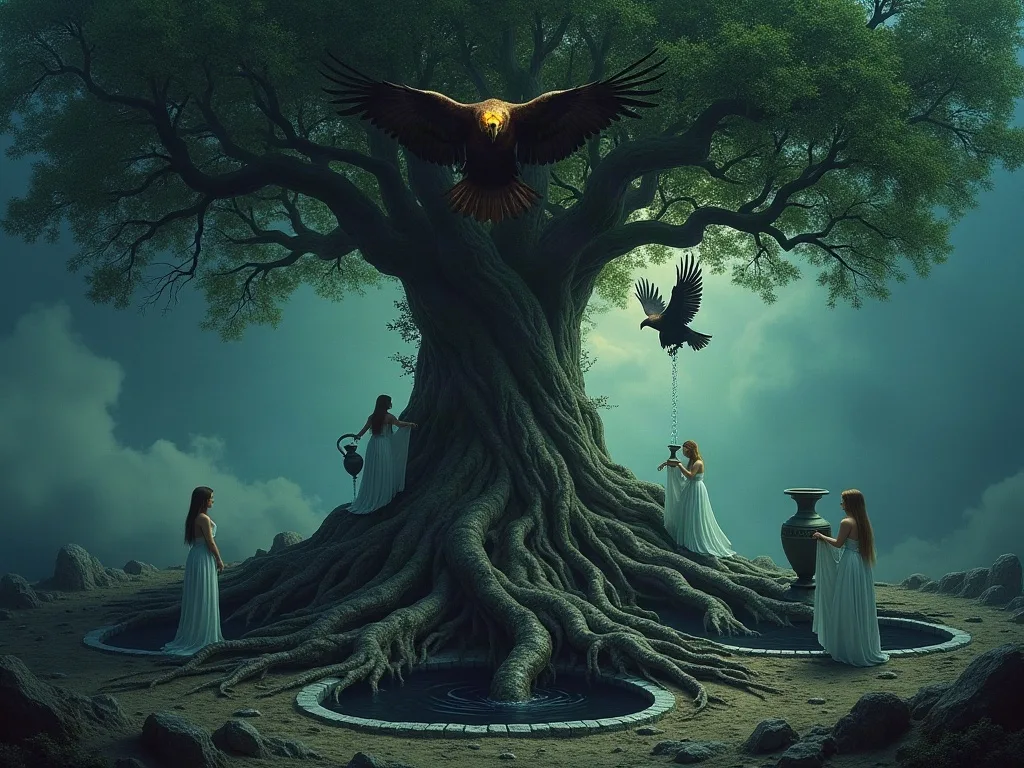
The primary sources are the Prose Edda, written by the Icelandic poet Snorri Sturluson around 1220 CE, and the older Poetic Edda, a collection of poems preserved in the Codex Regius manuscript from roughly the same century. Both agree on the architecture. Yggdrasil is an ash tree. Its three roots reach toward three distinct realms: Asgard (the realm of the Aesir gods), Jotunheim (land of the giants), and Niflheim (the cold underworld). At each root sits a well. The well beneath Asgard is Urðarbrunnr, the Well of Fate, where the Norns, the three weavers of destiny, tend the tree daily. Beneath Niflheim lies Hvergelmir, the primordial spring from which all rivers flow. Beneath Jotunheim is the well of Mimir, guarded by an entity so ancient that Odin paid his own eye for a single drink of its water.
The tree is alive with tension. The eagle perched at the crown and the serpent Níðhöggr gnawing at the roots exist in permanent enmity. The squirrel Ratatoskr runs between them, carrying insults in both directions. This is not decoration. It is a precise image of the cosmos as something always on the verge of collapse, held together by maintenance, not by permanence. The Norns water the roots every single day. If they stop, the tree dies. Snorri records in the Prose Edda: "The Norns who live near the well of the highest god take water every day from the spring and mix it with the sand around the well and pour it over the ash, so that its branches may not rot or wither."
Yggdrasil is also a map. Shamans and seiðr practitioners in Norse belief could travel its branches to reach other worlds. The tree is not merely structural; it is navigational. The nine worlds hang in it like fruit.
Ashvattha: the Sacred Fig Tree of Hindu Cosmology
Cross from Norse Scandinavia to the Indian subcontinent, and the cosmic tree changes species but not function. Ashvattha (Ficus religiosa, the sacred fig or Bodhi tree) appears in the Rigveda, among the oldest surviving religious texts on earth, dating to roughly 1500-1200 BCE. It also dominates one of the most compressed passages in the Bhagavad Gita, the philosophical dialogue embedded in the Mahabharata.
In Chapter 15 of the Bhagavad Gita, Krishna describes it this way: "There is a banyan tree which has its roots upward and its branches down, and the Vedic hymns are its leaves. One who knows this tree is the knower of the Vedas." The image is deliberately inverted. The roots of the Ashvattha grow upward, toward Brahman, the ultimate reality, while the branches spread downward into the material world of birth, action, and consequence. Humans live in the branches, always below the source.
This inversion is philosophically loaded. In Norse cosmology, Yggdrasil stands upright, a vertical map from underworld to heaven. In Hindu thought, the Ashvattha shows the spiritual world above and the material world below, the exact reverse of everyday perception. To understand that the tree grows downward is itself a step toward liberation.
The Upanishads, a body of philosophical texts from roughly 800-200 BCE, also use the tree as an image of the self's relationship to Brahman. The Katha Upanishad says: "This eternal Ashvattha has its roots above and branches below." The same tree reappears in Buddhism: it is under a Ficus religiosa at Bodh Gaya that Siddhartha Gautama achieves enlightenment. The species, the root-crown relationship, the centrality to cosmic order, all persist across traditions separated by centuries.
The Mesoamerican Ceiba: Axis of the Five Directions
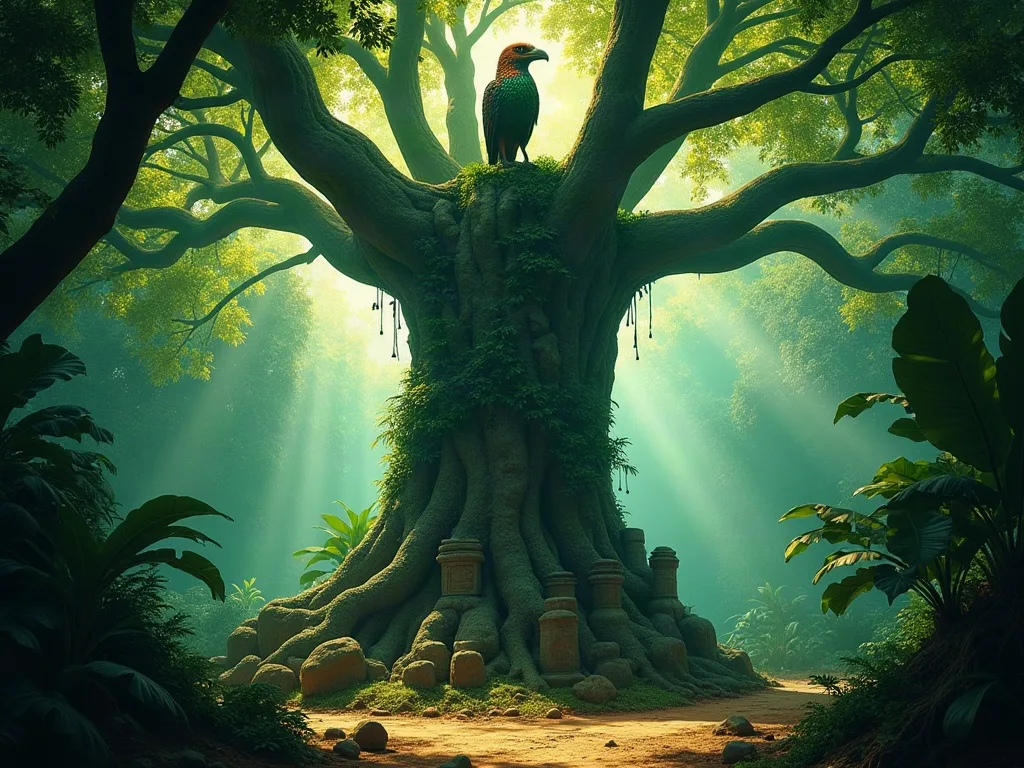
The Maya civilization built its cosmos around a tree too. The ceiba (Ceiba pentandra), a towering tropical hardwood that can reach 70 meters, stands at the center of Maya cosmological thought as Wacah Chan, the "Raised-Up Sky" tree. The Popol Vuh, the K'iche' Maya creation narrative written down in the 16th century but preserving far older oral traditions, is threaded through with the ceiba's cosmic role.
The Classic Maya conceived of not one world tree but five: one at the center and one at each cardinal direction, each with its own color and spiritual quality. The central tree connects the thirteen heavens above, the level of ordinary human life in the middle, and the nine layers of Xibalba, the Maya underworld. This mirrors Yggdrasil's tripartite structure almost exactly, though the number of layers differs significantly.
The Maya underworld Xibalba is where the Hero Twins Hunahpu and Xbalanque journey in the Popol Vuh, defeating the lords of death through trickery and wit. The ceiba marks the entrance to that descent. It is also the resurrection pole: after the twins defeat Xibalba, their father Hun Hunahpu, the Maize God, is reborn from the crack in a turtle shell shaped like the earth, with the world tree rising from his head on monuments like the famous sarcophagus lid of Pakal the Great at Palenque (683 CE).
That lid is one of the most studied artifacts in Maya archaeology. It shows Pakal reclining at the moment of death into the maw of the underworld, while the ceiba tree grows from his body upward, a crucifix-like structure that carries a celestial bird at its crown. Death, tree, rebirth: the structure of resurrection and the structure of the cosmos are the same thing.
Siberian and Central Asian Shamanic Trees: the Ladder Between Worlds
Before the Norse Eddas were written and before the Popol Vuh was committed to paper, shamans across Siberia and Central Asia were climbing the world tree. The practice is documented through ethnographic records from the 18th century onward, but the traditions themselves are almost certainly far older, extending back thousands of years into the Paleolithic.
Among the Yakut (Sakha) people of northeastern Siberia, the cosmic tree is a giant larch at the center of the earth. Its trunk disappears into the upper sky where the high god Ürüng Aiyy Toyon resides. Shamans, called oyun in the Yakut tradition, carve notches into a birch pole to represent the rungs of the tree and use ritual drumming to climb it in spirit, ascending to negotiate with sky spirits or descending to the lower world to retrieve lost souls.
The Buryat people of the Lake Baikal region share a nearly identical structure: a world birch connecting three cosmic zones, with the shaman's drum itself made from wood of the tree, making the ritual instrument a portable axis mundi. The Evenki and Ket peoples carry comparable traditions. Hungarian historical scholarship, particularly the work of Vilmos Diószegi in his 1958 study Tracing Shamans in Siberia, documented over a dozen Siberian ethnic groups with functionally identical world tree beliefs.
What makes this cluster remarkable is the shamanistic function. In Norse myth, Odin hangs from Yggdrasil to gain the runes; he performs what is structurally a shamanic initiation on the world tree. The parallel with Siberian shamanism is not coincidental. Many scholars of Norse religion, including Hilda Ellis Davidson in Gods and Myths of Northern Europe (1964), have argued that Norse cosmological thought preserves traces of an older, circumpolar shamanic tradition spread across Eurasia long before the Viking Age.
The Egyptian Ished Tree and the Persea: Writing Fate on Leaves
Egypt offers a different variant. The ished tree, a species scholars tentatively identify as a Mimusops laurifolia, appears in Heliopolis, the great sun city, as the tree under which Ra rested after creation. The tomcat form of Ra killed the serpent Apophis beneath this tree, protecting the cosmic order. Hieroglyphic inscriptions from New Kingdom temples, roughly 1550-1070 BCE, show the god Thoth and the goddess Seshat writing the names and deeds of pharaohs on its leaves, determining their fate and the length of their reign.
The leaf-as-fate motif connects directly to Yggdrasil: the Norns carve runes into the wood of the world tree to set destinies. The Egyptian god Thoth performs the same function on the leaves of the ished. In both traditions, the tree is not passive scenery. It is the substrate on which destiny is recorded.
A second Egyptian sacred tree, the persea (possibly Mimusops schimperi), carried similar associations with Ra and the sun and appeared regularly in royal tombs. Coffin texts and Book of the Dead papyri from the Middle Kingdom onward describe the deceased hoping to rest in the shade of the persea tree in the afterlife, a cosmic tree that survives even death.
The Kabbalistic Tree of Life: Cosmic Architecture in Jewish Mysticism
The Tree of Life, or Etz Chaim in Hebrew, is the central diagram of Kabbalah, the mystical tradition within Judaism that developed its most systematic form in medieval Spain and Provence, particularly through the Zohar, composed in the late 13th century and attributed to Moses de León.
The Kabbalistic tree is not a botanical image. It is a diagram of ten sefirot, the divine emanations through which Ein Sof (the infinite, boundless God) steps down into the finite world. The tree has roots in the divine and branches in the material, a structure that echoes the inverted Ashvattha of the Bhagavad Gita almost exactly. The three vertical columns of the diagram, severity, mercy, and balance, mirror the tripartite root structure of Yggdrasil.
This parallel is not evidence of direct borrowing. It is evidence of a shared cognitive architecture: when a tradition asks how the infinite becomes finite, how the divine becomes material, it reaches for the tree as the model. Roots above, branches below, a spine running through the middle.
The Zohar also describes the Tree of Life as growing at the center of the Garden of Eden alongside the Tree of Knowledge of Good and Evil. The Genesis tradition (whose earliest texts date to around the 10th-9th century BCE) already used paired trees to structure sacred space, well before Kabbalistic systematization.
The Germanic Irminsul and the Celtic Sacred Grove
Irminsul was a great wooden pillar or post, possibly representing the world tree in the religious practice of the continental Saxons. The Frankish Royal Annals record that Charlemagne destroyed it in 772 CE during his campaigns to Christianize Saxony. Its name likely derives from Irmin, a Saxon deity or hero, plus sul, meaning "pillar" or "column." Whether it was a stylized tree, a carved post, or a specific standing timber is unknown; no visual record from before its destruction survives.
The Celtic world had no single canonical world tree, but sacred groves called nemeton (a Gaulish term meaning "sacred space" or "sanctuary") functioned as ritualized contact points between the human and divine. The Druids, as described by Julius Caesar in his Gallic War (58-49 BCE) and by Pliny the Elder in his Natural History (77 CE), held the oak in particular reverence, and Pliny records that mistletoe cut from an oak was a sacred substance of the highest order. The single tree does not dominate Celtic cosmology the way Yggdrasil dominates Norse thought, but the sanctity of specific trees and the grove as axis mundi is consistent across Celtic archaeological and textual evidence.
Comparing the Structures: What Changes, What Stays
A direct look at the core features shows both the remarkable universality and the meaningful divergence:
| Tradition | Tree / Name | Species | Orientation | Key Function |
|---|---|---|---|---|
| Norse | Yggdrasil | Ash (Fraxinus) | Upright | Connects 9 worlds; shamanic travel; fate carved in wood |
| Hindu | Ashvattha | Sacred fig (Ficus religiosa) | Inverted (roots above) | Material world below Brahman; liberation through recognition |
| Maya | Wacah Chan / Ceiba | Ceiba (Ceiba pentandra) | Upright, 5 axes | Connects 13 heavens, earth, 9 underworld levels; resurrection |
| Siberian | Various (birch, larch) | Birch or larch | Upright | Shamanic ladder; drum made from tree |
| Egyptian | Ished / Persea | Mimusops spp. | Rooted in earth | Fate written on leaves; rest point of Ra; afterlife shade |
| Kabbalistic | Etz Chaim | Diagrammatic | Inverted (root in Ein Sof) | Emanation structure; divine-to-material pathway |
| Saxon | Irminsul | Wood pillar | Upright | Cosmic pillar; destroyed 772 CE |
Three things are universal: the vertical axis connecting distinct cosmic levels, the tree's role in sustaining or organizing those levels, and the presence of beings or activities at the tree that represent cosmological tensions (serpent vs. eagle, Thoth writing fate, shamans climbing).
Two things vary: species and orientation. The inversion of the Hindu and Kabbalistic trees compared to the Norse, Maya, and Siberian trees is not trivial. It reflects a fundamental theological difference. In traditions where the material world is primary or at least equal to the spiritual, the tree grows up toward the sky. In traditions where the material world is considered secondary, a lower emanation of a higher reality, the tree's roots go upward, toward the source, and the branches point down into matter.
How Mircea Eliade and Later Scholars Read the Cosmic Tree
Mircea Eliade's work, especially Shamanism: Archaic Techniques of Ecstasy (1951) and The Myth of the Eternal Return (1949), made the axis mundi a household term in the study of religion. His argument was that sacred space is always organized around a center point that connects the levels of the cosmos, and that the tree is the most common form this center takes. Eliade called this the imago mundi, the world image.
Later scholars have both built on and criticized his framework. Joseph Fontenrose argued that Eliade over-systematized and blurred real differences between traditions. Jonathan Z. Smith, in Map Is Not Territory (1978), pushed back against the idea of a universal archetype, arguing that what looks like the same symbol in different cultures often serves quite different social and political functions. Both critiques are fair. The Maya ceiba is doing different theological work than Yggdrasil, even if both sit at the cosmic center.
The most useful current position draws from both: the tree-as-axis is a genuine cross-cultural pattern, likely rooted in the near-universal human experience of trees as the tallest, oldest, most enduring living structures in the natural world. But each culture's version tells us something specific about that culture's understanding of death, power, fate, and the self's relationship to the cosmos. The pattern is shared. The meanings are distinct.
The World Tree in Modern Storytelling and Cultural Memory
The world tree has never left. Tolkien's two trees of Valinor, Laurelin and Telperion, which light the world before the sun and moon are created in The Silmarillion (1977), draw directly on Norse cosmology. Their destruction by Morgoth and Ungoliant echoes Níðhöggr gnawing at Yggdrasil's roots. The James Cameron film Avatar (2009) built its entire narrative around a cosmic tree called Hometree and the Tree of Souls, functioning as a literal network connecting all living things, a digitized Yggdrasil.
The symbol persists in tattooing culture, in logo design, in the architecture of libraries and cathedrals whose spines rise toward vaulted ceilings. The Christian cross, as a number of medieval theologians explicitly noted, inherited some of its cosmic-tree symbolism from the traditions it displaced and transformed. The Golden Legend (circa 1260 CE) by Jacobus de Voragine traces the wood of the True Cross back to a seed from the Tree of Knowledge planted in Adam's mouth at his death, a world tree narrative hiding inside a Christian text.
The Norse cosmology of Yggdrasil and the cosmic architecture it anchors remain the most fully documented example. But the tree's grip on the human imagination is global, ancient, and not yet finished.
Frequently asked questions about world trees in comparative mythology
Frequently asked questions
Is Yggdrasil the oldest world tree myth in recorded history?
Not quite. The Ashvattha appears in the Rigveda, whose earliest hymns date to roughly 1500-1200 BCE, predating the written Norse Eddas by over two millennia. The Siberian shamanic world tree traditions may be older still, though oral traditions are hard to date precisely. Yggdrasil is the most elaborately documented single world tree, but it is not the earliest.
Why do some world trees have their roots pointing upward?
The inverted orientation, most explicit in the Hindu Ashvattha and the Kabbalistic Tree of Life, reflects a theology in which the divine or infinite is the true source and the material world is a lower emanation. Roots go toward the source, branches spread into matter. Upright trees, like Yggdrasil and the Maya ceiba, tend to appear in traditions where the cosmos is a vertical ladder of equally real zones rather than a hierarchy of reality vs. illusion.
Did ancient cultures influence each other's world tree beliefs, or did these ideas arise independently?
Scholars are divided. Some convergence, particularly between Norse and Siberian traditions, likely reflects genuine historical contact or shared ancestry in a circumpolar shamanic culture that spread across Eurasia during prehistoric migrations. The parallels between Maya, Norse, and Indian traditions are much harder to attribute to diffusion and most scholars read them as independent developments from shared human cognitive tendencies. Mircea Eliade argued for a universal archetype; Jonathan Z. Smith cautioned that similar forms can serve very different functions.
What creatures typically live in or on the world tree?
The pattern is strikingly consistent: a celestial bird at the crown (the eagle in Yggdrasil, the Principal Bird Deity in Maya myth, the hamsa goose in Hindu texts), a serpent or dragon at the roots (Níðhöggr in Norse, the nagas in Hindu tradition), and a messenger figure moving between them. This tripartite animal arrangement encodes the cosmic tension between upper and lower worlds that the tree holds in balance.
What happened to the world tree in traditions that converted to Christianity or Islam?
The transition was gradual and rarely total. Saxon Irminsul was physically destroyed by Charlemagne in 772 CE. Norse world tree beliefs survived in texts because Christian Icelandic scholars like Snorri Sturluson preserved them. In Mesoamerica, the ceiba absorbed some Christian cross symbolism without losing its indigenous meaning. Kabbalistic Judaism integrated tree imagery into a monotheistic framework. The symbol tends to survive conversion by transformation rather than disappearance.
Which primary sources should I read to study world trees directly?
For Yggdrasil: the Prose Edda (Snorri Sturluson, c. 1220 CE) and the Poetic Edda (Codex Regius, c. 1270 CE). For Ashvattha: Bhagavad Gita Chapter 15 and the Katha Upanishad. For the Maya ceiba: the Popol Vuh (K'iche' Maya, transcribed c. 1550 CE). For Egyptian sacred trees: New Kingdom temple inscriptions and the Book of the Dead. For the Kabbalistic tree: the Zohar (13th century CE). Mircea Eliade's Shamanism (1951) remains the key secondary text for the cross-cultural comparison.
The Tree That Never Stops Growing: Unresolved Questions and Living Debates
Scholars of comparative religion have not settled the central question: is the world tree a universal archetype wired into human cognition, or is it a pattern that spread along specific historical routes and simply looks universal because the routes were so old?
The evidence cuts both ways. The circumpolar shamanic tradition offers a plausible corridor of transmission linking Siberian, Central Asian, and Norse world tree beliefs across the Eurasian landmass. Genetic and linguistic evidence consistently links these populations through deep prehistoric migrations. The parallels there may genuinely be inherited rather than coincidentally convergent.
But the Maya ceiba and the Norse Yggdrasil developed on continents separated by an ocean and a theoretical land-bridge crossed at least 15,000-20,000 years before either tradition was recorded. If they share the world tree image, that sharing happened either through the deepest possible cultural inheritance, carried in the minds of the first humans to cross into the Americas, or through independent invention driven by the same cognitive pressure: the need to picture, concretely, what holds the sky up.
That question is still open. And it is one of the genuinely thrilling questions in the study of myth, because both possible answers say something profound about what humans are. Either we all carry the same ancient memory, or we all, independently, look up at the tallest tree we can find and think: that must be the center of everything.
Odin's sacrifice on Yggdrasil and the Maya Hero Twins' descent into Xibalba are separated by an ocean and thousands of years. The tree they both climb is the same tree.
Free 25-page sample
Want the whole story?
Take the first 25 pages free. If it pulls you in, the full edition is yours as an instant PDF download, with a paperback on Amazon for selected titles.

Mythology
The World Mythology Book: The Gods, Heroes and Myths of Every Culture
The Gods, Heroes and Myths of Every Culture, in One Volume
The whole of world mythology in a single volume: Greek, Norse, Egyptian, Japanese, Hindu, Celtic, Slavic, Mesoamerican and African myths gathered side by side, each drawn from the primary sources.