
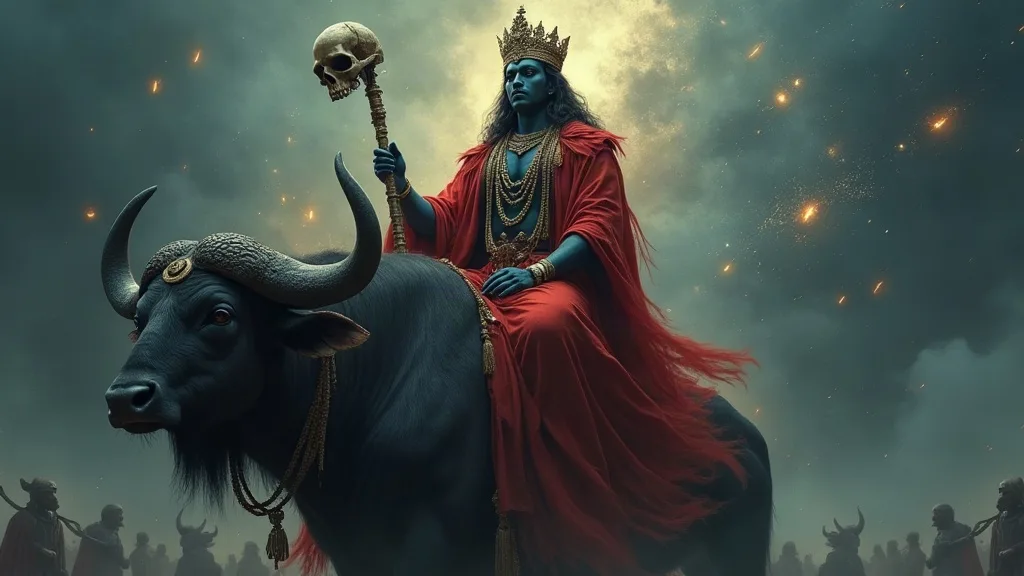
Yama, the God of Death: Keeper of Dharma and the Cosmic Order
In Hindu mythology, **Yama god of death** is not a destroyer but a keeper of cosmic order. Discover how the first mortal became lord of the afterlife, and why he embodies justice, not oblivion.
Contents
The sun has set over the realms of the living. A thread snaps. The Yamadutas, Yama's messengers, arrive on a buffalo, silent and unstoppable. They are not demons. They are time itself, made visible. They have come to escort a soul into the presence of Yama, the god who rules the House of the South, the gatekeeper between life and death, the judge who reads every deed written on the soul.
This is not a moment of horror in Hindu mythology. This is the work of cosmic order. Death, in the Hindu vision, is not chaos or punishment. It is duty. And Yama, stern and just, ensures that duty is fulfilled. He is older than the gods themselves; he was the first to die, and in his death, he became immortal.
Yama does not brandish a scythe. He wields a noose and a staff. His robe is blood-red. His skin is the colour of storm clouds. And in his eyes burns the knowledge of every life ever lived. To know Yama god of death is to understand how Hindu philosophy holds death not as the enemy, but as the teacher that makes all living meaningful.
The First Mortal Who Became Deathless
The Vedas, the oldest Hindu scriptures, written down around 1500 to 1200 BCE, tell the story of how Yama came to be. In the Rig Veda, Yama was not always a god. He was the son of Surya, the sun god, and Saranya, a goddess of the clouds. He had a twin sister, Yami. Together they were the first mortals in creation.
In those ancient times, death had no ruler. The boundary between the living world and the realm beyond did not exist. Yama and Yami walked together, and Yami asked her brother to love her as a mate, speaking the words: "Let us love each other. No one will know." But Yama refused. He turned away from her desire and chose instead a different path: the path of discipline, of asceticism, of holding fast to cosmic law. He established the boundary between the worlds. He became death's first witness.
For this choice, the gods granted him immortality and dominion. Yama crossed the threshold that all mortals must cross, but he did not vanish. He became the keeper of that threshold. He ruled over Yamaloka, the realm of the dead, also called Pitriloka, the realm of the ancestors. In the later Hindu texts, particularly the Yajur Veda and the Upanishads, Yama appears as a teacher. In the Katha Upanishad, written around 500 BCE, the young seeker Nachiketa journeys to Yamaloka and converses with Yama himself, who offers him teachings on the nature of the self and the immortal Brahman.
Yama's choice to remain alone, to refuse pleasure and embrace duty, made him the ideal ruler of the dead. He embodies dharma, the cosmic principle of right action and order. This is why he is not feared as a tyrant, but respected as a judge.
The Master of Dharma and the Weighing of Deeds
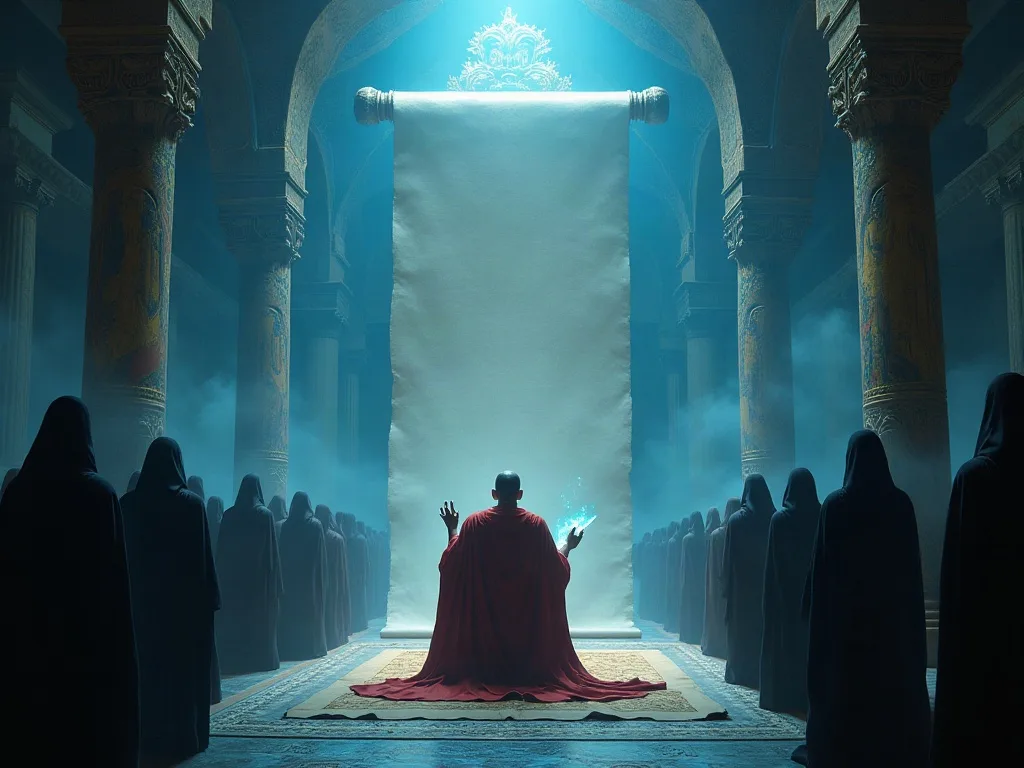
In the Hindu cosmology, the death of a human being is not an accident. It is a reckoning. The Garuda Purana, a medieval scripture compiled around 800-1000 CE, describes the journey in vivid detail. When a person dies, two messengers arrive: Yama's servants, the Yamadutas. They are described as terrifying to those who lived without dharma, and gentle to those who lived well. They place the soul in a vehicle and carry it toward Yamaloka.
The journey itself can take many paths. Some souls fly swiftly. Others stumble. The Puranas describe souls passing through regions of torment or beauty, depending on their karma. Karma is not punishment imposed from outside. It is the natural consequence of action. A soul that harmed others may experience suffering. A soul that gave generously may experience joy. Yama does not torture; the soul's own deeds create the experience.
Upon arrival at Yamaloka, the soul stands before Yama god of death in his palace. His scribe, Chitragupta, maintains the cosmic ledger. Every word spoken, every deed done, every thought harbored during life is written there. Chitragupta reads the record aloud. Yama listens. His judgment is final. Some souls are sent to heavenly realms called lokas to enjoy the fruits of good karma. Others are sent to lower realms to experience the consequences of harm. Still others are granted release from the cycle entirely, entering moksha, liberation and union with Brahman, the ultimate reality.
This is Yama at his most essential: not a punisher, but a keeper of accounts. His role is to ensure that actions have consequences, that the universe is not random, and that justice is real. Without Yama, the law of karma would be meaningless. Death would be arbitrary. Life would have no weight.
The Iconography and Forms of the God of Death

Statues and paintings of Yama across Hindu temples and homes present a consistent image. His skin is dark, often painted blue-black or storm-grey. He wears a blood-red garment. His crown is elaborate and austere. Around his neck hangs a garland of corpses or bones, symbolizing his dominion over death. In his right hand, he holds a staff topped with a skull. In his left hand, he holds a noose of rope, the pasa. Sometimes he holds a club. The noose especially carries multiple meanings: it represents the binding nature of karma, the inevitability of death, and also the compassionate binding that ties all beings to the cosmic law. It captures and holds only those whose time has come.
Yama rides upon a buffalo, an animal associated with both strength and darkness. The buffalo has no fear; it moves with purpose. This too reflects Yama's nature: he moves without hesitation, without mercy, but also without cruelty. He is simply doing his work.
In some regional variations, particularly in southern India, Yama appears differently. In Tamil iconography, he is sometimes shown with more gentle features, or even as a figure of wisdom rather than dread. In Bengal and parts of northern India, local versions of the death god merge with Yama while retaining distinct names and practices. The underlying principle remains: the god of death is the god of dharma, keeper of the boundary.
The colour of Yama's skin deserves attention. Dark colours in Hindu cosmology do not carry the Western association with evil. They signify depth, the unknowable, the absolute, the void out of which creation emerges. Yama's darkness is the darkness of transformation, of the state between one breath and the next, the moment when the living world dissolves and what remains becomes visible.
Yama and the Doctrine of Reincarnation
The existence of Yama makes sense only within the framework of samsara, the cycle of rebirth. In Hindu philosophy, death is not an ending. It is a transition. A soul does not arrive at Yama's court for judgment and then rest forever in a fixed heaven or hell. Instead, based on karma, the soul is granted a new birth. It returns to the living world in a new body, with new circumstances, to work through the consequences of its past deeds and to progress toward liberation.
Yama administers this turning wheel. He is not an endpoint but a station. A soul spends time in Yamaloka experiencing the fruits of karma, then is born again. The Bhagavad Gita, Hinduism's most beloved scripture, composed around 400 BCE, speaks of this process without fear: the soul is eternal and unchanging, while the body is temporary. Death claims the body, never the self. This is why Krishna, the divine teacher, tells the warrior Arjuna that there is nothing to grieve in death; the soul is reborn as surely as one steps out of an old garment and dons a new one.
Yama enforces this order. He is the guardian of dharma at the cosmic scale. If a soul escapes judgment, if karma were not binding, if death had no logic, then the entire system of cause and effect would collapse. The universe would be chaos. And chaos, in Hindu cosmology, is the worst evil. This is why Yama god of death is called not only the god of death, but the god of dharma itself.
The Meeting of Nachiketa and Yama: Wisdom at the Gates of Death
One of the most sacred Hindu narratives is the Katha Upanishad, part of the Yajur Veda, dating to around 500 BCE. It tells the story of a young seeker named Nachiketa who travels to Yamaloka to meet Yama directly. It is the Hindu mythology's closest parallel to Orpheus journeying to Hades, or to shamanic quests in other traditions.
Nachiketa's father, Vajasravasa, makes an offering and grows angry at his son's questions. In rage, the father tells his son: "I give you to Yama." The father means nothing by it, but the words carry power in Hindu cosmology. Nachiketa accepts his fate and travels to Yamaloka.
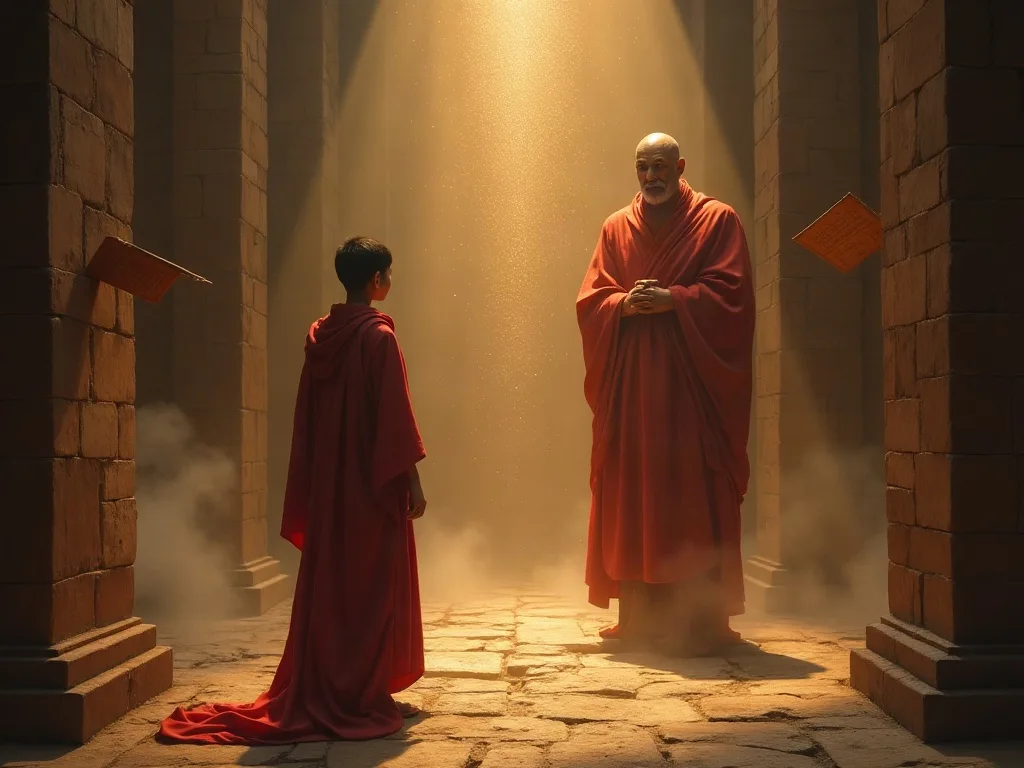
Yama is not in his palace when the boy arrives. By the law of hospitality, an absence of three days is shameful. When Yama finally returns, he offers the boy three boons to make amends for the insult. Nachiketa asks for three gifts. The first is that his father welcome him home with love. The second is knowledge of a sacred fire ritual that leads to heaven. The third is the deepest: Nachiketa asks Yama to teach him the secret of death itself. What happens after death? What is the nature of the self?
Yama hesitates. He offers gold, pleasure, long life, anything else. Nachiketa refuses. He asks only for truth. Yama then becomes a teacher. He reveals to Nachiketa the nature of Atman, the eternal self, which is distinct from the body and from the mind. The self does not die. The body is merely a temporary dwelling. Liberation comes not from fear of death, but from understanding that death is unreal to the essential self.
This conversation transforms the narrative of Yama god of death from terror into wisdom. Yama becomes a figure of profound spiritual teaching. He is the one who, by holding the boundary of death firm, makes it possible for humans to understand what lies beyond it. Death is the teacher. Yama is the keeper of that teaching.
Western Death God
Death is an enemy, a thief, a terrible end. The reaper takes all. Fear and darkness. No hope of meaning.
Yama, Hindu Death God
Death is a transition and a teacher. The soul continues; the body returns to earth. Each deed is weighed fairly. Fear dissolves when dharma is understood. Yama ensures justice, not oblivion.
Regional Variations and Local Names
Across the Indian subcontinent, Yama god of death takes on different faces. In Tamil tradition, particularly in the Shaivite south, Yama is sometimes called Yama, but also recognized in forms like Kalabhairava, a terrifying aspect of Shiva. In Bengal, the god Mrityu (which simply means "death") embodies similar functions. In some regional festivals, Yama appears not as a fearful judge but as a protective figure, a guardian who ensures that souls reach their proper destination.
In Odisha and other eastern regions, local death deities have been incorporated into the broader Yama mythology. Temple worship varies. Some temples dedicated to Yama emphasize his role as a just judge. Others focus on rituals that protect the living from premature death. The underlying principle remains: Yama is not worshipped out of dread, but out of respect for the cosmic order he represents.
The regional variation shows the depth of Hindu philosophy. Death is so central to human experience that many local traditions developed their own understanding of it. Yet all these variations feed into the larger vision: death is not random, not punishment, but part of an ordered cosmos where every action has consequence and meaning.
Yama in Popular Culture and Modern Hindu Practice
Today, Yama god of death remains a living presence in Hindu practice. Temples dedicated to Yama exist across India, though they are less numerous than temples to other deities. Devotional songs called bhajans invoke Yama respectfully. The festival of Diwali, the festival of lights, includes rituals that honor ancestors and acknowledge death as part of the cycle. The concept of Yamaraj (Yama as king) permeates popular storytelling, television, and film. Indian cinema has repeatedly portrayed Yama as a character, sometimes fearsome, sometimes wise, always powerful.
In modern Hindu philosophy and in traditions like Yoga and Vedanta, Yama appears in a different context. He is invoked not as a physical god to be feared, but as a principle: the principle of discipline, the boundary-keeper within the mind and spirit. The Yoga Sutras of Patanjali, compiled around 400 CE, speak of yama (without the capital Y) as one of the foundational practices of yoga: ethical restraint, the setting of boundaries, the discipline that makes higher consciousness possible. This yama (ethical discipline) has the same root as the name Yama (the god who sets the boundary between life and death). The two are connected: the internal discipline and the cosmic boundary serve the same function: to bring order out of chaos.
For many modern Hindus, Yama is not an object of worship in the way that Ganesha or Durga might be. Instead, he is a figure of reflection. Meditating on Yama means meditating on mortality, on the finite nature of human life, on the importance of living according to dharma. This meditation is not morbid; it is clarifying. It strips away vanity and reveals what truly matters.
In recent decades, Hindu philosophy has entered the global conversation. The concept of karma and rebirth has influenced Western spirituality, psychology, and even business ethics. And with that influence, Yama's presence, though often unnamed, has become felt. The idea that actions have consequences, that death is not an annihilation but a transition, that cosmic justice exists, all of these carry Yama's signature.
Yama's Place Among Other Death Deities Across World Mythology
Yama god of death is not alone in the world's mythologies. Nearly every culture has a death deity or underworld ruler. Yet Yama stands apart in a crucial way. He is not primarily a ruler of the underworld in the sense of governing a physical place. He is an administrator of karma and cosmic law. This distinguishes him from figures like Hades in Greek mythology, who rules a geographical realm, or Hel in Norse mythology, who presides over a specific hall of the dishonored dead.
The Mesoamerican god Xibalba ruled a treacherous underworld where souls were tested. Yama's realm is less a place of torment and more a place of cosmic accounting. The Egyptian Osiris presided over judgment of the dead and the afterlife, and in this role, Osiris and Yama share common ground: both weigh deeds and determine fate. Yet Osiris himself was once murdered and reborn, a cycle of death and resurrection. Yama, by contrast, is eternal and unchanging, the boundary itself made divine.
This distinction reflects different philosophical starting points. Greek and Norse mythologies often focused on heroic struggle and tragic fate. Egyptian mythology incorporated resurrection and renewal. Hindu mythology emphasizes cycles, return, and the ultimate goal of liberation from the cycle altogether. Yama is perfectly suited to this last vision. He is the keeper of the wheel that turns. His justice is not punishment or reward, but the natural playing out of cause and effect.
Frequently Asked Questions About Yama
Frequently asked questions
Is Yama evil or is he a good god?
Yama is neither. He is a keeper of cosmic law and order. He judges souls fairly based on their deeds, but he does not hate or despise the dead. His stern demeanor reflects his duty, not cruelty. The Yajur Veda calls him "Abhayakara," the giver of fearlessness, to those who lived righteously. To the wicked, he brings consequence, but this is justice, not malice.
What is the difference between Yama and Yamaraj?
Yamaraj (or Yama-raja) means "Yama the king" in Sanskrit. The two terms refer to the same deity. Yamaraj emphasizes Yama's royal authority and power. Some texts use the terms interchangeably; others use Yamaraj to emphasize a more kingly, regal aspect. In practice, both names are used in worship and in everyday Hindu speech to refer to the god of death.
Can Yama be defeated or tricked, like Hades in Greek myth?
Hindu mythology tells few stories of mortals successfully evading or deceiving Yama. The great saint Markandeya is said to have escaped death through intense devotion to Shiva. Some texts suggest that extreme spiritual power or divine grace might exempt a soul from Yama's judgment. However, the general understanding is that Yama's law is absolute and universal. Even the gods must respect it. This reflects the Hindu belief that dharma and karma are binding even to divine beings.
How did Yama become immortal if he was the first mortal?
Yama's immortality was a gift from the gods in recognition of his choice to uphold dharma and establish the boundary between life and death. His refusal to break cosmic law, even when his twin sister tempted him, made him worthy of immortal status. In Hindu thought, immortality is not simply endless life, but rather transcendence of ordinary cause and effect. Yama achieved this through duty and discipline.
Does Yama appear in the Vedas or only in later texts?
Yama appears in both. The Rig Veda, the oldest Vedic text, mentions Yama and his sister Yami. The Yajur Veda and the Atharva Veda develop his role further. However, the most detailed accounts of Yama and his realm come from later texts: the Upanishads, particularly the Katha Upanishad, and the Puranas, especially the Garuda Purana, which describes the afterlife journey in extensive detail. This shows that the concept of Yama and his judgment evolved and deepened over centuries of Hindu philosophy.
Why is Yama less popular in worship than other Hindu gods?
Yama is respected but rarely worshipped for blessing or favour the way that Ganesha or Durga are. This is because Yama's role is to judge and to administer karma, not to grant worldly benefits. However, Yama is acknowledged in rituals, particularly in the Shraddha ceremony, in which families honor their ancestors and ensure their safe passage through the afterlife. Yama is invoked respectfully during funerary rites and during meditation on mortality.
The Eternal Boundary: Yama's Enduring Significance
The image of Yama sitting in judgment, his ledger open, Chitragupta reading the record of a life, is one of Hinduism's most powerful visual metaphors. It says something true: actions matter. Consequences are real. The universe is fair. This is not the same as saying the universe is kind, or that suffering is easy to bear. Hindu philosophy does not deny pain or loss. Rather, it places them within a larger order where meaning is possible.
Yama god of death is the enforcer of meaning. He is the one who ensures that living ethically is not futile, that kindness is not wasted, that harm does have a cost. This is why he is both feared and respected. And this is why, in Hindu thought, the contemplation of death is not morbid resignation but the highest spiritual practice. By understanding Yama's role, by accepting that death is part of the cycle, the soul becomes free.
The buffalo beneath him stands eternal. Time passes. Civilizations rise and fall. But Yama remains, keeping watch at the boundary, turning the wheel of karma, ensuring that dharma holds. He is older than the gods. He will outlast the cosmos. And in that steadiness lies a strange kind of peace.
Free 25-page sample
Want the whole story?
Take the first 25 pages free. If it pulls you in, the full edition is yours as an instant PDF download, with a paperback on Amazon for selected titles.

Mythology
The World Mythology Book: The Gods, Heroes and Myths of Every Culture
The Gods, Heroes and Myths of Every Culture, in One Volume
The whole of world mythology in a single volume: Greek, Norse, Egyptian, Japanese, Hindu, Celtic, Slavic, Mesoamerican and African myths gathered side by side, each drawn from the primary sources.