Huitzilopochtli: Aztec God of War and Sun
Huitzilopochtli drove the Mexica from Aztlan to Tenochtitlan and held the sun aloft with human blood. Here is the full story of the Aztec god of war and sun.
Contents
The serpent of fire crashed down from Coatepec. Four hundred gods rushed uphill to kill their mother. They nearly made it.
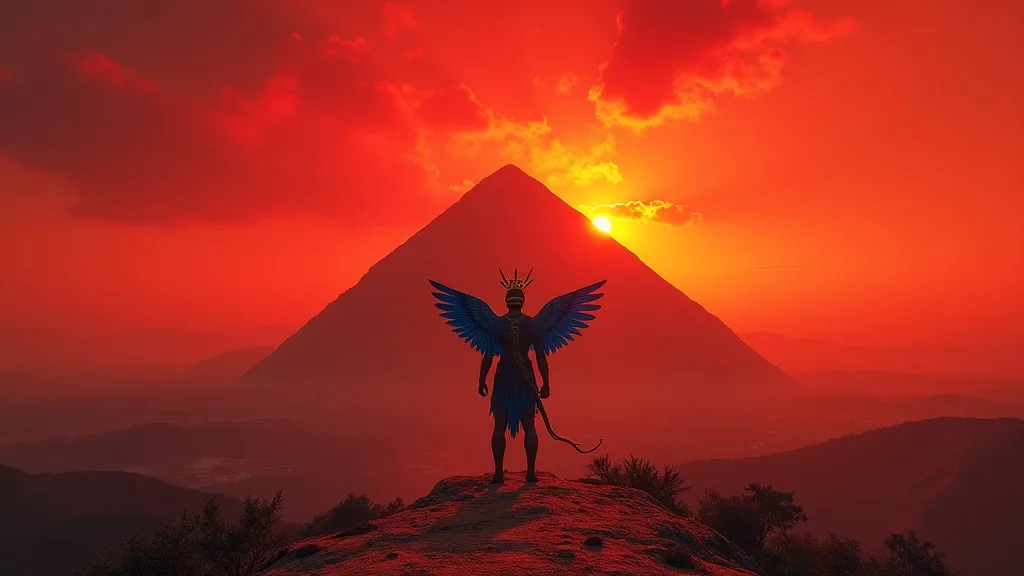
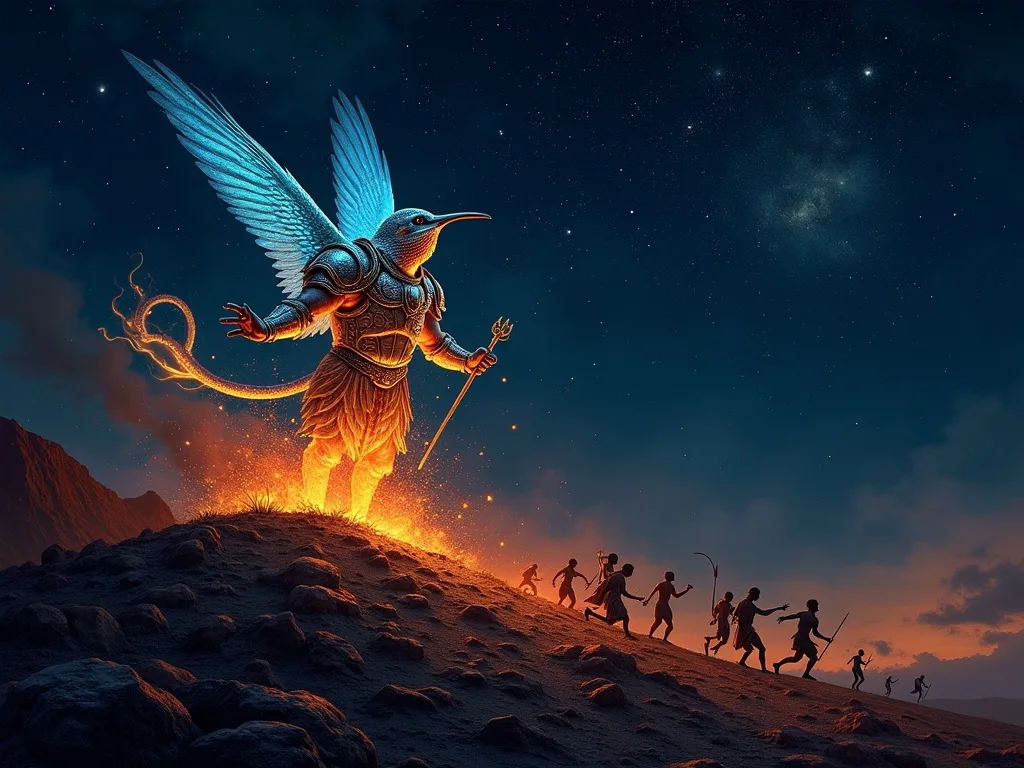
Then Huitzilopochtli burst from her womb fully formed, clad in blue hummingbird feathers, carrying a serpent of flame called Xiuhcoatl. He moved through the attacking gods in a single sweep, severing the head of his sister Coyolxauhqui and scattering her body down the hill. The other four hundred fled to the sky, became the stars, and the sun rose.
This is not prologue. This is the axis around which the entire Mexica cosmos rotated. Huitzilopochtli, god of war and sun, was not merely a patron of battle. He was the reason the sky stayed lit each morning, the reason Tenochtitlan existed at all, and the reason tens of thousands of captives climbed the steps of the Templo Mayor with obsidian knives waiting at the top. Understanding him means understanding why the Aztec Empire worked the way it did.
The Birth at Coatepec: A God Born Ready for War
The myth of Coatepec ("Snake Mountain") is preserved in the Florentine Codex, compiled by Fray Bernardino de Sahagún in the sixteenth century from Nahuatl-speaking informants who still held the stories alive in memory. The sequence is stark, almost cinematic.
Coatlicue, "She of the Serpent Skirt," was sweeping the hilltop shrine when a ball of feathers drifted down and lodged against her chest. She became pregnant. Her daughter Coyolxauhqui ("Golden Bells on Her Cheeks") was furious at what she saw as a stain on the family's honor, and she rallied her four hundred brothers, the Centzon Huitznahua (Four Hundred Southerners), to march on their mother.
The unborn child spoke from inside the womb and told Coatlicue not to fear. At the moment the army reached the summit, Huitzilopochtli emerged. His face was painted blue. His left leg was covered in hummingbird feathers. He carried the Xiuhcoatl, the fire serpent, as a weapon. He cut off Coyolxauhqui's head, then severed her limbs, and her body rolled down the hill in pieces.
Scholars including Cecelia Klein and Richard Townsend have read this myth as a cosmological allegory: Coyolxauhqui is the moon, the Centzon Huitznahua are the stars, and Huitzilopochtli's birth is sunrise. Every dawn reenacts the battle. The sun wins. The stars and moon retreat. But the sun's victory is never permanent; it must be renewed the next morning, and the morning after that, indefinitely. That is where sacrifice enters.
The great circular stone found at the base of the Templo Mayor in 1978, now housed in the Museo del Templo Mayor in Mexico City, depicts Coyolxauhqui's dismembered body in extraordinary detail. It was placed so that sacrificial victims, after their hearts were removed at the summit, would roll down and land on her image. The myth was not just recited; it was staged in stone and blood.
Patron of the Mexica: The Long March from Aztlan
Huitzilopochtli did not begin as a cosmic deity. Or rather, his role as a tribal patron came first, and his solar identity grew in power alongside the Mexica themselves.
According to the Mexica migration accounts recorded in the Crónica Mexicayotl and the Codex Boturini, Huitzilopochtli appeared to the ancestors of the Mexica at Aztlan (a place scholars have debated for over a century without a settled consensus) and commanded them to leave. He spoke through his priests, his teopixque, and through sacred bundles of bones and feathers that were carried on the backs of chosen men during the entire migration. These bundles were called tlaquimilolli and were treated as the god's living presence.
The god guided his people for roughly two hundred years of wandering through central Mexico. He gave them practical instructions: when to stop, when to move, where to find water, which alliances to accept. He also renamed them. They had been called Azteca (people of Aztlan). He told them to call themselves Mexica. Their identity was, in the most literal sense, his creation.
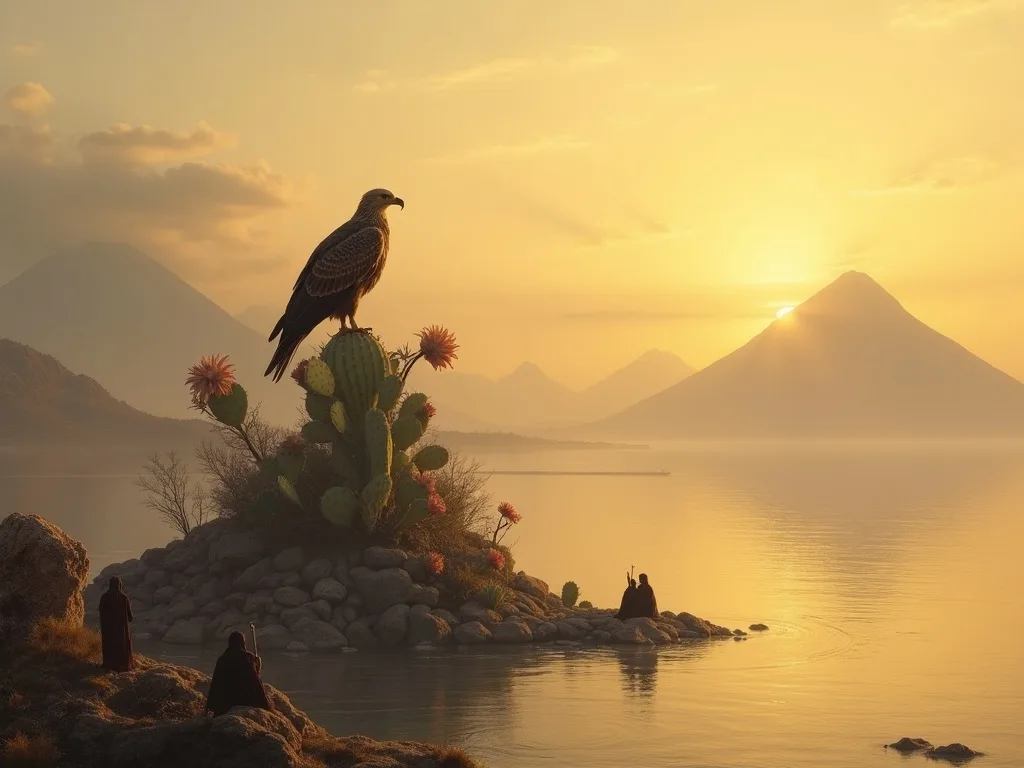
When the wanderers reached the Valley of Mexico, Huitzilopochtli's sign appeared on an island in Lake Texcoco: an eagle perched on a prickly pear cactus, devouring a serpent. This was the omen he had promised. The Mexica founded Tenochtitlan there in 1325 CE (a date recorded in multiple indigenous sources). The great temple they built at the city's center, the Templo Mayor, was the physical body of Coatepec. Its south side was dedicated to Huitzilopochtli; its north side belonged to Tlaloc, the ancient rain god.
The Mechanics of Solar Warfare: Why Blood Fed the Sun
The Aztec cosmos operated on a logic of debt. The gods had bled and died to create the current world, the Fifth Sun. The sun itself, according to the myth recorded at Teotihuacan, required a god to throw himself into a fire before it would move. Human blood was not cruelty for its own sake; it was the fuel that kept a fragile cosmological engine running.
Huitzilopochtli as the solar war god sat at the center of this system. Captured warriors were the highest offering. Their hearts, called tlapalteotl ("red divine thing") in some sources, were lifted toward the sun at the moment of sacrifice. The term the Mexica used for ritual sacrifice, nextlahualliztli, translates roughly as "the payment of debt." The language is accounting language, not just religious language.
The institution of the Xochiyaoyotl, the "Flower War," was partly built around this need. The Mexica and their neighbors staged regulated battles whose purpose was not territorial conquest but the capture of living warriors suitable for sacrifice. The Tlaxcalans, Cholultecs, and Huexotzincas were frequent opponents in Flower Wars. A warrior who took a captive called the captive his "beloved son," and the captive called the captor his "beloved father." The relationship was intimate and terrible.
Warriors who died in battle, and women who died in childbirth (considered equivalent to warriors dying in combat), ascended to the highest of the thirteen heavens, Tonatiuhichan, the House of the Sun. They spent four years accompanying the sun from dawn to noon. Then they transformed into hummingbirds or butterflies and descended to drink from flowers. Huitzilopochtli's own name encoded this promise.
Huitzilopochtli's Place Among the Aztec Pantheon
The Aztec pantheon was large, layered, and resistant to any simple hierarchy, but Huitzilopochtli occupied a rare position: he was both a founding tribal god and a cosmic one. This dual role created interesting tensions with other major powers.
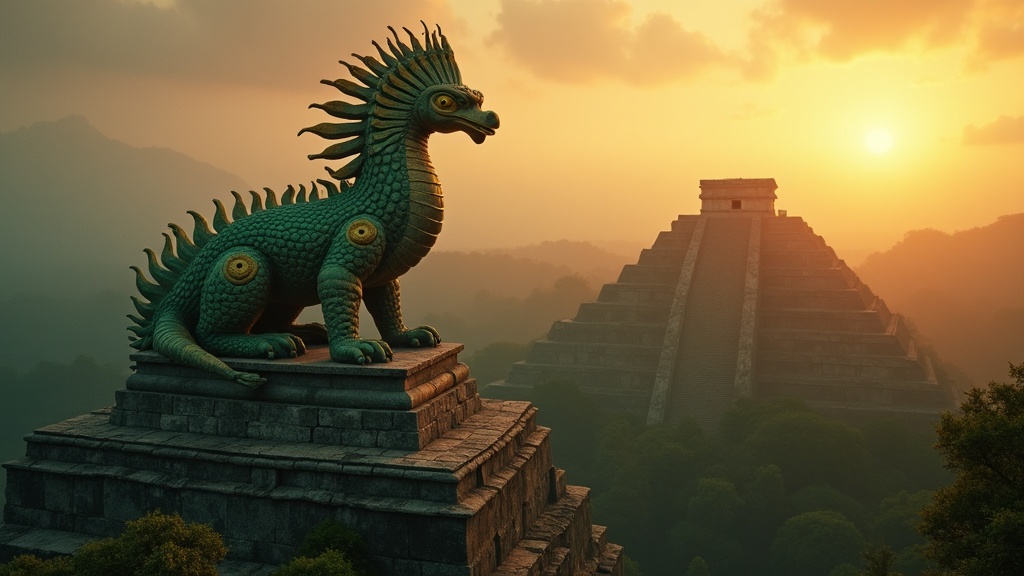
Quetzalcoatl, the feathered serpent, governed wind, learning, and the priestly arts. Where Huitzilopochtli was war and fire, Quetzalcoatl was breath and knowledge. The two were not adversaries in the way that, say, Huitzilopochtli and Tezcatlipoca were. Tezcatlipoca, the "Smoking Mirror," was perhaps the closest thing to a genuine rival: dark where Huitzilopochtli was blazing, nocturnal where the solar god was diurnal. In some accounts Tezcatlipoca presided over the north and the night sky, directly opposing the south and the noon sun that belonged to Huitzilopochtli.
Tonatiuh, the sun god proper, was a separate figure from Huitzilopochtli, and this is one of the subtler distinctions that trip up casual readers. Tonatiuh was the disk of the sun as an object, the face at the center of the famous Sun Stone. Huitzilopochtli was the force that kept that disk moving: the martial will, the blood-debt, the warrior who fights every dawn. They were functionally intertwined but iconographically distinct.
The Templo Mayor: His Mountain on Earth
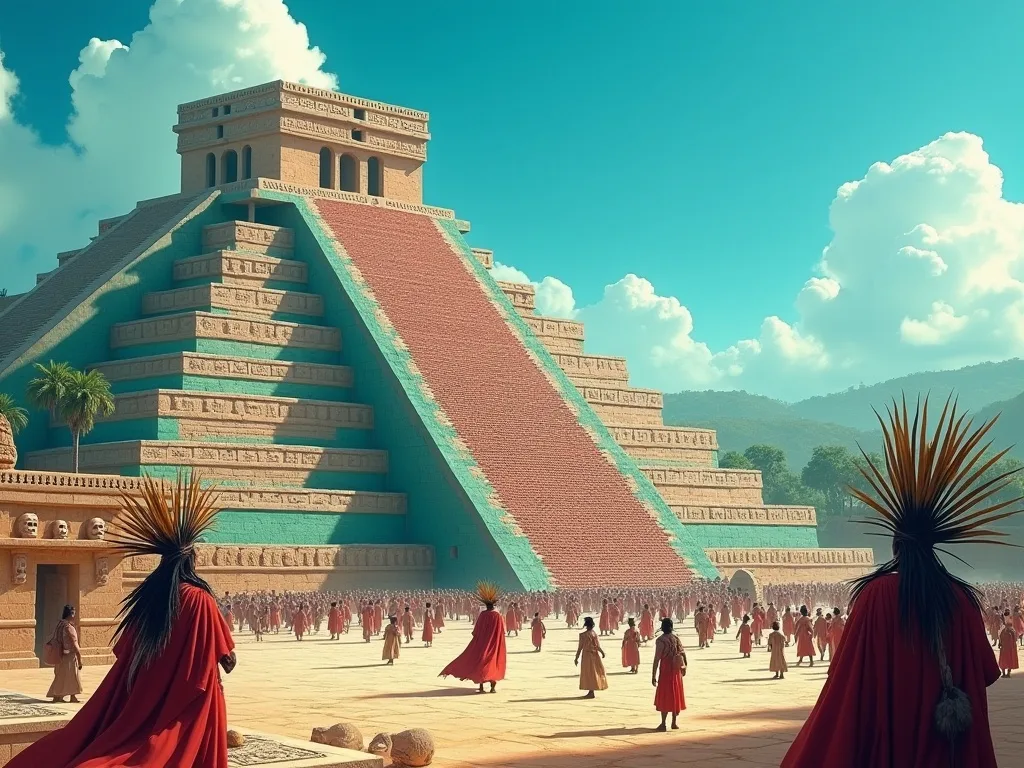
No temple in the pre-Columbian world was rebuilt more times or at greater expense than the Templo Mayor of Tenochtitlan. Archaeological work led by Eduardo Matos Moctezuma since the 1978 discovery of the Coyolxauhqui stone has revealed at least seven major construction phases, each one encasing the previous like a set of stone matryoshka dolls.
At every phase, the south pyramid (Huitzilopochtli's side) was enlarged. Offerings buried in its dedicatory caches included jaguar skeletons, greenstone beads, ceramic warriors, obsidian blades, and human skulls. One particularly striking cache contained a sacrificed wolf dressed in warrior costume with turquoise mosaic pieces near its skull, an image that collapses the boundary between animal and divine soldier.
The tzompantli, the skull rack, stood near the temple's base. Spanish observers wrote with visible horror about the number of skulls displayed there. Recent forensic work published in 2020 by a team from the Instituto Nacional de Antropología e Historia, analyzing skulls found in the rack's foundation, confirmed that the individuals came from diverse regions across Mesoamerica. They were not local residents. They were war captives, the god's guests, arriving from every direction the Mexica army could reach.
Huitzilopochtli's image at the summit was dressed each year in the festival of Toxcatl (one of the eighteen twenty-day months of the solar year). His idol was adorned in blue and yellow feathers, given a hummingbird helmet, and fed a dough effigy made of ground amaranth and human blood, called tzoalli, which the priests then broke apart and distributed to worshippers to eat. The ritual echoed, and predated, the Eucharistic logic the Spanish missionaries would later use as a conversion bridge.
Iconography: Reading the Blue God
Huitzilopochtli's visual vocabulary was precise. Artists working in the codex tradition (the Codex Telleriano-Remensis, the Codex Borbonicus, the Tonalamatl Aubin) followed strict conventions.
His identifying markers included:
- Blue-black body paint, the color of sacrifice and the south
- Hummingbird feathers on the left foot, a direct reference to his name and his role as patron of dead warriors
- The Xiuhcoatl (fire serpent), carried as a weapon or worn as a helmet
- Yellow and red stripes across his face, suggesting sunrise light
- A headdress of heron feathers in some depictions, symbol of prestige and martial authority
- Eagle warriors as his earthly counterparts, human soldiers who dressed as eagles in his honor
The color blue itself carried enormous symbolic weight in Aztec culture. Texotli (a turquoise or teal blue) was associated with sacrifice, with the sky, and with jade, the substance of preciousness. Huitzilopochtli bathed in this color. His name in the calendar, One Flint (Ce Tecpatl), linked him to the flint knife used in sacrifice, another loop in the iconographic system.
The Spanish Encounter and the Reframing of Huitzilopochtli
Hernán Cortés arrived in 1519 to a Tenochtitlan of roughly 200,000 to 300,000 people, a city larger than any in Europe at the time. When his soldiers climbed the Templo Mayor steps at the invitation of Motecuhzoma II, they saw the idol of Huitzilopochtli for themselves. Bernal Díaz del Castillo, in his True History of the Conquest of New Spain, described the god's image as terrifying, with huge eyes made of polished mirror, a body crusted with seeds and dried blood, and serpents coiling around it.
The Spanish read Huitzilopochtli through a Christian interpretive lens from the start. Franciscan friars identified him as a devil. They destroyed his idol in 1521 after the fall of Tenochtitlan and built the first Christian chapel on the platform of the Templo Mayor, a deliberate act of cosmological overwriting.
The deeper tragedy was epistemic. The richest library of screenfold books, the amoxtli, was burned or scattered. What survived came through indigenous informants working with Spanish missionaries, men like the tlamatinime who collaborated with Sahagún. The Florentine Codex, completed around 1577, is the most complete record of the old religion that exists, but it was filtered through the anxieties of colonial encounter. Historians read it carefully, knowing that some responses were shaped by what the informants thought a friar wanted to hear.
Huitzilopochtli in the Modern Imagination
The Aztec god of war and the sun did not vanish from the cultural landscape after the conquest. He transmuted.
In nineteenth-century Mexico, as the new nation searched for a foundation mythology, Aztec imagery was rehabilitated as a source of national pride. Huitzilopochtli appeared on government seals, in murals, in political rhetoric. The eagle-and-cactus symbol he ordained for the founding of Tenochtitlan became the seal of the Mexican Republic and still appears on the national flag today. The god's command became the nation's emblem.
In the twentieth century, Diego Rivera's murals at the Palacio Nacional in Mexico City returned Huitzilopochtli to full visual force: priests, sacrificial platforms, feathered warriors, and the sun burning overhead. Rivera was not a believer in any traditional sense, but he understood that Huitzilopochtli was load-bearing mythology, the kind a culture cannot simply replace.
Contemporary Mexica and Nahua communities in central Mexico continue to keep certain ceremonial traditions alive, some of them connected to the old solar calendar. The danza Azteca tradition, practiced widely in Mexico and in Mexican-American communities, includes movements and regalia that cite Huitzilopochtli's warrior iconography directly. The god's hummingbird and eagle imagery appears in muralism, tattoo art, and digital illustration across the global diaspora.
Scholars continue to debate his earliest origins. Some, including Inga Clendinnen, argue that Huitzilopochtli was originally a purely tribal god who was retrofitted with solar identity as the Mexica rose to power. Others see the solar and martial functions as inseparable from the beginning, given the consistency of the Coatepec myth across multiple sources. The question of how old the myth is before the surviving manuscripts is one archaeology and linguistics are still working to answer.
What is not in dispute: no single figure better explains the machinery of Mexica civilization than Huitzilopochtli. The city, the calendar, the war, the sacrifice, the sunrise. All roads, in Tenochtitlan, led to his blue-painted door.
Frequently Asked Questions About Huitzilopochtli
Frequently asked questions
What exactly does the name Huitzilopochtli mean?
The name comes from Nahuatl: huitzilin (hummingbird) and opochtli (left or south). The full meaning is usually rendered as "Hummingbird of the South" or "Hummingbird of the Left Hand." In Mexica cosmology, the south was the left side of the universe when facing the setting sun. Warriors who died in battle were believed to return as hummingbirds, making the name a direct statement about his domain.
Is Huitzilopochtli the same as the Aztec sun god Tonatiuh?
No, though the two are closely connected. Tonatiuh was the sun disk itself, the face depicted at the center of the Aztec Sun Stone. Huitzilopochtli was the martial force that kept the sun moving: the war god whose victories over the moon and stars each dawn sustained the solar cycle. Both required sacrificial blood, but Tonatiuh received it as cosmic nourishment while Huitzilopochtli received it as a warrior's tribute. Think of Tonatiuh as the engine and Huitzilopochtli as the fuel.
What was the Templo Mayor's connection to Huitzilopochtli?
The Templo Mayor was built as the earthly replica of Coatepec, the mythical Snake Mountain where Huitzilopochtli was born and first fought. The south pyramid, dedicated to him, was enlarged at least seven times between 1325 and 1519 CE. Sacrificial victims were killed at the summit and their bodies rolled down the steps to land on the carved image of Coyolxauhqui at the base, reenacting the birth myth in every ceremony. Excavations since 1978 have recovered thousands of ritual objects from dedicatory caches inside the structure.
Why did the Aztecs practice human sacrifice for Huitzilopochtli?
Within Mexica theology, the current world (the Fifth Sun) was sustained only by the ongoing payment of a debt to the gods who created it. Huitzilopochtli, as the force that drove the sun through the sky each day, required human hearts and blood to renew that drive. The Nahuatl term for sacrifice, nextlahualliztli, means "the payment of a debt." Captured warriors were the preferred offering because they embodied the martial energy the god needed. The system also served political functions: demonstrating Mexica power to subject peoples and reinforcing internal social hierarchies around military achievement.
Which primary sources describe Huitzilopochtli in detail?
The fullest accounts come from the Florentine Codex (compiled by Sahagún, c. 1577), Books I and II of which describe his attributes, festivals, and myths. The Crónica Mexicayotl by Fernando Alvarado Tezozomoc gives a detailed account of the migration from Aztlan under his guidance. The Codex Telleriano-Remensis and the Tonalamatl Aubin preserve his iconographic conventions. The Histoyre du Mechique, a sixteenth-century French manuscript based on lost indigenous sources, contains one of the more complete versions of the Coatepec myth. Archaeological evidence, including the Coyolxauhqui stone and the Templo Mayor offering caches, corroborates the textual accounts with physical detail.
How did Huitzilopochtli's cult survive the Spanish conquest?
It did not survive in an institutional sense: the Templo Mayor was demolished, the idol destroyed, and public worship criminalized by 1521. What survived was the iconography, the calendar knowledge held by tlamatinime (wise men), and elements absorbed into syncretic Catholic-indigenous practice in rural communities. In the nineteenth and twentieth centuries, Mexican nationalism consciously rehabilitated Huitzilopochtli's imagery as a pre-colonial foundation. The eagle-and-cactus symbol, originally his divine sign, now appears on Mexico's national flag.
Huitzilopochtli's Unresolved Origins and the Debate That Still Burns
The most productive argument in current Aztec scholarship is not about what Huitzilopochtli did, but about when his mythology took its final shape.
The Mexica were relative newcomers to the Valley of Mexico. They arrived in the thirteenth century as a minor, semi-nomadic group. Other cultures, particularly the Toltec tradition centered at Tula and the older stratum of Teotihuacan influence, had already filled the region with gods, calendars, and architectural conventions. When the Mexica rose to imperial power in the fifteenth century under Itzcoatl and his counselor Tlacaelel, there is strong evidence in the Codex Ramirez and in Sahagún's informant accounts that existing religious material was reorganized, and some older books were destroyed by Tlacaelel deliberately to create a more favorable history.
This raises a pointed question: how much of the Coatepec myth, and of Huitzilopochtli's cosmic solar role, was shaped or amplified by fifteenth-century political theologians rather than transmitted unchanged from Aztlan? Scholars like Miguel León-Portilla, working from Nahuatl poetry and philosophical texts, argue there was a genuine pre-imperial philosophical tradition underneath the later elaborations. Others, including Ross Hassig, treat the solar war theology primarily as an ideology of empire, designed to justify extraction of tribute and captives from subject peoples.
Neither view cancels the other. Religious systems can be simultaneously ancient and politically instrumentalized. What the debate reveals is that Huitzilopochtli, Aztec war and sun god, was a living, changing force, not a fixed icon. He was revised, expanded, and weaponized across centuries, much as Rome's Jupiter absorbed conquered gods, or as early Christian emperors refashioned older messianic traditions.
The hummingbird that rose from the womb at Coatepec never stopped moving. That is perhaps the most Huitzilopochtli thing about him.
Read the full book
Want the whole story?
The complete edition is an instant PDF download here, with a paperback on Amazon for selected titles.

Aztec
The Aztec Mythology Book: Quetzalcoatl, Huitzilopochtli, Tezcatlipoca, and the Five Suns of the Mexica
Blood, Feathered Serpents, and the Cosmic Engine of Tenochtitlan
The gods, heroes, and sacred calendar of the Mexica civilization. From the feathered serpent Quetzalcoatl to the five world ages, the complete mythology of Tenochtitlan.